
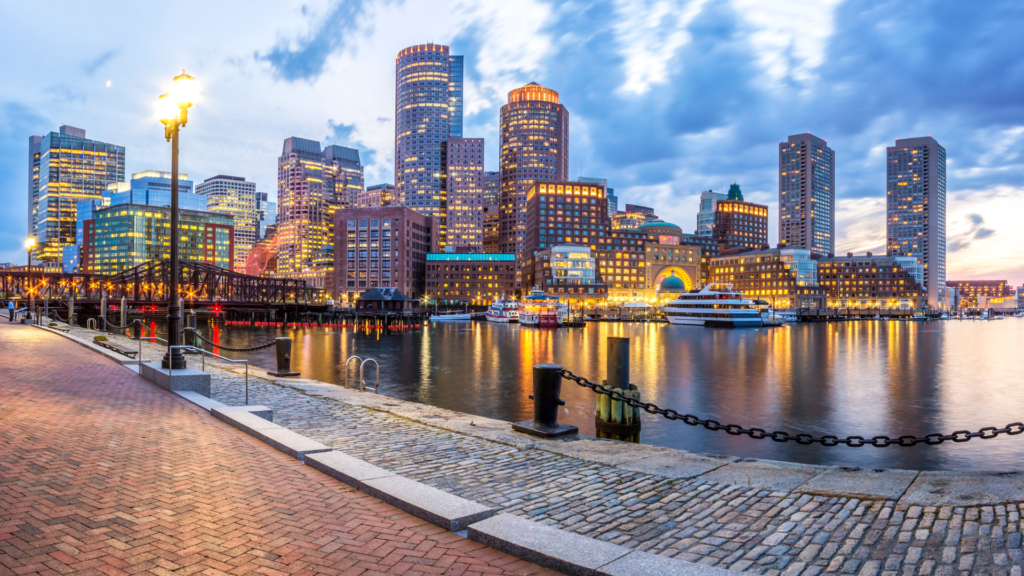
With over 7 million residents, Massachusetts has a thriving economy and business environment. Boston is one of America’s economic hubs, with the 8th largest GDP of any US metro area. Data centers in Massachusetts can serve a wide range of customers because of the state’s reliable network infrastructure, strategic location, and clean power supply.
The Bay State is home to 40 data center locations, making it easy for local and international customers to select a colocation facility that matches their unique requirements. This article will explore six reasons you should consider a Boston data center.
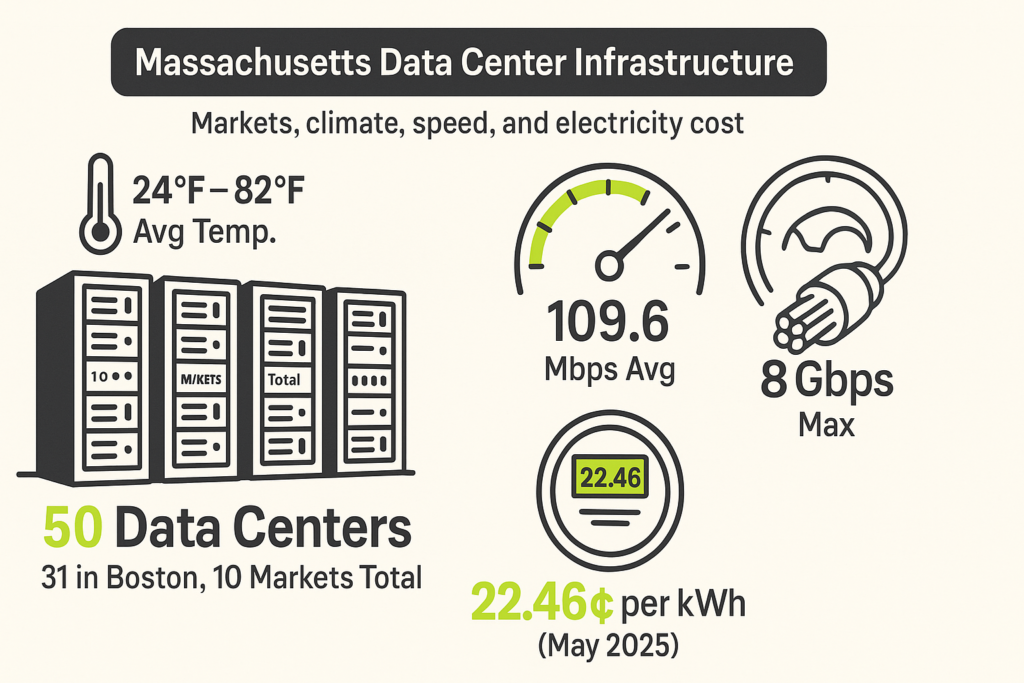
Massachusetts Data Center Infrastructure Overview
- Number of Data Centers: Massachusetts hosts 40 data centers across 10 markets, with 24 located in the Boston market. (Data Center Map)
- Average Temperature: Annual temperatures in Boston typically range from 24°F to 82°F.
- Internet Speed (Average & Maximum):
- Average Speed: Approximately 109.6 Mbps.
- Maximum Speed: Up to 8,000 Mbps (8 Gbps) available through select fiber providers. (Data Pandas)
- Energy Cost per kWh: As of June 2026, the average commercial electricity rate in Massachusetts is 24.52¢ per kWh.
Massachusetts Has a Thriving Data Center Industry
There are 40 data centers in the state, with the largest concentration of providers in the Metro Boston area. These data center providers support many local and international businesses that require colocation services. Boston colocation providers include:
- Markley Data Center (1 Summer Street, 02110 Boston)
- Csquare Boston BOS1-C (600 Winter Street, Waltham)
- EdgeConnex Boston Data Center (22 Linnell Circle, 01821 Billerica)
- Cogent Boston Data Center (59 Inner Belt Road, 02143 Somerville)
- Lumen Cambridge Boston Data Center (300 Bent Street, 02141 Cambridge)
- Evocative’s Boston Data Center (50 Inner Belt Road, 02143 Somerville) – Formerly INAP’s Boston data center before the colocation facility was acquired by Evocative in 2022
Boston’s colocation industry currently includes 24 data center locations listed in the Boston market by Data Center Map. Much of this is conveniently located close to downtown Boston. Because the region has numerous data center providers, customers can always find a data center and carrier access that meets their needs and budget.
The State Offers Excellent Network Connectivity
Major cloud platforms are accessible from Massachusetts through direct-connect and cloud on-ramp services, including Amazon Web Services (AWS) and Google Cloud. Massachusetts’ data centers can connect directly to these cloud providers and access low-latency network connectivity and support. The area also offers a number of cloud on-ramps that allow direct access to cloud servers.
Customers who colocate in the region can also partner with other network service providers. Some popular network providers include North Atlantic Networks, HughesNet, Viasat Internet, Verizon High-Speed Internet, and Spectrum Business. Boston’s robust network access options provide customers with true network diversity, unlimited bandwidth in Boston’s central business district in downtown Boston, and other parts of Massachusetts.
Massachusetts benefits significantly from the Amitié (AEC‑3) transatlantic submarine cable, which became fully operational in July 2023, linking Lynn, Massachusetts with Bordeaux, France, and Bude, UK. This fiber‑optic system spans approximately 6,783 km (4,215 mi), features 16 fiber pairs, and supports up to 400 Tbps, offering one of the lowest‑latency, high-capacity connections between the U.S. East Coast and Europe.
Furthermore, the cable passes through the Exclusive Economic Zone (EEZ), which connects data centers in Massachusetts to other cities like Beverly, Salem, Marblehead, Swampscott, Rockport, Gloucester, Manchester, and Lynn. Colocating in Massachusetts may be the right move to serve customers in these regions.
Massachusetts’ extensive connectivity infrastructure provides increased data transmission speeds and capacity. This ensures uptime and network reliability for your data center.
Massachusetts Has a Thriving Business Environment
One factor that attracts data center providers is the presence of economic incentives. To this end, Massachusetts has several tax breaks that colocation facilities and their customers can leverage.
- Finance Support Initiative: MassDevelopment offers financing programs for eligible Massachusetts businesses, but these programs are not a blanket 100% financing benefit for data center equipment.
- Economic Breaks: Massachusetts created a Qualified Data Center Sales and Use Tax Exemption for certified projects that meet the program’s requirements. However, the Executive Office of Economic Development paused new applications on June 25, 2026 while the state reviews its regulations and responsible-development framework.
- Real Estate Support: Massachusetts runs MassEcon, a non-profit that supports data centers that want to expand or relocate to the state. This program is designed to help colocation facilities transition smoothly into the state’s data center industry. For example, the company provides support with site location, real estate deals, and an overview of the state’s regional assets.
With an estimated population of 672,973 in 2025, Boston is the largest city in Massachusetts. The city has a bubbling economic environment that drives the growth of data centers in the state. Some of the largest employers in the city include tech companies, healthcare institutions, financial businesses, and universities, all of which have an increasing need for colocation services and support.
As a result of this growing economic demand, colocation facilities flock to the region to support local and international businesses that reside in Boston.
All these initiatives make it possible for customers to access reliable colocation services. This is because data centers in Massachusetts can collaborate directly with the state government for better deals and support.
Massachusetts Is Strategically Positioned
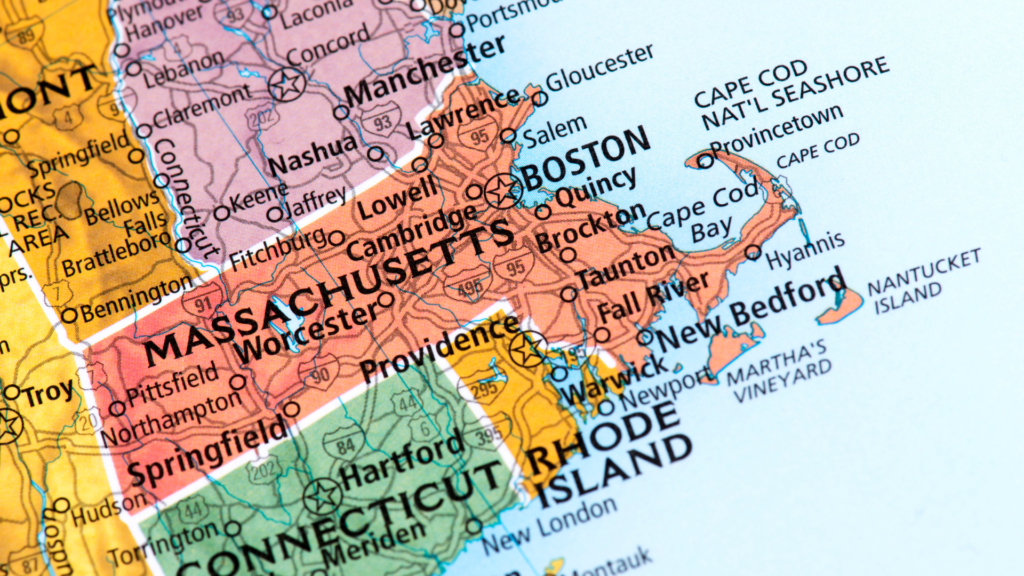
In the north, Massachusetts shares a border with Vermont and New Hampshire. It is also surrounded by the Atlantic Ocean in the east, New York in the west, and Connecticut in the south. Furthermore, Boston, Massachusetts, is less than six hours away from other top-tier colocation markets like New York, New Jersey, and Philadelphia. Because of its geographical location, data centers in the state can serve businesses within these regions.
Despite being surrounded by the Atlantic Ocean, Massachusetts has a very low natural disaster profile for natural disasters that affect other data center markets. Although the state experiences mild earthquakes occasionally, the most significant earthquake incident was recorded in 1775. In addition, the state’s emergency department provides maps and resources that help colo providers protect their business and customers’ interests.
Massachusetts Has a Reliable Power Grid and Supply
The state’s average electricity cost is 24.52¢ per kilowatt-hour (kWh) as of June 2026. Unfortunately, this drives up the cost of colocation services.
The state has three primary utility providers that support its power requirements: Eversource, National Grid, and Unitil. Massachusetts’ power generation system is a part of the Independent System Operator (ISO) New England. The ISO is one of Northern America’s most independent power grids, with 9,000 miles of high-voltage transmission lines.
This independent power generation system enables data centers to provide consistent quality service to their customers without fearing being offline. Massachusetts’s power cost is higher, but the state’s government has a mix of alternative power sources that data centers can use to reduce power-related costs. For example, the state contracts a lot of offshore wind power farms to generate electricity from alternative sources.
Furthermore, the state’s government has consistently advocated for developing and using cheap, renewable energy in the region. In 2023, clean power supplied 51.6% of Massachusetts electricity consumption, based on the state’s 2025 Climate Report Card.By implementing the Clean Energy and Climate Plan, the state aims to reach net-zero emissions by 2050.
In addition to this initiative, Massachusetts requires colocation facilities to purchase more renewable energy to support their operations. These initiatives allow colocation facilities and customers access affordable and consistent power supply while meeting their sustainability goals.
Many Top Universities Reside in the State
New England is home to many prestigious universities like Harvard University, Massachusetts Institute of Technology (MIT), and Boston University. These institutions are top-rated for the quality of their computer and engineering degrees and research programs.
For example, MIT ranks as one of the best technology schools in the world, and Harvard University is known to train some of the brightest engineering minds. All in all, Massachusetts educational institutions produce a steady stream of talented individuals. These professionals have the right skill set to support the state’s data center industry and foster collaboration with other data center markets via research.
Brightlio Can Help With Colocation Pricing in Massachusetts
We are committed to helping you find the right colocation partner in Boston, Massachusetts and other markets. Because Brightlio has a network of global data center providers, we can provide customized pricing that aligns with your company’s requirements and budgets.
Moreover, we also provide additional services to help your business build a secure and comprehensive technology infrastructure. Some of our IT services include public cloud solutions, network connectivity, unified communications, SD-WAN, and advisory services.
Get in touch with the team today to get started!
If you enjoyed this guide, please visit our guides to colocation in other states:
- California Data Centers: Brightlio’s Ultimate Guide to Colocation in the Golden State
- Data Centers in Connecticut: Six Reasons to Colocate in the Constitution State
- Data Centers in Florida: Colocation in the Sunshine State
- The Iowa Data Center Market: Colocation In America’s Heartland
- Data Centers in Maryland: Innovation in The Old Line State
- New Jersey Data Centers: Powering the Digital Future of the Garden State
- Data Centers in New York: The Gateway to Colocation in the Empire State
- Data Centers in Oregon: 5 Reasons to Colocate in the Pacific Northwest
- Data Centers in Texas: Colocation in the Lone Star State
- The Ohio Data Center Advantage

Adetayo Sogbesan writes for Brightlio on data center, cloud, and network infrastructure topics, delivering insights that help businesses optimize technology strategies and understand industry trends.
Recent Posts
What Is a Data Center?
10 Largest AI Data Centers in the World

Data Centers In Oklahoma: Why You Must Colocate

Data Center and Colocation In North Dakota
Let's start
a new project together