
North Dakota offers one of the most power-competitive data center markets in the United States, with low commercial electricity rates, cold-climate operating advantages, available land, and rising AI infrastructure investment. Fargo and Grand Forks support traditional colocation demand, while Williston, Ellendale, Jamestown, and Harwood show the state’s growing role in high-density compute, AI, HPC, and energy-adjacent data center development.
The state’s average commercial electricity rate was 7.46¢/kWh in March 2026, which is well below the U.S. average of 13.92¢/kWh. That power profile is one of the strongest reasons to consider North Dakota for colocation, high-density compute, disaster recovery, and cost-sensitive infrastructure.
North Dakota is still smaller than Northern Virginia, Dallas, Phoenix, Atlanta, Chicago, and Hillsboro for traditional enterprise colocation. Its growth story is different. The state is attracting AI campuses, high-density compute facilities, and energy-linked infrastructure because it offers abundant power, cool weather, lower land costs, and a tax policy built to attract qualified data centers.
North Dakota Data Center Infrastructure Overview
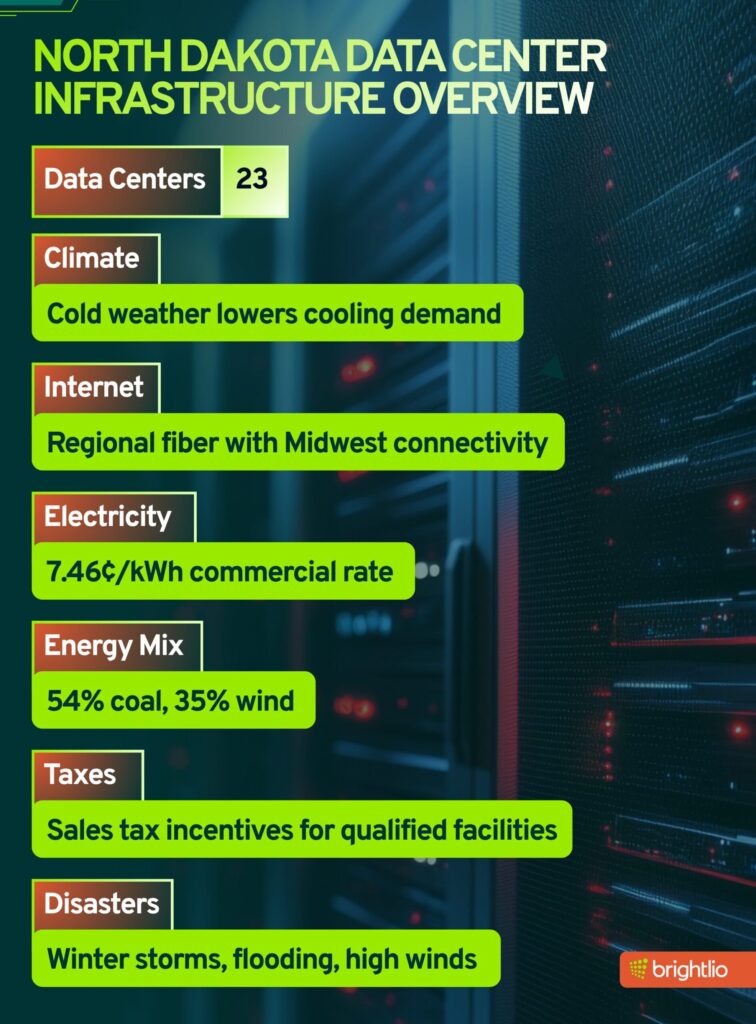
- Data centers: North Dakota has 23 data centers across 8 markets, led by Williston with 9, Fargo with 5, Grand Forks with 2, Bismarck with 2, Ellendale with 2, and smaller markets in Langdon, Tioga, and Jamestown.
- Climate: Fargo has cold winters and warm summers, with January averages near 3°F to 19°F and July averages near 61°F to 82°F. The cold climate can reduce cooling demand during long parts of the year.
- Internet: Fargo, Grand Forks, Bismarck, and Ellendale benefit from regional fiber networks, Midco, Dakota Carrier Network, Consolidated Communications, 702 Communications, and long-haul connectivity into Minneapolis, Chicago, Omaha, Denver, and Winnipeg.
- Electricity: North Dakota’s average commercial electricity rate was 7.46¢/kWh in March 2026, making it one of the lowest-cost power markets in the country for commercial users.
- Grid utilities: Major electric providers and partners include Cass County Electric Cooperative, Minnkota Power Cooperative, Montana-Dakota Utilities, Otter Tail Power, Xcel Energy, Basin Electric, and regional cooperatives.
- Energy mix: Coal and wind dominate North Dakota’s in-state generation. Coal supplied about 54% of generation in 2024, and wind supplied about 35%, one of the highest wind shares in the United States.
- Taxes: North Dakota offers a sales tax exemption for enterprise IT equipment and computer software used in qualified data centers. Eligible facilities must be newly built or substantially refurbished after December 31, 2020, contain at least 15,000 sq ft, use at least 50% of the space for data processing, and meet fire suppression and security requirements.
- Disasters: North Dakota’s primary natural hazards include severe winter storms, flooding, drought, hail, high winds, tornadoes, and wildfire in some areas. Facilities must account for extreme cold, snow, wind, and spring flood risk.
Why Colocate In North Dakota?
Colocating in North Dakota can reduce long-term power cost, support high-density compute, and place infrastructure in a cool-climate central U.S. market. The following factors explain where the state fits best and what buyers should evaluate before choosing a facility.
1. Market Access And Latency
North Dakota gives organizations a central northern U.S. location with practical reach into the Upper Midwest, Northern Plains, and Canadian border region. Fargo connects naturally into Minneapolis, Chicago, Omaha, Denver, and Winnipeg through regional and long-haul routes.
Fargo is the best traditional colocation market in the state because it has enterprise demand, fiber diversity, university talent, healthcare systems, financial services firms, and business access across the Red River Valley. Grand Forks and Bismarck support regional continuity, public sector workloads, and telecom aggregation.
Ellendale, Harwood, Jamestown, and Williston serve a different market profile. These locations are more tied to high-density compute, AI infrastructure, energy access, and large land positions than conventional enterprise colocation. That makes North Dakota useful for workloads where power cost, power availability, and site scale matter more than dense peering.
North Dakota is not a major cloud region. Most hybrid deployments still require transport into larger cloud and peering hubs. The common architecture pairs North Dakota colocation or AI capacity with private network links into Minneapolis, Chicago, Denver, Seattle, or other regional internet exchange and cloud access markets.
2. Network Connectivity And Peering
North Dakota’s network base has improved because data center growth requires high-capacity fiber. Fargo is the state’s primary network hub, with Midco, Dakota Carrier Network, Consolidated Communications, 702 Communications, and carrier infrastructure serving enterprise and colocation users.
Midco has become more visible in AI infrastructure connectivity. The company announced a five-year, multistate 400G connectivity agreement in May 2026 to support critical AI infrastructure in Ellendale. That agreement is important because it shows how large data center projects are pulling higher-capacity transport into the state.
Dakota Carrier Network supports statewide connectivity through its cooperative fiber footprint and data center assets in Fargo and Bismarck. DCN’s network serves businesses, government, healthcare, public safety, and communications providers across North Dakota.
North Dakota does not have the same interconnection density as Chicago, Minneapolis, Dallas, or Ashburn. Organizations that need dense peering, many direct cloud on-ramps, or large content exchange ecosystems should plan transport into larger markets. Organizations that need regional connectivity, private circuits, disaster recovery, managed infrastructure, and cost-effective high-density capacity can find stronger value inside North Dakota.
3. Power, Cost, And Sustainability
Power is North Dakota’s strongest data center advantage. The state’s commercial electricity rate was 7.46¢/kWh in March 2026, compared with the U.S. commercial average of 13.92¢/kWh. For colocation and high-density compute, this difference can have a major effect on long-term operating cost.
North Dakota has abundant energy resources. Coal plants remain central to the grid, and wind generation has become a major electricity source. In 2024, coal generated about 54% of the state’s electricity, and wind generated about 35%. That creates a mixed profile: strong power availability and a growing renewable component, but higher carbon intensity than states with larger hydro, nuclear, or solar shares.
AI and HPC projects in the state are using the power profile as a core site-selection factor. Applied Digital’s Polaris Forge 1 in Ellendale is designed for 400 MW of critical IT capacity for CoreWeave, with the campus engineered to expand over time. The company cites North Dakota’s cool climate, renewable access, and high-density power design as part of its cost model.
Buyers should review power terms carefully. Large-load data center projects can affect utility planning, transmission needs, generation resources, rate design, and community perception. Colocation customers should ask about committed power, utility provider, feeder diversity, generator runtime, power density, cooling design, and whether renewable claims are based on direct supply, contracts, or broader market accounting.
4. Tax Policy And Incentives
North Dakota has a specific sales and use tax exemption for qualified data centers. The exemption covers enterprise information technology equipment and computer software purchased for use in a qualifying facility. Covered categories can include servers, routers, cooling systems, power infrastructure, backup generation systems, batteries, racking, raised flooring, cabling, trays, software, maintenance, licensing, and software customization.

A qualified data center must be located on one parcel or contiguous parcels, contain at least 15,000 sq ft, use at least 50% of the space for data processing, and be newly constructed or substantially refurbished after December 31, 2020. The facility must be certified by the Tax Commissioner and must have fire suppression, fire prevention, and strong security features.
The exemption is useful because data centers buy large volumes of servers, networking equipment, electrical systems, and cooling gear. Removing sales and use tax from those purchases can reduce the total project cost for hyperscale, HPC, and large colocation builds.
North Dakota may provide additional local or general business incentives. New or expanding primary sector businesses can qualify for property tax exemption programs, subject to local approval and primary sector certification. Data center buyers should review each site with tax counsel, utility partners, local economic development officials, and the North Dakota Office of State Tax Commissioner before assuming incentive eligibility.
5. Workforce And Ecosystem
North Dakota has a tight labor market, with an April 2026 unemployment rate of 2.4%. That signals a healthy economy, but it can make specialized hiring harder for facility technicians, electricians, controls engineers, security staff, network engineers, and critical operations roles.
Fargo is the state’s strongest technical labor market. The area has Microsoft, North Dakota State University, healthcare systems, financial services companies, software firms, managed service providers, and a growing startup base. Grand Forks has the University of North Dakota, aerospace activity, defense-adjacent work, and regional healthcare demand. Bismarck supports government, energy, telecom, and professional services.
Large AI campuses will need a broader workforce strategy than traditional colocation sites. Construction labor, substation work, mechanical systems, electrical systems, fiber splicing, facility operations, and security coverage require close coordination with local contractors and regional suppliers. Applied Digital’s Harwood campus announcement projected more than 200 full-time employees at full operation, in addition to long-term contractors.
North Dakota can support data center operations, but staffing must be planned early. Buyers should review remote hands coverage, vendor availability, equipment maintenance response times, and winter travel procedures for any site outside Fargo or Grand Forks.
6. Risk And Resiliency
North Dakota’s risk profile is centered on cold weather, snow, wind, hail, flooding, drought, and severe storms. The state does not face hurricane or coastal storm surge risk, which makes it useful for disaster recovery designs that need distance from coastal exposure.
Extreme cold creates practical operating concerns. Facilities need winterized generators, fuel management, battery room controls, freeze protection, roof load review, snow removal plans, and reliable staff access during blizzards. Cold weather can reduce cooling cost, but it does not remove the need for strong mechanical design.
Flooding matters most in eastern North Dakota, especially near the Red River Valley. Fargo and Grand Forks have long flood histories, so site-level floodplain review is essential. Buyers should check elevation, drainage, utility routes, road access, and flood protection measures before selecting a site.
Severe winds and hail can affect roofs, exterior equipment, substations, and fiber routes. Midco’s Fargo facility uses an EF3-rated shell built for sustained winds up to 150 mph, and DCN describes its Bismarck and Fargo data centers as built for EF4 tornado-force winds with generator and battery support. These details show why physical hardening is an important buying criterion in the state.
Key Cities Or Submarkets In North Dakota
North Dakota’s data center market is spread across traditional colocation hubs, AI campus locations, and energy-linked compute markets. The following submarkets show where capacity, connectivity, and development activity are most visible.
1. Williston
Williston is North Dakota’s largest listed data center market by facility count, with 9 facilities on DataCenterMap. The market is tied to the Bakken energy region, natural gas availability, and high-density compute projects that can use flexible or energy-adjacent power models.
Atlas Power operates a major Williston data center site and positions its business around flexible load, Bitcoin mining, and GPU-as-a-service applications. Williston’s energy profile makes it attractive for operators that can pair compute demand with local power resources.
Williston is not the best fit for conventional enterprise colocation buyers that need many carriers, cloud on-ramps, or dense remote hands ecosystems. It is more relevant for high-density compute, crypto hosting, GPU infrastructure, and energy-integrated data center operations. Buyers should carefully evaluate noise controls, local permitting, power contracts, utility interconnection, and community impact.
2. Fargo
Fargo is North Dakota’s strongest enterprise colocation market. It has the largest business base, the deepest regional technology ecosystem, and the best mix of network providers in the state. DataCenterMap lists 5 Fargo data centers.
Fargo facilities include Midco, Consolidated Communications, 702 Communications, Dakota Carrier Network, and other network-oriented sites. The city supports healthcare, financial services, education, government, managed IT, and business continuity use cases across the Red River Valley.
Fargo is the first North Dakota market most traditional colocation buyers should evaluate. It offers stronger staffing, better vendor access, and better regional transport options than smaller markets. Floodplain status and winter resilience still require careful review.
3. Ellendale
Ellendale has become North Dakota’s highest-profile AI data center submarket because of Applied Digital’s Polaris Forge 1 campus. The campus is fully leased to CoreWeave for 400 MW of critical IT capacity across long-term leases, and the first 50 MW phase reached ready-for-service in October 2025.
The project positions Ellendale as a national AI infrastructure location rather than a conventional colocation market. Applied Digital cites cool climate, renewable access, high-density power design, and near-zero water consumption as part of the campus model.
Ellendale is best understood as a specialized AI and HPC market. It is not a general-purpose colocation hub like Fargo. Buyers interested in Ellendale should focus on power delivery, network transport, GPU readiness, cooling design, water use, and tenant access model.
4. Harwood
Harwood, north of Fargo, is the planned location for Applied Digital’s Polaris Forge 2 campus. The project was announced in August 2025 as a $3 billion, 280 MW AI Factory designed with room to scale beyond its initial capacity. Initial operations were planned for 2026, with full capacity targeted for early 2027.
Harwood benefits from proximity to Fargo’s workforce, transportation access, and regional fiber networks while offering a larger land profile than a dense urban site. The project involves Cass County Electric Cooperative and Minnkota Power Cooperative in power planning.
Harwood is important because it connects North Dakota’s AI campus growth with the Fargo metro area. That gives the region a stronger case for future data center supply chain growth, technician training, power infrastructure, and fiber investment.
5. Grand Forks
Grand Forks supports regional colocation, telecom, healthcare, university, and high-density infrastructure use cases. DataCenterMap lists 2 facilities in the market.
Midco operates a Grand Forks data center, and Core Scientific has a Grand Forks high-density facility positioned for AI and enterprise workloads. The city benefits from the University of North Dakota, Grand Forks Air Force Base, healthcare demand, and connectivity between Fargo, Winnipeg, and Minneapolis.
Grand Forks is best suited for regional continuity, colocation, AI-adjacent infrastructure, and workloads tied to northern North Dakota or the U.S.-Canada corridor. Site review should include flood risk, winter access, carrier diversity, and utility capacity.
6. Bismarck
Bismarck is North Dakota’s capital and a practical market for government, healthcare, telecom, energy, and enterprise continuity. DataCenterMap lists 2 facilities in Bismarck.
Dakota Carrier Network has a Bismarck data center presence, and the city benefits from its role as a government and telecommunications hub. Bismarck can serve public sector workloads, regional transport aggregation, backup infrastructure, and enterprise systems that need central North Dakota access.
Bismarck is smaller than Fargo for colocation density, but it can be valuable for organizations with statewide operations. Buyers should review carrier access, local redundancy, remote hands, and intercity transport to Fargo, Minneapolis, and Denver.
7. Jamestown, Tioga, And Langdon
Jamestown, Tioga, and Langdon represent smaller or specialized North Dakota markets. Jamestown is notable because Applied Digital operates a 106 MW data center hosting facility there, and earlier HPC activity helped set the stage for the company’s larger AI campus strategy in Ellendale and Harwood.
Tioga and Langdon are smaller listed markets and are more likely to matter for energy-linked compute, local telecom infrastructure, or specialized site needs than traditional enterprise colocation. These locations require careful review because smaller markets may have fewer carriers, fewer local vendors, and longer service response times.
These submarkets can work for specific power-driven or local infrastructure needs. They are less suitable for buyers that need many carriers, dense peering, direct cloud access, and broad onsite support.
Notable Colocation Providers And Facilities In North Dakota
North Dakota has a mix of traditional colocation providers, statewide telecom facilities, AI campuses, and high-density compute operators. The following providers and facilities show where capacity and market activity are concentrated.
1. Applied Digital Polaris Forge 1 Ellendale
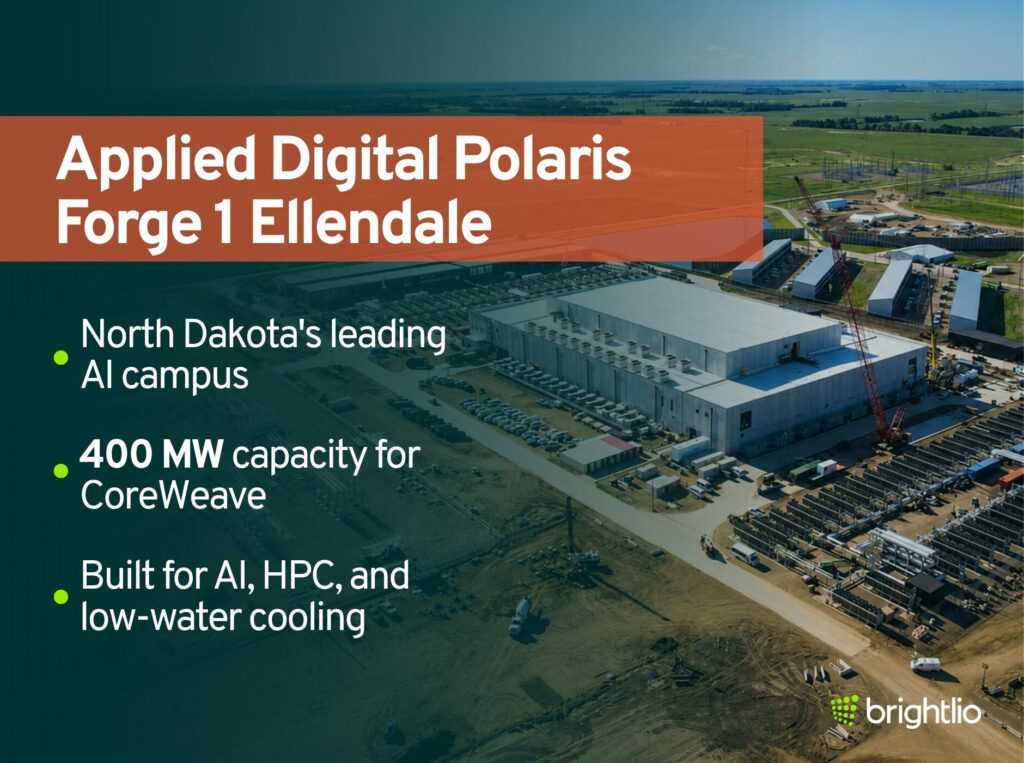
Applied Digital’s Polaris Forge 1 campus in Ellendale is North Dakota’s most important AI infrastructure project. The campus is contracted to deliver 400 MW of critical IT capacity to CoreWeave under long-term lease agreements.
The first 100 MW building reached ready-for-service for its first 50 MW phase in October 2025. The project is designed for high-density AI and HPC workloads and uses liquid cooling and power distribution designs with near-zero water consumption.
Polaris Forge 1 is best suited for AI hyperscale and HPC infrastructure rather than standard retail colocation. It shows why North Dakota is gaining attention from AI infrastructure buyers that prioritize power cost, land, cooling climate, and delivery speed.
2. Applied Digital Polaris Forge 2 Harwood
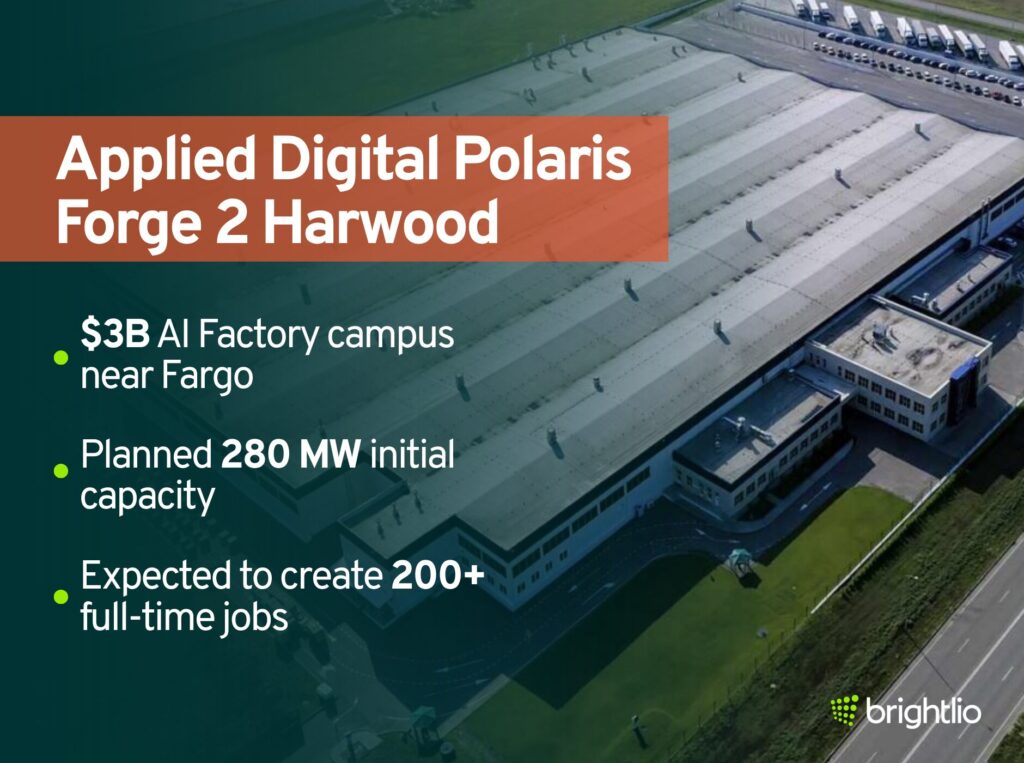
Applied Digital announced Polaris Forge 2 near Harwood as a $3 billion, 280 MW AI Factory campus. The site is designed with the ability to scale beyond its initial capacity and is expected to create more than 200 full-time jobs at full operation.
The campus is located near Fargo, which gives it access to a larger labor pool and better regional network infrastructure than more remote locations. The project involves Cass County Electric Cooperative and Minnkota Power Cooperative in power planning.
Polaris Forge 2 matters because it expands North Dakota’s data center growth from rural power campuses into the Fargo region. It could make the Fargo area more important for AI operations, fiber transport, technical hiring, and data center vendor support.
3. Applied Digital Jamestown Data Center
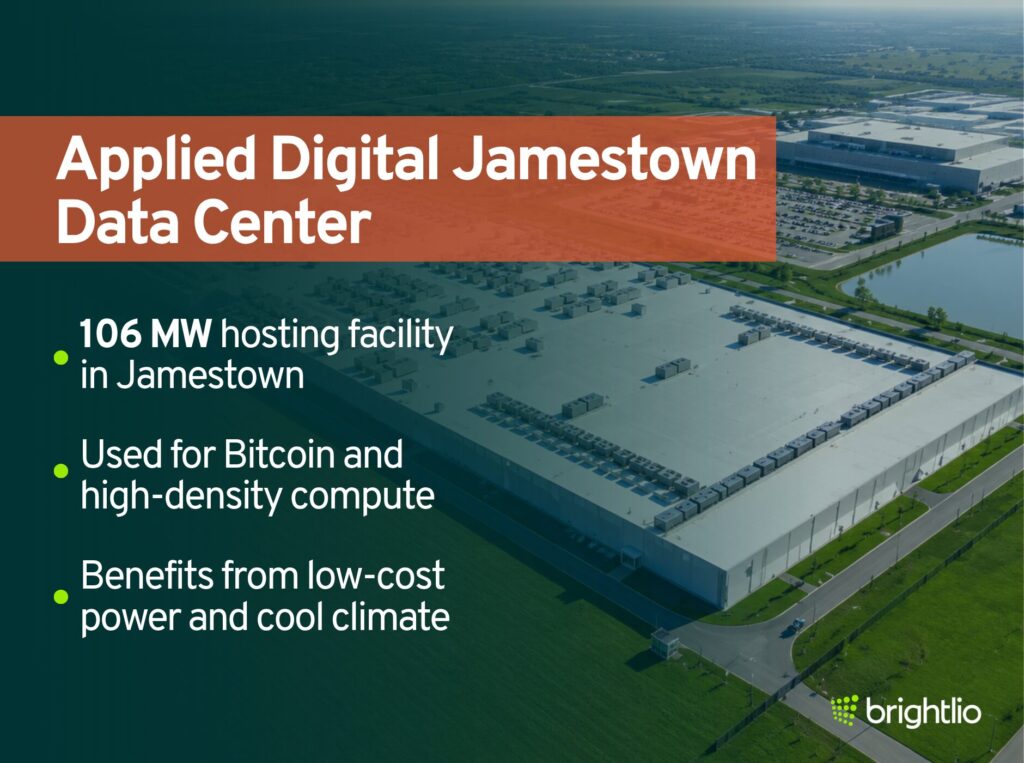
Applied Digital operates a 106 MW data center hosting facility in Jamestown. The facility has supported Bitcoin and high-density compute hosting, and Applied Digital has reported that the Jamestown site was operating at full capacity.
Jamestown helped give Applied Digital operating experience in North Dakota before its larger AI infrastructure expansion in Ellendale and Harwood. The site benefits from abundant power, cool climate, and a central North Dakota location.
Jamestown is more relevant for energy-heavy compute than conventional colocation. Buyers should evaluate tenant model, workload fit, conversion potential, power source, and network transport before treating it as a general enterprise option.
4. Midco Fargo Data Center
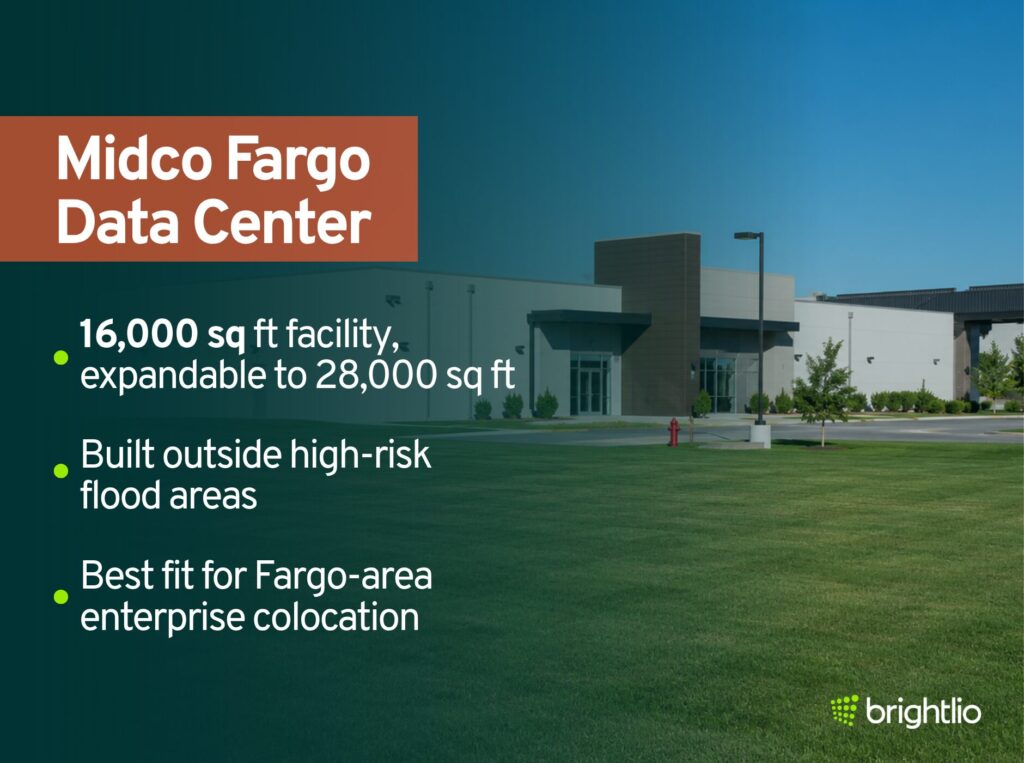
Midco’s Fargo data center is a 16,000 sq ft facility that is expandable to 28,000 sq ft. It is built outside high-risk flood exposure areas and uses an EF3-rated shell designed to withstand sustained wind speeds up to 150 mph.
The facility supports colocation, smart hands, security controls, VESDA detection, clean-agent fire protection, generator backup, and connectivity through Midco’s regional network. Midco’s North Dakota facilities in Fargo and Grand Forks are positioned for business continuity and regional infrastructure.
Midco Fargo is one of the best fits in North Dakota for traditional enterprise colocation. It supports healthcare, financial services, education, public sector, and midmarket IT teams that need a professionally operated Fargo-area site.
5. Midco Grand Forks Data Center
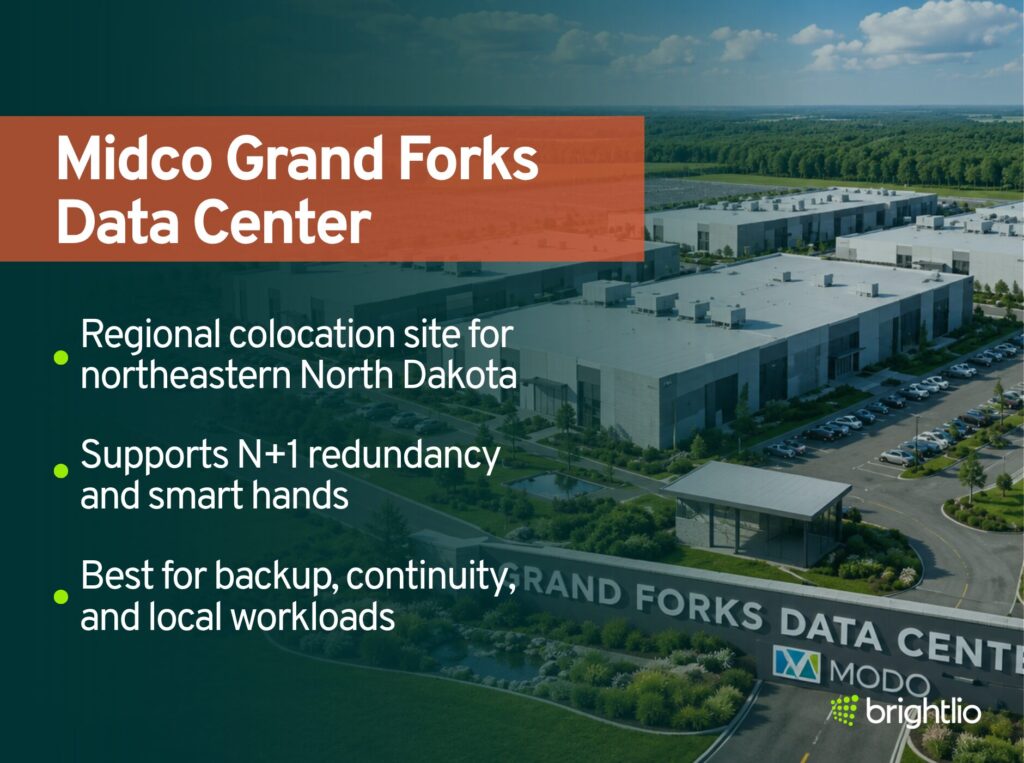
Midco’s Grand Forks data center gives northeastern North Dakota a regional colocation option. The facility supports colocation services, N+1 redundancy, SOC 2-oriented controls, smart hands, and Midco network connectivity.
Grand Forks is useful for organizations with operations in northern North Dakota, northwest Minnesota, and the U.S.-Canada corridor. The market has university, healthcare, aviation, defense-adjacent, and public sector demand.
The facility is best suited for regional continuity, smaller production environments, backup systems, and organizations that want infrastructure close to Grand Forks operations. Buyers should verify cabinet availability, power density, and carrier options during sourcing.
6. Dakota Carrier Network Data Centers
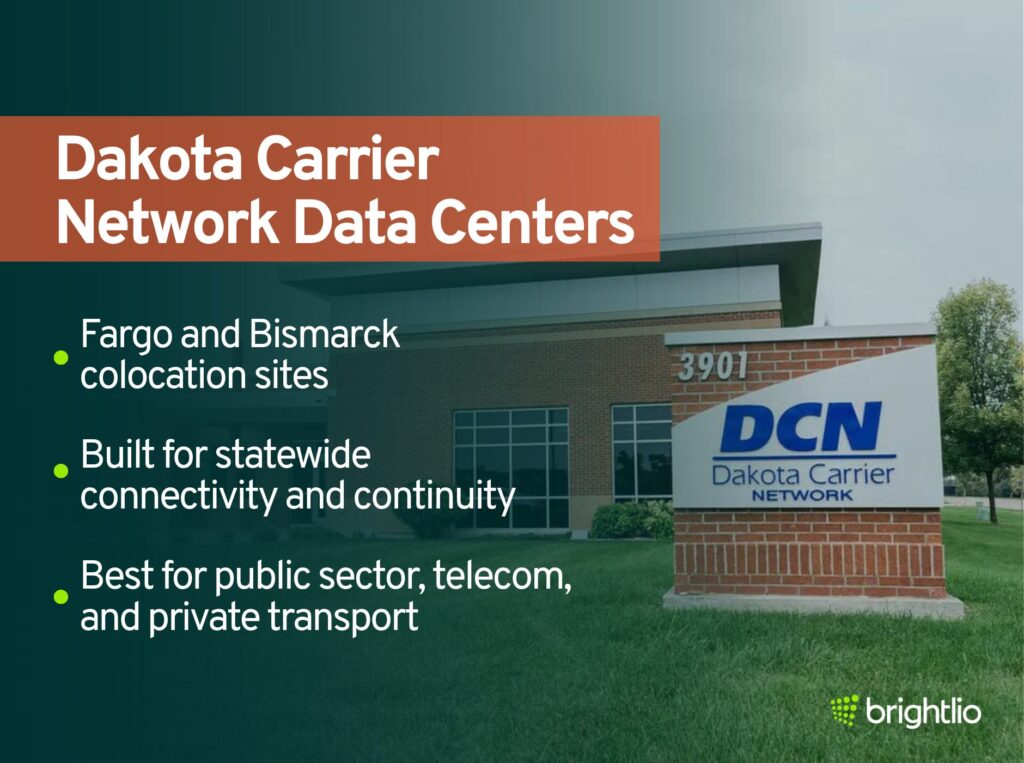
Dakota Carrier Network supports statewide connectivity and colocation services through assets in Fargo and Bismarck. DCN serves critical institutions, including healthcare, public safety, state government, financial organizations, and communications providers.
DCN’s Bismarck and Fargo data centers are described as built for EF4 tornado-force winds and backed by generator and battery plants. That physical hardening is important in a state where high wind, hail, and severe storms are part of the risk profile.
DCN is best suited for network-centric colocation, private transport, public sector workloads, telecom aggregation, and statewide business continuity. It is especially relevant for organizations that need reach across North Dakota rather than only one metro site.
7. Consolidated Communications Fargo Data Center
Consolidated Communications operates a Fargo data center at 3312 42nd Street South. Public listings describe the facility as offering about 1,700 sq ft of raised floor colocation space.
This facility is suited for smaller colocation footprints, local business continuity, and network-connected workloads in Fargo. It can support organizations that want a compact site tied to a telecom provider rather than a large campus deployment.
Buyers should confirm power capacity, redundancy, carrier options, remote hands, service levels, and current availability because smaller telecom-linked facilities can vary in the level of retail colocation support they provide.
8. 702 Communications Fargo Data Center
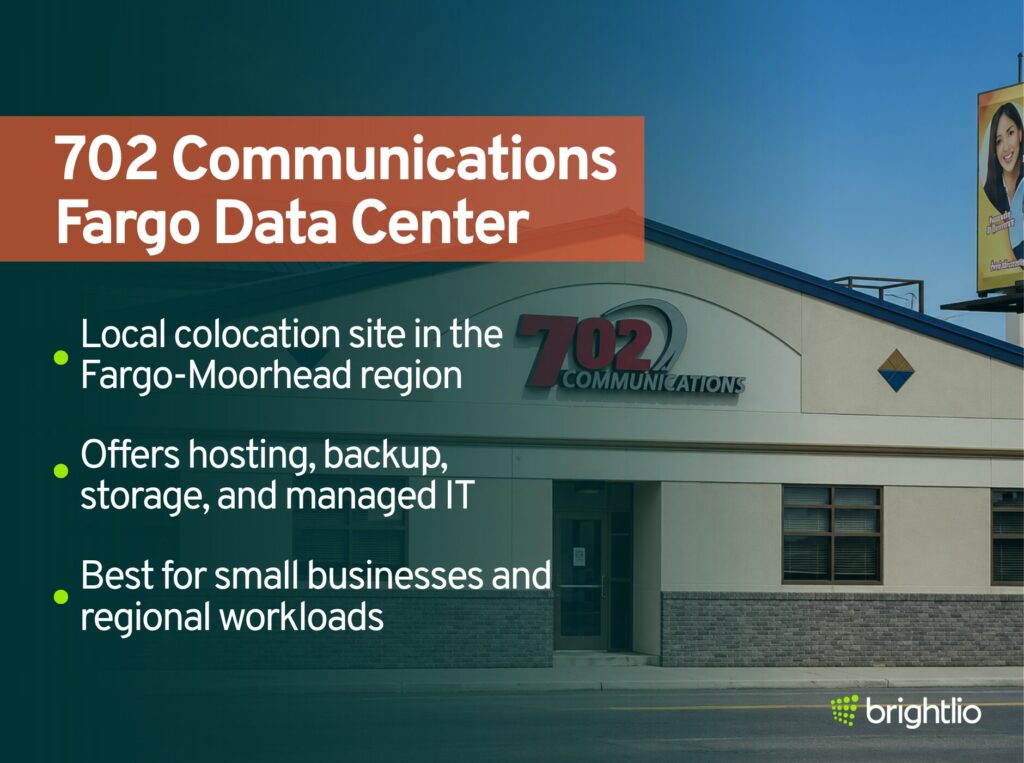
702 Communications provides data center and managed services in the Fargo-Moorhead region. The company serves Fargo, West Fargo, Wahpeton, Moorhead, Dilworth, and Breckenridge through its telecom and business services footprint.
The facility is a local carrier-neutral colocation option for businesses that need server hosting, private connectivity, managed IT, data backup, storage, monitoring, and maintenance services.
702 Communications is best suited for small businesses, local enterprises, and regional organizations that need hands-on provider support in the Fargo-Moorhead area. Larger high-density deployments should compare it with Midco, DCN, and larger regional options.
9. Core Scientific Grand Forks Data Center
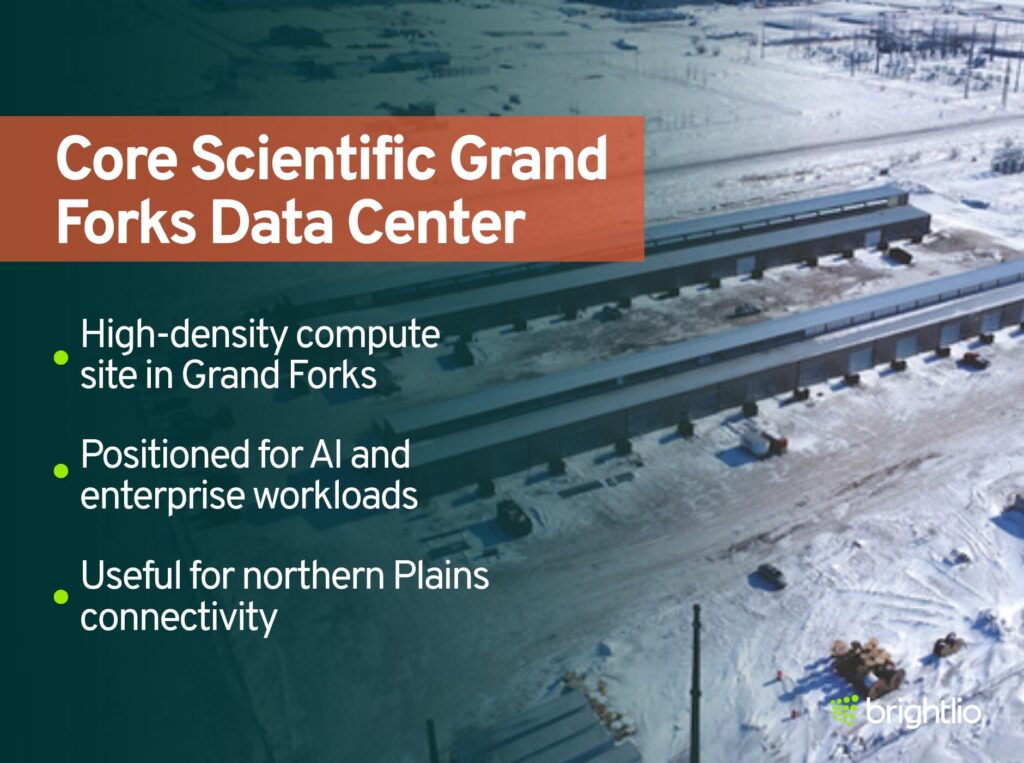
Core Scientific operates a high-density data center in Grand Forks. Public facility descriptions position the site for AI, enterprise workloads, and scalable high-density infrastructure.
Grand Forks gives the site access to regional power and fiber routes between Minneapolis, Fargo, and Winnipeg. The market is smaller than Fargo, but it has useful geography for northern Plains and cross-border connectivity.
Core Scientific Grand Forks is best suited for high-density compute and AI-adjacent workloads. Buyers should verify current tenant availability, power density, cooling design, and whether the facility supports standard colocation access or specialized hosting models.
10. Atlas Power Williston Data Center
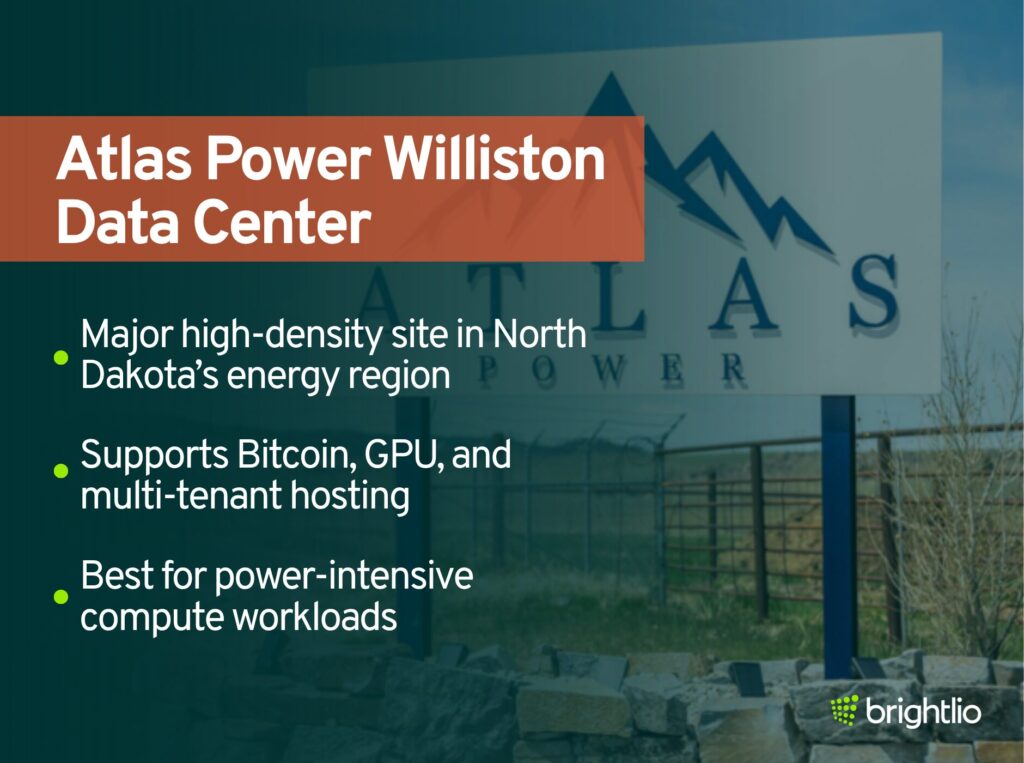
Atlas Power operates a major Williston data center site in North Dakota’s energy region. The company focuses on flexible and interruptible load, multi-tenant data center hosting, Bitcoin mining, and GPU-as-a-service applications.
The Williston site benefits from proximity to energy resources and a market profile built around power-intensive compute. Public market trackers list Atlas Power’s Williston facility as one of the largest data center sites in North Dakota.
Atlas Power is best suited for energy-linked high-density hosting rather than conventional enterprise colocation. Buyers should review noise management, site compliance, grid impact, power contracts, cooling model, and community relations during evaluation.
Recent Developments In North Dakota
- August 2025: Applied Digital announced Polaris Forge 2 near Harwood. The $3 billion AI Factory campus is designed for 280 MW, with capacity to scale beyond the first phase. Initial operations were scheduled for 2026, with full capacity expected in early 2027.
- August 2025: Applied Digital finalized an additional 150 MW lease with CoreWeave at Polaris Forge 1 in Ellendale. That brought the campus to 400 MW of total critical IT capacity under long-term CoreWeave leases.
- October 2025: Applied Digital reached ready-for-service for the first 50 MW phase at the first 100 MW Polaris Forge 1 building in Ellendale. The milestone marked the first operational phase of the fully leased AI campus.
- May 2026: Midco and Switch announced a five-year, multistate 400G connectivity agreement supporting AI infrastructure in Ellendale. The deal shows how major data center projects are pulling higher-capacity fiber into North Dakota.
- September 2025: North Dakota’s Legislative Council reviewed the qualified data center sales tax exemption as part of an economic development tax incentive study. The review focused on incentive purpose, fiscal impact, jobs, local incentives, and potential negative effects.
- March 2026: EIA data showed North Dakota’s average commercial electricity rate at 7.46¢/kWh. That rate kept the state among the most cost-competitive U.S. power markets for data center operations.
- April 2026: North Dakota’s unemployment rate was 2.4%, ranking second-lowest among states. That signals a strong labor market but creates hiring pressure for specialized data center operations roles.
How Brightlio Can Help With Colocation In North Dakota
Brightlio helps organizations compare North Dakota colocation, high-density compute, cloud connectivity, and disaster recovery options across Fargo, Grand Forks, Bismarck, Ellendale, Harwood, Jamestown, Williston, and nearby Midwest markets. Our team helps clients evaluate power pricing, available capacity, network diversity, cooling design, compliance needs, and long-term site risk.
We compare providers such as Midco, Dakota Carrier Network, Consolidated Communications, 702 Communications, Applied Digital, Core Scientific, Atlas Power, and other regional operators. For North Dakota projects, we pay close attention to commercial electricity exposure, utility agreements, generator runtime, fuel plans, cooling systems, winterization, floodplain status, wind hardening, carrier routes, and expansion rights.
Brightlio can support cabinet, cage, private suite, single-tenant, high-density, AI, and multi-site disaster recovery planning. Contact Brightlio to start planning a cost-effective and resilient colocation deployment in North Dakota.
Readers who found this overview of data centers in North Dakota useful may be interested in these regional guides covering other major U.S. data center markets.
Which U.S. State Has The Most Data Centers?
Virginia has the largest concentration of data centers in the United States.
Northern Virginia, especially Ashburn and Loudoun County, leads because it has dense fiber networks, major cloud infrastructure, large power delivery systems, mature operators, and a long record of enterprise and hyperscale development. North Dakota is growing quickly for AI and high-density compute, but Virginia remains the leading U.S. data center hub.
Who Is Building Data Centers In North Dakota?
Applied Digital, CoreWeave, Midco, Dakota Carrier Network, Core Scientific, Atlas Power, Consolidated Communications, and 702 Communications are among the most visible operators, tenants, or network-linked providers in North Dakota.
Applied Digital is the state’s most active large-scale data center developer. Its Polaris Forge 1 campus in Ellendale is leased to CoreWeave for 400 MW of critical IT capacity, and its Polaris Forge 2 campus near Harwood is planned as a $3 billion, 280 MW AI Factory. Applied Digital operates a 106 MW facility in Jamestown as well.
Fargo and Grand Forks remain the strongest traditional colocation markets. Midco, Dakota Carrier Network, Consolidated Communications, and 702 Communications serve enterprise and regional colocation needs. Atlas Power and Core Scientific reflect the state’s growth in high-density compute and energy-linked infrastructure.
Why Are People Protesting Against Data Centers?
People protest against data centers because large facilities can affect electricity demand, power rates, noise, water use, land use, local tax policy, and community character.
In North Dakota, public concern can vary by project type. Traditional Fargo colocation facilities usually have a smaller community footprint. Large AI campuses, crypto hosting sites, and energy-adjacent facilities can draw more questions because they require more power, larger utility planning, more visible infrastructure, and stronger noise controls.
Common concerns include high electricity demand, backup generator noise, cooling equipment noise, land conversion, water needs, ratepayer impact, tax exemptions, and limited permanent job creation relative to project scale. Strong project review should cover power sourcing, who pays for grid upgrades, utility rate impact, water systems, sound levels, emergency services, road access, tax revenue, and long-term local benefits.

Tamzid is a cybersecurity researcher with 5+ years of experience across SaaS, security, compliance, data centers and cloud. He writes for brightdefense.com and hipaasimple.com, covering security, compliance, and infrastructure topics. Certified through Cisco, Fortinet (NSE 1), and the Basel Institute on Governance in OSINT, he grounds his work in primary sources and verified data.
Recent Posts
What Is a Data Center?

10 Largest AI Data Centers in the World

Data Centers In Oklahoma: Why You Must Colocate

Data Center and Colocation In North Dakota
Let's start
a new project together