
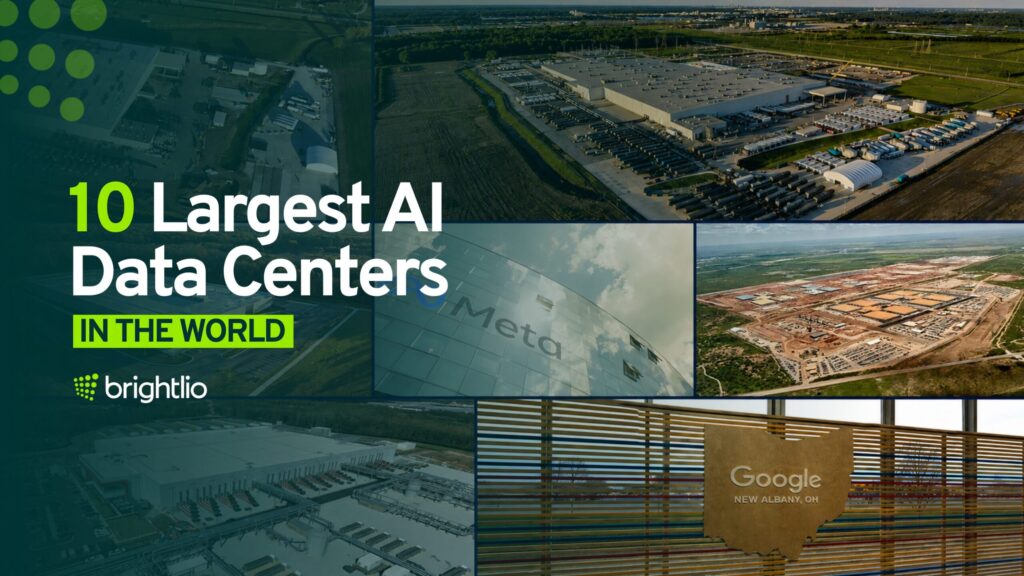
The largest AI data centers are single-purpose computing campuses built to train and run frontier artificial intelligence models. Each one concentrates hundreds of thousands of accelerator chips inside a few buildings and draws hundreds of megawatts of electricity, matching the peak demand of a mid-sized city.
This list ranks the ten largest operating AI data centers by IT power capacity, the standard measure for AI facilities. All figures come from Epoch AI’s Frontier Data Centers Hub, an independent tracker that estimates power, compute, and cost from satellite imagery, permit records, and company disclosures, current as of September 2, 2026.
The ranking covers operational facilities only. Announced gigawatt campuses still under construction, including Meta’s Hyperion and most of the wider Stargate program, appear in the context sections rather than the main ranking.
10 Largest AI Data Centers in the World
Here is the ranked list of the ten largest operating AI data centers, ordered from smallest to largest. The largest sits at the bottom, so keep scrolling to reach it.
For a quick comparison, the table below summarizes each facility.
| Rank | Data Center | IT Power | Compute (H100-eq) |
| 10 | Google Columbus | 303 MW | 409,000 |
| 9 | Colossus 1 | 340 MW | 276,000 |
| 8 | Google Pryor (North) | 368 MW | 763,000 |
| 7 | Fairwater Wisconsin | 369 MW | 446,000 |
| 6 | Stargate Abilene | 421 MW | 509,000 |
| 5 | Google New Albany | 453 MW | 616,000 |
| 4 | Meta Prometheus | 562 MW | 680,000 |
| 3 | Fairwater Atlanta | 636 MW | 769,000 |
| 2 | New Carlisle (Project Rainier) | 910 MW | 686,000 |
| 1 | Colossus 2 | 946 MW | 1,112,000 |
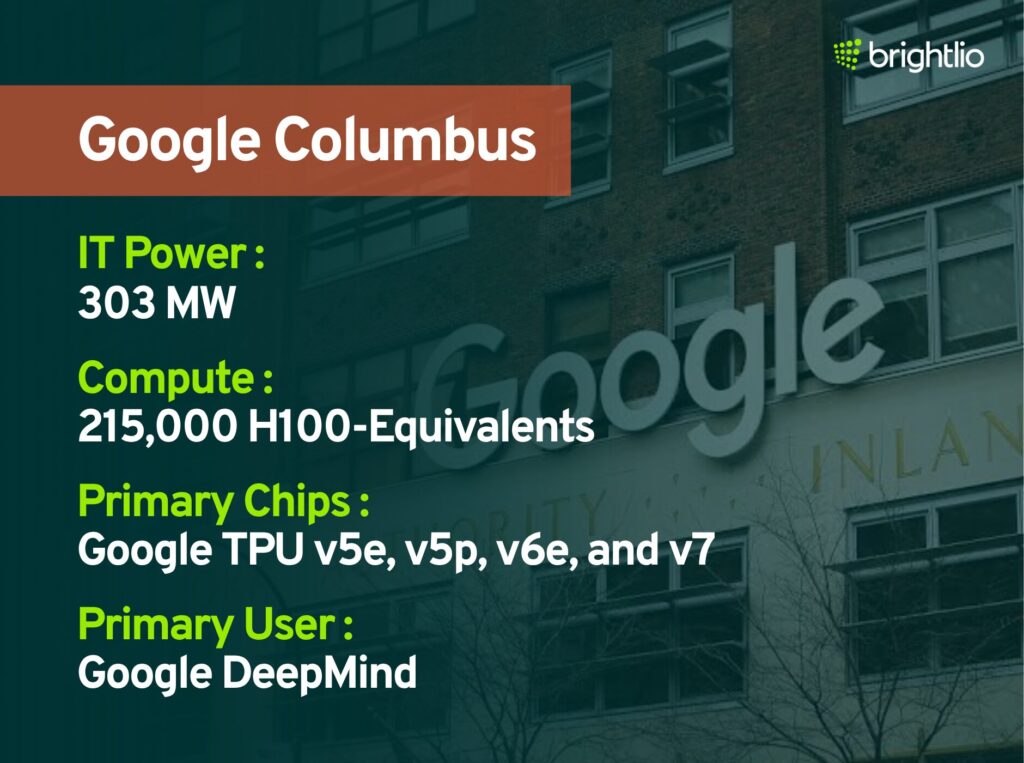
10. Google Columbus (Columbus, Ohio, USA)
- Operator: Google
- Location: Columbus, Ohio, USA
- IT Power: 303 MW
- Compute: ~409,000 H100-equivalents
- Estimated Total Capital Cost: $11.5 billion (Epoch AI estimate, including hardware)
- Primary Chips: Google TPU v5e, v5p, v6e, and v7
- Primary User: Google DeepMind (Epoch AI classifies this affiliation as speculative)
- Status: Operational
Google’s Columbus, Ohio, data center draws 303 MW and runs on Google’s custom Tensor Processing Units (TPUs), the accelerators the company designs in place of merchant GPUs. The site forms one node in Google’s central-Ohio footprint.
Columbus works alongside Google’s nearby New Albany campus. Independent analysis from SemiAnalysis estimates that Google’s combined central-Ohio sites top 1 gigawatt of total compute capacity, with roughly 500 MW dedicated to AI workloads and the remainder serving general cloud services.
TPU hardware gives Google a self-sufficient supply chain for AI compute. The Columbus site spans several chip generations, from TPU v5 through the newest v7, which reflects continuous hardware refresh across the campus.
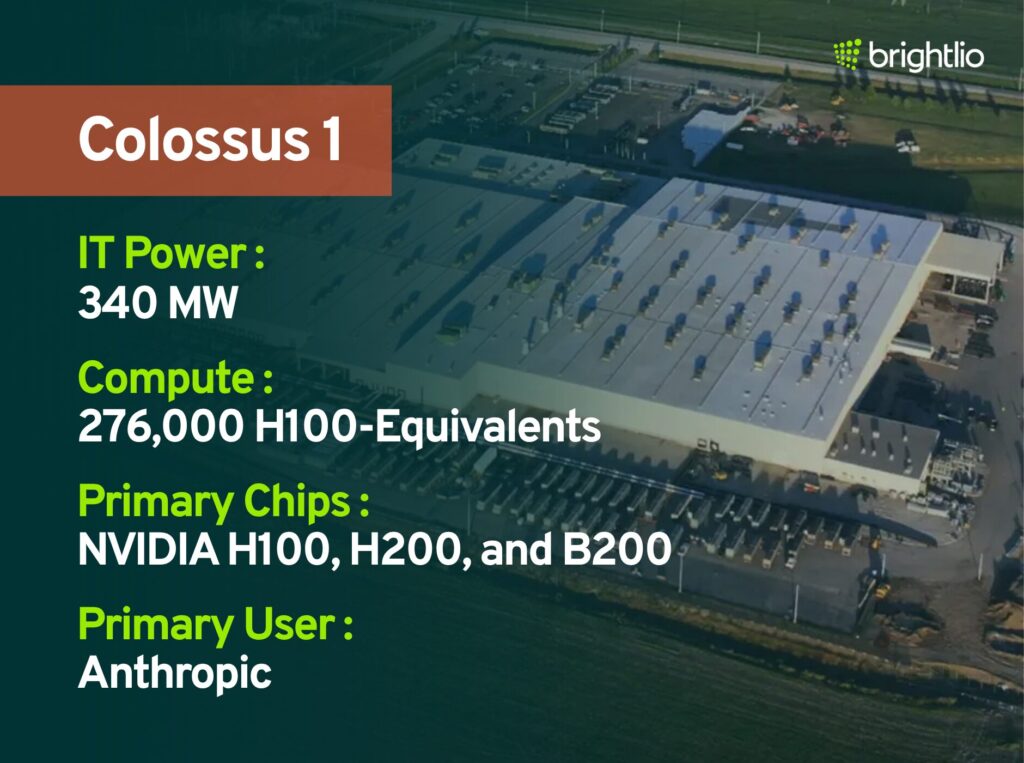
9. Colossus 1 (Memphis, Tennessee, USA)
- Operator: xAI
- Location: Memphis, Tennessee, USA
- IT Power: 340 MW
- Compute: ~276,000 H100-equivalents
- Estimated Total Capital Cost: $12.9 billion (Epoch AI estimate, including hardware)
- Primary Chips: NVIDIA H100, H200, and B200
- Primary User: Anthropic
- Status: Operational
Colossus 1 is xAI’s original Memphis supercomputer, drawing 340 MW of IT power at a former Electrolux appliance factory in South Memphis. xAI brought the first 100,000 NVIDIA H100 GPUs online in September 2024 after a build that the company says took 122 days from empty shell to training-ready cluster.
The site has since grown past its original footprint, adding H200 and NVIDIA GB200 systems on top of the initial H100 fleet. xAI built the facility primarily to train its Grok models. As of May 2026, Anthropic agreed to rent the full compute capacity of Colossus 1.
Colossus 1 pioneered xAI’s on-site generation model. The company installed dozens of natural gas turbines and Tesla Megapack battery systems to supply power ahead of permanent grid connections, a template it later scaled at Colossus 2. The gas turbines have drawn Clean Air Act scrutiny and prompted revised EPA permitting guidance in January 2026.
8. Google Pryor (North) (Pryor, Oklahoma, USA)
- Operator: Google
- Location: Pryor, Oklahoma, USA
- IT Power: 368 MW
- Compute: ~763,000 H100-equivalents
- Estimated Total Capital Cost: $13.9 billion (Epoch AI estimate, including hardware)
- Primary Chips: Google TPU v5p and v5e
- Primary User: Google DeepMind (Epoch AI classifies this affiliation as speculative)
- Status: Operational
Google’s Pryor North data center draws 368 MW of IT power and holds an estimated 763,000 H100-equivalents of compute. That makes it the eighth-largest operating AI data center by power and the third-largest by installed compute.
Epoch AI marked the site’s second building operational on August 24, 2026, following a warehouse retrofit and the construction of a new substation and cooling system. The expansion raised Pryor North from 53 MW and roughly 26,000 H100-equivalents to its current capacity.
The campus uses Google’s custom TPU v5p and v5e accelerators. Their high compute efficiency explains why Pryor North ranks much higher by processing capacity than by power draw.
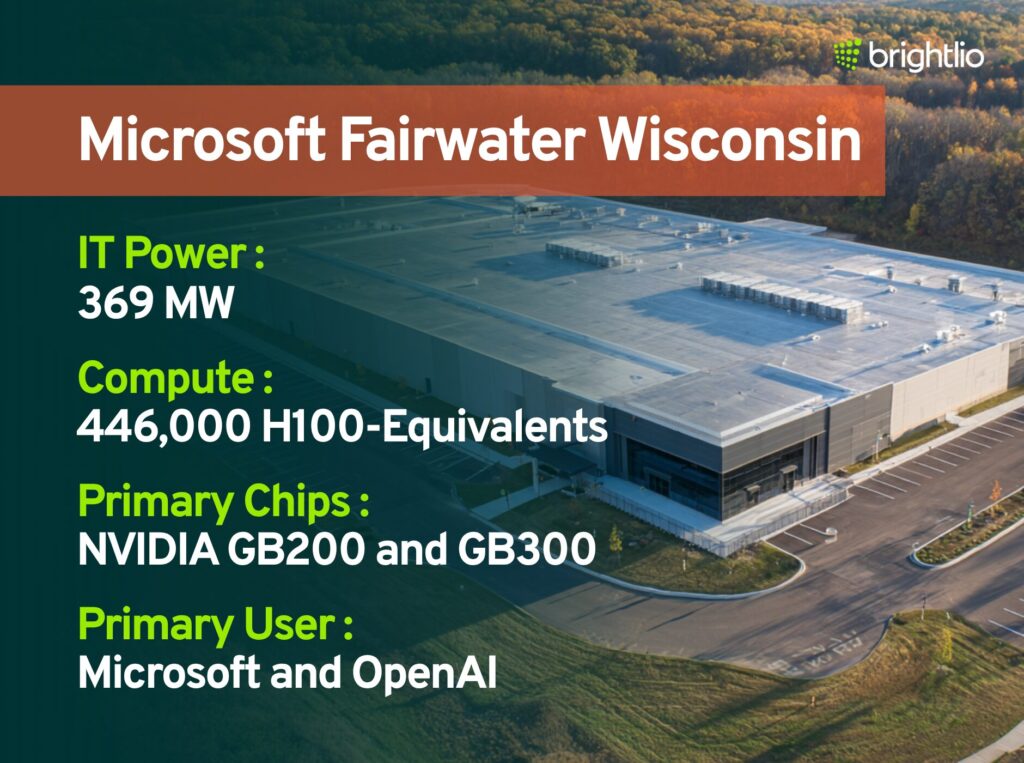
7. Microsoft Fairwater Wisconsin (Mount Pleasant, Wisconsin, USA)
- Operator: Microsoft
- Location: Mount Pleasant, Wisconsin, USA
- IT Power: 369 MW
- Compute: ~446,000 H100-equivalents
- Estimated Total Capital Cost: $14.0 billion (Epoch AI estimate, including hardware)
- Primary Chips: NVIDIA GB200 and GB300 (Blackwell)
- Primary Users: Microsoft and OpenAI (OpenAI classified as likely)
- Status: Operational
- Cooling: Closed-loop liquid cooling, near-zero operational water use
Microsoft’s Fairwater Wisconsin campus draws 369 MW of IT power and reached full operation on June 23, 2026. Microsoft designed the site to run as a single coherent AI supercomputer rather than a multi-tenant cloud region.
The campus links hundreds of thousands of NVIDIA Blackwell GPUs through an 800-gigabit-per-second Ethernet fabric and a protocol called Multi-Path Reliable Connected (MRC), co-developed with OpenAI and NVIDIA.
A two-story building layout shortens cable runs and reduces latency between racks. Microsoft states the campus spans three buildings across 315 acres and 1.2 million square feet, supported by 120 miles of medium-voltage underground cable.
Fairwater Wisconsin is the first site in Microsoft’s Fairwater family and an anchor of the company’s AI Wide Area Network (AI WAN), a dedicated fiber backbone that links Fairwater campuses into one distributed system.
6. OpenAI Stargate Abilene (Abilene, Texas, USA)
- Operator: Oracle (built by Crusoe)
- Location: Abilene, Texas, USA
- IT Power: 421 MW
- Compute: ~509,000 H100-equivalents
- Estimated Total Capital Cost: $15.9 billion (Epoch AI estimate, including hardware)
- Primary Chips: NVIDIA GB200 and GB300 (Blackwell)
- Primary User: OpenAI
- Status: Operational, remaining buildings under construction
The Stargate Abilene campus in Texas draws 421 MW of IT power and serves as the flagship site of Stargate, the $500 billion AI infrastructure program led by OpenAI, Oracle, and SoftBank. AI infrastructure company Crusoe built the campus, and it runs on Oracle Cloud Infrastructure.
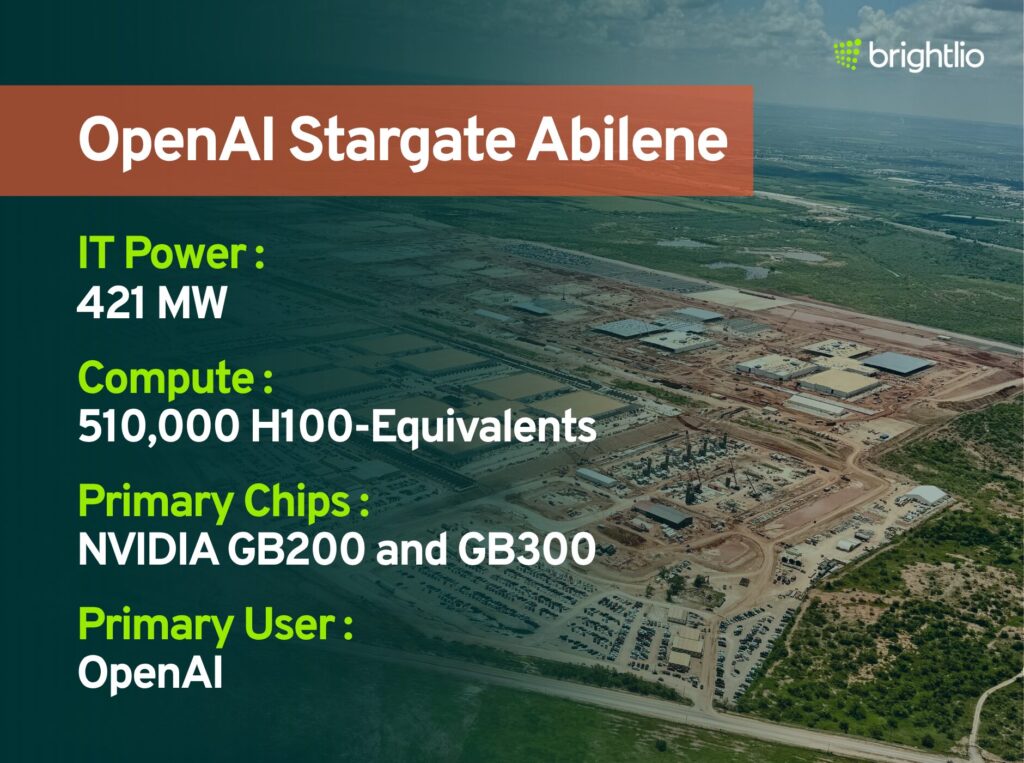
The first phase went live in September 2025. Oracle chairman Larry Ellison has said the eight-building campus will eventually house more than 450,000 NVIDIA GB200 GPUs and reach 1.2 gigawatts at full build-out, with the remaining buildings targeted for completion through 2026. Crusoe has disclosed roughly 50,000 Blackwell GPUs per building.
On-site natural gas and grid power, including local wind, supply the campus. OpenAI shelved a planned 600 MW expansion module in early 2026 and redirected that capacity to other Stargate locations. Microsoft has since partnered with Crusoe on the adjacent 900 MW site.
5. Google New Albany (New Albany, Ohio, USA)
- Operator: Google
- Location: New Albany, Ohio, USA
- IT Power: 453 MW
- Compute: ~616,000 H100-equivalents
- Estimated Total Capital Cost: $17.2 billion (Epoch AI estimate, including hardware)
- Primary Chips: Google TPU v5e, v5p, v6e, and v7
- Primary User: Google DeepMind (Epoch AI classifies this affiliation as speculative)
- Status: Operational
Google’s New Albany, Ohio, data center draws 453 MW of IT power, the larger of the company’s two tracked central-Ohio sites. The campus shares its business park with Meta’s Prometheus supercluster, making New Albany one of the densest concentrations of AI infrastructure in the United States.
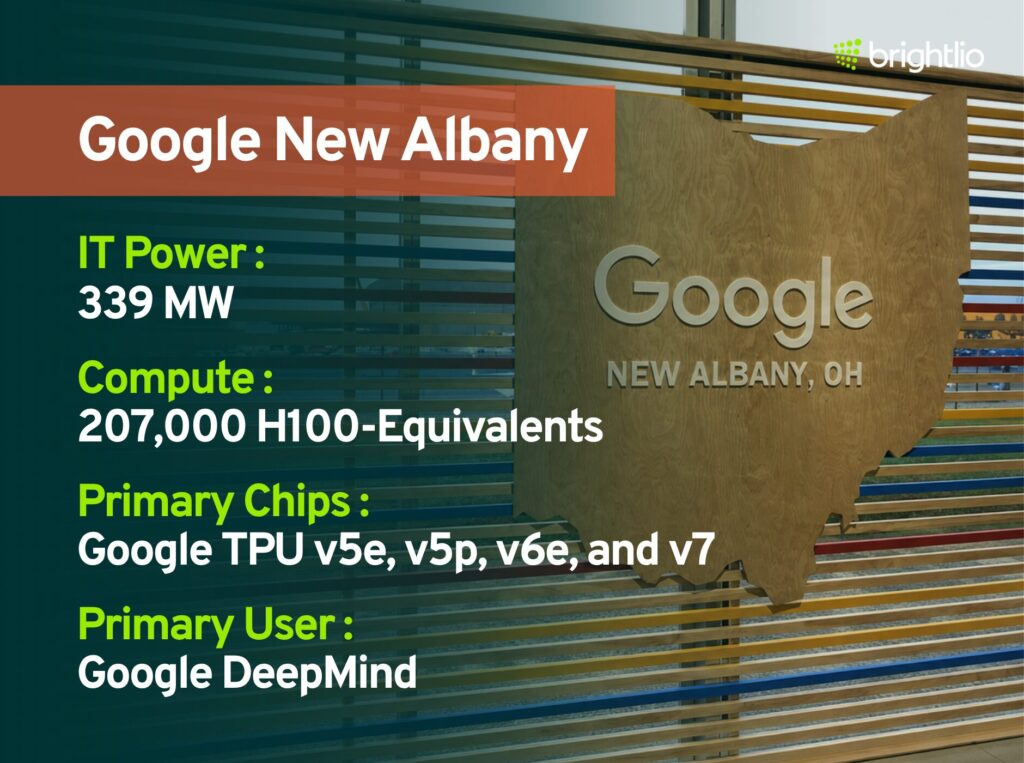
Both Google and Meta sites in New Albany operate inside AEP Ohio’s service territory, fall under Ohio’s data center sales-tax provisions, and connect to the regional PJM Interconnection grid. That shared infrastructure explains why several operators cluster in the same corridor.
Google targets 1 gigawatt of operational AI compute across its central-Ohio campuses by the end of 2026. New Albany carries the largest single share of that plan.
4. Meta Prometheus (New Albany, Ohio, USA)
- Operator: Meta
- Location: New Albany, Ohio, USA
- IT Power: 562 MW
- Compute: ~680,000 H100-equivalents
- Estimated Total Capital Cost: $21.3 billion (Epoch AI estimate, including hardware)
- Primary Chips: NVIDIA B200 (Blackwell)
- Primary User: Meta
- Status: Operational, scaling toward ~1 gigawatt
Meta’s Prometheus supercluster in New Albany, Ohio, draws 562 MW of IT power and is Meta’s largest operational AI cluster. Meta CEO Mark Zuckerberg announced the project in July 2025 and positioned it to train the next generation of Llama models.
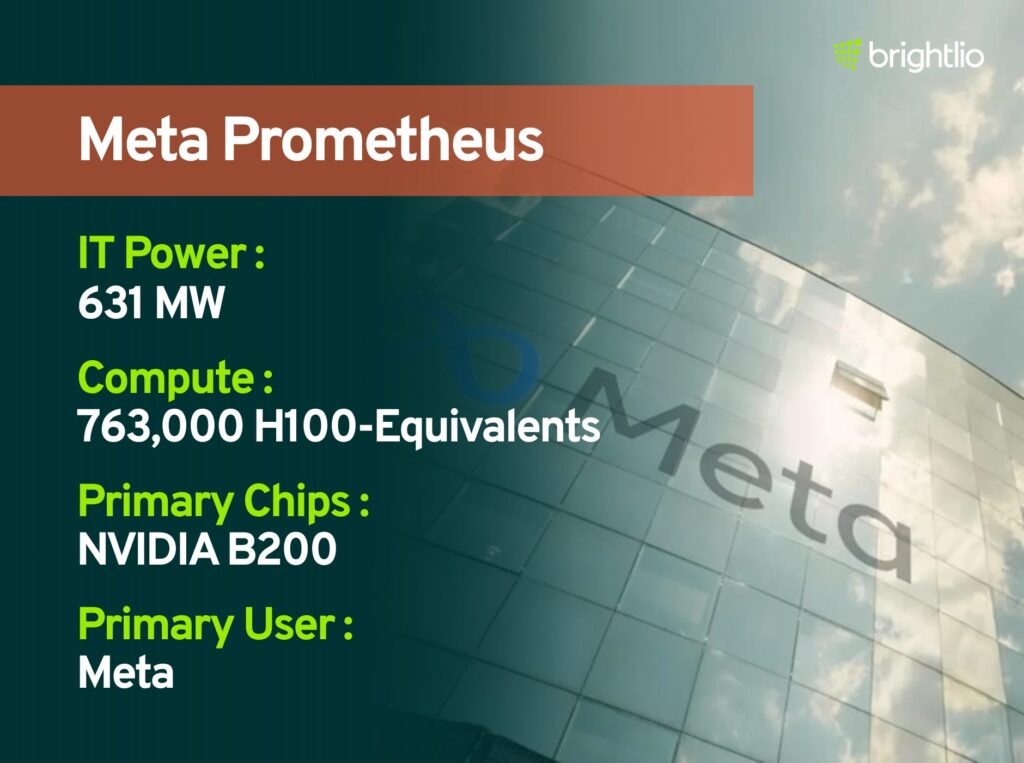
Prometheus stands out for its unusual construction. Epoch AI describes the site as a patchwork of weatherproof tents, colocation space, and traditional data center buildings spread across the length of the New Albany Business Park. The tent structures let Meta deploy capacity faster than conventional construction allows.
Meta has committed heavily to firm power for the campus. In January 2026 the company signed nuclear agreements with Vistra, TerraPower, and Oklo that add up to 6.6 gigawatts of electricity by 2035.
Meta also matches the site’s consumption with more than 800 MW of contracted Ohio and Indiana solar and wind. Prometheus continues scaling toward 854 MW and roughly 1 million H100-equivalents.
3. Microsoft Fairwater Atlanta (Fayetteville, Georgia, USA)
- Operator: Microsoft (built by QTS)
- Location: Fayetteville, Georgia, USA
- IT Power: 636 MW
- Compute: ~769,000 H100-equivalents
- Estimated Total Capital Cost: $24.1 billion (Epoch AI estimate, including hardware)
- Primary Chips: NVIDIA GB200 (Blackwell)
- Primary Users: Microsoft and OpenAI (OpenAI classified as likely)
- Status: Operational
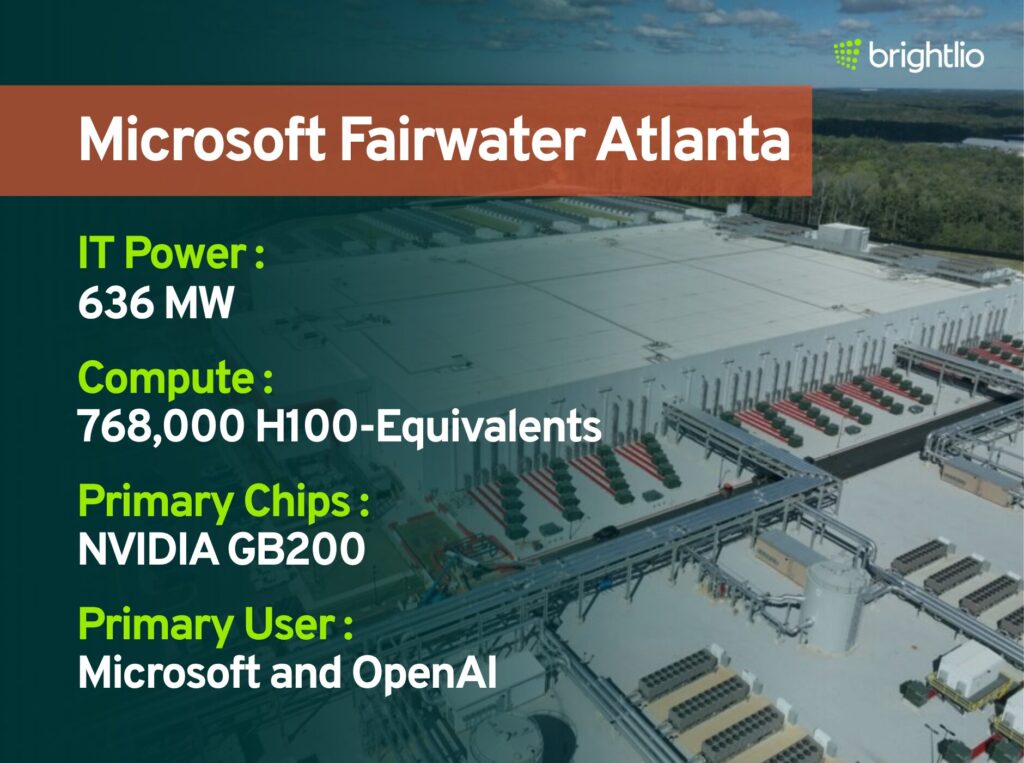
Microsoft’s Fairwater Atlanta campus near Fayetteville, Georgia, draws 636 MW of IT power and holds the largest installed compute of any Microsoft AI site. QTS built the shell, and Microsoft operates the facility as the second campus in its Fairwater family. Operations began in October 2025.
Atlanta connects to Fairwater Wisconsin through Microsoft’s AI WAN, forming what the company calls a planet-scale AI superfactory. The dedicated fiber backbone spans roughly 120,000 miles and lets synchronous training jobs run across sites hundreds of miles apart.
Each rack uses the NVIDIA GB200 NVL72 configuration, placing 72 Blackwell GPUs in a single high-bandwidth memory domain.
The site supports around 140 kW per rack and uses closed-loop liquid cooling that consumes almost no water in operation. Microsoft has indicated the campus initially serves OpenAI model training, though the partnership between the two companies has shifted since 2023, which is why Epoch AI marks the OpenAI affiliation as probable.
2. Amazon New Carlisle, Project Rainier (New Carlisle, Indiana, USA)
- Operator: Amazon Web Services
- Location: New Carlisle, Indiana, USA
- IT Power: 910 MW
- Compute: ~686,000 H100-equivalents
- Estimated Total Capital Cost: $34.5 billion (Epoch AI estimate, including hardware); about $11 billion in stated site investment
- Primary Chips: AWS Trainium2
- Primary User: Anthropic
- Status: Operational, expanding toward 2.25 gigawatts
Amazon’s New Carlisle campus in Indiana draws 910 MW of IT power and serves as the primary hub of Project Rainier, the AWS supercomputing cluster built for Anthropic. The site trains and runs Anthropic’s Claude models. Amazon brought the campus online in October 2025, less than a year after breaking ground.
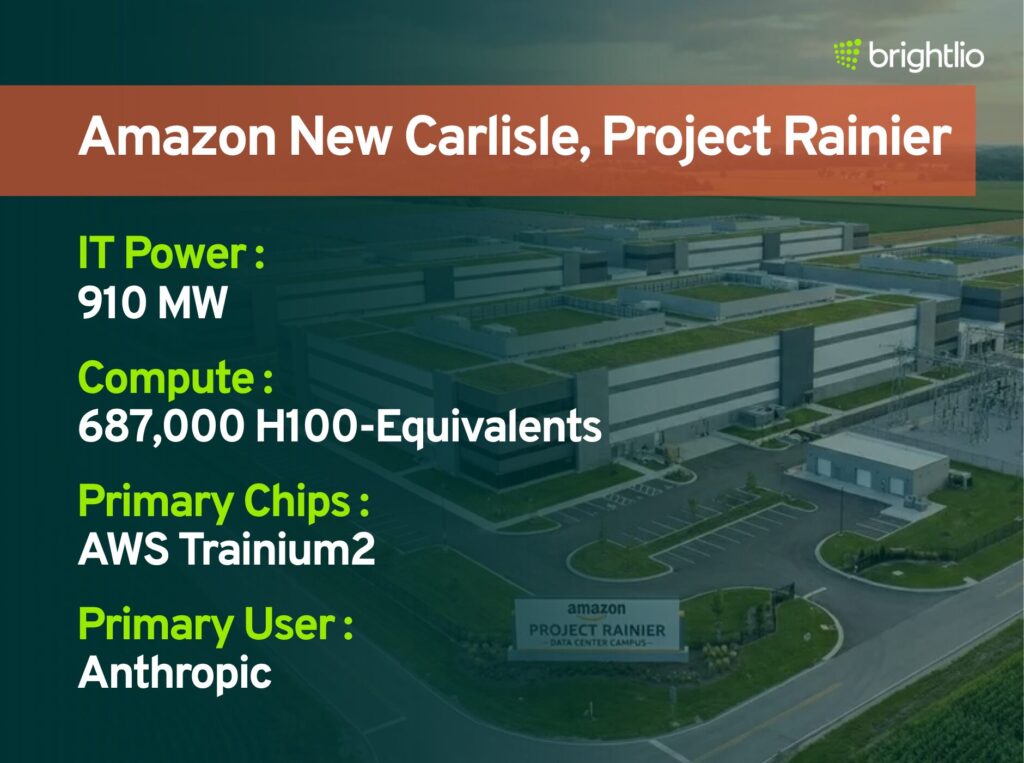
The campus runs on roughly 500,000 AWS Trainium2 chips, Amazon’s custom training accelerator, with a target of one million chips. Amazon states this is the largest known deployment of non-NVIDIA AI compute anywhere. The chips connect through NeuronLink cables and petabit-scale Elastic Fabric Adapter networking. Anthropic engineers worked directly with AWS Annapurna Labs to write low-level kernels for the Trainium silicon.
Project Rainier reflects a deep commercial relationship. Anthropic has committed to spend more than $100 billion on AWS compute over ten years and to reserve up to 5 gigawatts of Trainium capacity. Amazon plans to grow the New Carlisle campus to 32 buildings, about 6.5 million square feet, and roughly 2.25 gigawatts of grid draw, which would make it the single largest customer in its regional utility’s history. Epoch AI’s $34.5 billion estimate includes the Trainium2 hardware, while Amazon’s stated site investment is about $11 billion.
1. xAI Colossus 2 (Memphis, Tennessee, USA)
- Operator: xAI
- Location: Memphis, Tennessee, USA (with turbines in Southaven, Mississippi)
- IT Power: 946 MW
- Compute: ~1,112,000 H100-equivalents
- Estimated Total Capital Cost: $35.8 billion (Epoch AI estimate, including hardware)
- Primary Chips: NVIDIA B200 and B300
- Primary Users: xAI, Anthropic, Cursor
- Status: Operational, expanding toward 2 gigawatts
Colossus 2 is the largest operating AI data center in the world, drawing 946 MW of IT power and holding an estimated 1.1 million H100-equivalents, the most compute of any single site. xAI, the AI company founded by Elon Musk, operates the campus at a Tulane Road warehouse site in South Memphis. Epoch AI attributes ownership to SpaceX following the companies’ consolidation, and the site appears in a SpaceX SEC filing.
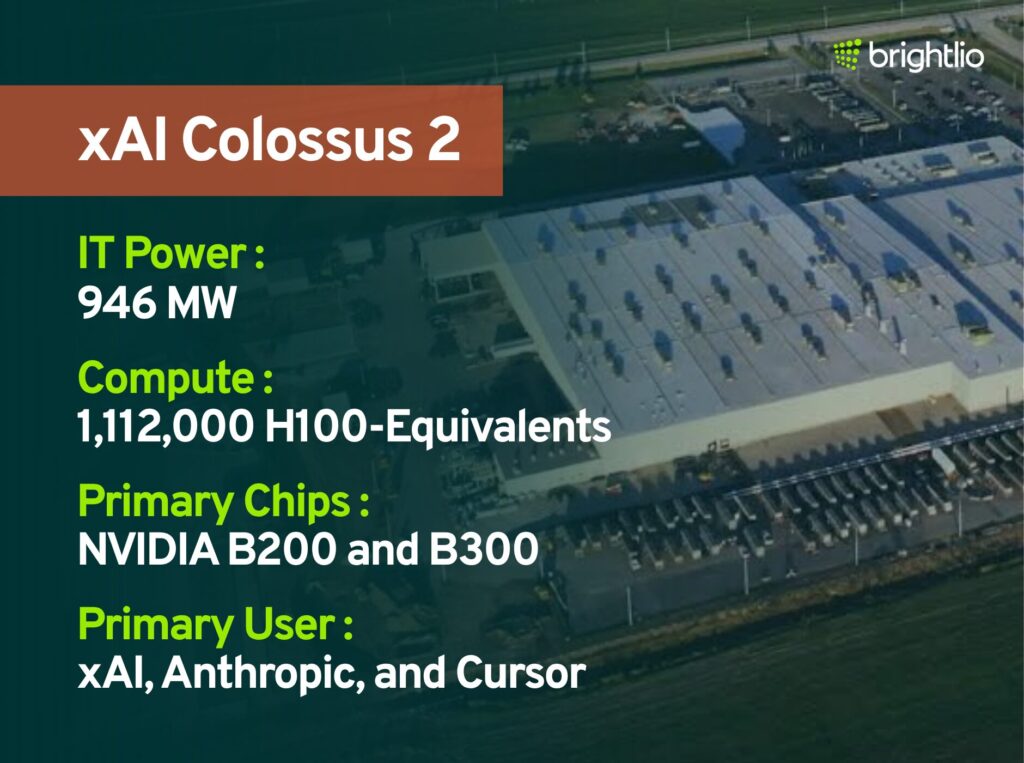
xAI kicked off the project in March 2025 and built at record speed. SemiAnalysis counted 119 air-cooled chillers on site by late August 2025, roughly 200 MW of cooling capacity, enough to support about 110,000 GB200 NVL72 systems. The campus houses NVIDIA B200 and B300 accelerators.
Power comes largely from on-site generation. xAI installed natural gas turbines across the state line in Southaven, Mississippi, reaching 46 operational turbines and up to 495 MW by May 2026, supported by Tesla Megapack battery systems. The turbines have drawn Clean Air Act challenges, and the Department of Justice moved to intervene in June 2026 on national security grounds, citing Grok’s use in Department of Defense applications.
Colossus 2 serves multiple tenants. xAI trains its Grok models on the campus, Anthropic contracted capacity beginning in mid-2026, and Google agreed to rent access to 110,000 GPUs from October 2026. xAI has stated plans to push the wider Colossus complex toward 2 gigawatts, and Musk has set a longer-term goal of one million GPUs.
What Is an AI Data Center?
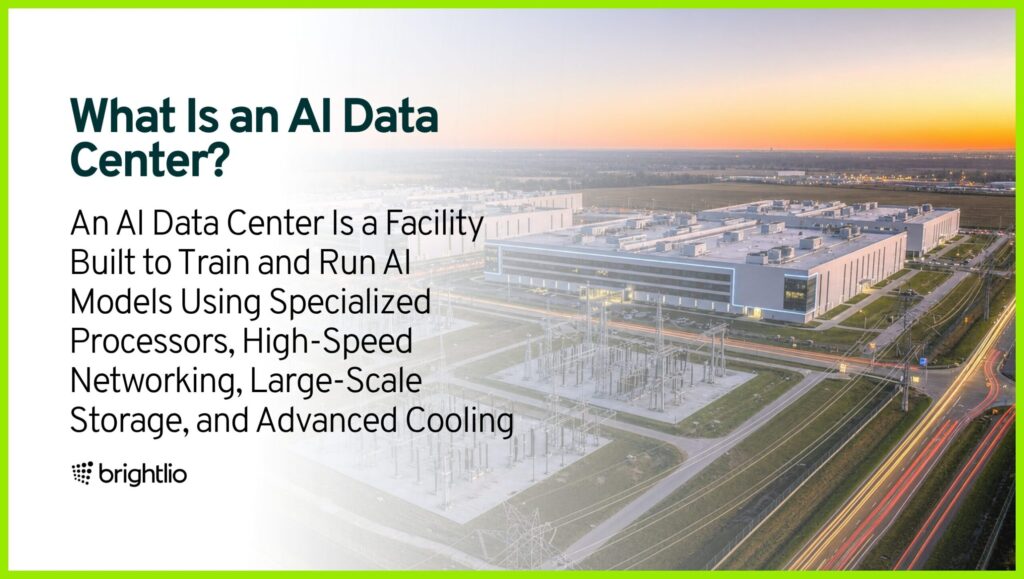
An AI data center is a facility designed to run computationally intensive artificial intelligence workloads, including model training and inference.
It combines specialized processors such as GPUs, Google TPUs, and AWS Trainium chips with high-speed networking, large-scale storage, and advanced cooling systems. These facilities require far greater rack density, electrical capacity, and cooling infrastructure than standard enterprise data centers.
IT power refers to the electricity delivered directly to servers and computing equipment, measured in megawatts. H100-equivalent compute expresses a facility’s processing capacity relative to one NVIDIA H100 GPU, allowing sites with different chip types to be compared on a common scale.
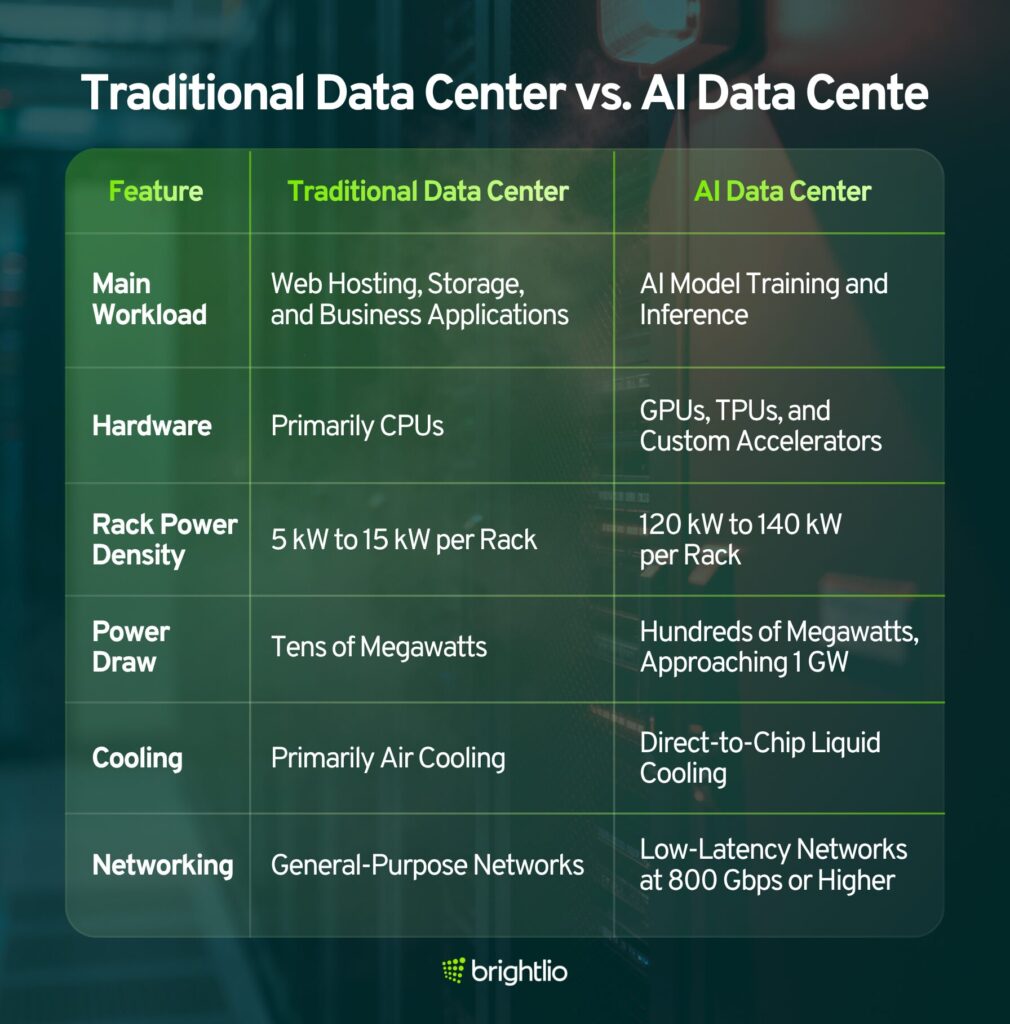
AI data centers operate at much higher power densities than conventional facilities. A standard cloud rack may draw 5 kW to 15 kW, while an NVIDIA GB200 NVL72 rack can require roughly 120 kW to 140 kW, often making liquid cooling and dedicated power infrastructure necessary.
What Is the Largest AI Data Center in the World?
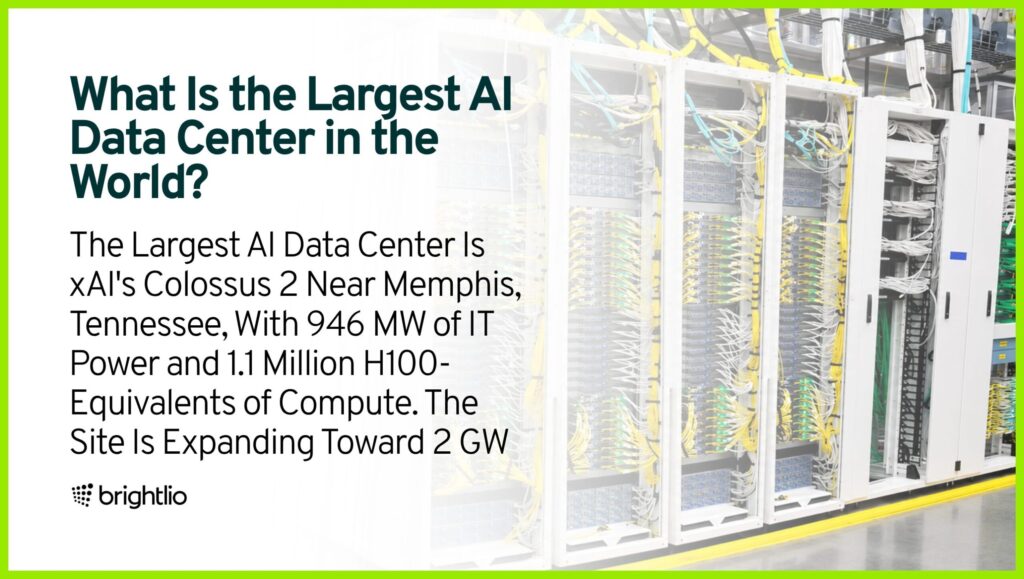
The largest AI data center in the world is xAI’s Colossus 2 near Memphis, Tennessee, drawing 946 MW of IT power. The campus holds an estimated 1.1 million H100-equivalents of compute, more than any other single site, and continues to expand toward a stated target of 2 gigawatts.
Colossus 2 edges out Amazon’s Project Rainier campus in New Carlisle, Indiana, which operates at about 910 MW and trains Anthropic’s Claude models. Both figures come from Epoch AI’s mid-2026 satellite tracking and continue to climb as the campuses ramp. Measured by installed compute rather than power, the order shifts slightly, a point covered in the compute section below.
What Is the Largest AI Data Center by Compute?
The largest AI data center by installed compute is xAI’s Colossus 2, at roughly 1.1 million H100-equivalents. The next positions differ from the power ranking because chip efficiency varies. Microsoft’s Fairwater Atlanta holds about 769,000 H100-equivalents, Google Pryor North about 763,000, Amazon’s New Carlisle roughly 686,000, and Meta’s Prometheus about 680,000.
The gap between the two rankings comes from hardware. Amazon’s New Carlisle draws more power (910 MW) than Fairwater Atlanta (636 MW) yet delivers less rated compute, because AWS Trainium2 consumes more electricity per unit of H100-equivalent performance than NVIDIA’s newer Blackwell GPUs. Google Pryor North also reaches about 763,000 H100-equivalents with 368 MW of IT power. Power capacity and compute capacity therefore track each other loosely, and the choice of metric changes the order of the leading sites.
Which Company Controls the Most AI Computing Power?
Google controls the most AI computing power of any single company, according to Epoch AI’s April 2026 analysis, driven largely by its custom TPU fleet across many campuses.
Ownership of global AI compute is highly concentrated among hyperscalers, large technology companies that operate extensive cloud and data center infrastructure. Epoch AI reports that five leading operators collectively own more than two-thirds of the world’s tracked AI compute.

The concentration shows in this ranking. Six operators and hardware owners, xAI, Amazon, Microsoft, Meta, Google, and Oracle, fill all ten positions, and every facility sits in the United States. Epoch AI’s September 2026 database covers 86 tracked sites, 14.6 million H100-equivalents, 13.3 GW of IT power capacity, and 18 owners.
What Is the Largest AI Data Center Outside the United States?
The largest AI data center outside the United States is Huawei’s Horinger campus in Hohhot, Inner Mongolia, China, at roughly 242 MW of IT power. The site runs on Huawei’s Ascend 910C accelerators, China’s domestic answer to restricted NVIDIA supply.
Other large non-US AI sites cluster in China and Southeast Asia. The DayOne Nusajaya campus in Johor Bahru, Malaysia, draws about 240 MW and reportedly serves Alibaba and ByteDance training workloads. VNET’s Bayin Ulanqab site in China operates at roughly 221 MW, and Alibaba’s Zhangbei campus at about 169 MW. Every facility in the global top ten by power capacity, however, remains inside the United States, which reflects the current concentration of frontier AI chips and capital.
How Much Power Do AI Data Centers Use?
The largest AI data centers use hundreds of megawatts each, and the biggest now approach one gigawatt of IT power. One gigawatt is the output of a large nuclear reactor and enough electricity to supply roughly one million US households. Epoch AI’s 86 tracked AI sites carry a combined 13.3 GW of IT power, which exceeds New York City’s peak demand of about 11 GW.
Individual sites range widely. Smaller AI facilities draw under 50 MW, comparable to a small city, while the record holders exceed 900 MW. Actual consumption typically runs at 60% to 80% of rated capacity because of idle time and maintenance. Power availability has become the primary constraint on AI expansion, which is why operators build on-site gas generation, sign long-term nuclear agreements, and cluster near existing grid infrastructure.
What Is the Difference Between an AI Data Center and a Traditional Data Center?
An AI data center is optimized for training and running machine learning models, while a traditional data center supports general workloads such as web hosting, storage, and business applications. The two differ across hardware, power density, cooling, and networking. The table below provides a detailed comparison of AI data centers and traditional data centers:
Final Thoughts
The world’s largest AI data centers are now measured primarily by power capacity rather than floor area. xAI’s Colossus 2 leads at 946 MW, followed by Amazon’s Project Rainier at 910 MW, while Microsoft, Meta, Google, and Oracle operate the remaining top sites. All 10 are located in the United States.
Chip concentration and power availability define this ranking. Leading campuses hold hundreds of thousands or more than 1 million H100-equivalents and increasingly rely on dedicated generation, nuclear agreements, and liquid cooling. Larger projects are already planned, including Meta’s 5 GW Hyperion campus, Amazon’s 2.25 GW New Carlisle campus, and the 9 GW Stargate program.
Read More Similar Posts:
Brightlio Delivers United States Colocation Services
Finding the right data center in the United States starts with Brightlio. As a telecommunications and colocation broker, we have data center partners across every major US market, ready to provide solutions matched to your needs and budget. Simply share your space, power, and connectivity requirements, and we’ll provide colocation pricing at no charge.
Beyond colocation, we offer connectivity, unified communications, cloud, infrastructure hosting, disaster recovery, and advisory services. This full suite of offerings gives your enterprise a complete technology solution through a single partner.
Contact Brightlio now to get started!
Frequently Asked Questions (FAQs)
1. What is the largest AI data center in the world?
The largest AI data center in the world is xAI’s Colossus 2 near Memphis, Tennessee, drawing about 946 MW of IT power and holding an estimated 1.1 million H100-equivalents of compute. It trains xAI’s Grok models and rents capacity to other AI companies, including Anthropic and Google.
2. How are the largest AI data centers ranked?
The largest AI data centers are ranked by IT power capacity, measured in megawatts. IT power is the standard metric for AI facilities because it reflects how much computing hardware a site can run, unlike floor area, which no longer tracks capacity. Compute capacity, measured in H100-equivalents, provides a secondary ranking that can shift the order.
3. Which company operates the largest AI data center?
xAI operates Colossus 2, the largest AI data center by both power and compute. Amazon operates the second largest, the New Carlisle Project Rainier campus. Microsoft, Meta, Google, and Oracle operate the remaining sites in the global top ten.
4. Where are the largest AI data centers located?
Every facility in the top ten by IT power sits in the United States, concentrated in Tennessee, Indiana, Ohio, Georgia, Texas, Wisconsin, and Oklahoma. The largest AI data center outside the United States is Huawei’s Horinger campus in Inner Mongolia, China.
5. What chips do AI data centers use?
Large AI data centers run NVIDIA H100, H200, and Blackwell GB200 and GB300 GPUs, Google TPU v5, v6, and v7 chips, and AWS Trainium2 accelerators. Google uses custom TPUs, Amazon deploys Trainium, and xAI, Microsoft, and Meta primarily use NVIDIA GPUs.
6. What is Project Rainier?
Project Rainier is Amazon’s AI supercomputing program built for Anthropic, the company behind the Claude models. Its primary campus in New Carlisle, Indiana, runs roughly 500,000 AWS Trainium2 chips and draws about 910 MW, making it the second largest AI data center in the world.
7. Why do AI data centers need so much power?
AI data centers concentrate hundreds of thousands of accelerators that each draw far more power than a standard server. A single AI rack can draw 120 kW to 140 kW, compared with 5 kW to 15 kW for a conventional rack. Training frontier models requires all that hardware to run at once, which pushes total campus draw into the hundreds of megawatts.
8. Are AI data centers available for colocation?
Most of the world’s largest AI data centers are not available for conventional colocation. Sites such as Colossus, Project Rainier, Prometheus, and Google’s campuses are owner-operated and dedicated to specific companies or models.
The broader AI colocation data center market serves organizations that need high-density GPU infrastructure without constructing a private hyperscale campus. Businesses can use specialized colocation providers for scalable power, liquid cooling, network connectivity, and managed infrastructure.
9. What is the largest AI data center by compute?
xAI’s Colossus 2 holds the most installed compute at roughly 1.1 million H100-equivalents. Microsoft’s Fairwater Atlanta and Google Pryor North follow at about 769,000 and 763,000 H100-equivalents. Amazon’s New Carlisle and Meta’s Prometheus come next at roughly 686,000 and 680,000.
10. Will larger AI data centers be built?
Yes. Meta’s Hyperion campus in Louisiana targets up to 5 gigawatts beginning in 2028, the Stargate program plans more than 9 gigawatts across seven US sites, and Amazon plans to scale New Carlisle toward 2.25 gigawatts. Analysts expect new single-site power and compute records through 2027 and 2028.

Tamzid is a cybersecurity researcher with 5+ years of experience across SaaS, security, compliance, data centers and cloud. He writes for brightdefense.com and hipaasimple.com, covering security, compliance, and infrastructure topics. Certified through Cisco, Fortinet (NSE 1), and the Basel Institute on Governance in OSINT, he grounds his work in primary sources and verified data.
Recent Posts

Data Centers In Indiana

Data Centers In Arizona
What Is a Data Center?

10 Largest AI Data Centers in the World
Let's start
a new project together