
New Hampshire offers a compact but practical colocation market for organizations that need Northeast coverage, proximity to Boston, and a tax-friendly operating base. The state does not compete with Northern Virginia, Dallas, Phoenix, or Atlanta on hyperscale capacity, but it serves a clear role for regional disaster recovery, edge infrastructure, healthcare workloads, financial services, public sector systems, and enterprises that need resilient infrastructure outside the densest metro areas.
New Hampshire’s market is concentrated in Manchester, Bedford, Portsmouth, Keene, Lebanon, Laconia, Littleton, and Salem. Manchester is the largest local hub, while Bedford has become more visible because of FirstLight’s 2026 expansion. The state benefits from cool weather, established fiber routes into Boston and Northern New England, and a business tax environment that eliminates sales and use tax.
Power cost is the main constraint. New Hampshire’s commercial electricity rates are higher than many U.S. data center markets, and large-scale capacity is more limited than in the South, Midwest, and major cloud regions. That makes New Hampshire better suited for regional colocation, network aggregation, compliance-sensitive enterprise systems, and disaster recovery rather than massive AI training campuses.
New Hampshire Data Center Infrastructure Overview
- Number Of Data Centers: New Hampshire hosts 10 data centers across 7 markets, including 4 in Manchester and 1 each in Keene, Lebanon, Laconia, Littleton, Salem, and Portsmouth.
- Average Temperature: Average monthly high and low temperatures in New Hampshire range from about 5°F in Berlin in January to about 82°F in Manchester in July, based on Weather Spark’s representative state locations.
- Internet Speed (Average & Maximum):
- Average Speed: Approximately 671 Mbps.
- Maximum Speed: Up to 8 Gbps in select locations such as Plymouth, Rindge, Bristol, Moultonborough, Enfield, Canaan, and Warner.
- Energy Cost Per kWh: As of June 2026, the average commercial electricity rate in New Hampshire is 19.89¢ per kWh.
Why Colocate In New Hampshire?
Colocating in New Hampshire can support regional resiliency, lower-latency access to Northern New England, and a secondary infrastructure footprint near Boston without placing every workload inside Massachusetts. The following factors explain where the state fits, what buyers should evaluate, and which constraints matter most.
1. Market Access And Latency
New Hampshire provides strong regional access for organizations serving Boston, Manchester, Nashua, Portsmouth, Portland, Burlington, and other Northeast markets. Manchester and Bedford sit close to Interstate 93, Interstate 293, and Manchester-Boston Regional Airport, which makes them practical for enterprise IT teams that need physical access without operating directly in downtown Boston.
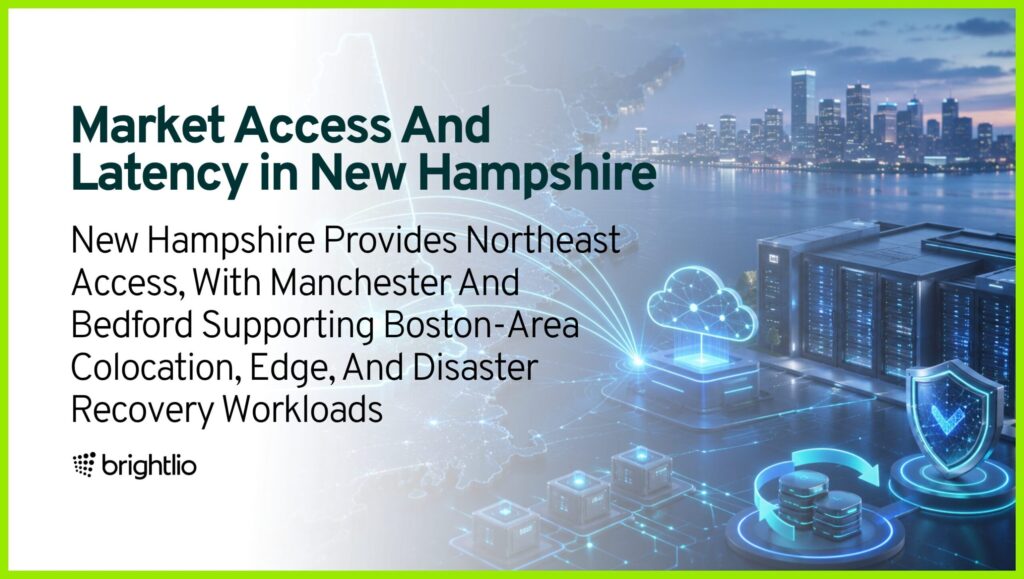
The state works well for disaster recovery and edge use cases. A company using Boston data centers for production can consider Manchester or Bedford for a secondary site, subject to shared-risk and route-diversity checks.
New Hampshire is not a major hyperscale region. The market is better understood as a regional colocation and connectivity layer that supports healthcare, education, financial services, manufacturing, state and local government, managed service providers, and small to midsize enterprise workloads.
2. Network Connectivity And Peering
New Hampshire’s strongest connectivity options are concentrated around Manchester, Bedford, and Portsmouth. FirstLight is the most visible colocation and fiber provider in the state, with facilities and network infrastructure that connect into a broader Northeast footprint. Other network operators and assets in the Manchester area include Consolidated Communications, Crown Castle Fiber, Comcast, Verizon, and regional fiber providers.
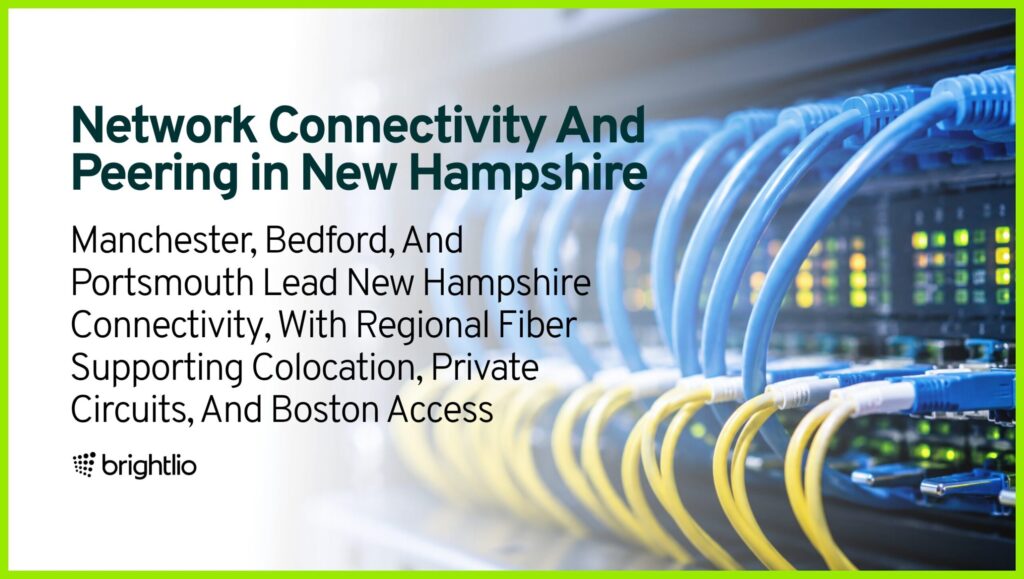
Carrier-neutral colocation is available in several facilities, but buyers should evaluate carrier lists carefully because New Hampshire does not have the same dense interconnection ecosystem as Boston, New York, or Northern Virginia. Direct access to major internet exchanges and cloud on-ramps usually depends on transport into Boston or another regional hub.
For many companies, this network profile is sufficient. New Hampshire can support private circuits, business continuity, managed connectivity, regional application hosting, and latency-sensitive access to Northern New England customers. Organizations that need dense peering, multiple direct cloud on-ramps, or very large wholesale capacity may need a hybrid architecture that pairs New Hampshire colocation with Boston, New York, or Ashburn connectivity.
3. Power, Cost, And Sustainability
Power is the most important cost consideration in New Hampshire colocation planning. The state’s commercial electricity rate is higher than many traditional data center markets, which can make large-scale deployments more expensive over time. Higher electricity rates matter because power and cooling usually represent a major share of long-term colocation operating cost.
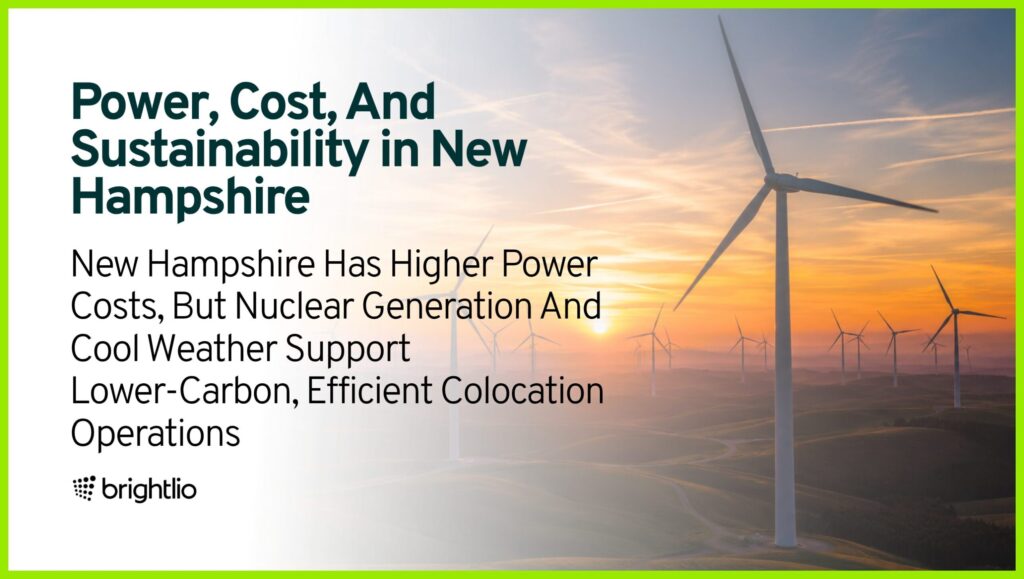
New Hampshire’s generation mix has a sustainability advantage because Seabrook Station supplies a large share of in-state electricity from nuclear power. Renewable generation from hydro, biomass, wind, and solar contributes additional low-carbon supply, though the state remains part of the broader ISO New England market where regional supply conditions affect prices.
The cool climate can help with cooling efficiency during parts of the year. Facilities with modern cooling systems, airflow controls, and economizer capability may reduce cooling overhead compared with hotter climates. Buyers should still validate power density, utility feeds, generator capacity, fuel contracts, and expansion rights because New Hampshire does not have the same utility-scale data center power availability as larger markets.
4. Tax Policy And Incentives
New Hampshire’s tax environment is one of the state’s strongest colocation advantages. The state has no sales tax and no use tax, which can reduce the acquisition cost of servers, storage systems, networking gear, and other data center equipment. For hardware-heavy deployments, that can make a meaningful difference in capital planning.
The state offers general business incentives, including economic revitalization credits, research and development tax credits, job creation programs, workforce training support, and Opportunity Zone benefits. These incentives are not data center-specific, so eligibility depends on project location, job creation, investment profile, and the operating entity.
New Hampshire does not currently have a dedicated data center incentive program comparable to the sales tax exemptions and long-duration abatements available in some other states. A proposed data center incentive framework did not advance in 2026, which means companies should plan around the state’s general tax structure rather than assuming project-specific data center relief.
5. Workforce And Ecosystem
New Hampshire has a strong regional workforce for technology, healthcare, advanced manufacturing, education, and professional services. Manchester and Nashua anchor the state’s largest employment corridor, while Portsmouth supports technology, defense-adjacent, logistics, and life sciences activity along the Seacoast. Lebanon and Hanover connect to the Upper Valley’s research, healthcare, and higher education ecosystem.
The state’s labor market is tight, which can help signal economic health but may make specialized hiring more competitive. Data center operators should plan carefully for facility technicians, network engineers, electricians, security staff, and operations roles. Many providers use a mix of local staff, regional field teams, remote monitoring, and managed services to support smaller markets. A managed colocation contract should specify which equipment tasks the provider handles and the response times that apply.
New Hampshire’s higher education and research base strengthens the broader ecosystem. The University of New Hampshire, Dartmouth College, community colleges, and regional training programs contribute to the talent pipeline. For colocation buyers, the practical advantage is access to a skilled Northeast workforce without needing to locate every system in Boston or New York.
6. Risk And Resiliency
New Hampshire’s main resiliency risks are winter storms, ice, flooding, high winds, and storm remnants that move inland from the Atlantic. Severe cold can affect fuel logistics, generator performance, rooftop equipment, and field access. Flooding risk varies heavily by location, making site-level review more important than statewide assumptions.
Modern colocation facilities in New Hampshire typically plan around redundant power, UPS systems, backup generation, access controls, environmental monitoring, and fire suppression. Buyers should verify generator runtime, fuel replenishment contracts, roof load design, snow removal procedures, floodplain status, and maintenance history.
The state’s lower tornado exposure can be an advantage compared with parts of the South and Midwest. That advantage does not remove the need for multi-site resilience. Many organizations will be better served with a distributed design that pairs a New Hampshire site with Boston, New York, Ashburn, or another regional data center market.
Key Cities Or Submarkets In New Hampshire
New Hampshire’s data center market is distributed across a small number of regional hubs. The following submarkets show where colocation, connectivity, and edge infrastructure activity are most concentrated.
1. Manchester
Manchester is New Hampshire’s largest data center market and the state’s most important network hub. The city has the strongest concentration of facilities, fiber providers, and enterprise demand. Its location near Boston, Nashua, Concord, and the Manchester-Boston Regional Airport makes it practical for organizations that need Northeast access with lower metro density.
FirstLight’s Manchester data center at 77 Sundial Avenue is one of the state’s most notable colocation sites. Manchester is also associated with Consolidated Communications and Crown Castle Fiber network assets, which helps support carrier diversity and regional connectivity.
Manchester is best suited for enterprise colocation, managed services, disaster recovery, network aggregation, and regional application hosting. Buyers that need the deepest peering ecosystem may still need transport to Boston or another larger interconnection market.
2. Bedford
Bedford is an important data center suburb west of Manchester. The town benefits from proximity to Manchester-Boston Regional Airport, major highways, and the broader Manchester-Nashua business corridor. Bedford is especially relevant because FirstLight expanded its local data center capacity in 2026.
The Bedford facility at 8 Commerce Drive supports cabinets, private suites, caged environments, and regional network services. FirstLight’s expansion added more space, power, and cooling capacity, making Bedford one of the more active New Hampshire colocation sites.
Bedford is best suited for organizations that want Manchester-area connectivity with a suburban site profile. It can support disaster recovery, production colocation, managed infrastructure, and private network deployments.
3. Portsmouth
Portsmouth gives New Hampshire a Seacoast data center option with access to eastern New Hampshire, southern Maine, and the Boston corridor. The city’s economy includes technology, healthcare, maritime activity, defense-adjacent work, tourism, and professional services.
FirstLight’s Portsmouth data center at 359 Corporate Drive provides a regional colocation option for organizations that need Seacoast coverage. The location is useful for companies with operations across Portsmouth, Dover, Rochester, southern Maine, and northeastern Massachusetts.
Portsmouth is best suited for regional business continuity, edge infrastructure, and enterprise workloads tied to Seacoast operations. Buyers should review coastal storm exposure and connectivity requirements during site selection.
4. Keene
Keene supports the Monadnock region and western New Hampshire. The local market is smaller than Manchester or Bedford, but it can serve regional businesses, education, healthcare, municipal systems, and disaster recovery needs.
FirstLight’s Keene data center at 310 Marlboro Street gives the region a local colocation option. Smaller regional facilities can be valuable for workloads that need physical proximity, continuity planning, or a secondary site away from larger metro areas.
Keene is best suited for modest enterprise deployments, backup infrastructure, and organizations with operations in western New Hampshire, southern Vermont, or north-central Massachusetts.
5. Lebanon
Lebanon connects New Hampshire’s data center footprint to the Upper Valley, including Hanover, Dartmouth College, Dartmouth Health, and regional life sciences activity. This makes Lebanon relevant for healthcare, research, education, and professional service organizations that need local infrastructure support.
FirstLight’s Lebanon data center at 16 Cavendish Court provides a local facility option in a market that would otherwise rely heavily on distant metros. The site can help organizations reduce dependence on Boston-area or central New Hampshire infrastructure.
Lebanon is best suited for regional continuity, healthcare-adjacent workloads, research support, and local enterprise colocation.
6. Salem, Laconia, And Littleton
Salem, Laconia, and Littleton represent smaller New Hampshire data center markets. Salem benefits from proximity to the Massachusetts border and the Interstate 93 corridor. Laconia supports the Lakes Region, while Littleton extends coverage toward northern New Hampshire.
These submarkets are not major colocation hubs, but they can matter for edge infrastructure, local business continuity, telecom aggregation, and regional service delivery. Buyers should treat them as niche options and validate power, network, staffing, and remote hands availability before committing production workloads.
Notable Colocation Providers And Facilities In New Hampshire
New Hampshire’s provider base is smaller than major data center states, but several facilities support enterprise colocation, connectivity, and disaster recovery needs. The following providers and sites show where the state’s most visible capacity is concentrated.
1. FirstLight Manchester Data Center
FirstLight’s Manchester data center at 77 Sundial Avenue is one of New Hampshire’s most important colocation facilities. The site supports full cabinets, half cabinets, private cages, and 24×7 access. It is positioned for enterprise colocation, regional connectivity, managed network services, and disaster recovery.
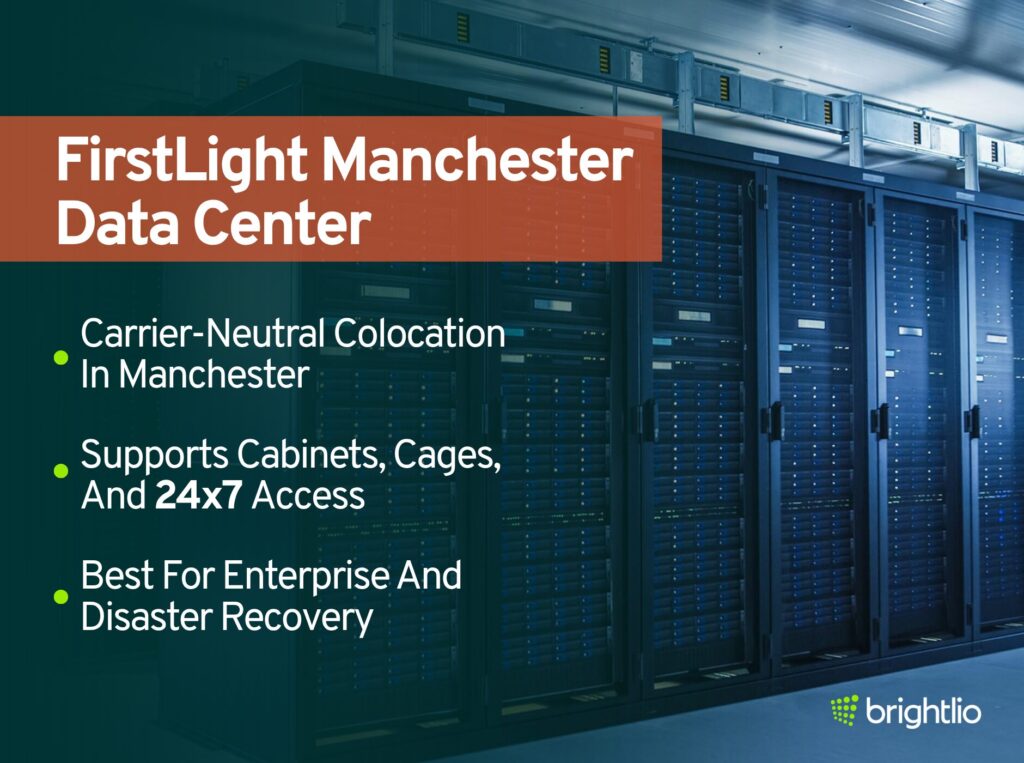
The facility is carrier-neutral and supports redundant internet connectivity, private line services, UPS protection, generator backup, environmental monitoring, and access controls. Manchester’s location gives customers practical access to Boston, Nashua, Concord, and the broader Northern New England market.
This facility is a strong fit for organizations that need a production or secondary site in southern New Hampshire with access to regional fiber and managed infrastructure services.
2. FirstLight Bedford Data Center
FirstLight’s Bedford data center at 8 Commerce Drive is one of the most active facilities in New Hampshire. The 2026 expansion added 25% more space and supported up to 100 additional racks, along with added power and cooling infrastructure.
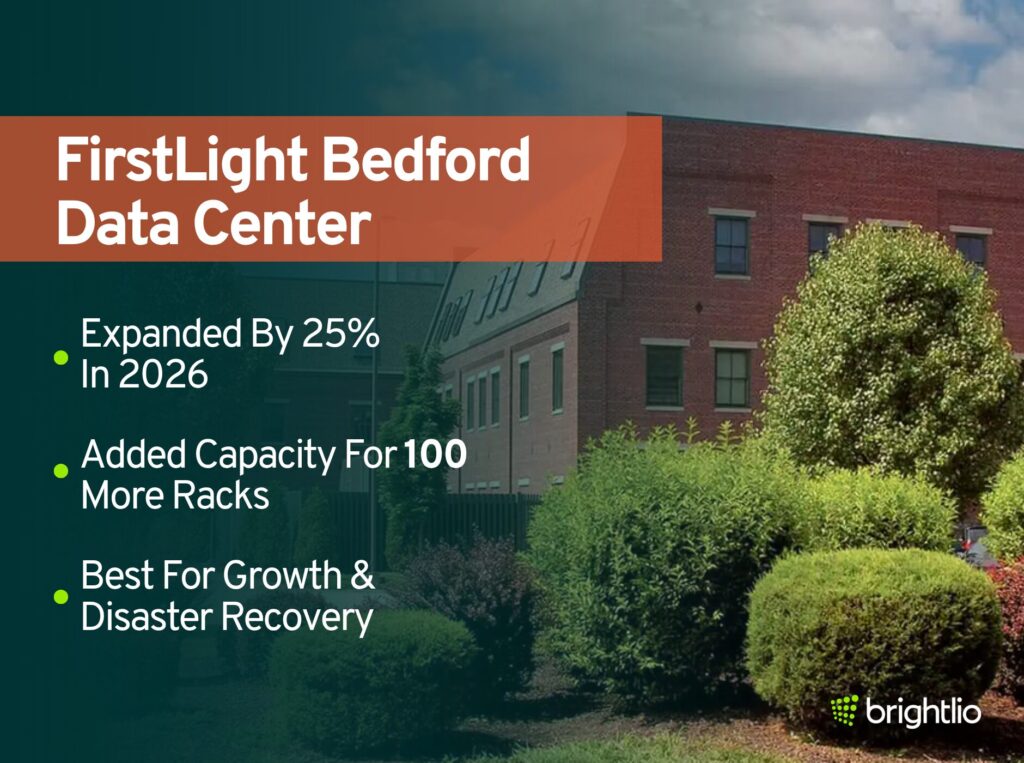
The Bedford facility supports cabinets, private suites, and caged environments for customers that need dedicated space and controlled access. The site connects into FirstLight’s broader fiber network, which helps customers reach Boston, regional cloud access points, and private network destinations.
Bedford is best suited for organizations that want a Manchester-area colocation site with room for growth. It is especially relevant for managed service providers, healthcare organizations, financial services firms, and enterprises planning disaster recovery in New England.
3. FirstLight Portsmouth Data Center
FirstLight’s Portsmouth data center at 359 Corporate Drive serves the New Hampshire Seacoast. It offers a regional option for businesses that need local infrastructure close to Portsmouth, Dover, Rochester, southern Maine, and northeastern Massachusetts.
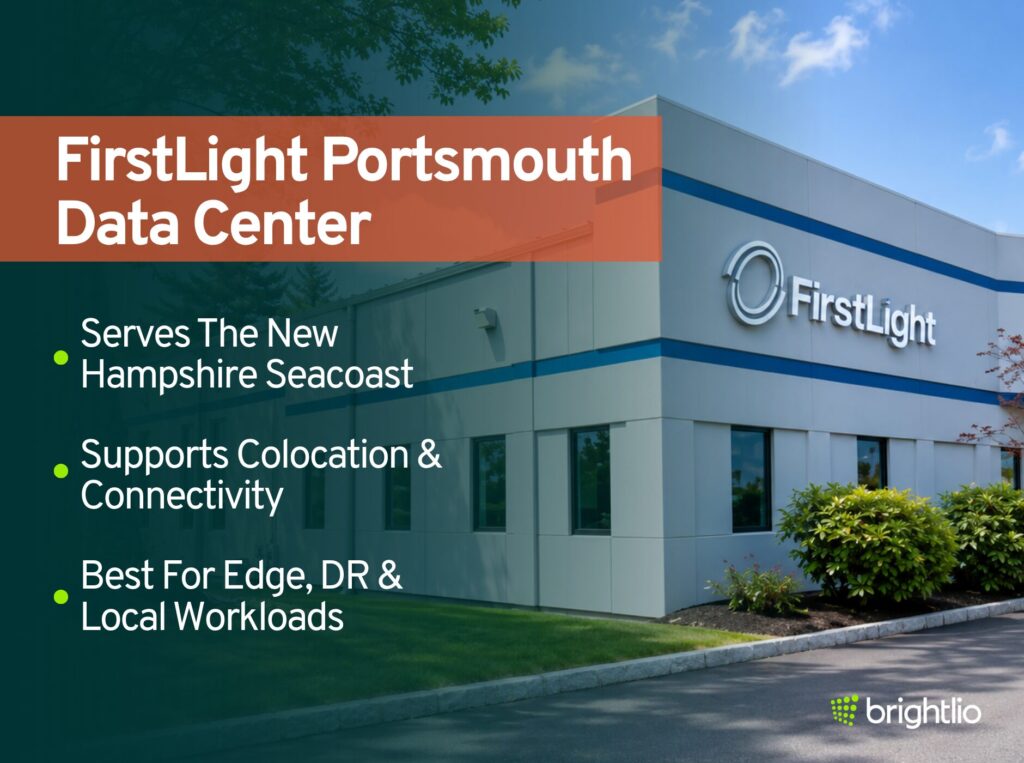
The facility supports colocation and connectivity services for organizations that need a smaller Northeast footprint. Portsmouth can work well for disaster recovery, branch infrastructure, edge systems, and application hosting tied to Seacoast operations.
Buyers should evaluate route diversity, coastal storm planning, remote hands support, and connections into Boston or other regional hubs before selecting Portsmouth as a primary production site.
4. FirstLight Keene Data Center
FirstLight’s Keene data center at 310 Marlboro Street supports western New Hampshire. It gives local organizations a colocation option without requiring all infrastructure to sit in Manchester, Boston, or Albany.
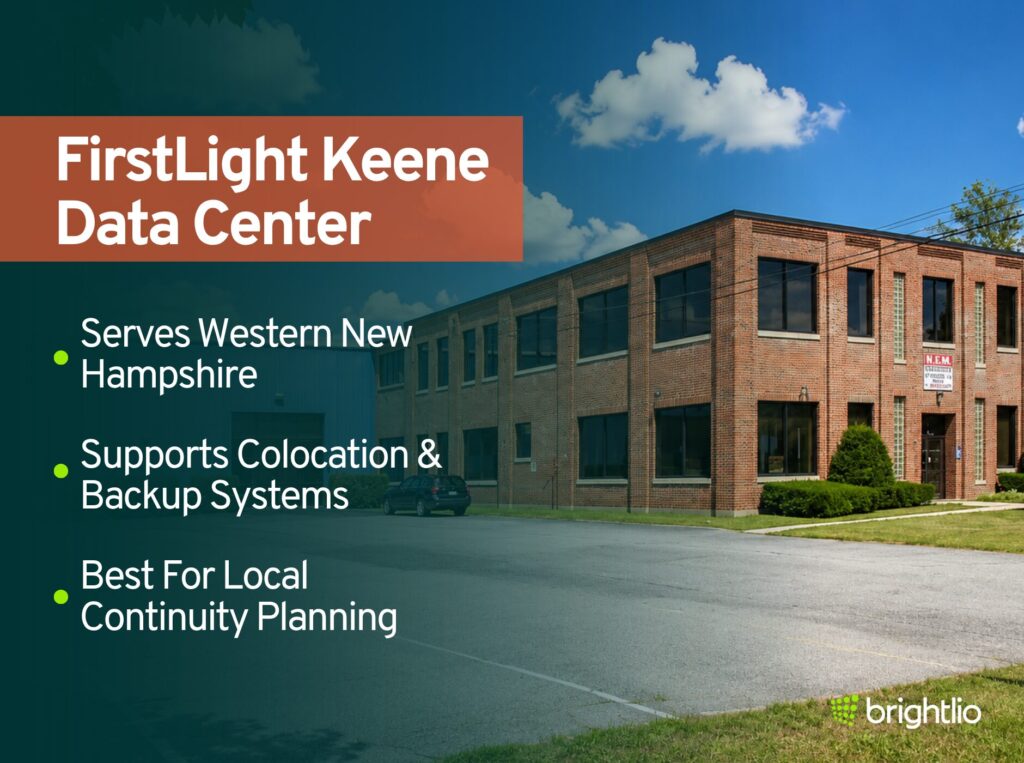
The Keene facility is best suited for modest deployments, regional backup systems, and enterprise continuity planning. Organizations with offices, campuses, clinics, or manufacturing sites in western New Hampshire can use Keene as a practical nearby infrastructure location.
Keene is not a large hyperscale submarket, so buyers should confirm power density, cabinet availability, network carriers, and managed service options before placing mission-critical workloads there.
5. FirstLight Lebanon Data Center
FirstLight’s Lebanon data center at 16 Cavendish Court supports the Upper Valley region. The location is relevant for healthcare, research, education, life sciences, and local enterprise needs tied to Lebanon, Hanover, and surrounding communities.
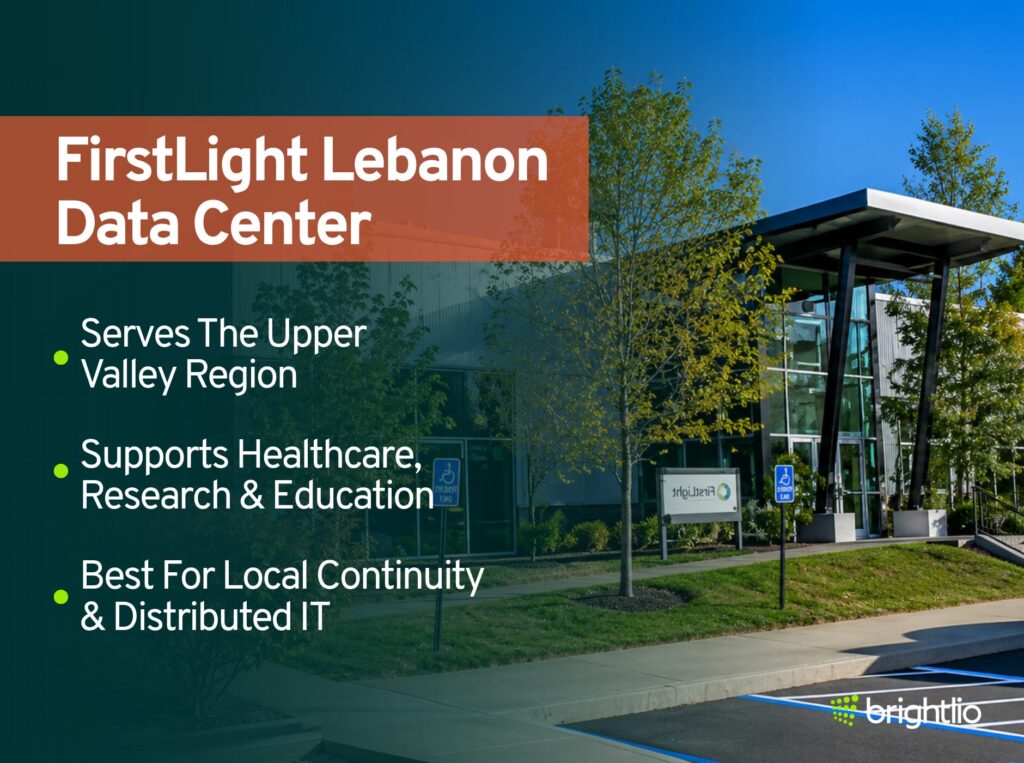
Lebanon can help organizations keep infrastructure close to regional operations while reducing dependence on larger metro sites. It can support continuity planning, remote office infrastructure, local application hosting, and smaller production environments.
This site is best evaluated as part of a distributed architecture. Many organizations will pair Lebanon with Manchester, Bedford, Boston, or another larger regional data center to achieve stronger redundancy.
6. Consolidated Communications And Crown Castle Fiber Manchester Assets
Manchester includes additional network and data center assets associated with Consolidated Communications and Crown Castle Fiber. These assets contribute to the city’s role as New Hampshire’s primary connectivity hub.
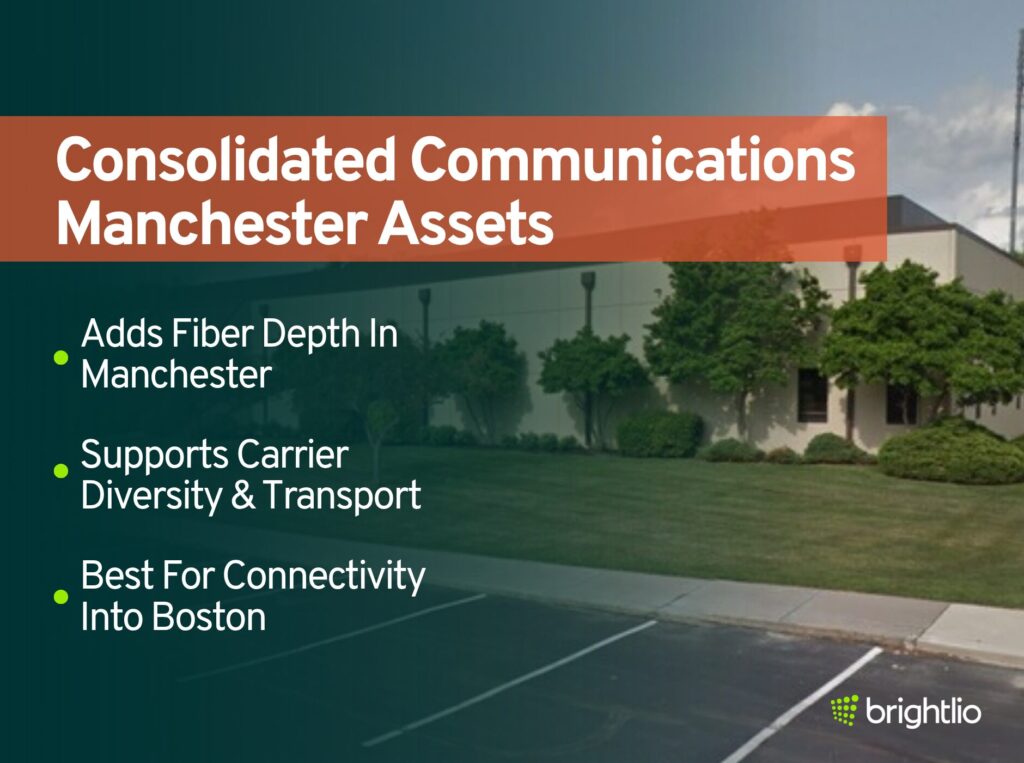
For colocation buyers, the practical value is carrier diversity and fiber availability. Network-rich sites can support private connectivity, internet transit, business continuity, and transport into Boston or other interconnection markets.
Organizations should confirm whether a given location offers retail colocation, network-only services, cross-connect options, service level agreements, and the exact redundancy profile before treating it as a production data center option.
Request A New Hampshire Colocation Quote
Recent Developments In New Hampshire (Last 12 To 24 Months)
- March 2026 – FirstLight expands Bedford data center: FirstLight announced an expansion of its Bedford facility, adding 25% more space and capacity for up to 100 additional racks. The project strengthened Bedford’s role as one of New Hampshire’s most active colocation locations.
- May 2026 – Nottingham proposal draws public attention: A proposed data center concept in Nottingham generated local debate over power use, water, noise, land use, and the town’s rural character. The project remained early-stage, with no confirmed tenant publicly identified.
- April 2026 – Data center incentive legislation did not advance: New Hampshire was among the states that considered data center-related incentive activity in 2026, but the proposed framework did not move forward. Buyers should rely on the state’s general tax advantages rather than a dedicated data center exemption program.
- March 2026 – Broadband performance remains a state priority: New Hampshire continued to rank strongly in broadband availability and performance discussions, with fiber providers expanding high-speed services in selected markets. This supports the broader connectivity environment for business infrastructure.
- March 2026 – Electricity rates remain a planning constraint: The EIA’s March 2026 data showed New Hampshire commercial power prices at 22.02¢/kWh. That reinforces the need to compare power terms, committed capacity, cooling design, and long-term rate exposure during colocation sourcing.
- 2025 to 2026 – Statewide data center policy discussion grows: New Hampshire’s small data center market received more attention as lawmakers, local officials, and residents evaluated how larger facilities could affect power demand, local permitting, tax revenue, and community character.
How Brightlio Can Help With Colocation In New Hampshire
Brightlio helps organizations compare colocation providers across New Hampshire and the broader Northeast. Our team can compare facilities in Manchester, Bedford, Portsmouth, Keene, Lebanon, and nearby Boston-area markets to find the best fit for power, latency, compliance, budget, and resilience requirements.
We help clients assess providers, validate redundancy claims, compare pricing, review contract terms, plan cross-connects, and design private connectivity into cloud and regional network hubs. For New Hampshire deployments, we pay close attention to power cost, carrier availability, cloud access, generator runtime, winter storm readiness, and expansion rights.
Contact Brightlio to plan a resilient and cost-effective New Hampshire colocation strategy that fits your production, disaster recovery, and regional connectivity needs.
Which U.S. State Has The Most Data Centers?
Virginia has the largest concentration of data centers in the United States.
Northern Virginia, especially the Ashburn area, leads because it has dense fiber networks, major cloud infrastructure, reliable interconnection options, and a long-established data center development ecosystem. The region is widely known as Data Center Alley and remains the benchmark for large-scale U.S. data center concentration.
Who Is Building Data Centers In New Hampshire?
FirstLight is the most visible active data center operator expanding in New Hampshire.
The company operates multiple facilities in the state and expanded its Bedford data center in 2026. A separate proposed project in Nottingham drew public attention in 2026, but that concept remained early-stage and did not have a publicly confirmed hyperscale tenant. Manchester has additional network and data center assets associated with Consolidated Communications and Crown Castle Fiber.
New Hampshire does not currently show the same publicly confirmed hyperscale campus activity seen in states such as Virginia, Georgia, Ohio, Texas, or Alabama. The state’s current market is better described as a regional colocation and connectivity market rather than a large hyperscale construction market.
Why Are People Protesting Against Data Centers?
People protest against data centers because large facilities can affect power demand, water use, noise, land use, utility planning, and local tax policy.
In New Hampshire, public concern has focused on whether proposed projects would fit rural communities, how much electricity they would require, whether cooling systems would affect water resources, and whether tax benefits would justify the land use. Residents in smaller towns may view large data center proposals differently than communities that already have industrial parks, major utility infrastructure, and large commercial development.
Common concerns include high electricity demand, generator noise, cooling equipment noise, land clearing, water consumption, visual impact, and a limited number of permanent jobs compared with the size of the facility. Strong project review usually requires clear information about power sourcing, backup generation, cooling design, sound levels, traffic, tax impact, and long-term community benefits.

Tamzid is a cybersecurity researcher with 5+ years of experience across SaaS, security, compliance, data centers and cloud. He writes for brightdefense.com and hipaasimple.com, covering security, compliance, and infrastructure topics. Certified through Cisco, Fortinet (NSE 1), and the Basel Institute on Governance in OSINT, he grounds his work in primary sources and verified data.
Recent Posts
Data Centers and Colocation In Michigan

Data Centers and Colocation in Wisconsin
Data Centers and Colocation in Tennessee
Data Centers and Colocation In Nevada
Let's start
a new project together