
Oklahoma offers a fast-growing data center market for companies that need low power costs, central U.S. reach, business-friendly incentives, and access to new AI and cloud infrastructure. Tulsa and Oklahoma City anchor the state’s traditional colocation market, while Pryor, Stillwater, Muskogee County, Claremore, and Oklahoma City are attracting larger hyperscale, AI, and high-density projects.
The state’s average commercial electricity rate was 8.33¢/kWh in March 2026, far below the U.S. commercial average of 13.92¢/kWh. This power advantage matters because electricity usually drives a large share of long-term colocation and high-density compute cost. Oklahoma’s large natural gas base, strong wind generation, and central geography strengthen the state’s position for data center development.
Oklahoma is not yet as dense as the top U.S. data center markets like Northern Virginia, Dallas, Phoenix, Atlanta, Chicago, or Hillsboro. Its value is more specific. The state gives buyers a cost-effective central region for colocation, disaster recovery, AI inference, cloud infrastructure, energy-linked compute, and secondary sites outside coastal risk zones.
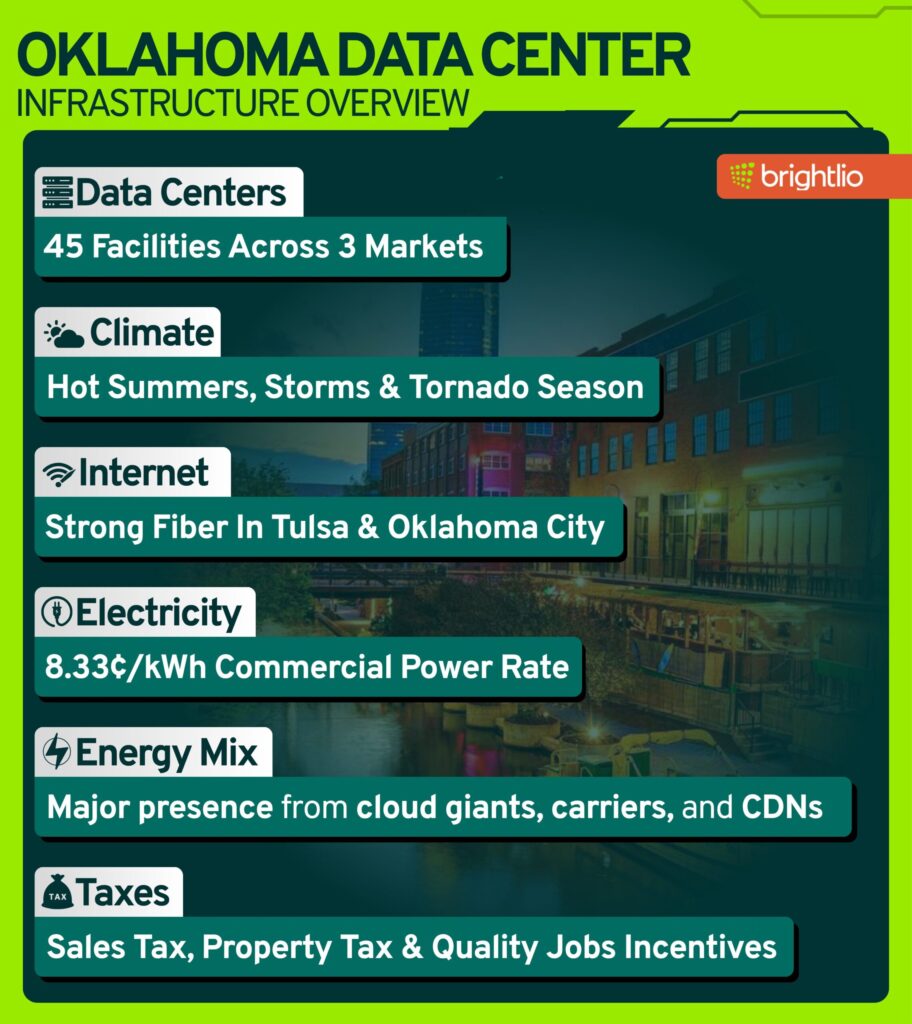
Oklahoma Data Center Infrastructure Overview
- Data centers: Oklahoma has 45 data centers across 3 markets. Tulsa leads with 31 facilities, followed by Oklahoma City with 13 and Stillwater with 1.
- Climate: Oklahoma City has hot summers, cool winters, and frequent weather swings. Cooling plans must account for heat, humidity, storms, and tornado season.
- Internet: Tulsa and Oklahoma City offer the strongest carrier and fiber options. Key providers include TierPoint, Cox Business, AT&T, Lumen, Windstream, Zayo, Dobson Fiber, TulsaConnect, and Midcon Data Services.
- Electricity: Oklahoma’s average commercial electricity rate was 8.33¢/kWh in March 2026. The average industrial rate was 5.88¢/kWh, which supports large-load and AI planning.
- Grid utilities: Major providers include OG&E, PSO, GRDA, Western Farmers Electric Cooperative, rural electric cooperatives, and municipal utilities.
- Energy mix: Oklahoma runs mainly on natural gas and wind. In 2024, natural gas supplied about half of in-state generation, while wind supplied about 41%.
- Taxes: Oklahoma offers data center sales tax exemptions, property tax exemptions for new real property investment, and Quality Jobs cash rebates.
- Disasters: Severe storms, tornadoes, hail, drought, flooding, wildfire, and winter storms are the main risks. Oklahoma has no hurricane landfall or coastal storm surge risk.
Why Colocate In Oklahoma?
Colocation in Oklahoma can lower power costs, improve central U.S. coverage, and support hybrid designs that connect to Dallas, Kansas City, Chicago, Denver, and other regional hubs.
The following factors explain where Oklahoma fits best and what buyers should review before choosing a facility.
1. Market Access And Latency
Oklahoma gives organizations a central U.S. position between Texas, Kansas, Missouri, Arkansas, and the Mountain West. Oklahoma City and Tulsa sit near major highway corridors and long-haul fiber routes that connect south toward Dallas, north toward Kansas City and Chicago, east toward Arkansas and St. Louis, and west toward Denver.
Oklahoma City works well for disaster recovery, regional application hosting, healthcare workloads, financial services, public sector systems, and companies with users across the Southern Plains. Tulsa supports enterprise colocation, energy-sector workloads, telecom aggregation, healthcare systems, and regional business continuity.
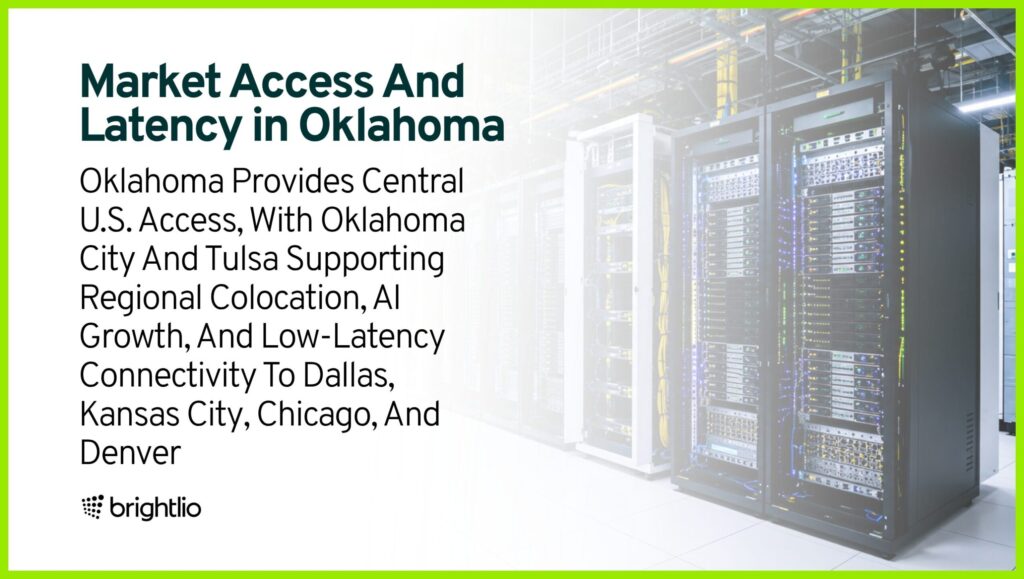
The state is gaining more AI relevance because of Google’s Pryor and Stillwater activity, Cerebras’ Oklahoma City AI data center, CloudBurst’s Oklahoma City campus plan, and proposed large-scale development in Claremore and Muskogee County. These projects place Oklahoma in a stronger position for AI inference, cloud services, and high-density compute.
Oklahoma is not a major public cloud region in the same way Northern Virginia, Oregon, Iowa, Texas, or Ohio are. Many buyers will still pair Oklahoma colocation with private transport to Dallas, Kansas City, Chicago, or other cloud and peering hubs.
2. Network Connectivity And Peering
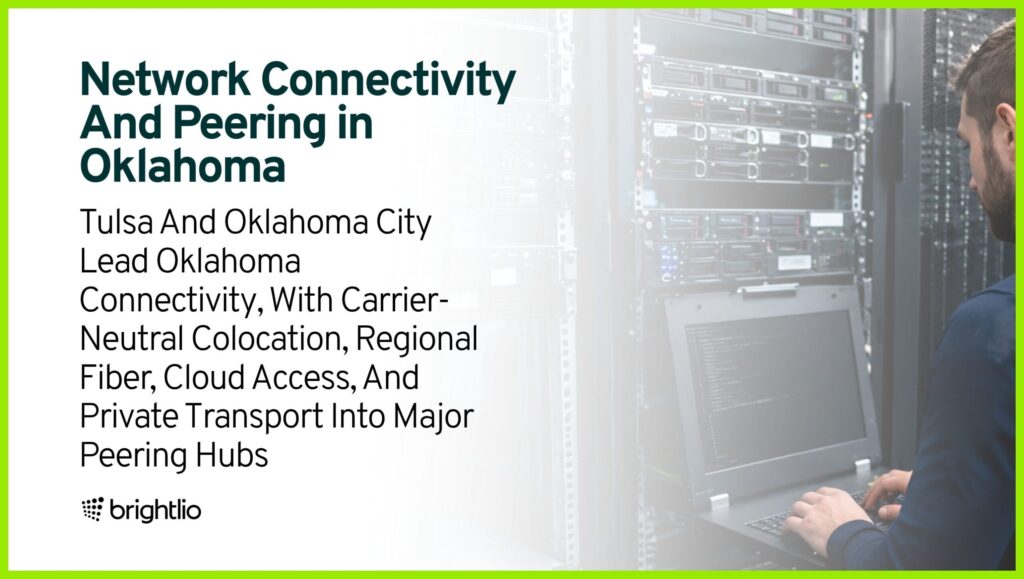
Tulsa and Oklahoma City have the strongest network depth in the state. TierPoint operates multiple carrier-neutral data centers in Oklahoma and connects its Oklahoma City and Tulsa sites into its broader national data center network. Tulsa has a larger facility count, while Oklahoma City has a stronger mix of enterprise colocation, AI infrastructure, and data center campus activity.
Carrier options vary by site. TierPoint facilities provide carrier-class, carrier-neutral access, multiple fiber paths, cloud fabrics, and cloud on-ramp options.
TulsaConnect’s Oklahoma City facility lists environmental monitoring, precision cooling, a dedicated 1200A 3-phase power feed, UPS systems, and onsite generation. RACK59 emphasizes fiber connectivity, redundant power, layered security, and managed services.
Oklahoma does not have the peering density of Dallas, Chicago, Ashburn, Silicon Valley, or New York. That means buyers with heavy interconnection requirements should plan private transport into major internet exchange and cloud access hubs. For regional colocation, disaster recovery, private cloud, backup, managed services, and AI inference, Oklahoma can provide a strong cost and location balance.
3. Power, Cost, And Sustainability
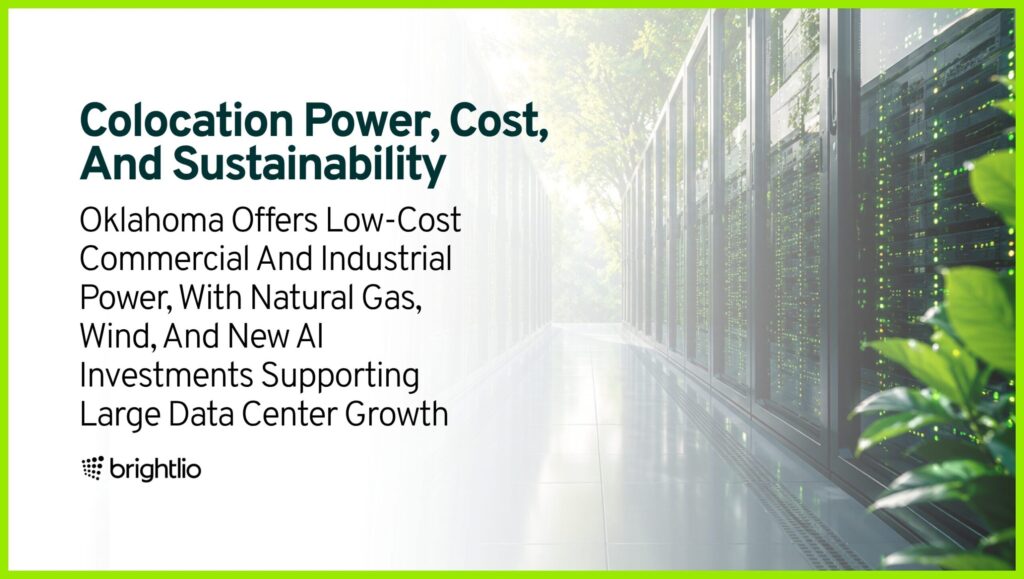
Power cost is Oklahoma’s strongest data center advantage. The state’s commercial electricity rate was 8.33¢/kWh in March 2026, and the industrial rate was 5.88¢/kWh. Large power users can benefit from lower operating costs than many coastal and northeastern markets.
Oklahoma’s energy mix is useful for large-load planning. Natural gas supplies dispatchable generation, while wind supplies a major share of renewable output. In 2024, wind supplied about 41% of Oklahoma’s in-state electricity generation. This gives the state a mix of low-cost power, renewable availability, and firm generation resources.
Google’s Oklahoma growth reflects this advantage. The company is expanding its Pryor data center and developing a new Stillwater data center campus as part of a $9 billion cloud and AI infrastructure investment in the state. Google has also tied its Oklahoma activity to energy infrastructure, workforce development, and AI education programs.
Power buyers should still review interconnection timelines, substation capacity, utility upgrade costs, demand charges, backup generation, renewable energy claims, and who pays for new transmission or distribution infrastructure. Large AI campuses can change local utility planning, so site-specific power due diligence matters.
4. Tax Policy And Incentives
Oklahoma offers tax incentives that can reduce data center project costs. The state’s data center incentive material lists sales tax exemptions for qualifying equipment and machinery purchases, including computers and servers. Web search portals and information-service data centers may qualify for a broader personal property exemption that can include electric power, computers, servers, machinery, and equipment.
The state also lists a property tax exemption on new real property investment for eligible data center operations. Personal property such as computers and servers may not qualify for the same property tax treatment, so buyers should separate real property, equipment, software, electric power, and construction costs during tax review.

Oklahoma’s Quality Jobs Program can provide a cash rebate of up to 5% of quarterly payroll for up to 10 years for qualifying companies that create new jobs and meet payroll and wage thresholds. This incentive may support larger operators, AI campuses, and facilities with meaningful technical, operations, and construction employment.
The incentive picture is useful, but it is not automatic. Qualification depends on NAICS classification, out-of-state revenue, payroll, wage thresholds, job creation, project type, local agreements, and state approval. Data center buyers should review incentives with tax counsel, the Oklahoma Department of Commerce, local economic development officials, and utility partners before final site selection.
5. Workforce And Ecosystem
Oklahoma has a practical technology and industrial workforce for data center operations. Oklahoma City supports energy, aviation, healthcare, bioscience, government, finance, and technology employers.
Tulsa supports energy, aerospace, manufacturing, telecom, healthcare, cybersecurity, and logistics demand. Stillwater connects to Oklahoma State University, while Norman connects to the University of Oklahoma.
Google’s 2025 announcement included workforce development tied to the electrical training ALLIANCE, with funding intended to increase Oklahoma’s electrical workforce pipeline by 135%.
This matters because data center growth depends on electricians, fiber technicians, mechanical contractors, controls engineers, facility technicians, security staff, and operations teams.

Oklahoma’s unemployment rate was 4.0% in April 2026. That gives the state more labor availability than some very tight data center markets, but large AI campuses and hyperscale builds still need early planning for construction trades, utility work, commissioning teams, and long-term facility staff.
Workforce strength is strongest around Oklahoma City and Tulsa. Smaller markets such as Claremore, Pryor, Stillwater, and Muskogee County may need regional staffing plans, contractor partnerships, remote monitoring, and clear service-level commitments.
6. Risk And Resiliency
Oklahoma’s main resilience challenge is severe weather. NOAA data shows severe storms dominate the state’s billion-dollar disaster history, with drought, flooding, wildfire, freeze events, and winter storms also present. Tornadoes, hail, straight-line winds, and intense thunderstorms should be part of every site review.
Modern Oklahoma data centers address these risks through reinforced structures, redundant power, onsite generators, UPS systems, fire suppression, security controls, and multiple carrier routes.
TierPoint’s Oklahoma City facilities use A-side and B-side power distribution, multiple standby generators, minimum 48-hour runtime, and 100% uptime SLAs. TierPoint’s Tulsa facilities use similar redundancy, carrier-neutral access, and audited compliance controls.

Oklahoma has no coastal storm surge risk and no direct hurricane landfall risk.
That makes the state useful for multi-site disaster recovery designs that need physical separation from Gulf Coast, Atlantic Coast, and West Coast hazards.
Earthquake risk exists in parts of Oklahoma, but it is not the same primary site-selection issue as severe storms.
Buyers should evaluate tornado hardening, roof design, hail protection, floodplain status, generator runtime, fuel contracts, utility route diversity, carrier path diversity, and staff access during severe weather. Facilities serving healthcare, financial services, public sector, and high-density compute workloads should use multi-site architectures rather than rely on one Oklahoma location.
Request An Oklahoma Colocation Quote
Key Cities Or Submarkets In Oklahoma
Oklahoma’s data center market is concentrated in Tulsa, Oklahoma City, and Stillwater, with major development interest extending into Pryor, Muskogee County, and Claremore. The following submarkets show where capacity, connectivity, and project activity are most visible.
1. Tulsa
Tulsa is Oklahoma’s largest listed data center market by facility count. DataCenterMap lists 31 Tulsa data centers, which makes it the state’s primary market for facility count and regional colocation options.
TierPoint operates two notable Tulsa facilities. The Archer Street data center has more than 36,000 total sq ft and more than 4,000 sq ft of raised floor space.
The State Farm Boulevard facility has more than 32,000 total sq ft and more than 16,000 sq ft of raised floor space. Both facilities provide carrier-neutral connectivity, redundant power, security controls, remote hands, and compliance support.
Tulsa is best for energy-sector companies, healthcare systems, regional enterprises, telecom aggregation, disaster recovery, and businesses that need northeastern Oklahoma access. The city also benefits from proximity to Pryor, Claremore, and Muskogee County, where larger AI and hyperscale projects are active or proposed.
2. Oklahoma City
Oklahoma City is Oklahoma’s strongest enterprise colocation and AI-adjacent market. DataCenterMap lists 13 Oklahoma City data centers, and the market includes TierPoint, RACK59, TulsaConnect, Scale Datacenter, Cerebras-linked infrastructure, CloudBurst’s planned campus, and other facility operators or network assets.
TierPoint operates two Oklahoma City facilities on Perimeter Center Place. One facility has more than 22,000 total sq ft and more than 14,000 sq ft of raised floor space. The second has more than 69,000 total sq ft and more than 34,000 sq ft of raised floor space. Together, TierPoint’s Oklahoma footprint spans about 130,000 sq ft across Oklahoma City and Tulsa.
Oklahoma City is best for enterprises that need colocation, private cloud, disaster recovery, backup, managed services, compliance-sensitive hosting, and central U.S. connectivity. It is also becoming more relevant for the AI colocation market because Cerebras launched a 10 MW Oklahoma City facility in partnership with Scale Datacenters, and CloudBurst is planning a 200 MW high-density campus.
3. Pryor And Mayes County
Pryor is one of Oklahoma’s most important hyperscale data center locations because Google has operated a major campus there for years. The facility sits in Mayes County near the MidAmerica Industrial Park and is being expanded under Google’s $9 billion Oklahoma cloud and AI investment plan.
Pryor’s value comes from land availability, industrial infrastructure, utility access, and proximity to the Tulsa region. Google’s continued investment makes Pryor one of the state’s flagship data center submarkets, even though it is not a traditional multitenant colocation hub.
Pryor is best understood as a hyperscale and cloud infrastructure market. Enterprise colocation buyers should usually compare Tulsa and Oklahoma City first, then use Pryor as a marker for the state’s hyperscale credibility and energy infrastructure.
4. Stillwater
Stillwater is Oklahoma’s newest major data center growth market. Google acquired land at the intersection of Perkins and Richmond Roads for a future data center campus. The project has been described as a potential $3 billion development that could include multiple data center buildings.
Stillwater benefits from Oklahoma State University, a central northern Oklahoma location, and access to regional utility infrastructure. The city’s role in Google’s Oklahoma expansion could add technical jobs, utility investment, construction activity, and demand for electrical workforce development.
Stillwater is not yet a mature colocation hub. Its data center relevance is mostly tied to Google’s campus plan. Over time, the project could create a stronger local supply chain, power infrastructure, and technical ecosystem.
5. Muskogee County
Muskogee County is emerging as a new hyperscale development area. Google, Muskogee County, the City of Muskogee, and Port Muskogee announced plans for two new data center campuses near Summit and Council Hill. These projects are part of Google’s broader Oklahoma infrastructure expansion.
The county’s strengths include land availability, industrial sites, utility planning potential, and proximity to eastern Oklahoma transportation and energy infrastructure. Port Muskogee’s involvement signals the importance of industrial development capacity and regional economic planning.
Muskogee County is not yet a conventional colocation market. It is best evaluated as a hyperscale and large-campus opportunity tied to power, land, and long-term infrastructure development.
6. Claremore
Claremore is a proposed AI data center submarket tied to Project Mustang. Beale Infrastructure has proposed a data center development in the Claremore Industrial Park, and the project has drawn public attention and local debate.
Claremore benefits from proximity to Tulsa, industrial land, and regional utility infrastructure. The project could add tax revenue, infrastructure investment, and permanent jobs, depending on final approvals and project details.
Claremore also shows the public review challenges facing large data center developments. Residents have raised concerns about electricity demand, water, noise, infrastructure cost, land use, transparency, and community character. Buyers watching Claremore should treat it as a useful case study in local approval risk.
Notable Colocation Providers And Facilities In Oklahoma
Oklahoma has a mix of traditional colocation providers, hyperscale campuses, AI facilities, and planned high-density developments. The following providers and facilities show where the state’s most visible capacity is concentrated.
Notable Colocation Providers and Facilities in Oklahoma
Oklahoma’s main operating colocation providers are concentrated in Oklahoma City and Tulsa, with TierPoint, RACK59, TulsaConnect, MIDCON Recovery Solutions, and Lumen offering the clearest public evidence of active data center services.
1. TierPoint Oklahoma Data Centers
TierPoint operates Oklahoma data centers in Oklahoma City and Tulsa, including facilities at 4121 Perimeter Center Place and 4114 Perimeter Center Place in Oklahoma City, plus Tulsa sites at 322 E. Archer Street and 12151 E. State Farm Boulevard. TierPoint claims to be the largest commercial data center provider in Oklahoma, so that wording should be treated as a company claim. The facility type is retail colocation and hybrid IT data center services.
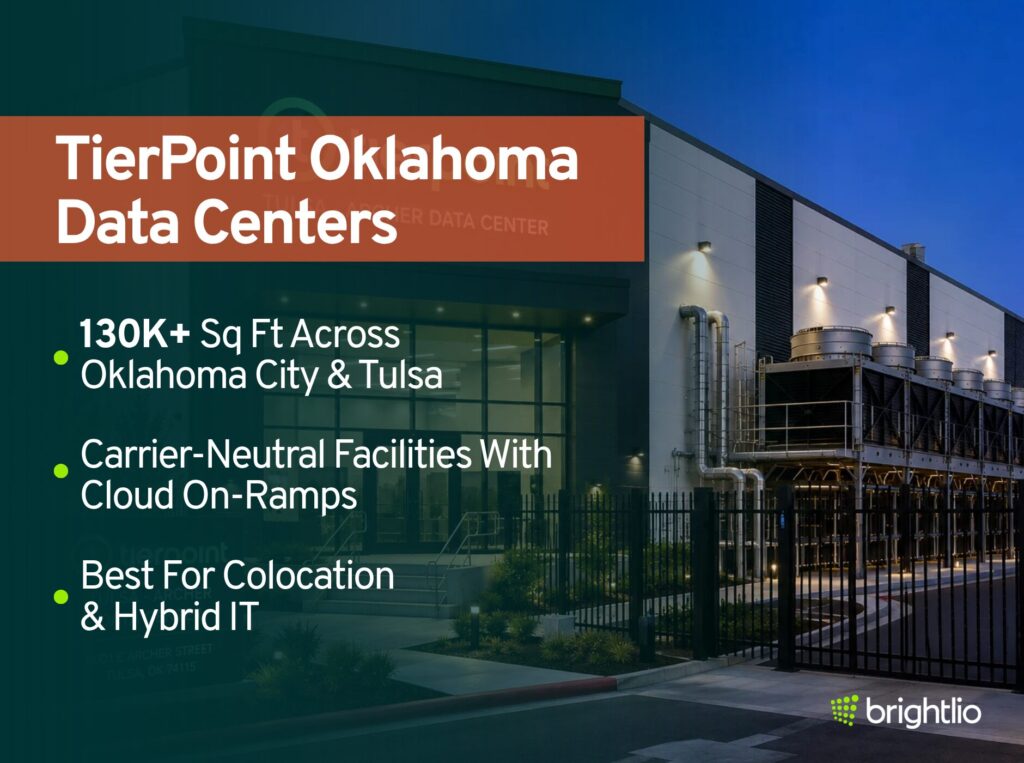
TierPoint publishes a combined Oklahoma footprint of 130,000 square feet, including 22,000+ total square feet and 14,000+ raised floor square feet at 4121 Perimeter, 69,000+ total square feet and 34,000+ raised floor square feet at 4114 Perimeter, and 36,000+ total square feet with 4,000+ raised floor square feet at Tulsa Archer.
Power capacity is not publicly published as a combined Oklahoma IT load. Cost or pricing is not publicly published. Connectivity includes carrier-neutral facilities, multiple diverse fiber access, cloud on-ramps and fabrics, and TierPoint Connect Point.
2. RACK59 Oklahoma City Data Center
RACK59 operates a data center at 7725 West Reno, Suite #304, Oklahoma City, OK 73127. RACK59 describes itself as “Oklahoma’s Premier Data Center,” so that phrase should be framed as the company’s self-description.
The facility type is retail colocation and managed data center services. Datacenters.com lists the facility at 250,000 square feet, with 15,000 square feet of raised floor space for colocation and access to 40.0 MW of power.
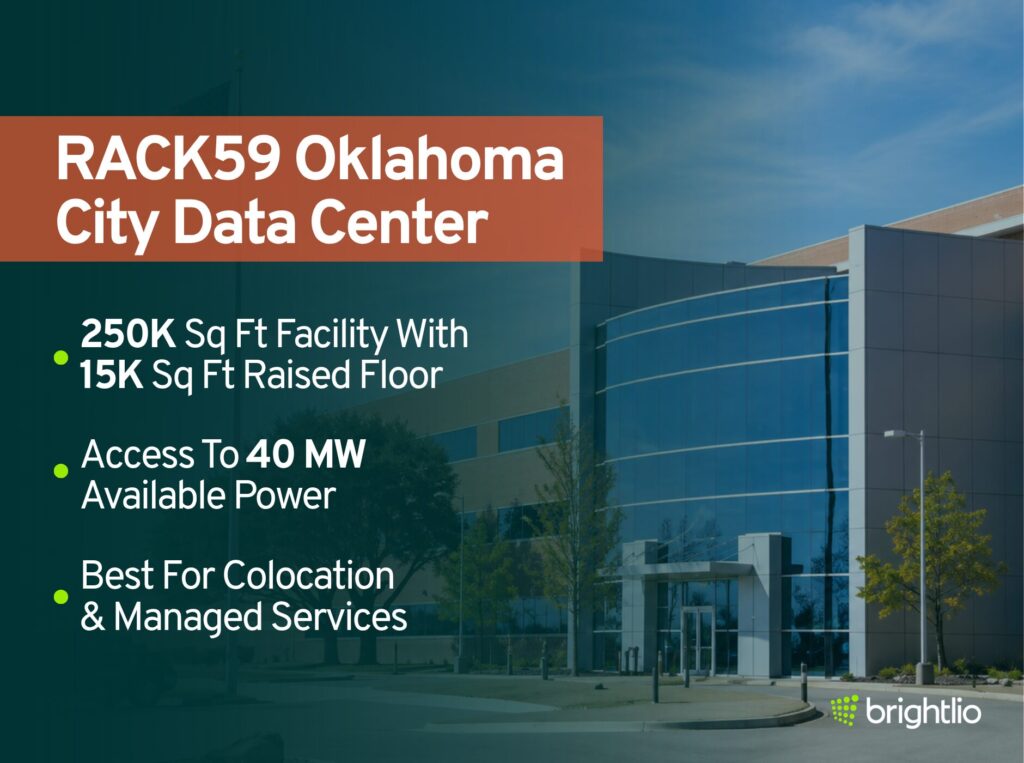
The 250,000-square-foot figure refers to the full facility or building size, while the 15,000-square-foot figure refers to raised floor space. The 40 MW figure should be described as available power or power access, not confirmed IT load.
RACK59 confirms redundant power, backup power, security controls, environmental monitoring, and fiber connectivity. Full pricing, on-net carrier lists, and cloud on-ramp details are not publicly published.
3. TulsaConnect Tulsa Data Centers
TulsaConnect operates active Tulsa data centers, including East Tulsa DC-3 and Downtown Tulsa DC-5. Datacenters.com lists East Tulsa DC-3 at 4500 S. 129th E Ave, Tulsa, OK 74134, and TulsaConnect’s contact page lists its main office at the same street address.
The facility type is retail colocation, cloud hosting, private cloud, and managed IT data center services. Power capacity is not publicly published as total IT load, but TulsaConnect confirms dual-substation electrical feeds, Eaton 9395 UPS systems, and on-site 800 kW CAT diesel generators.
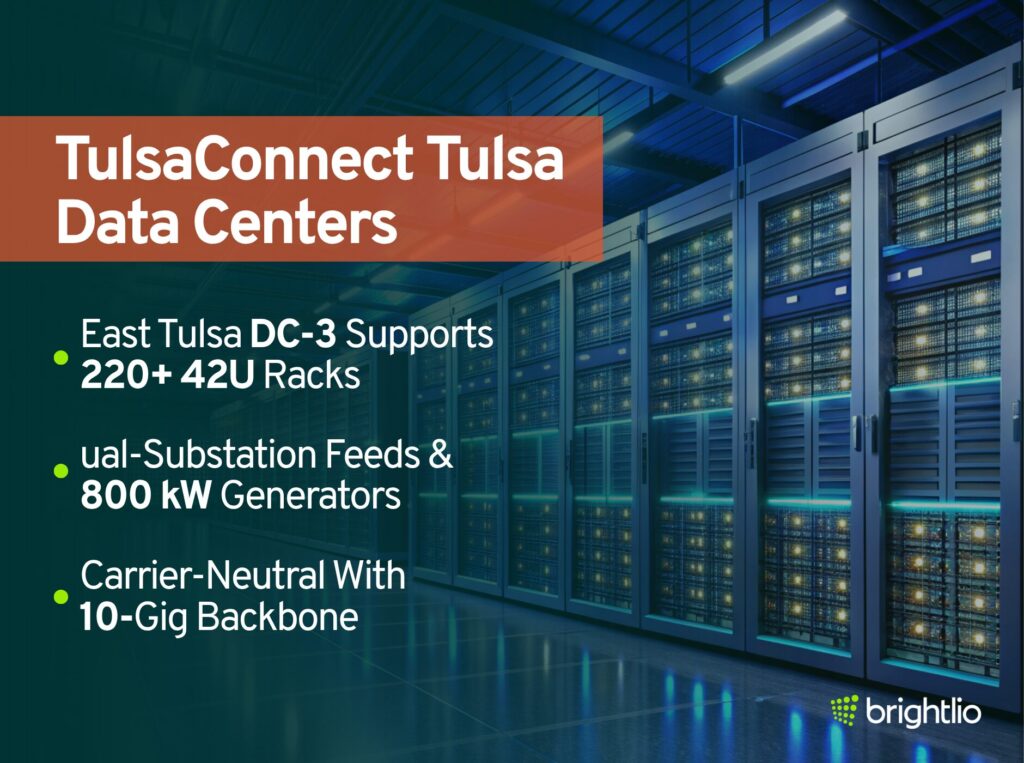
Facility size is not publicly published as total building square footage. TulsaConnect states that East Tulsa DC-3 is 16 feet underground and has 2 data center pods with capacity for up to 220+ 42U racks. Cost or pricing is not publicly published. Connectivity includes carrier-neutral service, redundant 10-Gig backbone connections from Lumen, Zayo, Cox, and Cogent, and fiber providers such as AT&T, Verizon Business, Windstream, and others.
4. MIDCON Recovery Solutions Bunkered Data Center
MIDCON Recovery Solutions operates a bunkered colocation and disaster recovery data center in Oklahoma City. MIDCON uses the phrase “F-5 bunkered tornado-proof data centers” on its official colocation page, so that wording should be presented as the company’s own language rather than a current tornado engineering rating.
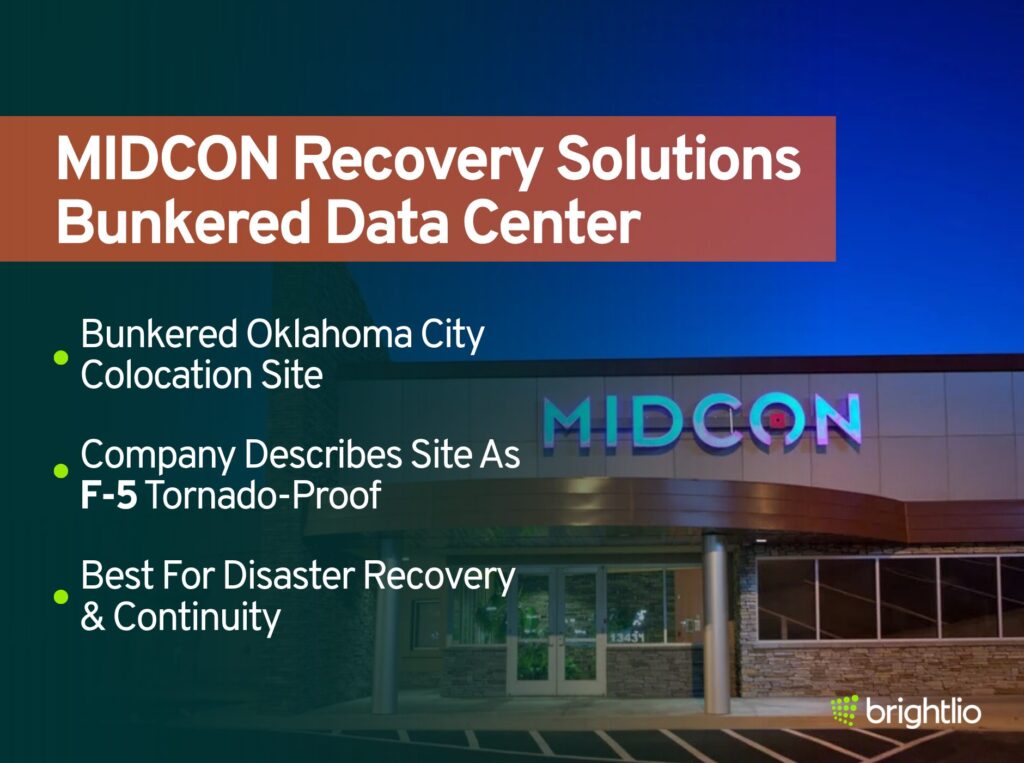
The current U.S. tornado damage rating system is the Enhanced Fujita Scale, which became operational on February 1, 2007. Power capacity, facility size, cost, pricing, carrier-neutral status, on-net carriers, cloud on-ramps, meet-me room access, fiber routes, and peering details are not publicly published on MIDCON’s official colocation page. The 14400 Bogert Parkway, Oklahoma City, OK 73134 address should be cited to third-party directory sources rather than MIDCON’s official site.
5. Lumen Tulsa 1 Data Center
Lumen has a Tulsa colocation presence, but the exact Tulsa 1 address is better supported by Datacenters.com than by Lumen’s public colocation page. Datacenters.com lists Lumen Tulsa 1 at 18 West Archer Street, Tulsa, OK, with 10,000 square feet of total space and 1,600 square feet of raised floor space for colocation.
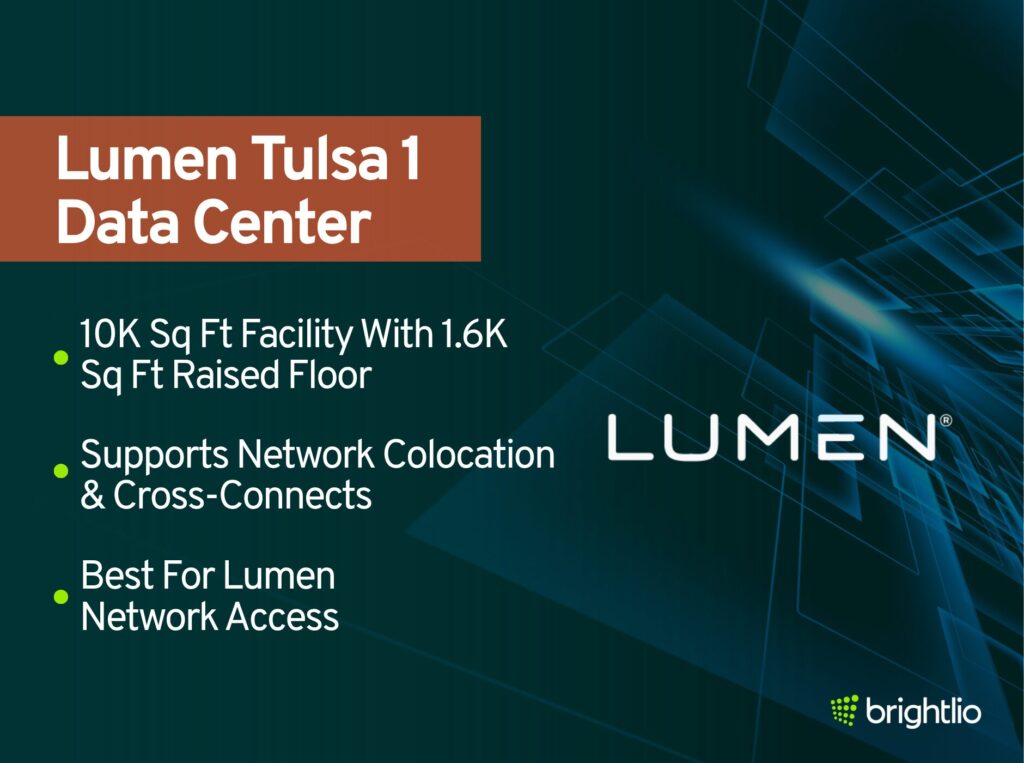
This is a network colocation and data center colocation. Power capacity, cost, and pricing are not publicly published for this specific facility.
Connectivity includes Lumen network colocation, cross-connects, AC and DC power options, 24/7 NOC monitoring, and access to Lumen’s broader network colocation services. Public Tulsa 1 details for on-net carriers, cloud on-ramps, meet-me rooms, and peering are not publicly published.
6. Google Pryor Data Center
Google’s Pryor data center campus in Mayes County is Oklahoma’s most established hyperscale facility. The site has operated for years and is being expanded under Google’s additional $9 billion Oklahoma investment.
The Pryor campus shows why Oklahoma appeals to hyperscale operators. The state offers lower power costs, industrial land, energy infrastructure, tax incentives, and access to workforce training partnerships.
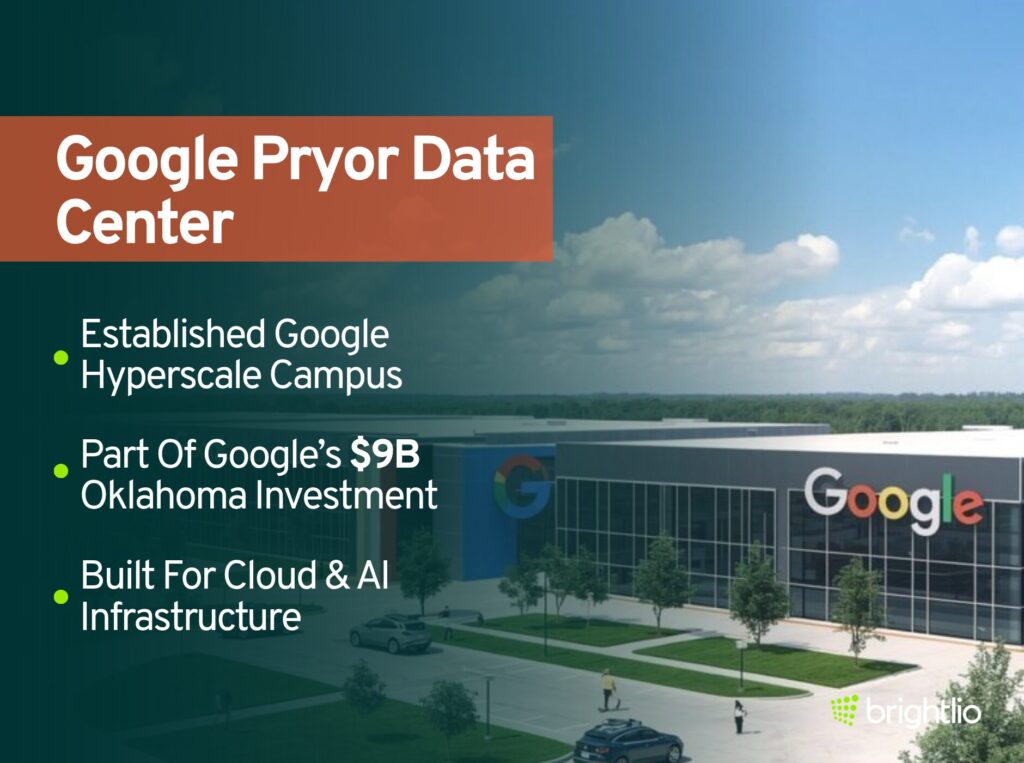
Google’s continued spending places Oklahoma among the more visible central U.S. cloud and AI infrastructure states.
The Pryor facility is not a retail colocation site for standard enterprise cabinets. Its importance is strategic because it proves Oklahoma can support large cloud infrastructure and long-duration hyperscale investment.
7. Google Stillwater Data Center Campus
Google is developing a new data center campus in Stillwater as part of its Oklahoma expansion. The project is tied to land at Perkins and Richmond Roads and has been described as a potential multi-building campus with major capital investment.
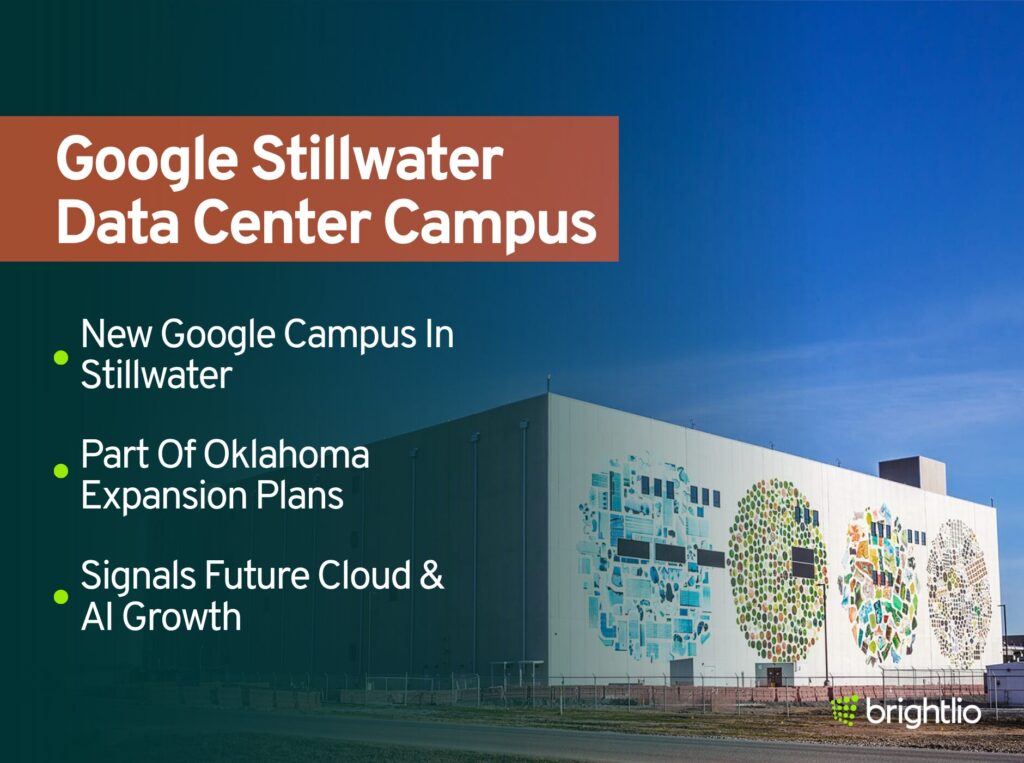
Stillwater gives Google access to a university market, regional land, and power infrastructure outside Tulsa and Oklahoma City. The project could become one of the largest economic development projects in the city’s history.
For colocation buyers, the Stillwater campus matters because it signals future growth in power infrastructure, construction capacity, technical workforce development, and AI-related demand across north-central Oklahoma.
8. Cerebras Oklahoma City AI Data Center
Cerebras launched a 10 MW AI data center in Oklahoma City in partnership with Scale Datacenters. The facility is tied to Cerebras CS-3 systems and AI inference infrastructure. This project is important because it moves Oklahoma City beyond standard enterprise colocation into high-density AI infrastructure.
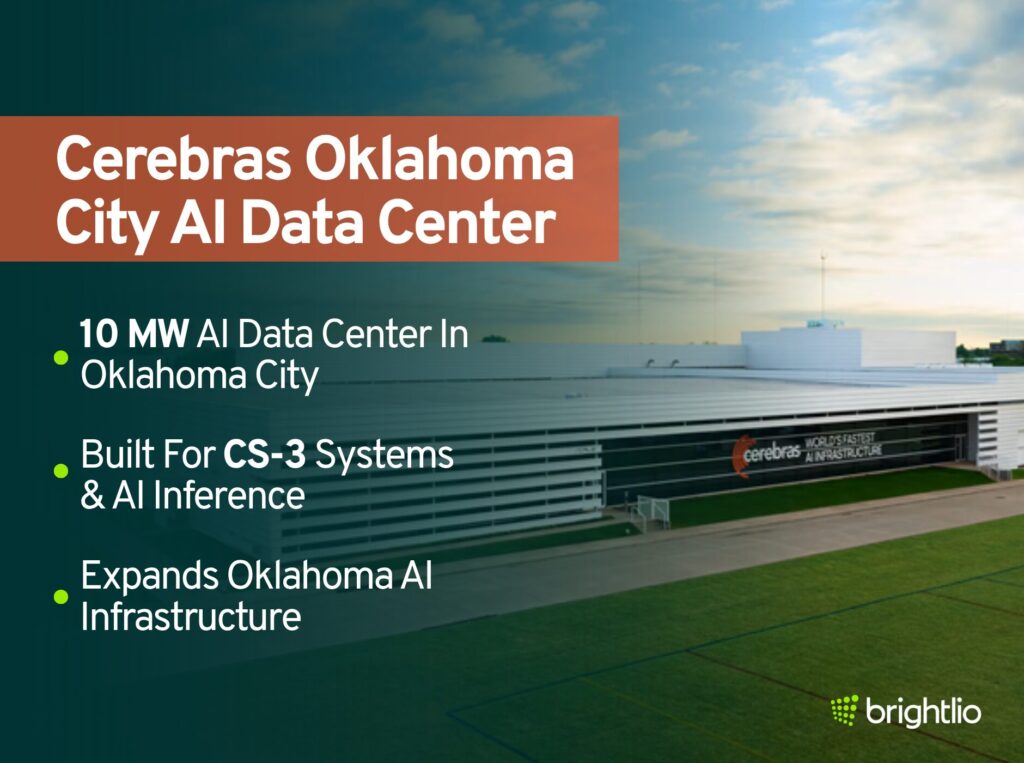
AI inference workloads need dense power, specialized cooling, high-speed networking, and operational support that differs from conventional cabinet-based colocation.
Cerebras Oklahoma City is best understood as specialized AI infrastructure rather than general retail colocation. Its presence signals that Oklahoma can attract advanced compute workloads when power, facility design, and project economics fit.
9. CloudBurst Oklahoma City Campus
CloudBurst is planning a high-density Oklahoma City campus with a 200 MW long-term target. The company lists a Q4 2025 groundbreaking, 30 MW ready-for-service target in Q4 2026, behind-the-meter design, N+1 redundancy, two fiber providers, and approximately 2 ms latency to Dallas.
CloudBurst positions the site for AI and high-density compute clients. The company’s planning materials describe a 70-plus acre site and a modular design approach.
CloudBurst matters because it could add a large high-density footprint to Oklahoma City. Buyers should review construction progress, grid power availability, behind-the-meter design, power contracts, cooling systems, tenant model, and fiber paths as the campus develops.
10. Beale Infrastructure Project Mustang In Claremore
Beale Infrastructure is leading Project Mustang, a proposed data center project in Claremore Industrial Park. The project has drawn local attention because of its potential scale, infrastructure needs, and public approval process.
The project is described as a long-term infrastructure investment with planned data center buildings, support infrastructure, and office space. Claremore officials have presented the project as an economic development opportunity, while residents have raised concerns about power, water, noise, transparency, and community effects.
Project Mustang is not yet a mature operating colocation option. It belongs in Oklahoma’s pipeline because it shows where AI-driven development may expand next near Tulsa.
Recent Developments In Oklahoma
- August 2025: Google announced an additional $9 billion investment in Oklahoma over the next two years for cloud and AI infrastructure. The plan supports a new Stillwater data center campus, expansion of the Pryor facility, and workforce development programs.
- September 2025: Cerebras launched a 10 MW AI data center in Oklahoma City in partnership with Scale Datacenters. The facility supports high-density AI inference and supercomputing workloads.
- November 2025: Stillwater’s data center project moved forward after planning approvals tied to Google’s new campus. The project is expected to support Google’s Oklahoma AI and cloud infrastructure expansion.
- November 2025: Google announced two data center campuses in Muskogee County near Summit and Council Hill. The projects add another eastern Oklahoma data center growth area to Google’s state footprint.
- Q4 2025: CloudBurst listed a planned Oklahoma City campus groundbreaking, with a 30 MW ready-for-service target for Q4 2026 and a long-term 200 MW campus plan.
- 2026: Claremore’s Project Mustang proposal continued to draw public attention, with residents debating power, water, noise, transparency, and community impact tied to Beale Infrastructure’s proposed AI data center development.
- March 2026: EIA data showed Oklahoma’s average commercial electricity price at 8.33¢/kWh and industrial price at 5.88¢/kWh. These prices kept the state highly competitive for data center power planning.
- April 2026: Oklahoma’s unemployment rate was 4.0%, giving the state more labor availability than several tighter data center markets, while still requiring early planning for skilled trades and facility operations.
How Brightlio Can Help With Colocation In Oklahoma
Brightlio helps organizations compare Oklahoma colocation, cloud connectivity, AI infrastructure, and disaster recovery options across Tulsa, Oklahoma City, Stillwater, Pryor, Muskogee County, and nearby regional markets. We help clients assess facility fit, power pricing, carrier access, compliance needs, power density, cooling design, tax incentives, and long-term site risk.
We compare providers and projects such as TierPoint, RACK59, TulsaConnect, Google, Cerebras, CloudBurst, Beale Infrastructure, and other Oklahoma operators or developers. For Oklahoma projects, we pay close attention to commercial electricity exposure, utility agreements, generator runtime, fuel plans, storm hardening, floodplain status, carrier routes, and expansion rights.
Brightlio can support cabinet, cage, private suite, single-tenant, high-density, AI, and multi-site disaster recovery planning. Contact Brightlio to start planning a cost-effective and resilient colocation deployment in Oklahoma.
Readers who found this overview of data centers in Oklahoma useful may be interested in these regional guides covering other major U.S. data center markets.
Frequently Asked Questions
Why is Oklahoma a good data center location?
Oklahoma is a good data center location due to its energy position, central U.S. location, and lower electricity cost profile. The EIA says Oklahoma produced almost three times more energy than it consumed in 2024, and wind supplied 41% of in-state electricity generation.
Are Oklahoma electricity costs favorable for colocation?
Oklahoma electricity costs are favorable compared with many states. The EIA listed Oklahoma at 8.59 cents per kWh in April 2026, while the U.S. total average was 13.88 cents per kWh. Colocation buyers still need facility-level colocation pricing for power commits, metered use, and contract escalation.
Which cities are best for colocation in Oklahoma?
Oklahoma City and Tulsa are the main colocation markets in Oklahoma. TierPoint lists facilities in both cities, TulsaConnect operates across Tulsa and Oklahoma City, and RACK59 operates a carrier-dense data center in Oklahoma City.
Which Oklahoma colocation providers should buyers review?
Oklahoma colocation buyers should review TierPoint, RACK59, and TulsaConnect. TierPoint states that it is the largest commercial data center provider in Oklahoma, RACK59 lists 30+ on-net providers, and TulsaConnect lists rack space, SOC1 Type II audited facilities, 100% uptime SLA, and up to 10-Gig uplinks.
How does colocation improve reliability over an office server room?
Colocation improves reliability through dedicated power systems, generator backup, controlled cooling, monitored access, and carrier connectivity. TulsaConnect lists UPS and generator-backed power, 24x7x365 escorted access, remote reboot, remote server access, and optional backup and managed security services.
What connectivity is available in Oklahoma data centers?
Oklahoma data centers can offer strong carrier and fiber options, depending on the facility. RACK59 states that it is carrier-neutral with 30+ on-net providers, while TulsaConnect lists Lumen, Zayo, Cox, Cogent, AT&T, MBO Networks, MPLS, Metro Ethernet, and 10-Gig fiber interconnects between East Tulsa, Downtown Tulsa, and Oklahoma City.
Can Oklahoma colocation support compliance-sensitive workloads?
Oklahoma colocation can support compliance-sensitive workloads when the provider has audited controls. Public listings for TierPoint Oklahoma City include certifications such as HIPAA, HITRUST, ISO 27001, NIST 800-53, PCI DSS, SOC 1 Type 2, SOC 2, and SOC 2 Type 2.
Can Oklahoma colocation support AI or high-density workloads?
Oklahoma colocation can support some AI and high-density workloads, but buyers must confirm rack power and cooling limits first. RACK59 markets support for AI, HPC, and cloud computing, and TierPoint lists high-density colocation with advanced cooling options at its Tulsa Archer data center.
How does Oklahoma’s data center growth affect buyers?
Oklahoma’s data center growth makes power planning more important. OG&E filed a proposed large-load tariff for data centers and other large-load customers, and KGOU reported that Google’s planned Stillwater and Muskogee data centers are expected to reach 1.2 GW of peak power use by 2036.
Are there Oklahoma incentives for data centers?
Oklahoma has incentives that may support qualifying data center projects. Oklahoma Commerce says the Quality Jobs Program can provide quarterly cash payments up to 5% of new payrolls for up to 10 years, subject to wage, payroll, health insurance, and other requirements.
Who is the best fit for Oklahoma colocation?
The best fit for Oklahoma colocation is a company that needs uptime, regional infrastructure control, carrier access, backup, disaster recovery, or compliance support. Good candidates include healthcare, finance, manufacturing, energy, SaaS, MSP, education, and local government organizations with users or operations in Oklahoma or nearby central U.S. markets.
Who may not need Oklahoma colocation?
A company may not need Oklahoma colocation when it uses only SaaS, has no owned infrastructure, or has no regional latency or recovery need. Very small server environments may fit managed hosting or public cloud better. Large hyperscale projects may need dedicated campuses and utility agreements instead of retail colocation.

Tamzid is a cybersecurity researcher with 5+ years of experience across SaaS, security, compliance, data centers and cloud. He writes for brightdefense.com and hipaasimple.com, covering security, compliance, and infrastructure topics. Certified through Cisco, Fortinet (NSE 1), and the Basel Institute on Governance in OSINT, he grounds his work in primary sources and verified data.
Recent Posts

Data Centers In Nebraska

Data Centers In Mississippi

Data Centers In Indiana

Data Centers In Arizona
Let's start
a new project together