

Cleveland offers downtown carrier access, suburban colocation facilities, and connections to other Midwest markets. Buyers can compare providers serving different needs, from a single cabinet to larger private deployments.
Facility counts, utility costs, and tax eligibility change. This guide uses current public listings and official data where available, then explains what to confirm in a site-specific quote.

Cleveland Data Center Infrastructure Overview
- Facilities: Data Center Map lists 25 Cleveland-area locations, including nearby suburbs. Directory listings are not a count of immediately available colocation space, and facilities may be listed under more than one operator.
- Electricity: In July 2026, Ohio’s average commercial price was 14.06¢ per kWh, versus 14.53¢ nationally; Ohio’s industrial average was 10.95¢, versus 9.77¢ nationally, according to the U.S. Energy Information Administration. These statewide sector averages are not a data center tariff or a colocation quote.
- Connectivity: Carrier choice depends on the building. DataBank’s downtown CLE1 facility lists 13 on-site carriers.
- Site selection: Compare available power, cooling density, network routes, support coverage, and weather resilience for each facility.
Why Do Businesses Consider Cleveland for Colocation?
Cleveland’s healthcare, manufacturing, finance, and technology organizations create demand for local infrastructure and network services. The city also hosts the Federal Reserve Bank of Cleveland. A nearby data center can help teams that need physical access, local support, or connectivity to partners in Northeast Ohio.
Location alone does not establish a performance advantage. Ask providers for the actual carrier options, measured latency to your users and cloud platforms, and the support arrangements that matter to your workload. Colocation requirements differ between a backup deployment and a primary production site.

What Are Cleveland’s Location and Weather Considerations?
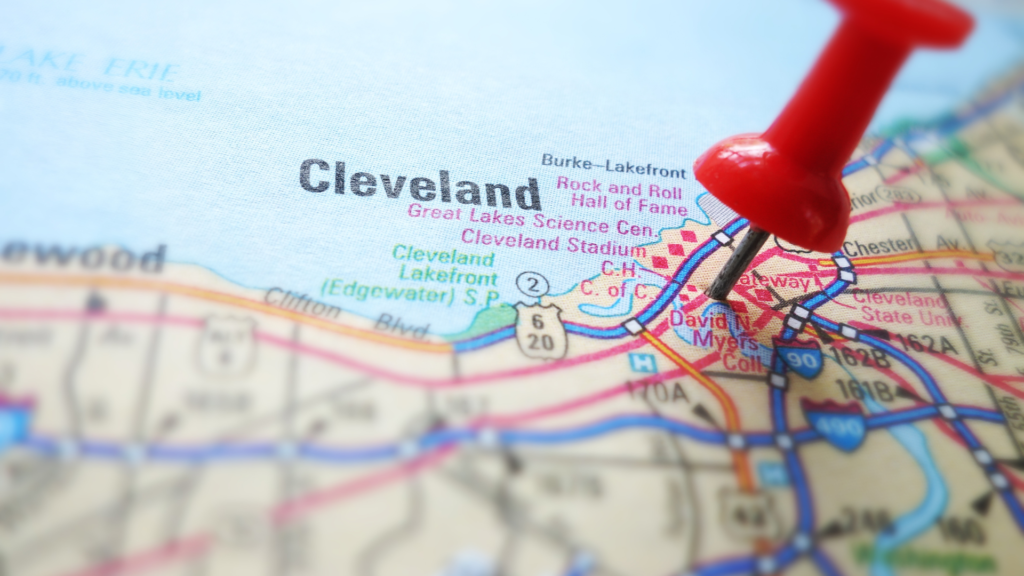
Cleveland’s position on Lake Erie connects it to regional markets, including Columbus, Chicago, Detroit, and Pittsburgh. A facility’s network routes and carrier handoffs determine latency and path diversity; geographic distance alone does not guarantee a low-latency connection.
The region is outside the coastal hurricane landfall zone, but it still faces severe weather. The National Weather Service in Cleveland identifies flooding, thunderstorms, tornadoes, lake-effect snow, extreme cold, and tropical-cyclone remnants among regional hazards. Compare flood exposure, generator and fuel arrangements, cooling redundancy, and diverse network entrances at each site.
Cooler weather can create opportunities for economizer cooling, depending on facility design and operating conditions. Ask providers for measured efficiency and the terms under which energy costs are passed through.
What Determines Cleveland Colocation Costs?
Old office-rent or residential real-estate figures cannot predict a colocation quote. The primary variables include usable space, committed power, cooling density, cross-connects, bandwidth, installation, support, and contract term.
Ohio’s July 2026 commercial electricity average was 14.06¢/kWh, slightly below the U.S. commercial average of 14.53¢/kWh. Its industrial average of 10.95¢/kWh was above the U.S. industrial average of 9.77¢/kWh. These EIA statewide averages cannot be used as a facility’s contracted rate. Compare written offers using the same power commitment and service requirements.

Do Cleveland Data Centers Qualify for Ohio Tax Incentives?
Ohio law allows the Tax Credit Authority to approve a complete or partial sales and use tax exemption for qualifying data center equipment at an eligible project. Under Ohio Revised Code section 122.175, an eligible data center project generally requires at least $100 million in qualifying capital investment within the applicable period and at least $1.5 million in annual qualifying employee compensation once the statutory timing requirement applies.
The exemption depends on an approved agreement, its scope, and the equipment and taxpayer involved. It is not a blanket 100% exemption for all providers or tenants. Local property-tax arrangements, where available, are separate and must be confirmed for a specific site. Ask the operator for its current eligibility and obtain tax advice for your transaction.

Which Cleveland Colocation Providers Should Buyers Compare?
Cleveland-area options include downtown facilities with carrier access and suburban sites with different space and power configurations. Confirm availability and technical terms with each operator before using a published specification in a procurement decision.
Expedient
Expedient operates Garfield Heights facilities in the Cleveland area. Its Garfield Heights 2 facility sheet describes a 12,500-square-foot raised-floor site. Ask Expedient for current capacity, cross-connect options, and managed service terms at the specific facility.
H5 Data Centers
H5’s downtown Cleveland facility is at 1625 Rockwell Avenue and provides colocation and network interconnection options. H5 operates the CL-IX internet exchange at the site. Confirm available suites, power density, certifications, and carrier access directly with H5.
DataBank
DataBank’s CLE1 facility at 1255 Euclid Avenue lists 7,440 IT square feet, 0.4 MW of critical IT load, and 13 on-site carriers. It offers cabinets and cages; check present capacity, cross-connect fees, and support hours when requesting a quote.
BlueBridge Networks
BlueBridge Networks offers Cleveland-area colocation and hybrid data center services. Discuss the particular site, service scope, compliance evidence, and recovery requirements with the provider rather than assuming a framework applies to every customer deployment.


How Can Brightlio Help With Cleveland Colocation?
Brightlio can help compare Cleveland-area colocation options by available space and power, carrier access, support, resilience, and total contract cost. We can coordinate related network connectivity and cloud requirements.
Contact Brightlio with your preferred location, rack or suite footprint, power demand, and connectivity needs to compare current provider quotes.

The Brightlio Team brings together experienced technology professionals with deep expertise in data centers, cloud, network infrastructure, and managed services. Through strategic insight and industry knowledge, the team delivers clear, reliable content and solutions that help businesses make informed technology decisions.
Recent Posts

Data Centers In Pennsylvania

Data Centers In Nebraska

Data Centers In Mississippi

Data Centers In Indiana
Let's start
a new project together