
Arizona is one of the largest and fastest-growing data center markets in the United States. Below-average business electricity rates and low seismic risk make the state an attractive location for businesses seeking colocation, cloud infrastructure, and capacity for demanding AI workloads.
Phoenix, Chandler, Tempe, and Mesa anchor the state’s colocation market, while cities such as Goodyear, Avondale, and Buckeye are attracting major hyperscale developments. This gives businesses a wide range of facilities to consider based on their power, connectivity, and expansion needs.
Let’s explore Arizona’s leading data centers, where they operate, and what each offers to help you find the right fit for your business.
Arizona Data Center Tracker
160data center listings
Phoenix 149Tucson 10Nogales 1
Phoenix holds 149 of Arizona’s 160 listings, and the state has paused new data center tax exemptions until June 2029.
Market Snapshot
Largest Operating Data Centers In Arizona
Arizona’s biggest operating campuses sit in Goodyear, Mesa, Chandler and Phoenix, and four of them publish 210 MW or more of campus capacity.
- Stream Data Centers Goodyear CampusGoodyear, full campus480 MWOperational
157-acre campus planned for seven buildings, with Phoenix I and II in service
- Location:
- Goodyear, Maricopa County
- Operator:
- Stream Data Centers
- Size:
- 418,200 sq ft facility on 157 acres
- Network:
- Under 2 ms to Phoenix carrier hotels, per Stream
- NTT Elliot Road CampusMesa, full campus240 MWOperational
Six-building campus designed for high-density AI workloads
- Location:
- Mesa, Maricopa County
- Operator:
- NTT DATA
- First building:
- PH1, with 36 MW of critical IT and 126,000 sq ft of data floor
- EdgeCore Mesa CampusMesa, full campus225 MWOperational
1.2 million sq ft campus, with PH01 in service and PH02 (108 MW) and PH03 (72 MW) under construction
- Location:
- Mesa, Maricopa County
- Operator:
- EdgeCore Digital Infrastructure
- PH01 size:
- 200,880 sq ft
- QTS Phoenix 2 CampusPhoenix, critical IT210 MWOperational
80-acre campus designed for more than 210 MW of critical capacity
- Location:
- Phoenix, near Sky Harbor Airport
- Operator:
- QTS Data Centers
- Buildings:
- DC1 to DC5
- CyrusOne Chandler CampusChandlerNot publishedOperational
Eight-building campus (PHX1 to PHX8) on South Ellis Street
- Location:
- Chandler, Maricopa County
- Operator:
- CyrusOne
- Design:
- Modular build commissioned in phases
- Aligned Phoenix CampusPhoenixNot publishedOperational
55-acre campus in north Phoenix, designed to Tier III standards
- Location:
- Phoenix (Deer Valley)
- Operator:
- Aligned Data Centers
- Uptime:
- 100% uptime SLA, per Aligned
- Apple Mesa Data CenterMesaNot publishedOperational
1.3 million sq ft facility with a reported $2 billion investment
- Location:
- Mesa, Maricopa County
- Operator:
- Apple
- Type:
- Enterprise, serving Apple’s own services
- Microsoft El Mirage CampusEl MirageNot publishedOperational
Home of Microsoft’s West US 3 Azure region
- Location:
- El Mirage, Maricopa County
- Operator:
- Microsoft
- Nearby:
- Second Microsoft campus in Goodyear
Largest Planned Data Centers In Arizona
Tract’s Buckeye park and Hassayampa Ranch account for 3,300 MW of the 4,645 MW shown here, though both are still land-stage projects.
- Tract Buckeye Technology ParkBuckeye, full build-out1,800 MWPlanned
2,019 acres zoned for up to 40 data centers over a 15-year build-out
- Location:
- Buckeye, Maricopa County
- Developer:
- Tract
- Investment:
- $20 billion at full build-out
- Power:
- Arizona Public Service
- Hassayampa RanchBuckeye, planned1,500 MWPlanned
2,000 acres acquired by Arizona Land Consulting for a 1.5 GW campus
- Location:
- West Buckeye, Maricopa County
- Developer:
- Arizona Land Consulting
- Nearby:
- Proposed Belmont smart city
- Project BaccaraWaddell, on-site generation700 MWApproved
Two data center buildings powered by about 700 MW of on-site natural gas generation
- Location:
- Waddell, near Surprise
- Developer:
- Takanock, LLC
- Timeline:
- Construction from Q3 2026, first building online Q1 2028
- Approval:
- Environmental certificate granted February 2026
- Prime Data Centers Phoenix CampusAvondale, critical IT240 MWUnder construction
Five 48 MW buildings with near-zero water use for cooling, per Prime
- Location:
- Avondale, Maricopa County
- Developer:
- Prime Data Centers
- Buildings:
- PHX01-01 to PHX01-05
- STACK Infrastructure PHX01 CampusAvondale, critical IT225 MWPlanned
Three buildings on a 100-acre campus
- Location:
- Avondale, Maricopa County
- Developer:
- STACK Infrastructure
- Buildings:
- PHX01A, PHX01B and PHX01C
- Menlo Digital MD-PX1Phoenix, critical IT180 MWPlanned
Five buildings with a dedicated substation of more than 257 MW
- Location:
- Phoenix (Ahwatukee)
- Developer:
- Menlo Digital
- Beale Infrastructure Project BlueMaranaNot publishedIn development
600-acre campus near Pinal Airpark Road and I-10 for cloud and AI
- Location:
- Marana area, Pima County
- Developer:
- Beale Infrastructure
- Power:
- Tucson Electric Power
Largest Colocation Facilities In Arizona
Retail colocation clusters in central Phoenix and the Chandler tech corridor, led by Iron Mountain’s 89 MW campus near Sky Harbor.
- Iron Mountain Phoenix CampusPhoenix1M+ sq ftColocation
Three buildings (AZP-1 to AZP-3) with 89 MW of capacity
- Location:
- Phoenix, near Sky Harbor Airport
- Operator:
- Iron Mountain Data Centers
- Certification:
- AZP-2 is North America’s first BREEAM design-certified data center, per Iron Mountain
- RadiusDC Phoenix I DC2Phoenix530,000 sq ftColocation
30 MW of total power capacity
- Address:
- 3221 E Elwood St, Phoenix
- Operator:
- RadiusDC (formerly PhoenixNAP)
- Digital Realty PHX15Chandler315,000 sq ftColocation
Located in Chandler’s Price Road tech corridor
- Address:
- 2121 S Price Rd, Chandler
- Operator:
- Digital Realty
- H5 Data Centers PhoenixChandler180,000 sq ftColocation
Tier III facility with up to 20 MW
- Address:
- 2600 W Germann Rd, Chandler
- Operator:
- H5 Data Centers
- Lumen Phoenix 1Phoenix47,836 sq ftColocation
AC and DC power options with generator backup
- Address:
- 811 S 16th St, Phoenix
- Operator:
- Lumen
- Expedient PhoenixPhoenix45,000 sq ftColocation
Carrier-neutral facility with redundant utility feeds and three diesel generators
- Address:
- 2475 W Townley Ave, Phoenix
- Operator:
- Expedient
- ColoBarn PhoenixTempe28,000 sq ftColocation
18,000 sq ft of raised floor for colocation
- Address:
- 8905 S Beck Ave, Tempe
- Operator:
- ColoBarn
- Raeden PhoenixPhoenix19,000 sq ftColocation
1.3 MW of available critical load with multi-carrier fiber
- Address:
- 1710 E Grant St, Phoenix
- Operator:
- Raeden
Choose a category to switch the list and highlight its sites on the map. Click any site card to find it on the map, or click a marker to jump to its card. Pins are approximate, and each MW figure carries the basis shown beside it.
Data sourced from Data Center Map, CBRE, EIA, NOAA, Tract, the City of Surprise and the Arizona Capitol Times, checked October 10, 2026. Listings count individual buildings, and the lists show the largest sites in each category.
Why Colocate In Arizona?
Arizona pairs below-average power prices with one of the deepest hyperscale pipelines in the country, though utility queues and water politics shape every deal. Six factors decide whether an Arizona deployment beats a West Coast or Texas alternative on cost, reach, and risk.
1. Market Access And Latency
Arizona gives West Coast workloads a lower-cost, lower-seismic home that still sits close to California users. Phoenix connects to Southern California, Las Vegas, Albuquerque, and Salt Lake City over long-haul fiber, which makes the metro a natural disaster recovery pair for Los Angeles and Bay Area production systems.
Inside the metro, distance barely registers. Stream rates its Goodyear campus at under 2 ms to Phoenix carrier hotels, so West Valley hyperscale sites and central Phoenix interconnection points behave like one market for most applications. A buyer can place compute in Goodyear and still cross-connect downtown without a measurable penalty.
That reach has a ceiling. Arizona covers the Southwest and Mountain West well, while users on the East Coast and in the Midwest sit behind long transport hauls to Dallas, Chicago, or Northern Virginia. Trading, gaming, and real-time media workloads aimed at those regions belong in facilities closer to their users, with Arizona handling backup and batch work.
2. Network Connectivity And Peering
Phoenix concentrates Arizona’s interconnection in a short list of carrier-dense buildings near downtown, Sky Harbor, and the Chandler tech corridor. Three exchange fabrics run in the metro. Phoenix-IX, a nonprofit exchange founded in 2012 by IOS, Hurricane Electric, and PhoenixNAP, operates a node inside EdgeConneX’s Tempe facility, while CyrusOne and Digital Realty run their own exchanges.
Carrier choice is strongest in the retail buildings. H5 Data Centers lists 10 on-net providers at its Chandler facility, with dark fiber and 100 Gbps service available, a typical profile for a carrier-neutral facility in the metro. Microsoft’s West US 3 Azure region in El Mirage gives hybrid deployments in-state cloud adjacency, which shortens the path between colocated hardware and Azure workloads.
Peering depth is the gap. Phoenix exchanges far less traffic than Los Angeles or Dallas, so content networks and large ISPs still hand off much of their traffic in those hubs. Buyers that need dense peering keep a presence in a tier-1 interconnection market and run private transport to Arizona.
3. Power, Cost, And Sustainability
Arizona’s business electricity rate averaged 12.21¢/kWh over the 12 months to July 2026, about 12% below the 13.85¢/kWh U.S. average. Palo Verde, the state’s nuclear plant, supplies roughly 27% of in-state generation, which gives Arizona a carbon-free baseload share few Sun Belt states can match. Natural gas still leads at 45%, with solar at 13%.
Energization dates decide most Arizona deals. In September 2025, Arizona Corporation Commission Chair Kevin Thompson described APS as an 8,400 MW system facing 19,000 MW of requests in its queue. Demand in that queue is more than double the system serving it, so a buyer’s real constraint is energization date.
The utilities are pricing that pressure into contracts. APS has asked regulators to raise rates for extra-large energy users, and SRP requires data centers above 20 MW to pay for 80% of forecast peak demand over 15 years. Developers are answering with their own power, led by Project Baccara’s on-site gas plant in Waddell.
Water shapes design as much as electricity does. Edged’s Mesa facility uses waterless cooling rated to save 138 million gallons a year, and Prime Data Centers claims near-zero cooling water use at its Avondale campus. Buyers comparing quotes against colocation pricing in other markets need to ask how a facility cools through a summer heat wave, because air-cooled and closed-loop systems trade water savings for higher summer power draw. Airflow discipline, including hot aisle containment, matters more in Phoenix than in almost any other U.S. market.
4. Tax Policy And Incentives
Arizona’s Computer Data Center (CDC) program is the state’s main data center incentive, administered by the Arizona Commerce Authority with tax relief handled by the Department of Revenue. A certified facility receives up to 10 years of state and local sales and use tax deductions on data center equipment, or 20 years when it qualifies as a sustainable redevelopment project. Covered equipment spans servers, networking gear, generators, UPS systems, cooling plant, and water conservation systems.
The investment thresholds depend on county size. A new data center needs $50 million of new investment within five years in a county above 800,000 residents, which covers Maricopa and Pima, and $25 million in smaller counties.
Colocation tenants share the benefit. A tenant contracting for at least 500 kW for two or more years qualifies for the same relief as the facility owner, which can strip sales tax from a large hardware refresh.
The program is now frozen to newcomers. The state stopped accepting new CDC applications on July 1, 2026, and the pause runs through June 30, 2029. Facilities certified before the freeze keep their relief, so a buyer planning a multi-megawatt deployment gets the most value from an operator whose building already holds certification. Confirming that status belongs on the first page of any Arizona RFP.
5. Workforce And Ecosystem
Arizona’s labor market is looser than most data center states right now. Unemployment reached 4.9% in July 2026, a post-pandemic high and above the 4.1% national rate, which gives operators more room to hire than in tight markets such as North Dakota.
The technical ecosystem runs deep. Arizona State University, the University of Arizona, and Northern Arizona University feed engineering and IT talent into the Valley, and the semiconductor cluster around TSMC’s Phoenix fabs and Intel’s Chandler campus anchors a large base of electrical, controls, and clean-room specialists.
That same cluster is a source of competition. Fabs and hyperscale campuses draw on the same electricians, mechanical contractors, and commissioning crews, so construction timelines in the West Valley can slip when two or three large projects peak at the same time. Retail colocation buyers feel this less: long-running Phoenix operators run staffed sites with on-call remote hands, and most metro facilities sit within a short drive of the central interconnection hubs.
6. Risk And Resiliency
Arizona’s risk profile is dominated by heat and water. Phoenix hit 118°F twice in July 2024, and sustained heat at that level derates generators, strains chillers, and pushes utility peaks to the limit during the same afternoons. Facilities in this market need cooling redundancy sized for the hottest week of the year, along with generator ratings tested at ambient temperatures above 110°F.
Drought and Colorado River shortages make water the most political part of any project. Tucson rejected the original Project Blue annexation in August 2025 largely over water concerns, and that vote reshaped how developers pitch cooling designs across the state.
The monsoon season, roughly July through September, brings flash flooding, dust storms, and lightning. Sites near desert washes need floodplain review, and rooftop equipment needs protection from blowing dust. Wildfire threatens transmission lines in the higher country more than the Valley floor.
Arizona is free of the hazards that dominate coastal markets. The state has no hurricane landfall or storm surge exposure, and its seismic risk is far lower than California’s, which is why Phoenix works as a recovery site for West Coast production.
Key Cities Or Submarkets In Arizona
Arizona’s supply splits between a mature colocation core in central Phoenix and the East Valley and a West Valley power corridor where the newest hyperscale campuses are rising. The six submarkets below run from the densest interconnection to the most speculative land plays.
1. Phoenix
Central Phoenix is the state’s interconnection and retail colocation hub, and most carrier-dense buildings sit between downtown and Sky Harbor Airport. Iron Mountain, QTS, and RadiusDC run the largest campuses near the airport and downtown, each profiled in the provider section below. Lumen Phoenix 1 offers 47,836 sq ft at 811 S 16th St, and Raeden adds 19,000 sq ft with multi-carrier fiber.
North Phoenix adds Aligned’s Deer Valley campus and Expedient’s carrier-neutral facility on W Townley Ave. Menlo Digital is planning MD-PX1 in Ahwatukee, a five-building, 180 MW project backed by a dedicated substation above 257 MW.
The Phoenix colocation market suits enterprises, managed service providers, and hybrid cloud buyers that need cross-connects, remote hands, and a short path to carrier hotels.
2. Mesa
Mesa is the East Valley’s hyperscale cluster. NTT’s six-building Elliot Road campus, profiled below, targets high-density AI tenants. EdgeCore’s 1.2 million sq ft campus reaches 225 MW at full build, with PH01 in service and PH02 (108 MW) and PH03 (72 MW) under construction.
Apple runs a 1.3 million sq ft facility in the city, and Edged opened a waterless AI data center in April 2026. Mesa’s buyers are mostly hyperscale operators, AI tenants, and wholesale users taking full halls or buildings.
3. Chandler And Tempe
Chandler and Tempe form the retail colocation corridor along Price Road and the I-10 and Loop 101 interchanges, close to Intel’s Chandler campus. CyrusOne’s eight-building campus, Digital Realty’s PHX15, and H5 Data Centers’ Tier III facility anchor the corridor, and each appears in the provider profiles below.
ColoBarn’s Tempe site adds 28,000 sq ft, with 18,000 sq ft of raised floor, for smaller footprints. EdgeConneX’s Tempe building hosts a Phoenix-IX node. This corridor suits mid-size enterprise deployments from a few cabinets to a private suite, especially for buyers that want tax-certified buildings and Chandler’s semiconductor-grade power infrastructure.
4. Goodyear, El Mirage, And Avondale
The West Valley is where Arizona’s hyperscale growth has moved. Stream Data Centers’ Goodyear campus, profiled below, already has Phoenix I and II in service on APS power delivered to the site. Microsoft anchors its West US 3 Azure region in El Mirage and runs a second campus in Goodyear.
Avondale holds two of the largest projects under way. Prime Data Centers is building PHX01 as five 48 MW buildings, and STACK Infrastructure plans a three-building, 225 MW campus on 100 acres. These sites suit build-to-suit and powered-shell buyers that measure demand in tens of megawatts.
5. Buckeye And Waddell
Buckeye and Waddell hold Arizona’s largest land-stage projects. Tract’s Buckeye Technology Park covers 2,019 acres zoned for up to 40 data centers, targeting 1,800 MW and $20 billion of investment over a 15-year build-out on APS power. Arizona Land Consulting’s Hassayampa Ranch plans 1,500 MW on 2,000 acres in west Buckeye, near the proposed Belmont development.
Takanock’s Project Baccara in Waddell, near Surprise, received its environmental certificate in February 2026 for two buildings powered by about 700 MW of on-site natural gas. Construction is scheduled to start in Q3 2026, with the first building online in Q1 2028.
These three projects account for 4,000 MW of the 4,645 MW in Arizona’s published pipeline, roughly 86%. All three sit years from delivery, which makes them relevant mainly to hyperscalers planning for 2028 and later.
6. Tucson, Marana, And Nogales
Southern Arizona is a small market with one large project in motion. Tucson holds 10 data center listings, mostly enterprise and regional colocation, and serves organizations that want an in-state recovery site outside the Phoenix grid.
Beale Infrastructure’s Project Blue has moved after a contested 2025. Tucson rejected annexation of the original Pima County site in August 2025, and the project now centers on a 600-acre campus in the Marana area near Pinal Airpark Road and I-10, served by Tucson Electric Power.
Nogales has 1 listing, MDC Data Centers, which serves cross-border connectivity with Mexico. These markets fit regional disaster recovery, southern Arizona enterprises, and border-trade workloads, with Phoenix still handling primary interconnection.
Notable Colocation Providers And Facilities In Arizona
Arizona’s provider mix runs from retail buildings that sell a single cabinet to hyperscale campuses that lease whole buildings. The ten facilities below start with the retail operators Brightlio quotes most often and finish with the campuses that define the market’s scale.
1. Iron Mountain Phoenix Data Center Campus
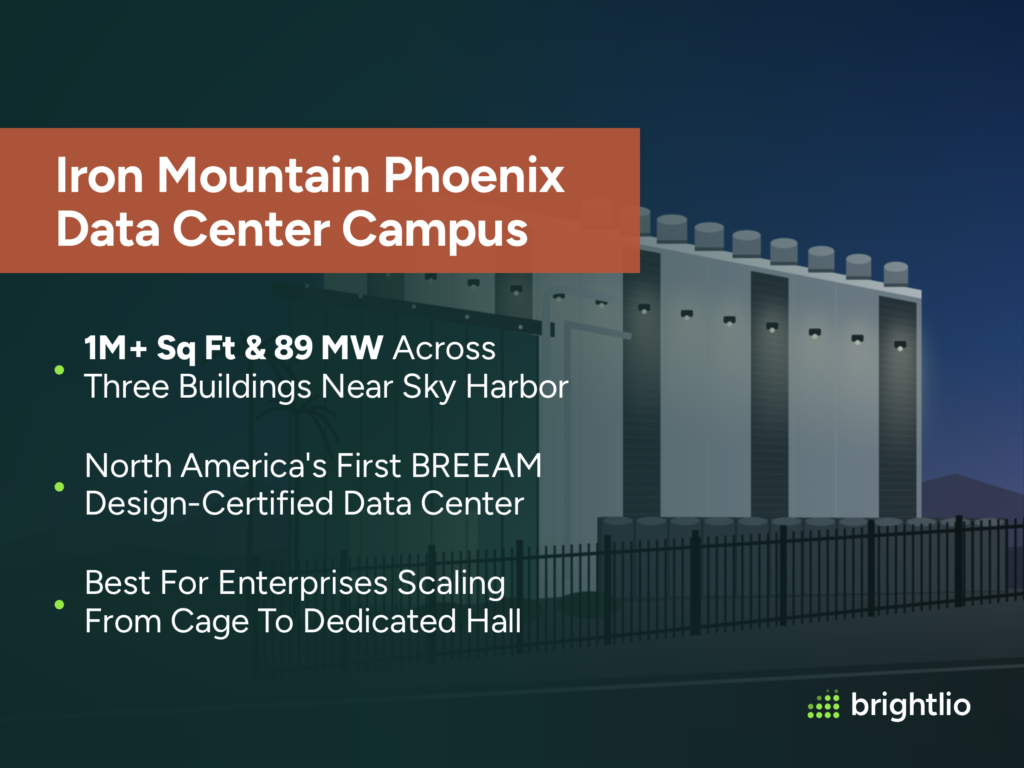
Iron Mountain Data Centers runs a three-building campus near Sky Harbor Airport, made up of AZP-1, AZP-2, and AZP-3. The campus offers more than 1 million sq ft and 89 MW of capacity, the largest retail-oriented footprint in the metro. Iron Mountain markets AZP-2 as the first BREEAM design-certified data center in North America, a useful credential for buyers with sustainability reporting obligations. The airport-adjacent location keeps cross-connect paths to central Phoenix carrier hotels short. Iron Mountain Phoenix is best suited for enterprises and cloud providers that want one campus able to scale from a cage to a dedicated hall.
2. RadiusDC Phoenix I Data Center
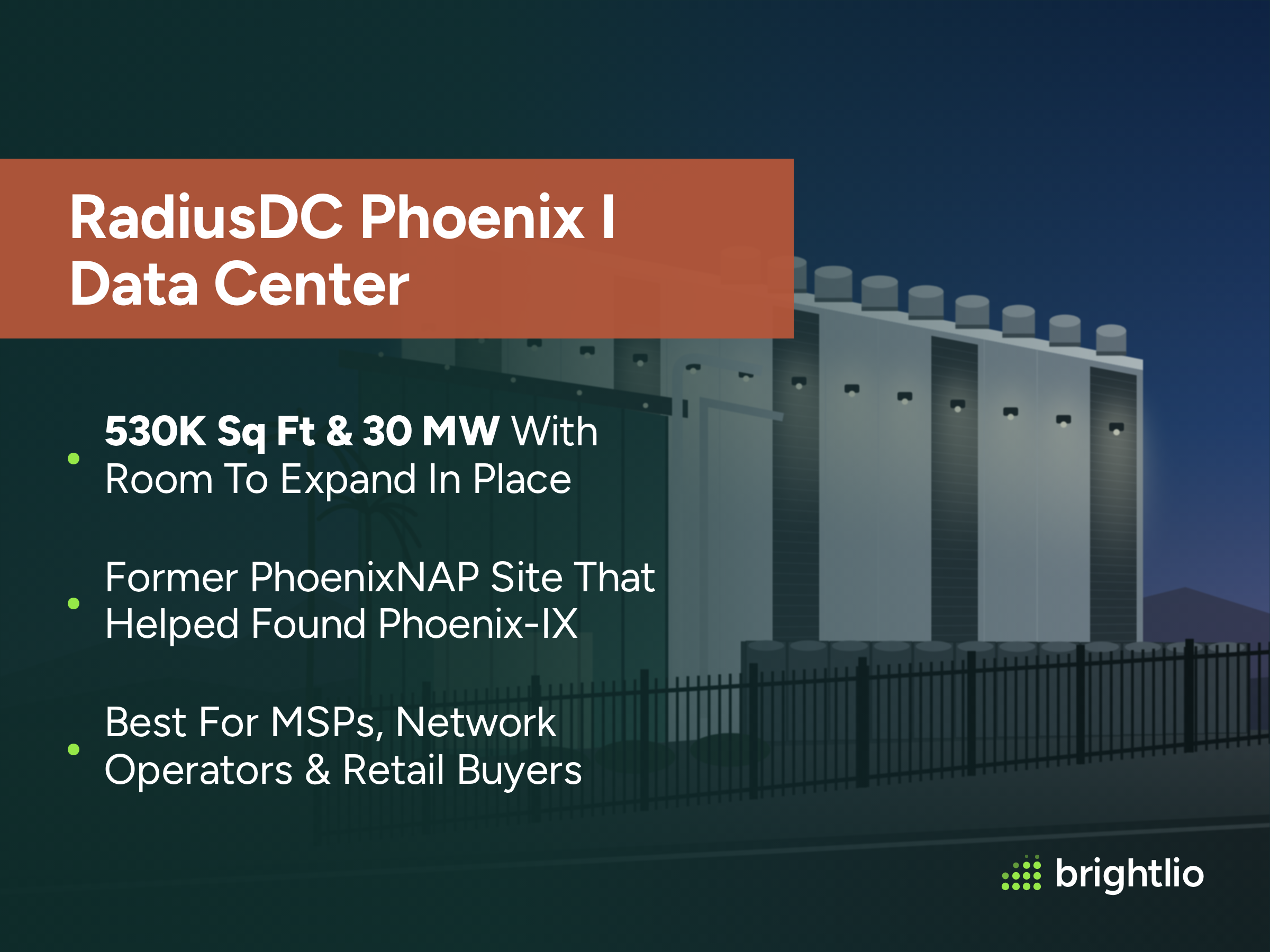
RadiusDC operates Phoenix I DC2 at 3221 E Elwood St, the facility formerly run under the PhoenixNAP name. The building covers 530,000 sq ft with 30 MW of total power capacity. PhoenixNAP helped found Phoenix-IX in 2012, so the site carries deep roots in the metro’s peering community. Its size leaves room for tenants to expand without changing buildings. RadiusDC Phoenix I is best suited for managed service providers, network operators, and retail buyers that want local interconnection and growth headroom under one roof.
3. Digital Realty PHX15 Chandler Data Center
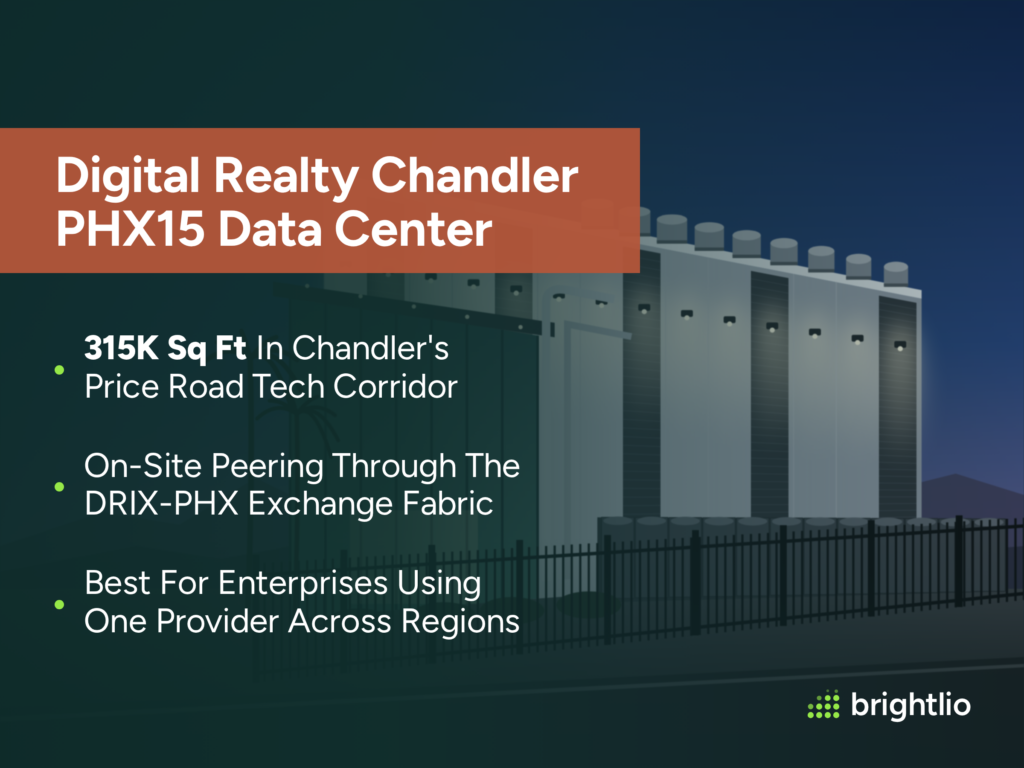
Digital Realty’s PHX15 sits at 2121 S Price Rd in Chandler’s tech corridor, with 315,000 sq ft of space. Digital Realty runs DRIX-PHX, one of the metro’s three exchange fabrics, which gives tenants a peering option inside the provider’s own ecosystem. The company’s global platform lets Phoenix deployments mirror infrastructure that buyers already run in other major markets. The Price Road location places tenants near Intel’s Chandler campus and the East Valley’s semiconductor supply chain. PHX15 is best suited for enterprises standardizing on one global colocation provider across several regions.
4. H5 Data Centers Phoenix
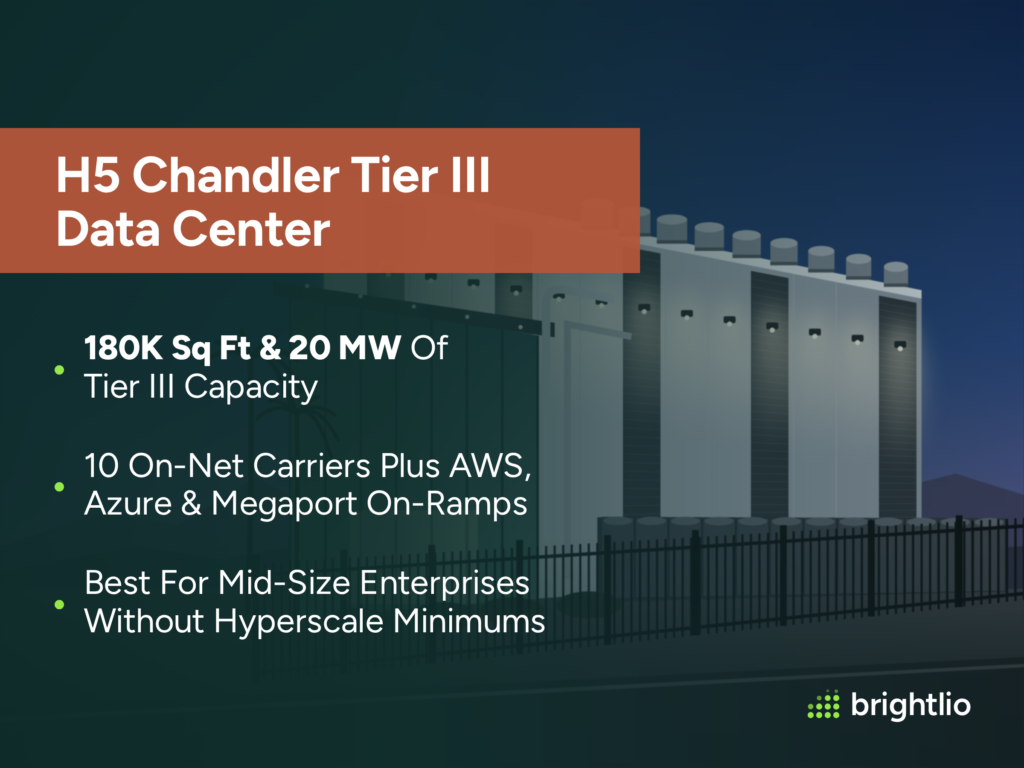
H5 Data Centers runs a 180,000 sq ft Tier III facility at 2600 W Germann Rd in Chandler, with up to 20 MW of capacity. H5 lists 10 on-net providers, including dark fiber and 100 Gbps options, along with direct connections to AWS, Microsoft Azure, and Megaport. The company holds SOC 2 attestation at the site and helps qualifying customers apply Arizona’s sales tax relief. H5 operates in other Brightlio markets, including Nashville, Denver, and San Antonio. H5 Phoenix is best suited for mid-size enterprises that want carrier choice and cloud on-ramps without hyperscale minimums.
5. CyrusOne Chandler Data Center Campus
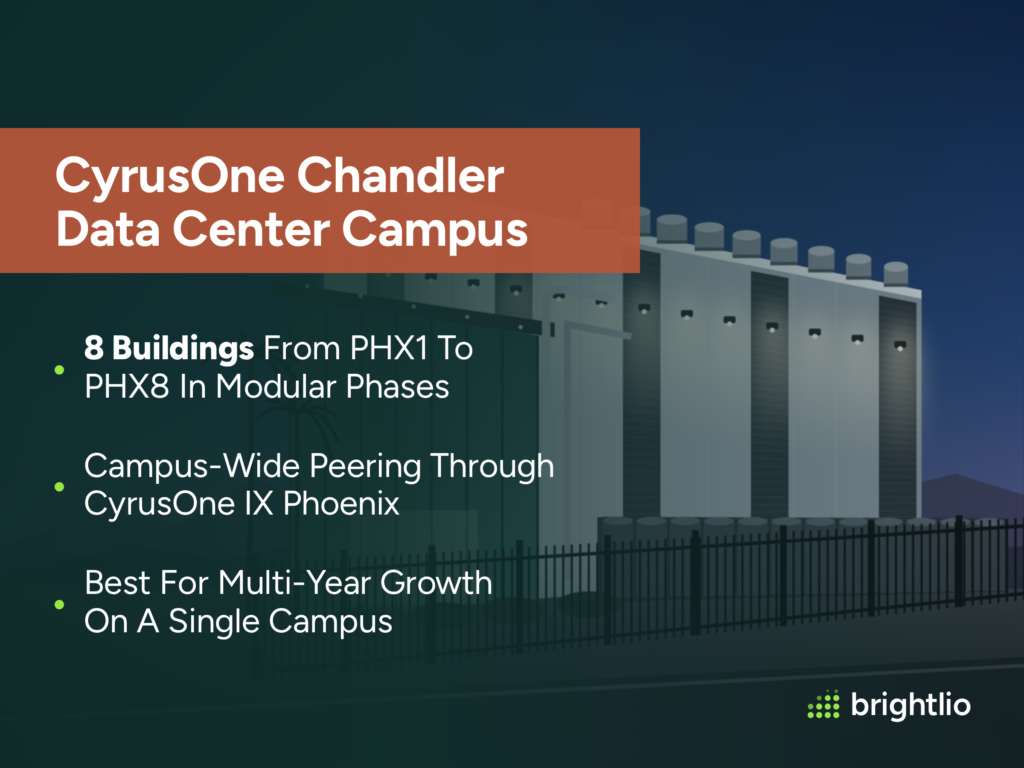
CyrusOne’s Chandler campus on S Ellis St spans eight buildings, PHX1 through PHX8, built in modular phases as demand arrives. CyrusOne does not publish total campus capacity, though the eight-building scale places it among the East Valley’s largest sites. The company operates CyrusOne IX Phoenix, an exchange fabric that serves tenants across the campus. Phased construction lets a tenant start in one hall and expand into new capacity without leaving the site. The Chandler campus is best suited for enterprises and cloud tenants planning multi-year growth on a single campus.
6. Aligned Phoenix Data Center Campus
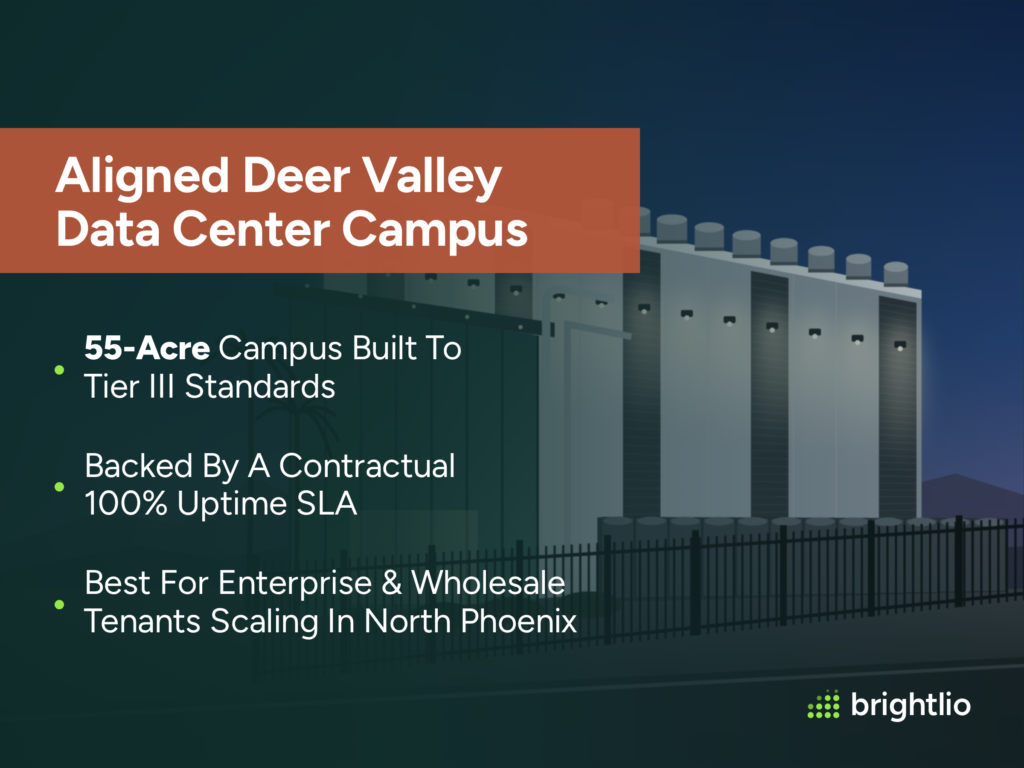
Aligned Data Centers operates a 55-acre campus in north Phoenix’s Deer Valley area, designed to Tier III standards. Aligned backs the site with a 100% uptime SLA, which shifts more outage risk onto the operator than a standard colocation contract does. The company does not publish campus capacity. Deer Valley sits away from the downtown core, so tenants trade a slightly longer path to carrier hotels for land and expansion room. Aligned Phoenix is best suited for enterprises and wholesale tenants that want contractual uptime commitments and space to scale in north Phoenix.
7. Expedient Phoenix Data Center
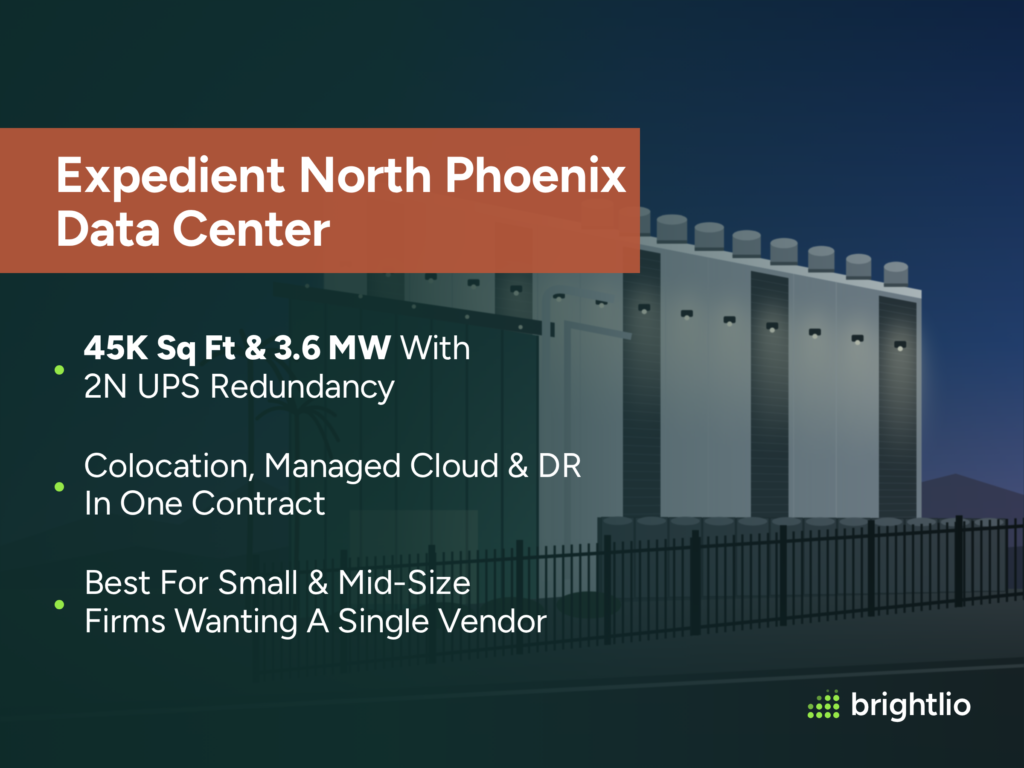
Expedient runs a 45,000 sq ft carrier-neutral facility at 2475 W Townley Ave in north Phoenix. The site carries 3.6 MW of critical IT load with a 2N UPS configuration, redundant utility feeds, and three diesel generators. Expedient pairs colocation with managed cloud and disaster recovery services, so customers can mix owned hardware and hosted capacity in one contract. Its smaller scale suits buyers who want a hands-on provider relationship. Expedient Phoenix is best suited for small and mid-size enterprises that want colocation and managed services from a single vendor.
8. QTS Phoenix 2 Data Center Campus
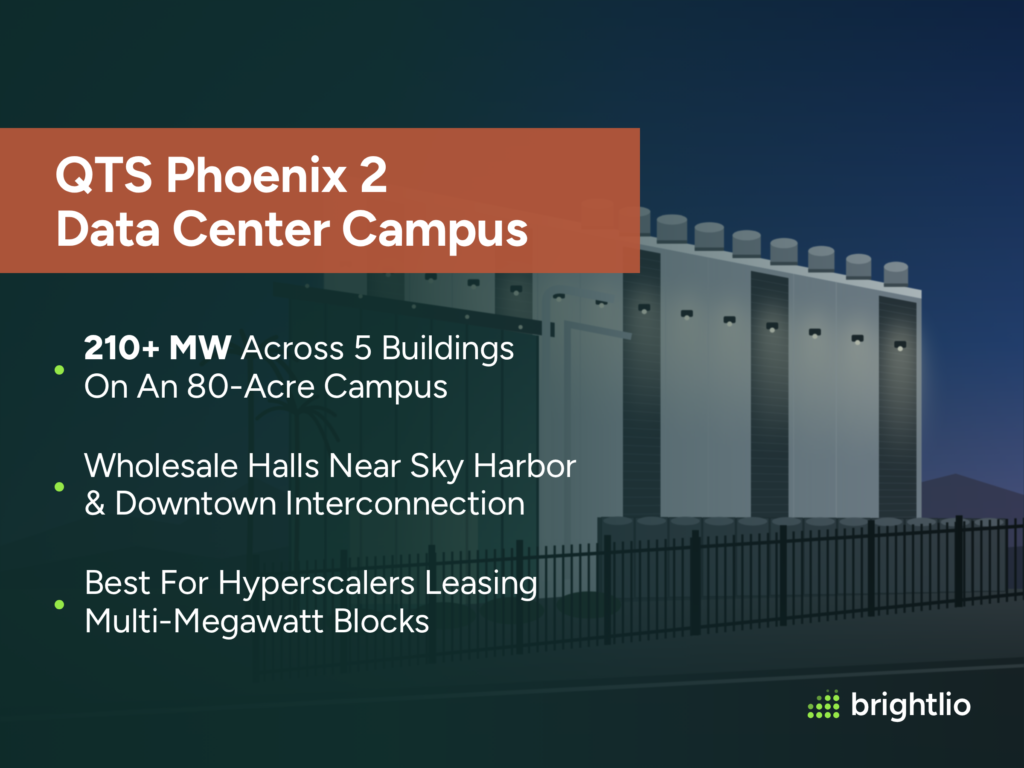
QTS Data Centers runs Phoenix 2, an 80-acre campus near Sky Harbor Airport designed for more than 210 MW of critical capacity across five buildings, DC1 through DC5. The campus is one of the largest operating sites in central Phoenix. QTS serves both hyperscale and large enterprise tenants, with wholesale halls as the core product. The central location gives large deployments direct proximity to downtown interconnection. QTS Phoenix 2 is best suited for hyperscalers and large enterprises leasing capacity in multi-megawatt blocks.
9. Stream Data Centers Goodyear Campus
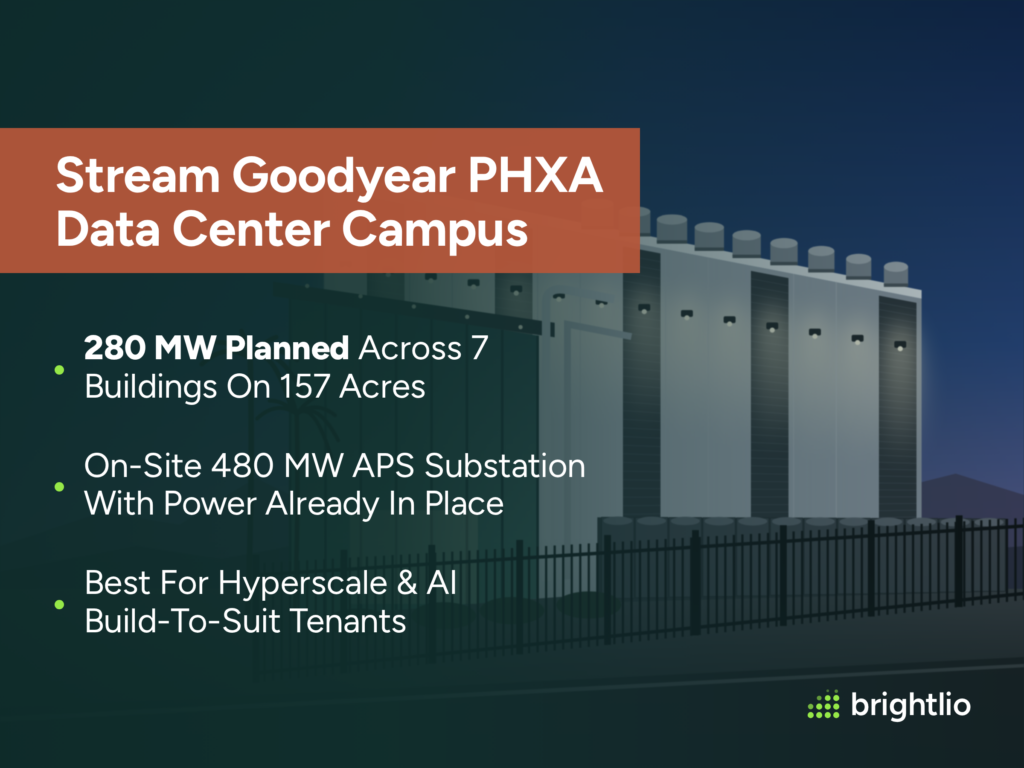
Stream Data Centers is building its PHXA campus at 2950 S Litchfield Rd in Goodyear across 157 acres. The campus is planned for seven buildings and 280 MW of critical capacity, supported by an on-site APS substation rated at 480 MW, and Phoenix I and II are in service. Having utility power on site removes the substation wait that delays most new West Valley projects. Stream Goodyear is best suited for hyperscale and large AI tenants that need build-to-suit capacity with power already in place.
10. NTT Elliot Road Data Center Campus
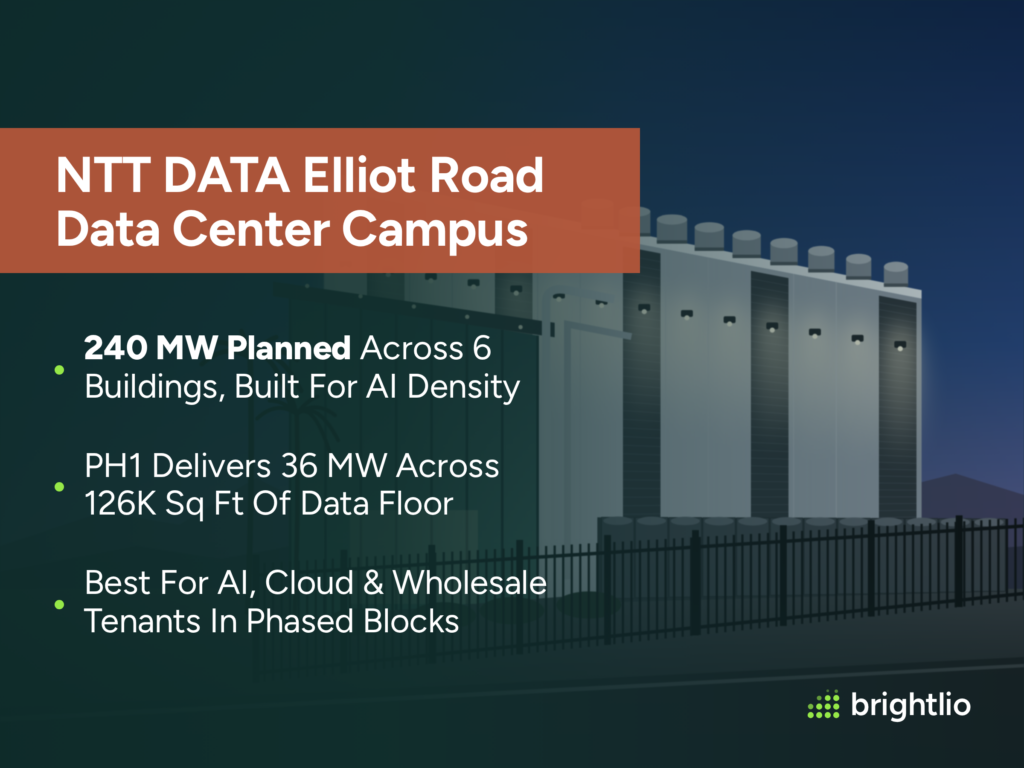
NTT DATA’s Elliot Road campus in Mesa is planned for six buildings and 240 MW, designed for high-density AI workloads. Its first building, PH1, delivers 36 MW of critical IT across 126,000 sq ft of data floor. NTT runs data centers across North America, Europe, and Asia, which matters to global buyers consolidating providers. The Mesa location sits inside the East Valley hyperscale cluster alongside EdgeCore and Apple. NTT Elliot Road is best suited for AI, cloud, and wholesale tenants that need dense power in phased building-sized blocks.
Recent Developments In Arizona (Last 12 To 24 Months)
- July 2026: Arizona’s three-year pause on new Computer Data Center tax applications took effect on July 1, running through June 30, 2029. New facilities planned in that window carry no sales tax exemption, which raises the value of buildings certified earlier.
- May 2026: Prime Data Centers broke ground on three of five buildings at its 240 MW PHX01 campus in Avondale. Three of the buildings are secured by a hyperscaler, which shows West Valley capacity is pre-leasing before it is built.
- April 2026: The Arizona Corporation Commission held a large-load workshop on April 16, where SRP presented 59 large-load customers with nearly 7,000 MW of combined load. Regulators and utilities agreed that data centers will carry the cost of the grid upgrades they trigger.
- April 2026: Edged opened a 36 MW waterless data center in Mesa. The launch put waterless cooling at the center of Arizona’s siting debate.
- February 2026: Takanock’s Project Baccara in Waddell received its environmental certificate for two buildings powered by about 700 MW of on-site natural gas. On-site generation is becoming a way around utility queues.
- January 2026: Marana approved rezoning for a Beale Infrastructure data center, while the Arizona Attorney General, the City of Tucson, and local groups petitioned to rehear TEP’s energy agreement for Project Blue. Southern Arizona projects now face legal challenges on power contracts as well as zoning.
- August 2025: The Tucson City Council rejected annexation for the original 290-acre, $3.6 billion Project Blue site amid water and energy concerns. The vote pushed the project toward Marana.
- June 2025: APS proposed a 45% rate increase for extra-large energy users, including data centers. The filing signaled that new large loads will pay a premium over existing customers.
Drawbacks And Considerations For Colocation In Arizona
Arizona’s strengths come with constraints that show up in contracts, schedules, and operating budgets. The five considerations below carry the most weight for buyers comparing Phoenix with other Western and Sun Belt markets.
1. Power Queues Delay New Capacity
APS’s request queue runs at more than double its system size, and SRP binds large loads to long take-or-pay commitments. New builds can wait years for energization, so buyers needing capacity in the next 12 months get the best odds in existing, energized buildings.
2. No Tax Exemption For Newly Certified Facilities Until 2029
The CDC application pause means a facility not certified before July 1, 2026 cannot offer the sales tax deduction until mid-2029. On a large hardware purchase, that difference can outweigh a lower monthly rate elsewhere.
3. Water Scrutiny And Local Opposition
Tucson’s rejection of Project Blue and the legal challenges that followed show how quickly water and power concerns can stall a project. Buyers backing new campuses face more permitting risk here than in markets with ample water.
4. Heat Raises Operating Costs
Summer peaks above 115°F push cooling loads and power bills up for months at a time, and air-cooled designs that save water draw more electricity. Operating budgets need to model the hottest quarter, since annual averages understate it.
5. Thinner Peering Than Tier-1 Hubs
Phoenix exchanges far less traffic than Los Angeles or Dallas, so content-heavy and latency-sensitive networks still need a presence in a larger interconnection market.
How Brightlio Can Help With Colocation In Arizona
Brightlio helps businesses find the right colocation, cloud connectivity, AI infrastructure, and disaster recovery solutions in Arizona. We compare providers across Phoenix, Chandler, Tempe, Mesa, and surrounding markets based on your budget, technical requirements, and growth plans.
Our team evaluates power costs, connectivity, security, compliance, and cooling capabilities to help you choose a facility that fits your needs. Whether you need a single cabinet, a private suite, or space for high-density AI workloads, we help you compare options and plan your deployment.
Our quotes are free. Contact Brightlio to explore Arizona colocation solutions and find the right fit for your business.
[Request An Arizona Colocation Quote button]
Frequently Asked Questions
Virginia has the most data centers in the United States, led by Northern Virginia’s Loudoun County cluster. Texas and California follow among the top data center markets in the US. Arizona ranks among the fastest-growing markets, with Phoenix absorbing 260+ MW in the first half of 2026.
Arizona has 160 data center listings from 46 operators. Phoenix holds 149 of them, Tucson 10, and Nogales 1. Listings count individual buildings, so large campuses appear more than once.
Tract, Arizona Land Consulting, Takanock, Prime Data Centers, STACK Infrastructure, Menlo Digital, and Beale Infrastructure lead Arizona’s planned projects. Operating campuses come from Stream Data Centers, NTT, EdgeCore, QTS, CyrusOne, Aligned, Apple, and Microsoft. Tract’s 1,800 MW Buckeye Technology Park is the largest planned project in the state.
Yes. Arizona’s business electricity rate averaged 12.21¢/kWh over the 12 months to July 2026, about 12% below the 13.85¢/kWh U.S. average. Large-load customers face extra contract terms, including SRP’s requirement that loads above 20 MW pay for 80% of forecast peak demand over 15 years.
Arizona’s Computer Data Center program offers up to 10 years of sales and use tax relief on data center equipment, or 20 years for sustainable redevelopment projects. The state stopped accepting new applications on July 1, 2026, and the pause runs through June 30, 2029. Facilities certified before the pause keep their relief, and qualifying colocation tenants using at least 500 kW for two or more years share it.
Phoenix, Chandler, and Tempe are the best fits for retail colocation, with the deepest carrier access and the largest choice of providers. Mesa, Goodyear, and Avondale suit hyperscale and AI tenants leasing at building scale. Tucson works for in-state disaster recovery outside the Phoenix grid.
Yes. NTT’s 240 MW Elliot Road campus in Mesa is designed for high-density AI, Edged opened a 36 MW AI-ready facility in Mesa in April 2026, and Stream’s Goodyear campus is planned for 280 MW of critical capacity. Energization dates are the main constraint, so buyers get faster access in campuses that already have utility power on site.
Water use depends on the cooling design. Newer Arizona facilities favor waterless and closed-loop systems: Edged’s Mesa site is rated to save 138 million gallons a year, and Prime claims near-zero cooling water use at its Avondale campus. Those designs draw more electricity during summer peaks.
Residents protest data centers over water use, electricity demand, utility rates, noise, and land use. In Arizona, the Tucson City Council rejected Project Blue’s annexation in August 2025 amid water and energy concerns. Project reviews now focus on cooling water, cost responsibility for grid upgrades, and local tax benefits.
Buyers serving users mainly on the East Coast or in the Midwest gain little from Arizona’s location. Networks that depend on dense peering get more from Los Angeles or Dallas. Organizations needing a new building with sales tax relief before mid-2029 face the CDC application pause.
Keep reading with our colocation guides for these states:

Tamzid is a cybersecurity researcher with 5+ years of experience across SaaS, security, compliance, data centers and cloud. He writes for brightdefense.com and hipaasimple.com, covering security, compliance, and infrastructure topics. Certified through Cisco, Fortinet (NSE 1), and the Basel Institute on Governance in OSINT, he grounds his work in primary sources and verified data.
Recent Posts

Data Centers In Arizona

What Is a Data Center?

10 Largest AI Data Centers in the World

Data Centers In Oklahoma: Why You Must Colocate
Let's start
a new project together