
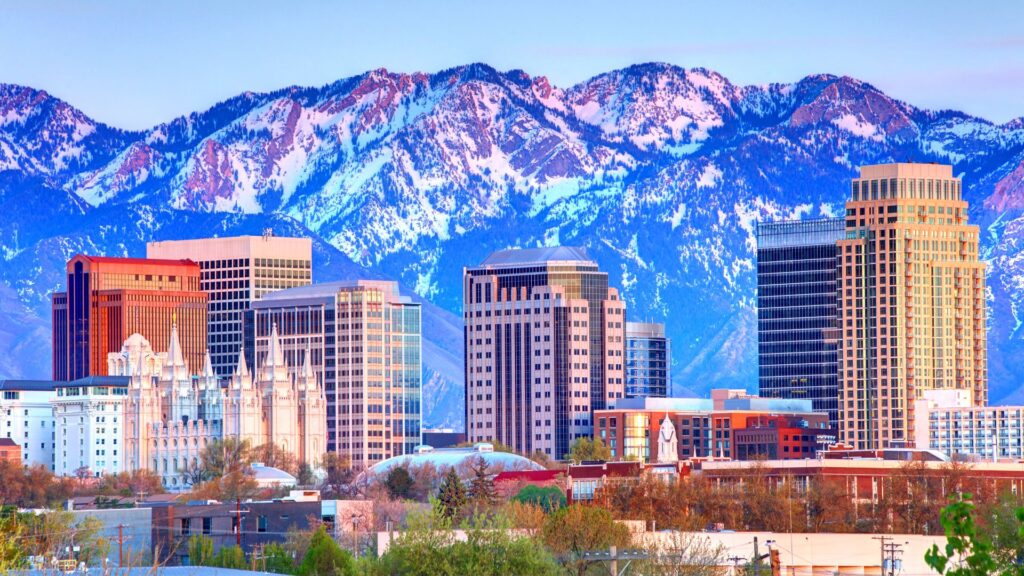
Salt Lake City is an established colocation market for organizations that need space, power, connectivity, and access to western U.S. markets. Utah’s electricity prices, local cloud region, and mix of downtown and suburban facilities give buyers several deployment options. Power availability, seismic design, carrier choice, and total contract cost still need to be assessed facility by facility.
Salt Lake City Data Center Infrastructure Overview
- Data centers: Data Center Map lists 27 facilities in the Salt Lake City market and 48 across seven Utah markets. Directory counts change as facilities open and listings are revised.
- Electricity prices: The U.S. Energy Information Administration’s January–June 2026 averages were 10.28¢/kWh for Utah commercial customers versus 13.86¢ nationally, and 8.49¢/kWh for Utah industrial customers versus 8.89¢ nationally. These statewide averages are not a data center tariff or a colocation quote.
- Cloud and connectivity: Google Cloud operates a Salt Lake City region with three zones. Carrier access and cloud interconnection differ by facility.
- Site risk: Buyers should review seismic engineering, flood exposure, backup power, and network diversity for each site.
Why Choose Salt Lake City for Colocation?
Salt Lake City offers several advantages for colocation, but their value depends on the facility and workload. Compare power, capacity, connectivity, tax eligibility, and resilience before making a decision.
How Do Power Costs Affect Salt Lake City Colocation?
Power is a major part of a colocation quote. EIA data for January–June 2026 put Utah’s average commercial electricity price at 10.28¢/kWh, about 26% below the national commercial average of 13.86¢/kWh. The Utah industrial average was 8.49¢/kWh, compared with 8.89¢/kWh nationally. These are statewide, sector-wide averages; a data center’s contracted rate depends on demand, location, utility tariff, and purchasing arrangement.
Utah’s dry climate can support economizer cooling during suitable conditions, but cooling performance depends on facility design and weather. Ask providers how they measure power usage effectiveness, account for cooling and power charges, and source any renewable electricity. Some operators, including Flexential, describe specific renewable-energy purchases for their Utah sites; this should not be assumed for every facility.
What Should Buyers Check About Land and Capacity?
Land price alone does not determine colocation cost. Available utility capacity, time to energize, zoning, fiber routes, cooling, and expansion rights can have a larger effect on a deployment. Downtown facilities and larger suburban campuses serve different space, power, and interconnection needs.
Compare quotes using the same cabinet or suite footprint, committed kilowatts, power density, cross-connects, bandwidth, installation charges, and renewal terms. Confirm available capacity and delivery dates directly with each provider.
Which Utah Data Center Tax Incentives Apply?
Utah provides a sales and use tax exemption for qualifying machinery, equipment, and operating repair or replacement parts used in a qualifying data center or its occupant’s operations, provided the items have an economic life of at least one year. The Utah Tax Commission’s exemption certificate states these conditions. An August 2026 Utah legislative analysis describes the qualifying data center threshold as at least 150,000 square feet.
Eligibility depends on the facility, buyer, equipment, and transaction. Colocation customers should ask a provider which tax treatment applies to their specific purchase and confirm it with a qualified tax adviser. The exemption is not a blanket tax break for every tenant or every data center expense.
How Connected Are Salt Lake City Data Centers?
Salt Lake City facilities offer different combinations of on-site carriers, fiber routes, cloud connections, and access to regional networks. For example, DataBank lists a downtown carrier hotel and five Bluffdale campus facilities, while Flexential lists multiple Salt Lake City metro locations. Compare each site’s carrier list, cross-connect fees, path diversity, and latency measurements instead of relying on a market-wide provider count.
Google Cloud’s Salt Lake City region has three zones and supports Cloud Interconnect. A nearby data center does not automatically provide a private connection or a particular latency: check the facility’s interconnection options and the network route to the workloads you use.
What Support Is Available for Local Operations?
The Salt Lake City metro has universities, technology employers, and data center operators that support local staffing and services. Ask prospective providers about on-site coverage, remote-hands hours, response times, security staffing, and the engineers available for planned or emergency work. Staffing terms vary by contract and facility.
What Natural Hazards Should Salt Lake City Data Centers Plan For?
Salt Lake City is inland, but its location does not eliminate natural hazards. The Wasatch fault crosses the region, and USGS has modeled a magnitude-7 earthquake scenario for the Salt Lake Valley. Seismic design, equipment anchoring, utility resilience, and recovery plans therefore matter when comparing facilities.
Request site-specific information on seismic standards, flood exposure, backup power and fuel, cooling redundancy, and diverse network entrances. Review the provider’s tested disaster recovery procedures rather than assuming the metro has minimal disaster risk.
Which Salt Lake City Colocation Providers Have Facilities?
Flexential lists five data centers in the Salt Lake City metro, including Downtown, Fair Park, Millcreek, and South Valley locations on its market page. The number of sites and available services should be confirmed when requesting a quote.
DataBank lists six area facilities: SLC1 downtown and SLC2–SLC6 at the Granite Point campus in Bluffdale. Its current market page lists approximately 10,610 square feet of IT space and 0.5 MW of critical IT load for SLC1. The Bluffdale facilities serve different capacity requirements.
XMission offers colocation in the area. Ask each provider for current cabinet or suite availability, committed power, connectivity, support terms, and a written quote. Older advertised entry prices and facility totals may no longer represent an available configuration.
Is Salt Lake City a Good Location for Colocation?
Salt Lake City merits consideration for deployments that need western U.S. connectivity, a choice of facility types, and access to a local Google Cloud region. Utah’s commercial electricity average was below the U.S. average in the first half of 2026, and qualifying data centers may benefit from an equipment sales tax exemption.
The right site depends on actual power availability, total contract cost, carrier diversity, and seismic resilience. Compare those factors across facilities before selecting a provider.
Utah Colocation – Brightlio Can Help!
If you are interested in exploring Utah enterprise colocation services, Brightlio would love to help. As a colocation broker, we offer competitive colocation pricing from our industry-leading network of partners.
Our services are free to you. The data center provider pays us a commission if you choose one of our recommended colocation services. The commission does not impact your cost.
We are also vendor-neutral. We have a network of vetted, global providers. We’ll give you our honest, expert opinion on each option so that you can make the best decision for your business. We believe in building long-lasting relationships through years of mutually shared success with our customers.
We are also experts in network connectivity and cloud solutions, allowing us to offer you a complete solution for your data center needs.
If you are interested in Salt Lake City, Utah colocation or exploring colocation in other markets, get started with Brightlio today!

John Minnix is the Founder and CEO of Brightlio, with two decades of experience in data center, cloud, and network solutions. He previously built VPLS Solutions into a top Southern California technology partner before its acquisition by Evocative, where he served as President and COO overseeing global sales, operations, and strategic acquisitions.
Recent Posts
Data Centers In Indiana
Data Centers In Arizona
What Is a Data Center?
10 Largest AI Data Centers in the World
Let's start
a new project together