

Nashville, Tennessee, has long been known for its rich musical heritage and vibrant arts scene. However, ashville is a regional colocation market with its largest campuses outside the city. Gallatin, about 30 miles northeast, holds Meta and Csquare. Downtown Nashville and the southern suburbs serve businesses that need local equipment access.
This guide’s Nashville inventory contains 23 sites, counting H5’s two downtown buildings separately.
Meta Gallatin has the largest published capacity at 300 MW. Csquare’s Gallatin campus has a 100 MW design, while Flexential operates three facilities in Brentwood and Franklin.
The market suits Middle Tennessee businesses that need nearby equipment and regional connectivity. Buyers needing a large private suite have fewer clearly established options. Tennessee’s commercial electricity rate was 13.94¢/kWh in June 2026, so buyers need a facility quote before assuming a power cost advantage.
This guide compares Nashville’s main submarkets and five featured operational sites. It examines the development pipeline and the tradeoffs that affect a colocation decision.
Nashville Data Center Tracker
22data center sites
5 operational3 planned14 colocation
Data Center Map counts 28 buildings in the Nashville market. Multi-building campuses count once in this tracker.
Market Snapshot
Largest Operating Data Centers In Nashville
Meta's Gallatin campus and Csquare's Gallatin site lead the metro on published capacity, followed by Flexential's three southern-suburb facilities.
- Meta Gallatin CampusGallatin, full campus300 MWOperational
Six-building campus on about 900 acres, officially launched in November 2024
- Location:
- Gallatin, Sumner County
- Operator:
- Meta
- Cooling:
- Direct outside-air cooling
- Expansion:
- Building 5 under construction
- Csquare Nashville (formerly Evoque)Gallatin, campus design100 MWOperational
500,000 sq ft campus with 82,500 sq ft in its first phase
- Address:
- 1398 Gateway Dr, Gallatin
- Operator:
- Csquare
- Carriers:
- Lumen, Zayo, Windstream, AT&T and Comcast
- Flexential Cool SpringsFranklinNot publishedOperational
One of three Flexential sites that together offer more than 174,000 sq ft of raised floor
- Address:
- 425 Duke Dr, Franklin
- Operator:
- Flexential
- Compliance:
- HIPAA and PCI
- Flexential BrentwoodBrentwoodNot publishedOperational
Part of Flexential's three-site Nashville footprint
- Address:
- 7100 Commerce Way, Brentwood
- Operator:
- Flexential
- Flexential FranklinFranklinNot publishedOperational
Part of Flexential's three-site Nashville footprint
- Address:
- 4600 Carothers Pkwy, Franklin
- Operator:
- Flexential
Planned Data Centers In Nashville
Three projects are in the pipeline, led by DC BLOX's proposed 50 MW campus at Grassmere Park.
- DC BLOX Nashville CampusNashville, full campus50 MWProposed
Two buildings totaling 69,220 sq ft on 24 acres, facing local opposition
- Address:
- 648 Grassmere Park, Nashville
- Developer:
- DC BLOX
- Quantum Leap Data CenterNashville, planned30 MWPlanned
70,000 sq ft facility in Fisk University's $1 billion campus plan
- Address:
- 1000 17th Ave N, Nashville
- Developer:
- Fisk University
- RadiusDC Nashville INashville, critical power12 MWUnder construction
102,500 sq ft facility set to open in 2026
- Address:
- 2902 Brick Church Pike, Nashville
- Developer:
- RadiusDC
5 Largest Colocation Facilities In Nashville
Retail colocation centers on downtown Nashville and the I-24 and I-65 corridors, with Lumen running three of the five largest facilities.
- Lumen Nashville 3Nashville40,000 sq ftColocation
AC and DC power with generator and battery backup
- Address:
- 2208 9th Ave N, Nashville
- Operator:
- Lumen
- Lumen Nashville 2Nashville30,400 sq ftColocation
N+1 cooling with diverse fiber connectivity
- Address:
- 2530 Perimeter Place Dr, Nashville
- Operator:
- Lumen
- Saragon NashvilleNashville27,502 sq ftColocation
7,755 sq ft of raised floor with Cogent, Zayo, AT&T and Windstream on site
- Address:
- 338 Woodycrest Ave, Nashville
- Operator:
- Saragon
- H5 Data Centers NashvilleNashville22,000 sq ftColocation
Downtown site with 11 carriers and the Nashville Internet Exchange
- Address:
- 147 4th Ave N, Nashville
- Operator:
- H5 Data Centers
- Lumen Nashville 1Nashville9,561 sq ftColocation
N+1 cooling and dual-authentication security
- Address:
- 2990 Sidco Dr, Nashville
- Operator:
- Lumen
Other colocation facilities, shown on the map as green squares: , , , , , , , , .
Choose a category to switch the list and highlight its sites on the map. Click any site card to find it on the map, or click a marker to jump to its card. Pins are approximate, and each MW figure carries the basis shown beside it.
Data sourced from Data Center Map, EIA, the Tennessee Department of Revenue, Compute Atlas, The Center Square and Climate-Zone, checked October 10, 2026. The lists show the largest sites in each category.
Why Colocate In Nashville?
Nashville offers local access for Middle Tennessee organizations and several established enterprise providers. Power arrangements and the limited development pipeline require closer review. The following six factors explain the market's practical advantages and constraints.
1. Market Access And Latency
Nashville is a practical location for applications used by employees and customers in Middle Tennessee. A local facility gives IT teams a nearby place to install equipment. It can shorten the network path between an application and its users, although the actual route determines the result.
Regional reach depends on the network route. A connection to Atlanta or Chicago may pass through intermediate cities. Buyers should test application performance over the proposed carrier's route before choosing a facility.

Downtown sites suit businesses that prioritize interconnection. Brentwood and Franklin offer established enterprise facilities near the southern business corridor. Gallatin holds the large campuses.
Disaster recovery needs a separate assessment. Two buildings in the same metro can share storm exposure or network infrastructure. A second site should provide enough separation to match the organization's recovery requirements.
2. Network Connectivity And Peering
Downtown Nashville provides an interconnection option through H5 Data Centers and the Nashville Internet Exchange. An internet exchange lets participating networks exchange traffic directly. That can reduce reliance on a third network for local traffic.
H5's facility at 147 Fourth Avenue North lists 24 on-net communications providers on the operator's current page. On-net means a provider has a network presence at the facility. H5's older Commerce Street building is a separate location, so the same provider list should not be assigned to both.

Carrier choice extends beyond downtown. Csquare's Gallatin carrier list includes Lumen and Zayo. AT&T, Windstream, and Comcast appear on the list as well. Saragon lists Cogent, Zayo, AT&T, and Windstream at its Woodycrest Avenue facility.
A carrier-neutral data center allows customers to choose among network providers. Ask which carriers have equipment inside the building. A nearby fiber route does not establish that a carrier can deliver service to the rack.
For example, a business buying two internet connections should ask whether they enter through separate routes. Different carrier names can still rely on a shared conduit. That shared section can undermine the intended backup connection.
3. Power Cost And Sustainability
Tennessee's average commercial electricity rate was 13.94¢/kWh in June 2026. This statewide benchmark is useful for context. It does not establish the rate charged to a Nashville data center or its tenants.
Nashville Electric Service buys power from the Tennessee Valley Authority, or TVA. It resells that power to customers in its service territory. Buyers have no retail electricity supplier choice there, although utility service should be confirmed separately for facilities outside Nashville.
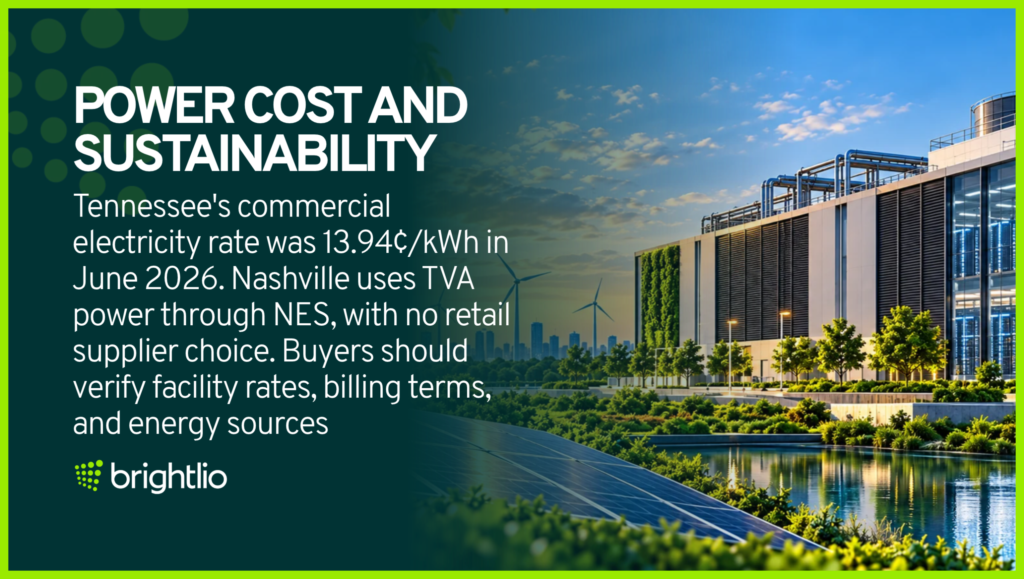
The actual bill depends on the applicable rate schedule. NES describes seasonal pricing and fuel adjustments. A colocation agreement can add a separate method for allocating cooling and electrical losses. These charges help explain why a statewide utility average and a data center quote can differ.
When comparing colocation pricing, ask whether electricity is metered or bundled into a fixed charge. Check how utility increases reach the customer. Reserved power and actual consumption need clear definitions in the contract.
Tennessee's 2024 generation mix was 42% nuclear, 23% coal, 22% natural gas, and 12% hydro. These statewide figures do not describe an individual facility's electricity supply. Buyers with carbon targets need evidence for the power arrangement offered by that provider.
4. Tax Policy And Incentives
Tennessee offers equipment exemptions for qualified data centers. Electricity used by a qualified facility receives a 1.5% sales tax rate. The investment threshold is more than $100 million, with at least 15 new jobs.
The Department of Revenue's application adds conditions to those headline thresholds. The investment period generally lasts three years. Qualifying jobs must meet wage and employment requirements, and the department issues a certificate after approval.
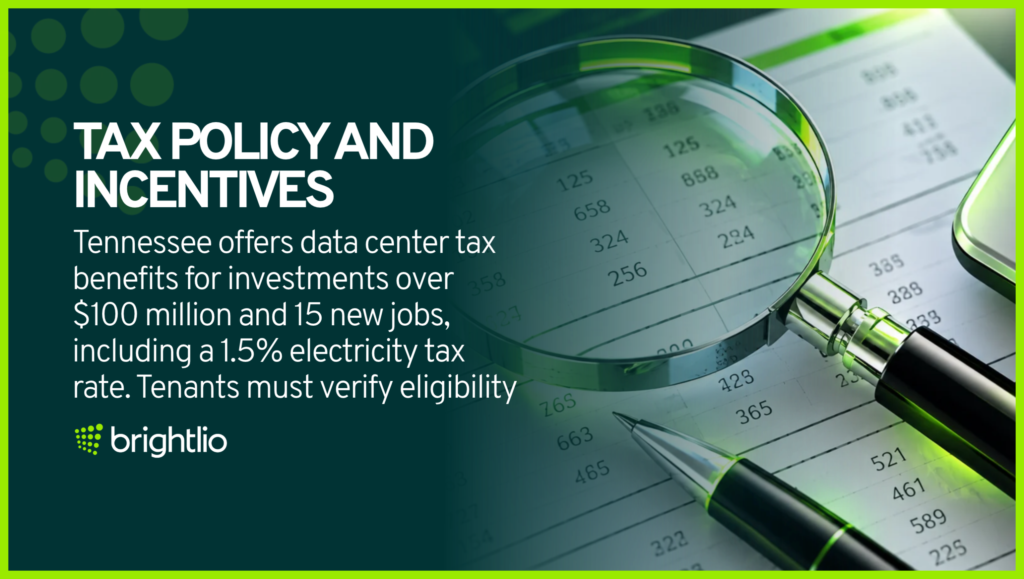
The distinction matters for a business leasing a few cabinets. A facility's eligibility does not establish that every tenant purchase receives an exemption. Buyers should confirm the treatment of their own equipment with the provider before including tax savings in a comparison.
Ask how the electricity tax appears on the quote. A reduced tax rate on power is different from a lower electricity price. A clear proposal identifies the charges that receive favorable treatment.
For example, compare the same deployment before and after the applicable tax. Do not apply a facility exemption to every equipment purchase or every line of the colocation invoice.
5. Workforce And Business Ecosystem
Nashville has an established business base that creates demand for enterprise infrastructure. Amazon selected the city for its operations hub in 2018. The announcement included a $230 million investment and 5,000 jobs.
An office announcement is separate from data center capacity. It helps explain the area's enterprise activity, but it does not create leasable cabinets or additional utility power.
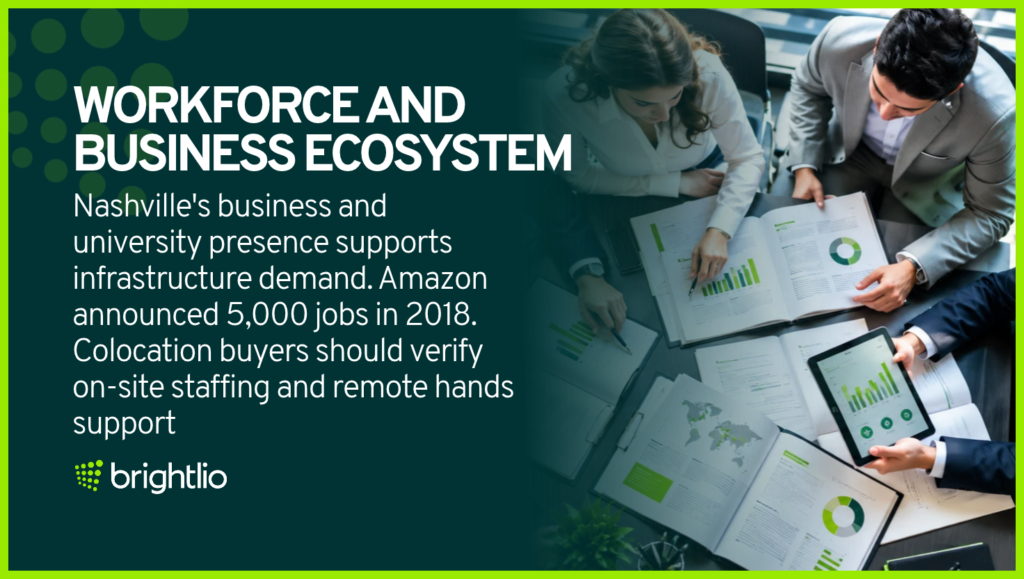
Vanderbilt University, Belmont University, and Tennessee State University contribute to the region's education base. Fisk University's planned technology center would add a facility connected to academic work. Its commercial availability remains a separate question.
For a colocation customer, staffing at the chosen building matters most. Ask whether technicians remain on site overnight. Check the response time and charges for remote hands. This service lets facility staff perform physical tasks on a customer's equipment.
A business without local IT staff may depend on that service for a failed drive or a cable change. Confirm the tasks included in the contract. A staffed facility does not necessarily include unlimited equipment support.
6. Risk And Resiliency
Tornadoes and severe thunderstorms are important Nashville hazards. Cumberland River flooding adds a location-specific concern. A facility's street address requires a closer assessment than a general statement about the metro's risk.
Ask where the building keeps its generators and electrical switchgear. Check the elevation of critical equipment and the routes staff use to reach the site. A dry data hall offers limited protection if flooding prevents fuel deliveries.
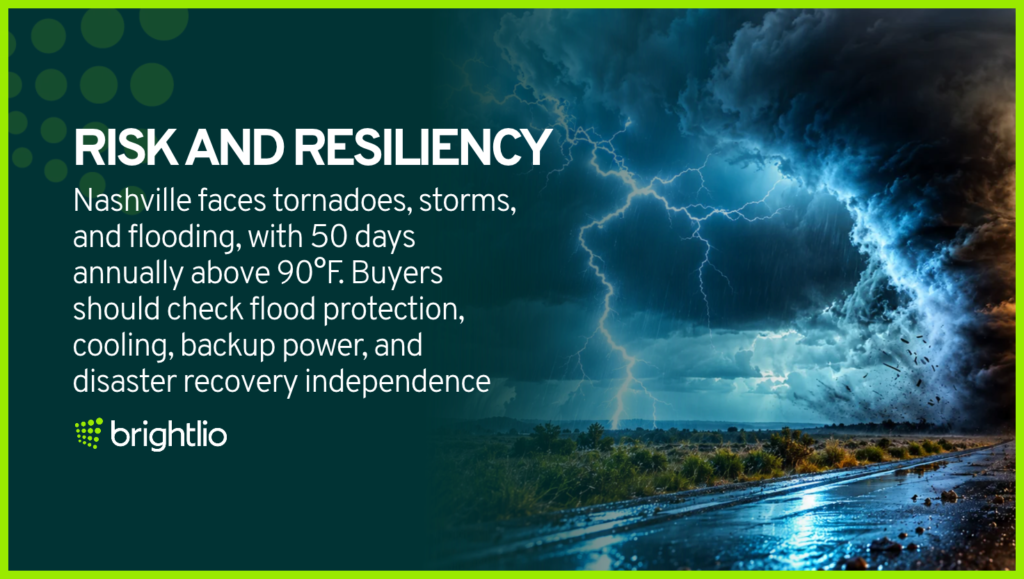
Nashville's annual average temperature is about 59°F. The climate baseline used here includes about 50 days per year above 90°F. Cooling systems must support the deployment during hot weather, including periods when equipment is out for maintenance.
Review the provider's storm procedures and generator testing records. For a recovery site, check whether the primary facility shares upstream power or fiber dependencies. Distance alone does not establish independence.
Key Nashville Data Center Submarkets
The metro separates into large campuses in Gallatin and enterprise facilities closer to Nashville's business districts. New proposals add development activity in the north and south. The following five submarkets help buyers narrow their search.
1. Downtown Nashville
Downtown suits buyers that need network interconnection near the city's business core. H5's two locations and DataBank Cummins Station provide alternatives to a suburban campus search.
H5's buildings need separate evaluation. The 22,000-square-foot former vXchnge site is at 211 Commerce Street. The former 365 Data Centers facility is at 147 Fourth Avenue North. H5 lists 19,700 square feet for that second location.
A quote should identify the building and the available service there. Confirm the carrier list at that address. Check whether reaching another network requires transport between buildings.
Downtown works for network equipment and modest enterprise deployments. Buyers seeking a large private suite should establish contiguous availability early. A city's total facility count says little about how much space can be delivered under one contract.
2. Brentwood And Franklin
The southern suburbs contain Flexential's three Nashville facilities. Brentwood is at 7100 Commerce Way. Cool Springs is at 425 Duke Drive, and Franklin is at 4600 Carothers Parkway.
The combined footprint exceeds 174,000 square feet of raised floor, meaning the technical floor area used for data center equipment. That total covers all three locations. It does not represent one building or currently vacant space.
This corridor is a practical starting point for businesses whose IT teams work south of Nashville. It offers multiple locations within one provider's portfolio. TierPoint in Franklin and Uniti in Brentwood add other operators to the search.
A two-site deployment within the corridor still needs a dependency review. Ask for the power feeds and carrier routes at each address. Two contracts with the same operator do not establish that the buildings can fail independently.
3. Gallatin And Sumner County
Gallatin holds the largest campuses in this Nashville inventory. Meta's 300 MW site anchors the area's private infrastructure. Csquare's former Evoque campus has a 100 MW design.
Their capacity serves different purposes. Meta uses its campus for its own infrastructure and does not offer retail colocation. Csquare is a commercial facility that buyers can approach about available space and power.
Csquare's campus covers 500,000 square feet in its stated design. Its first phase covers 82,500 square feet. Buyers should ask how much of the development is commissioned before assessing expansion options.
Gallatin is most relevant to customers seeking a larger campus setting. A hyperscaler operates infrastructure at very large scale, often for cloud services or its own platforms. Its presence does not establish a supply of retail cabinets nearby.
4. North Nashville And Trinity Hills
North Nashville contains two of the inventory's three development entries. RadiusDC Nashville I is at 2902 Brick Church Pike in Trinity Hills. Its original announcement specified 12 MW of critical power. The current operator page lists 102,000 square feet and 20 MW of building utility capacity.
Fisk University's Quantum Leap proposal adds 30 MW in a 70,000-square-foot technology center. The project location is 1000 17th Avenue North. Fisk's current Quantum Leap page places the broader program at $900 million, including a $400 million Innovation and Technology Center.
RadiusDC's current page describes two 6 MW halls under an in-service heading. It does not provide a dated opening confirmation. Treat its commissioning status as unconfirmed until the operator confirms delivery. Utility capacity and critical power are different measures and should not be added together.
Buyers considering this submarket should request a dated delivery schedule. Confirm the point at which utility power will support customer equipment. A completed building and a site ready for tenant installation are separate milestones.
5. South Nashville And The Southeast Corridor
South Nashville contains established facilities near the Sidco Drive and Woodycrest Avenue corridors. Lumen Nashville 1 occupies 9,561 square feet at 2990 Sidco Drive. Saragon has 27,502 square feet at 338 Woodycrest Avenue, including 7,755 square feet of raised floor.
Lumen Nashville 4 is in Berry Hill. Data Suites in Murfreesboro extends the search farther southeast. Murfreesboro is a separate market within a wider Middle Tennessee search, so buyers should test its routes to their offices.
DC BLOX's current Grassmere Park plan describes one 69,200-square-foot building at 10 MW. The operator places the project in evaluation. Local opposition adds delivery uncertainty. The project should remain separate from a shortlist of buildings available today.
This corridor merits attention from businesses with nearby operations. Compare the physical facility with the proposed network path. A convenient address can still involve an indirect connection to the application's users.
Five Leading Operational Data Centers In Nashville
The following profiles cover five featured operational facilities in the Nashville metro. Meta is a private campus. The other four entries provide commercial options, subject to available capacity. Published megawatt figures describe different measures and should not be added together as available supply.
1. Meta Gallatin Campus
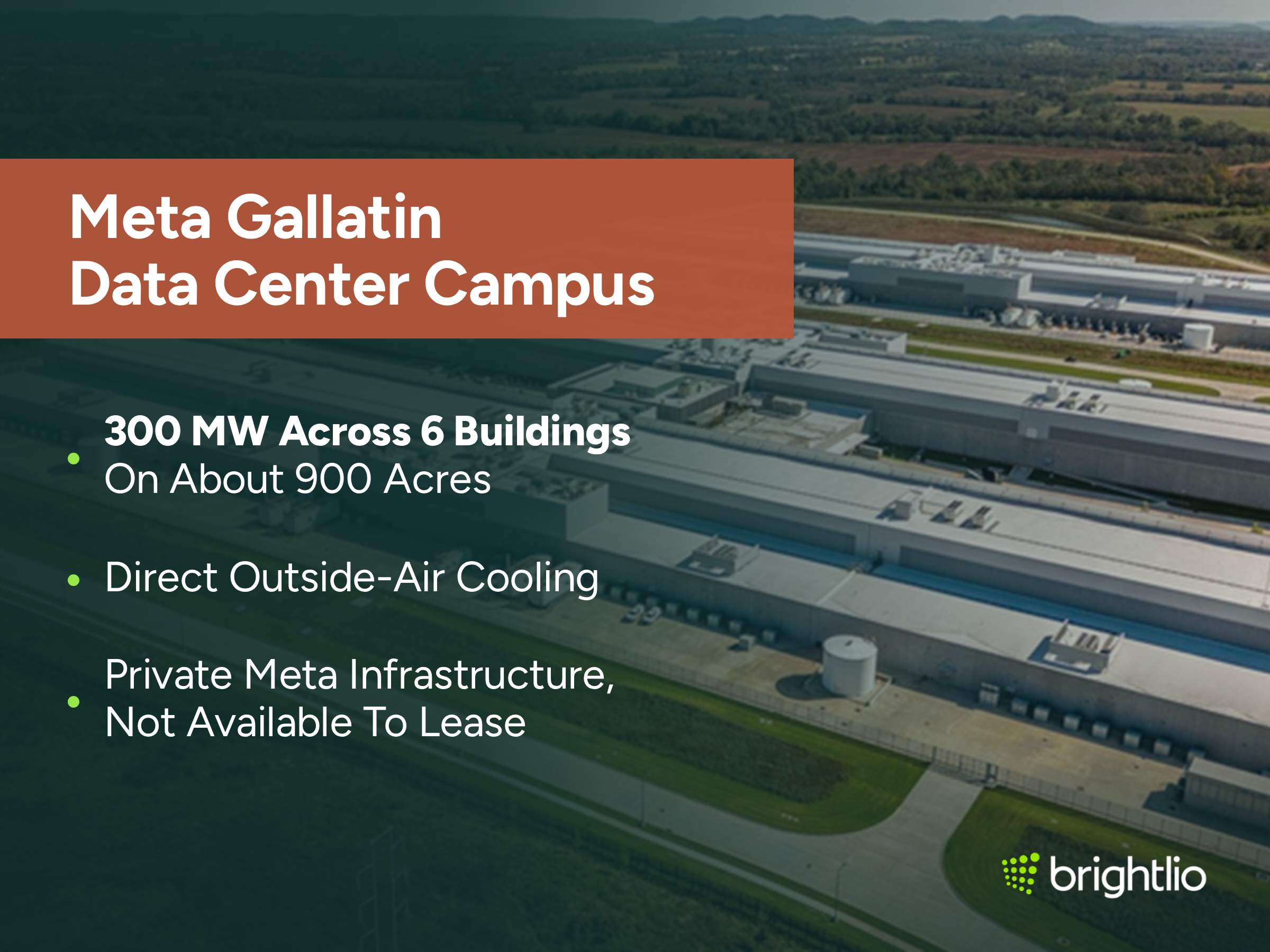
Meta's Gallatin campus has the market's largest published capacity at 300 MW. The six-building campus covers about 900 acres. It officially launched in November 2024.
The campus uses direct outside-air cooling. This design brings outside air into the cooling process when conditions allow. Building 5 remains under construction in the October 10 project snapshot.
Meta Gallatin is private infrastructure. Enterprise buyers cannot lease a rack there. Its size explains why the metro's headline capacity can look much larger than its retail colocation market.
The relevant comparison for an enterprise buyer is available commercial capacity. A private campus can influence regional power demand without increasing the number of facilities competing for that buyer's contract.
2. Csquare Nashville Formerly Evoque
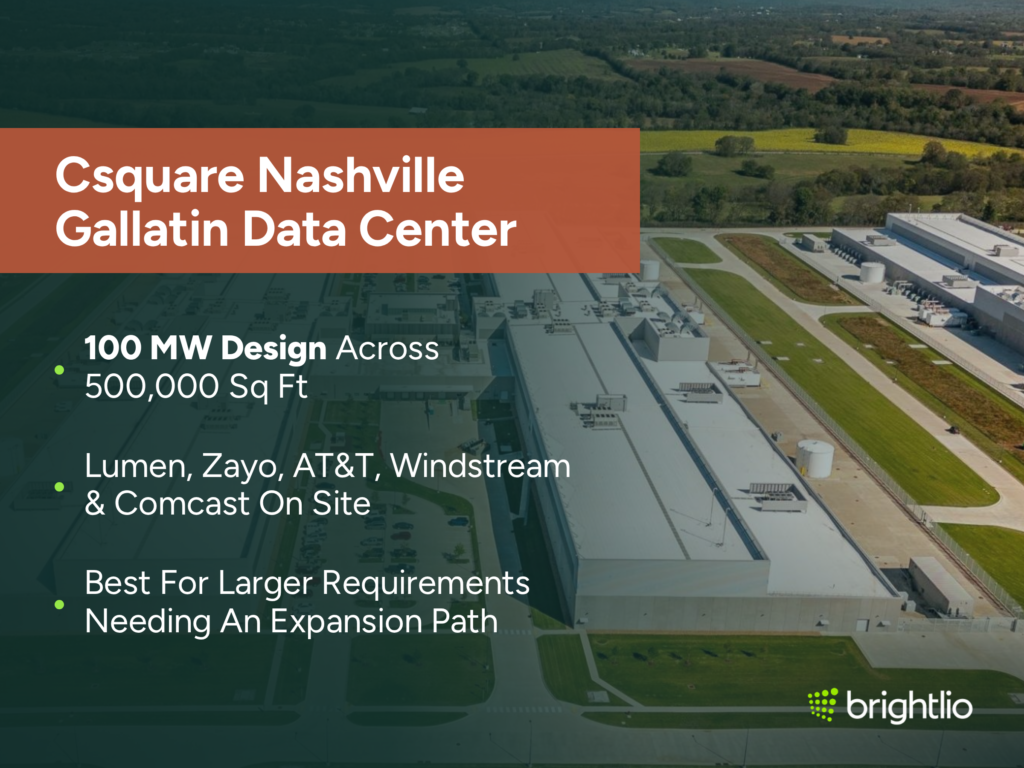
Csquare Nashville is at 1398 Gateway Drive in Gallatin. The campus has a 100 MW design across 500,000 square feet. Its first phase accounts for 82,500 square feet.
The carrier list includes Lumen and Zayo, alongside Windstream, AT&T, and Comcast. Buyers should confirm the networks available in the proposed phase. A campus carrier list does not establish service readiness in every room.
Csquare is worth evaluating for larger requirements that need a campus expansion path. Ask which power blocks are commissioned. Check the date and conditions for delivering the next block.
The design capacity is not a statement of vacant power. Contracted growth rights matter more than the site's full-build figure. A tenant needs a written commitment for the capacity it expects to use.
3. Flexential Cool Springs
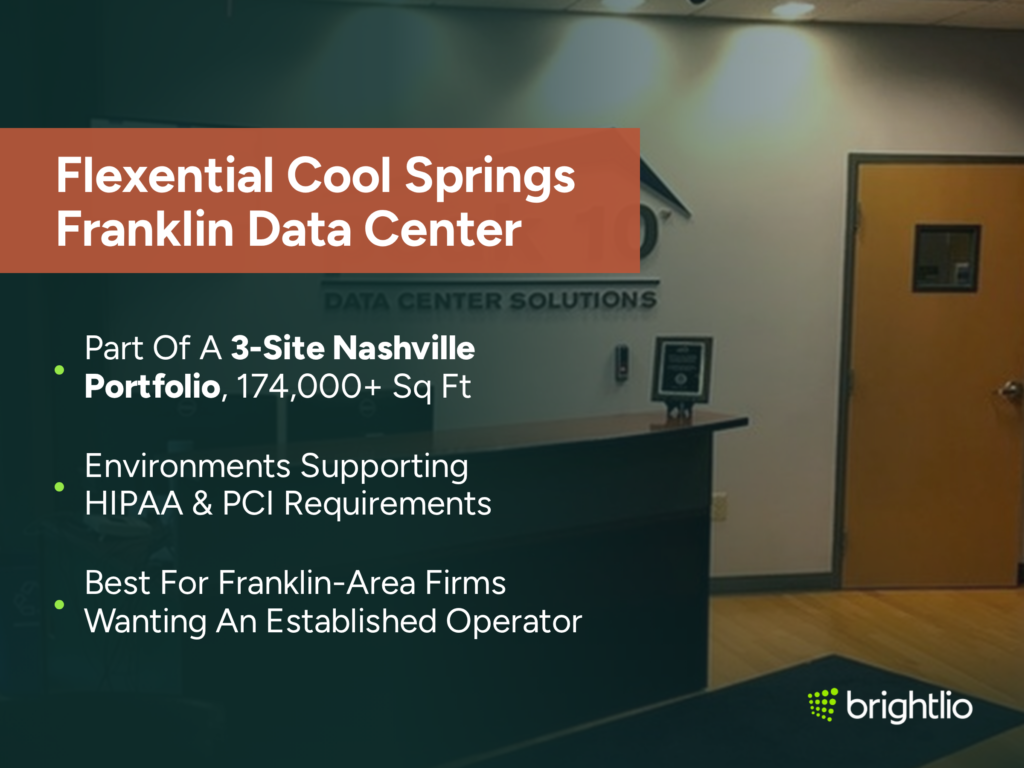
Flexential Cool Springs is at 425 Duke Drive in Franklin. It forms part of the operator's three-site Nashville portfolio, which provides more than 174,000 square feet of raised floor combined.
Flexential describes environments that support HIPAA requirements for health information and PCI requirements for payment card data. Buyers should review the scope of the provider's controls. Their own applications remain part of the compliance work.
Cool Springs is a practical option for businesses near Franklin that want an established enterprise operator. Request a quote tied to the rack density required by the application. Confirm the power and cooling available at the specific installation position.
The proposal should name Cool Springs explicitly. It should identify which services are delivered there and which require a connection to another location.
For a healthcare organization, the useful comparison is the service boundary. Establish which physical safeguards the provider manages. Confirm which records the organization can obtain for its own review.
4. Flexential Brentwood
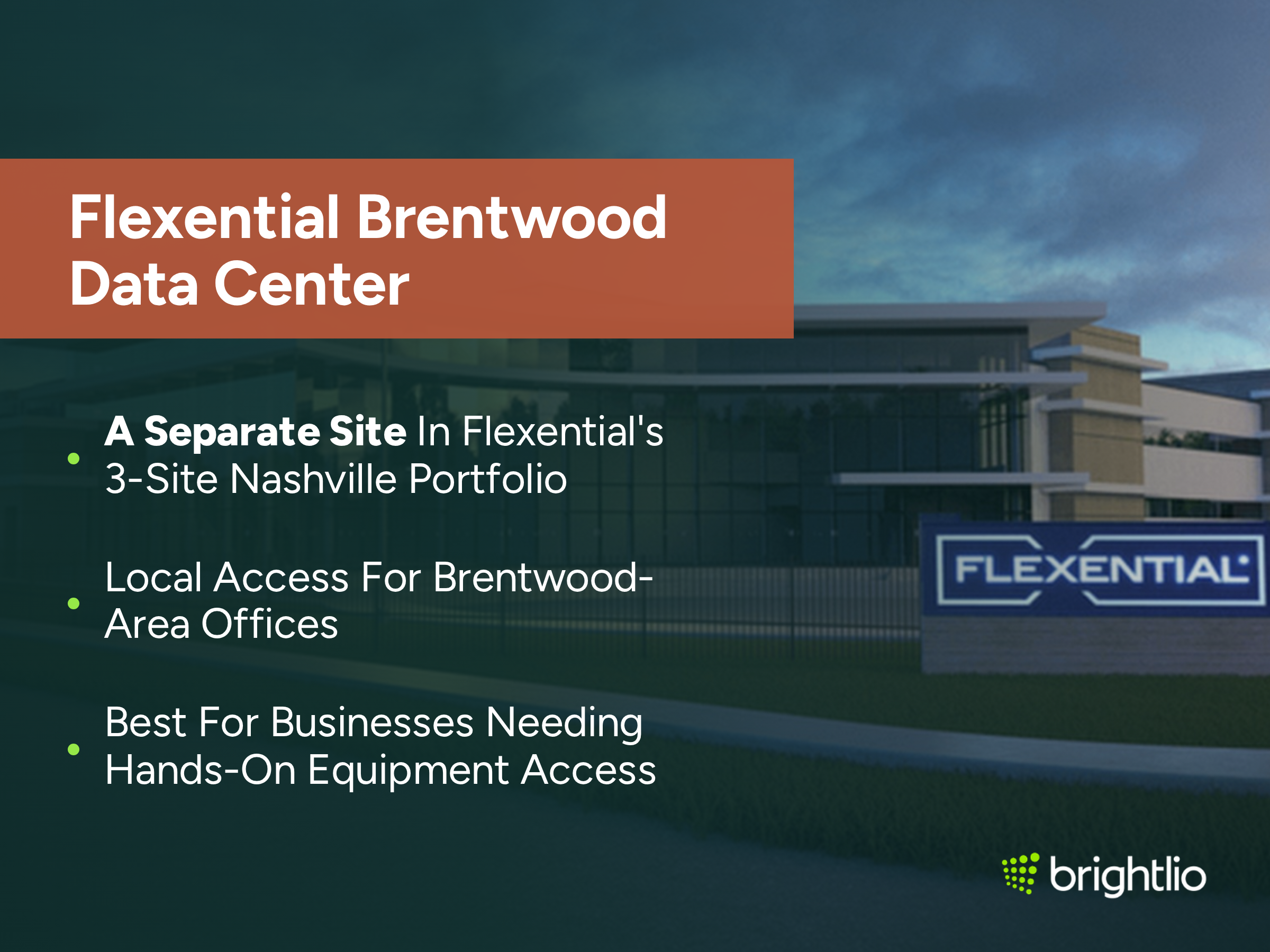
Flexential Brentwood is at 7100 Commerce Way. It is a separate facility within the same three-site Nashville portfolio. The combined portfolio footprint should not be assigned to this building alone.
Brentwood merits a comparison for businesses with nearby offices. Local access can simplify physical equipment work. The decision still depends on the service available at the chosen address.
A Brentwood quote should specify the allocated power and the expected installation date. Ask what expansion requires if the initial deployment grows. Capacity in another Flexential building may involve a move or a new network connection.
Expansion can be difficult if adjacent cabinets are occupied. Ask whether growth space can be reserved. Include the reservation cost when comparing the initial cabinet rate.
Buyers considering Brentwood and Franklin as a recovery pair should request a route review. Confirm whether the two buildings share utility or transport dependencies before treating them as independent locations.
5. Flexential Franklin
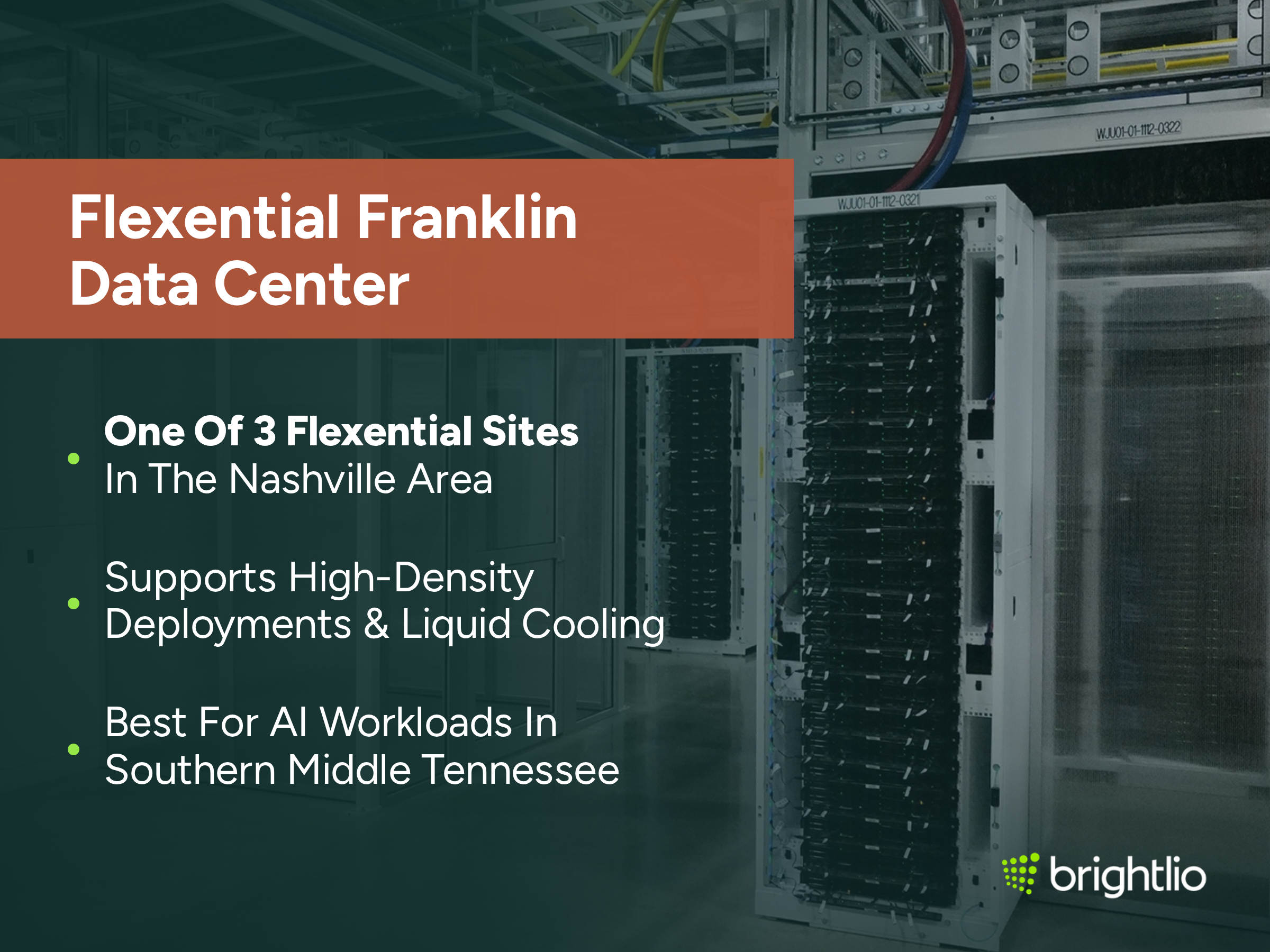
Flexential Franklin is at 4600 Carothers Parkway. It is one of Flexential's three operational Nashville-area facilities.
The location is relevant to enterprise buyers who want to compare southern-suburb facilities under one operator. It should receive its own technical proposal. A service description for the wider Nashville market does not define the configuration available in Franklin.
Flexential describes Franklin as supporting high-density deployments and liquid cooling. Liquid cooling removes heat through a circulating fluid rather than relying entirely on room air. The proposed installation still needs a technical review.
For an AI deployment, start with the power draw of each cabinet. Confirm whether the quoted cooling system supports that density. Establish who supplies the cooling connections before committing to equipment purchases.
Compare Franklin with Cool Springs and Brentwood when southern Middle Tennessee access matters. The available power and cooling at installation should determine which building makes the shortlist.
Recent Nashville Data Center Developments
Nashville's pipeline adds potential commercial capacity, but the three tracked projects have different development stages. The following events explain the market's recent direction.
- November 2024: Meta officially launched the Gallatin campus. The October 10 project snapshot still places Building 5 under construction.
- September 2025: RadiusDC broke ground on Nashville I in Trinity Hills. Its stated plan provides 12 MW of critical power in 102,500 square feet, with opening targeted for 2026.
- February 2026: H5 announced its acquisition of the former 365 Data Centers Nashville facility. The purchase added a separate 19,700-square-foot downtown location at 147 Fourth Avenue North.
- May 2026: Fisk University unveiled its Quantum Leap master plan. The May announcement described a $1 billion campus program. Fisk's current project page gives $900 million. Its technology center remains a 30 MW proposal.
- October 17, 2026 source check: DC BLOX's own project page describes a single 69,200-square-foot, 10 MW building in evaluation. This replaces the earlier two-building, 50 MW scope in the inventory. RadiusDC's current page describes in-service halls, but a dated opening confirmation remains unavailable.
The reconciled development entries total 52 MW: DC BLOX at 10 MW, Fisk at 30 MW, and RadiusDC at 12 MW. If RadiusDC's full critical capacity is confirmed operational, the remaining proposed total would be 40 MW. None of these totals measures vacant power available to a new customer.
Drawbacks And Considerations For Nashville Colocation
Nashville's main constraints affect the scale and certainty of a deployment. The following five considerations deserve attention before a buyer signs a contract.
1. A Smaller Choice Of Providers
The reconciled inventory contains 23 sites, including private campuses and development entries. The number of commercial sites available for a particular requirement is smaller.
Start with the power needed on the installation date. Ask which buildings can meet it. Comparing a shortlist of deliverable facilities is more useful than comparing the metro's headline site count.
2. TVA Costs And Limited Electricity Choice
Nashville customers in NES territory receive TVA-supplied power. They cannot choose a competing retail electricity supplier. The contract therefore needs clear treatment of utility changes.
The statewide 13.94¢/kWh benchmark does not establish a site-specific discount. Ask for the charges included in the quoted price. Check how seasonal adjustments affect the bill.
3. Tornado And Flood Exposure
Severe weather can interrupt access to a building even when backup power works. Cumberland River flooding creates an additional concern at exposed locations.
Review flood exposure at the parcel level. Check how the provider keeps staff and fuel deliveries moving during a regional disruption. A recovery plan should account for an inaccessible facility.
4. Opposition To New Development
DC BLOX's Grassmere Park proposal faces local opposition. Its current 10 MW scope is smaller than the earlier 50 MW plan.
The operator still places the project in evaluation. Customers should not build a deployment plan around proposed capacity alone. A contract needs a clear delivery obligation and a remedy for delay.
5. Limited Evidence Of Large Available Retail Blocks
Lumen Nashville 3 provides a 40,000-square-foot building. Larger commercial footprints exist elsewhere in the metro, including Csquare's campus and Flexential's portfolio. These building and portfolio figures do not establish how much space is available.
Large-suite buyers need evidence of contiguous available space and usable power. A building's floor area does not answer either question. High-density deployments need a separate cooling assessment.
How Brightlio Can Help With Nashville Colocation
Brightlio helps businesses compare Nashville facilities against their deployment requirements. We start with the power needed at installation. We check the expected growth over the contract term.
Our team compares provider proposals and network options. We help customers identify the charges included in each quote. We review available space separately from a campus's eventual design capacity.
For Nashville projects, we pay close attention to the proposed building address. We check carrier availability there and help buyers assess recovery options outside the immediate area.
We can compare cabinet deployments with private cages and suites. We can coordinate a wider market search when local capacity does not meet the requirement.
Request A Nashville Colocation Quote
Alternative Data Center Markets To Compare
Buyers who need more facility choices should compare Atlanta colocation. Evaluate available space using the same power and delivery requirements as the Nashville proposals.
Charlotte can form another Southeast comparison. Chicago is relevant to deployments serving the Midwest. Either choice needs route testing against the application's users.
The right alternative depends on the purpose of the deployment. A recovery location should provide the required separation. A primary site should meet the application's performance requirements at an acceptable total cost.
Frequently Asked Questions
1. How Many Data Centers Are In Nashville?
The reconciled inventory contains 23 sites after separating H5's two downtown buildings. It groups five headline operational facilities, fifteen additional colocation entries, and three development entries. The original October 10 Data Center Map snapshot counts 28 buildings, using a different basis.
2. What Is The Largest Data Center In Nashville?
Meta Gallatin has the largest published capacity in the tracker at 300 MW. The campus is in Gallatin, outside Nashville itself. It is private infrastructure and does not offer retail colocation.
3. Can I Lease Space At Meta Gallatin?
No. Meta operates the campus for its own infrastructure. Businesses seeking commercial space can evaluate Csquare in Gallatin or providers elsewhere in the metro.
4. Is Nashville Colocation Cheap?
A statewide electricity average cannot establish a colocation price. Tennessee's June 2026 commercial rate was 13.94¢/kWh. Compare the same cabinet power allocation across quotes. Include the network service and support needed to operate the deployment.
5. What Tax Incentives Apply To Tennessee Data Centers?
Qualified data centers receive exemptions for eligible equipment and a 1.5% electricity sales tax rate. The requirements include more than $100 million of investment and at least 15 new jobs. A tenant should confirm eligibility for its own purchases separately.
Flexential operates Cool Springs at 425 Duke Drive, Brentwood at 7100 Commerce Way, and Franklin at 4600 Carothers Parkway. The three-site portfolio exceeds 174,000 square feet of raised floor combined. Availability depends on the individual building.
Yes. The older former vXchnge facility has 22,000 square feet at 211 Commerce Street. The separate former 365 Data Centers site has 19,700 square feet at 147 Fourth Avenue North. Carrier information should be confirmed for the chosen address.
A provider must confirm the cabinet power and cooling required by the equipment. Flexential describes high-density capability and liquid cooling at Franklin. Confirm the configuration available for the proposed installation. Csquare's design capacity and RadiusDC's planned capacity require separate availability checks.
It can serve businesses that need a second Middle Tennessee location. A second local facility can share storm or infrastructure exposure with the primary site. Choose the recovery location after checking those shared dependencies.
DC BLOX's current proposal is 10 MW, and Fisk University's Quantum Leap proposal is 30 MW. RadiusDC adds 12 MW in the tracked development group, but its commissioning status is unconfirmed. The group totals 52 MW; the proposed total would be 40 MW if RadiusDC is confirmed operational.

The Brightlio Team brings together experienced technology professionals with deep expertise in data centers, cloud, network infrastructure, and managed services. Through strategic insight and industry knowledge, the team delivers clear, reliable content and solutions that help businesses make informed technology decisions.
Recent Posts

Data Centers In Pennsylvania

Data Centers In Nebraska

Data Centers In Mississippi

Data Centers In Indiana
Let's start
a new project together