
Idaho offers a small but fast-growing data center market for organizations that need affordable power, renewable-heavy electricity, Western U.S. reach, and a lower-density alternative to saturated coastal hubs. Boise anchors the state’s colocation market, while Kuna and Nampa are attracting larger development tied to hyperscale, AI, and single-tenant infrastructure.
The state’s biggest advantage is power. Idaho’s average commercial electricity rate was 9.84¢/kWh in March 2026, which is far below many West Coast markets. Idaho’s in-state electricity mix is renewable-heavy, led by hydropower and supported by wind and solar. That gives operators a useful combination of lower operating cost and cleaner energy sourcing.
Idaho does not yet have the data center density of Northern Virginia, Phoenix, Dallas, Hillsboro, or Silicon Valley. Its strength is more specific: Boise-area colocation, regional disaster recovery, AI-ready edge capacity, renewable energy projects, and large land positions near the Treasure Valley. Meta’s $800 million-plus Kuna campus, T5’s planned Nampa conversion, ValorC3’s new 10 MW Boise facility, and Diode Ventures’ planned Gemstone Technology Park show that Idaho is moving from a niche market into a more serious Western data center location.
Idaho Data Center Infrastructure Overview
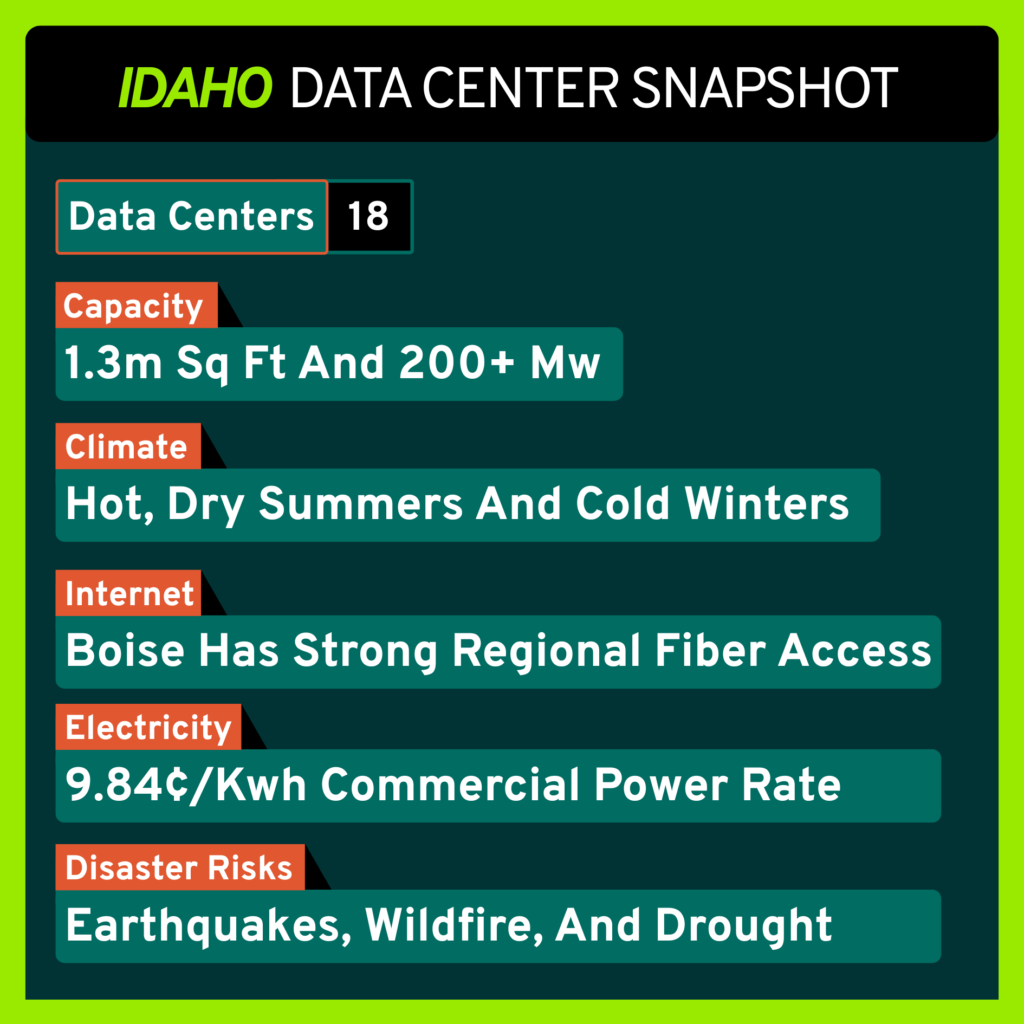
Idaho Data Center Snapshot
- Data centers: DataCenterMap lists 18 data centers across 5 Idaho markets. Boise leads the state with 13 facilities, followed by Coeur d’Alene with 2, plus smaller markets in Weiser, Idaho Falls, and Orofino.
- Capacity: Market trackers count Idaho differently, but capacity-oriented data points to roughly 1.3 million sq ft of data center floor space and more than 200 MW of IT capacity when hyperscale and planned Boise-area projects are included.
- Climate: Boise has hot, dry summers and cold winters. July highs average around 92°F, while January lows average around 25°F. Low humidity supports dry-climate cooling strategies, but summer heat still requires careful cooling design.
- Internet: Boise benefits from regional fiber routes, Syringa Networks’ Idaho fiber footprint, CenturyLink and Lumen assets, Zayo, Comcast, Cogent, and carrier-neutral options in major colocation facilities.
- Electricity: Idaho’s average commercial electricity rate was 9.84¢/kWh in March 2026. This makes Idaho one of the more cost-effective Western states for power-sensitive deployments.
- Grid utilities: Idaho Power serves the Treasure Valley and supports large-load planning for Boise, Nampa, and Kuna projects. Avista and Rocky Mountain Power serve other parts of the state.
- Energy mix: Idaho’s in-state generation is renewable-heavy, with hydropower as the backbone. Wind and solar have expanded, and Meta’s Kuna campus is tied to a 200 MW solar project under Idaho Power’s Clean Energy Your Way program.
- Tax incentives: Idaho offers a data center sales tax exemption for qualifying projects that invest at least $250 million within 5 years and create at least 30 new jobs in Idaho within the first 2 years of operation.
- Disasters: Earthquake risk is the main geologic issue, especially in central and eastern Idaho. Wildfire and drought matter in forested and rural areas, while hurricanes and coastal storm surge are not a concern.
Why Colocate In Idaho?
Colocating in Idaho can reduce power cost, support renewable energy goals, and place infrastructure between Pacific Northwest and Intermountain West markets. The following factors explain where Idaho fits best and what buyers should evaluate before choosing a facility.
1. Market Access And Latency
Idaho gives organizations a practical Western U.S. foothold between Seattle, Portland, Salt Lake City, Reno, and Denver. Boise sits on Interstate 84 and gives companies access to the Pacific Northwest, Mountain West, and inland Western markets from one regional base.
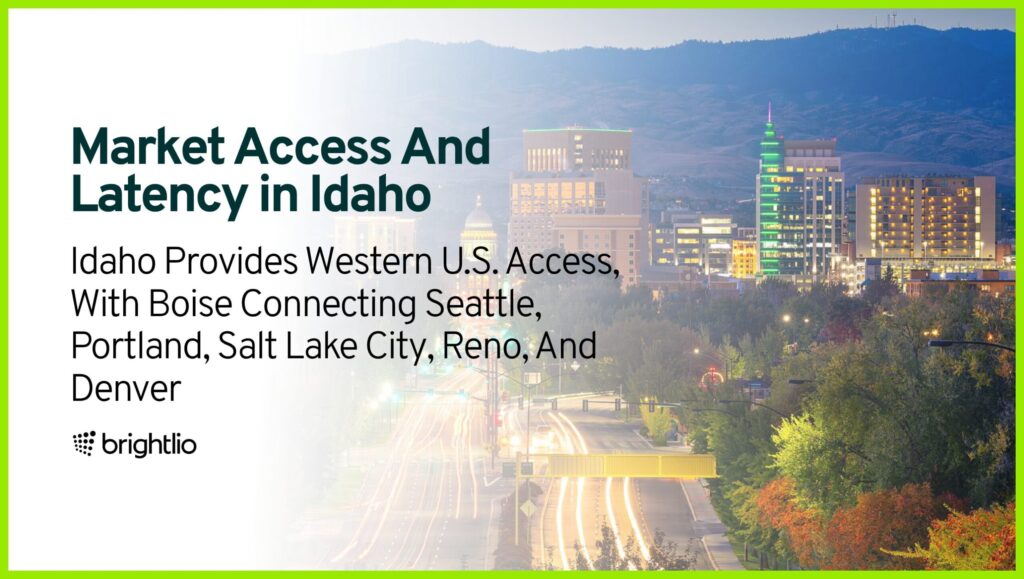
The Boise area works well for disaster recovery and production workloads that do not need to sit inside Seattle, Portland, San Francisco, or Salt Lake City. Companies with users across Idaho, eastern Oregon, eastern Washington, Utah, Montana, and Wyoming can use Boise colocation to shorten regional paths and reduce dependence on crowded coastal data center markets.
Idaho is not a primary public cloud region. Most cloud-heavy deployments still connect into Oregon, Utah, Washington, California, or Nevada. The best architecture often pairs an Idaho colocation site with private transport to nearby cloud regions and interconnection hubs.
2. Network Connectivity And Peering
Boise is Idaho’s main network hub. The market includes carrier-neutral colocation sites, regional fiber providers, and long-haul connectivity into the Pacific Northwest and Mountain West. Syringa Networks is especially important because it has served Idaho since 2002 and expanded its Boise fiber footprint through former Level 3 metro network assets.
Major facility carrier lists vary by site. ValorC3’s Boise facility lists CenturyLink, Zayo, Syringa, Level 3, Cogent, and Comcast. Centeris Boise lists Qwest, 360 Networks, Time Warner, and Integra through diverse routes. These options give buyers the ability to compare redundancy, private line availability, cloud connectivity, and bandwidth pricing.
Idaho does not have the deep peering density of Seattle, Portland, Silicon Valley, Los Angeles, or Northern Virginia. Companies that need heavy internet exchange access should plan transport into major peering markets. Companies that need regional connectivity, managed services, disaster recovery, private circuits, or hybrid cloud access can often meet those needs from Boise.
3. Power, Cost, And Sustainability
Idaho’s power profile is the strongest reason to consider the state. Commercial electricity prices are low compared with many Western markets, and hydropower gives Idaho a renewable-heavy generation base. That combination can lower ongoing operating cost and support sustainability goals for organizations with data center carbon reporting requirements.
Meta’s Kuna Data Center shows how large customers can use Idaho’s energy profile. Meta is working with Idaho Power on a 200 MW solar project and a green tariff through the Clean Energy Your Way program. The company says its data center electricity use is matched with 100% clean and renewable energy.
Boise-area colocation providers use the state’s energy profile in their positioning. Centeris describes its Boise site as powered by hydroelectric and wind sources. Modern projects, including ValorC3’s planned 10 MW Boise facility and T5’s Nampa conversion, point to closed-loop or air-cooling designs that reduce water use relative to more water-intensive cooling models.
4. Tax Policy And Incentives
Idaho’s data center sales tax exemption is a major incentive for large projects. The program applies to server equipment and construction materials for qualifying data center facilities. Projects must create and maintain at least 30 new jobs in Idaho within the first 2 years after operations begin, pay at or above the county average wage, and invest at least $250 million within 5 years after construction begins.
This incentive helps explain why Idaho has attracted hyperscale and large single-tenant interest. Server hardware, electrical systems, cooling components, and construction inputs can represent a large capital expense, so sales and use tax relief can materially affect project economics.
The incentive is not designed for every colocation buyer. Smaller deployments renting cabinets or cages usually benefit indirectly through provider pricing rather than direct tax relief. Large enterprise or single-tenant projects should review eligibility, clawback risk, wage requirements, timing, and whether the project can use other state incentives.
5. Workforce And Ecosystem
Idaho’s workforce is strongest around Boise, where healthcare, semiconductors, software, education, public sector operations, and advanced manufacturing create a practical technology labor base. Micron Technology anchors the semiconductor ecosystem, while Boise State University, the University of Idaho, Idaho State University, and College of Western Idaho support the broader talent pipeline.
The state’s labor market is tight. Idaho’s unemployment rate was 3.6% in April 2026, and the labor force was just over 1 million people. That signals a healthy economy, but it can make specialized hiring competitive for network engineers, facility technicians, electricians, security staff, and critical operations roles.
Boise is the best fit for organizations that need local staffing and vendor support. Rural or edge-oriented sites in smaller Idaho markets may need stronger remote hands agreements, regional field teams, and clear maintenance coverage.
6. Risk And Resiliency
Idaho has a different risk profile from coastal and southern data center markets. It has no hurricane exposure, no coastal storm surge, and lower tornado risk than many central states. That makes Idaho attractive for disaster recovery designs that need physical separation from coastal and severe storm zones.
Earthquake risk is the main geologic issue. The Idaho Geological Survey describes Idaho as earthquake country, with some of the largest recorded Intermountain West earthquakes occurring in or near the state. The 1983 M6.9 Borah Peak earthquake and the 2020 M6.5 Stanley earthquake show why seismic design matters.
Wildfire, drought, and smoke are seasonal concerns, especially in forested and rural areas. Boise Valley facilities usually face lower direct wildfire exposure than mountain communities, but smoke, grid stress, and regional emergency response conditions still belong in continuity planning. Buyers should review seismic design, utility redundancy, generator runtime, fuel contracts, fire risk, floodplain status, and carrier path diversity.
Key Cities Or Submarkets In Idaho
Idaho’s data center market is concentrated in the Boise metro area, with additional activity in Nampa, Kuna, Coeur d’Alene, Idaho Falls, Weiser, and Orofino. The following submarkets show where capacity, connectivity, and development activity are most visible.
1. Boise
Boise is Idaho’s primary data center market. It has the state’s largest concentration of colocation facilities, fiber routes, enterprise demand, and technical labor. DataCenterMap lists Boise as the clear state leader with 13 facilities.
Boise supports enterprise colocation, managed services, hybrid cloud connectivity, disaster recovery, and AI-adjacent capacity growth. The market includes Centeris Boise, ValorC3 Boise, Ark Data Centers Boise, Lumen and legacy telecom sites, and other carrier infrastructure.
Boise is best for companies that need regional support, lower power cost than coastal hubs, and strong access to the Treasure Valley business community. It is the first Idaho market most colocation buyers should evaluate.
2. Kuna
Kuna has become Idaho’s highest-profile hyperscale submarket because of Meta’s $800 million-plus data center campus. The project broke ground in 2022 and is planned to support approximately 1,000 skilled trade workers at peak construction, with operational jobs once complete.
Meta’s project is tied to renewable energy procurement and major local infrastructure work. The company invested $70 million in a water and wastewater treatment system given to the City of Kuna, with reuse systems designed to support irrigation water for non-edible crops.
Kuna is also the location of Diode Ventures’ planned Gemstone Technology Park, a 620-acre potential data center site in southeast Kuna. The project remains tied to planning, power, fiber, water, wastewater, traffic, and community review. Kuna is best understood as Idaho’s emerging large-campus data center market.
3. Nampa
Nampa is becoming more relevant because of T5 Data Centers’ planned conversion at 8300 Birch Lane. The 80,000 sq ft industrial building in the Park 84 industrial site is planned as a single-user data center in five phases.
The project is expected to use around 2.5 MW initially and expand to 8.25 MW over 2 to 5 years. T5 told local officials the site would use air-cooling and have limited water needs compared with larger water-intensive data centers.
Nampa benefits from proximity to Boise, Interstate 84, industrial zoning, land availability, and Idaho Power capacity planning. It is a practical option for single-tenant, AI, enterprise, and regional infrastructure users that need Treasure Valley access outside central Boise.
4. Coeur d’Alene
Coeur d’Alene gives Idaho a northern submarket with access to Spokane, eastern Washington, northern Idaho, and western Montana. The market is smaller than Boise, but it may fit companies with regional operations in the Inland Northwest.
Connectivity and facility options are more limited than in Boise. Buyers should validate carrier availability, power density, remote hands, backup generator design, and latency targets before using Coeur d’Alene for production workloads.
Coeur d’Alene is best for regional continuity, edge workloads, local business support, and secondary infrastructure tied to northern Idaho or Spokane-area operations.
5. Idaho Falls
Idaho Falls supports eastern Idaho and has relevance for energy, research, public sector, healthcare, and regional enterprise needs. Its proximity to Idaho National Laboratory gives the area a stronger technical and energy-sector identity than many smaller markets.
The local data center footprint is limited. Organizations looking at Idaho Falls should evaluate it as a niche regional site rather than a deep colocation hub. Use cases may include backup infrastructure, local hosting, municipal services, edge workloads, and workloads tied to eastern Idaho operations.
6. Weiser And Orofino
Weiser and Orofino represent smaller Idaho data center markets. These locations do not compete with Boise for scale, carrier density, or enterprise demand, but they may matter for edge infrastructure, telecom support, and local service delivery.
Buyers should be careful with smaller markets. Power cost may be attractive, but uptime planning depends on carrier paths, utility redundancy, physical access, and remote hands coverage. These submarkets are best for narrow use cases rather than broad production colocation.
Notable Colocation Providers And Facilities In Idaho
Idaho has a mix of established Boise colocation providers, hyperscale development, and planned Treasure Valley projects. The following providers and facilities show where Idaho’s current and near-term data center capacity is concentrated.
1. Centeris Boise Data Center
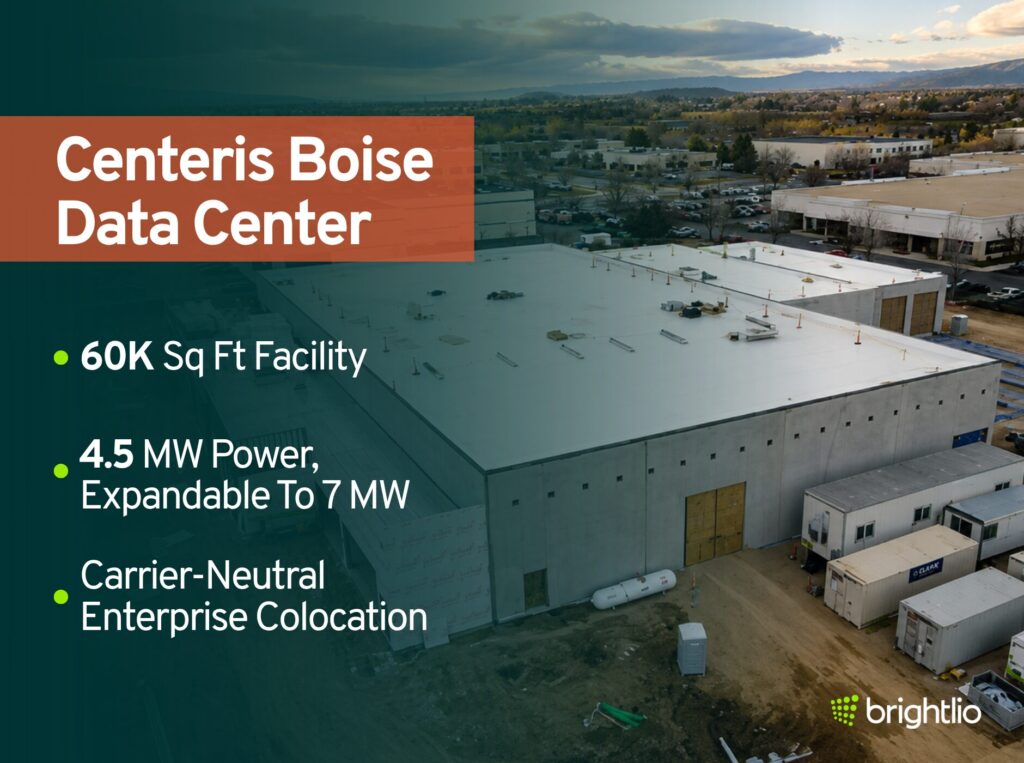
Centeris Boise is located at 9700 W. Bethel Court in Boise. The facility was formerly operated by HP and later associated with DataSite. It includes a 60,252 sq ft plug-and-play building with 28,958 sq ft of raised floor space across east and west wings.
The site sits on a secured 5-acre property and includes office space, common areas, and conference rooms. It provides 4.5 MW of utility power with expansion potential to 7 MW and uses a 7.75 MW onsite diesel generator for emergency power.
Centeris Boise is carrier-neutral and lists access to Qwest, 360 Networks, Time Warner, and Integra through diverse pathways. It is a strong fit for enterprise colocation, medium-density deployments, business continuity, and customers that value hydro and wind power sourcing.
2. ValorC3 Boise Data Center
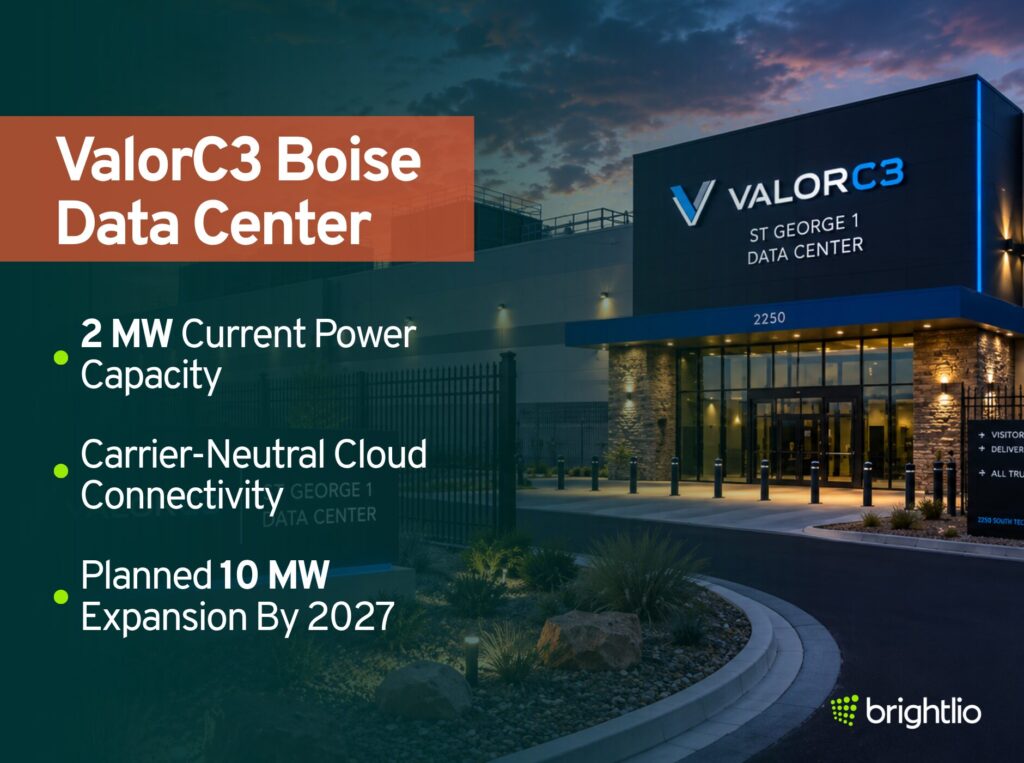
ValorC3’s Boise facility at 10215 W. Emerald Street supports colocation, cloud, connectivity, and managed services. The current site provides 2 MW of total power capacity, N+1 redundant generators and UPS, 48-plus hours of onsite fuel runtime, and carrier-neutral connectivity.
The carrier list includes CenturyLink, Zayo, Syringa, Level 3, Cogent, and Comcast. ValorC3 also positions the facility for direct access to AWS, Azure, Google Cloud, Oracle Cloud, and IBM Cloud through Megaport-enabled connectivity.
ValorC3 announced a second Boise data center in May 2025. The planned facility is expected to deliver 10 MW of capacity, use carrier-neutral infrastructure, support air and liquid cooling, and become operational in 2027. Upon completion, ValorC3 expects to offer 12 MW of total capacity in the Boise market.
3. Ark Data Centers Boise
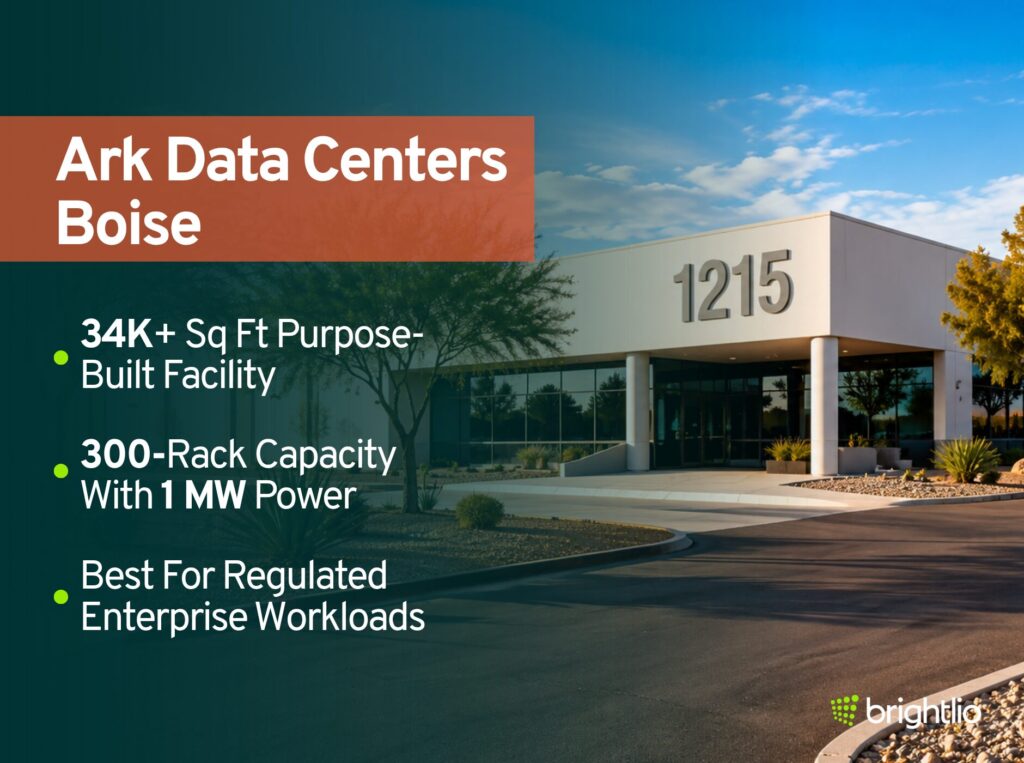
Ark Data Centers operates a Boise facility at 2653 South Victory View Way. The site was formerly known as Involta Boise and is positioned as a purpose-built colocation facility for mission-critical infrastructure.
Ark describes the Boise site as a 34,000-plus sq ft facility with environmental controls, redundant backup power, HVAC, specialized fire detection, reinforced concrete construction, and redundant fiber connections. The facility includes 10,000 sq ft of conditioned data center space, 300-rack capacity, and 1,000 kW of power capacity.
The facility supports private or shared colocation, suites and halls, storage, office space, biometric security, 24/7/365 critical monitoring, and SOC 2 facility assessment. It is a strong fit for regulated enterprises, healthcare, financial services, and organizations that need managed regional support.
4. Meta Kuna Data Center
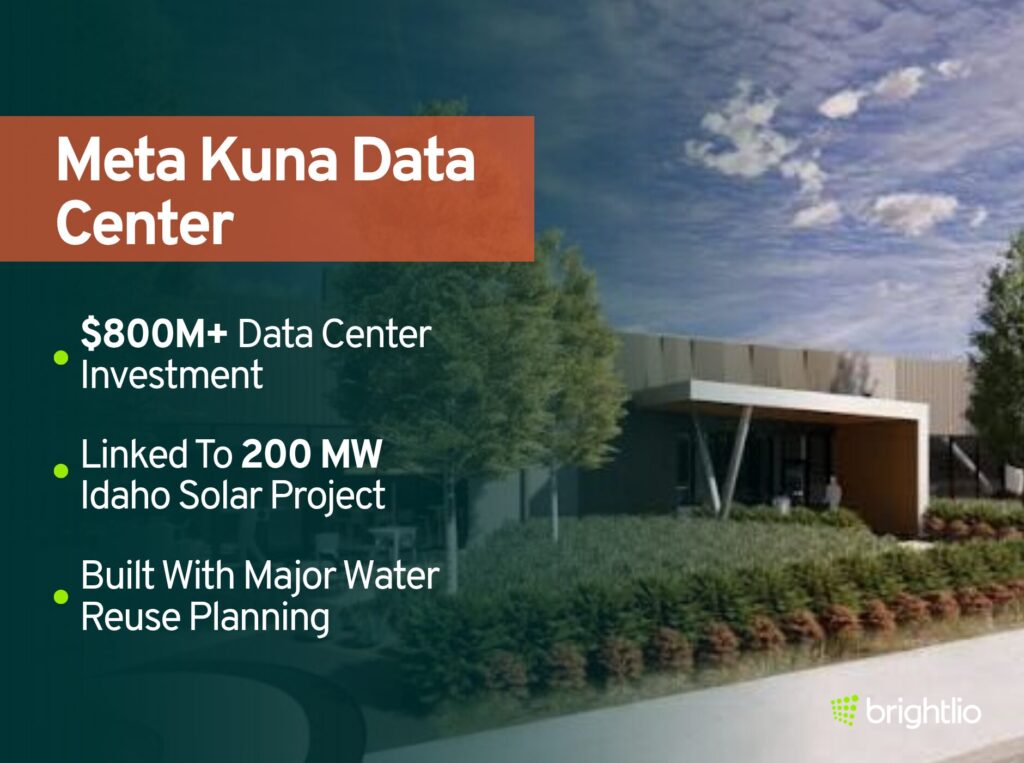
Meta’s Kuna Data Center is Idaho’s highest-profile hyperscale project. Meta reports more than $800 million in data center investment in Idaho, a 2022 groundbreaking, about 1,000 skilled trade workers at peak construction, and more than 25 operational jobs supported once complete.
The Kuna campus is tied to a 200 MW solar project in Idaho and a green tariff under Idaho Power’s Clean Energy Your Way program. Meta says the campus is part of its global infrastructure and that its data center electricity use is matched with 100% clean and renewable energy.
Water management is a major part of the project. Meta invested $70 million to build a water and wastewater treatment system given to the City of Kuna. The system supports reuse of treated campus wastewater for irrigation water for non-edible crops.
5. T5 Data Centers Nampa
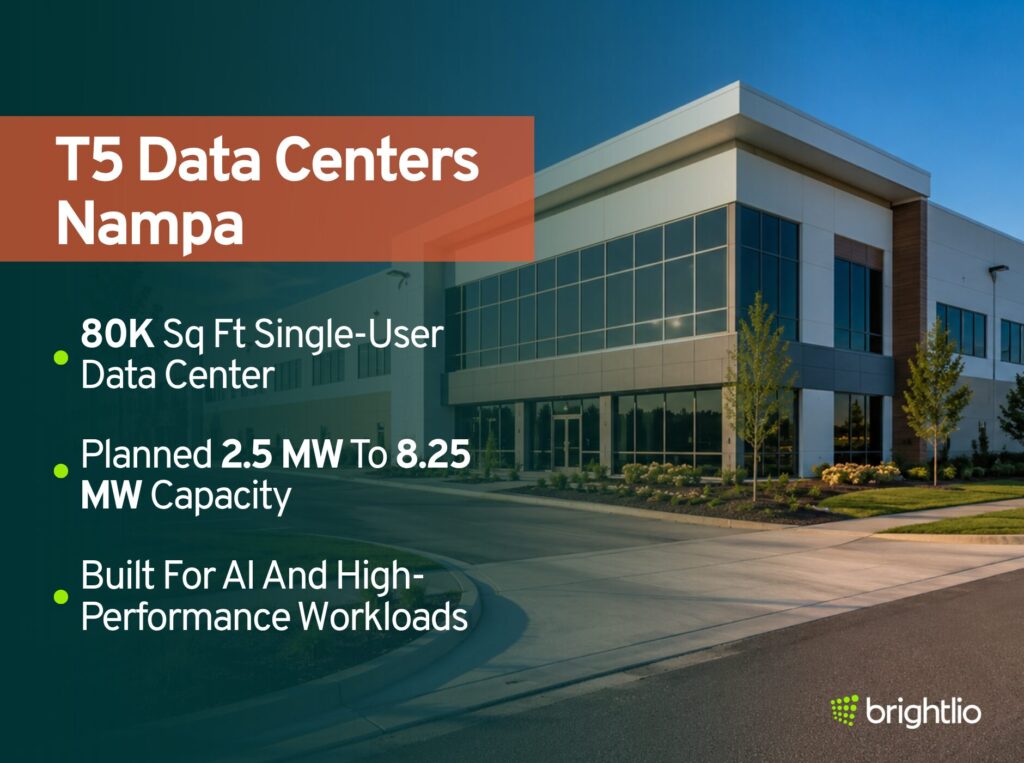
T5 Data Centers received approval to convert an 80,000 sq ft industrial building at 8300 Birch Lane in Nampa into a single-user data center. The site is part of the Park 84 industrial area and is planned across five phases.
The project is expected to start around 2.5 MW and grow to 8.25 MW over 2 to 5 years. T5 told the Nampa Planning and Zoning Commission that the project would use air-cooling and have limited power and water needs compared with many larger data centers.
T5 Nampa is important because it shows demand outside Boise city limits. The project fits single-tenant infrastructure, AI and high-performance workloads, and companies that want Treasure Valley access with an industrial site profile.
6. Diode Ventures Gemstone Technology Park
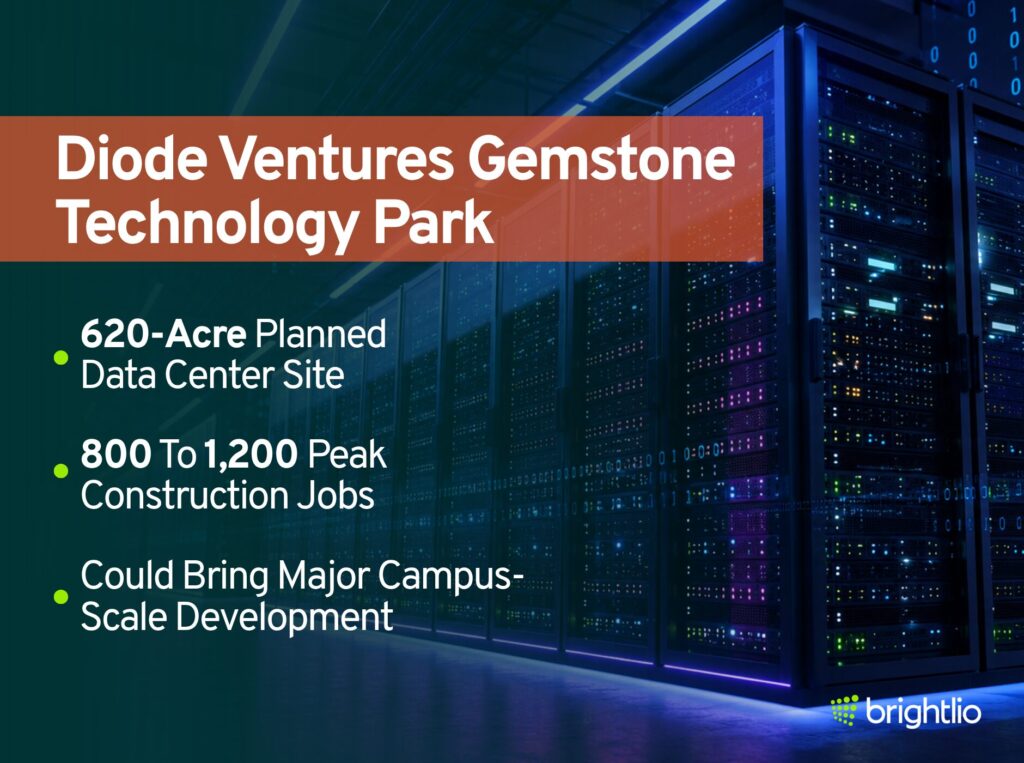
Diode Ventures is developing Gemstone Technology Park as a potential 620-acre data center site in southeast Kuna. The project is still in planning, with power, fiber, water, wastewater, traffic, and community details under review.
Diode says the project could bring major community investment, including $30 million over 13 years to support Kuna Rural Fire District staffing, $10 million over 20 years for Kuna Police, and $500,000 for Kuna School District athletics and technology funds. The company expects approximately 800 to 1,200 construction jobs at peak buildout and more than 100 permanent jobs once operating.
Gemstone matters because it could place Idaho in the running for larger campus-style data center development. The project still needs careful review because large-load sites can affect power planning, land use, traffic, noise, and local community expectations.
Recent Developments In Idaho (Last 12 To 24 Months)
- May 2025: ValorC3 announced a new 10 MW Boise data center. The planned facility is expected to become operational in 2027 and bring ValorC3’s Boise market capacity to 12 MW.
- September 2025: T5 Data Centers received approval to convert an 80,000 sq ft industrial building in Nampa into a single-user data center. The project is planned in five phases, starting around 2.5 MW and expanding to 8.25 MW.
- 2025: Diode Ventures advanced Gemstone Technology Park in Kuna. The 620-acre potential data center site drew attention for its scale, power needs, community funding commitments, and land-use implications.
- 2025: Meta’s Kuna campus moved through major construction. The company’s Idaho data center investment exceeds $800 million and is tied to a 200 MW solar project and a $70 million water and wastewater system for the City of Kuna.
- March 2026: EIA data showed Idaho’s average commercial electricity price at 9.84¢/kWh, keeping the state highly competitive against many Western markets.
- April 2026: Idaho’s unemployment rate remained at 3.6%, showing a stable but competitive labor market for technical and operations hiring.
- 2026: Idaho continued to review data center tax policy. Legislative proposals have signaled closer attention to electricity cost allocation, sunset dates, and the scope of exemptions, even though Idaho’s core data center incentive remains an important attraction for large projects.
How Brightlio Can Help With Colocation In Idaho
Brightlio helps organizations compare Idaho colocation, cloud connectivity, and data center sourcing options across Boise, Kuna, Nampa, and nearby Western markets. Our team helps clients evaluate power cost, available capacity, carrier options, cloud access, compliance needs, cooling design, and disaster recovery strategy.
We compare providers such as Centeris, ValorC3, Ark Data Centers, T5, and other regional operators to match workloads with the right facility profile. For Idaho projects, we pay close attention to power density, long-term electricity exposure, renewable energy claims, seismic design, generator runtime, fuel contracts, water use, and expansion rights.
Brightlio can support cabinet, cage, private suite, single-tenant, hybrid cloud, and multi-site disaster recovery planning. Contact Brightlio to start planning a cost-effective and resilient colocation deployment in Idaho.
Readers who found this overview of data centers in Idaho useful may be interested in these regional guides covering other major U.S. data center markets.
Which U.S. State Has The Most Data Centers?
Virginia has the largest concentration of data centers in the United States.
Northern Virginia, especially Ashburn and Loudoun County, leads because it has dense fiber networks, major cloud infrastructure, large power delivery systems, experienced operators, and a long history of enterprise and hyperscale development. Texas, Georgia, Ohio, Arizona, and other states are growing quickly, but Virginia remains the best-known U.S. data center hub.
Who Is Building Data Centers In Idaho?
Meta, ValorC3, T5 Data Centers, Diode Ventures, Centeris, and Ark Data Centers are among the most visible data center operators or developers in Idaho.
Meta is building its large Kuna Data Center with more than $800 million in investment. ValorC3 is expanding in Boise with a planned 10 MW facility expected in 2027. T5 is converting an 80,000 sq ft industrial building in Nampa for a single user. Diode Ventures is planning the 620-acre Gemstone Technology Park in Kuna. Centeris and Ark Data Centers operate established Boise colocation facilities.
Idaho’s market is still smaller than major hubs such as Northern Virginia, Dallas, Phoenix, Hillsboro, and Atlanta. Its growth is centered on Boise-area colocation, renewable-powered hyperscale development, AI-ready capacity, and large land positions in the Treasure Valley.
Why Are People Protesting Against Data Centers?
People protest against data centers because large facilities can affect electricity demand, water use, noise, land use, local tax policy, and community character.
In Idaho, public concern has focused most heavily on large projects near Kuna and Nampa. Residents have raised questions about power rates, water use, visual impact, traffic, emergency services, farmland conversion, and whether permanent jobs justify the size of proposed campuses.
Common concerns include high electricity demand, backup generator noise, cooling equipment noise, water consumption, land clearing, limited permanent employment, and tax incentives. Strong project review usually requires clear answers about power sourcing, who pays for grid upgrades, water systems, sound levels, fire protection, road impacts, tax revenue, and long-term community benefits.

Tamzid is a cybersecurity researcher with 5+ years of experience across SaaS, security, compliance, data centers and cloud. He writes for brightdefense.com and hipaasimple.com, covering security, compliance, and infrastructure topics. Certified through Cisco, Fortinet (NSE 1), and the Basel Institute on Governance in OSINT, he grounds his work in primary sources and verified data.
Recent Posts
What Is a Data Center?
10 Largest AI Data Centers in the World

Data Centers In Oklahoma: Why You Must Colocate
Data Center and Colocation In North Dakota
Let's start
a new project together