
Every time we stream a movie, scroll through social media, or back up files to the cloud, we’re tapping into the power of massive data centers. But those facilities don’t just pop up randomly. They’re clustered in key locations across the U.S. where power, space, and connectivity come together.
In this post, we look at the 10 biggest data center locations in the United States as of mid-2026. These are the regions that host sprawling campuses of servers, operated by some of the world’s biggest tech and infrastructure companies. We’ll break down where they are, why they matter, and who’s leading the charge in each one.
For anyone who has wondered where “the cloud” actually lives, this is your behind-the-scenes look.
Key Takeaways
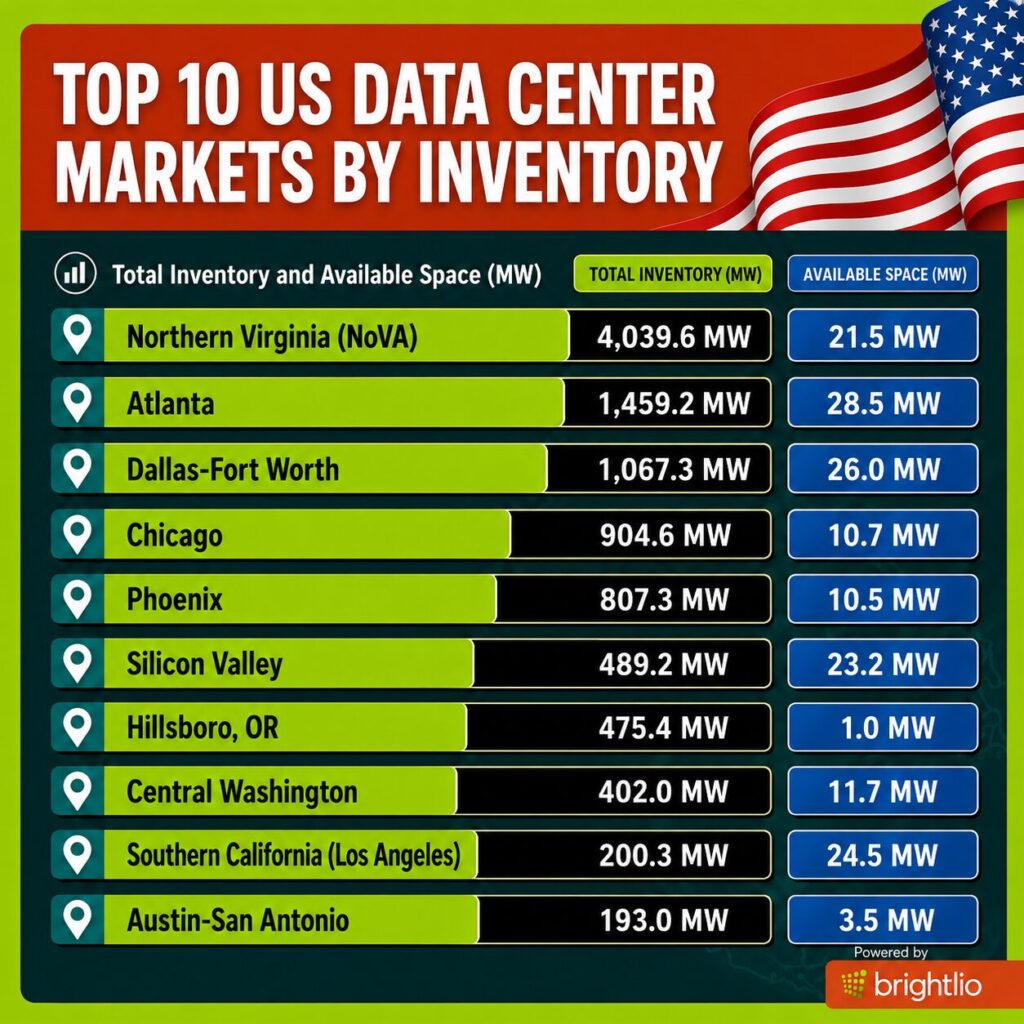
- Northern Virginia is the top U.S. data center hub with 300+ facilities and 4,039.6 MW of inventory, nearly three and a half times more capacity than all secondary U.S. markets combined, hosting AWS, Equinix, and Digital Realty.
- Atlanta now ranks second with 1,459.2 MW of inventory and 2,076 MW under construction, the fastest-growing major market in the country.
- Dallas-Fort Worth ranks third at 1,067.3 MW, the third U.S. market to surpass 1 gigawatt, while Chicago ranks fourth and now carries the nation’s highest rental rates.
- Phoenix (807.3 MW) and Silicon Valley (489.2 MW) round out the established markets, while Hillsboro, Oregon and Central Washington have entered the top 10 on the strength of cheap power and hyperscale demand.
- Austin-San Antonio and Southern California surpassed the New York Tri-State area in inventory in 2025 for the first time since CBRE began tracking the market.
- The largest U.S. data center is Switch’s TAHOE RENO 1 in Nevada, while major operators include Equinix, CoreSite, and Digital Realty.
Where Is the Largest Data Center in the US?
Switch’s Citadel Campus, located at the Tahoe Reno Industrial Center near Reno, Nevada is the largest data center campus in the United States.
The full campus is planned to provide up to 7.2 million square feet of data center space and massive power capacity across multiple facilities. Its first operational building, Tahoe Reno 1, covers about 1.3 million square feet and supports up to 130 megawatts of renewable power, making it one of the largest individual colocation data center buildings in the country.
Where Is the Biggest AI Data Center in the USA?
The biggest planned AI data center campus in the United States is Meta’s Hyperion campus in Richland Parish, Louisiana, near Holly Ridge.
The facility remains under construction and is planned to deliver 5 gigawatts of capacity, making it larger by projected capacity than other major U.S. AI developments. The largest operating AI data center is currently xAI’s Colossus 2 near Memphis, Tennessee, which draws 946 MW of IT power and holds an estimated 1.1 million H100-equivalents of compute.
What U.S. Cities Have the Most Data Centers?
The largest U.S. data center concentration is in Ashburn and Northern Virginia, commonly called Data Center Alley. Other major data center cities and metropolitan markets include Dallas–Fort Worth, Phoenix, Chicago, Atlanta, San Jose and Santa Clara in Silicon Valley, New York and Northern New Jersey, and Hillsboro near Portland, Oregon.
Northern Virginia remains the largest established market by operational capacity, while Dallas, Atlanta, and Phoenix are among the fastest-growing locations for new hyperscale and AI data center construction. Industry reports generally rank metropolitan markets rather than individual city limits because many facilities are built in surrounding suburbs with cheaper land and greater power availability.
What Are the Largest Data Centers Under Construction in the USA?
The largest U.S. data center project under active site development is Fermi America’s Project Matador near Amarillo, Texas, which is planned for up to 11 gigawatts of capacity and 18 million square feet of AI infrastructure, although much of the phased buildout remains dependent on future power plants and tenants. Meta’s Hyperion campus in Richland Parish, Louisiana, is the largest firmly confirmed AI data center campus under construction, with its planned compute capacity recently increased to 5 gigawatts.
Other major developments include Amazon’s Northern Indiana expansion, which is expected to add 2.4 gigawatts across multiple campuses; Vantage Data Centers’ 1.4-gigawatt Frontier campus in Shackelford County, Texas; and the 1.2-gigawatt Stargate campus in Abilene, Texas, where completed buildings are operating while additional facilities remain under construction.
Overview of US Data Centers
The United States is home to a vast and growing data center industry, with numerous primary data center markets and a wide range of data center services available. As a result, the country’s data center infrastructure is designed to support the increasing demand for data storage and processing, driven by the growth of cloud computing, big data, and the Internet of Things (IoT).
The market is expanding at a record pace. Supply across the eight primary U.S. markets grew 36% year over year to 9,432 MW at year-end 2025, net absorption hit a record 2,497.6 MW, and vacancy fell to a historic low of 1.4%, according to CBRE.
1. Northern Virginia: America’s Data Center Capital
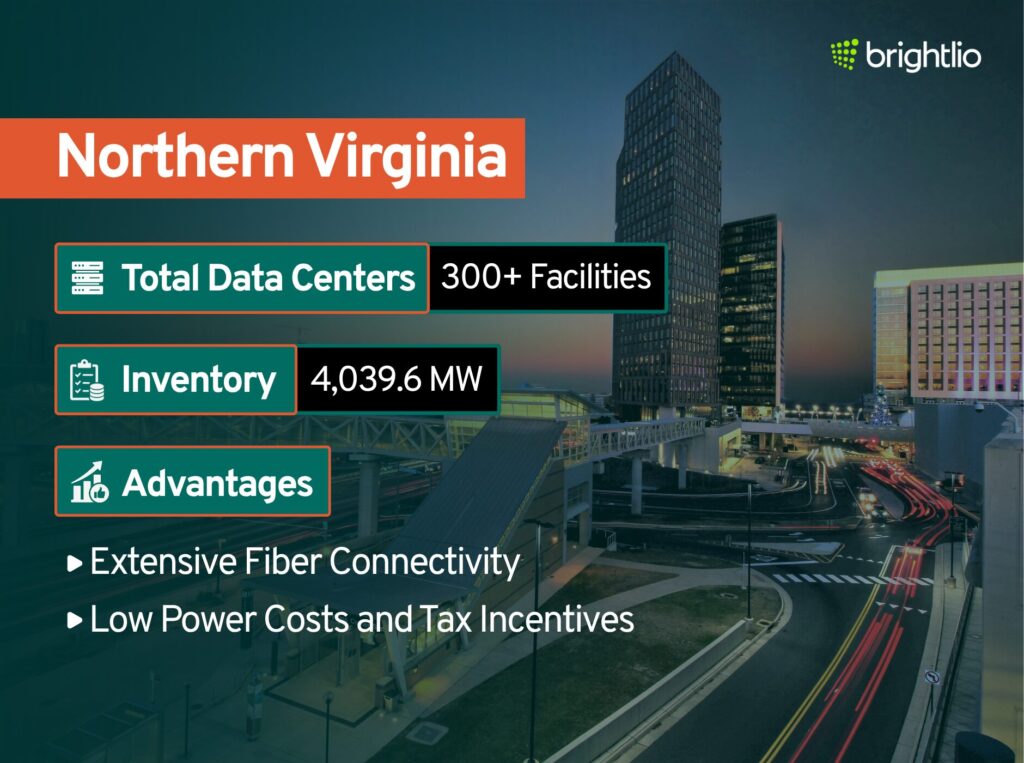
Northern Virginia is the largest data center market in the world, concentrated across Loudoun, Prince William, and Fairfax counties. The region closed 2025 with 4,039.6 MW of total inventory, up 37% in a single year, and became the first market to deliver more than 1 gigawatt of new capacity in one year.
Loudoun County, centered on Ashburn and Sterling, anchors the cluster, with Prince William and Fairfax adding depth around Manassas, Reston, and Bristow.
Supply cannot keep pace with demand. The region recorded 1,102 MW of net absorption in 2025, a 144% jump over the prior year, while vacancy fell to 0.5%, the lowest of any primary market.
Only 21.5 MW of capacity remained available at year-end, 96% of supply scheduled for 2026 already carries commitments, and preleasing now extends into 2027. Asking rates for requirements above 10 MW reached $155 to $185 per kW/month.
Grid Constraints Now Set The Pace
Power availability now sets the ceiling on new development. Dominion Energy serves roughly 450 data centers across Virginia and forecasts that peak load in its PJM delivery zone will climb 121% between 2025 and 2045, faster than any other zone in the regional grid.
Its connection queue holds about 25,000 MW of projects with committed energization dates and another 75,000 MW without them.
To spread infrastructure costs, Virginia's State Corporation Commission approved a dedicated GS-5 rate class for customers drawing more than 25 MW in November 2025. Starting in January 2027, those customers must cover at least 85% of contracted transmission and distribution demand and 60% of generation demand.
Dominion's batching system for connection approvals continues to lengthen delivery timelines, pushing new campuses south along the I-95 corridor toward Stafford, Spotsylvania, and Richmond.
A Global Connectivity Hub
Northern Virginia sits at the densest fiber intersection in North America. Equinix's DC2 facility in Ashburn operates as a primary interconnection point for carriers and cloud platforms, while the region ties into transatlantic subsea systems including MAREA and BRUSA through Virginia Beach landing stations.
Fiberlight acquired a 200-mile network to link the Northern Virginia campuses with those Virginia Beach cable landing stations, shortening the path between inland servers and transoceanic capacity.
Tax Structure And Local Revenue
Loudoun County taxes data center computer equipment at its general personal property rate and pairs that with a Virginia sales and use tax exemption on qualifying equipment.
To claim the exemption, an operator must invest at least $150 million in new capital and create at least 50 jobs paying 150% of the local average wage.
Data centers occupy about 4% of the county's commercial parcels yet generate 38% of its general fund revenue, which has let the board cut the residential real property rate from $1.145 to $0.805 per $100 of assessed value between 2016 and 2025.
On March 18, 2025, the Loudoun Board of Supervisors adopted zoning amendments that require a special exception for new data center projects, ending the prior by-right approval path.
Key Data Center Operators
Northern Virginia supports the full range of hyperscale, wholesale, and colocation development.
- Amazon Web Services - Purchased 189 acres in Prince William County for new development and is building the Lake Anna Technology Campus in Louisa County, planned for more than 1.7 million square feet across seven buildings.
- Digital Realty - Operates multiple Ashburn campuses that anchor the region's interconnection ecosystem and global colocation footprint.
- Equinix - Runs its DC platform in Ashburn, including DC2, home to one of the largest peering exchanges on the US East Coast.
- Vantage Data Centers - Is investing $2 billion in a 929,000-square-foot campus in Stafford County.
- CleanArc Data Centers - Began construction on a 900 MW campus in Caroline County, extending development well south of the core.
Northern Virginia's installed base, interconnection density, and revenue-positive tax structure keep it at the center of the global data center market. Power delivery timelines and transmission buildout will govern how fast the region adds capacity, though committed demand reaching into 2027 shows no slowing of tenant interest.
2. Atlanta: Growing Hub with Economic and Connectivity Advantages
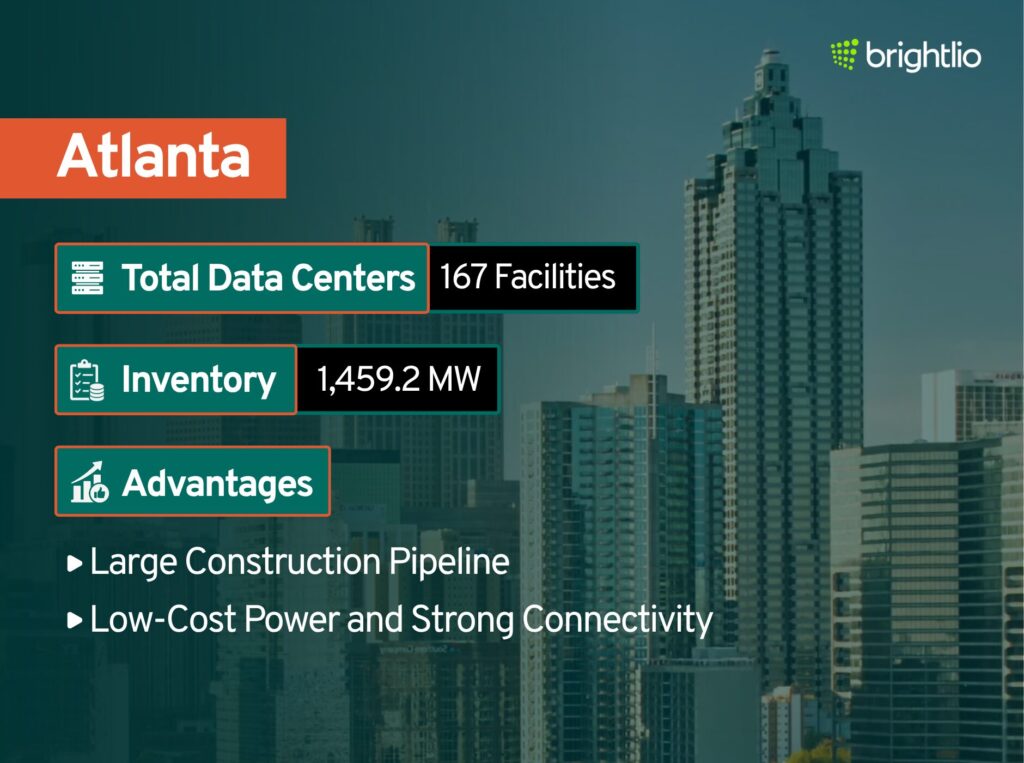
Atlanta is the second-largest data center market in the United States, spread across the metro core and suburban counties including Douglas, Fulton, and Coweta. The market closed 2025 with 1,459.2 MW of total inventory, up 458.8 MW in a single year. Downtown, the carrier hotel at 56 Marietta Street (ATL13) anchors regional interconnection, housing hundreds of networks inside a 10-story building.
Atlanta claimed the national lead for growth in 2024, then held its momentum as Northern Virginia reclaimed the top absorption spot in 2025. The market recorded 456 MW of net absorption last year, and vacancy tightened to 2% despite heavy delivery volume. Its 2,076 MW under construction ranks among the largest pipelines in the country.
Power Commitments Now Drive The Market
Electricity availability shapes every stage of Atlanta's growth. Georgia Power's approved 2025 Integrated Resource Plan projects roughly 8,500 MW of load growth over six years, up from a 400 MW estimate as recently as 2022.
On December 19, 2025, the Georgia Public Service Commission certified 9,985 MW of new generation, with about 80% of that capacity expected to serve data centers. Georgia Power projects spending more than $52 billion on grid expansion through 2030.
The state moved to shield other ratepayers from that buildout. In January 2025, the PSC approved a rule letting Georgia Power bill customers above 100 MW for upstream generation, transmission, and distribution costs, and extended contract terms to as long as 15 years with minimum billing requirements.
Multiple mega-scale projects arriving at once have created transmission constraints that will require targeted upgrades and a more geographically balanced spread of future development.
Connectivity And Location
Atlanta sits at a natural crossroads of long-haul fiber routes along the Southeast corridor, giving it low-latency reach to the East Coast, the Gulf, and Florida's subsea cable landings.
The 56 Marietta carrier hotel concentrates network density downtown, while newer hyperscale campuses in Douglas and Fulton counties draw dedicated fiber builds. Ample land and a deep regional labor pool have supported development well beyond the urban core.
Tax Structure And Policy Uncertainty
Georgia exempts qualifying data center equipment from state and local sales and use tax under a program enacted in 2018 and extended through 2033.
Investment thresholds scale with county population, requiring $250 million and 25 jobs in counties above 50,000 residents, with lower thresholds in smaller counties, plus a 36-month minimum contract to claim the benefit.
That incentive is now contested. A December 2025 evaluation by the Georgia Department of Audits and Accounts estimated $474.2 million in forgone state revenue for fiscal 2025 and concluded that only 30% of Georgia data centers could be attributed to the exemption.
During the 2026 legislative session, lawmakers introduced several bills to sunset or suspend it, and a wave of county-level moratoria swept the metro in 2025.
Key Data Center Operators
Atlanta supports hyperscale campuses, wholesale developments, and downtown interconnection facilities.
- Amazon Web Services - Is investing more than $11 billion across Butts and Douglas counties, with hundreds of operational roles and thousands of construction jobs projected.
- Microsoft - Is developing a $1.8 billion campus in Union City and a $1 billion campus near Rome.
- QTS Realty Trust - Operates the QTS Atlanta-Metro campus, one of the largest data center facilities in the Southeast.
- Switch - Is building a hyperscale campus exceeding 1 million square feet, extending its wholesale footprint into the region.
- Stream Data Centers - Secured land use and zoning approvals in Douglas County alongside STACK Infrastructure, clearing the way for major capacity expansion.
Atlanta's power commitments, construction pipeline, and Southeast location keep it the country's fastest-growing major market. Transmission constraints and an unsettled tax and zoning environment will shape how much of the announced pipeline reaches completion, though hyperscale demand for the region shows no sign of easing.
3. Dallas: Central Connectivity & Economic Efficiency
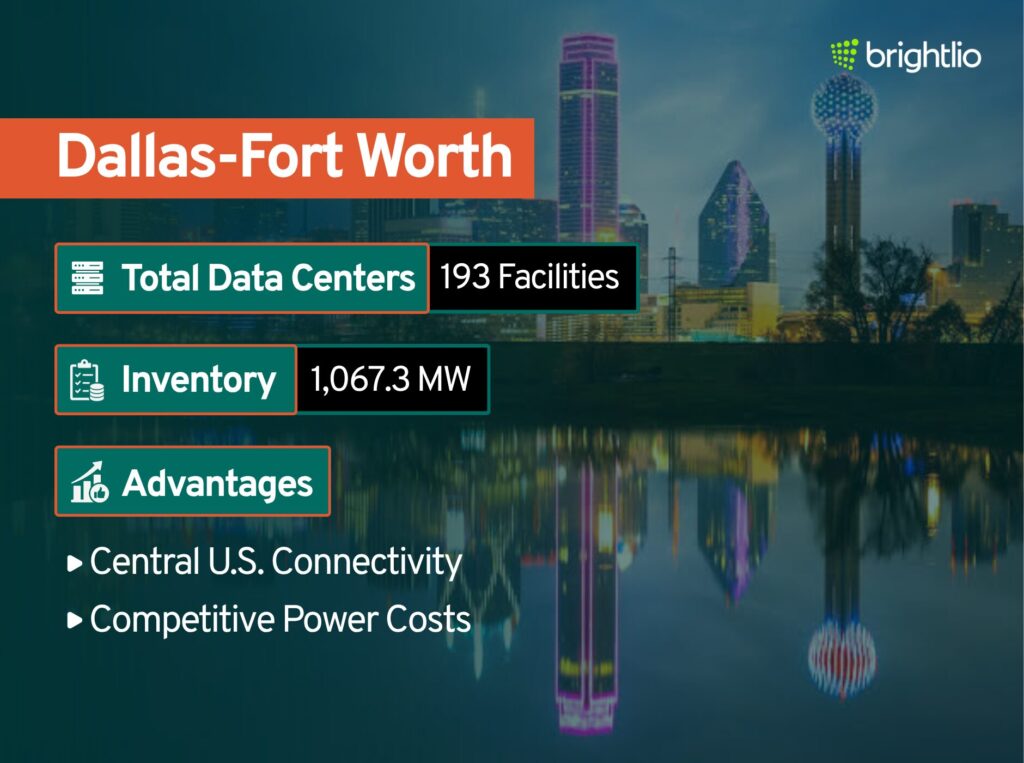
Dallas-Fort Worth is the third-largest data center market in the United States, stretching across the metroplex from Dallas and Fort Worth through suburbs including Irving, Plano, Garland, Lancaster, and Grand Prairie.
The region closed 2025 with 1,067.3 MW of total inventory, becoming the third US market to pass 1 gigawatt of supply after Northern Virginia and Atlanta. Its position near the center of the country gives it balanced latency to both coasts.
The metroplex absorbed 470.8 MW in 2025, an increase of 424 MW over the prior year. CBRE projects the market will double in size, supported by preleasing that already covers 89% of the space under construction.
The largest new hyperscale campuses cluster in south Dallas submarkets such as Lancaster, Forney, and Grand Prairie.
Power Availability Sets The Ceiling
Electricity access governs the pace of development across the metroplex. Oncor, which delivers power across roughly 40% of Texas, shows the scale of the shift: its average data center load has climbed from a historical 30 to 50 MW to 700 to 800 MW today, with some single facilities requesting 1,000 to 2,000 MW.
As of mid-2025, the utility's large commercial and industrial interconnection queue held 552 requests representing about 186,000 MW, and its five-year capital plan reached $36 billion, up from $1.2 billion a decade earlier.
The state grid carries the same strain. ERCOT tracked roughly 226 GW of large-load interconnection requests at the end of 2025, up from 63 GW a year earlier, with data centers making up close to three-quarters.
Texas passed Senate Bill 6 in June 2025 to standardize large-load interconnection, add cost-sharing, and require transparency around duplicate requests.
Oncor's Southern DFW Load Interconnection and Grid Strengthening Project, an estimated $1.219 billion effort, targets a December 2028 in-service date to relieve thermal and voltage constraints south of the metro.
Texas retains a genuine advantage even so, since its connect-and-manage model lets projects energize faster than most US grids, a factor developers cite as decisive in site selection.
Connectivity And Central Location
Dallas sits at a national fiber crossroads, roughly equidistant from both coasts. Equinix operates a major interconnection hub at the Infomart carrier hotel, at 1950 North Stemmons Freeway, linking metro and long-haul routes through its DA1 through DA6 facilities.
The metroplex holds the fourth-largest concentration of Fortune 500 headquarters in the country, anchoring steady enterprise and cloud demand alongside hyperscale growth.
Tax Structure
Texas exempts qualifying data centers from its 6.25% state sales and use tax on equipment, electricity, cooling systems, servers, and network infrastructure.
To qualify, a standard facility must invest at least $200 million, create at least 20 jobs within five years, and occupy at least 100,000 square feet under a single qualifying tenant. That exemption lowers the capital cost of large enterprise and hyperscale builds across the region.
Key Data Center Operators
Dallas-Fort Worth supports homegrown operators, national colocation providers, and gigawatt-scale hyperscale campuses.
- CyrusOne - Headquartered in Dallas, broke ground on a new Fort Worth campus in 2025 and has committed more than $2.4 billion across its Texas portfolio.
- STACK Infrastructure - Runs an 80 MW north Dallas campus and is developing DFW02 in Lancaster, a 193-acre site scalable to 500 MW.
- PowerHouse and Provident - Are co-developing a 768-acre campus in Grand Prairie, with 500 MW committed and a switchyard planned to scale toward 1.8 GW.
- Compass Datacenters - Builds hyperscale campuses with national reach from its Dallas headquarters.
- Google - Operates a data center complex in Midlothian, south of the metro, anchoring regional cloud capacity.
Dallas-Fort Worth's central location, business-friendly tax structure, and faster interconnection path keep it the third-largest US market and among the quickest to add capacity. Transmission buildout and grid constraints will govern the pace, though committed preleasing and gigawatt-scale campuses point to sustained hyperscale demand.
4. Chicago: Central Connectivity and Strategic Location
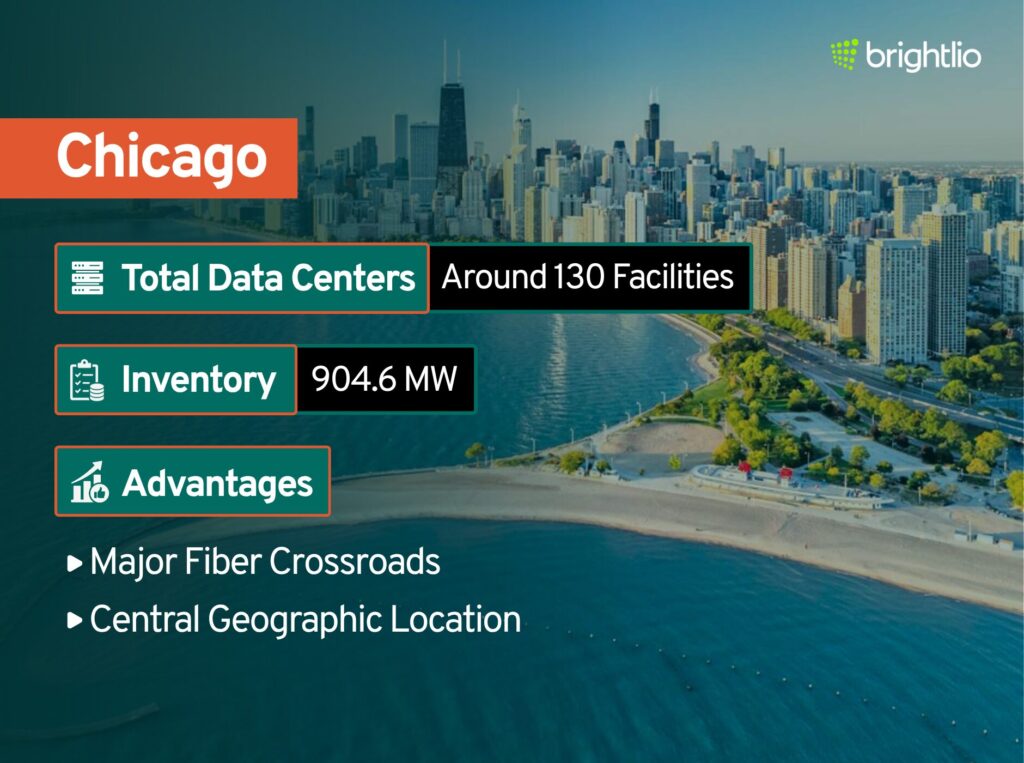
Chicago is the fourth-largest data center market in the United States, centered on the city and suburbs including Elk Grove Village, Northlake, Mount Prospect, Aurora, and DeKalb. The market holds 904.6 MW of inventory. Its central position gives it low-latency reach to both coasts, and tight supply has pushed rental rates to among the highest in the country.
Demand stays strong while power becomes the limiting factor. Vacancy sits near record lows, yet many new projects in ComEd territory face power-delivery timelines extending to 2031 or later, which has pushed developers toward southern and outer suburbs where substation capacity remains available.
Power Delivery Is The Binding Constraint
Illinois produces more nuclear power than any other state, with 11 reactors generating a majority of in-state electricity, giving operators access to carbon-free baseload supply that first drew hyperscale interest to the region. Power planners expect data center load on ComEd's grid to climb from roughly 400 MW to nearly 5 gigawatts.
That surge carries a cost. Data center demand added an estimated $13 billion across the past two PJM capacity auctions, and ComEd's chief executive attributes roughly $12 per month in added residential bills over four years to rising supply costs.
Meta signed a 20-year agreement with Constellation to purchase 1.1 GW of nuclear power, part of a wider move by hyperscalers to secure baseload supply directly from generators rather than wait on the grid.
Connectivity And Infrastructure
Chicago anchors the Midwest's densest network fabric. Digital Realty's facility at 350 East Cermak Road, one of North America's largest carrier hotels, hosts more than 40 carriers and exceeds 100 MW of load.
DE-CIX Chicago ranks among the fastest-growing internet exchanges in the country, interconnecting with New York and Dallas to form a major peering fabric. Abundant fresh water and low seismic risk add to the region's operational stability.
Tax Structure And The 2026 Incentive Pause
Illinois exempted qualifying data center equipment from state and local sales and use tax through its Data Center Investment Program, enacted in 2019.
Qualification required at least $250 million in capital investment over 60 months and 20 new full-time jobs paying 120% of the county median wage, with certificates issued in renewable five-year increments for up to 20 years.
From 2020 through 2024, 27 data centers drew more than $983 million in benefits.
That program is now paused. On June 5, 2026, after the General Assembly failed to pass data center reforms, Governor J.B. Pritzker directed the Department of Commerce and Economic Opportunity to stop processing new program agreements as of July 1, 2026. Agreements signed before that date remain honored, and the governor called on lawmakers to build a longer-term framework during the fall veto session.
Key Data Center Operators
Chicago supports downtown interconnection hubs, suburban hyperscale campuses, and wholesale developments.
- Digital Realty - Operates 350 East Cermak, the region's primary interconnection hub and one of the largest carrier hotels in North America.
- CloudHQ - Broke ground on a $2.5 billion, 1.5-million-square-foot campus in Mount Prospect, its entry into suburban Chicago.
- Meta - Is investing more than $1 billion to expand its DeKalb cloud campus toward 2.4 million square feet.
- CyrusOne - Operates an Aurora campus and is developing a $500 million facility in Sangamon County, the first major hyperscale project in central Illinois.
- Aligned Data Centers - Runs ORD-01 in Northlake and is building ORD-02, a 228,768-square-foot facility supporting 36 to 52 MW.
Chicago's nuclear-backed grid, central location, and interconnection density keep it the fourth-largest US market and the Midwest's primary hub. Power-delivery delays and the paused incentive program will slow near-term development, though carbon-free baseload supply and deep network infrastructure continue to draw hyperscale and AI demand.
5. Phoenix: A Leading Alternative for Data Centers
Phoenix is the fifth-largest data center market in the United States, spanning the metro from Phoenix and Chandler through Mesa, Tempe, Scottsdale, Goodyear, and Glendale.
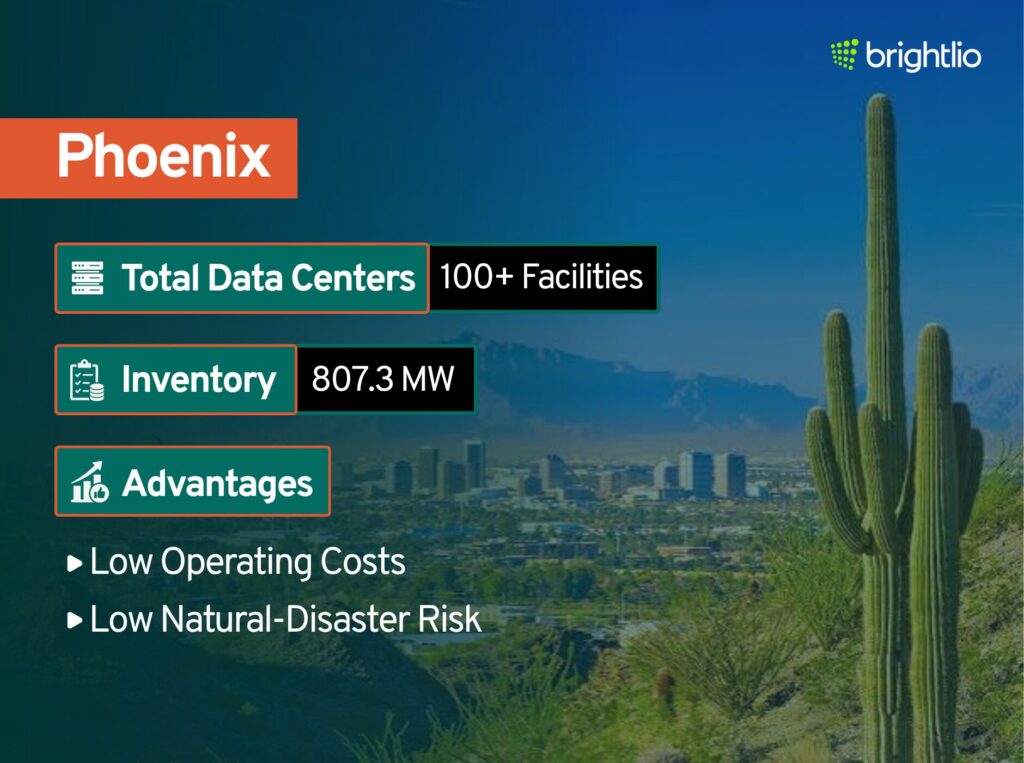
The region holds 807.3 MW of inventory across more than 100 facilities, built on low land costs, dense fiber, and a low natural-disaster profile that drew a decade of hyperscale migration out of California.
Demand still runs ahead of what the grid can deliver. Phoenix recorded 256 MW of power absorption in 2025 with five new projects underway, though power-delivery restrictions now shape which sites advance.
Newer development concentrates in the West Valley around Goodyear and Buckeye, where land and potential power remain available.
Grid Strain Now Defines The Market
Power availability has become the market's central constraint. In April 2026, Governor Katie Hobbs released a strategic energy plan warning that proposed data center loads could nearly triple combined Arizona Public Service and Salt River Project demand, requiring up to 29,000 MW of new generation.
APS is evaluating interconnection requests exceeding 13 GW against a system that served roughly 7 GW in 2024, stretching approval cycles to as long as three years. SRP has begun processing its first cluster study of 25 applicants.
Those timelines have pushed operators toward building their own power. Vantage paired with VoltaGrid to secure 1 GW of dispatchable generation at its campuses, and Aligned Data Centers deployed a 63 MW microgrid capable of islanding from the grid.
Water use adds a second constraint in the desert climate, prompting waterless and refrigerant-based cooling designs across newer facilities.
Connectivity And Location
Phoenix functions as the interconnection anchor of the Desert Southwest. Digital Realty operates a major connectivity hub at 120 East Van Buren Street in downtown Phoenix, tying the metro into fiber and cable routes that link Phoenix, Las Vegas, and Southern California into a single Sun Belt corridor.
The region's minimal exposure to earthquakes and hurricanes has long made it a lower-risk alternative to coastal California sites.
Tax Structure And The Three-Year Moratorium
Arizona's data center sales tax exemption, approved in 2013, exempted qualifying equipment from state and local sales and use tax and cost the state roughly $38 million a year. That incentive is now frozen.
In June 2026, Governor Hobbs signed a budget imposing a three-year moratorium on new data center tax exemptions, barring the Arizona Commerce Authority from accepting applications from July 1, 2026 through June 30, 2029.
Developers rushed 113 applications into the two weeks before the freeze, nearly matching the total from the program's prior 13 years. Construction of new centers continues, since the pause applies only to the tax benefit.
Key Data Center Operators
Phoenix supports hyperscale campuses, wholesale colocation, and a growing set of operators building their own power.
- Digital Realty - Runs retail and wholesale colocation and operates the 120 East Van Buren interconnection hub downtown.
- Vantage Data Centers - Secured 1 GW of on-site generation through a VoltaGrid partnership to work around grid delays.
- Aligned Data Centers - Deployed a 63 MW microgrid capable of operating independently of the utility grid.
- phoenixNAP - Headquartered in Phoenix, operates a major interconnection hub with direct cloud access.
- Edged Energy - Runs a Mesa facility that eliminates evaporative cooling, saving an estimated 94 million gallons of water a year.
Phoenix holds its place as a top-five US market on the strength of cheap land, dense fiber, and low disaster risk. Grid capacity and water availability now govern the pace of growth, and the three-year tax pause adds a layer of policy uncertainty, though on-site generation and efficient cooling are giving operators paths around both constraints.
6. Silicon Valley: Hub of Innovation and Connectivity
Silicon Valley is a major data center market anchored by Santa Clara and San Jose, with additional capacity in Sunnyvale, Palo Alto, and Milpitas.
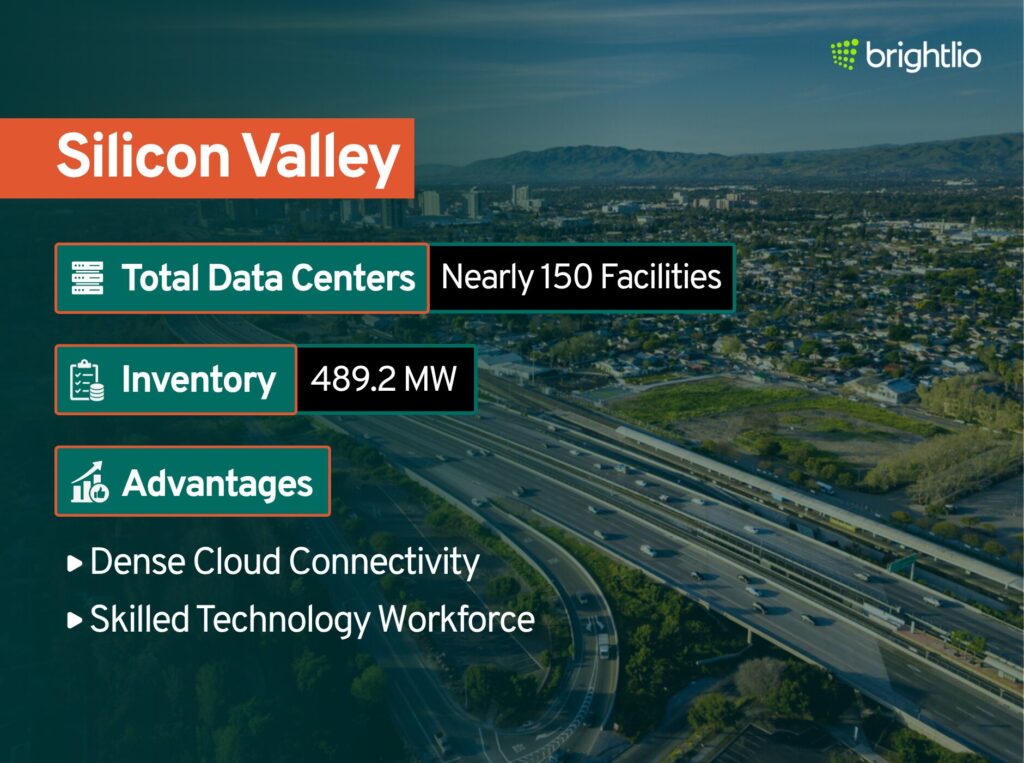
The region holds 489.2 MW of inventory across roughly 150 facilities, sitting beside the headquarters of Meta, Alphabet, Apple, and Nvidia.
Santa Clara alone concentrates more than 40 data centers within 18 square miles, a density that rivals Northern Virginia's Data Center Alley.
Physical growth has effectively stopped. CBRE reported the market's footprint contracted by 1.4 MW in 2025, down from 42 MW of absorption in 2024, as power limits capped new supply and pushed several planned sites back to industrial use.
Vacancy fell to a record-low 4.5%, and the 144 MW under construction is 84% preleased, waiting largely on substation capacity.
Power Is The Hard Ceiling
Two utilities serve the market. Silicon Valley Power, Santa Clara's municipal utility, has historically charged 25% to 40% less than PG&E in surrounding towns, which made Santa Clara the region's data center capital.
That advantage now meets a hard limit: SVP's grid is capacity-constrained, several Santa Clara substation sites are not expected to energize until 2028 or 2029, and their timing may slip as the local grid runs at maximum.
Operators are engineering around the shortage. ECL is developing CSC-1, a 35 MW Santa Clara facility that combines onsite hydrogen and natural gas generation with a grid connection, and SVP has partnered with energy startup Emerald AI on a pilot to run data centers as grid-responsive loads that moderate power draw during peaks, freeing capacity for new connections. Electricity rates across the market rank among the highest of any primary US data center hub.
Connectivity And Innovation
Silicon Valley remains one of the most interconnected regions on the West Coast, with direct onramps to major cloud platforms, multiple internet exchange points, and high-capacity fiber.
Proximity to the engineering talent and headquarters of the largest technology and AI companies sustains a level of demand few markets can match, keeping preleasing high even as physical growth stalls.
Cost Structure And Incentives
California offers no statewide data center sales tax exemption, unlike Virginia, Georgia, Texas, Arizona, and Illinois. Paired with the nation's highest construction and power costs, that absence makes Silicon Valley one of the most expensive places in the country to build and operate a data center.
Demand holds regardless, driven by the value of placing compute next to the companies and talent that define the industry.
Key Data Center Operators
Silicon Valley supports interconnection-dense colocation and a growing set of hyperscale campuses.
- Equinix - Operates multiple interconnection and colocation facilities across San Jose, Palo Alto, and Sunnyvale.
- Digital Realty - Runs wholesale and colocation capacity throughout the Santa Clara and San Jose submarkets.
- CoreSite - Provides carrier-neutral colocation and peering for enterprises and cloud providers.
- Vantage Data Centers - Commissioned 16 MW of preleased capacity at its new Santa Clara campus in 2025.
- Microsoft - Purchased a 65-acre San Jose site for $73.2 million, zoned for a 50 MW facility, as it pursues capacity beyond Santa Clara.
Silicon Valley stays a critical market on the strength of its interconnection density and proximity to the industry's core, even as power constraints have frozen physical growth.
New supply depends on substation energization later this decade and on flexibility programs that stretch existing capacity, while high costs and the absence of tax incentives frame it as a market operators enter for proximity to the industry's center.
7. Hillsboro, Oregon: The Pacific Gateway
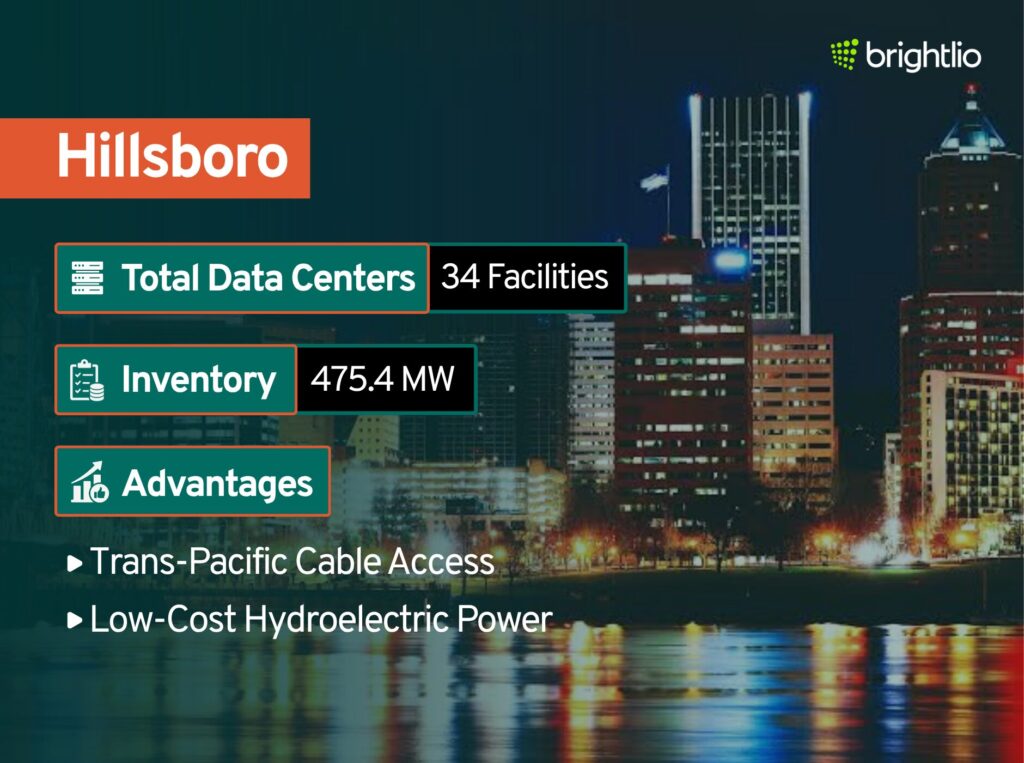
Hillsboro, just west of Portland, has climbed into the top U.S. data center markets with 475.4 MW of inventory. CBRE now counts it among the eight primary North American markets, and it is one of the tightest in the country, with just 1.0 MW of available supply at year-end 2025.
Several advantages drive the market. Oregon has no state sales tax, and enterprise zone programs offer substantial property tax abatements for data center development. Power costs are among the lowest on the West Coast, supplied largely by hydroelectric generation. Hillsboro serves as a landing area for trans-Pacific subsea cables, giving it direct, low-latency connectivity to Asia-Pacific markets.
A Direct Gateway To Asia-Pacific
Hillsboro’s strongest connectivity advantage comes from its access to transpacific subsea cable systems. Flexential’s Hillsboro 2 facility, known as the Network Access Point of the Northwest, connects to the Bifrost, Hawaiki, and New Cross Pacific cable systems.
Bifrost entered service in 2025 as the first subsea cable to directly connect Singapore with the west coast of North America. The Hillsboro campus provides access to more than 300 on-net carriers, major cloud platforms, and regional carrier hotels. These connections make the city a strategic location for cloud, media, gaming, and enterprise workloads serving Asia-Pacific markets.
Power Supply And Economic Advantages
Portland General Electric supplies the Hillsboro market. According to PGE, 40% of its 2025 retail electricity load was served through non-emitting resources. PGE continues to add renewable generation, energy storage, and grid infrastructure to support regional electricity demand.
Oregon’s POWER Act created a separate utility customer class for large data centers. The framework requires high-load facilities to cover more of the grid and infrastructure costs associated with their development. PGE received regulatory approval to implement the new data center rate structure in May 2026.
Hillsboro’s Enterprise Zone program can provide a 100% property tax abatement on qualified new capital assets for three to five years. Oregon enacted a temporary moratorium on new Enterprise Zone approvals for data centers in March 2026 while state and local officials reviewed development and incentive policies.
Key Data Center Operators
Hillsboro supports a growing mix of hyperscale, wholesale, and colocation operators.
- Flexential - Operates Hillsboro 1 through Hillsboro 5 and plans to develop Hillsboro 6, a 350,000-square-foot facility designed to support 27 MW of capacity.
- STACK Infrastructure - Operates its flagship POR03 campus, which spans approximately 55 acres and is planned for around 200 MW of total capacity.
- QTS Data Centers - Maintains three Hillsboro campuses, including the 51-acre Hillsboro 2 campus with more than 180 MW of planned power capacity.
- NTT Global Data Centers - Operates the 36 MW HI1 facility and plans to expand its total Hillsboro capacity to approximately 354 MW.
- Aligned Data Centers - Is developing a 27-acre, 108 MW campus and deploying a 31 MW battery storage system to improve access to grid power.
Hillsboro’s near-zero vacancy, direct transpacific cable routes, access to non-emitting electricity, and large campus developments make it one of the West Coast’s leading data center markets.
Land and transmission limitations will restrict short-term availability, but the city’s connection to Asia-Pacific networks will continue to support demand from cloud, AI, and enterprise customers.
8. Central Washington: Hydropower-Driven Growth
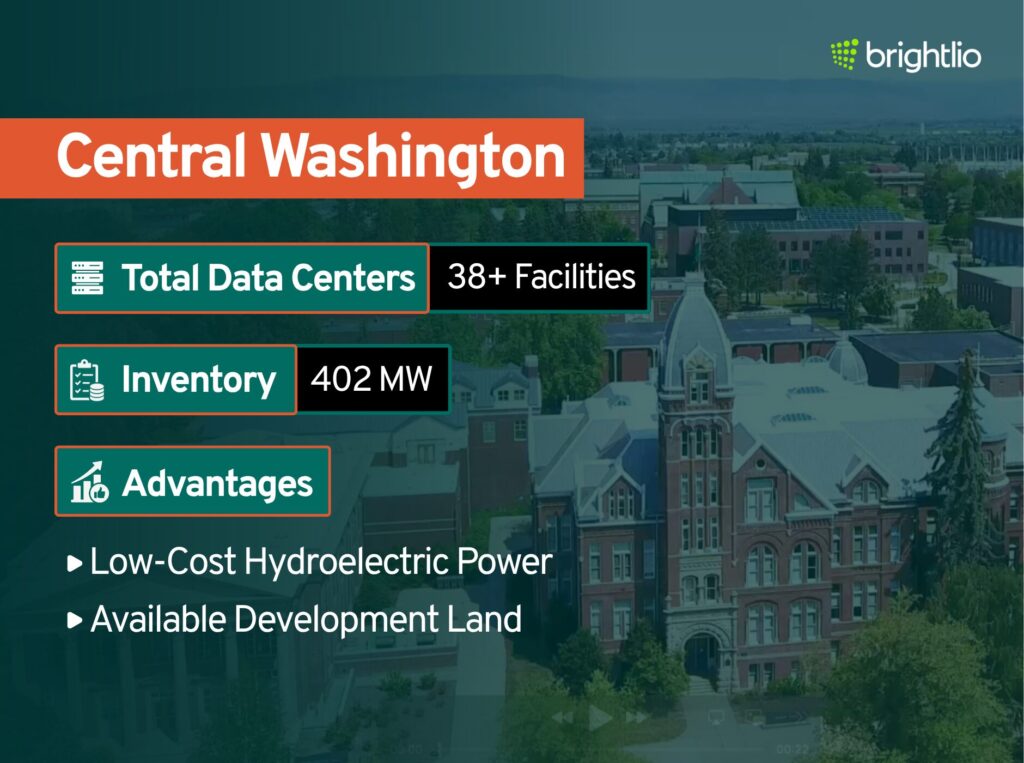
Central Washington is now the eighth-largest data center market in North America, with development concentrated around Quincy, East Wenatchee, and nearby Columbia Basin communities. The market reached 402 MW of total inventory at year-end 2025, up from 246.4 MW one year earlier. This growth allowed Central Washington to surpass the New York Tri-State market in total capacity for the first time.
Demand absorbed most of the new capacity entering the market. Central Washington recorded 147.9 MW of net absorption in 2025, the highest level among North American secondary markets and a 146.5% increase from 2024. Vacancy stood at 2.9%, leaving approximately 11.7 MW available. The region had another 32.1 MW under construction, with 72% of that capacity already preleased.
Low-Cost Hydroelectric Power
Hydroelectric power remains Central Washington’s main advantage. Grant County Public Utility District owns and operates the Priest Rapids and Wanapum dams on the Columbia River. Together with its smaller hydroelectric projects, these facilities provide more than 2,100 MW of renewable generation capacity.
Access to locally generated hydropower has given Quincy and surrounding communities some of the lowest data center operating costs in the country. The dry regional climate supports extensive outside-air and evaporative cooling, reducing the amount of mechanical cooling required during much of the year.
Rapid data center expansion is beginning to place pressure on the regional grid. Grant PUD introduced temporary limits on additional data center load growth to reduce the risk of voltage instability and outages. The utility is adding solar generation and other power resources as electricity demand grows beyond the output available from its existing Columbia River dams.
Expanding Regional Fiber Connectivity
Central Washington combines rural operating economics with access to several regional fiber networks. Grant PUD maintains an open-access fiber-optic system across Grant County, supporting gigabit services for local businesses and infrastructure operators.
New long-haul routes are strengthening connections between the region’s data center clusters. Intermountain Infrastructure Group operates a diverse fiber ring between Quincy and East Wenatchee and activated new routes connecting Wenatchee, Quincy, and Spokane. These systems provide additional paths toward Seattle, Spokane, and other western cloud markets.
Data Center Tax Advantages
Washington provides a sales and use tax exemption for qualifying data center businesses and tenants. Eligible purchases can include server equipment, electrical infrastructure, and installation services. These benefits have helped reduce the capital cost of developing large facilities in rural markets such as Grant County.
The state narrowed part of the rural incentive program in July 2026. New exemption certificates are no longer available for refurbished rural data centers, and replacement servers are no longer treated as eligible equipment under that provision. New qualifying facilities may still receive exemptions under the broader data center program.
Key Data Center Operators
Central Washington supports a mix of hyperscale, wholesale, and colocation facilities.
- Microsoft - Operates data centers in Quincy and East Wenatchee and is developing additional facilities in Malaga and East Wenatchee.
- Vantage Data Centers - Operates an 89 MW Quincy campus containing three facilities and approximately 775,000 square feet of data center space.
- Sabey Data Centers - Provides colocation, powered-shell, and build-to-suit services from its Quincy campus. A major expansion is adding more than 85 MW of critical power across two buildings.
- CyrusOne - Operates the PNW1 campus, which provides approximately 720,000 square feet of technical IT space and access to renewable hydroelectric power.
- H5 Data Centers - Operates a 240,000-square-foot purpose-built Quincy facility with capacity planned to reach 40 MW at full development.
Central Washington’s hydropower, tax incentives, expanding fiber routes, and available development land have supported one of the fastest capacity increases in North America. Limited transmission capacity may slow near-term projects, but continued investment around Quincy, Wenatchee, and Malaga keeps the region central to Washington’s cloud and AI infrastructure growth.
9. Southern California (Los Angeles): A Key West Coast Market
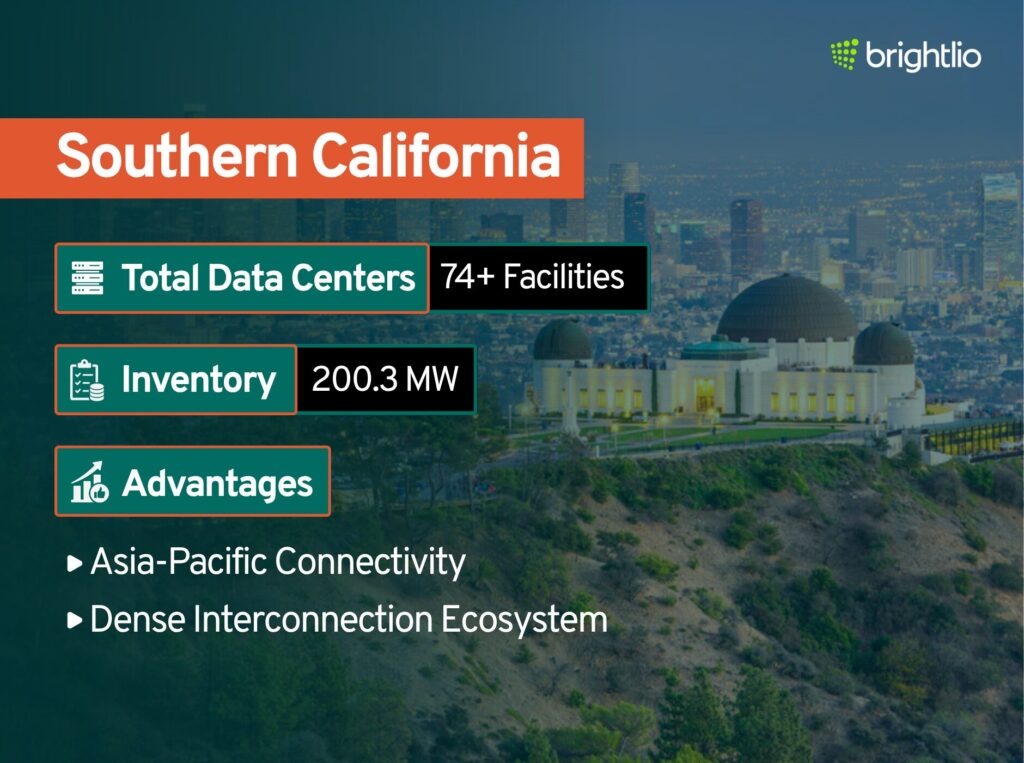
Southern California is a major West Coast data center market supported by a large customer base, dense network infrastructure, and direct Asia-Pacific connectivity. Development is concentrated in Downtown Los Angeles, Vernon, El Segundo, Torrance, Burbank, and Orange County.
Southern California reached 200.3 MW of total inventory at year-end 2025, surpassing the New York Tri-State market for the first time since CBRE began tracking the sector in 2016, with 24.5 MW available.
About 100 MW is under construction and 300 MW is planned.
Much of the market's older available space is unsuitable for high-density AI workloads, and CBRE expects AI deployments to remain the primary source of new demand.
A Pacific Connectivity Hub
Los Angeles connects U.S. businesses with Asia-Pacific through transpacific subsea cables and long-haul fiber routes. One Wilshire anchors the region's network ecosystem, supporting media, gaming, content delivery, cloud, and other latency-sensitive applications.
High Power Costs And Limited Space
Power costs remain a major constraint. California’s average commercial electricity price reached 25.75 cents per kWh in April 2026, nearly twice the national average.
Vernon has become a preferred expansion area due to its municipally owned utility, industrial land, and proximity to Downtown Los Angeles. New facilities can connect to major carrier hotels through short dark-fiber routes.
AI-Ready Development
Prime Data Centers opened its 33 MW LAX01 facility in Vernon. The site supports liquid-cooled and GPU-dense AI systems.
DataBank and Goodman Group are developing another 32 MW facility in Vernon, with capacity scheduled to enter service between late 2026 and 2027.
Key Data Center Operators
- CoreSite - Operates One Wilshire and two nearby facilities with access to more than 325 networks.
- Digital Realty - Runs facilities across Downtown Los Angeles, El Segundo, and Burbank.
- Equinix - Connects customers with cloud providers, carriers, and media platforms.
- Prime Data Centers - Operates the 33 MW LAX01 AI-ready facility in Vernon.
- DataBank - Operates at One Wilshire and is developing a 32 MW Vernon facility.
Southern California remains a key West Coast market due to its interconnection ecosystem, Asia-Pacific access, and growing AI infrastructure. High electricity costs and limited powered land continue to restrict new development.
10. Austin-San Antonio: Texas’s Second Data Center Corridor
Austin and San Antonio form Central Texas’s second major data center corridor after Dallas-Fort Worth. Development extends from Austin and Round Rock through San Marcos and New Braunfels to San Antonio, creating an infrastructure market along Interstate 35.
Austin supplies a large technology workforce and enterprise customer base, while San Antonio offers lower land costs and room for hyperscale campuses.
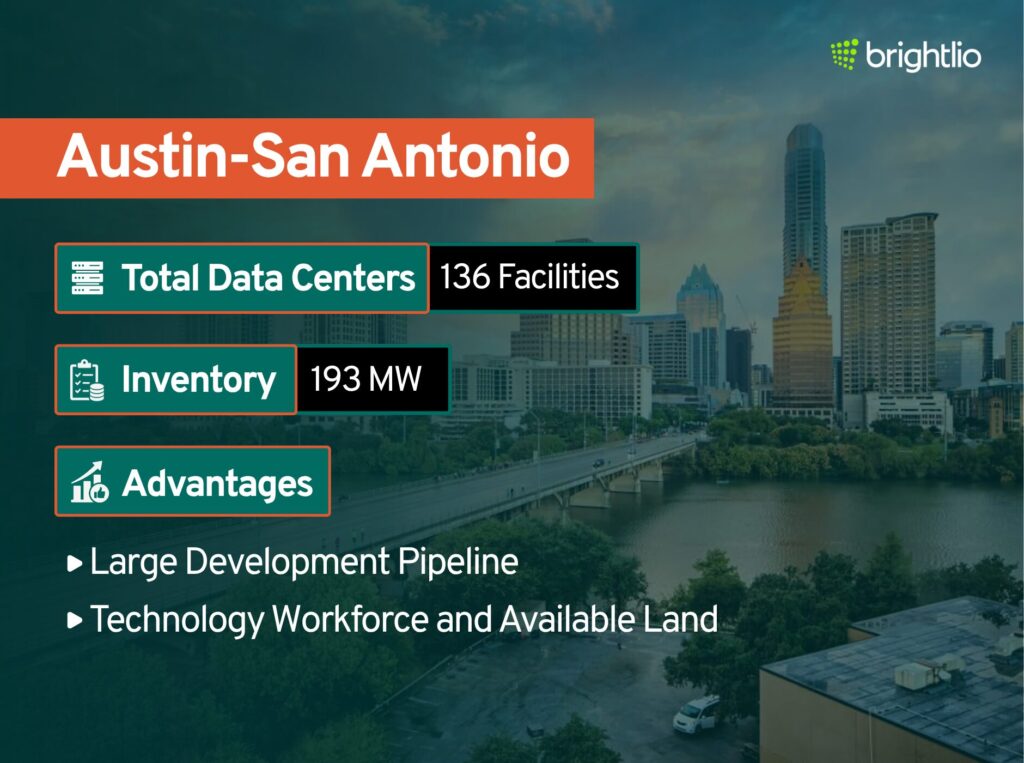
The corridor is expanding faster than its existing supply. CBRE recorded a 2.3% vacancy rate. Capacity under construction reached 462 MW, with 97% already preleased.
By year-end 2025, Austin-San Antonio had surpassed the New York Tri-State market in total inventory for the first time since CBRE began tracking the sector in 2016.
Expanding Beyond Central Austin
New development is shifting toward areas where larger parcels and utility capacity remain available. Operators are targeting northeastern Austin suburbs served by Oncor, including Round Rock, Pflugerville, and Hutto. Interest has moved south into Lower Colorado River Authority territory as power requests increase across the metro.
San Antonio adds another major development cluster west and southwest of the city. Microsoft operates facilities across Bexar and Medina counties, while Stream Data Centers is expanding through its Westover Hills campuses. The separation between Austin and San Antonio gives companies multiple deployment locations within the same regional market.
Competitive Power And Utility Access
Central Texas operates within the ERCOT electricity market and receives power through several utilities. Austin Energy serves the central city, Oncor supplies many northern and eastern suburbs, and LCRA supports communities south of Austin. CPS Energy supplies the San Antonio market.
Austin Energy manages or contracts for more than 4,600 MW of generation capacity, including natural gas, nuclear, wind, and solar resources. CPS Energy strengthened San Antonio’s power portfolio through the 2025 acquisition of four natural gas facilities with approximately 1,632 MW of combined capacity.
Large power requests are creating longer interconnection timelines across both metros. CBRE reported historically high demand for utility capacity, while CPS Energy has warned that transmission upgrades will be required to accommodate major new loads.
A Connected Technology Corridor
Austin’s concentration of technology companies, cloud users, and semiconductor operations creates steady demand for colocation and low-latency infrastructure. Carrier-neutral facilities offer access to metro fiber systems and long-haul routes connecting Central Texas with Dallas, Houston, and other major markets.
Facilities such as Sabey’s Round Rock campus provide dual fiber entrances, redundant pathways, and access to carriers including AT&T, Cogent, LOGIX, and Zayo. Stream’s San Antonio campus uses separate telecommunications entrances and multiple carrier rooms to provide physical network diversity.
Data Center Tax Advantages
Texas provides a 6.25% state sales and use tax exemption for eligible equipment, electricity, cooling systems, servers, storage devices, and network infrastructure used by qualifying data centers.
Standard qualifying facilities must invest at least $200 million and create at least 20 jobs within five years. The facility must contain at least 100,000 square feet used by a single qualifying occupant. These incentives reduce the cost of developing large enterprise and hyperscale facilities throughout Central Texas.
Key Data Center Operators
Austin-San Antonio supports hyperscale cloud campuses, wholesale developments, and enterprise colocation facilities.
- Microsoft – Operates and develops data centers across Bexar and Medina counties. Its Greater San Antonio facilities employed approximately 530 people as of 2025.
- Stream Data Centers – Is developing a 135-acre San Antonio campus planned for 200 MW and 1.5 million square feet at full build. Its first building has been commissioned and fully leased.
- Sabey Data Centers – Operates its Austin campus in Round Rock, designed for up to 84 MW. A second liquid-cooling-ready building will add 54 MW.
- CyrusOne – Operates the AUS2 and AUS3 facilities near Austin-Bergstrom International Airport, providing a combined 242,000 square feet of technical space.
- Digital Realty – Provides cloud-neutral and carrier-neutral colocation from its Austin facilities, including the AUS11 location in the Met Center area.
- DataBank – Operates Austin facilities with enterprise colocation, interconnection, cloud, and managed infrastructure services.
Austin-San Antonio’s low vacancy, large construction pipeline, technology workforce, and available suburban development sites have turned the corridor into one of the fastest-growing U.S. data center markets.
Read More Similar Posts:
Other Key Connectivity Hubs
Three long-established regions no longer rank in the top 10 by inventory, but they remain among the most important interconnection points in the country.
New York Tri-State Area: The Financial Sector’s Hub
The New York Tri-State area, covering New York, New Jersey, and Connecticut, hosts more than 130 data centers, driven largely by demand from the financial sector. In 2025 the region was surpassed in inventory by Austin-San Antonio, Southern California, and Central Washington, though it remains a critical hub for low-latency, high-performance data infrastructure.
Rising energy use, especially from AI workloads, has sparked legislative efforts like the proposed Sustainable Data Centers Act, aiming to require renewable energy use and annual reporting.
The region offers proximity to NYC at lower costs, with more space and expansion opportunities in New Jersey than Manhattan. It provides direct access to transatlantic cabling and high-speed fiber networks, supporting fast, reliable global connections.
Electricity is primarily provided by Consolidated Edison (ConEd) in New York at approximately $0.14 to $0.16 per kWh, while PSE&G and Jersey Central Power & Light supply New Jersey at approximately $0.10 to $0.12 per kWh.
The region’s critical connectivity hubs include Digital Realty’s prominent facilities at 60 Hudson Street and 111 8th Avenue in Manhattan. Equinix operates major connectivity points at 755 and 800 Secaucus Road in New Jersey (sites NY2, NY4, NY5, and NY6).
Standout regional providers include Telehouse America, which operates facilities in Manhattan and Staten Island and manages NYIIX, one of the largest internet exchanges in the region, and Sabey Data Centers, which runs SDC Manhattan at 375 Pearl Street with over a million square feet of secure, purpose-built space.
Miami: A Strategic Gateway to Latin America
Miami is a key global data hub, connecting the U.S. with Latin America, the Caribbean, and Europe. At the center is Equinix’s NAP of the Americas, a 750,000 sq. ft. facility hosting 160+ carriers and handling traffic for over 150 countries. Built for resilience, it’s a main entry point for subsea cables like ARCOS-1.
With strong logistics via PortMiami and MIA, plus business perks like low taxes and foreign trade zones, Miami attracts tech and finance firms looking for fast, reliable international connectivity.
Its infrastructure includes the ARCOS-1 Cable Landing Station, which supports direct, efficient links to Mexico and Latin America. Economic incentives include no inventory or unitary taxes, relatively low state corporate income tax rates, four strategically located foreign trade zones (FTZ), and competitive energy costs that support cost-efficiency for large-scale operations.
How Many Data Centers Are in the United States?
There are approximately 4,530 listed data centers in the United States as of July 2026. The total varies between industry databases based on which facility types they include.
Northern Virginia remains the country’s largest data center market by installed capacity, followed by Atlanta and Dallas-Fort Worth.
Cloud computing and AI demand continue to drive development across primary and emerging US markets.
5 Notable Data Centers in the US
The United States hosts major interconnection hubs for cloud platforms, financial firms, and large enterprises. The following five facilities stand out for their scale, connectivity, and regional role.
1. Equinix DC2 Data Center (Ashburn, Virginia)
Equinix DC2 sits on the company’s Ashburn campus in Northern Virginia. The facility provides 118,446 square feet of colocation space. It provides access to one of the world’s largest peering markets and the largest peering exchange on the US East Coast.
DC2 uses N+1 power and cooling redundancy, with at least 30 hours of generator autonomy at full load. Its certifications include ISO 27001, NIST 800-53/FISMA High, PCI DSS, and SOC 2 Type II. The facility supports cloud, enterprise, and public-sector workloads near Washington, D.C.
2. Equinix NY4 Data Center (Secaucus, New Jersey)
Equinix NY4 in Secaucus serves financial, media, and enterprise customers across the New York metropolitan area. The facility provides 151,771 square feet of colocation space and access to Equinix International Business Exchange services.
NY4 uses N+1 power and cooling redundancy, with at least 30 hours of generator autonomy at full load. Its certifications include ISO 27001, PCI DSS, NIST 800-53/FISMA High, and SOC 2 Type II. These features support trading systems, financial platforms, and regulated enterprise workloads near New York City.
3. CoreSite LA1 Data Center (Los Angeles, California)
CoreSite LA1 occupies One Wilshire in downtown Los Angeles, one of the West Coast’s most connected buildings. The facility provides more than 171,000 square feet of data center space. CoreSite’s wider Los Angeles campus provides access to more than 325 networks, including global carriers and subsea cable systems.
LA1 connects to CoreSite LA2 and LA3 through dark fiber. Multiple subsea cables provide routes between the West Coast and Asia-Pacific markets. CoreSite completed a major electrical upgrade at One Wilshire in August 2025, including a new generator plant and other critical infrastructure improvements.
4. Equinix MI1 Data Center (Miami, Florida)
Equinix MI1 in downtown Miami serves as a primary network exchange point between the United States and Latin America. The facility provides 255,513 square feet of colocation space within a six-story reinforced-concrete building.
MI1 uses N+1 power and cooling redundancy, with at least 30 hours of generator autonomy at full load. The facility is positioned above the 500-year base flood elevation. Its certifications include ISO 27001, NIST 800-53/FISMA High, PCI DSS, and SOC 2 Type II, supporting regulated deployments that require direct access to Latin American markets.
5. Digital Realty ORD10 at 350 E Cermak (Chicago, Illinois)
Digital Realty’s ORD10 at 350 E Cermak is a major Midwest interconnection hub. The eight-story facility spans 1,005,500 square feet and supports deployments ranging from individual cabinets to multi-megawatt suites. It provides access to more than 70 network providers.
ORD10 uses N+1 UPS and cooling redundancy. Its compliance coverage includes ISO 27001, PCI DSS, SOC 2, and SOC 3. The building holds LEED Gold and Energy Star certifications. Its scale and network density support cloud, financial, and enterprise deployments that require direct connectivity in Chicago.
What Are Tier 1 Data Centers?
Tier 1 data centers, formally called Tier I facilities, provide the basic infrastructure needed to operate IT systems beyond a standard office environment.
A Tier I facility must include an uninterruptible power supply, dedicated IT space, cooling equipment that operates outside normal office hours, and an engine generator.
Tier I facilities use a single distribution path and must shut down during major maintenance or repairs. Unexpected equipment or distribution failures can interrupt IT operations.
The commonly cited 99.671% uptime, equal to about 28.8 hours of downtime per year, is an industry estimate rather than a current Uptime Institute certification requirement.
Uptime Institute now classifies facilities according to infrastructure topology and operational capabilities.
Where Are the Largest Data Centers in the US?
Some of the largest publicly documented data center campuses and buildings in the United States include:
- The Citadel Campus (Tahoe Reno, Nevada): Operated by Switch, the Citadel Campus is projected to reach 17.4 million square feet of data center space and 850 MW of power capacity at full completion. The campus serves Northern California, the Pacific Northwest, and other western US markets from a site covering more than 2,000 acres.
- The Core Campus (Las Vegas, Nevada): Switch’s Core Campus provides up to 2.4 million square feet of data center space and 315 MW of power capacity. The multi-building campus serves cloud, enterprise, and high-density computing deployments across the southwestern United States.
- DataBank Red Oak Campus (Red Oak, Texas): DataBank currently lists four data centers totaling 800,000 square feet of IT space and 240 MW of critical IT load. The planned eight-building campus will provide 1.6 million square feet of IT space and up to 480 MW when fully developed.
- Digital Realty ORD10 (Chicago, Illinois): Digital Realty’s ORD10 facility at 350 East Cermak spans 1,005,500 square feet across eight stories. The facility provides access to more than 70 network providers and supports deployments ranging from individual cabinets to multi-megawatt data center suites.
Final Thoughts
Power availability has become the defining factor in the U.S. data center market. Northern Virginia still leads by a wide margin, and Atlanta, Dallas-Fort Worth, and the western hubs keep expanding, yet grid capacity, transmission timelines, and interconnection queues now set the ceiling on how fast each region can grow. Demand remains historically high across every primary market.
The regulatory backdrop shifted sharply in 2026. Arizona, Illinois, and Georgia moved to pause or scale back data center tax incentives, Virginia and Texas began reassigning grid costs to large-load customers, and development started flowing toward regions with faster access to power.
Operators answered by contracting nuclear capacity, building on-site generation, and deploying grid-responsive designs. For businesses deciding where to place infrastructure, the choice now turns on power, cost, and policy as much as on latency and connectivity.
Find the Right Data Center Solution with Brightlio
Businesses across the country turn to Brightlio for data center solutions in the leading US markets. As a telecommunications and colocation broker, we connect you with top-tier colocation, cloud, and connectivity services matched to your requirements.
You need scalable colocation in Northern Virginia, cost-effective power in Phoenix, or high-speed connectivity in New York, and we'll pair you with the right provider. Tell us your space, power, and connectivity needs, and we'll deliver colocation pricing at no charge.
Beyond colocation, we offer connectivity, unified communications, cloud, and advisory services to support your IT infrastructure. Brightlio serves as a single partner for performance, reliability, and cost efficiency across your technology stack.
Contact Brightlio today to get started!
FAQs
1. What Defines a "Data Center Market" in the U.S.?
A data center market is a region with multiple large-scale data center campuses. These clusters share infrastructure advantages in power, network connectivity, and real estate, and they host a mix of colocation providers, cloud hyperscalers, and enterprise operators.
2. Which Region Is the Largest Data Center Market in the U.S.?
Northern Virginia, often called "Data Center Alley," is the nation's largest market. It hosts more than 300 data centers with 4,039.6 MW of inventory and a 0.5% vacancy rate, supporting hyperscalers including AWS, Azure, Google Cloud, and Meta.
3. What Are the Second and Third Largest Data Center Hubs?
Atlanta ranks second with 1,459.2 MW of inventory and the nation's largest construction pipeline at 2,076 MW. Dallas-Fort Worth ranks third with 1,067.3 MW, the third U.S. market to surpass 1 gigawatt of supply.
4. Which Other U.S. Regions Host Significant Data Center Clusters?
Other major hubs include Chicago (904.6 MW), Phoenix (807.3 MW), Silicon Valley (489.2 MW), Hillsboro, Oregon (475.4 MW), and Central Washington (402 MW), followed by fast-growing markets such as Southern California and Austin-San Antonio.
5. Why Are These Specific Locations Particularly Attractive?
Key factors include competitive power costs, tax incentives, dense fiber networks, and access to large blocks of electrical capacity. Central Washington shows the pattern: Grant County PUD's Columbia River dams supply more than 2,100 MW of low-cost hydroelectric generation, giving Quincy-area facilities some of the lowest operating costs in the country. Several states, including Arizona, Georgia, and Illinois, moved to pause or scale back their data center tax incentives in 2026.
6. How Is the Rapid Growth in AI Impacting Data Center Development?
The AI boom has triggered a surge in data center construction. Synergy Research Group counts almost 800 hyperscale data centers in the known development pipeline as of early 2026, enough to double hyperscale capacity in about three years. Hyperscalers such as Meta, Google, and Microsoft are developing large-scale campuses in Virginia, Texas, Indiana, Louisiana, Wisconsin, and other states.
7. How Much Power Do U.S. Data Centers Consume?
Data center supply in the eight primary U.S. markets alone reached 9,432 MW at year-end 2025, up 36% in a single year. In Northern Virginia, Dominion Energy's connection queue holds roughly 25,000 MW of data center projects with committed energization dates, and the utility projects its regional peak load will keep climbing well into the 2030s.
8. What Role Do Energy and Sustainability Considerations Play?
Energy availability now drives site selection more than any other factor. Operators pursue low-cost, reliable power, increasingly through direct nuclear agreements and on-site generation.
Meta contracted 1.1 GW of nuclear capacity from Constellation, and operators in Phoenix and Silicon Valley have deployed microgrids and dispatchable generation to work around constrained grids.
Utilities in Virginia, Georgia, and Texas have moved to assign more grid and transmission costs to data center customers.
9. How Do Data Center Locations Impact Latency and Global Connectivity?
Proximity to large metro areas and key network exchange points, such as Equinix's Ashburn campus, the Infomart in Dallas, and Miami's NAP of the Americas, reduces latency and improves performance.
These hubs support intercontinental data transfer through dense fiber and subsea cable connections.
10. Which US State Has the Most Data Centers?
Virginia has the most, anchored by Northern Virginia, the world's largest data center market. The state hosts more than 300 data centers, and Loudoun County alone is often cited as carrying a large share of global internet traffic on any given day.
11. Who Is the Biggest Builder of Data Centers in the US?
Digital Realty is one of the largest builders and operators of data centers in the United States, with a national network of facilities. It operates alongside global players such as Equinix and the hyperscalers, which increasingly build their own campuses.
12. How Many Data Centers Are There in the US?
The United States hosts approximately 4,530 listed data centers as of July 2026, the most of any country. Totals vary between industry databases depending on which facility types are counted.
13. How Many Data Centers Are in North Carolina?
North Carolina is one of the fastest-growing secondary markets, with the Charlotte-Raleigh corridor tracked by CBRE among its secondary hubs. The state hosts major corporate campuses, including Google's Lenoir facility, operational since 2009, and Apple's Maiden campus.
AWS is building an approximately $10 billion campus in Richmond County, the largest upfront corporate investment in the state's history.

Tamzid is a technology writer focused on SEO, content marketing, and data center infrastructure. He explains topics like colocation, cloud architecture, and network connectivity in clear, practical terms. At Brightlio, he tracks data center trends and the systems that keep digital services online.
Recent Posts
10 Largest AI Data Centers in the World

Data Centers In Oklahoma: Why You Must Colocate

Data Center and Colocation In North Dakota

Idaho Data Centers And Colocation Opportunities
Let's start
a new project together