
Reno’s data center market includes EdgeCore’s planned 216 MW campus, designed to provide nearly 1 million square feet of space. Reno colocation allows businesses to house their servers in third-party facilities with power, cooling, and network connectivity.
The region offers proximity to West Coast markets, fiber connections to California, and renewable energy options. This guide covers Reno’s data center providers, connectivity, power costs, and location advantages to help businesses compare colocation options.
Let’s find out what Reno colocation offers your business.
Reno Data Center Infrastructure Overview
| Metric | Details |
|---|---|
| Data Center Listings | 39 across the Reno area, including planned sites. |
| Typical Temperatures | 23°F to 90°F. |
| Internet Speeds | Up to 5 Gbps residential through AT&T and 100 Gbps business through Net NV, where available. |
| Network Latency | 4.5 ms from Switch Tahoe Reno to the Bay Area. |
| Electricity Prices | Nevada averages, June 2026: 9.83¢/kWh commercial; 10.16¢/kWh industrial. |
Reno Enjoys a Strategic Geographic Location
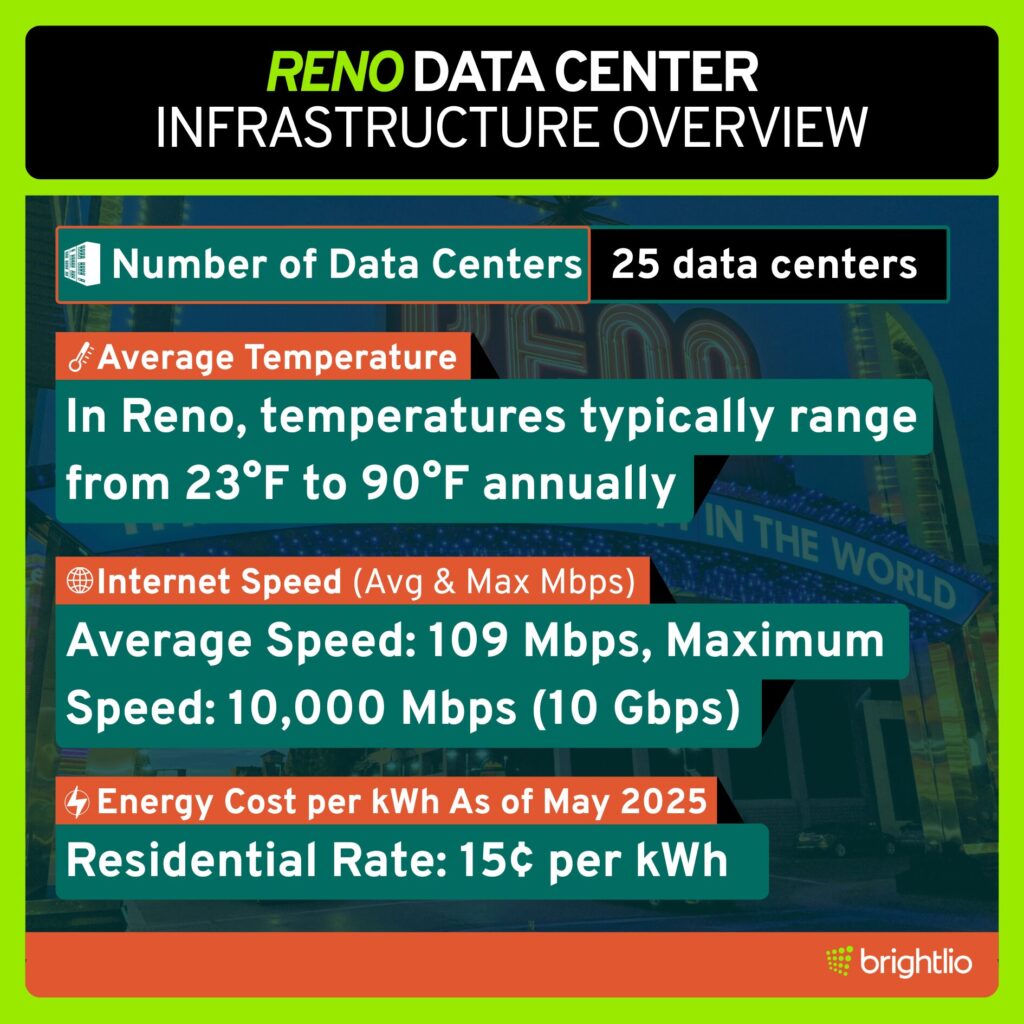
Reno provides an inland location near major West Coast data center markets. EdgeCore’s Tahoe Reno campus sits 250 miles from Silicon Valley. This proximity supports off-site backups and disaster recovery deployments for California businesses.
Reno’s high-desert climate offers opportunities to reduce cooling energy use during cooler months. Actual savings depend on facility design, outdoor temperatures, and equipment requirements. NOVVA’s Tahoe Reno facility combines this climate with air-cooled chillers that avoid evaporative water consumption.
Reno sits within an active fault region. Businesses evaluating disaster recovery facilities should assess seismic design, backup power, and physical separation between network routes.
Reno Offers Fiber Connectivity and Regional Peering
Reno connects colocation customers to West Coast markets through regional and long-distance fiber networks. Businesses can select facilities with multiple carriers and physically separate fiber routes to support network redundancy.
Zayo’s $153 million Nevada Middle Mile project is designed to add more than 800 miles of fiber along I-80 and US 93. The project targets broadband access for over 40,000 unserved or underserved locations. Its open-access structure allows multiple service providers to use the infrastructure.
The Tahoe Internet Exchange, or TahoeIX, supports local peering, which lets participating networks exchange traffic directly. This keeps local traffic within Northern Nevada and reduces dependence on out-of-state routes. Colocation buyers should compare carrier availability, connection speeds, and route diversity at each facility.

Reno Delivers Cost-Effective Operations
Nevada’s lower commercial electricity prices support Reno’s appeal for colocation. The statewide average for June 2026 is 9.83¢/kWh, compared with 27.33¢/kWh in California. Actual facility power charges depend on utility tariffs and contract terms.
Nevada has no state corporate or personal income tax. Qualifying data center projects can receive partial sales, use, and personal property tax abatements. These incentives depend on program approval and eligibility requirements.
Businesses should compare the full cost of rack space, power, bandwidth, cross-connects, and remote-hands support. Contract length, power commitments, and installation fees can materially change colocation pricing over the life of a Reno deployment.
Reno Offers Solar and Geothermal Energy Options
Reno’s renewable energy options include Nevada’s solar and geothermal resources. Solar facilities generate electricity during daylight hours, while geothermal plants use underground heat to produce power around the clock. This continuous output supports data centers’ constant electricity demand.
In February 2026, Ormat signed an agreement with NV Energy for up to 150 MW of new geothermal capacity to support Google’s Nevada operations. The development schedule targets 2028 to 2030 for the new plants to enter service. The agreement required regulatory approval at announcement.
Renewable energy coverage varies across Reno colocation providers. Facilities can purchase renewable electricity through utility programs or contracts with generators. Renewable energy certificates record the environmental attributes of renewable generation and support electricity sourcing claims. Annual matching compares renewable purchases with yearly consumption, while hourly matching considers generation and consumption during the same hours.
Businesses comparing Reno facilities should request the percentage of electricity covered, the projects supporting that coverage, and the provider’s matching method. Confirmation that projects are operating and certificates are retired on customers’ behalf helps businesses assess how the service supports their emissions goals.
Why Colocate in Reno?
Reno offers businesses access to West Coast markets, lower electricity costs than California, renewable energy options, and geographic separation for backup infrastructure. Its colocation facilities support production workloads, disaster recovery, and future expansion.
Below are six benefits of colocating in Reno:
- Lower Electricity Costs: Nevada’s average commercial electricity price was 9.83¢ per kWh in June 2026, compared with 27.33¢ in California. This difference supports Reno’s appeal for power-intensive workloads. Actual colocation charges depend on the provider’s utility arrangements, cooling overhead, and service contract.
- Access to West Coast Markets: Reno provides an inland location near Northern California for businesses serving western U.S. customers. Regional fiber connections support applications, data transfers, and connections between facilities. Network performance depends on the carrier, route, and destination.
- Geographic Separation for Disaster Recovery: Businesses with primary infrastructure in California can use Reno for backup storage and recovery systems. Keeping infrastructure in separate locations reduces dependence on a single site. Effective recovery planning considers shared utility dependencies, fiber routes, and local hazards.
- Seasonal Cooling Efficiency: Reno’s cooler months create opportunities to use outdoor temperatures for heat removal. Facilities with suitable cooling systems can reduce mechanical refrigeration during these periods, lowering the electricity required to support servers.
- Renewable Energy Options: Nevada’s solar and geothermal resources create opportunities for renewable electricity procurement. Geothermal plants can generate power around the clock, supporting continuous data center demand. Customers should confirm the renewable coverage included in their provider’s service.
- Capacity for Business Growth: Colocation lets businesses expand their infrastructure without constructing and operating a dedicated data center. Choosing a Reno provider with available rack space, sufficient power, and suitable cooling supports growth as computing and storage requirements increase.
Recent Data Center Developments in Reno (Last 12 Months)
Reno’s data center market saw construction progress, new energy agreements, and changes to development approvals between September 14, 2025, and September 14, 2026. Below are five developments affecting Reno and the surrounding region:
- August 2026: Regional Planning Review. The Truckee Meadows Regional Planning Agency held a public discussion on August 5 to present research and gather feedback on data center development. Its public engagement process supports recommendations for regional rules and regulations.
- June 2026: Reno Extends Its Development Pause. Reno City Council voted 6–1 on June 1 to suspend special use permits for new data centers until August 31, 2027, or until development regulations are in place. The action concerns Reno city approvals; surrounding jurisdictions, including Storey County, have separate approval processes.
- February 2026: Google Secures Future Geothermal Supply. Ormat signed an agreement with NV Energy for up to 150 MW of new geothermal capacity supporting Google’s Nevada operations. The planned projects target operation between 2028 and 2030. The agreement required regulatory approval at announcement.
- January 2026: EdgeCore Confirms Reno Construction Progress. EdgeCore’s January 13 update confirmed active construction on the first of three 72 MW buildings at its Greater Reno campus. The buildings represent 216 MW of planned capacity.
- January 2026: Switch Signs a Geothermal Agreement. Switch signed a 20-year agreement to purchase approximately 13 MW of geothermal power from Ormat’s Salt Wells plant near Fallon. Electricity deliveries supporting Switch’s Nevada data centers are scheduled to begin in Q1 2030.
Reno Has State-of-the-Art Data Centers
Reno’s not just gambling on data—it’s all-in. With lower power costs, strong fiber connectivity, and Silicon Valley just over the hill, the city has become a serious data center market. Businesses comparing Nevada locations may also want to weigh Reno against the Las Vegas colocation market. Here’s a breakdown of the biggest moves happening right now:
1. Switch Tahoe Reno, Citadel Campus
Switch Tahoe Reno, known as the Citadel Campus, provides commercial colocation in the Tahoe Reno Industrial Center in Storey County. The campus supports enterprise, cloud, and AI workloads. Its expansion plans call for multi-gigawatt power capacity upon completion.
The campus offers 4.5 ms latency to the Bay Area and a dedicated 7 ms fiber connection to Las Vegas through the Switch SUPERLOOP network. Facilities use Switch’s proprietary Tier 5 Platinum design standard and include a 100% power uptime guarantee. High-density infrastructure and connections between Switch campuses support businesses planning deployments across multiple locations.
2. NOVVA Tahoe Reno
NOVVA Tahoe Reno provides commercial colocation on a 20-acre campus in the Tahoe Reno Industrial Center. The facility contains 300,000 square feet of total building space, including 180,000 square feet of data hall space. Its design combines six 10 MW data halls with a 100 MW on-site substation.
The facility supports deployments from 250 kW to 30 MW. Air-cooled chillers avoid evaporative water consumption for cooling. The campus includes 24/7 security and on-site offices for customers.
3. EdgeCore Reno Campus
EdgeCore’s Reno campus is a hyperscale data center development in the Tahoe Reno Industrial Center. Plans include three buildings with 216 MW of IT power capacity and nearly 1 million square feet of space on a 56-acre site.
Each building is designed for a single hyperscale customer, with power and cooling systems configured for that customer’s workloads. The air-cooled design targets water consumption below 0.01 liters per kilowatt-hour of IT energy use, supporting large deployments with limited cooling water demand.
4. Vantage NV1 Campus
Vantage’s NV1 campus is a hyperscale data center development in Storey County near Reno. The 137-acre campus is planned for four buildings, with 224 MW of IT power capacity and 1.1 million square feet of space.
The design supports air and liquid cooling for cloud and AI workloads, with power densities of 360 to 720 watts per square foot. A closed-loop chilled water system limits cooling water consumption. Planned connectivity includes multiple carrier options and at least two fiber paths per carrier.
Drawbacks and Considerations for Colocation in Reno
Reno colocation requires careful assessment of natural hazards, power availability, development restrictions, and facility capabilities. Below are seven drawbacks and considerations for businesses evaluating the market:
- Total Contract Costs: Compare the complete cost of rack space, electricity, network connections, installation, and technical support. Minimum power commitments, annual price increases, and expansion charges can materially affect the cost over the contract term.
- Earthquake and Wildfire Exposure: Reno faces earthquake hazards that affect site selection and building design. Review structural protection, equipment anchoring, and recovery procedures. Wildfire preparedness should cover smoke filtration, emergency access, backup power, and fuel deliveries.
- Power Availability and Delivery Dates: Regional data center growth requires generation, transmission, and substation upgrades. Confirm how much power is available for your deployment, when additional capacity becomes usable, and which infrastructure dependencies could affect expansion.
- Network Performance: Proximity to California provides a useful starting point for connectivity planning. Actual performance depends on the facility’s carriers and network routes. Verify latency to your users and cloud services, connection charges, and whether backup connections follow physically separate paths.
- Cooling and Water Requirements: Reno’s cooler seasons provide cooling opportunities, while summer conditions still require sufficient heat-removal capacity. Review performance at your intended rack density, water consumption, and support for liquid cooling where required.
- Development Restrictions: Reno’s June 2026 decision pauses special use permits for new data centers until August 31, 2027, or until development regulations are in place. Confirm the specific property’s jurisdiction, existing approvals, and expansion permissions.
- Distance From Your Technical Team: Businesses operating outside Northern Nevada must account for travel and equipment delivery times. Review the provider’s on-site technical assistance, response commitments, spare-parts storage, and emergency maintenance arrangements.
How Brightlio Can Help With Colocation in Reno
Brightlio helps businesses compare Reno colocation providers, evaluate technical requirements, and negotiate pricing. Its colocation services cover individual servers, full racks, private cages, suites, and deployments across multiple locations.
The selection process starts with your space, power, cooling, connectivity, and budget requirements. Brightlio connects your business with suitable providers, gathers quotes, and helps compare the costs and capabilities included in each proposal.
Brightlio helps evaluate expansion options as your computing and storage needs increase. A single point of contact coordinates provider discussions, organizes technical questions, and helps your team assess responses.
Contact Brightlio to discuss your requirements and request Reno colocation quotes.
Frequently Asked Questions Regarding Reno Colocation
Here is the reformatted version with the questions as H3:
1. What is the total storage or compute capacity of the Citadel data center near Reno?
Switch’s Citadel Campus (also known as TAHOE RENO) will eventually span 7.2 million sq ft of data center space with up to 650 MW of power capacity. The first facility, Tahoe Reno 1, is about 1.3–1.4 million sq ft with 130 MW capacity.
2. Where is Switch’s Reno data center located, and how is it linked to the Citadel campus?
Switch’s Reno facility is located at 1 Superloop Circle, inside the Tahoe Reno Industrial Center. It’s directly part of the Citadel Campus. The site connects through Switch’s own SUPERLOOP fiber network, a 500-mile multi-terabit ring that links it to their Las Vegas Core Campus and provides 4 ms latency to the Bay Area.
3. What services does Switch offer at its Reno facility, and which industries does it serve?
Switch provides exascale colocation, high-density cabinets (up to 55 kW per cabinet), Tier V Platinum reliability, 100% uptime power guarantee, telecom auditing & SD-WAN/MPLS services, and on-site security/fire brigade. Industries served include e-commerce (e.g. eBay), semiconductors, cloud providers, healthcare, finance, and government-grade applications.
4. Has Google built or acquired a data center within TRIC?
Yes: in 2017, Google acquired roughly 1,200 acres in TRIC for a data center project. Construction began around 2019.
5. What is the current status of Google’s data infrastructure in the Reno area?
As of the latest available info, Google owns the land and has construction underway at its TRIC site. No operating facility has been announced yet — it remains in the development phase.
Tract is a land/development company that creates data center parks near TRIC. They operate sites like Peru Shelf Technology Park, Peru Ridge, and South Valley Tech Park, providing infrastructure-ready parcels that complement facilities like Citadel and Google’s.
Within TRIC, major large-scale data centers include:
– Switch Citadel Campus (Tahoe Reno 1 & 2, with more coming)
– Google’s developing campus (under construction)
– Tract’s multiple development parks
– Other operators (e.g., Vantage, EdgeCore, NOVVA) expanding nearby
No exact count is available, but there are at least several hyperscale campuses and numerous shell campuses.
On‑site power plants: TRIC features municipal utilities, rail-served gas, and five power plants generating over 900 MW. Switch also added 179 MW of behind‑the‑meter solar capacity.
Low-cost, low-risk energy: approximately 4.9 ¢/kWh, 100% renewables, and tax incentives apply.
Fiber: Switch’s SUPERLOOP, along with multiple fiber paths, supports high-capacity routing to the West Coast.
There is no known facility called “Webb” in Reno. It may be a naming error or confusion with another data center like NOVVA. Clarification would help in tracking accurate information.
No large-scale Amazon data center has been confirmed in the Tahoe Reno Industrial Center. Their regional infrastructure appears to be focused elsewhere for now.

John Minnix is the Founder and CEO of Brightlio, with two decades of experience in data center, cloud, and network solutions. He previously built VPLS Solutions into a top Southern California technology partner before its acquisition by Evocative, where he served as President and COO overseeing global sales, operations, and strategic acquisitions.
Recent Posts
Data Centers In Pennsylvania

Data Centers In Nebraska

Data Centers In Mississippi

Data Centers In Indiana
Let's start
a new project together