
Michigan has one of the largest retail colocation bases in the Midwest and almost no operating hyperscale capacity. Switch’s Pyramid campus near Grand Rapids is the largest operating site, designed for 320 MW and 1.8 million sq ft at completion.
The next four operating sites are enterprise facilities: Liquid Web’s Lansing DC3 (90,000 sq ft) and DC2 (32,000+ sq ft), IronGate’s Bunker in Warren, and US Signal’s Detroit MI03 in Belleville (25,000+ sq ft).
That is about to change. Stargate Michigan, the Oracle and OpenAI campus in Saline Township, broke ground in June 2026 with 1,400 MW of contracted load, and Google plans a gigawatt-scale campus in Van Buren Township.
The buildout comes with real friction. Business power costs 16.09¢/kWh, well above the national average, the Attorney General is fighting Stargate’s power contracts in court, and at least 19 Michigan municipalities have passed data center moratoriums.
Retail buyers get a deep, competitively priced market around Detroit, Grand Rapids, and Lansing. New large campuses face expensive power and a hostile local climate.
Michigan Data Center Tracker
63data center facilities
5 operational17 planned41 colocation
Data Center Map counts 79 buildings across 12 markets here. Multi-building campuses count once, while tenant suites in shared buildings count separately.
Market Snapshot
Largest Operating Data Centers In Michigan
These are the five largest operating sites. Switch's Pyramid campus near Grand Rapids is the only one that publishes a capacity figure, and every other listing appears on the map, with operating sites in green and planned ones in coral.
- Switch Pyramid CampusCaledonia, campus design320 MWOperational
Campus designed for up to 1.8 million sq ft and 320 MW at completion, with the Pyramid and a second 312,000 sq ft building open
- Address:
- 6100 E Paris Ave SE, Caledonia
- Operator:
- Switch
- Power:
- 100% renewable energy through Consumers Energy
- Liquid Web Lansing DC3LansingNot publishedOperational
90,000 sq ft facility with 50,000 sq ft of whitespace, opened in January 2010
- Address:
- 2703 Ena Dr, Lansing
- Operator:
- Liquid Web
- Role:
- Also the company's headquarters
- Liquid Web Lansing DC2LansingNot publishedOperational
32,000+ sq ft facility with N+1 generators and links to four Tier 1 providers
- Address:
- 4428 S Creyts Rd, Lansing
- Operator:
- Liquid Web
- IronGate The BunkerWarrenNot publishedOperational
Enterprise data center in Warren known as The Bunker
- Address:
- 28201 Van Dyke Ave, Warren
- Operator:
- IronGate Data Centers
- US Signal Detroit MI03BellevilleNot publishedOperational
25,000+ sq ft facility with room to expand to 100,000 sq ft
- Address:
- 9275 Haggerty Rd, Belleville
- Operator:
- US Signal
5 Largest Planned Data Centers In Michigan
Stargate Michigan in Saline Township and Google's Van Buren campus account for 2,400 MW of the 2,580 MW in the five largest projects.
- Stargate Michigan (Related Digital Saline Township)Saline Township, contracted load1,400 MWPlanned
Up to five buildings totaling 2.2 million sq ft, including three large data halls
- Location:
- Saline Township, Washtenaw County
- Developer:
- Related Digital, for Oracle and OpenAI
- Power:
- DTE contracts for 1,383 MW, conditionally approved in December 2025
- Construction:
- Groundbreaking held June 1, 2026
- Google Van Buren CampusVan Buren Township, gigawatt-scale1,000 MWPlanned
Gigawatt-scale campus planned on 282 acres north of I-94
- Location:
- Van Buren Township, Wayne County
- Developer:
- Panattoni, for Google
- Raeden Detroit 3 (Gibraltar)Gibraltar, proposed100 MWProposed
Proposed on a former steel plant site, with power from DTE
- Address:
- 27800 W Jefferson Ave, Gibraltar
- Developer:
- Raeden
- Spark AI Foundry LansingLansing, proposed50 MWProposed
Brownfield campus in the evaluation phase
- Location:
- Lansing, Eaton County
- Developer:
- Spark AI Foundry
- Hyperscale Data Dowagiac CampusDowagiac, planned30 MWPlanned
AI data center campus in Cass County
- Location:
- Dowagiac, Cass County
- Developer:
- Hyperscale Data, Inc.
Other planned projects, shown on the map in coral: , , , , , , , , , , , .
5 Largest Colocation Facilities In Michigan
Retail colocation clusters along Southfield's Northwestern Highway and Lahser Road corridor, with Cogent's 31,149 sq ft downtown Detroit facility as the largest single site.
- Cogent Data Center DetroitDetroit31,149 sq ftColocation
42U cabinets, carrier-neutral connectivity up to 100GE and redundant diesel generators
- Address:
- 1320 3rd Ave, Detroit
- Operator:
- Cogent Communications
- Lumen Detroit 3Detroit12,757 sq ftColocation
AC and DC power with generator and battery backup
- Address:
- 1965 Porter St, Detroit
- Operator:
- Lumen
- Liquid Web SouthfieldSouthfield12,000 sq ftColocation
16,000 sq ft building with 12,000 sq ft dedicated to data center operations
- Address:
- 21700 Melrose Ave, Southfield
- Operator:
- Liquid Web
- Raeden Detroit 2Detroit10,000 sq ftColocation
Downtown enterprise colocation with N+1 infrastructure, which Raeden says can scale to 3 MW
- Address:
- 1050 Woodward Ave, Detroit
- Operator:
- Raeden
- Liquid Web DearbornDearborn7,000 sq ftColocation
Nearly 7,000 sq ft facility with 3,200 sq ft of raised floor near Detroit Metro Airport
- Address:
- 22005 Outer Dr W, Dearborn
- Operator:
- Liquid Web
Other colocation facilities, shown on the map as green squares: , , , , , , , , , , , , , , , , , , , , , , , , , , , , , , , , , , , .
Choose a category to switch the list and highlight its sites on the map. Click any site card to find it on the map, or click a marker to jump to its card. Pins are approximate, and each MW figure carries the basis shown beside it.
Data sourced from Data Center Map, EIA, Switch, ServerCountry, Compute Atlas and Inflect, checked October 10, 2026. Listings count individual buildings, and the lists show the largest sites in each category.
Why Colocate In Michigan?
Michigan's case rests on retail depth, labor availability, a cold climate, and a long-running tax break. Power price is missing from that list on purpose: Michigan's business rate is one of its weakest points, and it appears with the drawbacks.
Five benefits hold up under scrutiny.
1. Market Access And Latency
The Detroit metro is the largest enterprise market in Michigan, anchored by the auto industry, its suppliers, and health systems. Detroit sits directly across the river from Windsor, Ontario, which makes it a natural gateway for workloads that serve both the U.S. and Canada.
Chicago is the nearest major interconnection hub, about a four-to-five-hour drive west. Grand Rapids and Lansing serve western and central Michigan, so a buyer can split production and recovery across two Michigan metros on separate utility systems.
Michigan is a regional market. Latency-sensitive workloads aimed at the coasts still belong closer to those users.
2. Network Connectivity And Peering
Retail colocation clusters along Southfield's Northwestern Highway and Lahser Road corridor. 123Net runs three Southfield sites there, and EdgeConneX, Verizon, Lumen, TelNet, US Signal, and 365 Data Centers operate nearby.
Downtown Detroit adds carrier-neutral capacity. Cogent's facility at 1320 3rd Ave offers 42U cabinets, connectivity up to 100GE, and redundant diesel generators.
Lansing has its own peering point. ACD.net runs MetroIX, an internet exchange where networks swap traffic locally, alongside Liquid Web's three Lansing data centers.
Depth is the limit. Michigan's buildings are small, and the densest peering in the region still happens in Chicago.
3. Tax Policy And Incentives
Michigan exempts qualified data center equipment from its 6% sales and use tax, and a 2024 law extended that relief through 2050. Sites on brownfields or former power plants keep it through 2065.
The colocation exemption is the one most buyers will touch. The newer enterprise exemption, in effect since April 2025, applies only to single-company campuses that invest at least $250 million and create 30 jobs paying 150% of the regional median wage.
Enterprise sites must use municipal water and earn a green building certification. Those terms suit hyperscale campuses and leave smaller private builds outside the program.
4. Workforce And Ecosystem
Michigan's labor market has slack, which is rare among data center states. Unemployment reached 5.0% in August 2026, the fourth-highest rate in the country and nearly a full point above the 4.1% national rate.
That slack helps operators hire. Electricians, mechanical technicians, and controls staff are easier to find in Michigan than in tight markets such as Nebraska or Indiana.
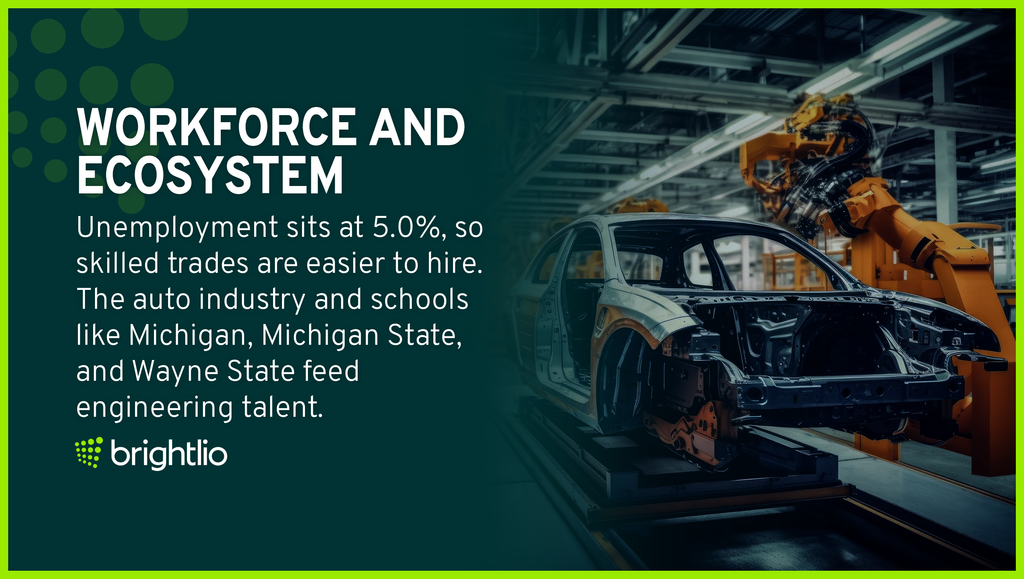
The auto industry adds a deep engineering and manufacturing workforce. The University of Michigan, Michigan State, Wayne State, and Michigan Tech supply computing and engineering graduates.
5. Climate And Low Natural Hazard Risk
Michigan's long cold seasons give operators extended free cooling, which means outside air can cool the data hall for much of the year. That cuts cooling costs compared with Southern markets.
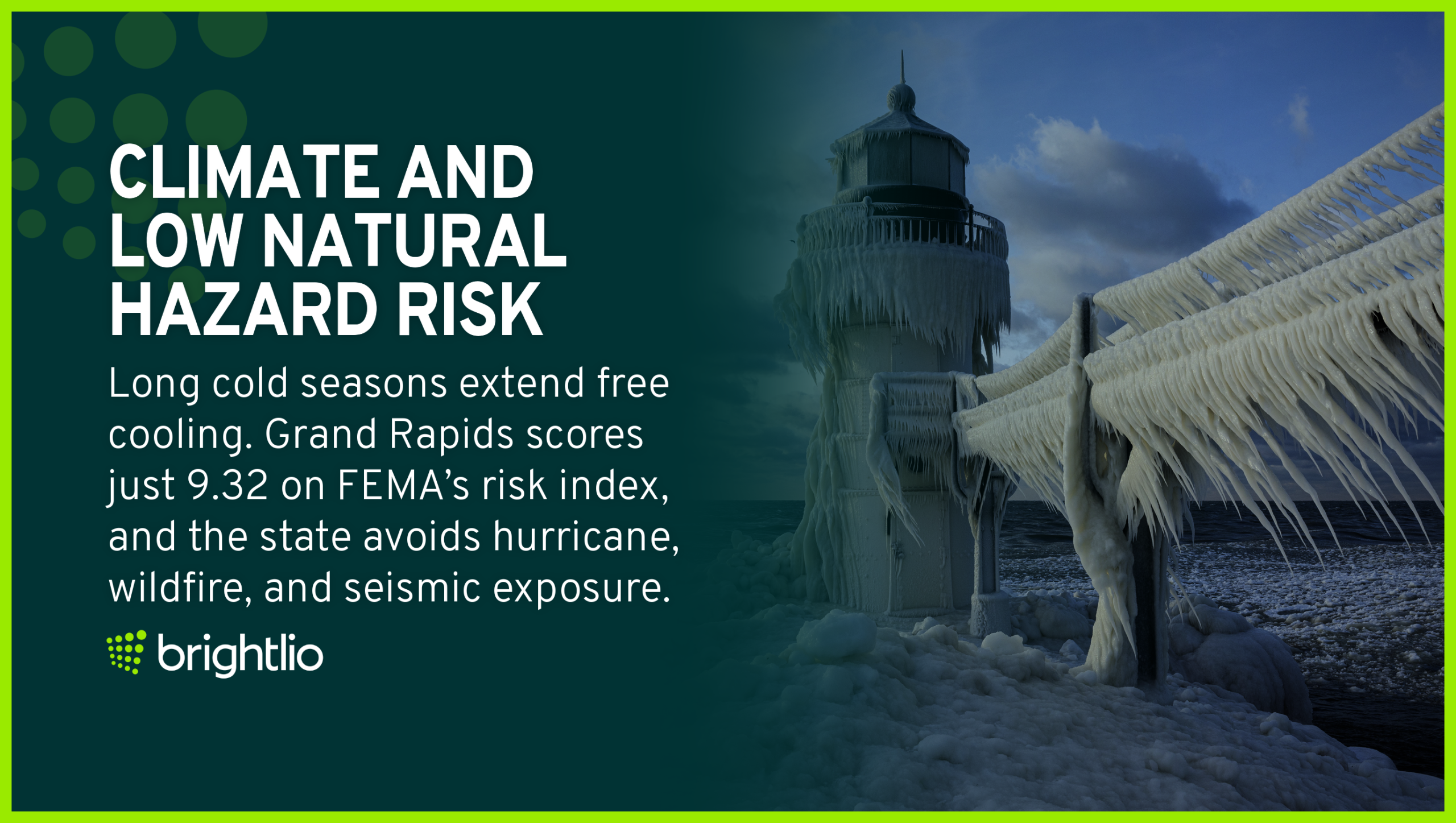
Natural hazard exposure is low. Grand Rapids scores 9.32 out of 100 on FEMA's National Risk Index, with severe storms and winter weather as the main threats.
Facilities still need winter fuel plans and storm-hardened roofs. The state is free of the hurricane, wildfire, and seismic exposure that shapes site selection elsewhere.
Key Cities Or Submarkets In Michigan
Michigan's market splits between a dense retail base in metro Detroit, two smaller hubs in Grand Rapids and Lansing, and a new hyperscale corridor forming southwest of Detroit.
The five submarkets below run from the deepest retail supply to the largest and most contested projects.
1. Metro Detroit And Southfield
Metro Detroit holds Michigan's largest concentration of retail colocation. The Southfield corridor along Northwestern Highway and Lahser Road carries the most buildings, while downtown Detroit has the largest single site.
Cogent's downtown facility at 1320 3rd Ave is the biggest retail building in the state at 31,149 sq ft. Lumen Detroit 3 offers 12,757 sq ft at 1965 Porter St, and Raeden Detroit 2 runs 10,000 sq ft at 1050 Woodward Ave, with room to scale to 3 MW per Raeden.
The suburbs add smaller sites. Liquid Web runs 12,000 sq ft of data center space in Southfield and 7,000 sq ft in Dearborn near Detroit Metro Airport, and Troy, Royal Oak, Farmington Hills, Westland, and Auburn Hills host additional operators.
IronGate's Bunker in Warren and US Signal's MI03 in Belleville, both profiled below, round out the metro. The Detroit colocation market suits automotive, healthcare, and financial buyers that need cabinets to small cages with broad carrier choice.
2. Washtenaw County: Saline Township And Ann Arbor
Washtenaw County holds Michigan's largest planned project. Related Digital is building Stargate Michigan in Saline Township for Oracle and OpenAI, with up to five buildings totaling 2.2 million sq ft and 1,400 MW of contracted load.
The project arrived over local objections. The township board rejected the rezoning 4 to 1, Related Digital sued, and the township settled within weeks, with Related agreeing to pay $14 million.
The backlash spread. The City of Saline passed a 12-month moratorium in January 2026, and Ypsilanti's utility authority approved a 12-month moratorium on water service to data centers in April 2026, blocking a proposed University of Michigan and Los Alamos supercomputing center.
Ann Arbor's retail market is small, with OTAVA, Synergy Broadband, and Velocity running local sites. The county suits university and research buyers, and anyone planning a new campus here faces the strongest opposition in the state.
3. Van Buren, Gibraltar, And Allen Park
Wayne County's southern and western suburbs are where Michigan's next hyperscale wave is forming. Panattoni is developing a gigawatt-scale 1,000 MW campus for Google on 282 acres north of I-94 in Van Buren Township.
Raeden has proposed a 100 MW campus on a former steel plant site at 27800 W Jefferson Ave in Gibraltar, with DTE power. Solstice Data plans a 26 MW site in Allen Park.
The pipeline is concentrated. Stargate Michigan and Google's Van Buren campus account for 2,400 MW of the 2,580 MW in Michigan's five largest planned projects, about 93%, so two projects carry nearly all of the state's future capacity.
4. Grand Rapids And West Michigan
Grand Rapids holds Michigan's largest operating campus, Switch's Pyramid in Caledonia, profiled below. US Signal runs two sites in Kentwood and Byron Center, and 123Net, Iserv, Everstream, Altafiber, and CBTS operate local facilities.
Microsoft has four planned sites in the region, in Caledonia, Dorr Township, Gaines Township, and Lowell Township. Project Peninsula is planned in Cedar Springs, and Hyperscale Data plans a 30 MW AI campus in Dowagiac in southwest Michigan.
West Michigan suits enterprises that want a lower-cost alternative to Detroit and a recovery site on Consumers Energy's grid, separate from DTE.
5. Lansing
Lansing is Liquid Web's home market. The company runs three data centers in the city, including DC2 and DC3, both profiled below, and its headquarters sits at the DC3 campus.
ACD.net's MetroIX gives Lansing a local internet exchange, and Everstream and Lumen add carrier options. Spark AI Foundry is evaluating a 50 MW brownfield campus, and Deep Green plans a 20 MW site.
Lansing suits state government, Michigan State University, and hosting customers, and it works as a central Michigan recovery site for Detroit deployments.
Notable Colocation Providers And Facilities In Michigan
Michigan's five largest operating sites include one hyperscale-grade campus and four enterprise facilities. Only Switch publishes a capacity figure, which says a lot about how small the rest of the operating base is.
The five profiles below follow the tracker's ranking.
1. Switch Pyramid Campus Grand Rapids
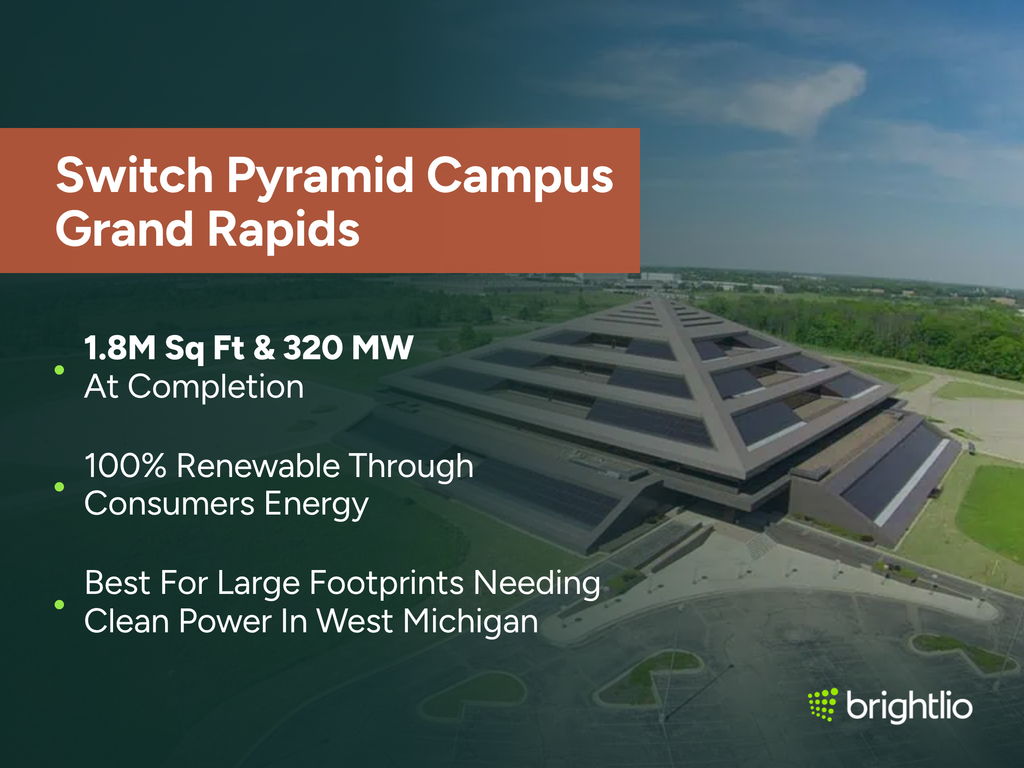
Switch's campus at 6100 E Paris Ave SE in Caledonia is designed for up to 1.8 million sq ft and 320 MW at completion. The Pyramid and a second 312,000 sq ft building are open today.
The campus runs on 100% renewable energy through Consumers Energy. That gives tenants a clean-power claim most Michigan facilities cannot match on a grid where gas and coal still supply more than half of generation.
Switch Pyramid is best suited for enterprises and cloud tenants that need large footprints, high security, and renewable supply in West Michigan.
2. Liquid Web Lansing DC3
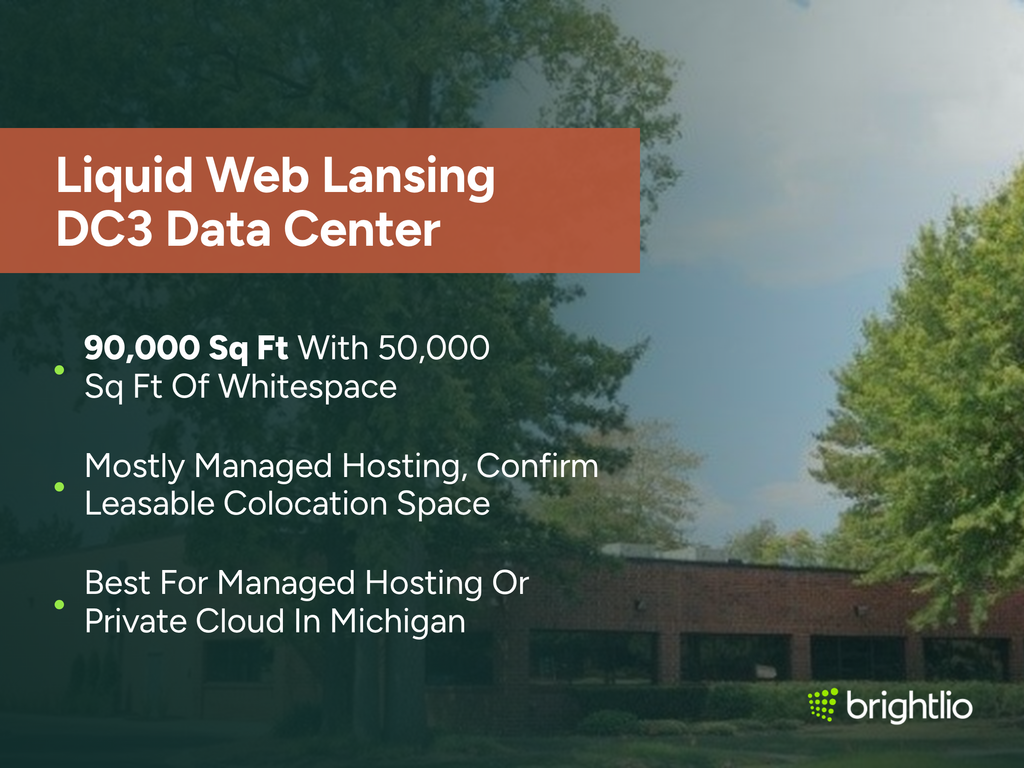
Liquid Web's DC3 at 2703 Ena Dr in Lansing covers 90,000 sq ft, with 50,000 sq ft of whitespace. It opened in January 2010 and doubles as the company's headquarters.
Liquid Web is best known for managed hosting and dedicated servers, so most of the floor serves its own hosting customers. Buyers looking for traditional colocation need to confirm what space Liquid Web leases to outside tenants.
DC3 is best suited for businesses that want managed hosting or private cloud from a Michigan provider with in-state operations.
3. Liquid Web Lansing DC2
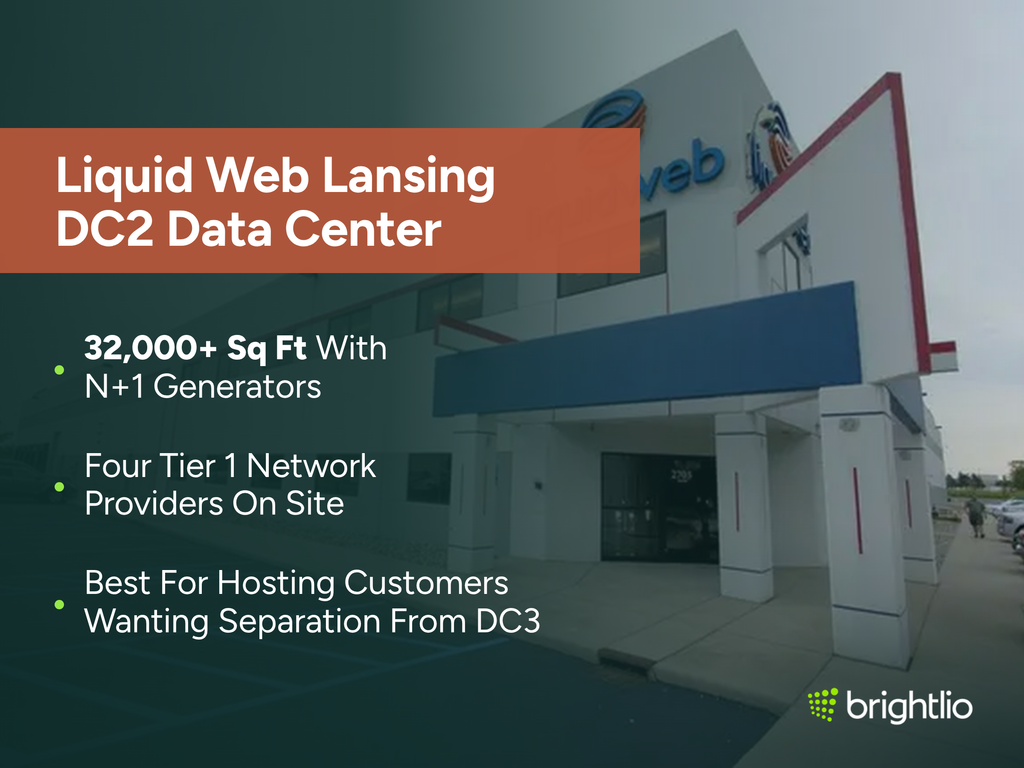
Liquid Web's DC2 at 4428 S Creyts Rd covers more than 32,000 sq ft. It runs N+1 generators and connects to four Tier 1 network providers.
The site gives Liquid Web a second Lansing facility for redundancy, separate from DC3.
DC2 is best suited for hosting customers that want geographic separation inside one provider's Lansing footprint.
4. IronGate The Bunker Warren
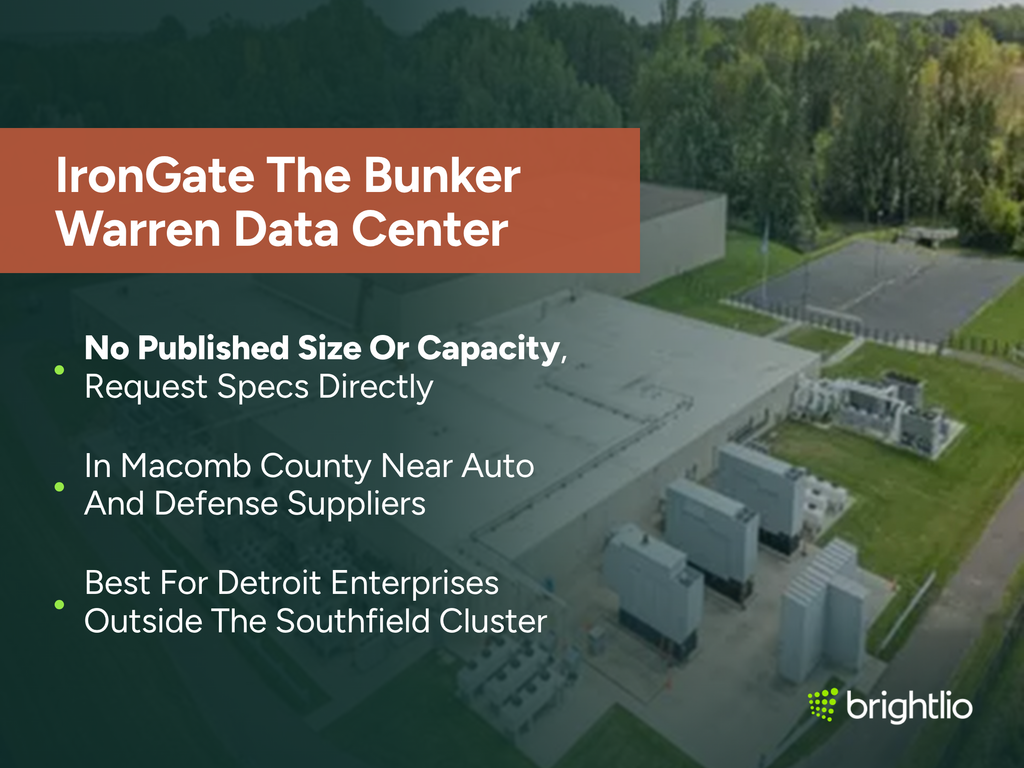
IronGate Data Centers runs an enterprise facility known as The Bunker at 28201 Van Dyke Ave in Warren. IronGate does not publish its size or capacity.
The Warren location sits in Macomb County, north of Detroit and close to the region's automotive and defense suppliers.
The Bunker is best suited for metro Detroit enterprises that want a local provider outside the Southfield cluster. Buyers need to request specs directly, since none are public.
5. US Signal Detroit MI03 Belleville
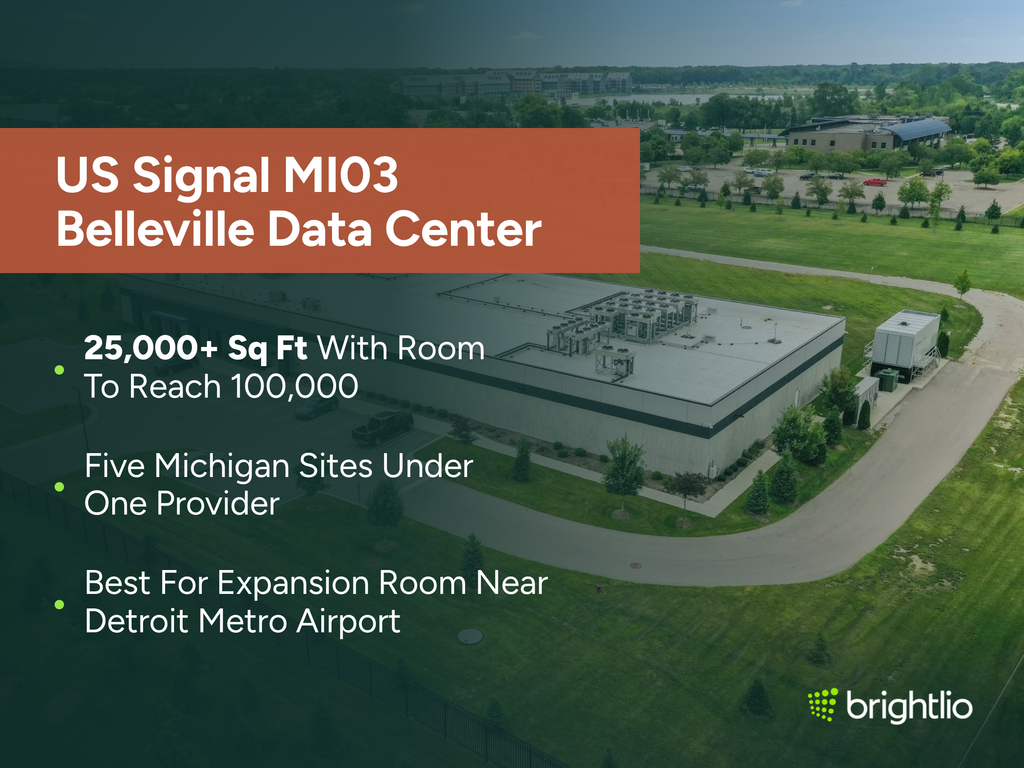
US Signal's MI03 at 9275 Haggerty Rd in Belleville covers more than 25,000 sq ft and has room to expand to 100,000 sq ft.
US Signal runs five Michigan data centers, from Belleville and Southfield to Auburn Hills and the Grand Rapids area, which lets buyers build multi-site deployments with one provider.
MI03 is best suited for enterprises near Detroit Metro Airport that want expansion room and a statewide footprint for disaster recovery.
Recent Developments In Michigan (Last 12 To 24 Months)
- August 2026: Attorney General Dana Nessel and environmental groups filed briefs asking the Michigan Court of Appeals to overturn the DTE contracts that supply 1.4 GW to Stargate Michigan. The case will shape how future data center power deals get reviewed.
- June 2026: Related Digital broke ground on Stargate Michigan in Saline Township on June 1, starting Michigan's first hyperscale campus despite the township's original rejection.
- April 2026: Nessel appealed the Michigan Public Service Commission's approval to the Court of Appeals, and Ypsilanti's utility authority approved a 12-month moratorium on water service to new data centers.
- March 2026: The Public Service Commission unanimously rejected Nessel's request to reopen the DTE contracts, keeping the approval in place.
- December 2025: The Public Service Commission conditionally approved DTE's 19-year and 15-year contracts covering 1,383 MW for Stargate, without a contested case hearing.
- April 2025: Michigan's enterprise data center sales tax exemption took effect, opening state relief to single-company campuses investing at least $250 million.
Drawbacks And Considerations For Colocation In Michigan
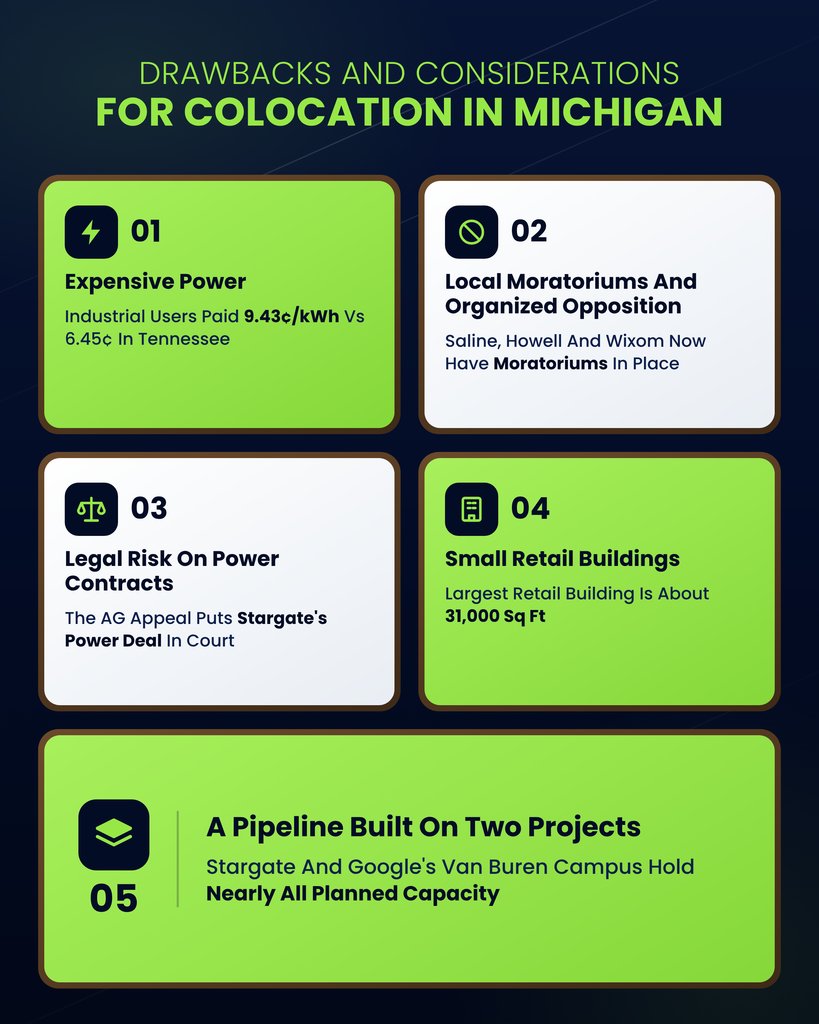
Michigan's retail market is solid, but large new projects face costs and resistance that buyers need to price in.
The five drawbacks below carry the most weight when comparing Michigan with Chicago, Ohio, and Indiana.
1. Expensive Power
Michigan's business rate sits well above the national average, and industrial users paid 9.43¢/kWh in May 2026, against 6.45¢ in Tennessee in the same month. Buyers comparing colocation pricing across the Midwest will find Michigan's power line among the highest.
2. Local Moratoriums And Organized Opposition
Saline Township's experience turned communities against data centers. Moratoriums now cover Saline, Howell Township, Wixom, and other municipalities, and a developer pulled a $1 billion Howell Township proposal after residents pushed back.
3. Legal Risk On Power Contracts
The Attorney General's appeal puts Stargate's power deal in front of the courts. Any large new campus on DTE or Consumers Energy power can expect the same scrutiny of its contract terms.
4. Small Retail Buildings
Michigan's largest retail colocation building is about 31,000 sq ft. Buyers needing multiple private suites or dense cloud on-ramps will find more in Chicago.
5. A Pipeline Built On Two Projects
Stargate Michigan and Google's Van Buren campus make up nearly all of the state's planned capacity. A delay at either one would leave Michigan with little new hyperscale supply.
How Brightlio Can Help With Colocation In Michigan
Brightlio helps organizations compare Michigan colocation, cloud connectivity, AI infrastructure, and disaster recovery options across Detroit, Southfield, Troy, Grand Rapids, Lansing, Ann Arbor, and nearby Midwest markets. Our team helps clients evaluate facility fit, power pricing, carrier access, compliance needs, power density, cooling design, and long-term site risk.
We compare providers such as Switch, Cogent, Lumen, Raeden, Liquid Web, US Signal, 123Net, EdgeConneX, OTAVA, and other Michigan operators. For Michigan projects, we pay close attention to DTE and Consumers Energy contract terms, sales tax exemption eligibility, local moratoriums, winter fuel planning, carrier routes to Chicago, and expansion rights.
Brightlio can support cabinet, cage, private suite, single-tenant, high-density, AI, and multi-site disaster recovery planning, and our quotes come free to clients. Contact Brightlio to compare Michigan colocation solutions and start planning a cost-effective and resilient deployment.
Frequently Asked Questions
1. Which U.S. State Has The Most Data Centers?
Virginia has the most data centers in the United States, led by Northern Virginia's Loudoun County cluster. Michigan is a mid-size market with 63 facilities in the tracker.
2. How Many Data Centers Are In Michigan?
Michigan has 63 data center facilities from 31 operators: 5 operational campuses, 17 planned projects, and 41 colocation sites. Data Center Map counts 79 buildings across 12 markets, since it lists campus buildings and tenant suites separately.
3. What Is The Largest Data Center In Michigan?
Switch's Pyramid campus in Caledonia, near Grand Rapids, is the largest operating site, designed for 320 MW. The largest planned project is Stargate Michigan in Saline Township, with 1,400 MW of contracted load.
4. Who Is Building Data Centers In Michigan?
Related Digital is building Stargate Michigan for Oracle and OpenAI, and Panattoni is developing Google's Van Buren campus. Microsoft has four planned sites in West Michigan, and Raeden, Spark AI Foundry, Hyperscale Data, Solstice Data, and Deep Green are behind smaller projects.
5. Are Michigan Electricity Costs Favorable For Colocation?
No. Business customers paid 16.09¢/kWh in May 2026, well above the national average, and industrial users paid 9.43¢/kWh. Power is the weakest part of Michigan's pitch.
6. What Tax Incentives Does Michigan Offer Data Centers?
Qualified colocation data centers are exempt from Michigan's 6% sales and use tax on equipment through 2050. Single-company enterprise campuses qualify only with at least $250 million of investment and 30 high-wage jobs, and brownfield or former power plant sites keep the exemption through 2065.
7. Which Cities Are Best For Colocation In Michigan?
Metro Detroit, especially the Southfield corridor and downtown Detroit, has the most retail options and carriers. Grand Rapids offers Switch's Pyramid campus and a separate utility grid, and Lansing works for hosting and recovery.
8. Can Michigan Colocation Support AI Or High-Density Workloads?
Today, mainly at Switch's Pyramid campus. Stargate Michigan and Google's Van Buren campus will add gigawatt-scale AI capacity once they come online, but Michigan's retail buildings are small and not built for dense GPU deployments.
9. Why Are Michigan Communities Fighting Data Centers?
Residents in Saline Township rejected Stargate's rezoning, then watched the project proceed after a lawsuit and settlement. That outcome spread fears about power costs, water use, and local control, and at least 19 municipalities have since passed moratoriums.
10. Who May Not Need Michigan Colocation?
Buyers choosing a market for cheap power will do better in the South. Enterprises needing large private suites or the densest peering will find more in Chicago, and developers needing fast local approvals face moratoriums across southeast Michigan.
Keep reading with our colocation guides for these nearby markets:

Tamzid is a cybersecurity researcher with 5+ years of experience across SaaS, security, compliance, data centers and cloud. He writes for brightdefense.com and hipaasimple.com, covering security, compliance, and infrastructure topics. Certified through Cisco, Fortinet (NSE 1), and the Basel Institute on Governance in OSINT, he grounds his work in primary sources and verified data.
Recent Posts
Data Centers and Colocation In Michigan

Data Centers and Colocation in Wisconsin
Data Centers and Colocation in Tennessee

Data Centers and Colocation In Nevada
Let's start
a new project together