
Wisconsin’s largest operating data center is Microsoft’s Fairwater 1 campus in Mount Pleasant, with a 450 MW phase-one load.
The Wells Building in Milwaukee follows with 12 MW of building design power. Aventus Lakes has about 0.5 MW available today on a planned path to 1.5 MW.
Data Holdings Milwaukee and TierPoint Milwaukee complete the operating-site list, with neither publishing total capacity. Fairwater is a single-tenant AI campus with no colocation access.
Milwaukee’s commercial facilities offer space for enterprise hardware and network infrastructure.
Wisconsin suits local enterprises needing access to their equipment, Milwaukee deployments requiring carrier interconnection, and buyers choosing facilities with cold-weather cooling capabilities.
It offers limited appeal to organizations selecting a market primarily for cheap electricity. Large AI construction projects provide no guarantee of rentable cabinets or near-term expansion space.
Wisconsin Data Center Tracker
44data center facilities
5 operational10 planned29 colocation
Data Center Map counts 53 buildings across 10 markets here. Multi-building campuses count once, while tenant suites in shared buildings count separately.
Market Snapshot
Largest Operating Data Centers In Wisconsin
These are the five largest operating sites by published capacity. Microsoft's Fairwater campus in Mount Pleasant dwarfs everything else, and every other listing appears on the map, with operating sites in green and planned ones in coral.
- Microsoft Fairwater 1 CampusMount Pleasant, phase 1 load450 MWOperational
AI supercomputing campus on the former Foxconn site, fully operational since June 2026
- Location:
- Mount Pleasant, Racine County
- Operator:
- Microsoft
- Investment:
- $3.3 billion for phase 1
- Cooling:
- Liquid-cooled NVIDIA GPUs
- The Wells BuildingMilwaukee, building design12 MWOperational
15-story, 160,000 sq ft carrier hotel. The 12 MW is the building's design capacity, not power available to lease
- Address:
- 324 E Wisconsin Ave, Milwaukee
- Owner:
- 1547 Critical Systems Realty
- Aventus LakesMilwaukee, available today0.5 MWOperational
About 0.5 MW available today. Aventus describes a path to 1.5 MW, which isn't energized yet
- Address:
- 7901 W Clinton Ave, Milwaukee
- Operator:
- Aventus Data Centers
- Data Holdings MilwaukeeMilwaukeeNot publishedOperational
Facility the operator describes as Tier III+, built for 30+ kW cabinets
- Address:
- 3135 W Highland Blvd, Milwaukee
- Operator:
- Data Holdings
- TierPoint MilwaukeeWest MilwaukeeNot publishedOperational
Expanded facility with private suites, cabinets and cloud services
- Address:
- 3701 W Burnham St, West Milwaukee
- Operator:
- TierPoint
5 Largest Planned Data Centers In Wisconsin
Vantage's Lighthouse campus, the Stargate Wisconsin project, accounts for 902 MW of the roughly 1,240 MW shown here.
- Vantage Lighthouse Campus (Stargate Wisconsin)Port Washington, four buildings902 MWPlanned
672-acre campus with four facilities totaling 2.5 million sq ft for AI and cloud
- Location:
- Port Washington, Ozaukee County
- Developer:
- Vantage Data Centers
- Microsoft Fairwater 2Mount Pleasant, planned337.6 MWUnder construction
Second Mount Pleasant facility of about 1.3 million sq ft, targeted for 2028
- Location:
- Mount Pleasant, Racine County
- Developer:
- Microsoft
- Meta Beaver Dam CampusBeaver DamNot publishedUnder construction
$1 billion, 700,000 sq ft AI campus with dry cooling, slated to open in 2027
- Address:
- 8715 to 8773 Co Rd A, Beaver Dam
- Developer:
- Meta
- QTS WisconsinViennaNot publishedProposed
615-acre site for up to 15 buildings, starting with three to five
- Location:
- Town of Vienna, Dane County
- Developer:
- QTS Data Centers
- Dane County Data Exchange 2MadisonNot publishedPlanned
14-acre site next to 60 MW of medium-voltage power, built for high-density AI
- Address:
- 3351 Dairy Dr, Madison
- Developer:
- Dane County Data Exchange
Other planned projects, shown on the map in coral: , , , , .
5 Largest Colocation Facilities In Wisconsin
Retail colocation is spread across metro Milwaukee and Madison, led by US Signal's 60,000 sq ft Madison facility.
- US Signal Madison WI02Madison60,000 sq ftColocation
Energy-efficient facility designed for low noise
- Address:
- 5515 Nobel Dr, Madison
- Operator:
- US Signal
- Expedient FranklinFranklin10,000 sq ftColocation
Raised floor with redundant utility feeds and two diesel generators
- Address:
- 4777 Ironwood Dr, Franklin
- Operator:
- Expedient
- Cogent Data Center Milwaukee 2Milwaukee5,831 sq ftColocation
42U cabinets with UPS and generator backup
- Address:
- 2915 S 5th Ct, Milwaukee
- Operator:
- Cogent Communications
- Cogent Data Center MilwaukeeMilwaukee608 sq ftColocation
Raised-floor colocation inside the Wells Building carrier hotel
- Address:
- 324 E Wisconsin Ave, Milwaukee
- Operator:
- Cogent Communications
- EdgeConneX MadisonMadisonNot publishedColocation
Edge data center serving the Madison metro
- Address:
- 4916 E Broadway, Madison
- Operator:
- EdgeConneX
Other colocation facilities, shown on the map as green squares: , , , , , , , , , , , , , , , , , , , , , , , .
Choose a category to switch the list and highlight its sites on the map. Click any site card to find it on the map, or click a marker to jump to its card. Pins are approximate, and each MW figure carries the basis shown beside it.
Data sourced from Data Center Map, EIA, Wisconsin Watch, Measured AI and the Wisconsin Department of Revenue, checked October 10, 2026. Listings count individual buildings, and the lists show the largest sites in each category.
Why Colocate In Wisconsin?
Wisconsin's strongest colocation case comes from its existing commercial facilities and the operating needs they can meet. The four benefits below cover interconnection, local provider choice, cooling potential, and qualified tax relief.
1. Carrier-Hotel Access In Milwaukee
Milwaukee's Wells Building gives network-focused buyers a carrier-hotel location inside the state. Cogent operates colocation space inside the building, creating an option for hardware that needs access to its network.
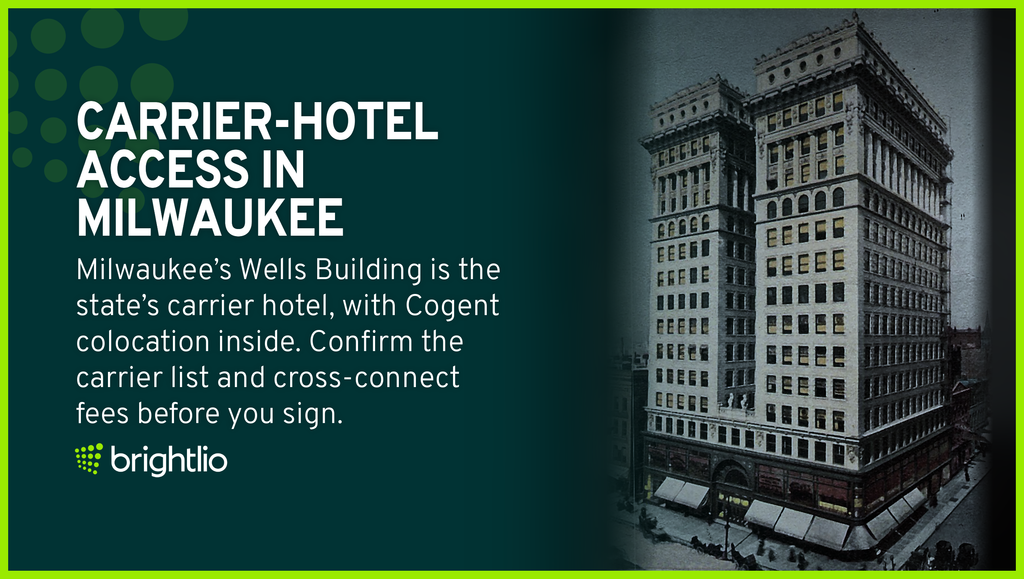
A carrier-hotel address does not confirm that every required carrier reaches the proposed cabinet. Request the current carrier list and cross-connect charges before comparing the building with a suburban facility. The useful advantage is access to the networks your deployment needs.
2. Retail Options Across Milwaukee And Madison
Wisconsin buyers can compare commercial operators in both major metros. Milwaukee-area choices include Data Holdings, TierPoint, Aventus, and Expedient in Franklin. Madison has US Signal, EdgeConneX, and Dane County Data Exchange.
This gives local IT teams a route to outsourced facility operations while keeping hardware within their service area.
A deployment needing cabinet space and cloud services can start with TierPoint's offering. A Madison organization can compare its local operators before committing to a distant facility. Confirm remote-hands coverage and hardware replacement procedures during that comparison.
3. Cold Weather Supports Free Cooling
Wisconsin's long cold seasons give compatible facilities extended opportunities to use free cooling. Outside conditions can reduce the work required from mechanical refrigeration.

The benefit depends on the installed system. An air-side economizer brings outside air into the cooling process; a water-side economizer uses outdoor conditions to cool the facility's water loop. Neither capability follows automatically from a Wisconsin address.
Request the operator's economizer operating limits and annual cooling energy data. Those records show whether the building converts its climate into an operating advantage.
4. Tax Relief At Qualified Facilities
Wisconsin's qualified data center sales and use tax exemption covers eligible servers and networking equipment. Its scope extends to electricity and qualifying cooling infrastructure.
Qualification requires WEDC certification. In counties with more than 100,000 residents, the minimum qualified investment is $150 million within 5 years of certification.
That threshold makes certification a material part of facility selection for buyers evaluating tax treatment. Request the certificate covering the proposed building and written confirmation of which purchases qualify. Purchases made before the certification date fall outside the exemption.
Key Cities Or Submarkets In Wisconsin
Wisconsin's retail choices center on Milwaukee and Madison. Its largest AI projects sit outside those retail cores and serve a different procurement need. The five submarkets below move from existing commercial supply to the campus development pipeline.
1. Milwaukee
Milwaukee is the starting point for buyers prioritizing carrier access and commercial provider choice. The Wells Building, Aventus Lakes, and Data Holdings appear in the facility profiles below.
Cogent offers 608 sq ft of raised-floor colocation inside the Wells Building at 324 E Wisconsin Ave. Its separate Milwaukee 2 facility has 5,831 sq ft at 2915 S 5th Ct, with UPS and generator backup. These are distinct leasing options, so a quote needs to name the building and the available cabinet power.
Vaultas, Netwurx, TSR Solutions, and New Era Technology add commercial options in the city. Milwaukee suits enterprises keeping hardware near their IT teams and network buyers evaluating carrier-hotel access.
2. Madison
Madison gives buyers a second concentration of retail facilities. US Signal Madison WI02 offers 60,000 sq ft at 5515 Nobel Dr, the largest floor-area figure in the colocation list. That footprint makes it a candidate for expansion discussions, subject to available power and usable tenant space.
EdgeConneX operates at 4916 E Broadway, with no capacity or floor area published. Other Madison options include US Signal WI01, Dane County Data Exchange I, 5NINES, SupraNet, HC Colo #1, and Lumen Madison 1.
The development pipeline includes Dane County Data Exchange 2 at 3351 Dairy Dr. Its 14-acre site sits beside 60 MW of medium-voltage power, which does not prove an allocated facility supply. A buyer considering that project needs a utility-backed delivery schedule before committing hardware.
QTS's proposed Town of Vienna development adds a potential campus outside Madison. Its 615-acre site could hold up to 15 buildings, beginning with 3 to 5. Existing retail buildings remain the practical starting point for deployments requiring a confirmed delivery date.
3. Milwaukee Suburbs And Kenosha
The suburban market gives buyers alternatives to a central Milwaukee address.
Expedient Franklin provides 10,000 sq ft of raised floor at 4777 Ironwood Dr. The facility has redundant utility feeds and 2 diesel generators, making its electrical design worth reviewing alongside the downtown options.
Franklin has CyberLynk, while Mequon has ISCorp's North MQN and South MQN facilities. Brookfield adds Uniti and Lumen Milwaukee. Germantown, Hartland, and Greenfield contain Ethoplex, Airiam, and Veolia facilities, respectively.
Kenosha offers OFFSITE and ExcalTech. These locations suit organizations whose staff and equipment service routes are concentrated outside central Milwaukee.
4. Appleton, Green Bay, Eau Claire, And Wisconsin Rapids
Regional Wisconsin has named commercial facilities outside the Milwaukee and Madison clusters. New Era Technology serves Appleton, WIN operates in Green Bay and Eau Claire, and CyberOne Data operates in Wisconsin Rapids.
These markets merit consideration when local equipment access is a firm requirement. A regional business can compare its nearest facility with Milwaukee or Madison after pricing transport and remote hands.
Recovery deployments need a separate failure-domain review. Distance between cities does not prove independence from shared carrier routes or upstream utility infrastructure.
5. Mount Pleasant, Port Washington, And Beaver Dam
Wisconsin's largest AI campuses sit in these markets. Microsoft's operating Fairwater campus in Mount Pleasant serves its own infrastructure requirements.
Microsoft Fairwater 2 is under construction with 337.6 MW planned across about 1.3 million sq ft. Its target opening is 2028, placing it outside a near-term retail search.
Port Washington holds Vantage's planned Lighthouse campus, the Stargate Wisconsin project. The project accounts for 902 MW across 4 buildings, making it dominant within the state's 1,240 MW of planned capacity shown. A delay at Lighthouse would therefore change the pipeline substantially.
Meta's Beaver Dam campus is under construction for its AI workloads. Beaver Dam Data Center Campus and Connect Beaver Dam are additional planned projects with no supplied capacity or delivery dates. Cabinet and private-suite buyers have a clearer procurement path through existing commercial facilities.
Notable Colocation Providers And Facilities In Wisconsin
Wisconsin's largest operating sites include a private AI campus and commercial buildings with different leasing models. The five profiles below follow the tracker order and explain which buyers can use each site.
1. Microsoft Fairwater 1 Mount Pleasant Data Center Campus
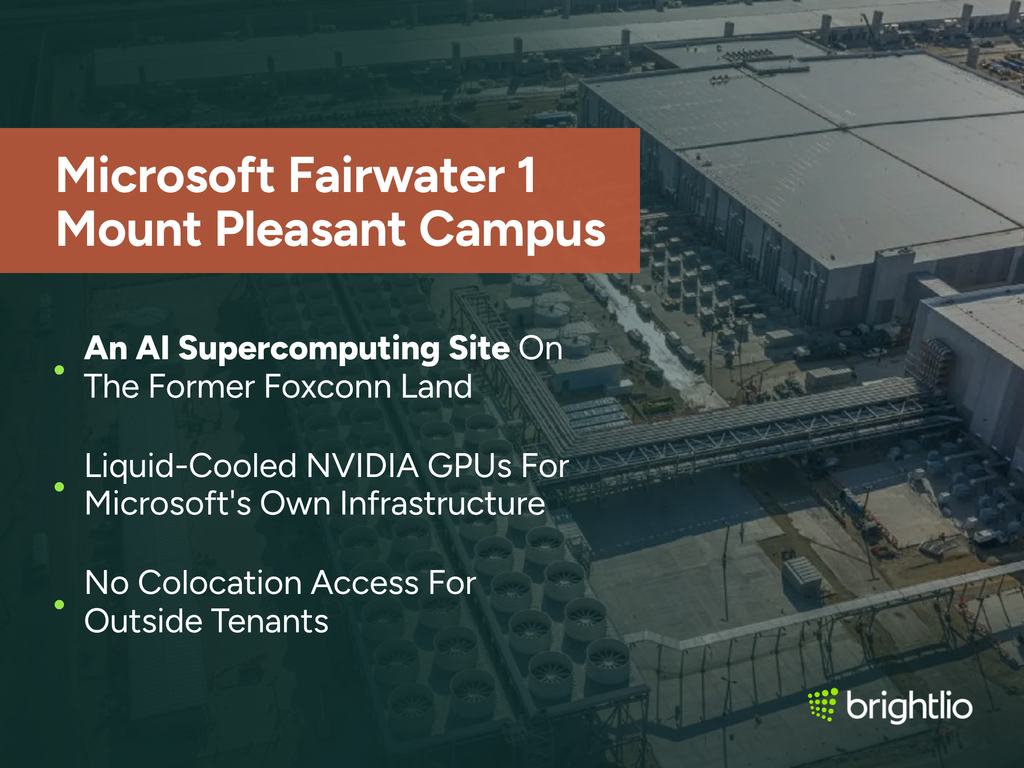
Microsoft operates Fairwater 1 on the former Foxconn site in Mount Pleasant, Racine County. The campus houses an AI supercomputing deployment with liquid-cooled NVIDIA GPUs.
Its purpose separates it from the commercial providers in this guide. Liquid cooling supports Microsoft's GPU infrastructure, but it gives no evidence of cooling capacity available to an outside tenant.
Fairwater serves Microsoft's AI infrastructure requirements and offers no colocation access. Enterprise buyers need a commercial facility with a leaseable deployment footprint.
2. The Wells Building Milwaukee Data Center
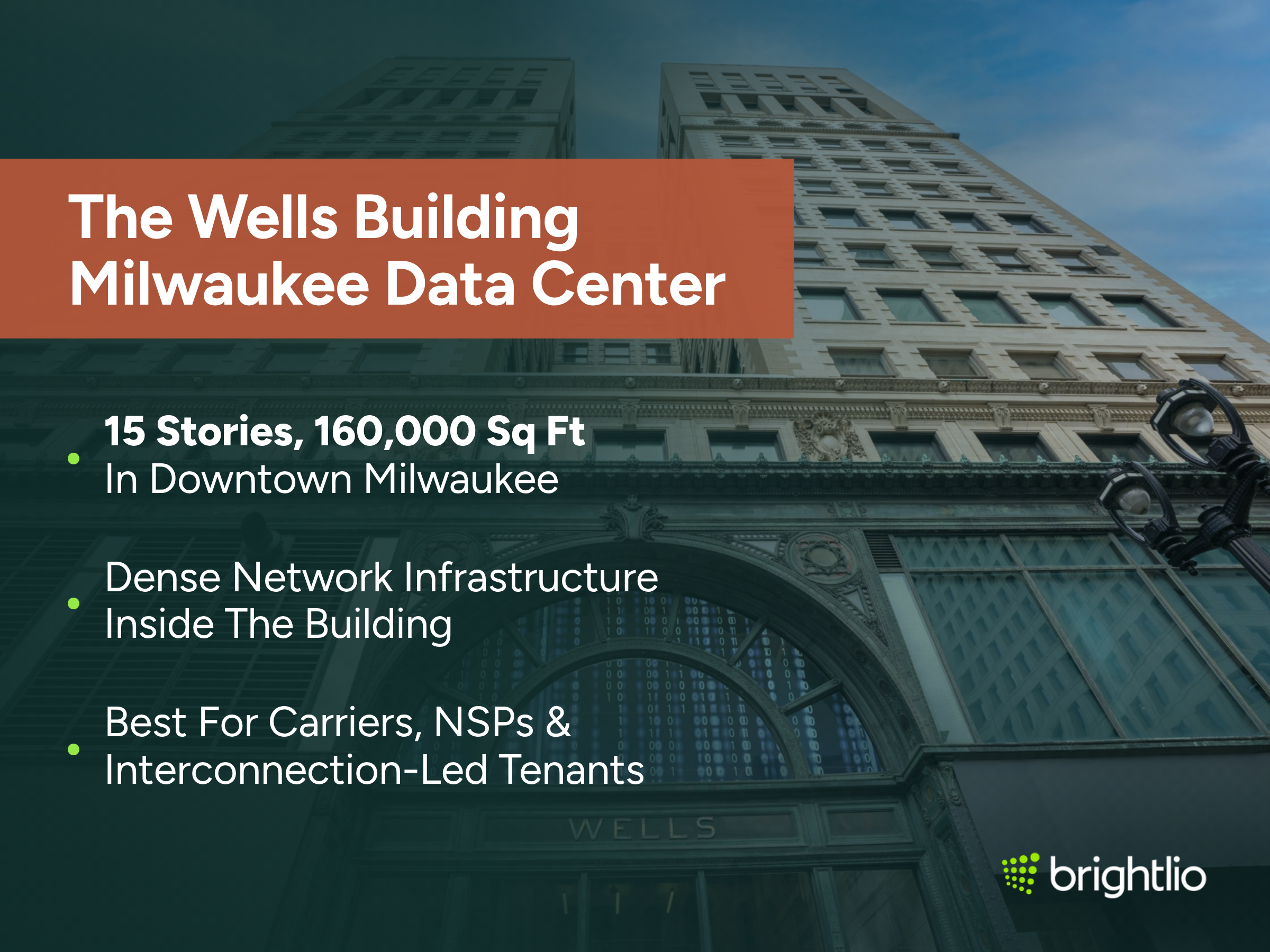
The Wells Building is a 15-story, 160,000 sq ft carrier hotel in downtown Milwaukee. The owner is 1547 Critical Systems Realty.
Its distinguishing feature is the concentration of network infrastructure inside the building. A deployment's value depends on the carriers reachable from its leased space and the terms for connecting to them.
The Wells Building is best suited for carriers, network service providers, and enterprises prioritizing interconnection. Confirm the landlord or tenant supplying the space, since a building address alone does not define the service contract.
3. Aventus Lakes Milwaukee Data Center
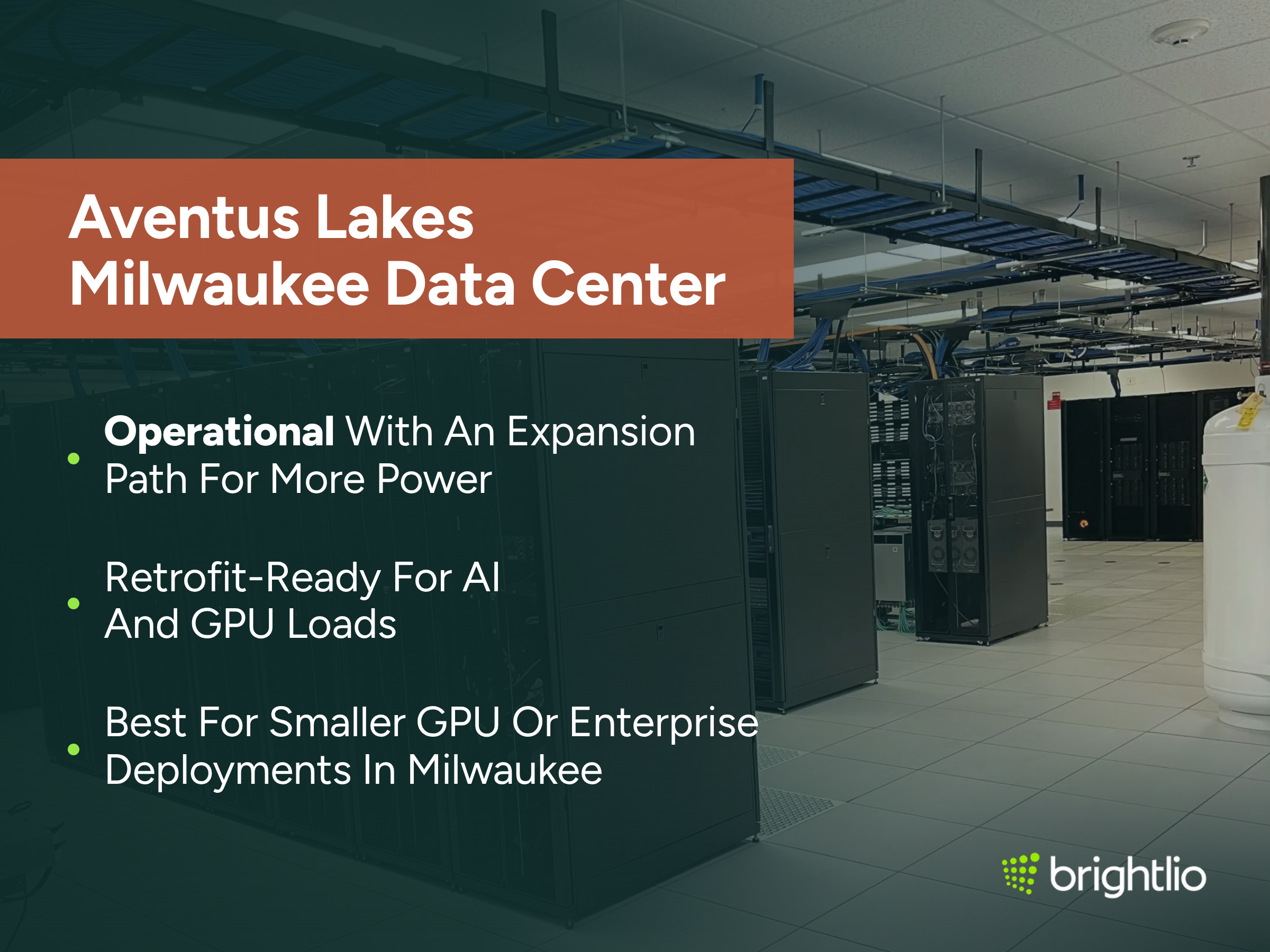
Aventus Data Centers operates Aventus Lakes at 7901 W Clinton Ave in Milwaukee. The facility is operational and has an expansion path for additional power.
The site is retrofit-ready for AI and GPU loads. That description makes it a candidate for technical review, while the difference between current availability and planned capacity remains material to deployment timing.
Aventus Lakes is best suited for buyers evaluating smaller GPU or enterprise deployments in Milwaukee. Request a rack-level cooling specification and the delivery conditions for expansion power before reserving hardware.
4. Data Holdings Milwaukee Data Center
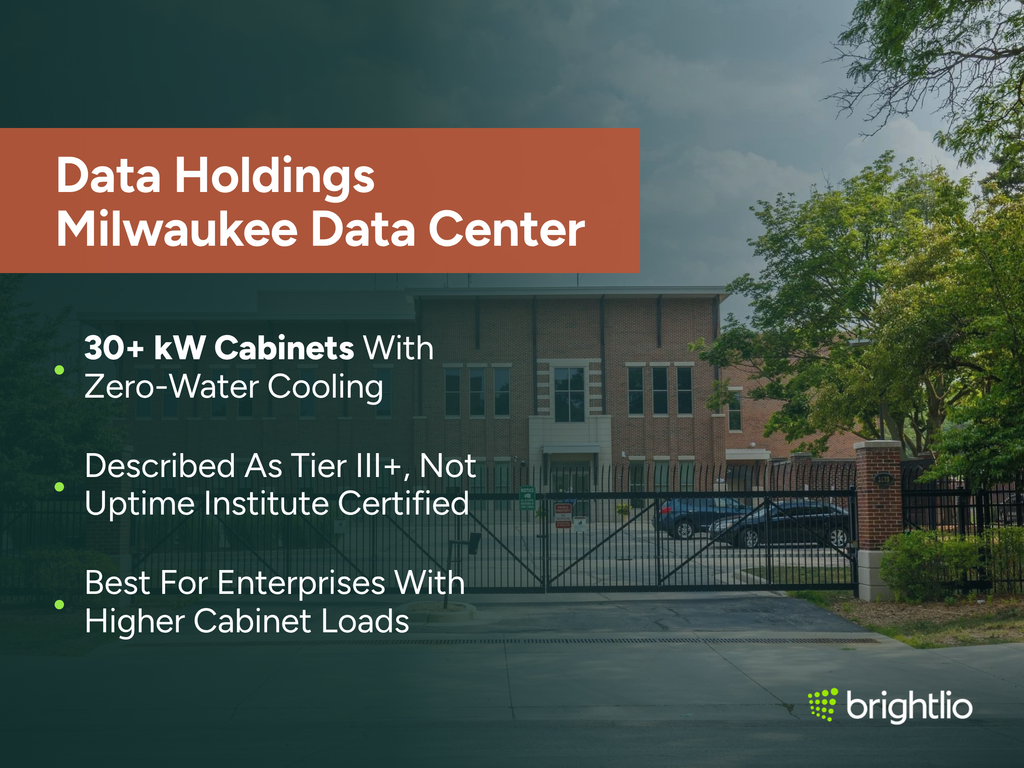
Data Holdings operates at 3135 W Highland Blvd in Milwaukee. The facility offers 30+ kW cabinets and zero-water cooling, with no total capacity figure published.
Those cabinet specifications make it a relevant high-density candidate. The facility carries a Tier III+ description, which does not independently confirm an Uptime Institute certification.
Data Holdings is best suited for enterprises evaluating higher cabinet loads and cooling water constraints. Match the proposed server configuration to the available cabinet power and the facility's approved cooling design.
5. TierPoint Milwaukee Data Center
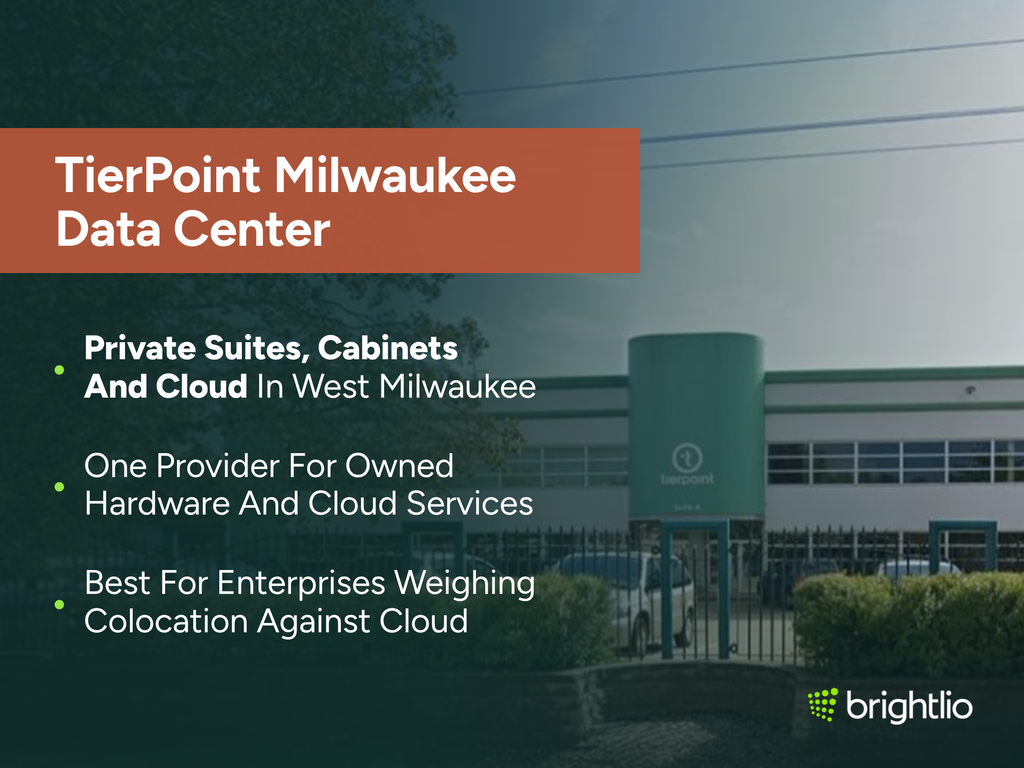
TierPoint's expanded Milwaukee facility sits at 3701 W Burnham St in West Milwaukee. It provides private suites, cabinets, and cloud services, with no total capacity figure published.
The combination gives buyers a commercial option for owned hardware alongside cloud services. A private suite still needs a clear boundary between the operator's responsibilities and the tenant's equipment obligations.
TierPoint Milwaukee is best suited for enterprises comparing cabinet or suite deployments with cloud requirements. Review the service scope and available expansion space as part of the same proposal.
Recent Developments In Wisconsin (Last 12 To 24 Months)
The recent milestones cover operating capacity, construction permits, and electricity contract terms.
- June 2026: Microsoft brought Fairwater 1 into full operation after its $3.3 billion phase-one investment. The opening adds operating AI infrastructure without creating a public colocation offering.
- June 2026: Wisconsin DNR issued air permits covering 45 diesel-fired emergency generators at Vantage's Lighthouse campus, as detailed in the Lighthouse environmental review. The permit advances backup-power infrastructure without confirming the campus's energization date.
- April 2026: The Wisconsin PSC's We Energies tariff decision set a 15-year minimum initial term for eligible very large customers and lowered the eligibility threshold to 100 MW. Campus-scale power procurement now carries an explicit long-term commitment under that tariff.
- December 2025: Wisconsin DNR granted wetland exemptions and construction stormwater coverage at Vantage's 672-acre Lighthouse site. Environmental permissions are a separate delivery milestone from utility service and tenant-ready space.
- November 2025: The City of Beaver Dam released Meta campus information for a 700,000 sq ft AI development. The project expands the state's private computing footprint without adding an enterprise retail offering.
Drawbacks And Considerations For Colocation In Wisconsin
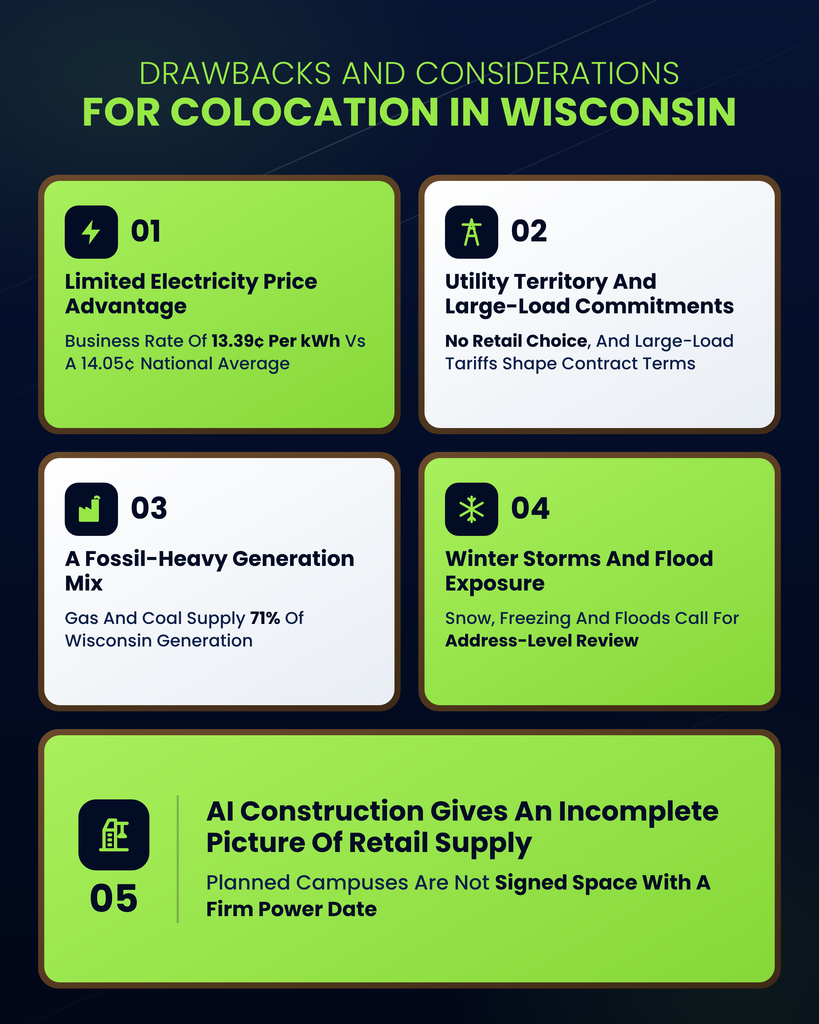
Wisconsin's local access and cooling potential come with limits that affect procurement. The five considerations below cover electricity pricing, utility obligations, grid emissions, physical risk, and the gap between AI construction and rentable space.
1. Limited Electricity Price Advantage
Wisconsin's business electricity rate was 13.39 cents per kWh in July 2025, while industrial users paid 9.87 cents per kWh. The national commercial average for the same month was 14.05 cents per kWh; neighboring Iowa's was 13.18 cents per kWh in the EIA electricity price table. Wisconsin has a modest commercial advantage against the national benchmark, with a cheaper neighboring comparison available.
These are historical statewide rates. Compare current quotes using the utility tariff class, demand charges, and the operator's electricity billing formula. A low energy charge can coexist with an expensive total contract.
2. Utility Territory And Large-Load Commitments
We Energies, Alliant, WPS, and MGE operate within MISO, and Wisconsin offers no retail electricity choice. The serving utility remains a location constraint after a facility is selected.
Large-load tariffs make contract duration and infrastructure cost recovery part of campus economics. Cabinet tenants need to check whether a provider can pass through utility increases or recover stranded expansion costs through their contract.
Request the tariff name and the provisions governing price changes. A quote without those terms leaves an important part of future operating cost unresolved.
3. A Fossil-Heavy Generation Mix
Natural gas supplies 36% of Wisconsin generation and coal supplies 35%. Nuclear contributes 15%, with solar at 6%, using the tracker's 2025 mix. Buyers with carbon targets face a local generation base dominated by fossil fuel.
An operator's renewable electricity claim needs a separate accounting review. Request the contractual instruments and the reporting period used to support it. State generation shares cannot prove the emissions associated with a particular tenant's procurement arrangement.
4. Winter Storms And Flood Exposure
Cold weather helps compatible cooling systems and complicates facility access. Snow can obstruct deliveries, while freezing conditions require protection for exposed water systems and outdoor equipment.
Flood review belongs at the individual address. Request the floodplain determination and the height of critical electrical equipment above the local flood level. Recovery planning needs a fuel-delivery route and staff access plan that remain usable during severe weather.
5. AI Construction Gives An Incomplete Picture Of Retail Supply
Wisconsin's largest private campuses draw attention to the state without making their infrastructure available to retail tenants. Planned development cannot substitute for a signed offer of space and an enforceable power delivery date.
Treat proposed expansion as a separate procurement option from an operating building. Require a commissioning schedule and remedies for late delivery before committing to capacity that depends on construction.
How Brightlio Can Help With Colocation In Wisconsin
Brightlio helps buyers compare facilities across Milwaukee, Madison, Franklin, Mequon, Brookfield, and Kenosha. We evaluate available space and power against your deployment requirements. Carrier access and expansion terms form part of that comparison.
Our team can compare options from Data Holdings, TierPoint, Aventus, US Signal, Expedient, Cogent, and other local operators.
For Wisconsin deployments, we check utility pricing provisions and tax certification. We examine winter access, flood exposure, and the power delivery assumptions behind expansion proposals.
We support cabinet, cage, private-suite, high-density, and multi-site recovery deployments. Quotes are free to clients.
Contact Brightlio to compare Wisconsin colocation solutions against your technical requirements and delivery schedule.
Frequently Asked Questions
Which U.S. State Has The Most Data Centers?
Virginia has the most data centers in the United States. Northern Virginia contains the country's leading concentration of facilities. Directory totals depend on whether individual buildings and multi-building campuses count separately.
How Many Data Centers Are In Wisconsin?
The Wisconsin tracker contains 44 sites across 31 operators. Its categories comprise 5 operational, 10 planned, and 29 colocation sites. Data Center Map lists 53 buildings across 10 markets, using a different counting approach.
What Is The Largest Data Center In Wisconsin?
Microsoft Fairwater 1 in Mount Pleasant is Wisconsin's largest operating data center, with a 450 MW phase-one load. It runs AI infrastructure with liquid-cooled NVIDIA GPUs. The campus offers no colocation access.
Who Is Building Data Centers In Wisconsin?
Microsoft, Vantage, Meta, QTS, and Dane County Data Exchange appear in Wisconsin's development pipeline. Their projects have different statuses, with QTS still proposed and Microsoft Fairwater 2 under construction. A developer's presence does not confirm tenant-ready space.
Are Wisconsin Electricity Costs Favorable For Colocation?
Wisconsin's historical commercial rate has a modest advantage against the national benchmark. The tracker gives 13.39 cents per kWh for July 2025, compared with the national commercial average of 14.05 cents per kWh. Current facility quotes need to include demand charges and electricity billing terms before a buyer can judge the saving.
What Tax Incentives Does Wisconsin Offer Data Centers?
Qualified, WEDC-certified data centers can receive sales and use tax relief on eligible purchases, including equipment and electricity. Certification and investment requirements govern eligibility. A tenant needs written confirmation of how the exemption applies to its own purchases and charges.
Which Cities Are Best For Colocation In Wisconsin?
Milwaukee and Madison are the main starting points for retail colocation. Milwaukee offers the Wells Building carrier hotel and commercial operators around the metro. Madison gives local buyers options from US Signal, EdgeConneX, and regional providers.
Can Wisconsin Colocation Support AI Or High-Density Workloads?
Yes. Data Holdings offers 30+ kW cabinets, and Aventus Lakes is retrofit-ready for GPU deployments. Confirm the available cooling design and rack power for the proposed hardware; Microsoft's private AI campus provides no rentable capacity.
Will Wisconsin Data Centers Increase My Electricity Bill?
A particular bill increase cannot be attributed to data centers from this tracker alone. The PSC's We Energies large-customer decision places specific cost obligations on eligible customers. Colocation tenants still need to inspect their own contract for utility pass-through charges and future rate changes.
Who May Not Need Wisconsin Colocation?
Organizations without a local hardware, latency, or facility requirement may gain little from choosing Wisconsin specifically. Buyers prioritizing the lowest power cost need matching-period comparisons with other markets. Workloads that fit public cloud services can compare that option before taking on a physical colocation commitment.
Keep reading with our colocation guides for these nearby markets:

Tamzid is a cybersecurity researcher with 5+ years of experience across SaaS, security, compliance, data centers and cloud. He writes for brightdefense.com and hipaasimple.com, covering security, compliance, and infrastructure topics. Certified through Cisco, Fortinet (NSE 1), and the Basel Institute on Governance in OSINT, he grounds his work in primary sources and verified data.
Recent Posts

Data Centers and Colocation In Michigan

Data Centers and Colocation in Wisconsin

Data Centers and Colocation in Tennessee

Data Centers and Colocation In Nevada
Let's start
a new project together