

Tennessee’s data center market is built on AI clusters and cheap industrial power, and both are under strain. xAI’s Colossus 2 in Memphis runs an estimated 946 MW of IT load, xAI’s Colossus 1 adds 300 MW, and Meta’s Gallatin campus reaches 300 MW at full build.
Bitdeer’s Knoxville site (86 MW) and Google’s Clarksville campus, which publishes no capacity figure, round out the five largest operating sites.
The Tennessee Valley Authority sells industrial power at 6.45¢/kWh, one of the lowest rates in the country, and the grid runs more than half carbon-free. That advantage is narrowing: TVA approved a new data center rate class in August 2026 that raises data center bills about 10%, and xAI’s Memphis power plant is in federal court over air permits.
Retail colocation is concentrated in Nashville and stays modest in size. Hyperscale and AI tenants still get one of the best power deals in the Southeast, while enterprises get a solid regional market without the depth of Atlanta.
Tennessee Data Center Tracker
65data center listings
Nashville 28Memphis 13Knoxville 9Chattanooga 56 others 10
Nashville holds 28 of Tennessee’s 65 listings, but the biggest power draws sit in Memphis, Gallatin and Clarksville.
Market Snapshot
Largest Operating Data Centers In Tennessee
These are the five largest operating sites by published capacity. xAI’s two Memphis clusters lead the state, and every other listing appears on the map, with operating sites in green and planned ones in coral.
- xAI Colossus 2Memphis, IT load, est.946 MWOperational
Former warehouse on Tulane Road running about 946 MW of IT power as of August 2026, per Epoch AI estimates
- Location:
- Whitehaven, Memphis
- Operator:
- xAI
- Power:
- On-site gas turbines plus a power plant in Southaven, Mississippi
- Target:
- About 2 GW across the Memphis complex
- xAI Colossus 1Memphis, reported300 MWOperational
Former Electrolux plant converted into an AI cluster in 122 days
- Location:
- Riverport Rd, Memphis
- Operator:
- xAI
- Online since:
- July 2024
- Tenant:
- Anthropic leases all compute capacity (since May 2026)
- Meta Gallatin CampusGallatin, full campus300 MWOperational
Six-building campus on about 900 acres, officially launched in November 2024
- Location:
- Gallatin, Sumner County
- Operator:
- Meta
- Cooling:
- Direct outside-air cooling
- Expansion:
- Building 5 under construction
- Bitdeer KnoxvilleKnoxville, site power86 MWOperational
Bitcoin mining site now being converted for AI workloads
- Address:
- 5101 S National Dr, Knoxville
- Operator:
- Bitdeer Technologies Group
- Google Montgomery County CampusClarksvilleNot publishedOperational
$600 million campus on the former Hemlock Semiconductor site, opened in November 2019
- Location:
- Clarksville, Montgomery County
- Operator:
- Buildings:
- Four listed
Also operating, shown on the map as green circles: , , , , , , .
Largest Planned Data Centers In Tennessee
Project River and Cielo’s Clarksville campus account for 1,850 MW of the 1,957 MW shown here, and both are still proposals.
- Project River Energy CampusCleveland, planned1,500 MWProposed
Data center and energy campus announced in Bradley County in August 2026
- Location:
- Bradley County
- Developer:
- Wright Brothers Construction
- Cielo Montgomery County AI CampusClarksville, planned350 MWProposed
Proposed AI campus near Google’s Clarksville site
- Location:
- Clarksville, Montgomery County
- Developer:
- Cielo Digital Infrastructure
- DC BLOX Nashville CampusNashville, full campus50 MWProposed
Two buildings totaling 69,220 sq ft on 24 acres, facing local opposition
- Address:
- 648 Grassmere Park, Nashville
- Developer:
- DC BLOX
- Quantum Leap Data CenterNashville, planned30 MWPlanned
70,000 sq ft facility in Fisk University’s $1 billion campus plan
- Address:
- 1000 17th Ave N, Nashville
- Developer:
- Fisk University
- 5CDC Memphis MEM01Memphis, first phase15 MWIn development
Conversion of the former Fred’s headquarters on Getwell Road
- Address:
- 4280 Getwell Rd, Memphis
- Developer:
- 5C Group
- RadiusDC Nashville INashville, critical power12 MWUnder construction
102,500 sq ft facility set to open in 2026
- Address:
- 2902 Brick Church Pike, Nashville
- Developer:
- RadiusDC
- xAI 5414 Tulane Road ExpansionMemphisNot publishedPlanned
$659 million, 312,000 sq ft expansion beside Colossus 2
- Address:
- 5414 Tulane Rd, Memphis
- Developer:
- xAI
Also planned, shown on the map as coral circles: , , .
Largest Colocation Facilities In Tennessee
Retail colocation clusters in Nashville and its southern suburbs, with Litewire’s Tier 4 building in McMinnville as the largest single facility.
- Litewire Data CenterMcMinnville285,000 sq ftColocation
Tier 4 certified building with 2N power and cooling, operating since 2014
- Address:
- 204 Red Rd, McMinnville
- Operator:
- Litewire
- Lumen Nashville 3Nashville40,000 sq ftColocation
AC and DC power with generator and battery backup
- Address:
- 2208 9th Ave N, Nashville
- Operator:
- Lumen
- Lumen Nashville 2Nashville30,400 sq ftColocation
N+1 cooling with diverse fiber connectivity
- Address:
- 2530 Perimeter Place Dr, Nashville
- Operator:
- Lumen
- Saragon NashvilleNashville27,502 sq ftColocation
7,755 sq ft of raised floor with Cogent, Zayo, AT&T and Windstream on site
- Address:
- 338 Woodycrest Ave, Nashville
- Operator:
- Saragon
- H5 Data Centers NashvilleNashville22,000 sq ftColocation
Downtown site with 11 carriers and the Nashville Internet Exchange
- Address:
- 147 4th Ave N, Nashville
- Operator:
- H5 Data Centers
- Lumen Memphis 1Memphis13,000 sq ftColocation
DC power with generator and battery backup
- Address:
- 3993 Crowfarn Dr, Memphis
- Operator:
- Lumen
- Lumen Nashville 1Nashville9,561 sq ftColocation
N+1 cooling and dual-authentication security
- Address:
- 2990 Sidco Dr, Nashville
- Operator:
- Lumen
- TierPoint NashvilleFranklinNot publishedColocation
Tier III certified for design and construction by the Uptime Institute
- Address:
- 311 Eddy Ln, Franklin
- Operator:
- TierPoint
More operating colocation, shown on the map as green squares: , , , , , , , , , , , , , , , , , , , , , , , , .
Choose a category to switch the list and highlight its sites on the map. Click any site card to find it on the map, or click a marker to jump to its card. Pins are approximate, and each MW figure carries the basis shown beside it.
Data sourced from Data Center Map, EIA, the Tennessee Department of Revenue, Compute Atlas, BEP Research, The Center Square and Climate-Zone, checked October 10, 2026. Listings count individual buildings, and the lists show the largest sites in each category.
Why Colocate In Tennessee?
Tennessee wins on industrial power price, a low-carbon grid, and a central Southeast location. It loses on network depth, a weaker tax package than its neighbors, and rising friction over who pays for TVA’s next wave of generation.
The six factors below weigh each side:
1. Market Access And Latency
Nashville sits within a day’s drive of most of the Southeast and lower Midwest. Interstate fiber runs north to Louisville and Kentucky, south to Birmingham and Atlanta, and west through Memphis toward Dallas.
Memphis adds a second gateway on the Mississippi River, with routes into Arkansas, Mississippi, and the central U.S. Knoxville and Chattanooga cover East Tennessee and the Atlanta corridor.
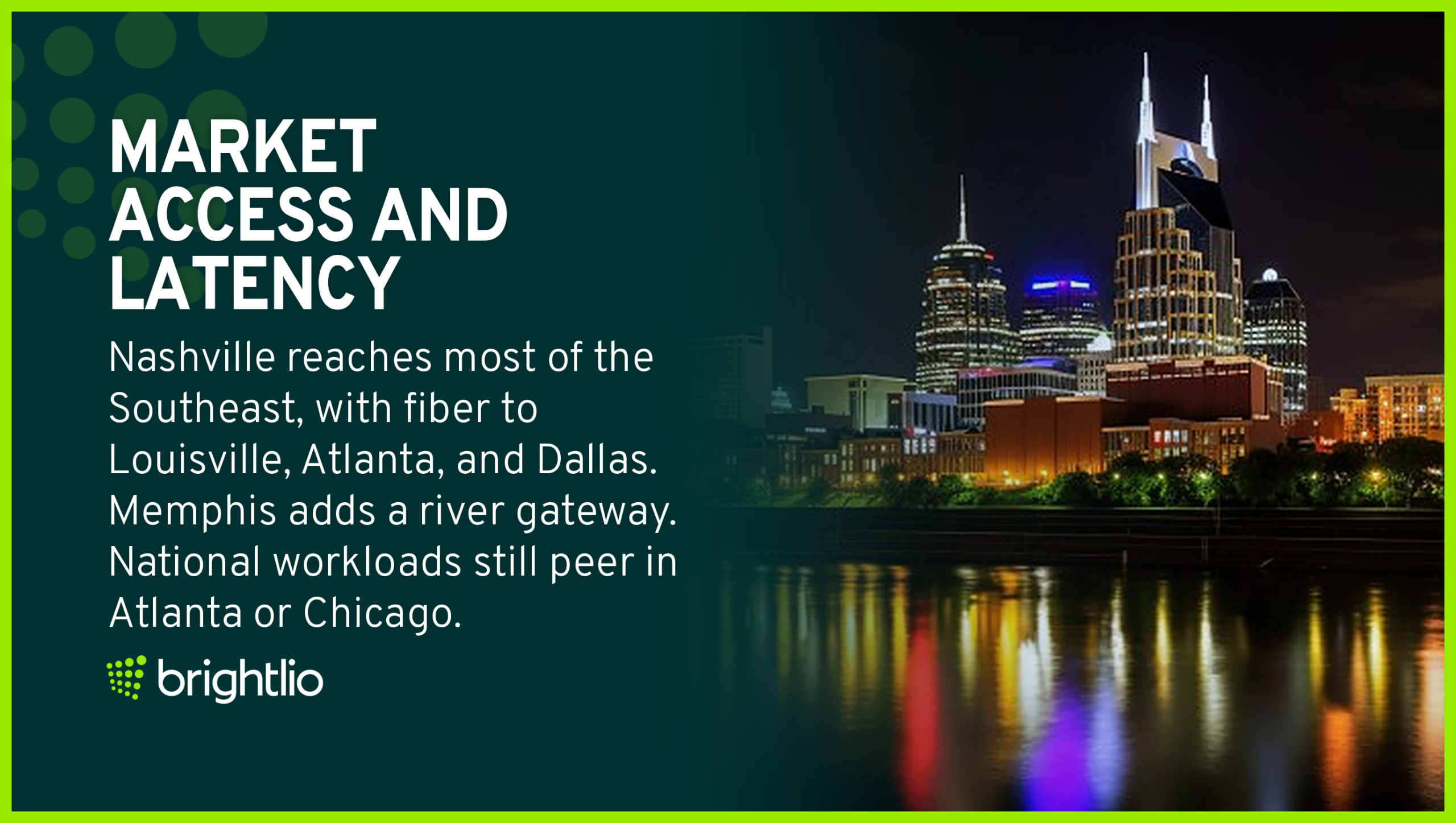
The catch is that most of that traffic still peers somewhere else. Tennessee is a regional market, and latency-sensitive workloads serving national audiences belong in Atlanta, Dallas, or Chicago.
2. Network Connectivity And Peering
Downtown Nashville holds the state’s interconnection core. H5 Data Centers’ facility at 147 4th Ave N hosts 11 carriers and the Nashville Internet Exchange, and Saragon’s Woodycrest Ave site carries Cogent, Zayo, AT&T, and Windstream.
Carrier choice is solid for a regional market. Buyers can find carrier-neutral buildings in Nashville, Franklin, Brentwood, Memphis, and Knoxville.
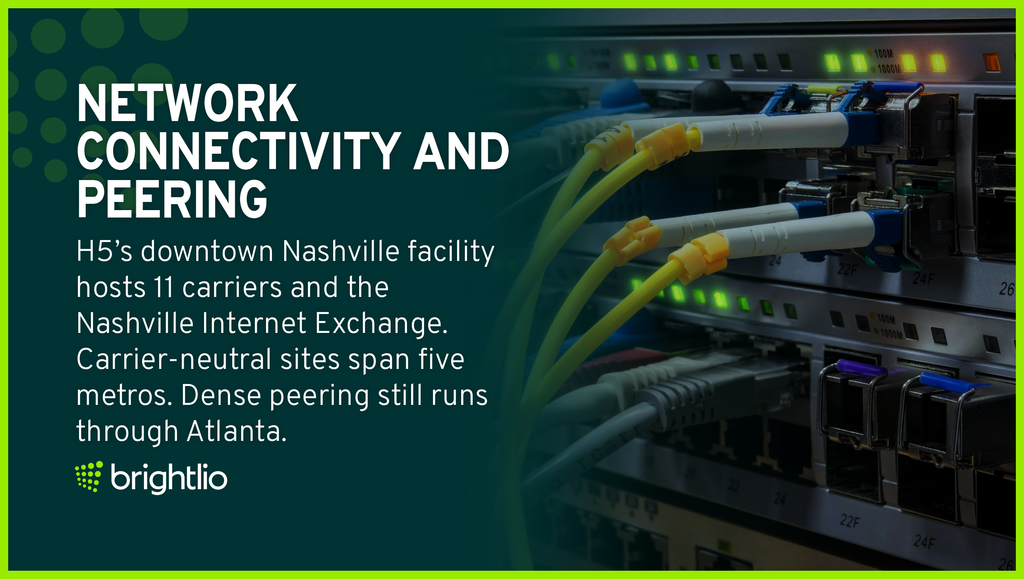
Peering depth is limited. Content networks and large ISPs exchange most Southeast traffic in Atlanta, so Tennessee deployments that depend on dense peering run transport there.
3. Power, Cost, And Sustainability
Power is Tennessee’s strongest card for large loads. Industrial customers paid 6.45¢/kWh in May 2026, while business customers paid 13.52¢/kWh, so a hyperscale buyer on an industrial contract pays less than half the commercial rate.
Retail colocation tenants see a smaller benefit. Their power arrives through a provider’s blended rate, so buyers comparing colocation pricing across the Southeast will find Tennessee competitive without being a bargain.
The grid is cleaner than most in the region. Nuclear supplied 42% of generation in 2024 and hydro 12%, so more than half of in-state power came from carbon-free sources. Coal still contributed 23% and natural gas 22%.
The Tennessee Valley Authority controls all of it. Local power companies such as MLGW in Memphis and NES in Nashville resell TVA power, and there is no retail choice, so every large buyer negotiates with the same federal utility.
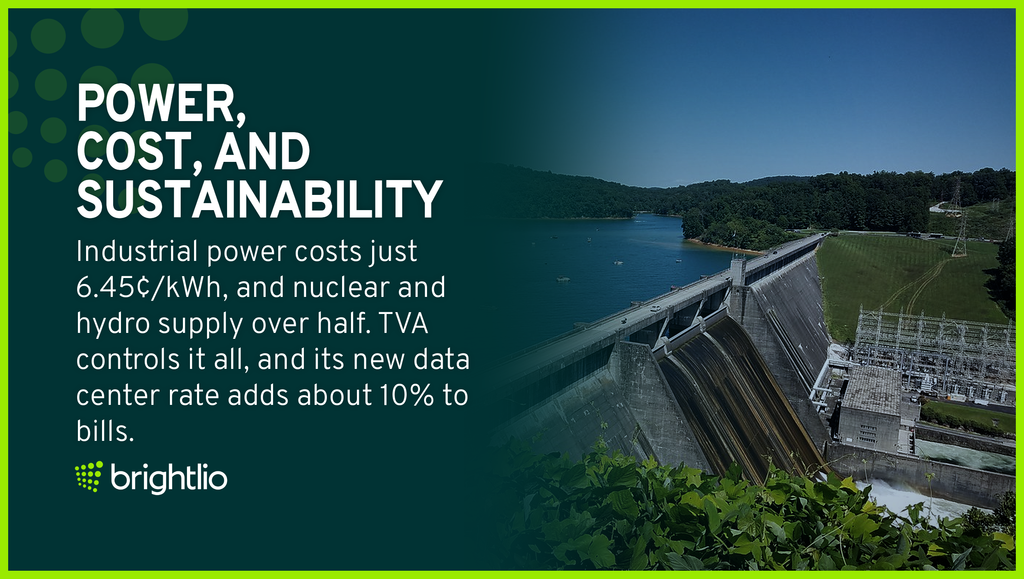
TVA is straining under demand. Data centers made up 10% of TVA’s load last year, and the utility held 11 GW of data center requests in July 2025 against a system of about 38 GW. Its 2026 resource plan calls for 11 GW to 32 GW of new generation by 2040, and it drops most planned solar and all planned wind in favor of coal, gas, and nuclear.
The new rules cost more. TVA’s board approved a dedicated data center rate class on August 20, 2026, effective October 1, that raises data center bills about 10%, adds capacity commitment terms, and lets TVA interrupt service for sites that start running before their power is ready.
4. Tax Policy And Incentives
Tennessee exempts qualifying data center equipment from sales tax and taxes the facility’s electricity at a reduced 1.5%. To qualify, a site must invest $100 million and create 15 jobs.
That package works, but it is weaker than the best in the Midwest. Indiana, for example, exempts both equipment and electricity outright, while Tennessee still collects a tax on every kilowatt-hour.

The job requirement matters for smaller projects. A retail colocation building or an edge site rarely creates 15 permanent jobs, so the incentive mainly benefits large campuses.
5. Workforce And Ecosystem
Tennessee’s unemployment rate fell to 3.4% in July 2026, well below the 4.1% national rate. That looks strong, but it hides a shrinking workforce: about 55,000 fewer Tennesseans held jobs in July 2026 than in December 2025.
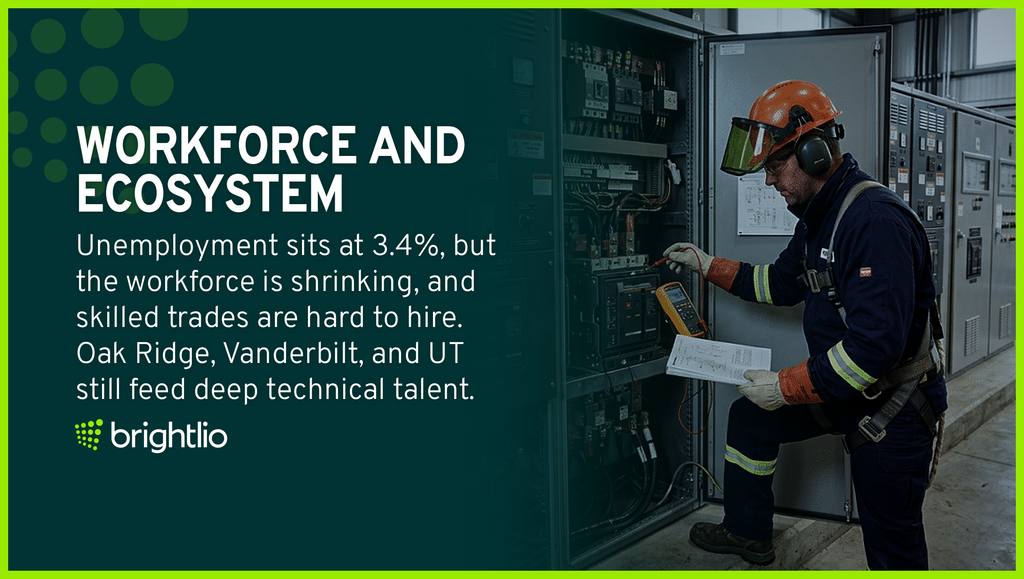
A tight, shrinking labor pool makes skilled trades hard to hire. Electricians, controls technicians, and critical facility staff are in demand across Memphis, Gallatin, Clarksville, and Knoxville at the same time.
The ecosystem still runs deep. Nashville’s healthcare cluster, Memphis’s logistics base, Oak Ridge National Laboratory near Knoxville, and universities including Vanderbilt and the University of Tennessee feed technical talent into the state.
6. Risk And Resiliency
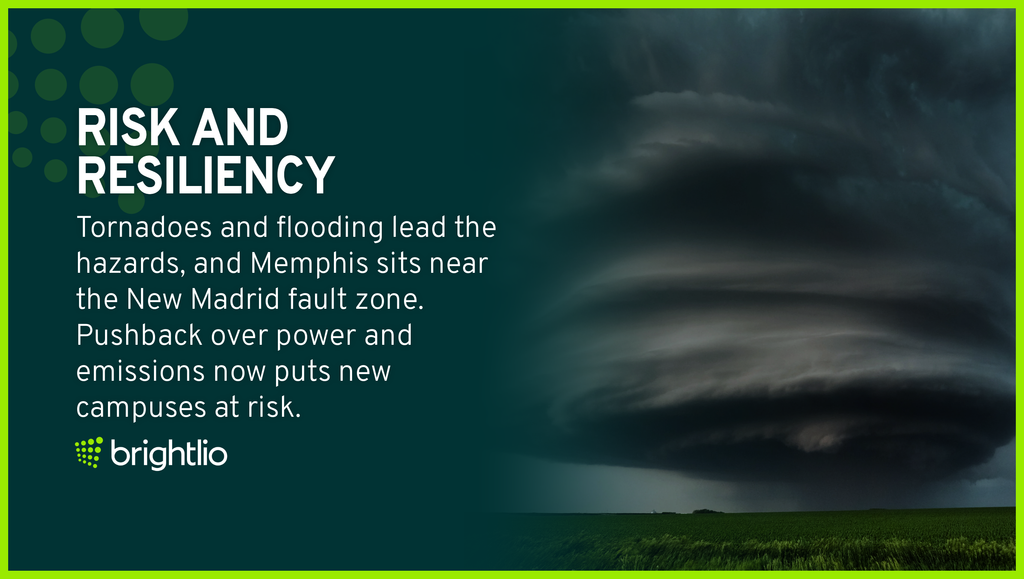
Tornadoes and flooding are Tennessee’s main natural hazards. Facilities need wind-rated construction, floodplain review near rivers and creeks, and generator plans for multi-day outages.
West Tennessee carries a risk most Southeast markets do not. Memphis sits near the New Madrid Seismic Zone, so buyers placing critical systems there need seismic design review and a recovery site outside the region.
Heat adds cost. Nashville averages 59°F over the year but sees about 50 days above 90°F, which lengthens the cooling season compared with Midwest markets.
The largest risk is political. The NAACP sued xAI in April 2026 over 27 gas turbines powering Colossus 2 from Southaven, Mississippi, alleging they ran without required air permits, and the Southern Alliance for Clean Energy has called for an 18-month moratorium on new large data centers in Tennessee and four other Southeast states.
Buyers backing new campuses need a credible plan for power, emissions, and community support. Buyers who need certainty get it in buildings already energized under TVA’s existing contracts.
Key Cities Or Submarkets In Tennessee
Tennessee’s map splits between a retail colocation core in Nashville, an AI power cluster in Memphis, hyperscale campuses north of Nashville, and a scattering of smaller markets in East Tennessee.
The six submarkets below run from the deepest retail supply to the most speculative pipeline.
1. Nashville
Nashville is Tennessee’s retail colocation hub, with 28 of the state’s 65 listings. Downtown holds the carrier core around H5 Data Centers, while Lumen, Saragon, Flexential, EdgeConneX, DataBank’s Cummins Station site, Uniti, and Csquare spread across the metro and its southern suburbs of Franklin and Brentwood.
The buildings are mostly mid-size. Lumen Nashville 2 offers 30,400 sq ft at 2530 Perimeter Place Dr, and Lumen Nashville 1 runs 9,561 sq ft at 2990 Sidco Dr.
New supply is arriving slowly. RadiusDC is building Nashville I, a 102,500 sq ft, 12 MW facility at 2902 Brick Church Pike set to open in 2026, and Fisk University’s $1 billion campus plan includes the 30 MW Quantum Leap Data Center.
DC BLOX’s proposed 50 MW campus at 648 Grassmere Park, two buildings totaling 69,220 sq ft on 24 acres, faces local opposition. Even in Nashville, new data center zoning is contested.
The Nashville colocation market suits healthcare, financial services, and regional enterprises that need cabinets to small suites with good carrier choice. It does not offer the scale buyers find in Atlanta.
2. Memphis
Memphis is Tennessee’s AI power center, and almost all of it belongs to xAI. Colossus 1 and Colossus 2, both profiled below, together account for 1,246 MW, and xAI plans a $659 million, 312,000 sq ft expansion at 5414 Tulane Rd beside Colossus 2.
Retail supply is small. Lumen Memphis 1 offers 13,000 sq ft at 3993 Crowfarn Dr, and Expedient, EdgeConneX, DataBank, and Verizon run local sites. 5C Group is converting the former Fred’s headquarters at 4280 Getwell Rd into the 15 MW MEM01.
Memphis is a one-tenant AI data center market with a thin retail layer. It carries seismic exposure from the New Madrid zone and the legal and political fallout from xAI’s turbines, so most enterprises use it for local workloads and keep primary systems elsewhere.
3. Gallatin And Clarksville
The counties north of Nashville host Tennessee’s longest-running hyperscale campuses. Meta’s Gallatin campus in Sumner County and Google’s Clarksville campus in Montgomery County are both profiled below.
Clarksville is drawing more. Cielo Digital Infrastructure has proposed a 350 MW AI campus near Google’s site, which would make Montgomery County one of the largest planned hubs in the state.
Neither area offers retail space. They matter to hyperscalers, AI tenants, and the contractors who build for them.
4. Knoxville
Knoxville has 9 listings and one large site: Bitdeer’s former bitcoin mine on S National Dr, profiled below, which is converting to AI workloads.
Retail options come from TenHats, Scipio Technologies, and Uniti. Knoxville Utilities Board reports three data centers operating in its service territory.
Oak Ridge National Laboratory nearby gives the region research and federal demand. Knoxville suits East Tennessee enterprises and recovery sites, and it is too small for large retail deployments.
5. Chattanooga And Cleveland
Chattanooga has 5 listings, including DC BLOX, Scipio Technologies, and MCA, and it serves as Tennessee’s link to the Atlanta corridor and Georgia.
Nearby Bradley County holds the largest planned project in the state. Wright Brothers Construction announced Project River in August 2026, a 1,500 MW data center and energy campus near Cleveland.
The pipeline is fragile. Project River and Cielo’s Clarksville campus account for 1,850 MW of the 1,957 MW of planned capacity in Tennessee that publishes a figure, about 95%, and both are still proposals.
6. McMinnville And Rural Tennessee
Outside the metros, two kinds of sites dominate. Litewire’s Tier 4 building in McMinnville, profiled below, is the largest single colocation facility in the state.
The rest are bitcoin mining sites, including CleanSpark operations in Lenoir City, Jellico, New Tazewell, Winfield, and Jackson, plus a mining site in Crossville. They draw on cheap TVA power and offer no retail space.
These sites show how far Tennessee’s power advantage reaches into rural counties. For enterprise buyers, McMinnville is the only rural option worth a tour.
Notable Colocation Providers And Facilities In Tennessee
Tennessee’s provider list starts with the five largest operating sites, all single-tenant AI, hyperscale, or mining campuses, and continues with the retail operators where enterprise buyers can actually lease space.
The ten facilities below cover both groups.
1. xAI Colossus 2 Memphis Data Center
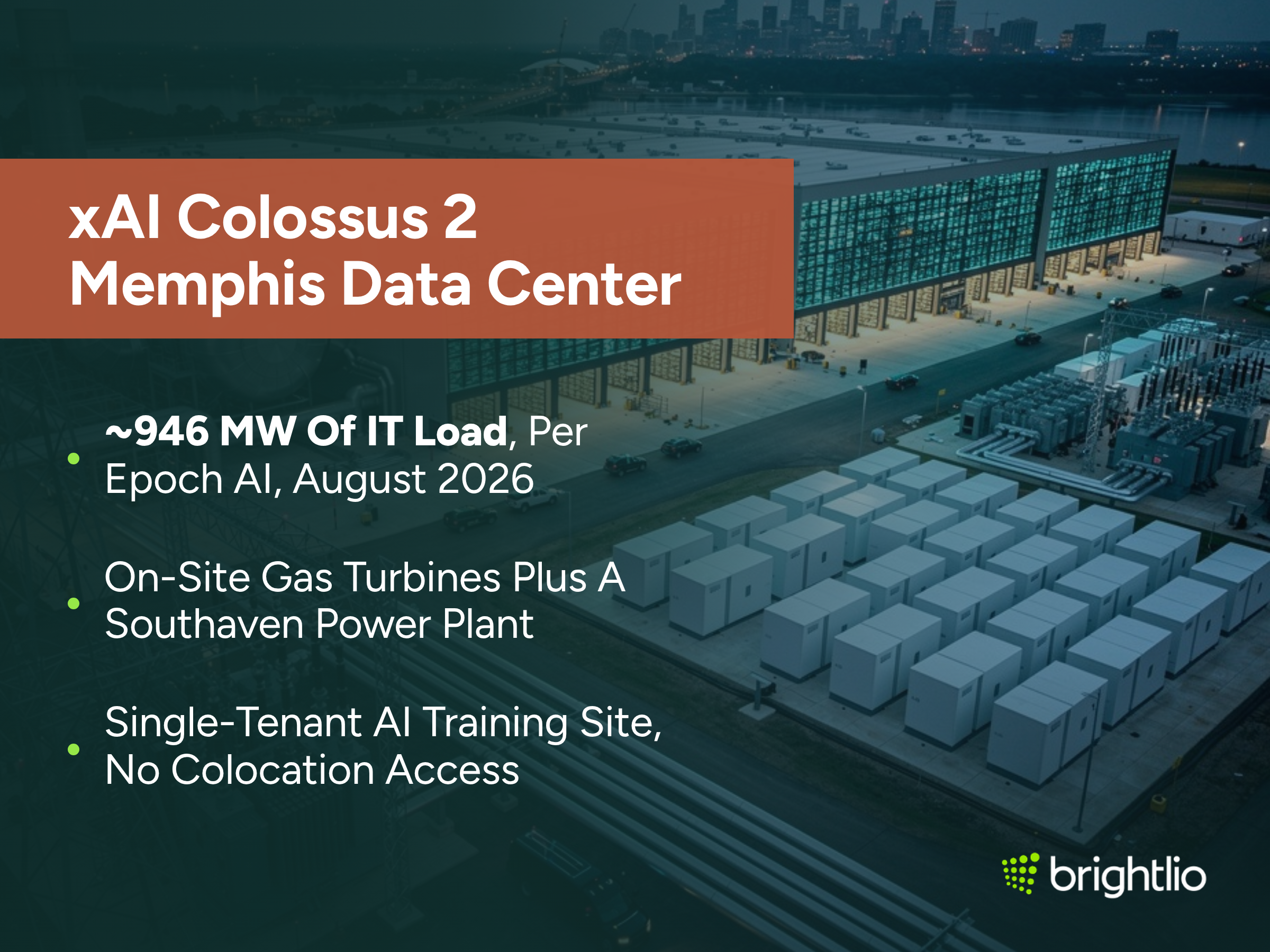
xAI’s Colossus 2 occupies a former warehouse on Tulane Road in Memphis’s Whitehaven area and ran an estimated 946 MW of IT load as of August 2026, per Epoch AI. xAI’s target for the full Memphis complex is about 2 GW.
Power comes from on-site gas turbines plus a power plant across the state line in Southaven, Mississippi. That plant’s 27 turbines are the subject of the NAACP’s Clean Air Act lawsuit.
Colossus 2 is a single-tenant AI training site with no colocation access. It shows how fast AI capacity can arrive in Tennessee, and how much regulatory exposure comes with self-built power.
2. xAI Colossus 1 Memphis Data Center
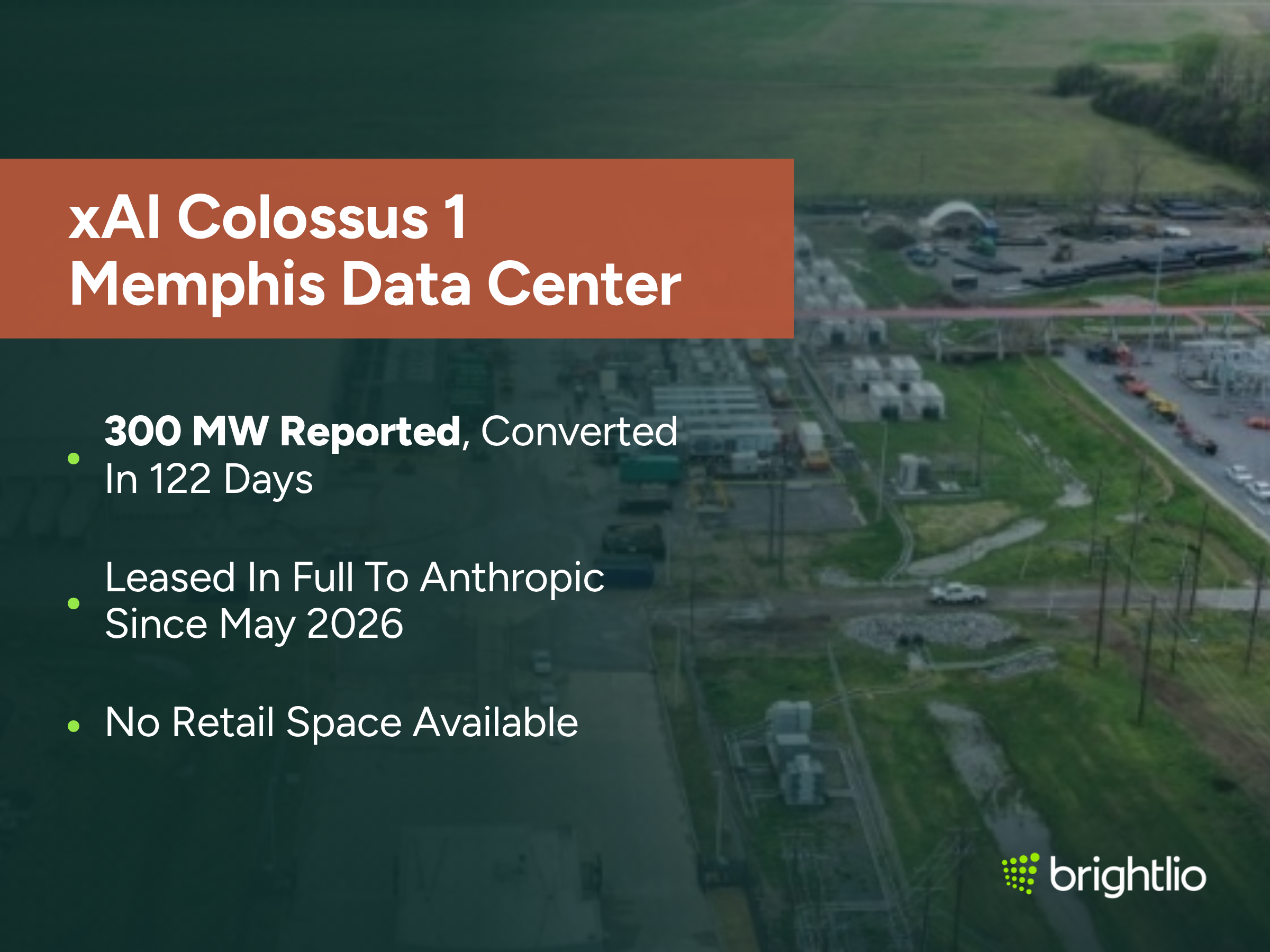
Colossus 1 sits in a former Electrolux plant on Riverport Rd that xAI converted into an AI cluster in 122 days. It came online in July 2024 and carries a reported 300 MW.
Since May 2026, Anthropic has leased all of the cluster’s compute capacity, which turns Colossus 1 into a leased AI facility serving an outside tenant.
No retail space is available. Colossus 1 matters as proof that a converted industrial building in Memphis can host frontier-scale AI at speed.
3. Meta Gallatin Data Center Campus
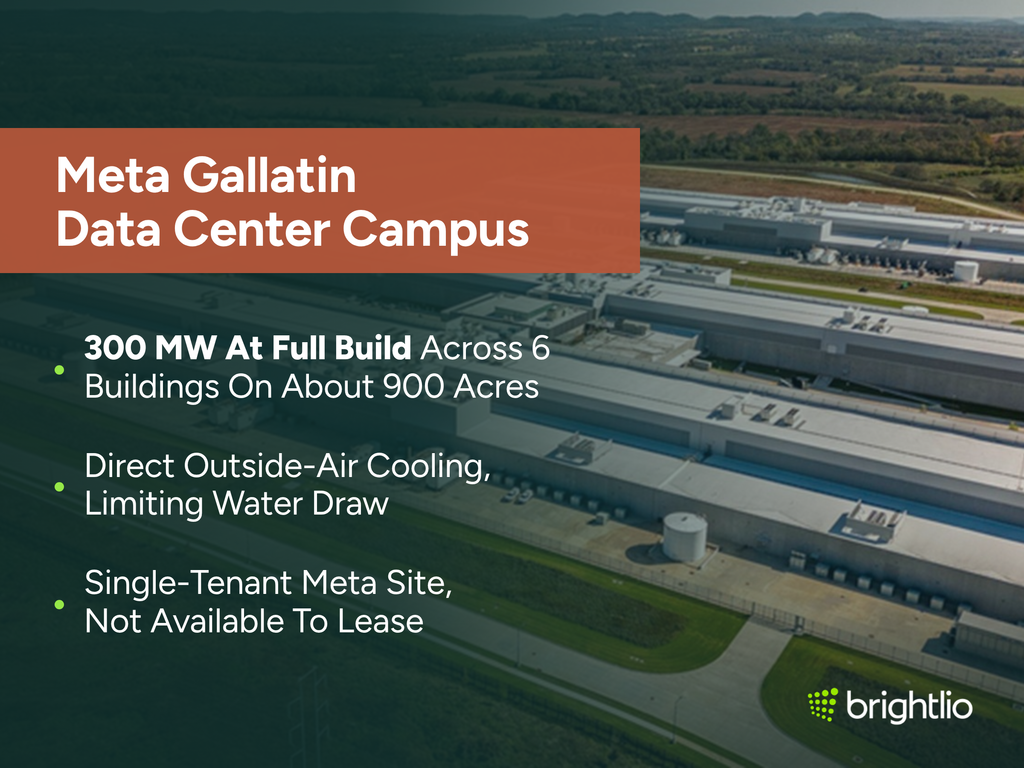
Meta’s Gallatin campus covers about 900 acres in Sumner County, with six buildings and 300 MW at full build. Meta officially launched it in November 2024, and Building 5 is under construction.
The campus uses direct outside-air cooling, which suits Middle Tennessee’s mild months and limits water draw.
Gallatin is a single-tenant Meta site. Its value to other buyers is the transmission and fiber investment it has brought north of Nashville.
4. Bitdeer Knoxville Data Center
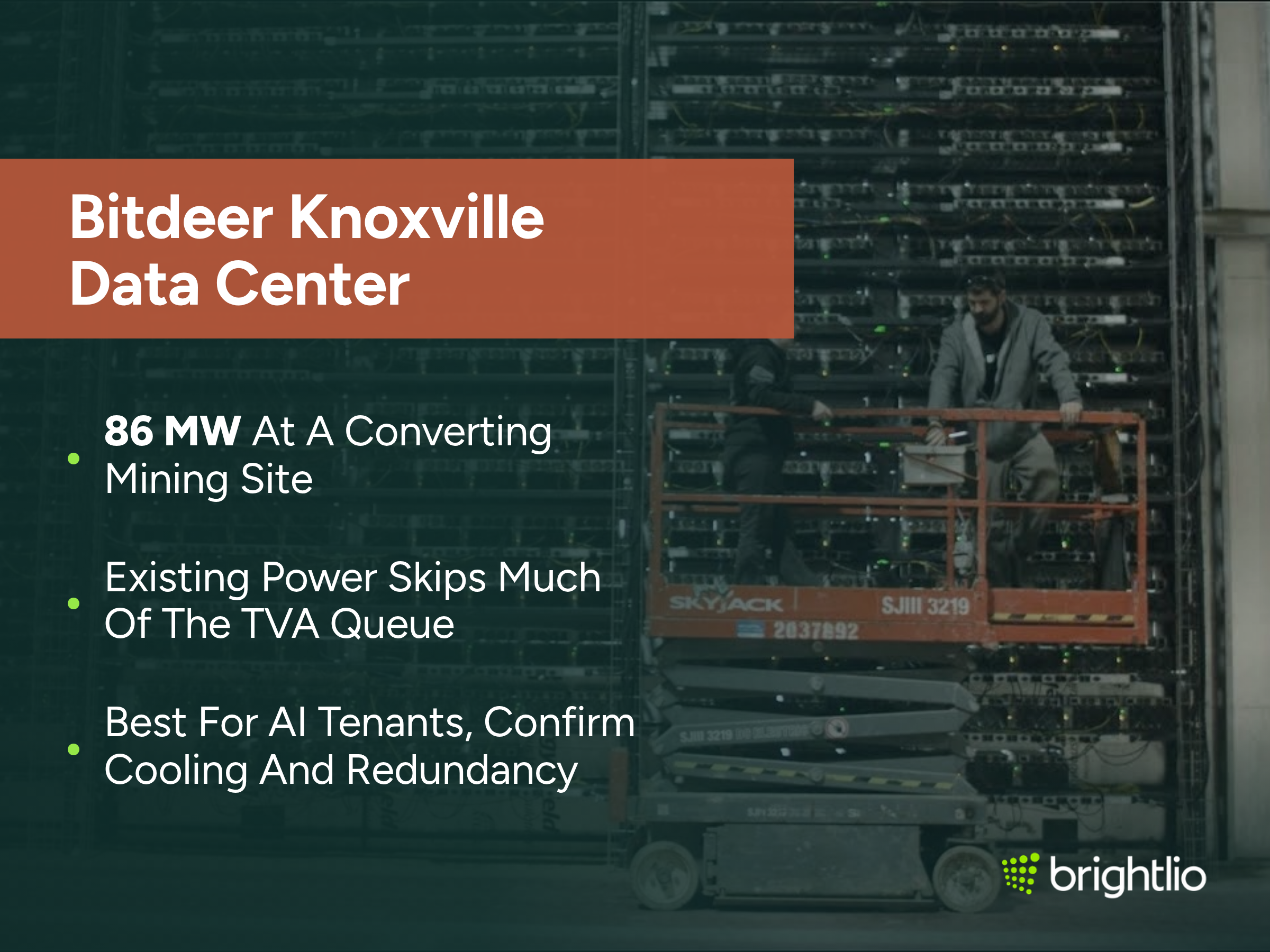
Bitdeer Technologies Group runs an 86 MW site at 5101 S National Dr in Knoxville. The facility began as a bitcoin mine and is converting to AI workloads.
Converting a mining site keeps its existing power connection, which lets an AI tenant skip much of TVA’s interconnection queue.
Bitdeer Knoxville suits AI and high-density tenants seeking powered capacity in East Tennessee. Buyers need to confirm cooling and redundancy levels, since mining builds rarely match enterprise standards.
5. Google Montgomery County Data Center Campus
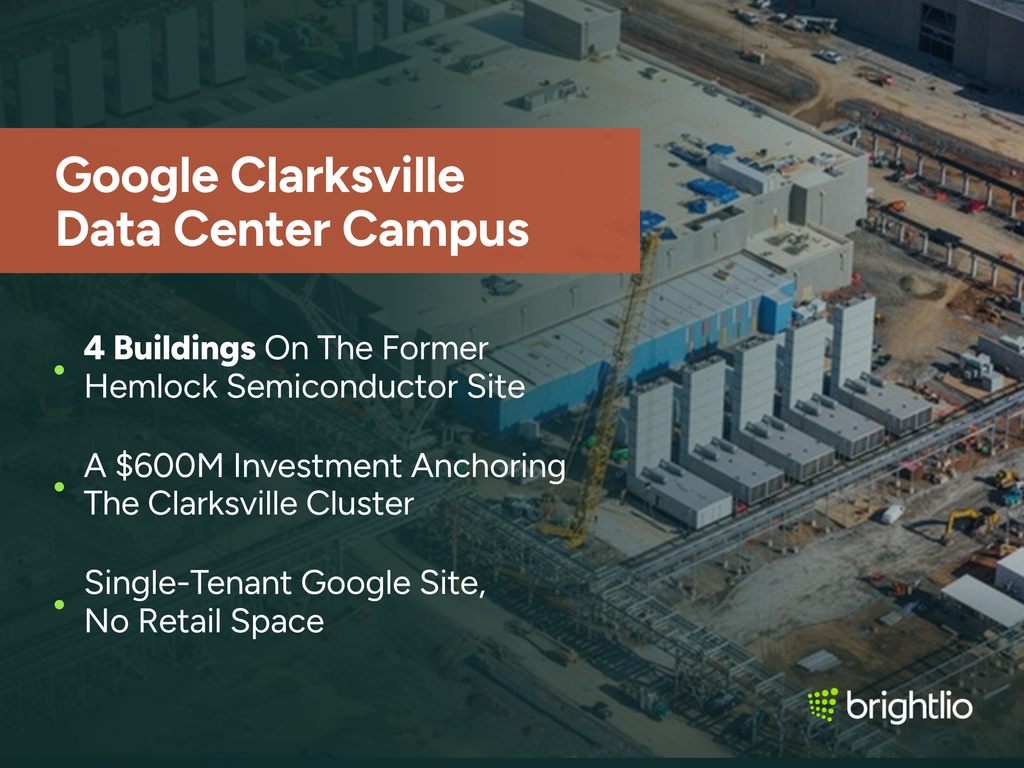
Google’s Clarksville campus sits on the former Hemlock Semiconductor site in Montgomery County, with a $600 million investment and four buildings listed. It opened in November 2019, and Google does not publish its capacity.
The site anchors the growing Clarksville cluster, where Cielo has proposed its own AI campus next door.
Like the other hyperscale sites, Clarksville offers no retail space.
6. Litewire McMinnville Data Center
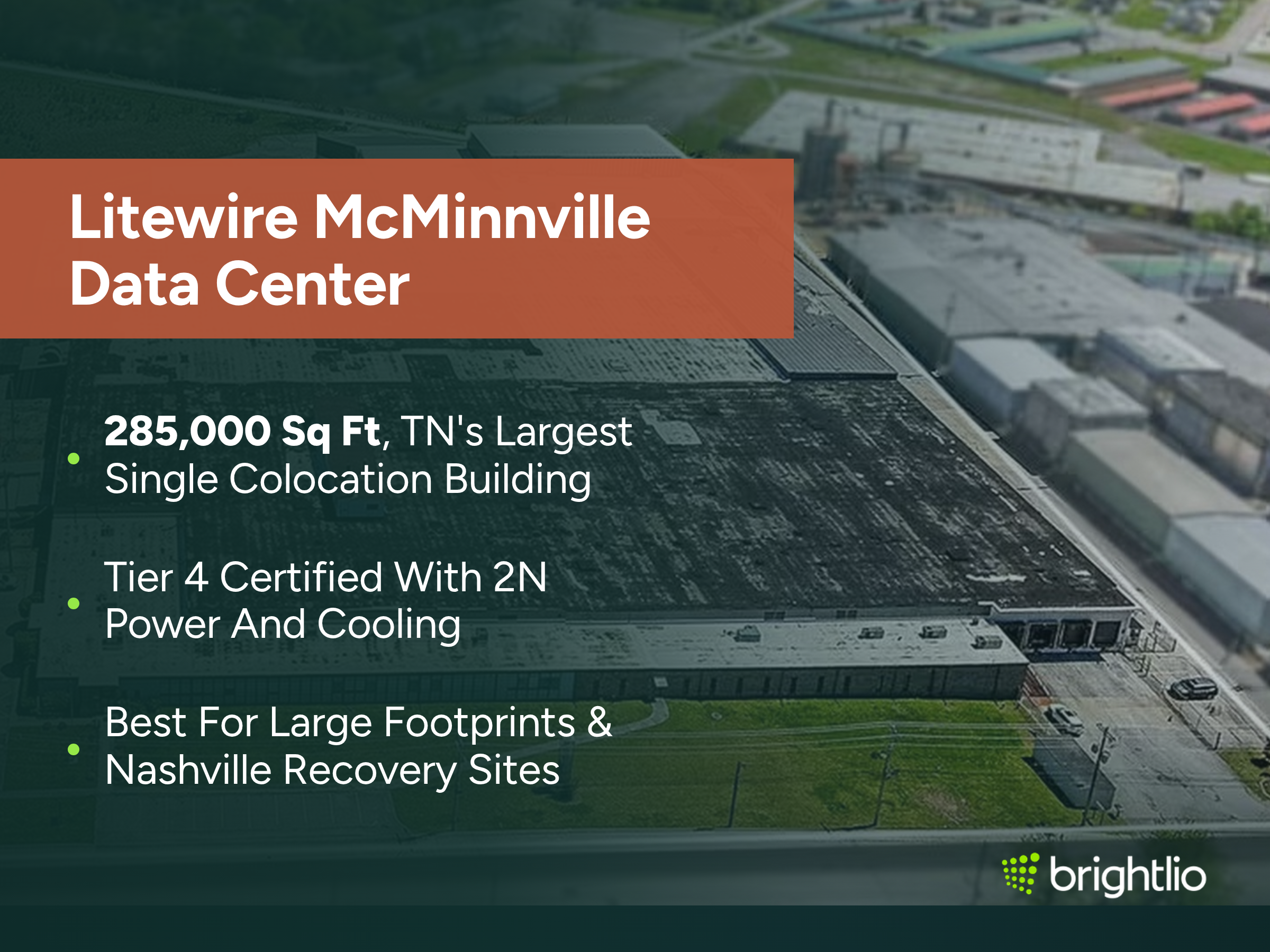
Litewire’s McMinnville facility at 204 Red Rd covers 285,000 sq ft, the largest single colocation building in Tennessee. It is Tier 4 certified, with 2N power and cooling, and has operated since 2014.
The rural location, about an hour southeast of Nashville, trades carrier density for scale and fault tolerance.
Litewire is best suited for enterprises that need Tier 4 redundancy and large footprints, and for Nashville firms that want a recovery site outside the metro.
7. H5 Data Centers Nashville
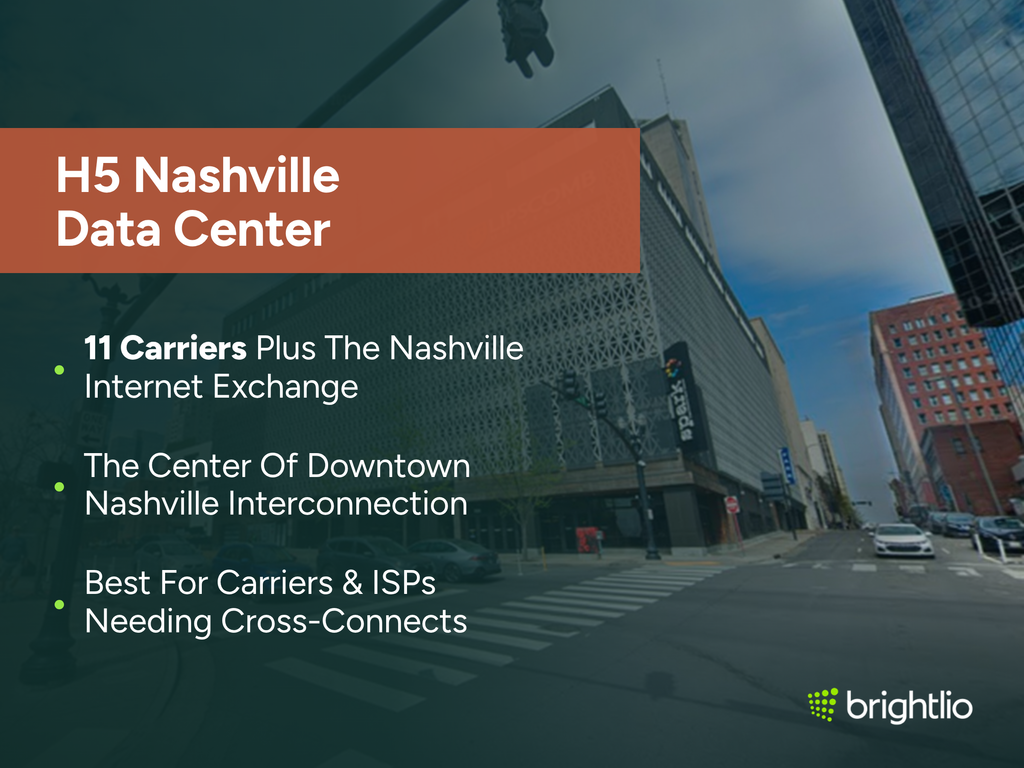
H5’s downtown facility at 147 4th Ave N offers 22,000 sq ft with 11 carriers and the Nashville Internet Exchange on site, which makes it the center of the city’s interconnection.
H5 operates in other Brightlio markets, including Phoenix, so multi-region buyers can standardize on one provider.
H5 Nashville is best suited for carriers, ISPs, and enterprises that need direct cross-connects and peering in downtown Nashville.
8. Lumen Nashville 3
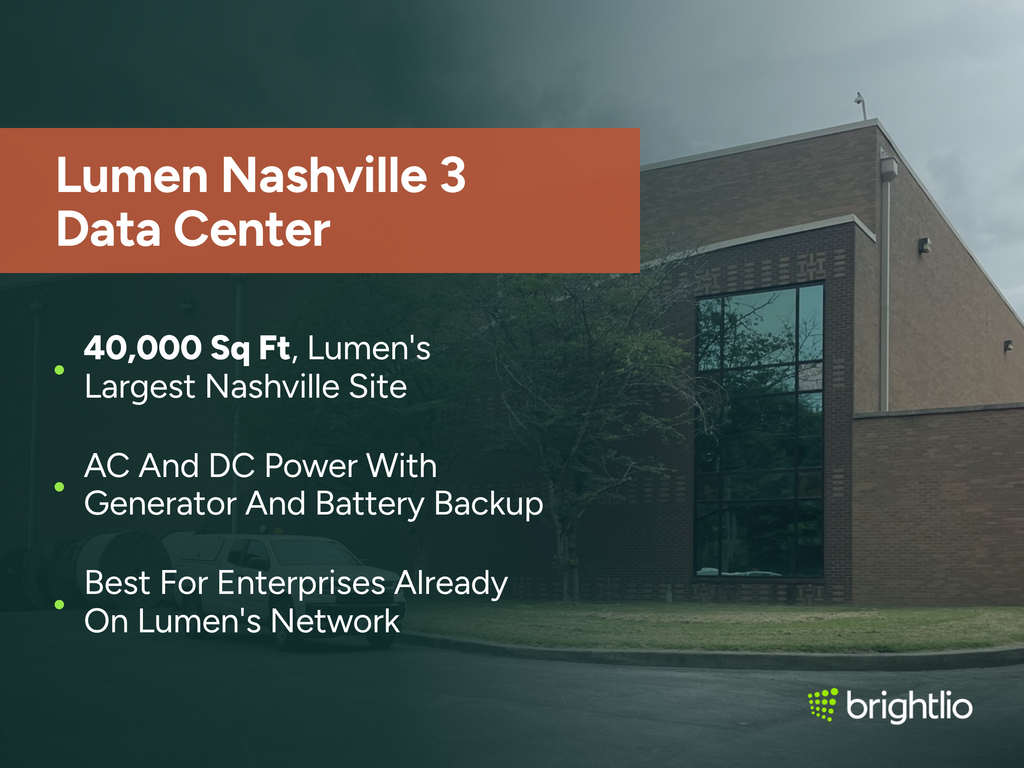
Lumen’s largest Nashville site, at 2208 9th Ave N, covers 40,000 sq ft with AC and DC power and generator and battery backup.
Lumen pairs the space with its own national fiber network, so tenants can buy colocation and transport from one carrier.
Lumen Nashville 3 is best suited for enterprises already on Lumen’s network that want on-net colocation with room to grow.
9. Saragon Nashville Data Center
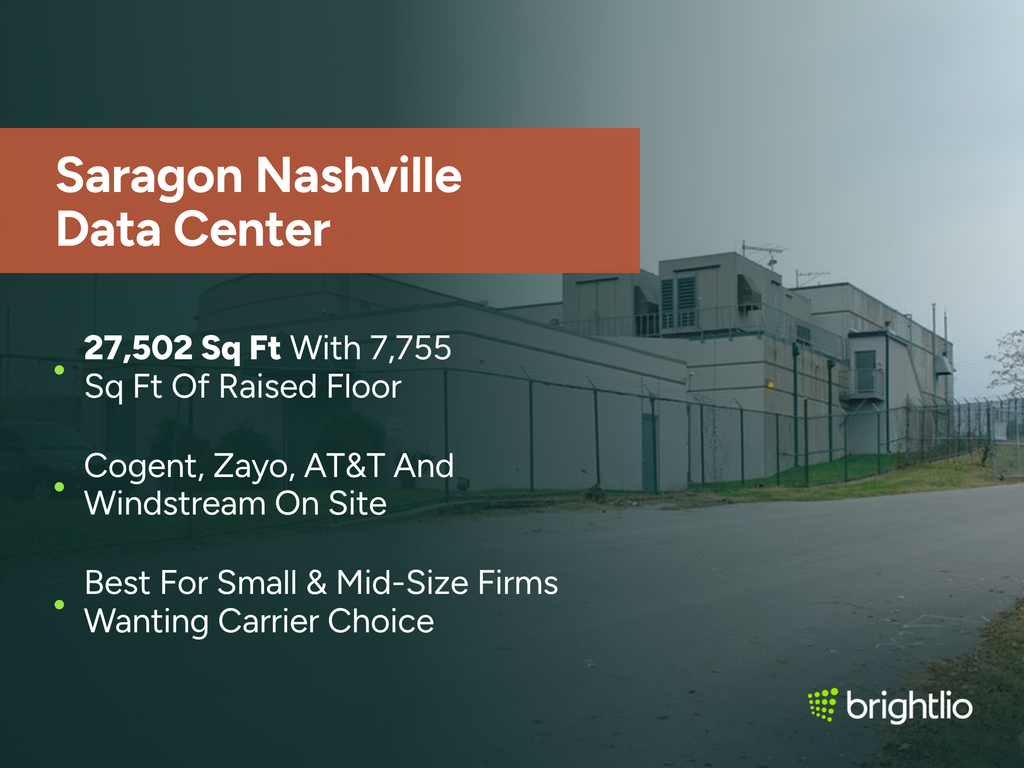
Saragon’s facility at 338 Woodycrest Ave covers 27,502 sq ft, with 7,755 sq ft of raised floor. Cogent, Zayo, AT&T, and Windstream all have a presence on site.
The smaller raised-floor footprint keeps the site focused on cabinet and cage customers.
Saragon is best suited for small and mid-size enterprises that want a local provider with multiple carriers in the building.
10. TierPoint Nashville Data Center
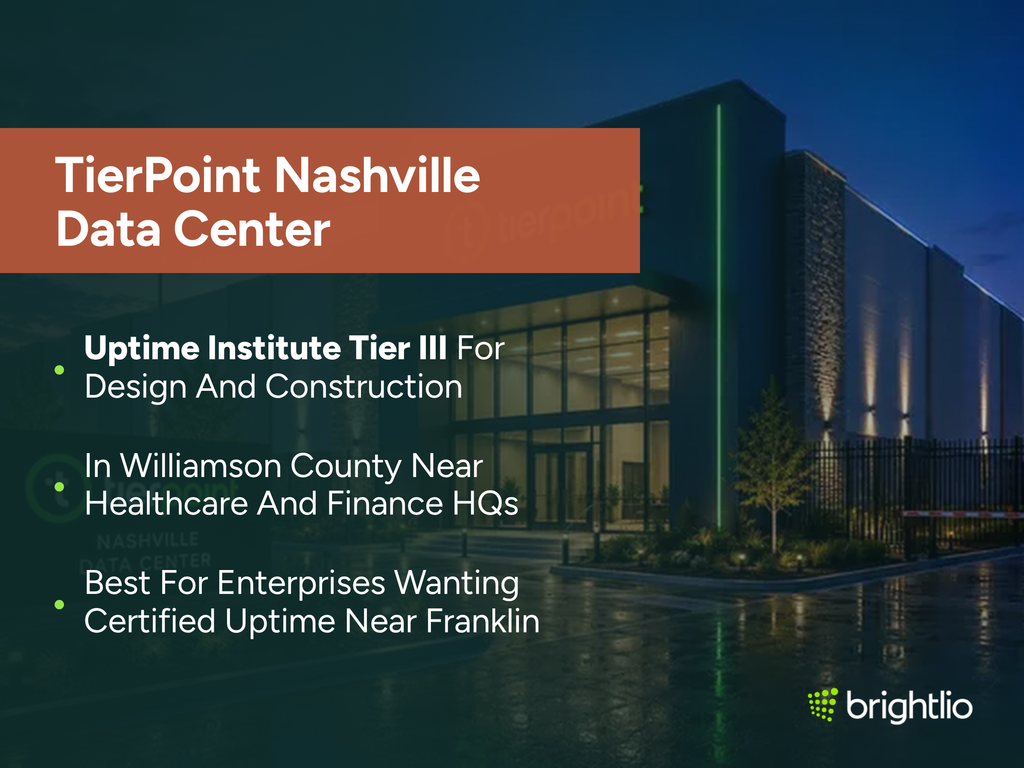
TierPoint’s Franklin facility at 311 Eddy Ln holds Uptime Institute Tier III certification for both design and construction. TierPoint does not publish its capacity.
The Williamson County location sits in the heart of Nashville’s corporate suburbs, close to healthcare and financial services headquarters.
TierPoint Nashville is best suited for enterprises that want independently certified uptime and managed services near Franklin and Brentwood.
Recent Developments In Tennessee (Last 12 To 24 Months)
- August 2026: TVA’s board approved a dedicated data center rate class on August 20, effective October 1, which raises data center billing about 10% and adds capacity commitment and interruption provisions.
- August 2026: Wright Brothers Construction announced Project River, a 1,500 MW data center and energy campus in Bradley County, now the largest planned project in Tennessee.
- August 2026: Epoch AI estimated xAI’s Colossus 2 at about 946 MW of IT load, making it the largest operating data center in the state.
- May 2026: Anthropic began leasing all compute capacity at xAI’s Colossus 1, turning the Memphis cluster into a leased AI facility.
- April 2026: The NAACP, represented by Earthjustice and the Southern Environmental Law Center, sued xAI over 27 gas turbines powering Colossus 2, alleging they ran without required air permits.
- March 2026: Mississippi regulators granted an air permit for xAI’s Southaven turbines, a decision environmental groups are appealing.
- November 2024: Meta officially launched its 300 MW Gallatin campus, Tennessee’s largest hyperscale site at the time.
Drawbacks And Considerations For Colocation In Tennessee
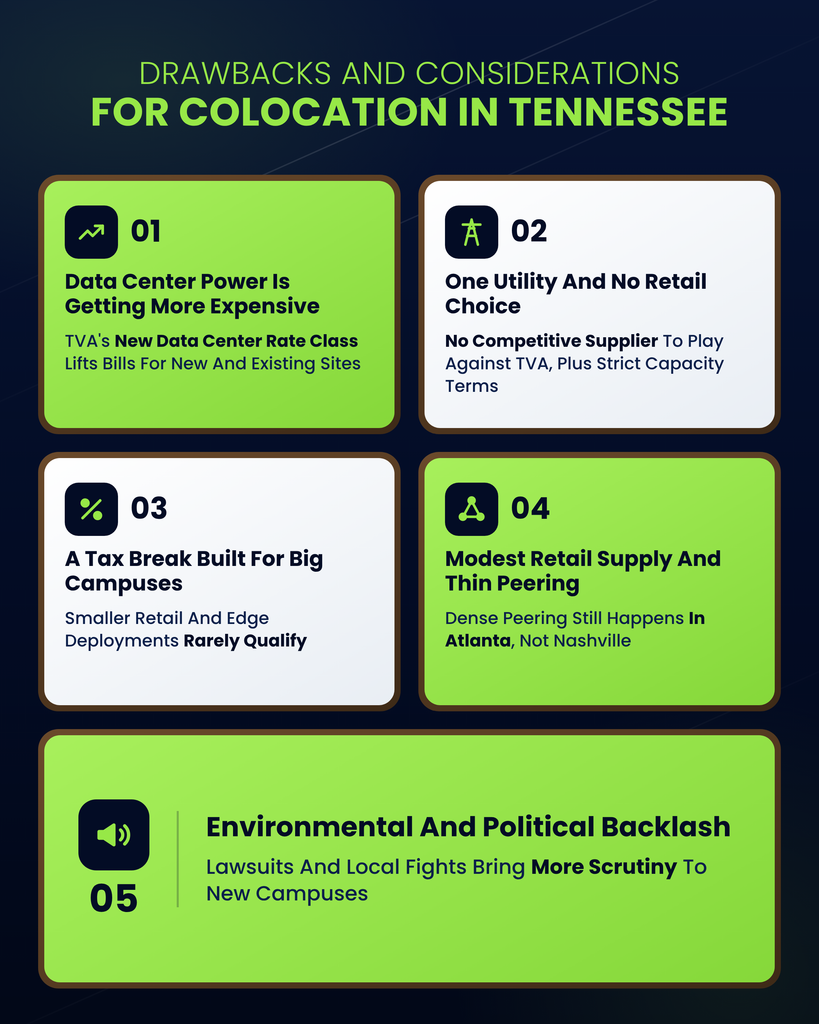
Tennessee’s power deal is real, but the market carries costs and risks that buyers need to price in. The five considerations below matter most when comparing Tennessee with Atlanta, Virginia, and other Southeast markets.
1. Data Center Power Is Getting More Expensive
TVA’s new data center rate class lifts bills for new and existing sites, and the utility’s resource plan leans on new coal, gas, and nuclear plants that take years to build. Cheap industrial power is still available, but each new contract costs more than the last.
2. One Utility And No Retail Choice
Every large buyer in Tennessee negotiates with TVA through a local power company. There is no competitive supplier to play against TVA, and capacity commitments now come with strict terms.
3. A Tax Break Built For Big Campuses
The equipment exemption and reduced power tax require a large investment and a minimum headcount. Smaller retail and edge deployments rarely qualify, and even qualifying sites still pay tax on electricity.
4. Modest Retail Supply And Thin Peering
Nashville’s retail buildings are mid-size, and dense peering still happens in Atlanta. Buyers needing large private suites or many cloud on-ramps will find more south of the state line.
5. Environmental And Political Backlash
xAI’s turbine lawsuit, the regional moratorium campaign, and local fights over projects such as DC BLOX in Nashville show that data center growth is now a political issue in Tennessee. New campuses face more scrutiny than they did two years ago.
How Brightlio Can Help With Colocation In Tennessee
Brightlio helps organizations compare Tennessee colocation, cloud connectivity, AI infrastructure, and disaster recovery options across Nashville, Franklin, Brentwood, Memphis, Knoxville, Chattanooga, McMinnville, and nearby Southeast markets.
Our team helps clients evaluate facility fit, power pricing, carrier access, compliance needs, power density, cooling design, and long-term site risk.
We compare providers such as H5 Data Centers, Lumen, Saragon, TierPoint, Litewire, Flexential, DataBank, EdgeConneX, RadiusDC, and other Tennessee operators.
For Tennessee projects, we pay close attention to TVA rate class and capacity commitments, local power company terms, tax exemption eligibility, tornado and flood exposure, seismic risk in West Tennessee, carrier routes to Atlanta, and expansion rights.
Brightlio can support cabinet, cage, private suite, single-tenant, high-density, AI, and multi-site disaster recovery planning, and our quotes come free to clients. Contact Brightlio to compare Tennessee colocation solutions and start planning a cost-effective and resilient deployment.
[Request A Tennessee Colocation Quote button]
Frequently Asked Questions
1. Which U.S. State Has The Most Data Centers?
Virginia has the most data centers in the United States, led by Northern Virginia’s Loudoun County cluster, and Texas and California follow among the top data center markets in the US. Tennessee is a smaller market with 65 listings, but its two xAI clusters in Memphis total 1,246 MW.
2. How Many Data Centers Are In Tennessee?
Tennessee has 65 data center listings from 21 operators. Nashville holds 28, Memphis 13, Knoxville 9, and Chattanooga 5, with six smaller markets sharing the remaining 10.
3. What Is The Largest Data Center In Tennessee?
xAI’s Colossus 2 in Memphis is the largest, with an estimated 946 MW of IT load as of August 2026. Colossus 1 and Meta’s Gallatin campus follow at 300 MW each.
4. Who Is Building Data Centers In Tennessee?
xAI, Meta, and Google lead Tennessee’s operating base. The planned pipeline comes from Wright Brothers Construction, Cielo Digital Infrastructure, DC BLOX, RadiusDC, 5C Group, and Fisk University, with Project River’s 1,500 MW campus in Bradley County the largest proposal.
5. Are Tennessee Electricity Costs Favorable For Colocation?
For large loads, yes. Industrial customers paid 6.45¢/kWh in May 2026 against 13.52¢/kWh for business customers. TVA’s new data center rate class, effective October 1, 2026, raises data center bills about 10%, so the advantage is shrinking.
6. What Tax Incentives Does Tennessee Offer Data Centers?
Qualifying data centers pay no sales tax on equipment and a reduced 1.5% tax on electricity. To qualify, a site must invest $100 million and create 15 jobs, which puts the incentive out of reach for most retail and edge deployments.
7. Which Cities Are Best For Colocation In Tennessee?
Nashville and its southern suburbs of Franklin and Brentwood are the best fit for retail colocation, with the most providers and carriers. McMinnville offers Tier 4 space at Litewire, while Memphis, Knoxville, and Chattanooga serve regional and recovery needs.
8. Can Tennessee Colocation Support AI Or High-Density Workloads?
Yes, at hyperscale. xAI’s Memphis clusters, Meta’s Gallatin campus, and Bitdeer’s Knoxville conversion all run high-density compute. Leasable retail space for AI is limited, so most buyers needing dense GPU deployments work through build-to-suit or converted mining sites.
9. Why Are People Protesting Against Data Centers In Tennessee?
Residents and advocacy groups object to air pollution, electricity costs, water use, and land use. The NAACP sued xAI in April 2026 over gas turbines powering Colossus 2, and the Southern Alliance for Clean Energy has called for an 18-month moratorium on new large data centers in the region.
10. Who May Not Need Tennessee Colocation?
Networks that depend on dense peering get more from Atlanta. Smaller deployments that cannot meet the tax incentive’s investment and jobs thresholds lose much of Tennessee’s appeal, and buyers placing critical systems in Memphis need to plan around New Madrid seismic risk.
Keep reading with our colocation guides for these nearby markets:

Tamzid is a cybersecurity researcher with 5+ years of experience across SaaS, security, compliance, data centers and cloud. He writes for brightdefense.com and hipaasimple.com, covering security, compliance, and infrastructure topics. Certified through Cisco, Fortinet (NSE 1), and the Basel Institute on Governance in OSINT, he grounds his work in primary sources and verified data.
Recent Posts

Data Centers and Colocation In Michigan

Data Centers and Colocation in Wisconsin

Data Centers and Colocation in Tennessee

Data Centers and Colocation In Nevada
Let's start
a new project together