
Nebraska built its data center market on cheap public power and generous tax credits, and in July 2026 the state shut off the credits. Meta’s Sarpy County campus leads the operating base at an estimated 320 MW, followed by MARA’s bitcoin mining site in Kearney (100 MW) and AAIM’s Nebraska 1 site in Aurora (15 MW).
Google’s Omaha and Papillion campuses round out the five largest operating sites. Google publishes no capacity for either, though the Omaha campus alone covers about 1.43 million sq ft.
Power remains the draw. Nebraska is the only state where every utility is publicly owned, and its business rate of 8.77¢/kWh in 2023, the latest state figure, sits well below the national average.
The welcome has cooled. Governor Jim Pillen’s executive order bars new data centers from ImagiNE Nebraska tax credits, a June 2026 law stops data centers from leaning on ratepayer-funded power, and counties are passing moratoriums. Existing campuses and Omaha’s retail market remain solid, but new builds face a state that no longer wants to pay for them.
Nebraska Data Center Tracker
37data center listings
Omaha 16Papillion 12Lincoln 6Grand Island 3
Omaha and Papillion hold 28 of Nebraska’s 37 listings, and Google and Meta campuses account for 19 of them.
Market Snapshot
Largest Operating Data Centers In Nebraska
These are the five largest operating sites by published capacity. Google’s two campuses don’t publish MW, so they rank last here despite their size, and every other listing appears on the map, with operating sites in green and planned ones in coral.
- Meta Sarpy CampusPapillion, utility estimate320 MWOperational
Eight-building campus spanning Papillion and Springfield, online since 2020
- Location:
- Sarpy County
- Operator:
- Meta
- Investment:
- $1.5 billion
- Utility:
- Omaha Public Power District
- MARA KearneyKearney, site power100 MWOperational
Bitcoin mining site running 5.5 EH/s on grid power with air cooling
- Address:
- 3215 Global Dr, Kearney
- Operator:
- MARA Holdings
- AAIM Nebraska 1Aurora, site power15 MWOperational
Flagship site built in five months and running since October 2024
- Address:
- 1428 Kremer Ave, Aurora
- Operator:
- AAIM Data Centers
- Google Omaha CampusOmahaNot publishedOperational
Four buildings totaling about 1.43 million sq ft, operational since November 2024
- Address:
- 11110 State St, Omaha
- Operator:
- Google Papillion CampusPapillionNot publishedOperational
Four-building campus on Gold Coast Road from a $600 million original build
- Address:
- 14651 to 15249 Gold Coast Rd, Papillion
- Operator:
Largest Planned Data Centers In Nebraska
Project Horizon in Kearney accounts for 368 MW of the roughly 380 MW shown here, while Google’s Lincoln campus doesn’t publish a capacity figure.
- Project HorizonKearney, planned368 MWUnder construction
Large Kearney campus tied to MARA Holdings
- Location:
- Kearney, Buffalo County
- Developers:
- MARA Holdings, SDV and Worldwide Mission Critical
- AAIM Nebraska 2Hastings, planned12.5 MWUnder construction
Second AAIM site near Hastings, following the Aurora build
- Location:
- Near the CPI Hayland elevator, Adams County
- Developer:
- AAIM Data Centers
- Google Lincoln CampusLincolnNot publishedUnder construction
Google’s third Nebraska campus
- Location:
- Lincoln, Lancaster County
- Developer:
- Sequitor Edge KearneyKearneyNot publishedPlanned
Data center planned on 16 acres in the Tech oNE Crossing park
- Location:
- Kearney, Buffalo County
- Developer:
- Sequitor Edge
- Olive Creek Data CenterHallamNot publishedPlanned
Modular facility on 10 acres with water-efficient design
- Address:
- 27077 SW 42nd St, Hallam
- Developer:
- Monolith Inc.
Largest Colocation Facilities In Nebraska
Retail colocation centers on Omaha and its southern suburbs, led by H5’s 32-acre La Vista campus and the 1623 Farnam carrier hotel.
- H5 Data Centers OmahaLa Vista234,500 sq ftColocation
32-acre campus, formerly Yahoo’s Omaha data center
- Address:
- 10917 Harry Watanabe Pkwy, La Vista
- Operator:
- H5 Data Centers
- Scott Data CenterOmaha80,000+ sq ftColocation
Tier III facility with a weather-hardened exterior, opened in 2006
- Address:
- 6805 Pine St, Omaha
- Operator:
- Scott Technology Center
- TierPoint Omaha-MidlandsPapillion50,000 sq ftColocation
Tier IV facility built to withstand F5 tornado winds
- Address:
- 11425 S 84th St, Papillion
- Operator:
- TierPoint
- Cogent Data Center OmahaOmaha30,361 sq ftColocation
Gated facility with 400GE ports and multi-carrier connectivity
- Address:
- 810 S 7th St, Omaha
- Operator:
- Cogent Communications
- LightEdge OmahaPapillion16,377 sq ftColocation
Multi-tenant site retrofitted in 2017, linked to LightEdge’s Iowa and Missouri sites
- Address:
- 1148 American Pkwy, Papillion
- Operator:
- LightEdge
- IP Pathways OmahaOmaha4,000 sq ftColocation
White space with full and partial cabinets plus public cloud
- Address:
- 5940 S 118th Cir, Omaha
- Operator:
- IP Pathways
- 1623 FarnamOmahaNot publishedColocation
Omaha’s main carrier hotel, with more than 40 carriers in the building
- Address:
- 1623 Farnam St, Omaha
- Operator:
- 1623 Farnam
- Lincoln Data CenterLincolnNot publishedColocation
Downtown Lincoln site with diverse fiber back to the Omaha carrier hotel
- Address:
- 206 S 13th St, Lincoln
- Operator:
- Lincoln Data Centers
More operating colocation, shown on the map as green squares: , , , , , , , , .
Choose a category to switch the list and highlight its sites on the map. Click any site card to find it on the map, or click a marker to jump to its card. Pins are approximate, and each MW figure carries the basis shown beside it.
Data sourced from Data Center Map, Nebraska Department of Water, Energy, and Environment, EIA, the Nebraska Examiner, Compute Atlas, ServerCountry and More Than Just Parks, checked October 10, 2026. Listings count individual buildings, and the lists show the largest sites in each category.
Why Colocate In Nebraska?
Nebraska wins on power price, a central location, a cold climate, and a capable Omaha retail market. It loses on tax incentives, which the state has now withdrawn for new data centers, and on political goodwill.
The six factors below weigh each side.
1. Market Access And Latency
Omaha sits near the geographic center of the country on the I-80 corridor, one of the main east-west long-haul fiber routes. That position puts the metro within reach of both coasts and of nearby hubs such as Kansas City, Denver, Chicago, and Des Moines.

Central placement makes Omaha a natural disaster recovery site for companies running primary systems on either coast. Lincoln, about an hour southwest, adds a second in-state site on separate fiber.
Nebraska is not a first-choice market for latency-sensitive workloads aimed at large coastal populations. It works best for backup, recovery, and Midwest-focused production.
2. Network Connectivity And Peering
Omaha’s interconnection centers on 1623 Farnam, the metro’s main carrier hotel, with more than 40 carriers in the building. Cogent’s Omaha facility at 810 S 7th St offers 400GE ports and multi-carrier access.
Lincoln’s downtown data center connects over diverse fiber back to the Omaha carrier hotel, so the two cities share one interconnection core.

The ecosystem is solid for a mid-size market but smaller than Chicago or Kansas City. Buyers who depend on dense peering or many cloud on-ramps still run transport to those hubs.
3. Power, Cost, And Sustainability
Power is Nebraska’s strongest card. Business customers paid 8.77¢/kWh in 2023, the latest state figure, and industrial customers paid 7.64¢/kWh, both far below the national average.
The pricing comes from public ownership. Nebraska is the only state where every utility is publicly owned, and its utilities, including the Omaha Public Power District, run in the Southwest Power Pool, so profits do not drive retail rates.
That advantage is now protected from data centers. LB 1261, signed in June 2026, prevents data centers from relying on power built and funded by Nebraska ratepayers, which means new large loads pay for their own generation and grid upgrades.
For buyers comparing colocation pricing, existing Omaha facilities keep the benefit of cheap public power. New hyperscale projects will pay more to connect than early campuses did.
The grid is mixed on carbon. Coal supplied 46% of generation in 2025 and wind 29%, with nuclear at 17% and natural gas at 4%. Wind and nuclear together provide close to half of in-state power, but coal remains the single largest source.
4. Tax Policy And Incentives
Nebraska has turned off the main incentive. On July 20, 2026, Governor Pillen signed an executive order barring any new data center application from approval for ImagiNE Nebraska Act tax credits, and he later clarified that the ban covers all new data center projects.
The cost drove the decision. The governor’s office says the state gave up $317 million in direct credit revenue to data centers between January 2021 and June 2026, and State Sen. Mike Jacobson argued that data centers face no real competitive pressure to need the credits.

The order also creates a task force to recommend further safeguards for water and power, and lawmakers have floated a bill to remove data centers from ImagiNE entirely.
The practical effect is plain. A new data center in Nebraska today gets cheap power at full cost and no state tax credits, while projects approved before the order keep the credits they already earned.
5. Workforce And Ecosystem
Nebraska’s labor market is one of the tightest in the country. Unemployment was 2.9% in July 2026, well below the 4.1% national rate.
Construction trades are in heavy demand. Mining and construction employment hit an all-time high of 71,487 in July 2026, which leaves little slack for the electricians and mechanical crews data center builds need.

Omaha’s financial services, insurance, and defense sectors, along with the University of Nebraska system, supply IT and engineering talent. Operators outside Omaha and Lincoln will find hiring harder.
6. Risk And Resiliency
Tornadoes and severe spring storms are Nebraska’s main hazards, along with Missouri River flooding in the east. TierPoint’s Papillion facility is built to withstand F5 tornado winds, which shows how seriously local operators take wind risk.
The cold climate helps. Long winters give operators extended free-cooling seasons, though summer heat still pushes cooling loads up through July and August.

The largest risk is political. The executive order, LB 1261, and county moratoriums show that Nebraska’s leaders now treat data center growth as something to manage closely. Buyers backing new campuses need to plan for slower approvals and higher costs than the state’s first wave of projects faced.
Key Cities Or Submarkets In Nebraska
Nebraska’s data centers cluster in the Omaha metro, with Lincoln as a second hub and a cluster of power-driven sites along I-80 in central Nebraska.
The five submarkets below run from the deepest retail market to the smallest rural sites.
1. Omaha
Omaha holds 16 of Nebraska’s 37 listings and the state’s interconnection core at 1623 Farnam, profiled below. Google’s Omaha campus at 11110 State St is the city’s largest site, and Scott Data Center and Cogent anchor the retail market, both profiled below as well.
Smaller options fill out the market. IP Pathways runs 4,000 sq ft of white space at 5940 S 118th Cir with full and partial cabinets and public cloud, and Lumen, Uniti, FNTS, and LoCoCoLo operate local sites.
Omaha suits financial services, insurance, healthcare, and government buyers that need cabinets to private suites with strong carrier access. It is a strong regional market for companies that want retail colocation on low-cost public power.
2. Papillion And La Vista
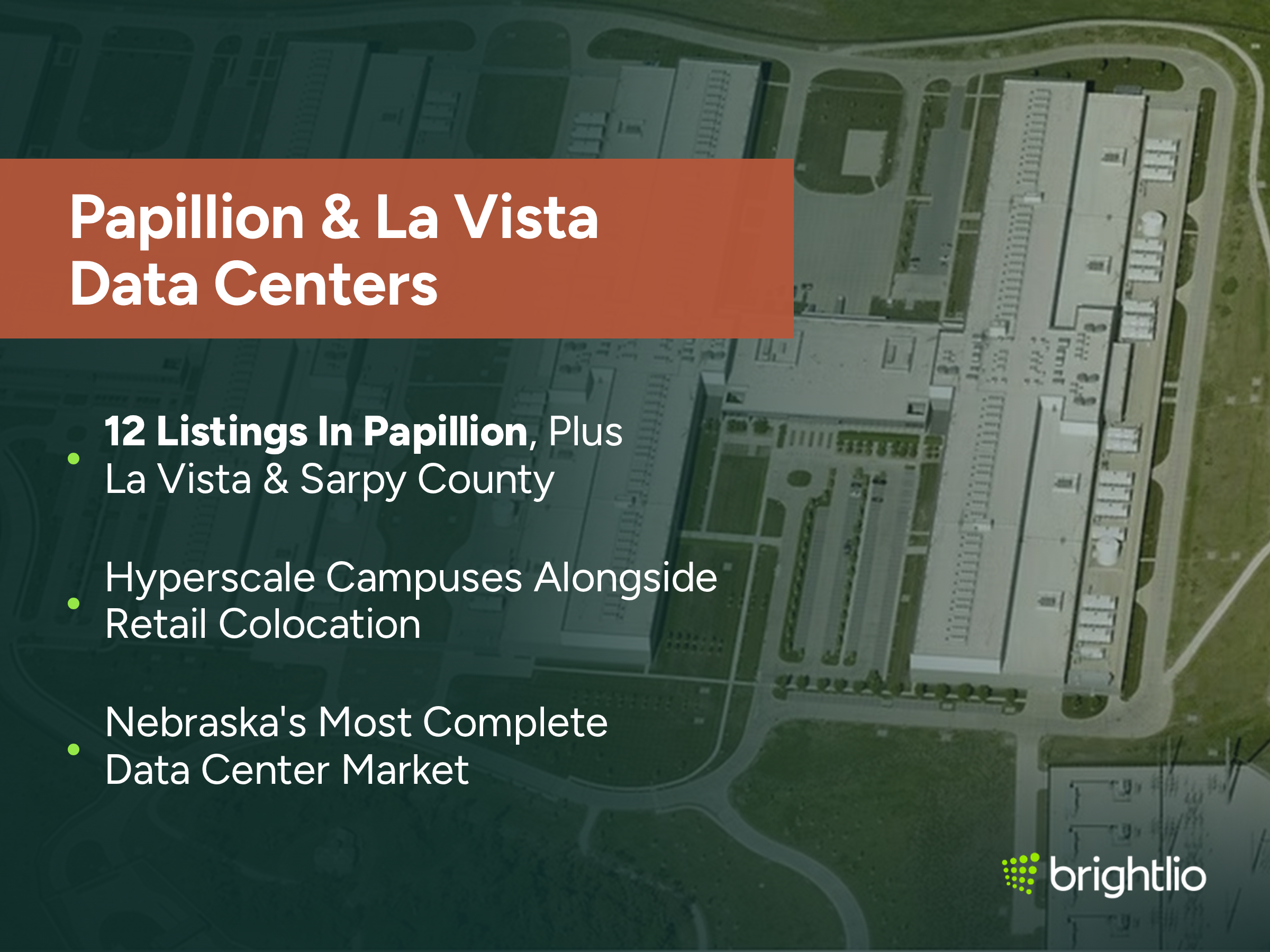
Sarpy County, just south of Omaha, is where Nebraska’s hyperscale growth landed. Papillion alone holds 12 listings, and Meta’s Sarpy campus and Google’s Papillion campus, both profiled below, account for most of them.
The county carries strong retail supply too. H5 Data Centers’ former Yahoo campus in La Vista and TierPoint’s Tier IV Omaha-Midlands facility in Papillion are profiled below, and LightEdge runs a 16,377 sq ft multi-tenant site at 1148 American Pkwy, retrofitted in 2017 and linked to LightEdge’s sites in Iowa and Missouri.
Sarpy County is the most complete data center market in the state, mixing hyperscale campuses with retail buildings. Future campuses there will arrive without state tax credits.
Before committing to an AI data center deployment, confirm rack power limits, cooling support, and available expansion capacity.
3. Lincoln
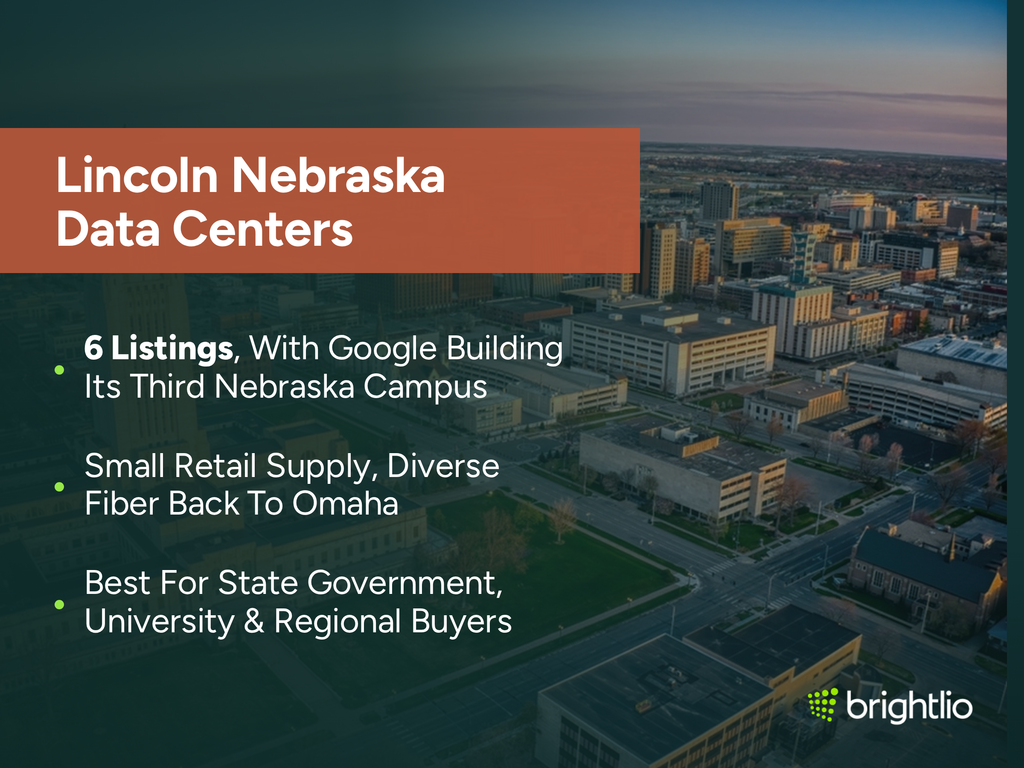
Lincoln has 6 listings and a growing hyperscale presence. Google is building its third Nebraska campus in Lancaster County.
Retail supply is small. Lincoln Data Centers runs a downtown site at 206 S 13th St with diverse fiber back to the Omaha carrier hotel, and Uniti and Binary.net operate local facilities.
Monolith Inc. plans the Olive Creek Data Center on 10 acres at 27077 SW 42nd St in nearby Hallam, a modular facility with a water-efficient design.
Lincoln suits state government, university, and regional buyers, and it works as a recovery site for Omaha deployments.
4. Kearney
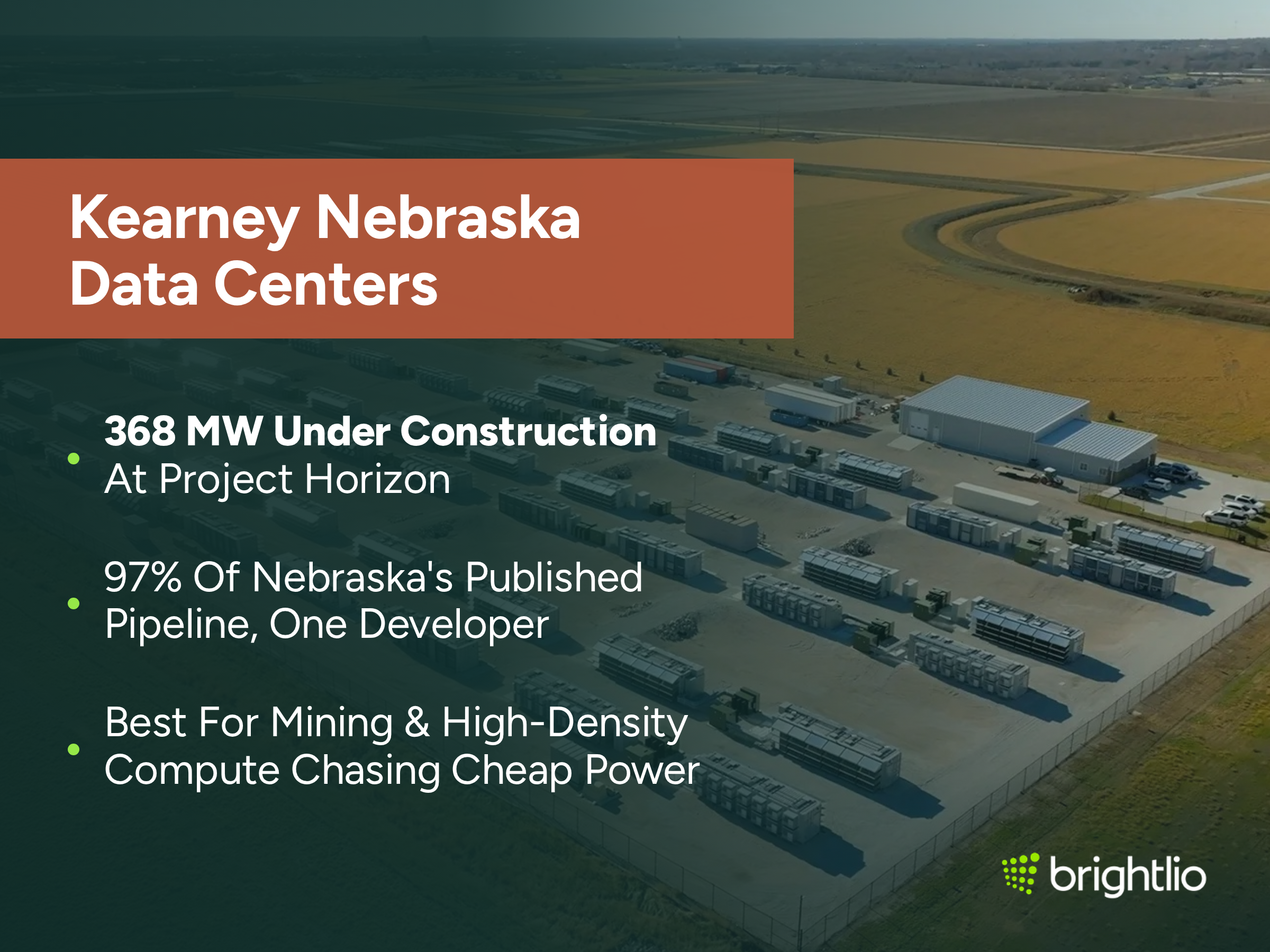
Kearney is Nebraska’s power-driven compute market. MARA’s bitcoin mining site at 3215 Global Dr, profiled below, is the second-largest operating site in the state.
The city holds almost all of Nebraska’s published pipeline. Project Horizon, tied to MARA Holdings and developed with SDV and Worldwide Mission Critical, is under construction at 368 MW, and Sequitor Edge plans a data center on 16 acres in the Tech oNE Crossing park.
The pipeline depends on one developer. Project Horizon accounts for 368 MW of the roughly 380 MW of planned capacity in Nebraska that publishes a figure, about 97%, and its sponsor is a bitcoin miner.
Kearney offers no meaningful retail colocation. It matters to mining and high-density compute operators chasing cheap power.
5. Grand Island, Aurora, And Hastings
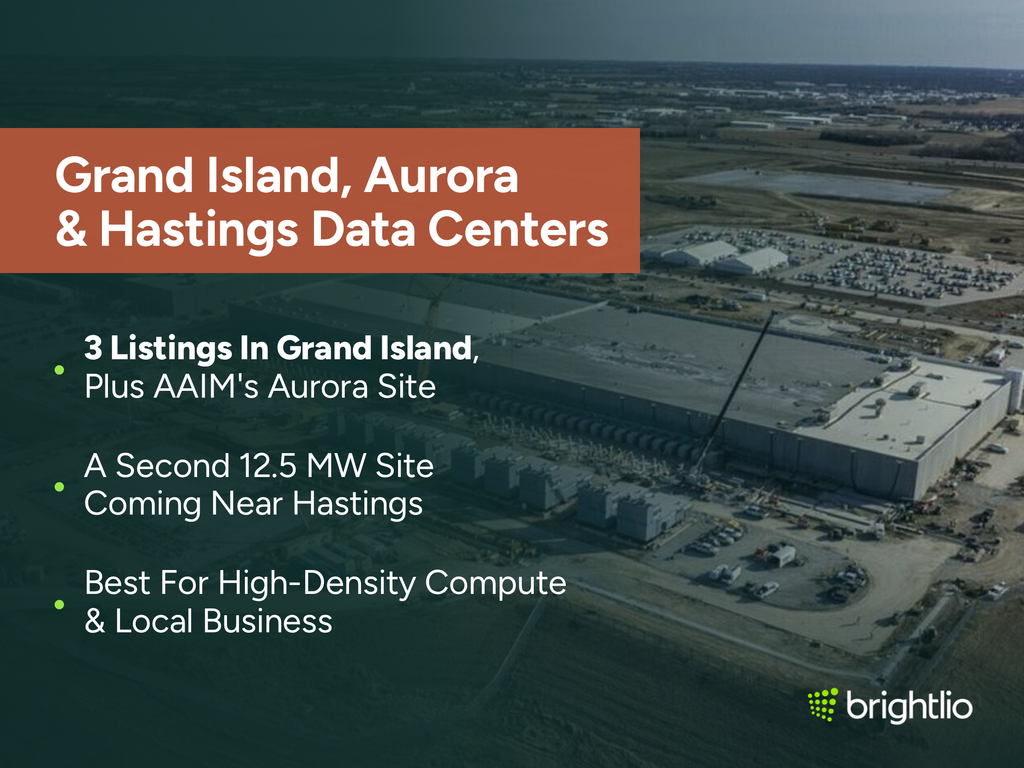
Central Nebraska’s smaller sites follow the same power-first model. Grand Island holds 3 listings, and AAIM Data Centers runs its Nebraska 1 site in Aurora, profiled below.
AAIM is building a second 12.5 MW site near Hastings, beside the CPI Hayland elevator in Adams County.
These markets serve high-density compute and local businesses. They are too remote and too small for enterprise colocation.
Notable Colocation Providers And Facilities In Nebraska
Nebraska’s provider list starts with the five largest operating sites, all single-tenant hyperscale or mining campuses, and continues with the retail operators where enterprise buyers can lease space.
The ten facilities below cover both groups.
1. Meta Sarpy Data Center Campus
Meta’s Sarpy campus spans Papillion and Springfield with eight buildings and an estimated 320 MW based on utility figures. It has been online since 2020, backed by a $1.5 billion investment.
The Omaha Public Power District serves the campus, which makes it the largest load among Nebraska’s data centers.
Meta Sarpy is a single-tenant hyperscale site with no colocation access. Its relevance to other buyers is the transmission and fiber it brought to Sarpy County.
2. MARA Kearney Data Center
MARA Holdings runs a 100 MW bitcoin mining site at 3215 Global Dr in Kearney, producing 5.5 EH/s on grid power with air cooling.
MARA is tied to Project Horizon, the 368 MW campus under construction nearby, so Kearney’s growth depends heavily on one mining company.
The site offers no retail space and is built to mining standards.
3. AAIM Nebraska 1 Aurora
AAIM Data Centers built its 15 MW flagship site at 1428 Kremer Ave in Aurora in five months, and it has run since October 2024.
The fast build shows what central Nebraska’s power and land can deliver for high-density compute. AAIM is building a second site near Hastings.
AAIM Nebraska 1 is best suited for high-density and mining-adjacent compute tenants seeking powered capacity outside the metros.
4. Google Omaha Data Center Campus
Google’s Omaha campus at 11110 State St covers four buildings and about 1.43 million sq ft, operational since November 2024. Google does not publish its capacity.
The campus is Google’s newest operating site in the state, with a third campus under construction in Lincoln.
Google Omaha offers no retail space.
5. Google Papillion Data Center Campus
Google’s Papillion campus covers four buildings at 14651 to 15249 Gold Coast Rd, built from a $600 million original investment. Capacity is not published.
Together with Meta, Google’s Sarpy County presence makes Papillion the densest hyperscale cluster in Nebraska.
Like the Omaha campus, Papillion is single-tenant.
Recent Developments In Nebraska (Last 12 To 24 Months)
- July 2026: Governor Jim Pillen signed an executive order on July 20 barring new data centers from ImagiNE Nebraska tax credits and creating a task force on water and power safeguards. His office put the state’s lost credit revenue to data centers at $317 million since 2021.
- July 2026: Counties across Nebraska passed or explored moratoriums on new data centers while studying their power and water demands.
- June 2026: Pillen signed LB 1261, which prevents data centers from relying on power built and funded by Nebraska ratepayers.
- November 2024: Google’s Omaha campus at 11110 State St became operational, adding about 1.43 million sq ft across four buildings.
- October 2024: AAIM Data Centers brought its 15 MW Nebraska 1 site in Aurora online after a five-month build.
Drawbacks And Considerations For Colocation In Nebraska
Nebraska still offers cheap power and a capable Omaha market, but the state has turned cautious on new data centers. The five considerations below help buyers compare Nebraska facilities with data centers in Iowa and other Midwest markets.
1. No State Tax Credits For New Projects
The executive order removes ImagiNE credits for every new data center. Neighboring states still offer incentives, so a new Nebraska project starts at a cost disadvantage.
2. New Large Loads Pay Their Own Way
LB 1261 keeps data centers from leaning on ratepayer-funded generation. Existing facilities keep cheap public power, but new campuses will pay more to connect than the first wave of campuses did.
3. A Coal-Heavy Grid
Coal is still the largest single source of Nebraska’s power. Buyers with carbon targets will need renewable contracts to offset it, despite the state’s strong wind output.
4. Local Moratoriums And Political Risk
County moratoriums and a governor openly skeptical of data center subsidies make new approvals slower and less certain. Buyers who need certainty get it in existing Omaha buildings.
5. A Pipeline Built On One Project
Nearly all of Nebraska’s published planned capacity sits in Project Horizon, a mining-linked campus in Kearney. Any delay there would leave the state with little new capacity on the way.
How Brightlio Can Help With Colocation In Nebraska
Brightlio helps organizations compare Nebraska colocation, cloud connectivity, AI infrastructure, and disaster recovery options across Omaha, La Vista, Papillion, Bellevue, Lincoln, and nearby Midwest markets. Our team helps clients evaluate facility fit, power pricing, carrier access, compliance needs, power density, cooling design, and long-term site risk.
We compare providers such as H5 Data Centers, Scott Data Center, TierPoint, Cogent, LightEdge, 1623 Farnam, IP Pathways, Lincoln Data Centers, and other Nebraska operators. For Nebraska projects, we pay close attention to public power district terms, the end of ImagiNE credits for new projects, LB 1261 connection costs, tornado hardening, Missouri River flood exposure, carrier routes to Chicago and Kansas City, and expansion rights.
Brightlio can support cabinet, cage, private suite, single-tenant, high-density, AI, and multi-site disaster recovery planning, and our quotes come free to clients. Contact Brightlio to compare Nebraska colocation solutions and start planning a cost-effective and resilient deployment.
Frequently Asked Questions
Which U.S. State Has The Most Data Centers?
Virginia has the most data centers in the United States, led by Northern Virginia’s Loudoun County cluster, and Texas and California follow among the top data center markets in the US. Nebraska is a smaller market with 37 listings.
How Many Data Centers Are In Nebraska?
Nebraska has 37 data center listings from 14 operators. Omaha holds 16, Papillion 12, Lincoln 6, and Grand Island 3.
What Is The Largest Data Center In Nebraska?
Meta’s Sarpy campus is the largest published site, at an estimated 320 MW across eight buildings in Papillion and Springfield. Google’s Omaha and Papillion campuses are large too, but Google does not publish their capacity.
Who Is Building Data Centers In Nebraska?
Google is building its third Nebraska campus in Lincoln. MARA Holdings, SDV, and Worldwide Mission Critical are behind the 368 MW Project Horizon in Kearney, and AAIM Data Centers, Sequitor Edge, and Monolith Inc. are developing smaller sites.
Are Nebraska Electricity Costs Favorable For Colocation?
Yes. Business customers paid 8.77¢/kWh in 2023, the latest state figure, and industrial customers paid 7.64¢/kWh, both well below the national average. New large loads face higher connection costs under LB 1261, which bars them from relying on ratepayer-funded power.
What Tax Incentives Does Nebraska Offer Data Centers?
For new projects, none at the state level. Governor Pillen’s July 20, 2026 executive order bars new data centers from ImagiNE Nebraska tax credits, and only projects approved earlier keep their benefits.
Which Cities Are Best For Colocation In Nebraska?
Omaha and its southern suburbs of La Vista and Papillion are the best fit, with the 1623 Farnam carrier hotel and the largest retail buildings in the state. Lincoln works for state government, university, and recovery needs.
Can Nebraska Colocation Support AI Or High-Density Workloads?
Yes, mostly at hyperscale and mining sites. Meta and Google run large campuses in Sarpy County, and Kearney and Aurora host power-driven compute. Retail buyers planning an AI data center deployment will find the most room at H5’s La Vista campus.
Why Is Nebraska Pulling Back On Data Centers?
The state’s leaders decided the subsidies cost too much and the power demand threatened public power customers. The governor’s office counted $317 million in credit revenue lost to data centers since 2021, and counties have moved to study water and power impacts before approving new sites.
Who May Not Need Nebraska Colocation?
Developers counting on state tax credits will find better terms in neighboring states. Networks that depend on dense peering get more from Chicago or Kansas City, and companies with strict carbon targets face a grid where coal is still the largest source.

Tamzid is a cybersecurity researcher with 5+ years of experience across SaaS, security, compliance, data centers and cloud. He writes for brightdefense.com and hipaasimple.com, covering security, compliance, and infrastructure topics. Certified through Cisco, Fortinet (NSE 1), and the Basel Institute on Governance in OSINT, he grounds his work in primary sources and verified data.
Recent Posts

Nuclear Powered Data Centers

10 Largest Data Centers in Europe

Data Centers and Colocation In Minnesota

Data Centers and Colocation In Missouri
Let's start
a new project together