

Minnesota’s largest operating sites start with Csquare’s Minneapolis MSP1 campus in Shakopee, with 19.1 MW of utility power, and CENTRA’s Minneapolis MSP1 facility in Eagan, with 10+ MW of power capacity. These sites give buyers commercial options to evaluate for enterprise and high-density deployments.
DataBank MSP3 Brooklyn Park, DataBank MSP2 East Twin Cities, and T5@Minneapolis complete the operating-site list. Their total capacities are not published. Buyers need facility-specific proposals to compare available power and expansion space.
Minnesota suits Twin Cities enterprises needing local hardware access, network buyers prioritizing downtown interconnection, and deployments that can use cold-weather cooling. It is a poor fit for budgets that depend on tax-exempt electricity or immediate access to planned campus capacity. The development pipeline provides no guarantee of rentable space on a buyer’s required date.
Minnesota Data Center Tracker
49data center facilities
5 operational12 planned32 colocation
Data Center Map counts 81 buildings across 13 markets here. Multi-building campuses count once, while tenant suites in shared buildings count separately.
Market Snapshot
Largest Operating Data Centers In Minnesota
These are the five largest operating sites by published capacity. Csquare's Shakopee campus and CENTRA's Eagan site lead, and every other listing appears on the map, with operating sites in green and planned ones in coral.
- Csquare Minneapolis MSP1 CampusShakopee, utility power19.1 MWOperational
28,900 sq ft campus with 19.1 MW of utility power and nine carriers
- Address:
- 4450 Dean Lakes Blvd, Shakopee
- Operator:
- Csquare
- Buildings:
- MSP1-A and MSP1-B
- CENTRA Minneapolis MSP1Eagan, power capacity10+ MWOperational
150,000 sq ft facility the operator describes as Tier III+, built for high-density AI loads
- Address:
- 3640 Nasseff Way, Eagan
- Operator:
- CENTRA
- Redundancy:
- Distributed redundant power (4/3) and N+1 cooling
- DataBank MSP3 Brooklyn ParkBrooklyn ParkNot publishedOperational
First facility on DataBank's Brooklyn Park campus, opened in 2021
- Address:
- 8111 Oxbow Creek Dr N, Brooklyn Park
- Operator:
- DataBank
- DataBank MSP2 East Twin CitiesEaganNot publishedOperational
Enterprise-class managed space and colocation in Eagan
- Address:
- 3255 Neil Armstrong Blvd, Eagan
- Operator:
- DataBank
- T5@MinneapolisMinneapolisNot publishedOperational
Downtown facility with power and space configurable to tenant density and redundancy needs
- Address:
- 1001 3rd Ave S, Minneapolis
- Operator:
- T5 Data Centers
5 Largest Planned Data Centers In Minnesota
Tract's Farmington park and the Hermantown project account for 1,308 MW of the 1,966 MW in the five largest projects, while Meta's Rosemount campus is the furthest along.
- Tract Farmington Technology ParkFarmington, reported700+ MWPlanned
12-building technology park planned in Farmington
- Location:
- Farmington, Dakota County
- Developer:
- Tract
- Investment:
- $5 billion reported
- Hermantown Data CenterHermantown, reported600 MWPlanned
Proposed campus near Duluth linked to Google, Harmony Group and Mortenson
- Location:
- Hermantown, St. Louis County
- Investment:
- $1.2 billion reported
- Meta Rosemount CampusRosemount, full build-out308 MWUnder construction
715,000 sq ft campus on 280 acres of UMore Park, targeted to open in 2026
- Address:
- 1367 145th St E, Rosemount
- Developer:
- Meta
- Investment:
- $800 million+
- Power:
- Xcel Energy, 100% renewable
- CloudHQ MSP1 CampusChaska, critical IT200 MWPlanned
Campus southwest of downtown Minneapolis built for up to 200 MW of critical IT load
- Address:
- 2007 Schoolmaster Dr, Chaska
- Developer:
- CloudHQ
- Scannell Technology ParkMonticello, by 2027150 MWPlanned
1.3 million sq ft development aiming for 150 MW by 2027
- Location:
- Monticello, Wright County
- Developer:
- Scannell Properties
Other planned projects, shown on the map in coral: , , , , , , .
5 Largest Colocation Facilities In Minnesota
Retail colocation clusters in downtown Minneapolis's 511 Building, the state's main carrier hotel, and in the southwest and east suburbs, led by IronGate's 85,000 sq ft Woodbury facility.
- IronGate Twin Cities EastWoodbury85,000 sq ftColocation
Purpose-built, carrier-neutral colocation facility
- Address:
- 401 Bielenberg Dr, Woodbury
- Operator:
- IronGate Data Centers
- LightEdge Minneapolis IChaska75,675 sq ftColocation
Freestanding facility designed to withstand 185 mph winds
- Address:
- 1708 West Creek Ln, Chaska
- Operator:
- LightEdge
- US Signal Minneapolis MN01Eden Prairie50,000 sq ftColocation
Tier III design-certified facility with flywheel power backup
- Address:
- 10290 W 70th St, Eden Prairie
- Operator:
- US Signal
- Cogent Data Center St. PaulSt. Paul46,025 sq ftColocation
Gated facility with 42U cabinets, private cages and ports up to 100GE
- Address:
- 847 Earl St, St. Paul
- Operator:
- Cogent Communications
- Cologix MIN1Minneapolis45,000 sq ftColocation
Cologix's space in the 511 Building, home of the Midwest Internet Cooperative Exchange
- Address:
- 511 11th Ave S, Minneapolis
- Operator:
- Cologix
Other colocation facilities, shown on the map as green squares: , , , , , , , , , , , , , , , , , , , , , , , , , , .
Choose a category to switch the list and highlight its sites on the map. Click any site card to find it on the map, or click a marker to jump to its card. Pins are approximate, and each MW figure carries the basis shown beside it.
Data sourced from Data Center Map, EIA, the Minnesota House, BCSE, ServerCountry and Inflect, checked October 10, 2026. Listings count individual buildings, and the lists show the largest sites in each category.
Why Colocate In Minnesota?
Minnesota's practical advantages come from its operating facilities, downtown interconnection, and climate. Equipment tax relief remains useful despite the removal of the electricity exemption. The five benefits below cover network access, suburban provider choice, cooling potential, generation mix, and qualifying equipment purchases.
1. Downtown Minneapolis Interconnection
The 511 Building is Minnesota's main carrier hotel. Cologix MIN1 occupies space inside the building, which is home to the Midwest Internet Cooperative Exchange.
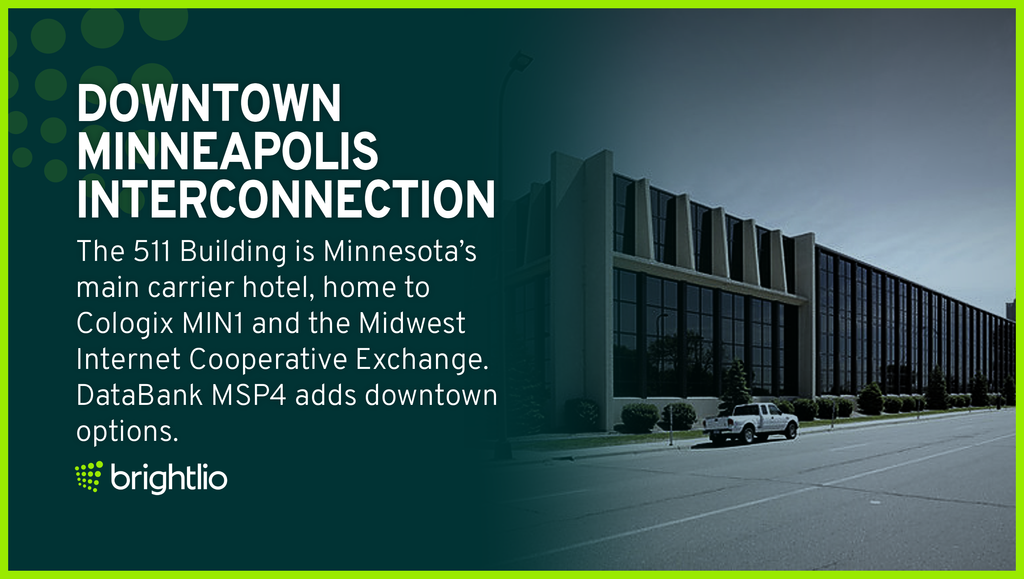
That concentration makes downtown Minneapolis a starting point for buyers needing network interconnection. Cologix's other downtown facilities and DataBank MSP4 provide further options within the city.
Request the carrier list for the exact space under consideration. Cross-connect pricing and access to the exchange need confirmation in the proposal. A downtown address alone does not define the networks available to a tenant.
2. Commercial Options Across The Twin Cities Suburbs
Retail colocation extends beyond downtown Minneapolis. IronGate serves Woodbury, while LightEdge operates in Chaska. US Signal adds an Eden Prairie option.
Eagan has CENTRA and DataBank facilities. Shakopee has Csquare's operating campus, and Brooklyn Park has DataBank MSP3.
This distribution gives enterprise buyers a choice of locations near their staff and equipment service routes. A suburban facility can suit organizations that prioritize hardware access or require a deployment outside the downtown core.
Compare remote-hands response times and replacement-part procedures alongside the monthly rate. Those service terms determine how effectively a local team can support equipment without visiting the facility.
3. Long Cold Seasons Support Free Cooling
Minnesota's cold winters give compatible cooling systems extended opportunities to use outdoor conditions. That can reduce mechanical cooling demand.
The installed system determines the benefit. Air-side economizers use outside air in the cooling process. Water-side economizers use outdoor conditions to cool a facility's water loop.
Request annual cooling energy data and the system's economizer operating limits. Winter protection matters within that review, particularly for exposed piping and outdoor equipment. Climate creates an opportunity that the building's design must convert into usable savings.
4. Wind And Nuclear Contribute To The Generation Mix
Wind supplies 25% of Minnesota's electricity generation, while nuclear contributes 22%, using the overview's 2025 figures. These sources give the state a substantial generation contribution without direct combustion emissions.
That mix is relevant to buyers evaluating the electricity associated with their infrastructure. It does not determine the contractual electricity supply or emissions accounting of an individual facility.
Request the operator's electricity procurement terms and the evidence supporting renewable energy claims. A buyer with carbon commitments needs that information before treating a Minnesota address as sufficient proof of compliance with its targets.
5. Equipment Tax Relief Supports Hardware Investment
Minnesota's data center tax provisions retain exemptions for qualifying IT equipment and software. The exemption period extends to 35 years, giving qualifying facilities a long window for eligible purchases.
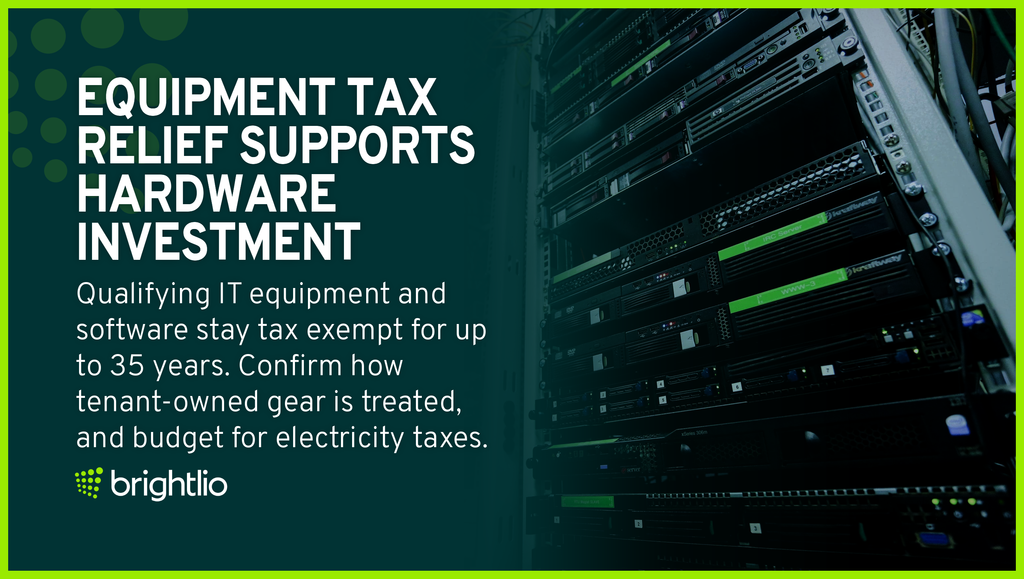
The benefit matters to deployments with recurring server and networking refreshes. Eligibility still depends on the facility and the purchases involved.
Request the facility's certification details and written confirmation of the treatment of tenant-owned equipment. Keep electricity taxes in the operating budget, since the equipment exemption does not extend to electricity.
Key Cities Or Submarkets In Minnesota
Minnesota's retail market centers on downtown Minneapolis and the surrounding Twin Cities suburbs. The largest planned campuses extend the map into outer-metro communities and the Duluth area. The five submarkets below run from the main interconnection hub to locations where future construction carries more weight.
1. Downtown Minneapolis
Downtown Minneapolis is the starting point for buyers prioritizing interconnection. The 511 Building houses the Midwest Internet Cooperative Exchange and colocation operators serving the same carrier-hotel location.
Cologix MIN1 occupies 45,000 sq ft at 511 11th Ave S. That figure describes Cologix's space, without defining the size of the entire building. Buyers need a proposal specifying their leased footprint and access to the required networks.
Cologix MIN4 adds 16,000 sq ft, while Lumen Minneapolis 3 provides 14,200 sq ft. Cologix MIN2, MIN3, and MIN5 broaden the downtown operator's footprint. DataBank MSP4 provides another option inside the downtown market.
T5@Minneapolis appears in the facility profiles below. Other city listings include IronGate Downtown Minneapolis, Aureon, Uniti, and Cogent.
Downtown suits carriers and enterprises that place cross-connect access ahead of proximity to a suburban office. Confirm whether connections remain inside the building or require transport to another address.
2. Southwest And West Twin Cities Suburbs
Chaska, Eden Prairie, Edina, Shakopee, and Minnetonka give buyers commercial options outside downtown. The mix includes freestanding facilities and operating campuses.
LightEdge Minneapolis I offers 75,675 sq ft at 1708 West Creek Ln, Chaska. Its building is designed to withstand 185 mph winds, giving buyers a specific structural criterion to examine during site review. Flexential provides another Chaska option.
US Signal Minneapolis MN01 has 50,000 sq ft at 10290 W 70th St, Eden Prairie. Its Tier III design certification and flywheel power backup warrant review alongside the proposed deployment's redundancy requirements.
Eden Prairie has EdgeConneX EDCMSP01 and Trustwave NOC. Edina contains DataBank MSP1 West Twin Cities and Fidium, while Minnetonka has Lumen facilities and US Internet. Csquare's Shakopee campus is profiled below.
CloudHQ's planned MSP1 campus at 2007 Schoolmaster Dr, Chaska, targets up to 200 MW of critical IT load. That future project needs a separate delivery assessment from the operating retail buildings.
This submarket suits organizations whose technical teams work in the western or southwestern metro. Compare staff access and remote-hands support before assuming a suburban location reduces support costs.
3. Woodbury, St. Paul, And Eagan
The eastern and southeastern metro contains retail buildings alongside Eagan's operating campuses. Woodbury and St. Paul provide the largest supplied retail floor-area figures in this part of the market.
IronGate Twin Cities East offers 85,000 sq ft at 401 Bielenberg Dr, Woodbury. Its purpose-built, carrier-neutral configuration makes it a candidate for enterprises comparing provider access and expansion space. IronGate Twin Cities West adds 30,000 sq ft in Woodbury.
Cogent's St. Paul facility covers 46,025 sq ft at 847 Earl St. It provides 42U cabinets, private cages, and ports up to 100GE, giving buyers defined cabinet and network-service options to evaluate.
CENTRA Minneapolis MSP1 and DataBank MSP2 East Twin Cities operate in Eagan and appear in the facility profiles below. Unisys adds another Eagan listing, while H5 operates in St. Paul.
Connect Eagan is a planned 5 MW project. Its planned capacity cannot substitute for a current offer of usable space.
These locations suit east-metro enterprises and buyers evaluating Eagan's high-density options. Recovery deployments need confirmation that the proposed secondary site uses independent carrier routes and utility infrastructure.
4. Brooklyn Park, Plymouth, And The North Metro
DataBank MSP3 anchors the supplied operating-site list in Brooklyn Park. Its campus location gives northwestern metro buyers an alternative to downtown and the southern suburbs.
Plymouth contains DataBank's 10300 6th Ave listing. ABcom operates in New Brighton, extending the commercial inventory into the northern metro.
US Internet Robbinsdale appears in the planned inventory. No capacity or delivery date is supplied, so it remains a future option requiring confirmation.
This area merits consideration when staff access from the northern metro is a firm requirement. Request available cabinet power and expansion terms before comparing a campus proposal with a smaller commercial listing.
5. Outer-Metro Development And The Duluth Area
The outer-metro pipeline contains Minnesota's largest planned projects. These locations matter primarily to buyers evaluating future campus-scale infrastructure.
Tract's Farmington Technology Park plans 12 buildings and 700+ MW in Dakota County. Meta's Rosemount campus is under construction with 308 MW at full build-out and a target opening in 2026. Meta's private campus provides no public colocation access.
Scannell Technology Park in Monticello targets 150 MW within a 1.3 million sq ft development, with delivery aimed at 2027. Faribault's planned Archer Minneapolis Campus adds 120 MW to the supplied project list.
Hermantown's proposed 600 MW campus near Duluth is linked to Google, Harmony Group, and Mortenson. Ark Data Centers Duluth provides an existing colocation listing in the northern market, with no size or capacity supplied.
These projects expand the geographic search for large deployments. Buyers needing cabinets on a fixed near-term schedule have a clearer starting point in existing Twin Cities facilities.
Notable Colocation Providers And Facilities In Minnesota
Minnesota's largest operating sites include suburban campuses and a downtown facility with configurable space and power. Their suitability depends on the deployment's electrical requirements and service needs. The five profiles below follow the tracker order.
1. Csquare Minneapolis MSP1 Data Center Campus
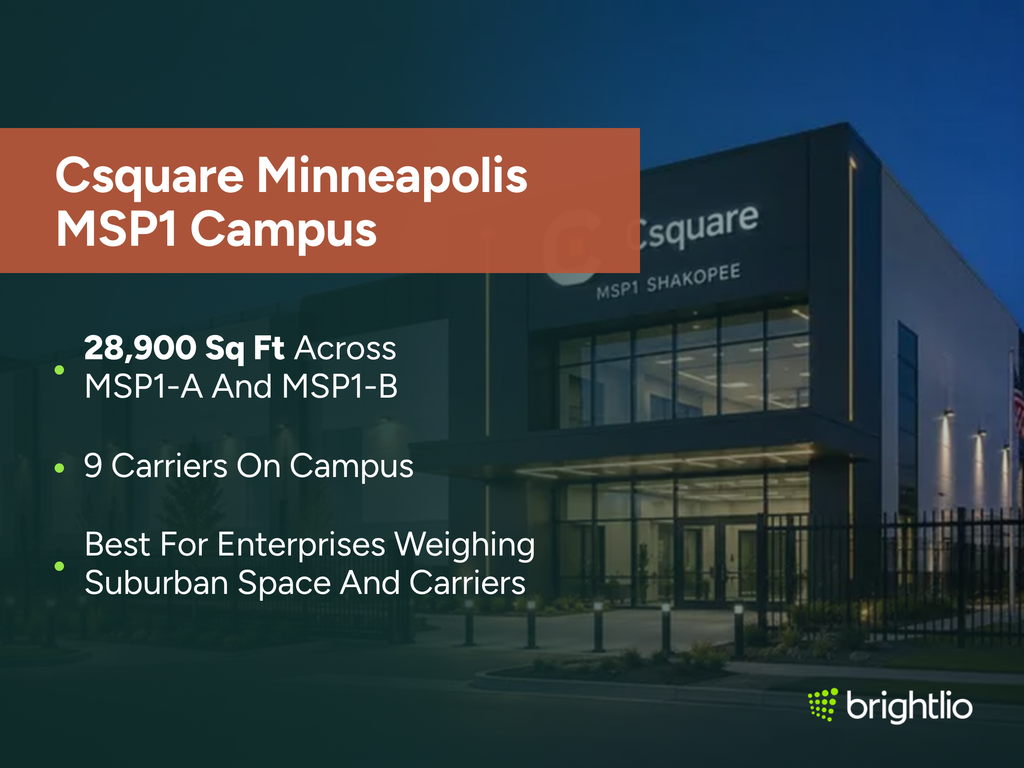
Csquare operates a 28,900 sq ft campus at 4450 Dean Lakes Blvd, Shakopee. The campus comprises MSP1-A and MSP1-B.
Its 9 carriers give buyers a defined network inventory to examine. Confirm which carriers reach the proposed tenant space and whether connections require transport between buildings.
Csquare Minneapolis MSP1 is best suited for enterprises comparing suburban campus space with carrier access. Request available tenant power and expansion terms separately from the campus's utility supply.
2. CENTRA Minneapolis MSP1 Eagan Data Center
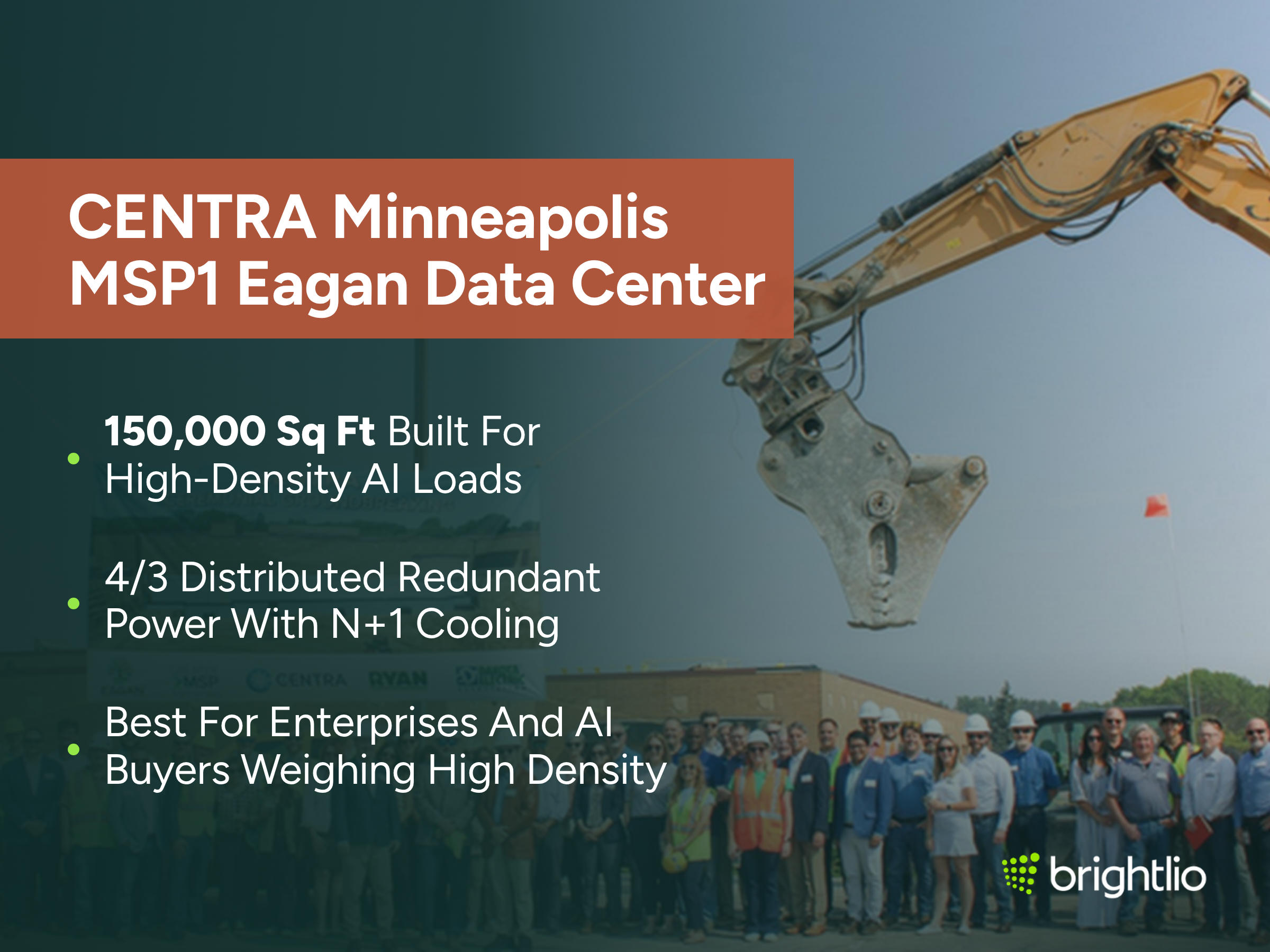
CENTRA operates a 150,000 sq ft facility at 3640 Nasseff Way, Eagan. The operator describes the facility as Tier III+ and built for high-density AI loads.
Its electrical configuration uses 4/3 distributed redundant power, with N+1 cooling. Those specifications give buyers a starting point for reviewing maintenance conditions and equipment failure scenarios.
CENTRA Minneapolis MSP1 is best suited for enterprises and AI buyers evaluating high-density deployments. Confirm the supported cabinet load and cooling method for the proposed servers before accepting a technical proposal.
3. DataBank MSP3 Brooklyn Park Data Center
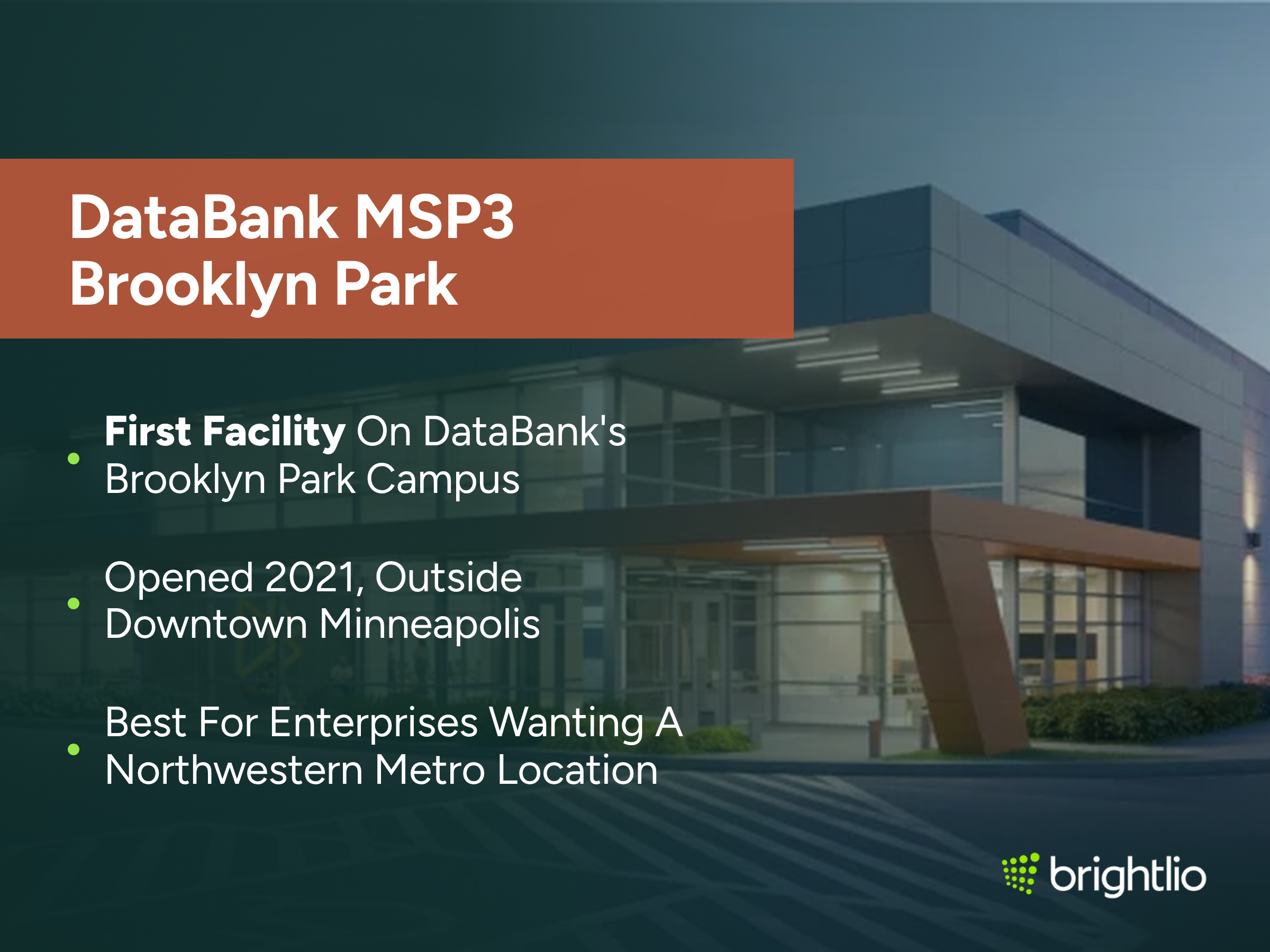
DataBank MSP3 operates at 8111 Oxbow Creek Dr N, Brooklyn Park. It opened in 2021 as the first facility on DataBank's Brooklyn Park campus, with no total capacity published.
The campus location gives northwestern metro buyers an operating option outside downtown Minneapolis. Expansion remains a contractual question until DataBank specifies the space and power it can deliver.
DataBank MSP3 is best suited for enterprises seeking a northwestern Twin Cities location. Compare the initial deployment allocation with the capacity reserved for future growth.
4. DataBank MSP2 East Twin Cities Data Center
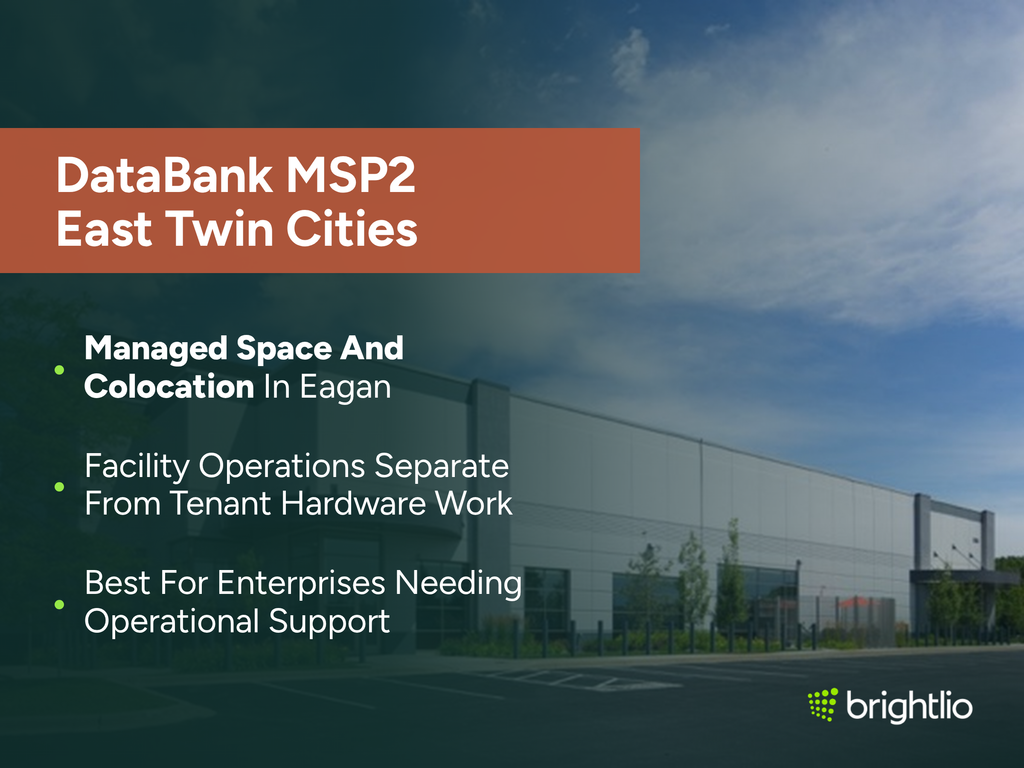
DataBank MSP2 provides enterprise-class managed space and colocation at 3255 Neil Armstrong Blvd, Eagan. Total capacity is not published.
The combination of managed space and colocation makes the service boundary important. A proposal needs to distinguish facility operations from work performed on the tenant's hardware.
DataBank MSP2 is best suited for enterprises evaluating an Eagan deployment with operational support. Confirm the remote-hands scope and escalation process alongside the leased footprint.
5. T5 Minneapolis Data Center
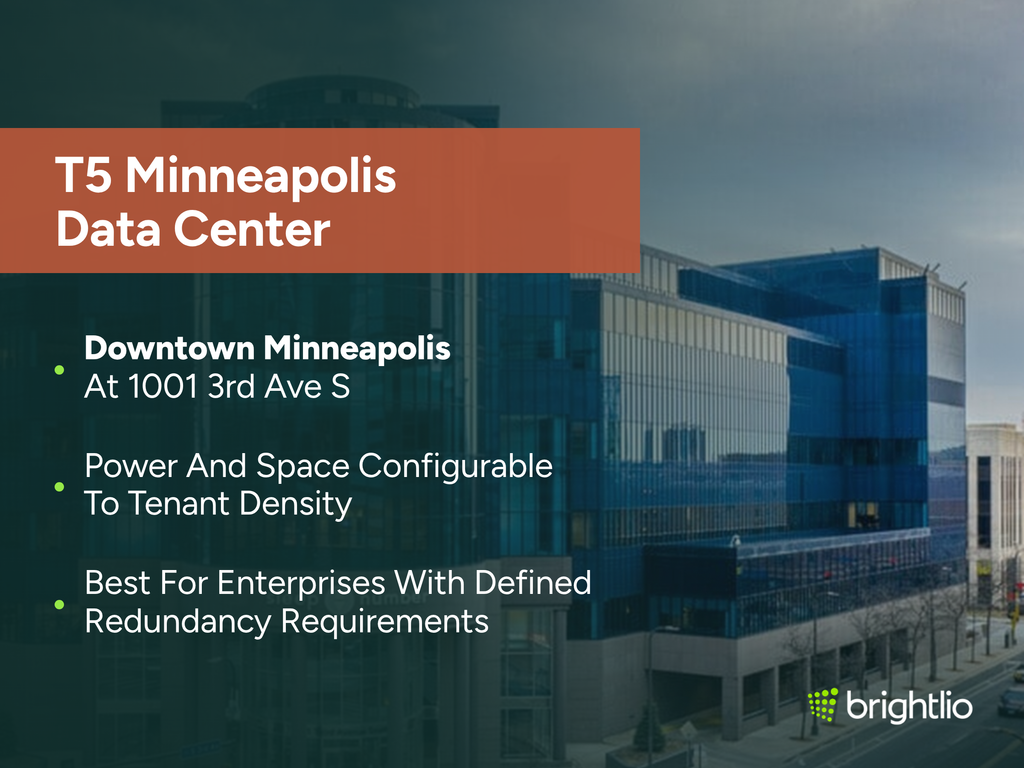
T5@Minneapolis operates at 1001 3rd Ave S, Minneapolis. The downtown facility offers power and space configurable to tenant density and redundancy requirements, with no total capacity published.
That configuration gives buyers a basis for discussing deployment-specific electrical arrangements. The proposal needs to specify the power available during maintenance and the cooling capacity supporting the agreed load.
T5 Minneapolis is best suited for enterprises needing a downtown location with defined density or redundancy requirements. Review the proposed configuration and commissioning criteria before committing equipment.
Recent Developments In Minnesota (Last 12 To 24 Months)
Recent activity combines project review, local litigation, and changes to operating costs.
- September 2026: Farmington acknowledged dismissal filings from plaintiffs in 2 legal matters involving the city's technology park, with final court directions still pending in the municipal project update. Buyers need the final court disposition before treating those disputes as closed.
- June 2026: Hermantown opened another public comment period for Google's proposed campus, with an environmental study area covering 26 parcels in the city's review notice. Environmental review remains a separate milestone from confirmed utility service and construction delivery.
- March 2026: Google disclosed its involvement in Hermantown's planned $1.2 billion data center project. A named prospective user gives buyers clearer project context without changing its planned status.
- July 2025: Minnesota's electricity sales tax exemption ended for qualifying data center purchases from July 1, as set out in the Department of Revenue's legislative bulletin. Operating budgets need to include electricity tax despite the continuing equipment exemption.
- June 2025: Minnesota enacted annual fees ranging from $2 million to $5 million for qualified large-scale data centers within the peak-demand bands in its data center regulatory law. Campus-scale financial models need to account for these charges alongside utility service costs.
Drawbacks And Considerations For Colocation In Minnesota
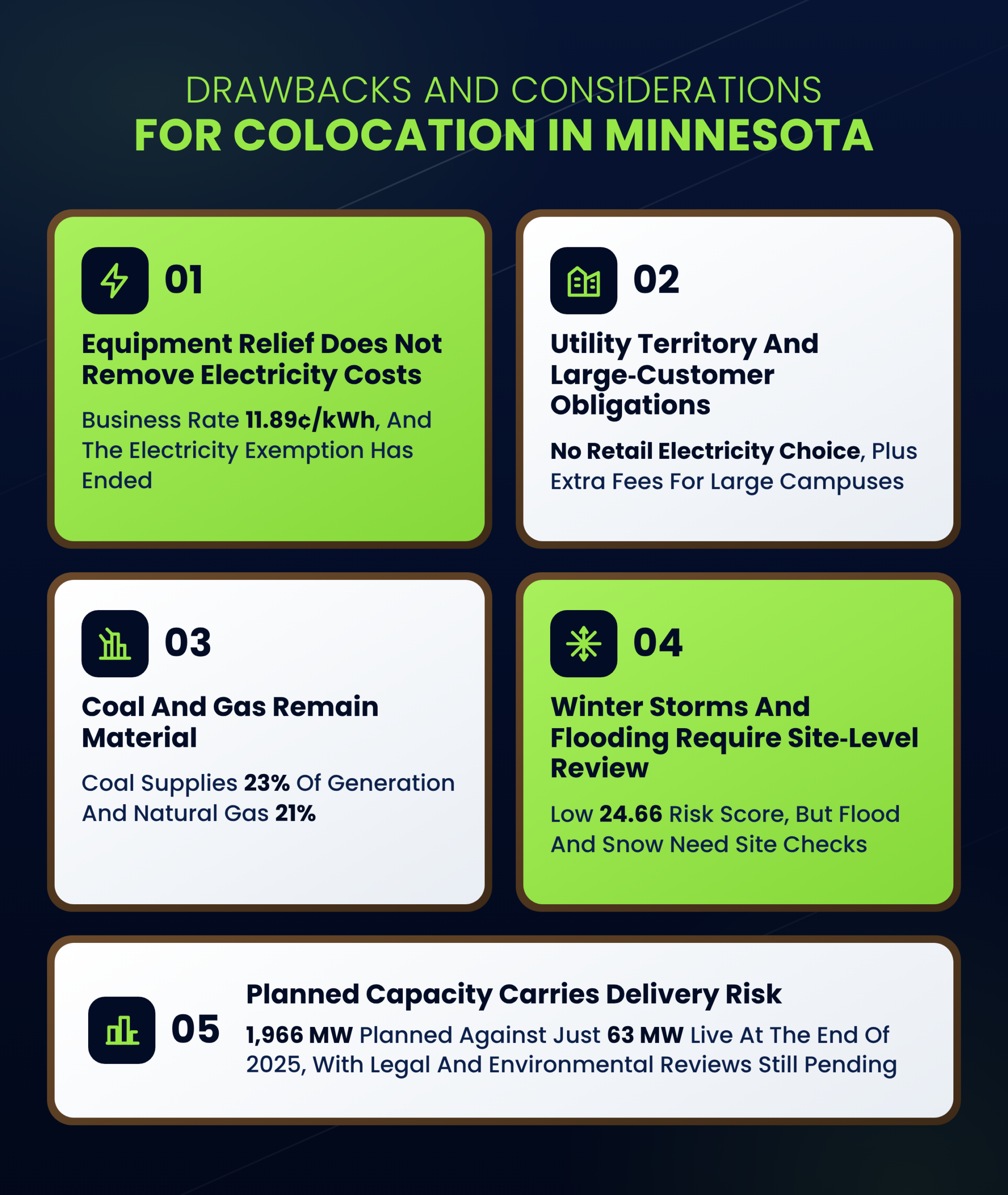
Minnesota's existing retail facilities provide practical options, but tax treatment and delivery conditions affect the buying decision. The five considerations below cover electricity costs, utility obligations, fossil generation, physical exposure, and planned capacity.
1. Equipment Relief Does Not Remove Electricity Costs
Minnesota's business electricity rate was 11.89¢/kWh in November 2025, while industrial users paid 9.30¢/kWh. These are different customer-class averages, so the industrial figure cannot be assumed in a retail colocation budget.
The electricity exemption has ended. Equipment tax relief therefore provides an incomplete picture of recurring operating costs.
Request the applicable utility tariff and the operator's electricity billing formula. Compare demand charges, taxes, and minimum commitments within the same proposal. A statewide energy average cannot substitute for that calculation.
2. Utility Territory And Large-Customer Obligations
Xcel Energy, Minnesota Power, and Otter Tail operate within MISO, and Minnesota offers no retail electricity choice. Selecting a facility fixes the serving utility as part of the location decision.
Qualifying large campuses face additional regulatory obligations and annual fees. A cabinet tenant's exposure depends on the provider's contract and any provisions allowing those costs to pass through.
Review utility adjustment clauses and the charges attached to expansion. A proposal needs to explain which costs are fixed and which can change during the term.
3. Coal And Gas Remain Material
Coal supplies 23% of Minnesota's generation, while natural gas contributes 21%. The state's wind and nuclear contribution does not eliminate fossil generation from the electricity mix.
A facility's renewable electricity claim requires its own evidence. Request the contractual instruments and accounting period supporting the claim.
Buyers with carbon targets need to distinguish state generation shares from the electricity procurement supporting their deployment. The facility address alone cannot demonstrate that a tenant meets its target.
4. Winter Storms And Flooding Require Site-Level Review
Minnesota's FEMA National Risk Index score is a low 24.66 in the overview. That statewide result does not determine flood exposure or winter access at an individual building.
Snow can obstruct staff access and equipment deliveries. Exposed water systems need protection against freezing, while generator fuel arrangements need workable delivery routes during severe weather.
Flood review needs the building's floodplain determination and the height of critical electrical equipment above the relevant flood level. A recovery site needs an access plan that remains usable during the same conditions that disrupt the primary location.
5. Planned Capacity Carries Delivery Risk
The tracker shows 1,966 MW of planned capacity against 63 MW of live capacity at the end of 2025. The figures describe different stages of development, so the pipeline cannot be treated as an inventory of immediately usable power.
Farmington's legal proceedings and Hermantown's environmental review show why local process belongs in the delivery assessment. A planned campus needs permissions and utility commitments before it can support a tenant's schedule.
Require a construction programme and a utility-backed power delivery date for space that depends on development. The contract needs remedies for late delivery and a clear allocation of commissioning responsibilities.
How Brightlio Can Help With Colocation In Minnesota
Brightlio compares facilities across Minneapolis, St. Paul, Shakopee, Eagan, Brooklyn Park, Woodbury, Chaska, and Eden Prairie. We evaluate available power and cooling against your hardware requirements. Carrier access and expansion terms form part of that comparison.
Our team reviews options from providers such as DataBank, Cologix, IronGate, US Signal, Csquare, and CENTRA. For Minnesota deployments, we check utility pricing provisions and electricity tax treatment. We examine winter access and site-specific flood exposure.
We support cabinet, cage, private-suite, high-density, and multi-site recovery deployments. Quotes are free to clients. Contact Brightlio to compare Minnesota colocation solutions against your requirements and delivery schedule.
Frequently Asked Questions
1. Which U.S. State Has The Most Data Centers?
Virginia has the most data centers in the United States. Northern Virginia contains the country's leading concentration of facilities. Directory totals vary with the treatment of individual buildings and multi-building campuses.
2. How Many Data Centers Are In Minnesota?
The Minnesota tracker contains 49 facilities across 28 operators. Its categories comprise 5 operational, 12 planned, and 32 colocation facilities. Data Center Map counts 81 buildings across 13 markets, using a different counting method.
3. What Is The Largest Data Center In Minnesota?
Csquare's Minneapolis MSP1 campus in Shakopee leads the operating-site list, with 19.1 MW of utility power. CENTRA Minneapolis MSP1 in Eagan follows with 10+ MW of power capacity. Available tenant power needs confirmation separately from these facility figures.
4. Who Is Building Data Centers In Minnesota?
Tract, Meta, CloudHQ, Scannell Properties, and Archer appear in Minnesota's development pipeline, alongside the Hermantown project linked to Google. Meta's Rosemount campus is under construction, while the other major projects retain their planned status in the overview. Their presence does not confirm space available to an enterprise tenant.
5. Are Minnesota Electricity Costs Favorable For Colocation?
The statewide rate alone does not prove a colocation cost advantage. Minnesota's business electricity rate was 11.89¢/kWh in November 2025. Compare current facility quotes with electricity tax, demand charges, and minimum power commitments included.
Qualifying Minnesota data centers can receive sales tax exemptions on eligible IT equipment and software for 35 years. Facility qualification and purchase eligibility govern the benefit. Request the certification details and written confirmation covering tenant-owned equipment before including savings in a budget.
Minneapolis and its surrounding Twin Cities suburbs are the main starting points for commercial colocation. Downtown Minneapolis suits buyers prioritizing carrier-hotel access, while Shakopee, Eagan, Woodbury, Chaska, and Eden Prairie provide suburban options. Brooklyn Park merits consideration for organizations requiring a northwestern metro location.
Yes. CENTRA Minneapolis MSP1 is built for high-density AI loads, while T5@Minneapolis offers configurations based on tenant density and redundancy requirements. Confirm rack power and the cooling method for the exact server configuration before accepting a proposal.
No. The electricity exemption ended in July 2025. Eligible equipment and software retain their separate exemption. Colocation tenants need to check how electricity taxes appear in the provider's billing formula.
Organizations without a local hardware, network, or facility requirement may gain little from choosing Minnesota specifically. Buyers prioritizing electricity cost need matching-period comparisons with competing markets. Workloads that fit public cloud services can compare that option before committing to physical colocation space.
Keep reading with our colocation guides for these nearby markets:

Tamzid is a cybersecurity researcher with 5+ years of experience across SaaS, security, compliance, data centers and cloud. He writes for brightdefense.com and hipaasimple.com, covering security, compliance, and infrastructure topics. Certified through Cisco, Fortinet (NSE 1), and the Basel Institute on Governance in OSINT, he grounds his work in primary sources and verified data.
Recent Posts

Data Centers and Colocation In Minnesota

Data Centers and Colocation In Missouri
Data Centers and Colocation In New Mexico

Data Centers and Colocation In Washington
Let's start
a new project together