
Nuclear-powered data centers use electricity from nuclear generation to support servers, networking, cooling, and other facility systems. That electricity can reach the data center through the grid or through a dedicated connection near a power plant.
The appeal is straightforward: computing facilities need substantial power throughout the day, and nuclear plants can generate electricity through the night and during periods of low wind or sunlight. Technology companies are pursuing agreements that support existing plants, restart retired reactors, and help develop new nuclear capacity.
For your business, the important questions are how the electricity reaches the facility, when it becomes available, and what the agreement actually guarantees. Read on to explore the operating models, project examples, benefits, and challenges behind nuclear-powered data centers.
What Is a Nuclear Powered Data Center?
A nuclear-powered data center is a computing facility whose electricity supply or energy procurement includes nuclear generation. The operator may buy nuclear energy without owning a reactor or locating one beside the server building.
A facility connected to a regional grid receives electricity from the generation serving that network. A separate agreement may allocate nuclear output or its environmental attributes to the customer.
This distinction matters when you compare providers. A claim about nuclear procurement should explain the plant involved, contracted quantity, delivery period, and treatment of outages. Your business still needs to assess the data center’s electrical redundancy, cooling, connectivity, and service commitments.
How Can Nuclear Power Supply a Data Center
Developers can connect nuclear generation and computing demand in several ways. The model affects who owns the assets, how electricity is delivered, and which risks the customer takes on.
The following are the three common approaches:
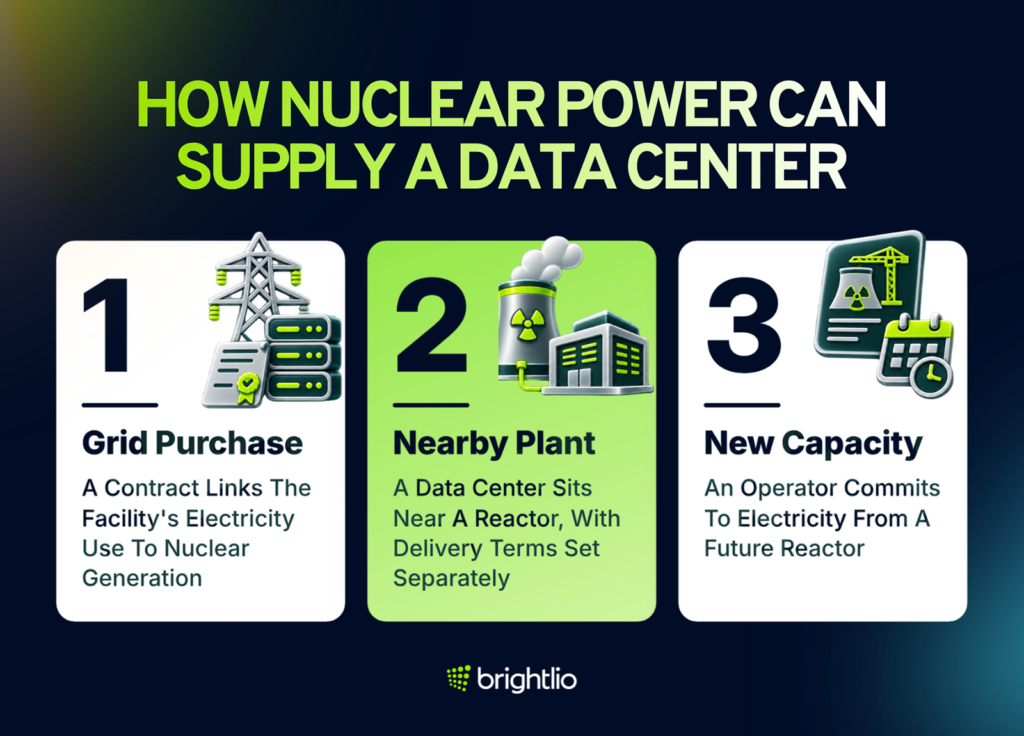
1. Purchase Nuclear Energy Through the Grid
A company can enter a power purchase agreement, or PPA, associated with a nuclear plant. Depending on the structure, the arrangement may provide electricity, financial settlement, environmental attributes, or a combination of these.
The data center can remain connected to its local utility. It does not need to sit next to the reactor, and the contract does not make the facility electrically independent of the grid. Buyers should distinguish annual energy matching from matching consumption and generation in each hour.
2. Locate Computing Near a Nuclear Plant
A campus can be developed beside a nuclear facility, with a connection designed around the generation source. This can create opportunities to coordinate infrastructure and electricity supply.
Physical proximity does not establish the final delivery arrangement. A nearby data center may still receive utility service through the grid. The project must define metering, transmission responsibilities, backup supply, and the rules governing its connection.
3. Develop New Nuclear Capacity for Future Demand
An operator can support a new reactor through a purchase commitment, investment, or development partnership. Some proposals involve small modular reactors, or SMRs, intended to serve a utility network or industrial campus.
This approach can support long-term expansion, but the computing schedule must account for nuclear development milestones. An agreement to purchase future electricity is different from an operating plant with capacity ready to deliver.
How Do Nuclear Powered Data Centers Work
Nuclear generation changes the source of electricity, while the data center still needs conventional power distribution and cooling systems. Reliable service depends on the complete path from generation to the equipment running your applications.
The following are the four main functions:
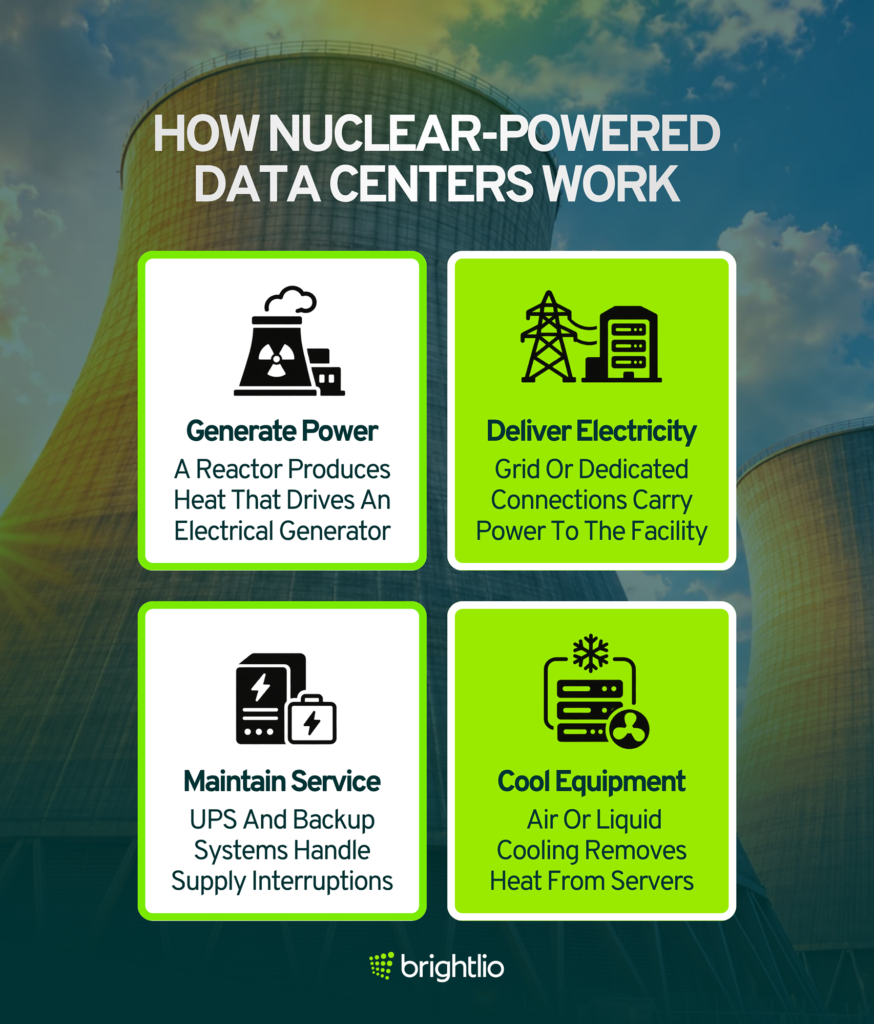
1. Generate Electricity Through Nuclear Fission
A reactor produces heat through controlled nuclear fission, the splitting of atomic nuclei. In conventional nuclear power plants, that heat produces steam, which drives a turbine connected to an electrical generator.
Reactor designs use different fuels, coolants, and system arrangements. When reviewing a power rating, distinguish thermal output, the heat produced by the reactor, from electrical output available to the network.
2. Deliver Power to the Facility
Transformers, switchgear, transmission or distribution lines, and utility connections carry electricity toward the data center. The delivery route depends on whether the facility uses a grid connection or a dedicated arrangement.
The data center needs sufficient capacity across the complete delivery route, available when its customers require it.
3. Distribute Power and Manage Interruptions
Within the facility, electrical systems distribute power to racks, network equipment, and cooling infrastructure. Uninterruptible power supplies bridge short interruptions, while the site’s wider backup design addresses longer disruptions.
Nuclear plants need maintenance and refueling, and unplanned shutdowns can occur. The provider must explain what supplies the facility during those events and how the transition is tested. Reactor output alone is not an uptime guarantee.
4. Remove Heat From the Computing Equipment
Servers produce heat regardless of how their electricity is generated. Air cooling, direct-to-chip liquid cooling, or other thermal systems must remove it at the required rack density.
The power plant also has its own heat rejection requirements. A nuclear supply agreement does not eliminate either cooling obligation. Water availability, water temperature, and the selected cooling technologies can influence the suitability of both sites.
Notable Nuclear Power Projects For Data Centers
Nuclear power projects supporting data centers include agreements with operating plants, reactor restarts, and proposed new facilities. The following table compares 10 projects and their announced capacity and delivery milestones.
| No. | Project | Supply Model And Capacity | Operating Or Delivery Status |
| 1 | Amazon And Talen At Susquehanna | The agreement covers up to 1,920 MW from an existing plant. | The plant operates today; full contracted deliveries are expected by 2032. |
| 2 | Meta And Constellation At Clinton | The agreement covers 1,121 MW, including a planned 30 MW uprate. | The plant operates today; the agreement begins in 2027. |
| 3 | Microsoft And Constellation At Crane | A reactor restart would restore approximately 835 MW. | The restart is targeted for 2027. |
| 4 | Google, Kairos Power, And TVA At Hermes 2 | A new advanced reactor project targets 50 MW. | Groundbreaking occurred in April 2026; operations are targeted for 2030. |
| 5 | Amazon, Energy Northwest, And X-energy At Cascade | The proposed facility starts at 320 MW, with expansion to 960 MW. | Operations are targeted for the 2030s. |
| 6 | Meta And Vistra At Three Nuclear Plants | Agreements cover 2,609 MW of existing generation and planned uprates. | Purchases begin in late 2026; full capacity is expected by 2034. |
| 7 | Meta And Oklo In Pike County | A proposed advanced nuclear campus targets 1.2 GW. | Initial operations are targeted for 2030, with full development by 2034. |
| 8 | Meta And TerraPower’s Natrium Program | Two initial reactors would provide 690 MW, with potential expansion to approximately 2.8 GW. | Initial delivery is targeted as early as 2032. |
| 9 | Google And Elementl Power | Three potential sites target at least 600 MW each. | The program remains in early development; delivery dates are unannounced. |
| 10 | Amazon, X-energy, And AEP In Indiana | A proposed 12-reactor facility would provide 960 MW. | The project remains exploratory; an operating date is unannounced. |
The capacity figures describe electricity generation or contracted supply. They do not represent the IT load of individual data centers. The following 10 project profiles explain the supply arrangements, development stages, and delivery targets.
1. Amazon And Talen At Susquehanna
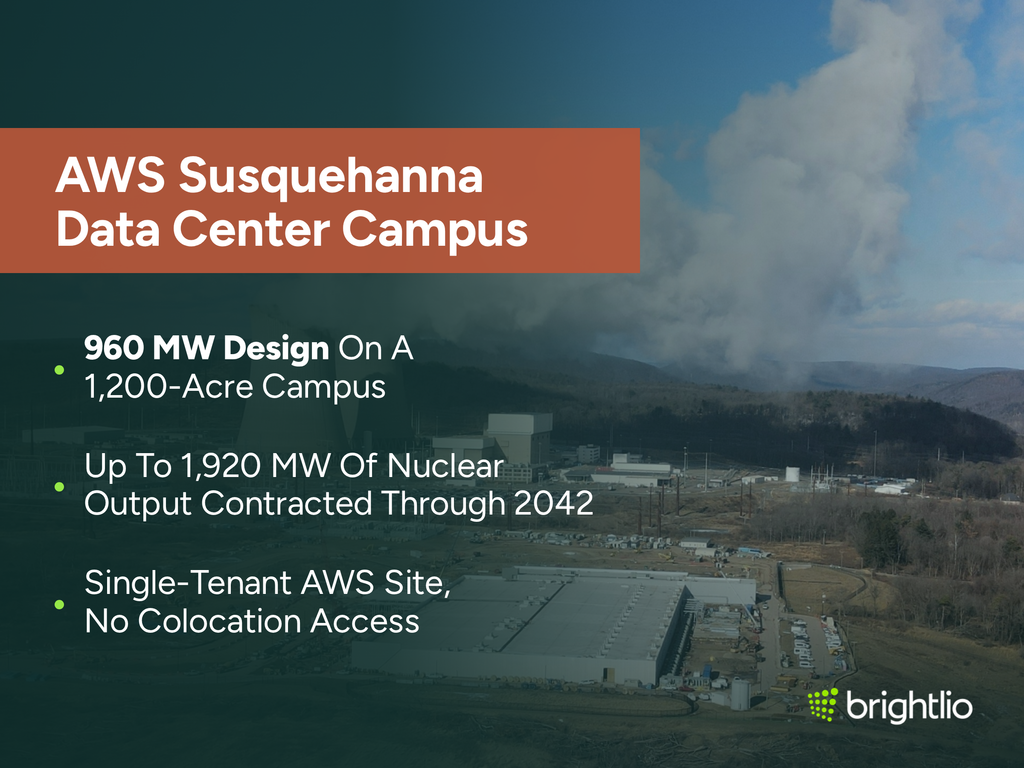
Amazon’s agreement with Talen secures nuclear electricity from the operating Susquehanna plant in Pennsylvania. The expanded arrangement covers 1,920 MW at full contract volume through 2042, with extension options. Deliveries increase over time and are expected to reach the full quantity no later than 2032.
The agreement supports the AWS campus adjacent to Susquehanna and can supply other Amazon sites in Pennsylvania. Talen describes a transition toward grid-based delivery, with completion expected in spring 2027. This structure connects the supply arrangement to the regional electricity network.
Susquehanna provides an example of an existing nuclear plant supporting growing data center demand through a long-term commercial agreement. Its contracted volume represents electricity supply across the arrangement and should remain separate from the computing capacity of the neighboring AWS campus.
Key Features And Project Details
- Location: Susquehanna is an operating nuclear plant in Pennsylvania.
- Contracted supply: The agreement reaches 1,920 MW at full volume.
- Contract term: Electricity purchases extend through 2042, with extension options.
- Delivery schedule: Full contracted deliveries are expected no later than 2032.
2. Meta And Constellation At Clinton
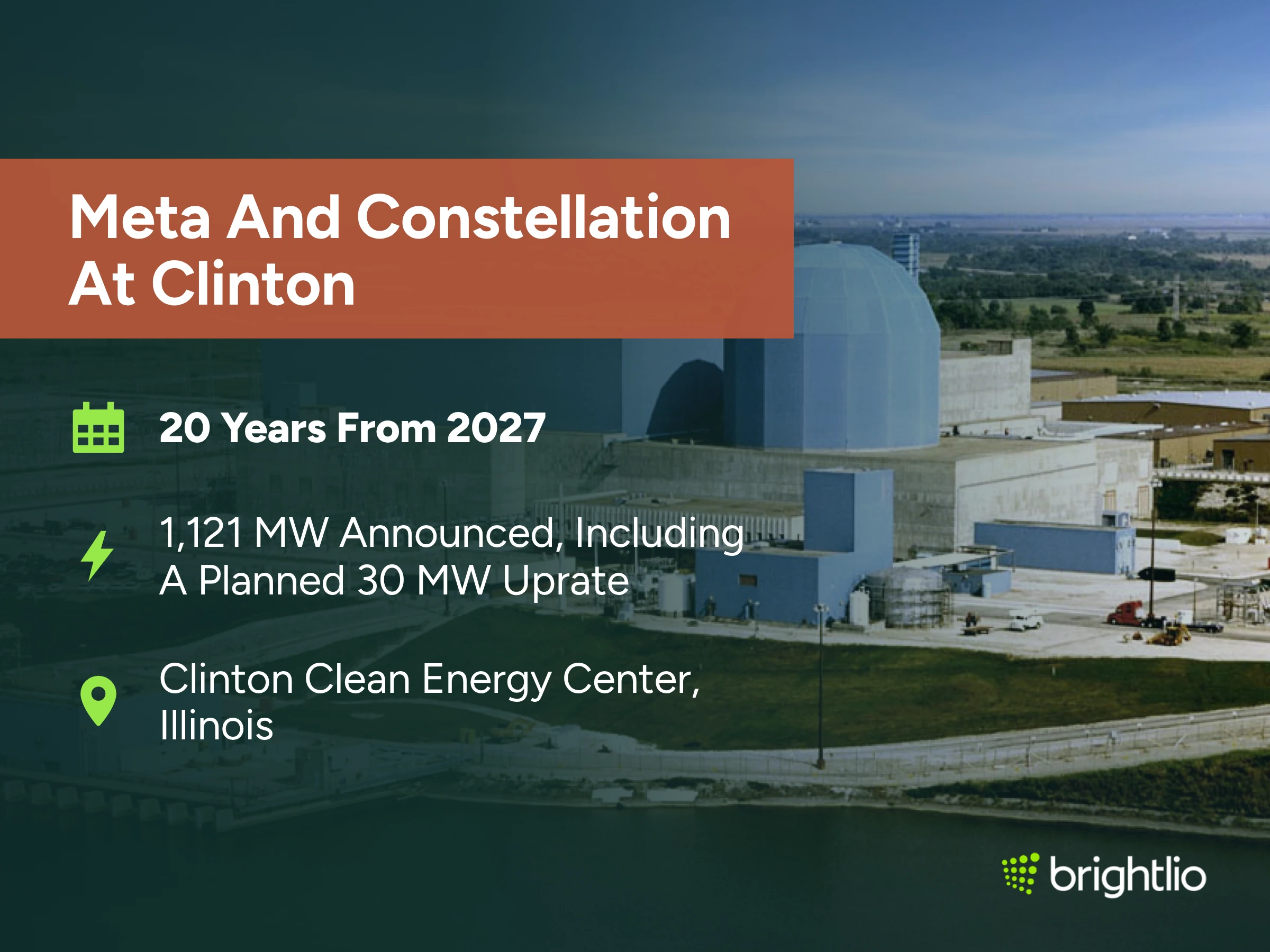
Meta’s agreement with Constellation supports continued operation of the Clinton Clean Energy Center in Illinois. The 20-year agreement begins in 2027 and covers an announced 1,121 MW, including a planned 30 MW increase in generating output.
Clinton already produces electricity, so the agreement combines support for existing generation with a smaller addition of new capacity. Increasing the output of an existing reactor is known as an uprate. The planned 30 MW uprate accounts for the additional generation associated with this arrangement.
The project illustrates how data center electricity demand can support investment in an operating nuclear facility. Its significance includes continued generation and additional output without requiring an entirely new nuclear plant.
Key Features And Project Details
- Location: Clinton Clean Energy Center is in Illinois.
- Agreement duration: The arrangement runs for 20 years from 2027.
- Announced capacity: The agreement covers 1,121 MW, including the planned uprate.
- Additional generation: The proposed uprate would add 30 MW to the plant’s output.
3. Microsoft And Constellation At Crane
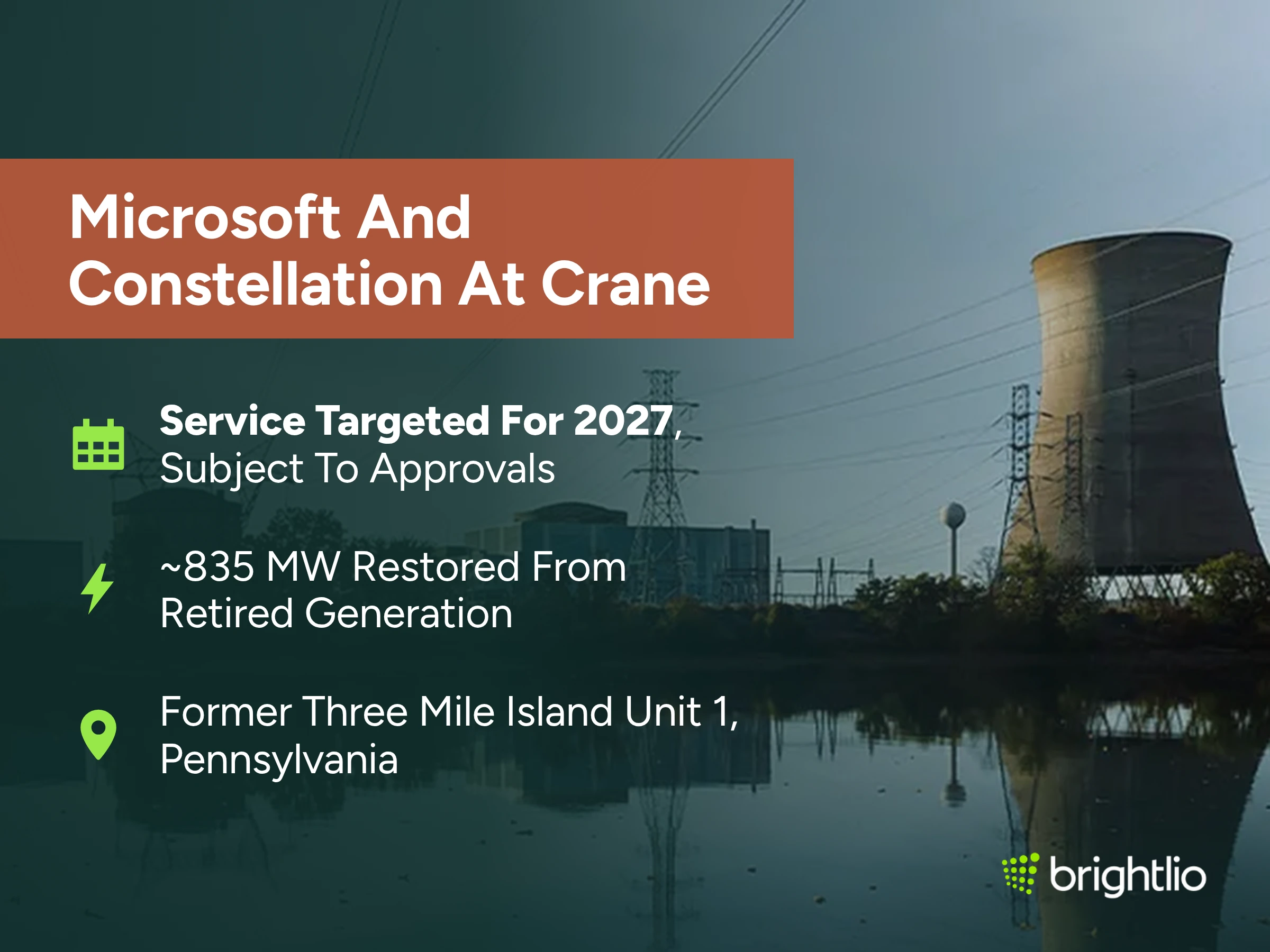
Microsoft’s long-term electricity agreement with Constellation supports the planned restart of the Crane Clean Energy Center in Pennsylvania. The project would return approximately 835 MW of generating capacity to the grid, with service targeted for 2027.
Crane is the former Three Mile Island Unit 1, which retired for economic reasons in 2019. It is separate from Three Mile Island Unit 2, the reactor involved in the 1979 accident. The restart concerns the previously operating Unit 1 facility.
The development requires remaining approvals and restart work before electricity generation can resume. Its capacity should therefore be classified as a planned return of retired generation. The 2027 date remains a target until the plant completes the work required to return to service.
Key Features And Project Details
- Location: The project is at the former Three Mile Island Unit 1 site in Pennsylvania.
- Planned output: The restart would restore approximately 835 MW.
- Commercial support: Microsoft’s long-term agreement supports the project.
- Delivery target: Constellation targets a return to service in 2027, subject to remaining requirements.
4. Google, Kairos Power, And TVA At Hermes 2
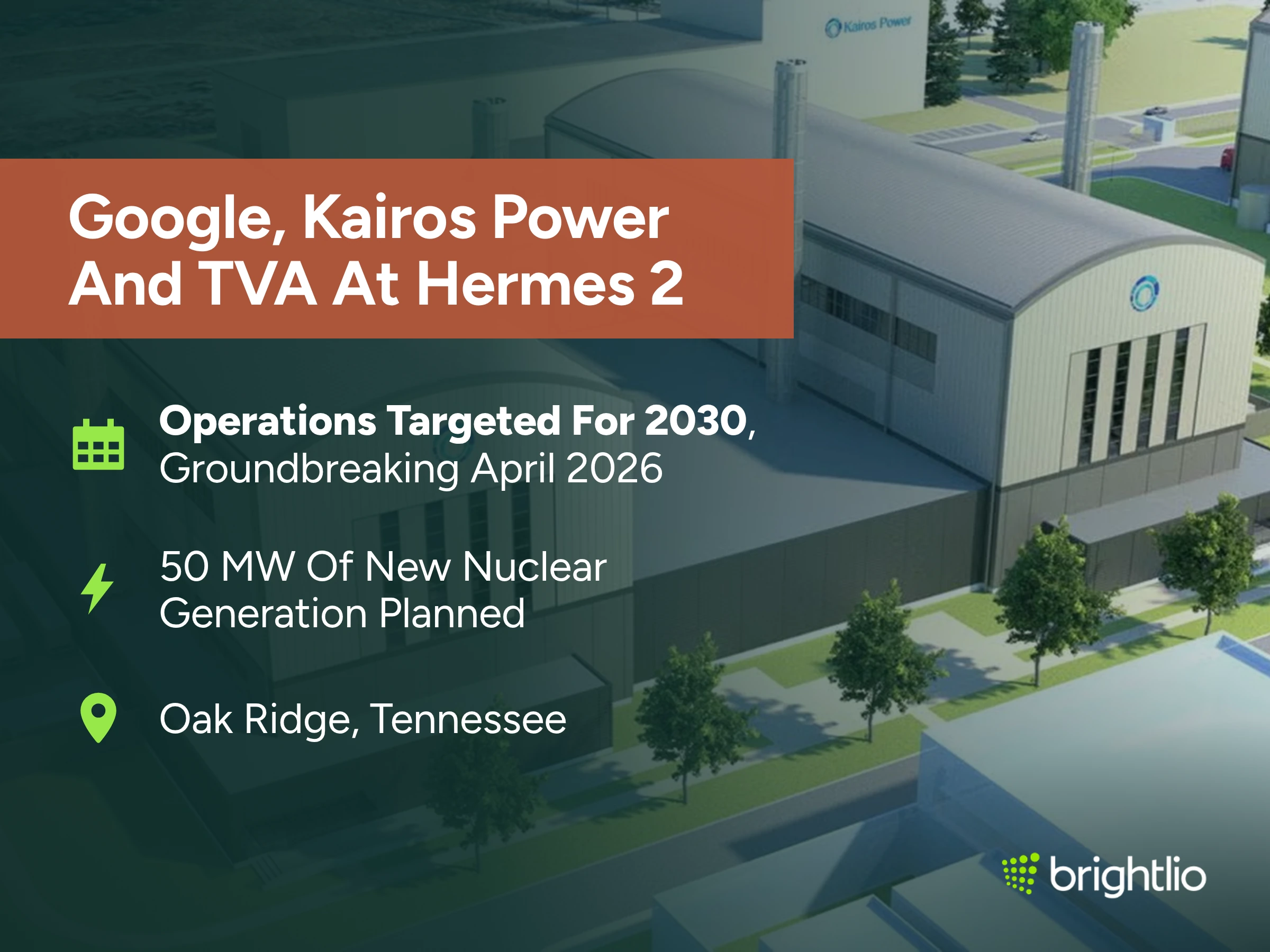
Google’s collaboration with Kairos Power supports the Hermes 2 advanced nuclear project in Tennessee. The development targets 50 MW of generating capacity, with operations scheduled for 2030. Kairos Power broke ground on the project in April 2026.
The Tennessee Valley Authority, or TVA, will purchase the electricity. Google will procure clean energy attributes through TVA to support its regional data centers. These attributes represent the environmental characteristics associated with the electricity generated.
Hermes 2 follows a utility-connected supply model. Electricity enters the TVA system, and Google’s participation supports new nuclear generation serving the region. The construction milestone marks progress toward delivery, but the announced capacity remains future supply until the facility begins operating.
Key Features And Project Details
- Location: Hermes 2 is being developed in Tennessee.
- Planned capacity: The project targets 50 MW of new nuclear generation.
- Supply arrangement: TVA will purchase the electricity, and Google will procure clean energy attributes.
- Project schedule: Groundbreaking occurred in April 2026, with operations targeted for 2030.
5. Amazon, Energy Northwest, And X-energy At Cascade
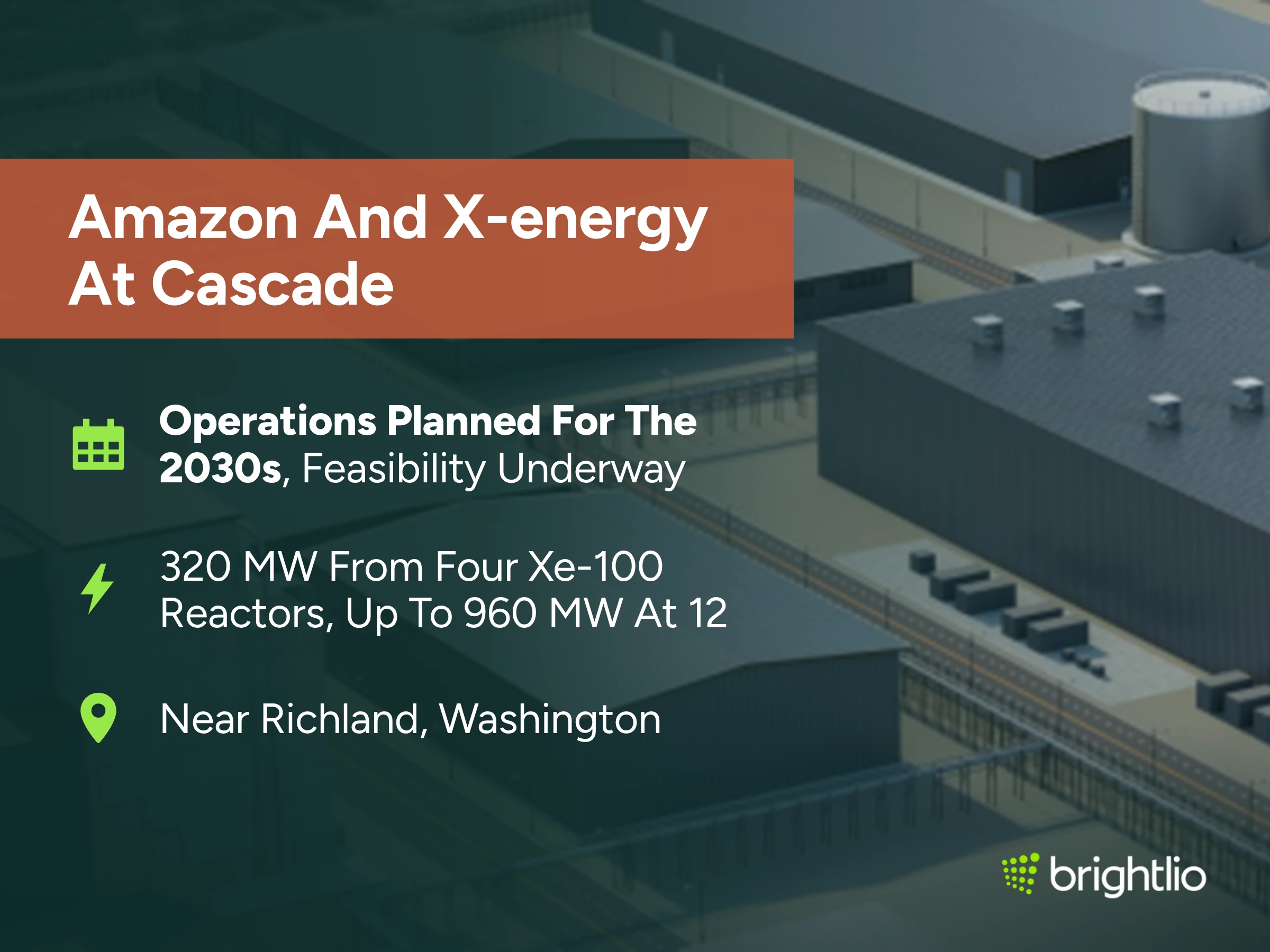
Amazon is supporting the proposed Cascade Advanced Energy Facility near Richland, Washington, with Energy Northwest and reactor developer X-energy. The initial phase would use four Xe-100 small modular reactors to generate 320 MW. Expansion to 12 reactors could increase total output to 960 MW.
The planned site is near the operating Columbia Generating Station. Cascade would supply Amazon and regional utilities, with public power utilities potentially purchasing up to half of the fully expanded project’s output.
The development combines a large corporate electricity customer with potential regional utility participation. Feasibility work is underway, and Amazon targets operations in the 2030s. Both the initial and expanded capacity figures remain development targets subject to licensing and project execution.
Key Features And Project Details
- Location: The proposed facility is near Richland, Washington.
- Initial development: Four Xe-100 reactors would provide 320 MW.
- Expansion potential: A 12-reactor facility could provide 960 MW.
- Potential customers: Amazon and regional utilities would purchase the electricity.
- Delivery target: Operations are planned for the 2030s.
6. Meta And Vistra At Perry, Davis-Besse, And Beaver Valley
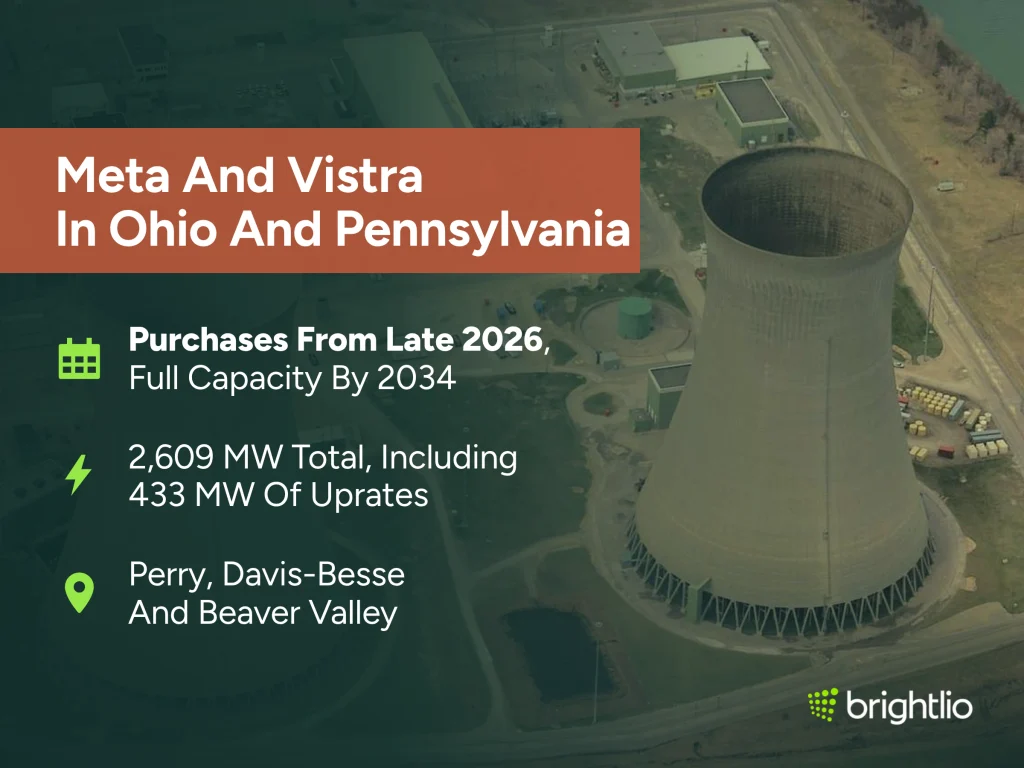
Meta’s 20-year agreements with Vistra cover 2,609 MW of existing and planned nuclear capacity across plants in Ohio and Pennsylvania. The arrangements include 2,176 MW from the operating Perry and Davis-Besse plants, plus 433 MW of planned output increases across those facilities and Beaver Valley.
The agreements combine purchases from existing reactors with uprates that would add generating capacity. Electricity will continue entering the PJM regional grid, supporting Meta’s operations and other electricity users connected to that system.
Purchases are scheduled to begin in late 2026, with the full contracted capacity expected online by 2034. The difference between these dates reflects the phased addition of capacity. The full 2,609 MW should therefore remain separate from the smaller amount of new generation created through the uprates.
Key Features And Project Details
- Facilities: The agreements involve Perry, Davis-Besse, and Beaver Valley.
- Existing generation: Purchases cover 2,176 MW from Perry and Davis-Besse.
- Additional capacity: Planned uprates across the three facilities total 433 MW.
- Delivery schedule: Purchases begin in late 2026, with full contracted capacity expected by 2034.
7. Meta And Oklo In Pike County
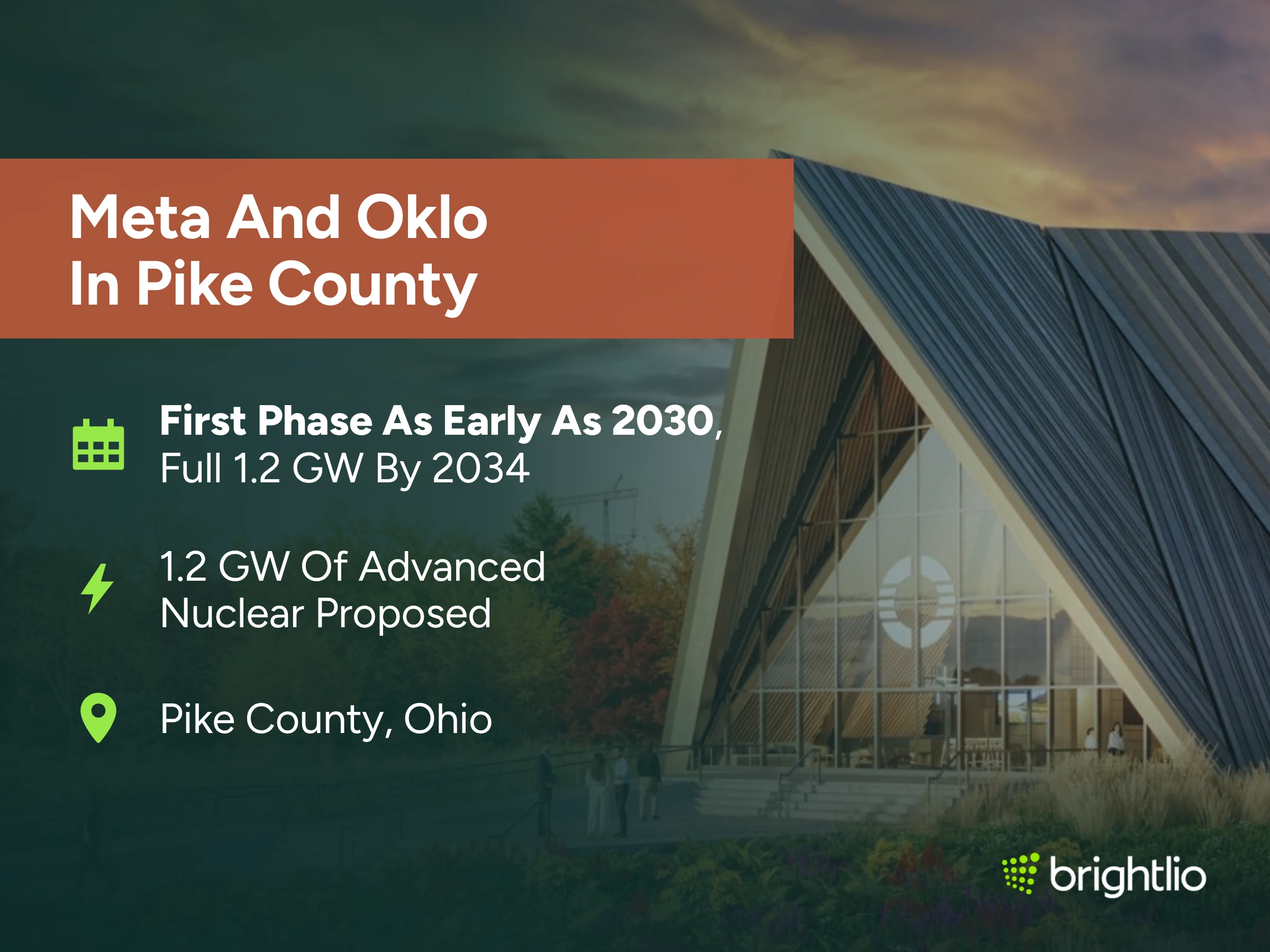
Meta is supporting Oklo’s proposed 1.2 GW advanced nuclear campus in Pike County, Ohio. The agreement creates a mechanism for Meta to prepay for electricity and help fund early development, including nuclear fuel procurement and the initial deployment of Oklo’s Aurora powerhouses.
The proposed campus follows a phased schedule. Oklo places pre-construction and site characterization in 2027, followed by general construction in late 2028 or early 2029. The first phase targets operation as early as 2030, with development continuing toward the full 1.2 GW by 2034.
The arrangement links a prospective electricity customer with funding for early project requirements. The campus remains a proposed development, and its schedule depends on progress through licensing, construction, and commissioning.
Key Features And Project Details
- Location: The proposed campus is in Pike County, Ohio.
- Planned capacity: Full development targets 1.2 GW.
- Funding structure: Meta’s prepayments would support early development and fuel procurement.
- Initial operations: The first phase targets service as early as 2030.
- Expansion schedule: Oklo targets the full campus capacity by 2034.
8. Meta And TerraPower’s Natrium Development Program
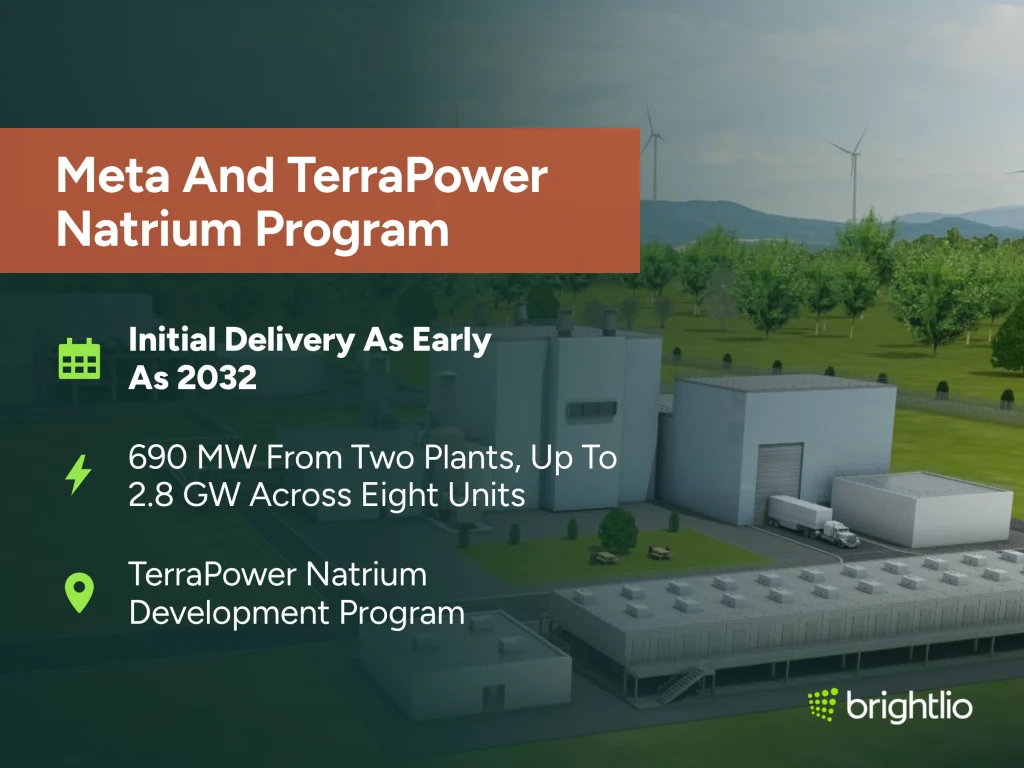
Meta’s agreement with TerraPower supports the development of two Natrium reactor plants totaling 690 MW, with rights to energy from up to six additional units. Initial delivery is targeted as early as 2032. The potential eight-unit program would provide approximately 2.8 GW of baseload nuclear capacity.
Each Natrium plant combines a 345 MW reactor with an energy storage system. Stored energy can increase electrical output to 500 MW for more than five hours, providing additional output for limited periods.
The reactor rating and storage-supported output describe different capabilities. The 345 MW figure represents each reactor’s generating capacity. The 500 MW figure includes a temporary contribution from stored energy. This distinction matters when comparing the program’s continuous supply potential with data center electricity requirements.
Key Features And Project Details
- Initial commitment: Two planned reactors would provide 690 MW of combined generation.
- Expansion potential: Rights to six additional units could bring the program to approximately 2.8 GW.
- Storage capability: Each plant can temporarily increase output to 500 MW for more than five hours.
- Delivery target: Initial electricity delivery is targeted as early as 2032.
9. Google And Elementl Power’s Three-Site Program
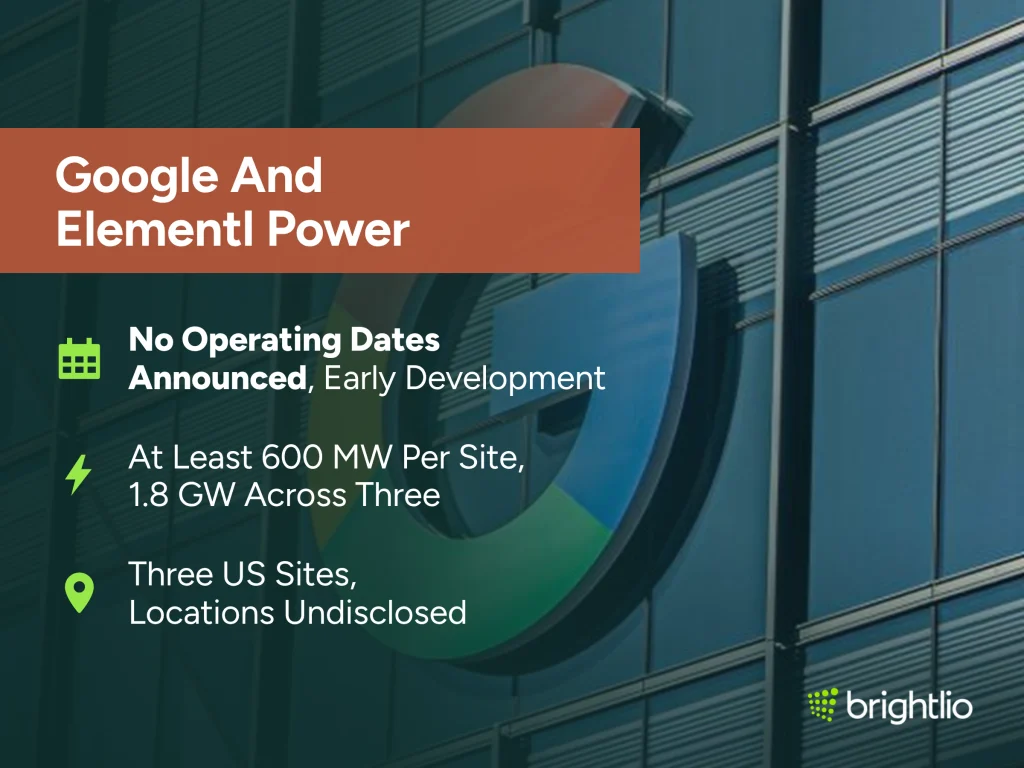
Google is providing early development capital to Elementl Power for three potential nuclear project sites in the United States. Each site targets at least 600 MW, creating a combined development ambition of at least 1.8 GW.
The agreement gives Google the option to purchase electricity from the projects once they are completed. Funding supports early site preparation and development work needed to advance potential generating facilities.
Reactor technology and project partners remain under evaluation in the announced program. This makes the arrangement an early development commitment with future purchase options. The capacity figures describe potential projects, and the announcement does not provide operating dates for the three sites.
Key Features And Project Details
- Program scope: Elementl is evaluating three potential U.S. nuclear sites.
- Site capacity: Each project targets at least 600 MW.
- Combined potential: The three sites represent at least 1.8 GW of proposed generation.
- Google’s role: Google provides early capital and retains an option to purchase future electricity.
- Development status: Technology choices, project partners, and delivery schedules remain under development.
10. Amazon, X-energy, And AEP In Indiana
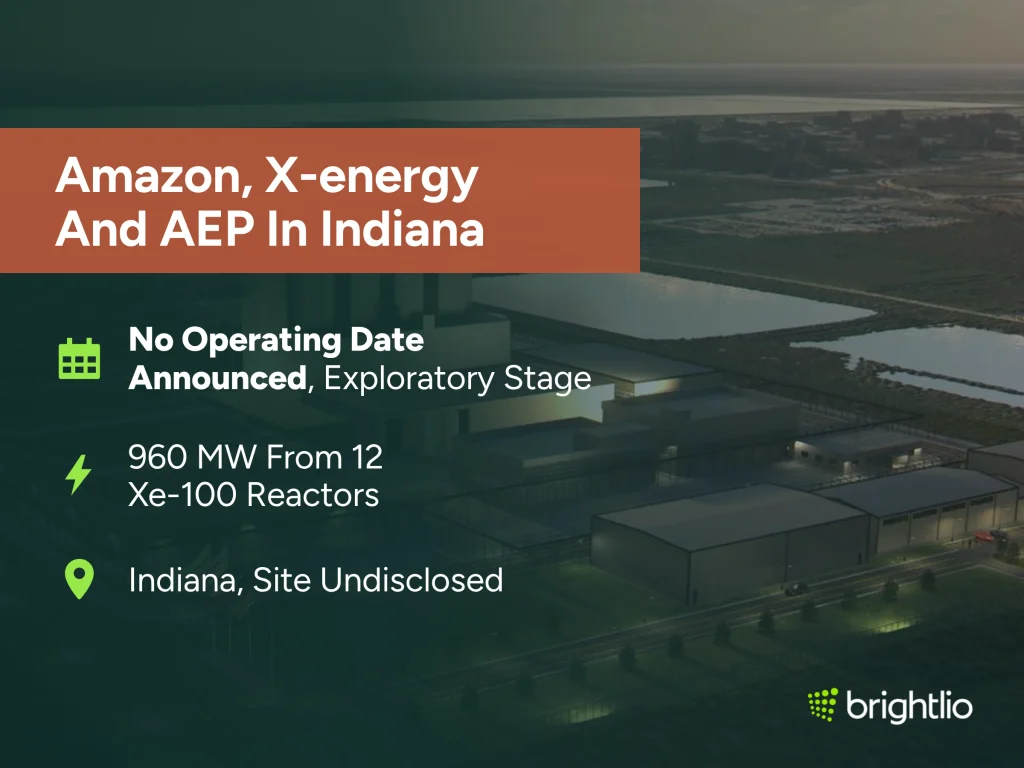
Amazon, X-energy, and American Electric Power are exploring a nuclear project in Indiana using 12 Xe-100 small modular reactors. The proposed facility would provide 960 MW of new generation for the regional electricity grid and Amazon’s data centers.
Amazon is funding project development and would become the plant’s first electricity customer once it enters operation. The proposal is the second project in Amazon and X-energy’s collaboration, following Cascade in Washington.
The broader collaboration aims to support more than 5 GW of new U.S. nuclear capacity by 2039. That date applies to the wider deployment program. The Indiana announcement describes an exploratory development agreement and does not provide a project-specific operating date.
Key Features And Project Details
- Location: The proposed development is in Indiana.
- Reactor configuration: The facility would use 12 Xe-100 reactors.
- Planned capacity: Total generating output would reach 960 MW.
- Customer participation: Amazon funds development and would serve as the first electricity customer.
- Delivery status: The project remains exploratory, with no announced operating date.
What Are the Potential Benefits of Nuclear Powered Data Centers
Nuclear energy can help operators address the challenge of supplying large computing loads with lower-carbon electricity. The benefit depends on the generation source, delivery arrangement, and alternatives available in the market.
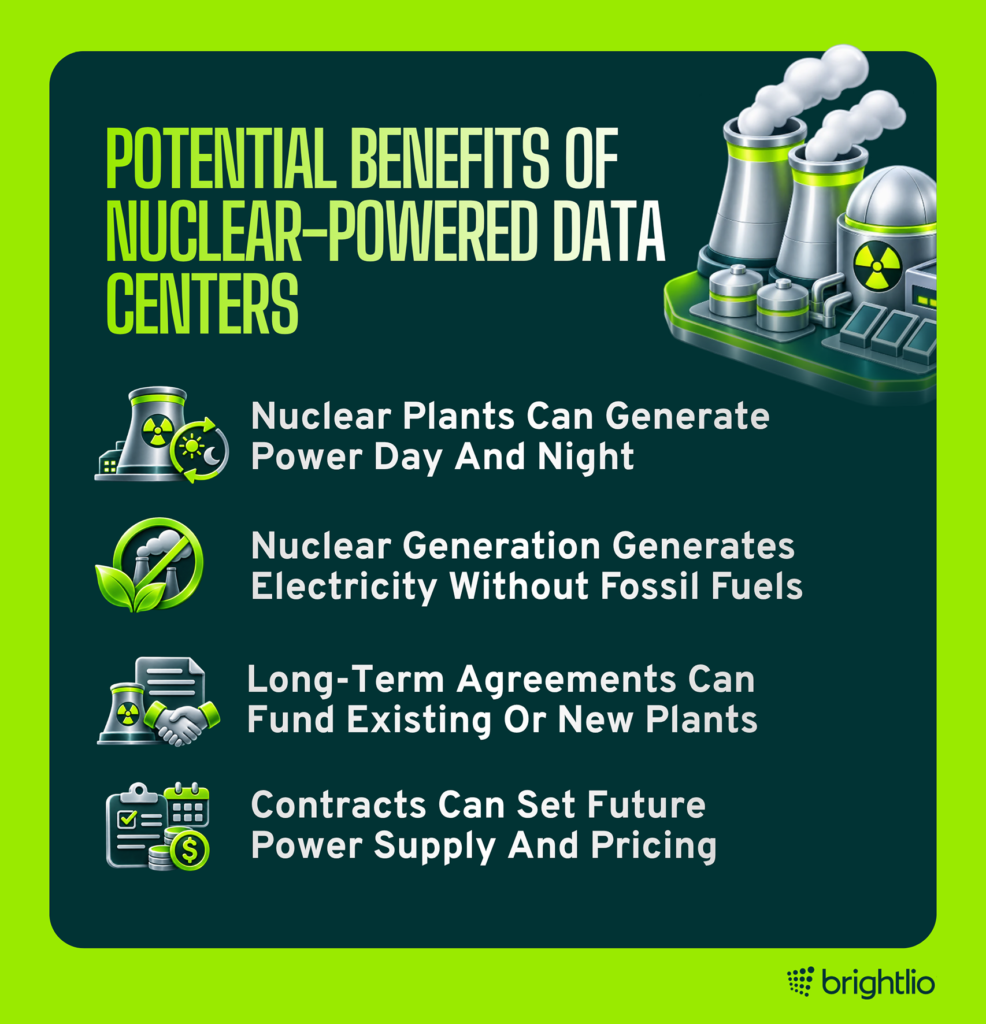
The following are the four potential advantages:
1. Support Electricity Demand Throughout the Day
Nuclear plants can generate across day and night without depending on sunlight or wind at the time of production. That characteristic can complement facilities running continuous cloud services, storage, and other workloads.
Capacity factor measures the energy a plant produces compared with the maximum it could produce at its rated output over the same period. A high capacity factor is useful for energy planning, but it does not remove the need to cover outages or verify delivery reliability.
2. Reduce Emissions From Electricity Generation
Nuclear generation produces electricity without burning fossil fuel in the reactor. It can therefore support a lower-carbon electricity portfolio where it replaces more emissions-intensive generation.
The wider lifecycle still includes fuel extraction and processing, construction, maintenance, and decommissioning. Customers should distinguish low operational emissions from a claim that the entire facility or supply chain has no carbon footprint.
3. Support Investment in Electricity Supply
Long-term customer commitments can help support plant life extensions, restarts, output increases, or new construction. Each contributes differently to the electricity system.
Keeping an existing plant operating preserves supply. An uprate adds output to that plant, while a new reactor adds generation through a separate development. Identifying which outcome a contract supports makes its contribution easier to evaluate.
4. Improve Long Term Power Planning
A well-structured agreement can provide visibility into future electricity quantities and pricing terms. That can help align an operator’s expansion plans with a defined source of supply.
Predictability depends on the contract. Delivery charges, escalation clauses, replacement power, and exposure to market prices can still affect the bill. A long agreement is useful when its commitments match the customer’s growth and operating needs.
What Challenges Must Nuclear Powered Data Centers Overcome
The requirements extend beyond securing a nuclear energy contract. Developers must coordinate generation, delivery infrastructure, financing, and the data center’s own construction schedule.
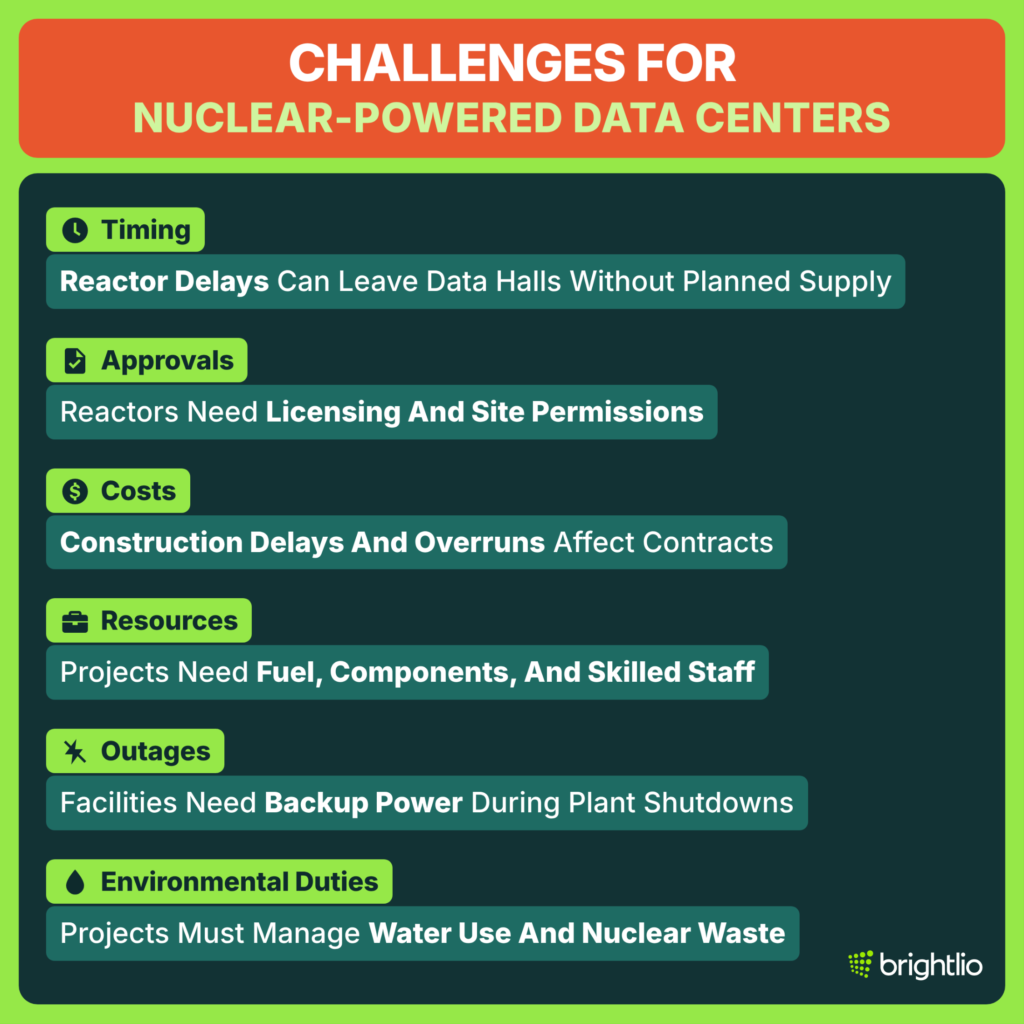
The following are the six challenges to assess:
1. Aligning Reactor and Data Center Timelines
A data hall may be ready before the planned reactor or restart can deliver power. Delays can leave an operator paying for infrastructure that cannot yet support its intended workload.
An interim supply plan should explain how the facility operates before nuclear delivery begins and who pays if that period runs longer than expected.
2. Completing Licensing and Site Approvals
In the United States, the Nuclear Regulatory Commission’s licensing process governs activities including the construction and operation of commercial reactors. The required approvals depend on the project and its licensing pathway.
A technology review, construction authorization, and permission to operate are different milestones. Power delivery, land use, and environmental work also require coordination with the relevant organizations.
3. Financing Construction and Managing Cost Risk
New nuclear projects require substantial investment before electricity can be sold. Early deployments of a design can also face uncertainty around construction methods, component supply, and delivery schedules.
Those risks may appear in electricity pricing or contractual commitments. Buyers should understand who carries cost overruns, what happens if delivery is delayed, and whether they must pay for unused contracted quantities. A contract should also identify the party responsible for procuring replacement electricity.
4. Securing Fuel and Specialist Resources
A reactor needs a qualified fuel supply, specialized components, and trained personnel. Some advanced designs require fuel types with different supply constraints from those used by the existing commercial fleet.
The development plan should address the initial fuel load, later reloads, equipment manufacturing, and operator readiness.
5. Maintaining Reliability During Plant Outages
A nuclear unit can be unavailable during refueling, scheduled maintenance, or an unexpected event. A data center must remain able to support its applications through the resulting change in supply.
This requires a coordinated approach across utility service, backup equipment, electrical protection, and operating procedures. A nearby reactor is not automatically a second independent power path, and a purchase contract does not provide onsite backup capacity.
6. Managing Water Use and Nuclear Waste
Nuclear facilities need arrangements for radiation protection, physical security, emergency preparedness, used fuel management, and eventual decommissioning. Communities also have a stake in water use, land use, and local infrastructure impacts.
The power plant’s cooling demand and the data center’s cooling demand should be assessed together where they share local resources. Clear responsibility and transparent project information help customers understand the long-term operating commitments behind the electricity supply.
What Role Could Small Modular Reactors Play?
Small modular reactors use smaller reactor units and designs intended to support modular construction or deployment. The category includes different technologies, so one project’s cost, fuel requirements, or licensing progress should not be assumed to apply to another.
For data center developers, the attraction is the possibility of adding generation in stages that better match growth. Factory production and repeated construction may eventually improve delivery consistency, but those benefits depend on successful execution and a functioning supply chain.
SMRs still require suitable sites, licensing, fuel, trained operators, and arrangements for waste and decommissioning.
Evaluate each design using its actual licensing, construction, and operating progress. A proposed benefit from repeat manufacturing is still a projection until the developer demonstrates it.
How Does Nuclear Compare With Other Power Options?
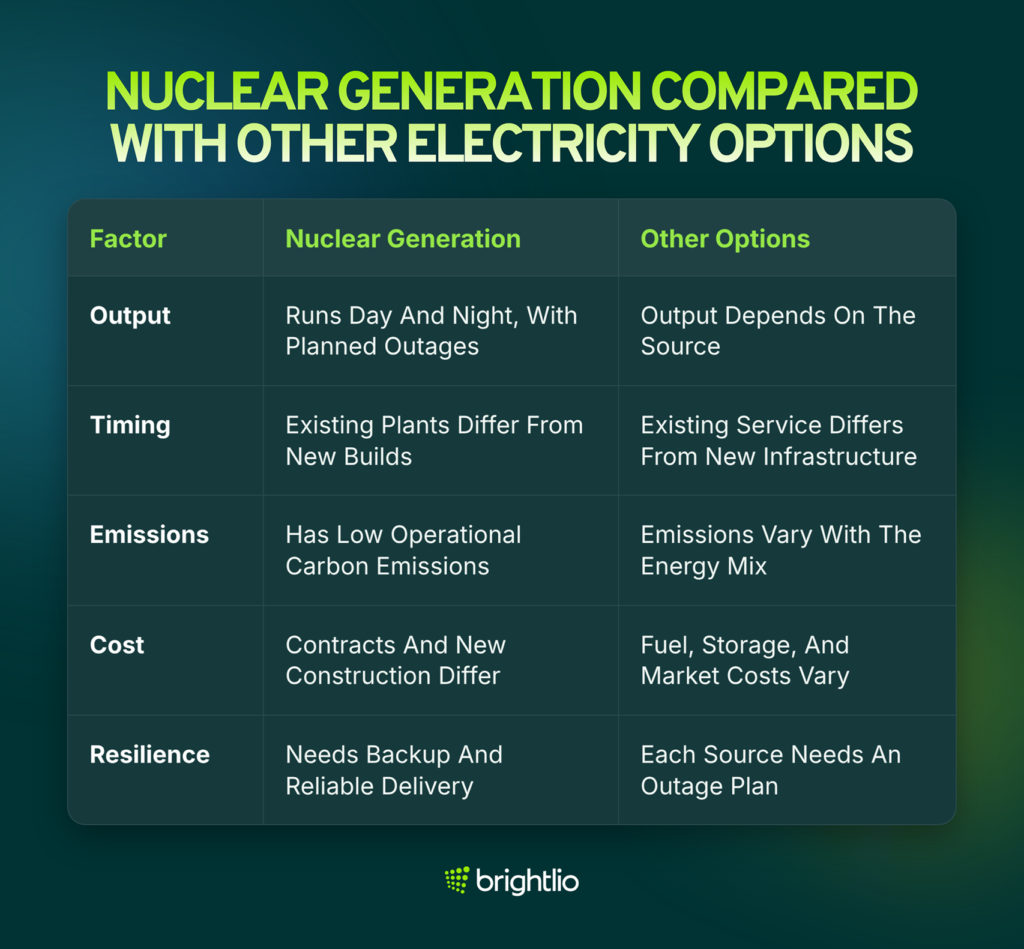
Data centers often rely on a portfolio of generation and procurement arrangements. A fair comparison considers delivery reliability, environmental performance, timing, and the complete cost of serving the workload.
The following table summarizes the main considerations:
Does Nuclear Power Make Data Centers Cheaper?
Nuclear electricity does not automatically lower a customer’s colocation or cloud bill. An agreement with an operating plant has different economics from a project that must finance and build new reactors.
The delivered cost includes the applicable generation price, transmission and distribution charges, capacity arrangements, backup coverage, and contract adjustments. The data center also pays for cooling, staffing, networking, and other services that continue regardless of the electricity source.
Brightlio’s colocation pricing guide explains the broader charges to compare. Ask providers whether energy pricing is included, passed through, or subject to minimum commitments and annual increases.
Power figures also need consistent definitions. As an illustrative example, a facility averaging 100 MW of IT demand at an annual power usage effectiveness, or PUE, of 1.2 would average 120 MW of total facility demand. PUE is total facility energy divided by IT equipment energy. Over a 365-day year, the example requires approximately 1.05 million megawatt-hours of electricity.
The example is not a project forecast. It shows why 100 MW of contracted generation cannot simply be labeled 100 MW of continuously supported IT capacity. The supply plan must cover facility overhead, generation availability, and the delivery arrangement.
When Should Your Business Consider a Nuclear Powered Data Center?
Nuclear supply may be relevant when you need substantial long-term capacity and want to assess the electricity behind a cloud or colocation service. Most enterprise buyers will evaluate a provider’s energy arrangements. If you need an emissions claim for your own reporting, confirm which energy attributes the provider allocates to your service and how it documents that allocation.
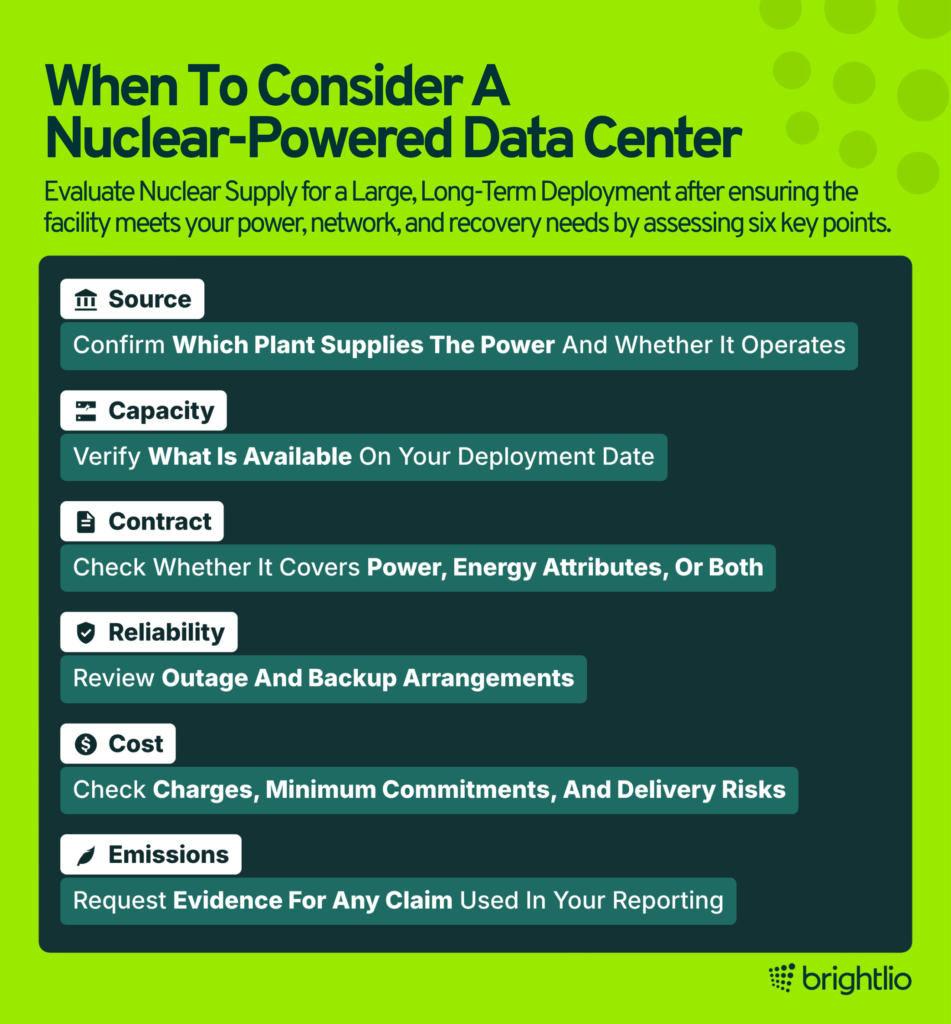
Start with the workload. Define the deployment date, committed power, rack density, network requirements, and recovery objectives before comparing energy claims. Brightlio’s guide to colocation explains the service model, while its data center location guides can help you research alternative markets.
The following questions can help you assess a proposal:
- Which plant or project supports the energy claim, and is it operating?
- What capacity can the provider deliver at our site and deployment date?
- Does the agreement cover electricity, environmental attributes, or both?
- How are plant outages and network interruptions covered?
- Which costs, minimum commitments, and delivery risks affect our contract?
- What evidence supports the emissions claim and its accounting period?
For example, a business needing capacity within a year should compare available facilities on their documented delivery commitments. A reactor targeted for the next decade may support a later expansion plan, but it does not solve that immediate requirement.
What Is the Future of Nuclear Powered Data Centers?
Existing plants, restarts, and advanced reactors can each contribute to future electricity supply. Their roles will depend on project execution, economics, infrastructure availability, and the ability to earn regulatory and community support.
For data center customers, the most useful milestones are commercial generation, completed utility connections, tested facility systems, and contracted capacity available on schedule. These are stronger grounds for a deployment decision than the size of an announced energy agreement alone.
Nuclear can be part of a broader power strategy alongside other generation, storage, and grid resources.
Find the Right Data Center Solution With Brightlio
Your infrastructure decision starts with capacity, connectivity, reliability, and a clear understanding of cost. Brightlio helps businesses compare colocation, cloud, and connectivity options against those requirements.
If you are evaluating a provider’s power strategy or planning your next deployment, contact Brightlio to discuss your requirements and explore suitable solutions.
Frequently Asked Questions
1. Does a Nuclear Powered Data Center Need an Onsite Reactor?
No. It can purchase nuclear energy or related attributes through an agreement while receiving electricity from the grid. An onsite or adjacent reactor is one possible arrangement, not a requirement.
2. Is Nuclear Energy Renewable?
Nuclear energy is generally classified as a low-carbon, nonrenewable energy source because it uses finite fuel resources such as uranium. Low-carbon and renewable describe different characteristics.
3. Can Nuclear Power Support AI Data Centers?
Yes. Nuclear generation can contribute electricity for AI computing, but the facility still needs adequate delivered power, rack capacity, cooling, and networking. The electricity source does not establish whether a particular building can host an AI workload.
4. Do Nuclear Powered Data Centers Still Need Backup Power?
They still need a resilience design that covers interruptions. Nuclear plants can shut down, and faults can occur between the generator and the servers. The appropriate backup arrangement depends on the facility and its service commitments.
5. Are Small Modular Reactors Available for Immediate Deployment?
Readiness depends on the specific technology, site, approvals, and supply chain. A proposed SMR project should not be treated as available electricity until it completes the work required for commercial operation and delivery.
6. Does a Nuclear Energy Agreement Guarantee Zero Emissions?
No. The claim depends on the electricity arrangement, accounting method, and scope. Nuclear generation has low operational carbon emissions, while construction, fuel processing, backup generation, and other activities can contribute to the wider footprint.

Tamzid is a cybersecurity researcher with 5+ years of experience across SaaS, security, compliance, data centers and cloud. He writes for brightdefense.com and hipaasimple.com, covering security, compliance, and infrastructure topics. Certified through Cisco, Fortinet (NSE 1), and the Basel Institute on Governance in OSINT, he grounds his work in primary sources and verified data.
Recent Posts
Nuclear Powered Data Centers
10 Largest Data Centers in Europe

Data Centers and Colocation In Minnesota

Data Centers and Colocation In Missouri
Let's start
a new project together