
Colorado data centers give businesses a choice between downtown Denver interconnection hubs, suburban enterprise campuses, and Colorado Springs facilities. Denver has the deepest concentration of providers in the state. Colorado Springs gives buyers a separate location to evaluate for regional operations and disaster recovery.
The Colorado tracker checked October 22, 2026, counts 44 operating sites, split between 10 campuses and 34 colocation facilities. Its full inventory contains 54 facilities when planned sites are included. Data Center Map lists 60 facilities across five markets, using a different approach to shared buildings and individual listings.
The state’s commercial electricity price averaged 13.81¢ per kilowatt-hour in July 2026. That was roughly 5% below the national commercial average. Colorado’s dry climate supports outside-air cooling, though the savings depend on each facility’s equipment and operating conditions.
This guide covers the reasons to colocate in Colorado, its main submarkets, and five notable operating facilities. It explains the local development restrictions and environmental risks that buyers should consider before choosing a site.
Colorado Data Center Tracker
54data center facilities
10 operating campuses10 planned34 colocation
Data Center Map lists 60 facilities across 5 markets, counting rooms within shared buildings as separate listings. This tracker counts each campus or building once, merges duplicate listings at one address and adds projects from local news. 44 sites operate today: 10 campuses and 34 colocation facilities. Planned MW figures mix IT capacity and total power, so they are not directly comparable.
Market Snapshot
Notable Operating Data Center Campuses In Colorado
These are five notable operating campuses, not a size ranking. Colocation facilities sit in their own tab, and several campuses here also sell colocation. Most Colorado operators don't publish MW, so every other site appears on the map, with operating sites in green and planned ones in coral.
- T5@Colorado Springs CampusColorado Springs, total campus designUp to 100 MWOperational
64-acre campus with five buildings listed, which the operator says can scale to 100 MW
- Address:
- 3233 Janitell Rd, Colorado Springs
- Operator:
- T5 Data Centers
- Novva Colorado SpringsColorado Springs, reported power40 MWOperational
37-acre former Progressive campus, where Novva plans a 250,000 sq ft addition and waterless cooling. The Gazette reports the site at 40 MW
- Address:
- 650 Sybilla Ln, Colorado Springs
- Operator:
- Novva Data Centers
- DataBank Centennial Campus (DEN2 and DEN5)Centennial, critical IT load20 MWOperational
Two-building campus with 87,510 sq ft of IT space
- Addresses:
- 6900 S Peoria St and 6961 S Quentin St, Centennial
- Operator:
- DataBank
- H5 Data Centers DenverGreenwood Village300,000 sq ftOperational
300,000 sq ft campus with two sites the operator describes as Tier III
- Address:
- 5350 S Valentia Way, Greenwood Village
- Operator:
- H5 Data Centers
- EdgeConneX Denver (EDCDEN01 and EDCDEN02)EnglewoodNot publishedOperational
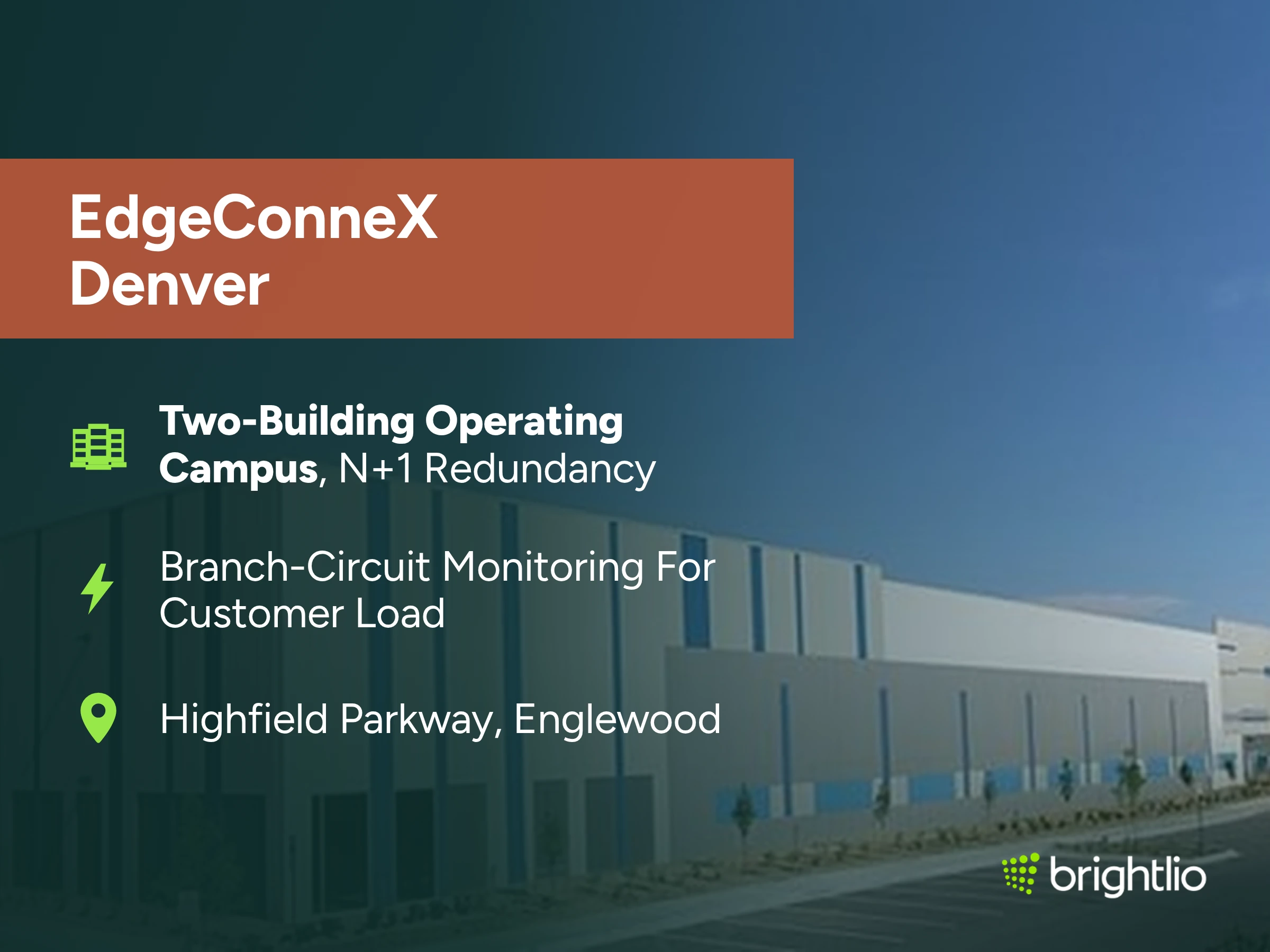
Two EdgeConneX buildings on Highfield Parkway in the Denver Tech Center
- Addresses:
- 8535 and 8451 Highfield Pkwy, Englewood
- Operator:
- EdgeConneX
Other operating sites, shown on the map in green: , , , , .
Planned Data Centers In Colorado
Vantage's 334 MW Trident campus in Aurora leads the pipeline, followed by Colorado Springs projects. Westbridge's 380 MW Fontus project is left off because its site has not been disclosed.
- Vantage Trident Campus (CO21)Aurora, planned IT capacity334 MWPlanned
Two two-story buildings totaling about 860,000 sq ft, with roughly 500 MW of total electrical demand and 28 backup diesel generators
- Location:
- E 48th Ave and E-470, Aurora
- Developer:
- Vantage Data Centers
- Project PrimestoneColorado Springs, initial building100 MWPlanned
GPU testing facility on 33.8 acres, with an option for a second 100 MW building. Completion of the first is expected in 2027, and the developer says it is not a data center under a narrow definition
- Address:
- 3819 Janitell Rd, Colorado Springs
- Developer:
- Sansone Group, with Broadstone Net Lease as investor
- QTS Aurora-Denver CampusAurora, campus160 MWUnder construction
Three-building campus on 65 acres
- Address:
- 1160 N Gun Club Rd, Aurora
- Developer:
- QTS Data Centers
- Raeden Project TaurusColorado Springs, proposed50 MWProposed
Conversion of the former Intel chip plant, about 450,000 sq ft, off Garden of the Gods Road
- Address:
- 1565 High Tech Way, Colorado Springs
- Developer:
- Raeden
- Spark AI Foundry LovelandLoveland, planned30 MWPlanned
AI and HPC colocation facility planned as part of the operator's national network
- Address:
- 3800 N Wilson Ave, Loveland
- Developer:
- Spark AI Foundry
Other planned projects, shown on the map in coral: , , , , .
Notable Colocation Facilities In Colorado
Denver's colocation market centers on the 910 15th Street carrier hotel downtown and the Denver Tech Center in Englewood and Centennial. These five are notable facilities, not a size ranking.
- CoreSite Denver (DE1) at 910 15th StDenverNot publishedColocation
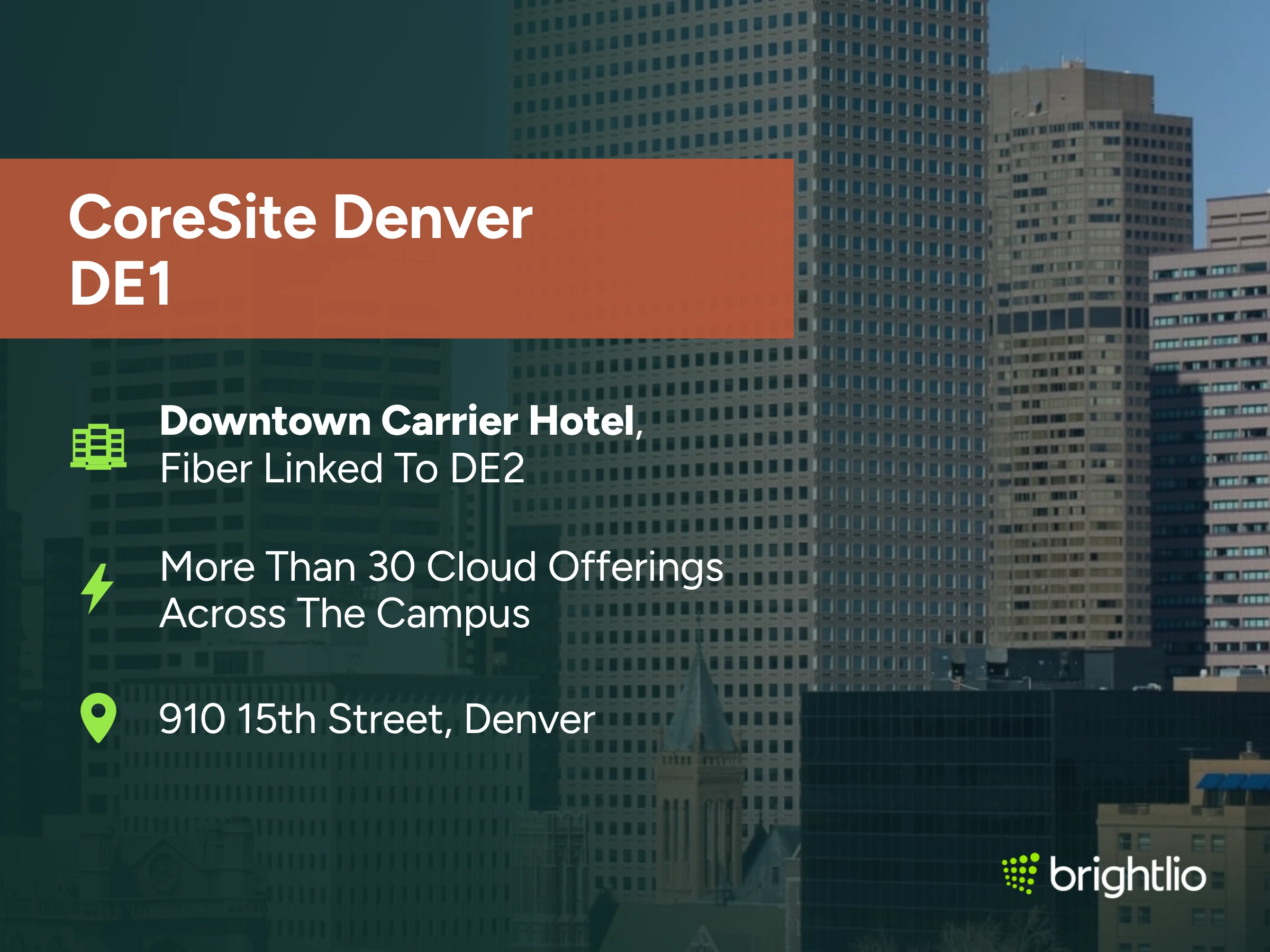
Downtown carrier hotel in the Denver Gas and Electric Building, also home to 910Telecom, Massive Networks and Lumen
- Address:
- 910 15th St, Denver
- Operator:
- CoreSite
- Equinix DE1EnglewoodNot publishedColocation
Equinix's original Denver facility near the Denver Tech Center
- Address:
- 9706 E Easter Ave, Englewood
- Operator:
- Equinix
- 1500 Champa (DataBank DEN3)DenverNot publishedColocation
Downtown building owned by RadiusDC, with DataBank's DEN3 inside
- Address:
- 1500 Champa St, Denver
- Operator:
- RadiusDC and DataBank
- US Signal Denver CO01Englewood35,000 sq ftColocation
35,000 sq ft facility in the Denver Tech Center
- Address:
- 8675 Concord Center Dr, Englewood
- Operator:
- US Signal
- Expedient CentennialCentennial18,500 sq ftColocation
18,500 sq ft of raised floor
- Address:
- 7347 S Revere Pkwy, Centennial
- Operator:
- Expedient
Other colocation facilities, shown on the map as green squares: , , , , , , , , , , , , , , , , , , , , , , , , , , , , .
Choose a category to switch the list and highlight its sites on the map. Click any site card to find it on the map, or click a marker to jump to its card. Pins are approximate, and each MW figure carries the basis shown beside it.
Data sourced from Data Center Map, EIA, Independence Institute, Colorado Public Radio, Baxtel, Colorado Newsline, Pikes Peak Bulletin, The Gazette, DatacenterDynamics, KUNC, Rocky Mountain PBS and Architect Digital, checked October 22, 2026. Totals count each campus or facility once; Data Center Map's own count lists individual facilities.
Why Colocate In Colorado
Colorado combines an established colocation market with access to major network providers. Its strongest advantages are the connections and services available at operating facilities.
Cooling conditions and electricity prices can help the economics of a deployment when the building design supports them.
1. Established Network And Cloud Connections
Downtown Denver offers access to carrier hotels, which are buildings where telecommunications networks interconnect. CoreSite DE1 at 910 15th Street is one example. CoreSite lists more than 150 networks across its Denver campus, a count that covers the campus rather than each individual building.
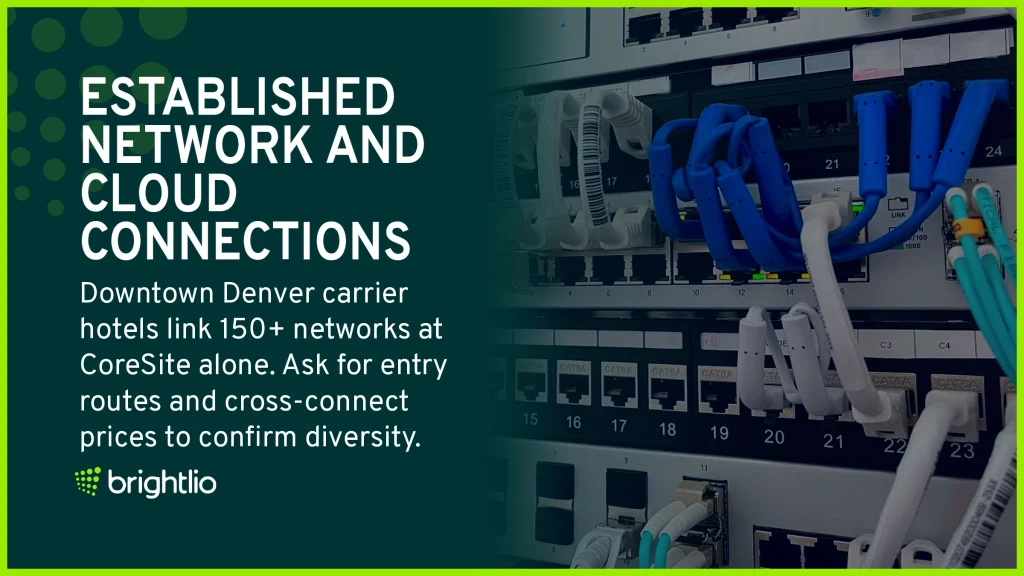
A carrier-neutral data center lets customers choose among network providers available at the site. That flexibility can help a business connect its offices, customers, and cloud services through different suppliers.
Two carriers can share a fiber route, so a carrier list alone does not establish route diversity. Request the physical entry routes and cross-connect prices. A cross-connect is a short connection between customer equipment and another provider inside a facility.
2. A Choice Of Operating Facilities And Services
The tracker's 34 colocation facilities give Colorado buyers options beyond large dedicated campuses. Downtown buildings serve businesses that prioritize interconnection. Suburban facilities offer another group of providers for enterprise infrastructure and managed services.
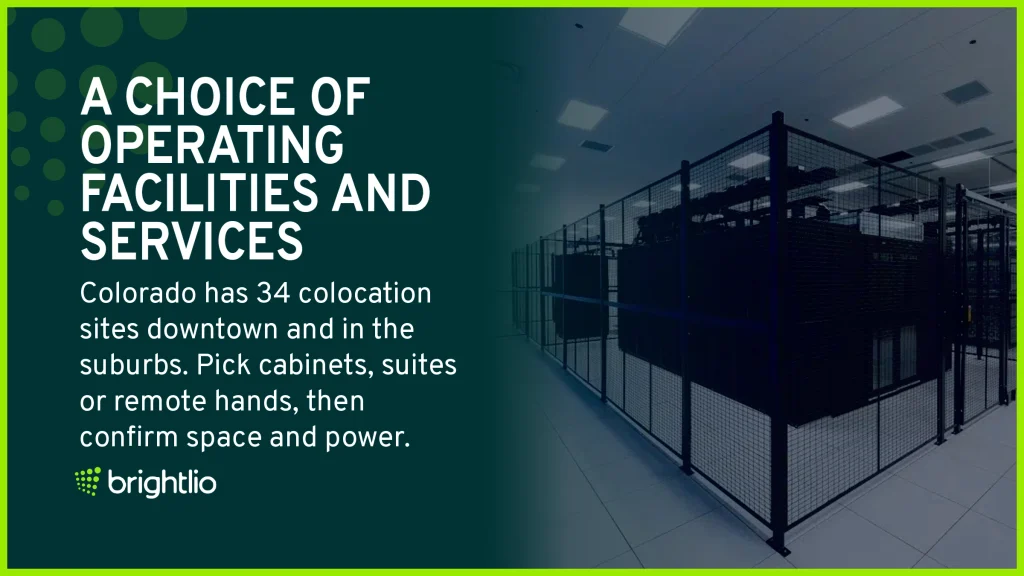
The difference matters when defining a requirement. A company leasing one cabinet needs a different proposal from a customer seeking a private suite.
A business with limited local IT staff may place greater value on remote hands, the on-site assistance that handles tasks such as replacing a drive or checking cabling.
An operating-site count gives buyers a shortlist to investigate. The operator must confirm that the required cabinet space and usable power are available for the deployment date.
3. A Climate That Supports Efficient Cooling
Cool, dry air can reduce the amount of mechanical refrigeration a data center needs. An economizer is a cooling system that uses suitable outdoor conditions to help remove heat. It can transfer heat through outside air or a separate fluid circuit, depending on the design.
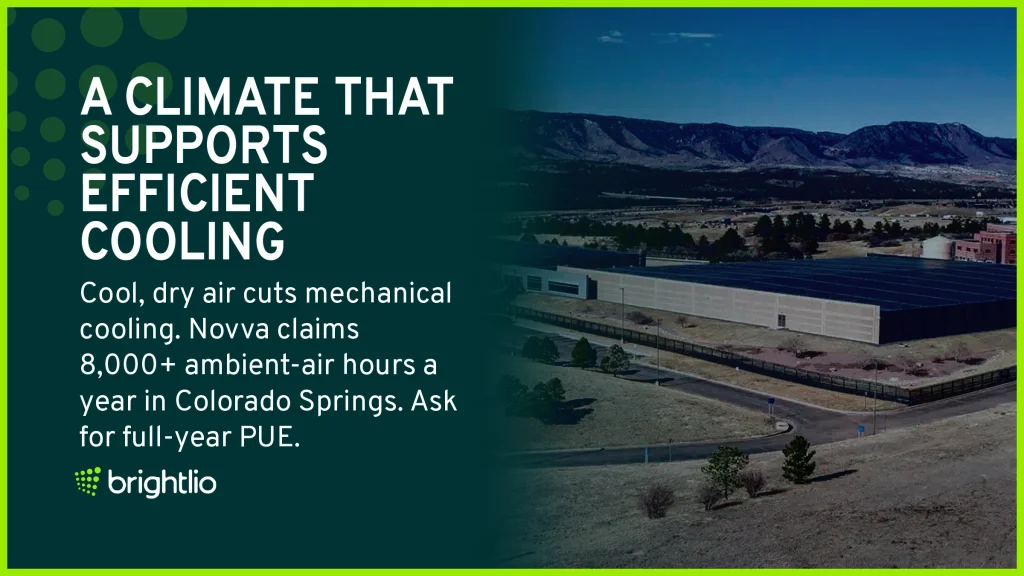
Novva says its Colorado Springs location supports more than 8,000 hours of ambient-air cooling annually. That figure describes the operator's site-specific claim. Other buildings can have different temperature limits and cooling arrangements.
Power usage effectiveness, or PUE, compares total facility electricity with the electricity used by IT equipment. A lower PUE indicates less electricity spent on supporting systems at the measurement boundary.
Compare full-year measurements at a similar operating load, since a design target alone does not show actual efficiency.
4. Commercial Electricity Prices Below The National Average
EIA's July 2026 electricity data puts Colorado's commercial average at 13.81¢/kWh, compared with 14.53¢/kWh nationally. The difference is 0.72 cents per kilowatt-hour, or about 5%.
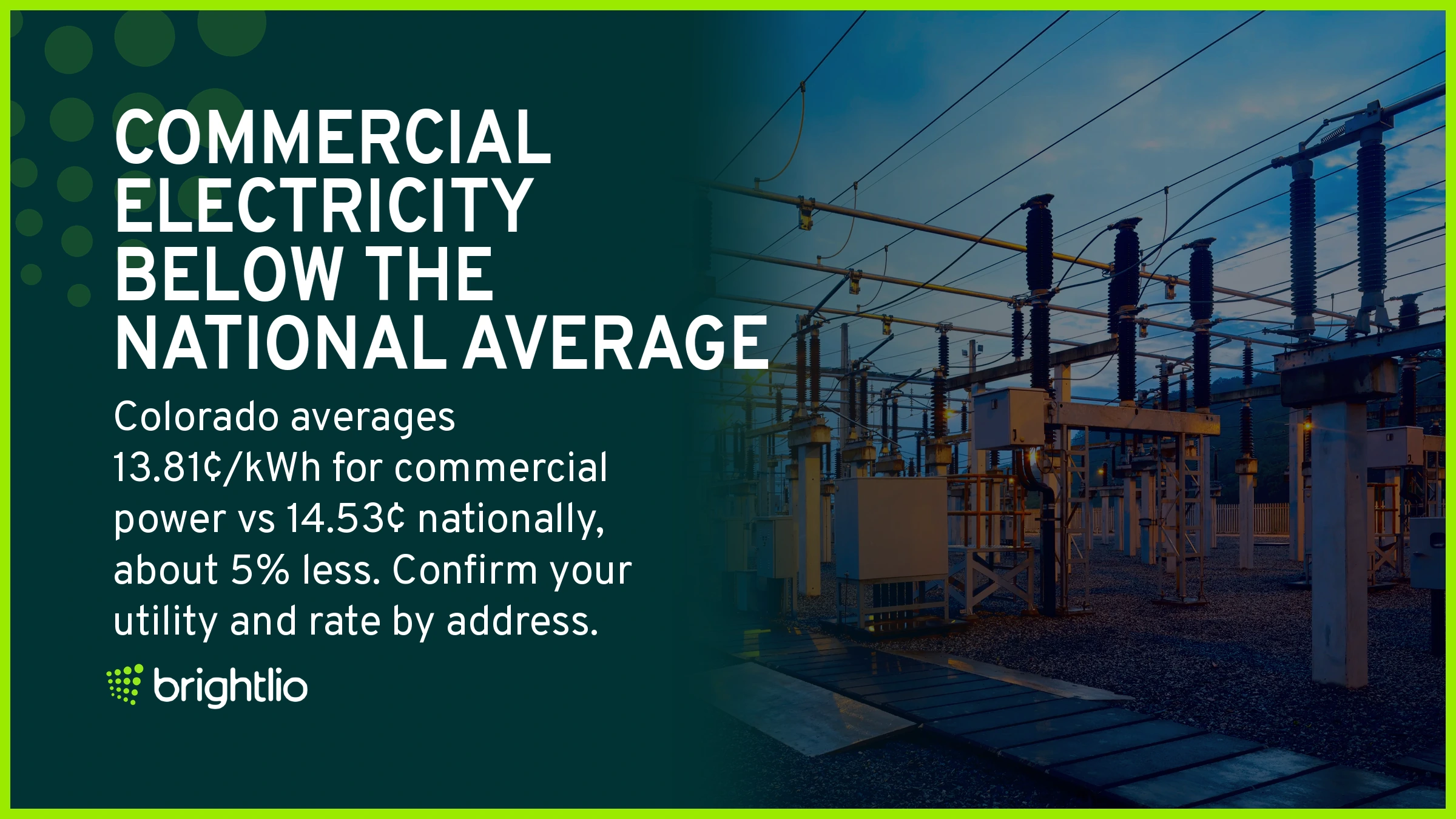
For a constant 100 kW load over a 730-hour month, that difference represents about $526 in electricity at the two average rates. The calculation is a benchmark for energy consumption. A colocation bill includes additional costs and follows the provider's contract.
Xcel Energy's Public Service Company of Colorado is the state's largest utility. Tri-State supplies many rural electric cooperatives, while Colorado Springs Utilities serves Novva's site. The utility and applicable rate depend on the address.
The tracker's 2025 generation snapshot assigns 31% to natural gas and 29% to wind. Coal accounts for 24%, while solar contributes 13%. That statewide mix provides context for emissions comparisons. A customer's renewable-energy claim needs evidence tied to its own electricity procurement.
Where Colorado Data Centers Are Located
Colorado's commercial data center market follows the Front Range, with the largest provider concentration around Denver. The street address matters more than the metro label. A facility marketed as a Denver data center may be in Englewood, Centennial, Greenwood Village, or Aurora, each with its own local requirements.
Downtown Denver
Downtown is a logical starting point for organizations that need access to several networks. CoreSite DE1 operates in the Denver Gas and Electric Building at 910 15th Street. The tracker identifies other telecommunications providers within the same building.
Another downtown location is 1500 Champa Street. RadiusDC owns the property, and DataBank operates DEN3 within it. Property ownership and the operator delivering the contracted service are separate details to confirm when comparing facilities.
For an interconnection-heavy deployment, compare the available carriers and cloud connections at the specific suite. Include cross-connect charges and building access procedures in the proposal review.
The Denver Tech Center And Southern Suburbs
Englewood, Greenwood Village, and Centennial contain a broad group of enterprise and colocation facilities. Operators in the tracker include DataBank, H5, EdgeConneX, Equinix, US Signal, and Expedient.
DataBank's Centennial campus operates DEN2 and DEN5. H5's campus is in Greenwood Village. EdgeConneX's two Denver facilities are on Highfield Parkway in Englewood.
The range of providers makes this area useful for comparing operating designs and support models. Buyers should assess travel time from their offices alongside the technical requirements, particularly when their own engineers will perform maintenance.
Aurora And The Eastern Denver Metro
Aurora's operating inventory includes facilities from Flexential, 365 Data Centers, and Lumen. The area provides another set of locations for buyers comparing the Denver metro's colocation options.
An Aurora address should receive its own utility and hazard review. It should receive a separate network assessment, too. A connection to a downtown hub can involve a carrier circuit with its own installation schedule and recurring charge.
Businesses evaluating two metro sites should compare their physical dependencies. Separate street addresses can still rely on a shared utility corridor or fiber route.
Colorado Springs
Colorado Springs has a separate operating market south of Denver. Novva's facility is at 650 Sybilla Lane. The tracker identifies smaller colocation options from providers including Springs Hosting and Uniti.
Colorado Springs is relevant to local operations and disaster recovery evaluations. Test the network performance between the two sites and assess whether they share infrastructure that could fail in the same event.
The choice should account for recovery objectives. The recovery point objective defines how much data loss a business can tolerate. The recovery time objective defines how quickly a service must return after an interruption.
Boulder And The Northern Front Range
The tracker includes operating facilities around Boulder, Louisville, and Fort Collins. Named providers include Massive Networks, Earthnet, and FRII. These locations give northern Front Range businesses additional sites to investigate.
A local facility may make equipment visits easier for a nearby IT team. Buyers should still confirm cabinet availability and on-site staffing. The broader Denver market's carrier count should never be assumed to apply to a northern Front Range building.
Boulder County's land-use rules require attention to jurisdiction. Its county land-use review concerns unincorporated areas, with incorporated cities responsible for their own rules.
Five Notable Operating Colorado Data Centers
These five profiles cover operating facilities with different strengths. They are not a size ranking. Operators describe capacity using different measures, and several do not provide a comparable operating IT-power figure.
1. Novva Colorado Springs
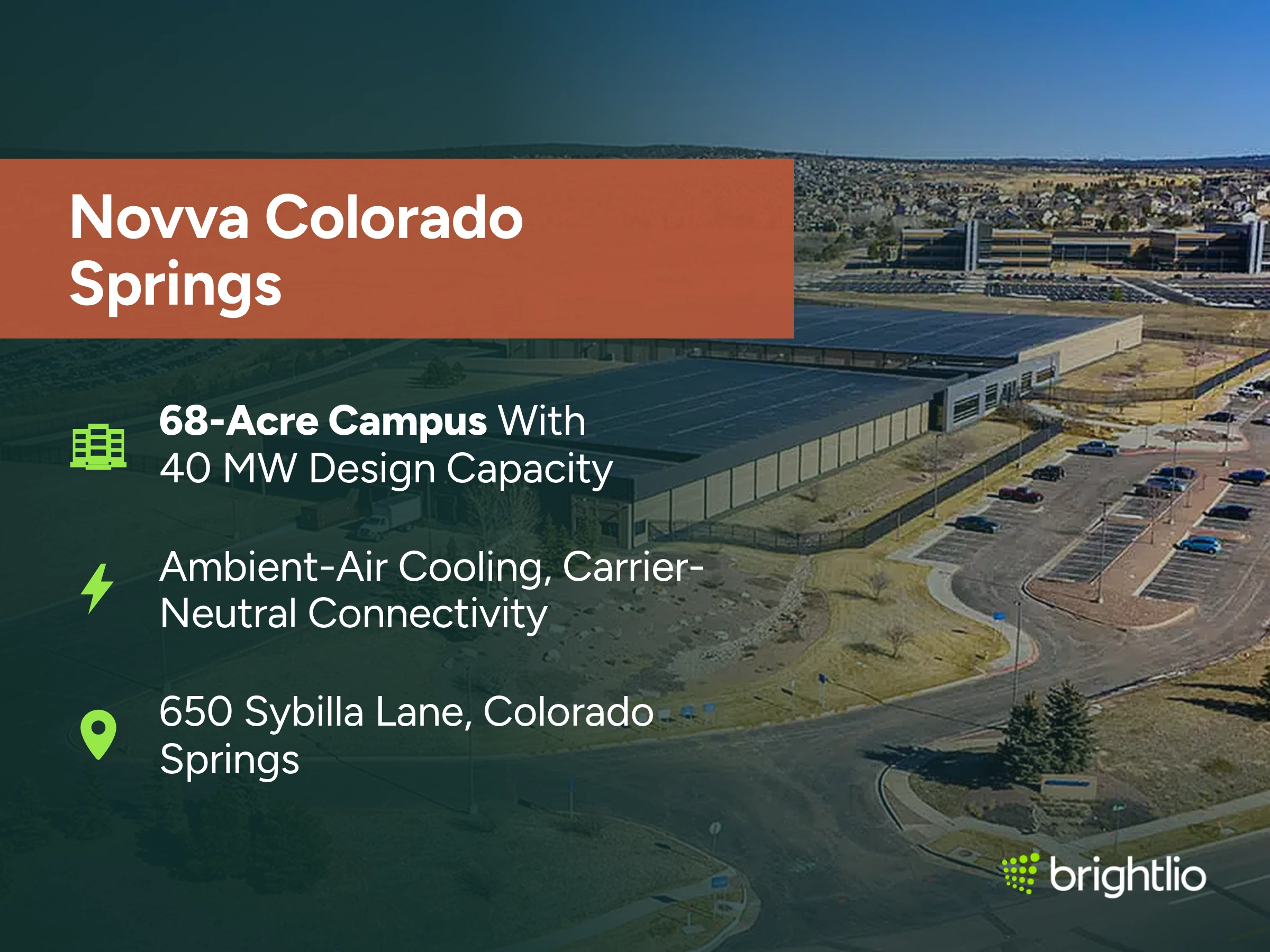
Location: 650 Sybilla Lane, Colorado Springs. Operator: Novva Data Centers.
Novva's Colorado facility page describes 40 MW of campus design capacity. A separate building specification lists a 6 MW utility feed. Buyers should have the operator identify the commissioned capacity and power available for their particular deployment.
The operator describes a 68-acre campus. Its figure of 37 acres refers to available land, rather than the entire property. The page identifies Colorado Springs Utilities as the utility supplier and describes carrier-neutral connectivity.
Novva emphasizes ambient-air and waterless cooling. Its technical specifications include chilled-water equipment, so buyers should review the actual cooling configuration serving their space. A waterless cooling claim needs a defined boundary before it can support a water-consumption comparison.
A proposal should identify the allocated power and cooling arrangement for the contracted space. Confirm the network connections available in that deployment, including any transport needed to reach Denver.
2. DataBank Centennial Campus
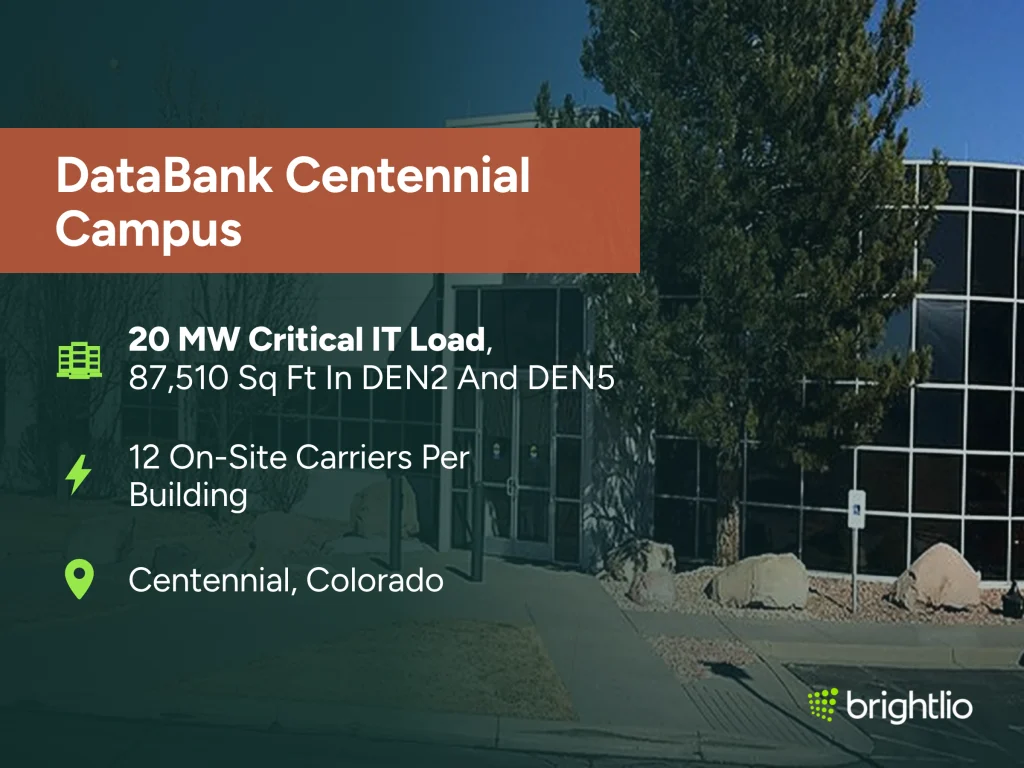
Location: 6900 South Peoria Street and 6961 South Quentin Street, Centennial. Operator: DataBank.
DataBank's Centennial campus comprises DEN2 and DEN5. Together, they provide 20 MW of critical IT load and 87,510 square feet of IT space on 11 acres. Critical IT load is the power allocated to computing equipment.
DEN2 accounts for 4 MW and 31,510 square feet of IT space. DEN5 accounts for 16 MW and 56,000 square feet. Those building figures are components of the campus total.
The operator lists 12 on-site carriers at each building. It identifies an off-site Xcel Energy substation as the campus power source.
These figures let buyers compare the campus with another proposal using IT load and IT floor area. Confirm which building will host the equipment and how much capacity the agreement reserves.
3. H5 Data Centers Denver
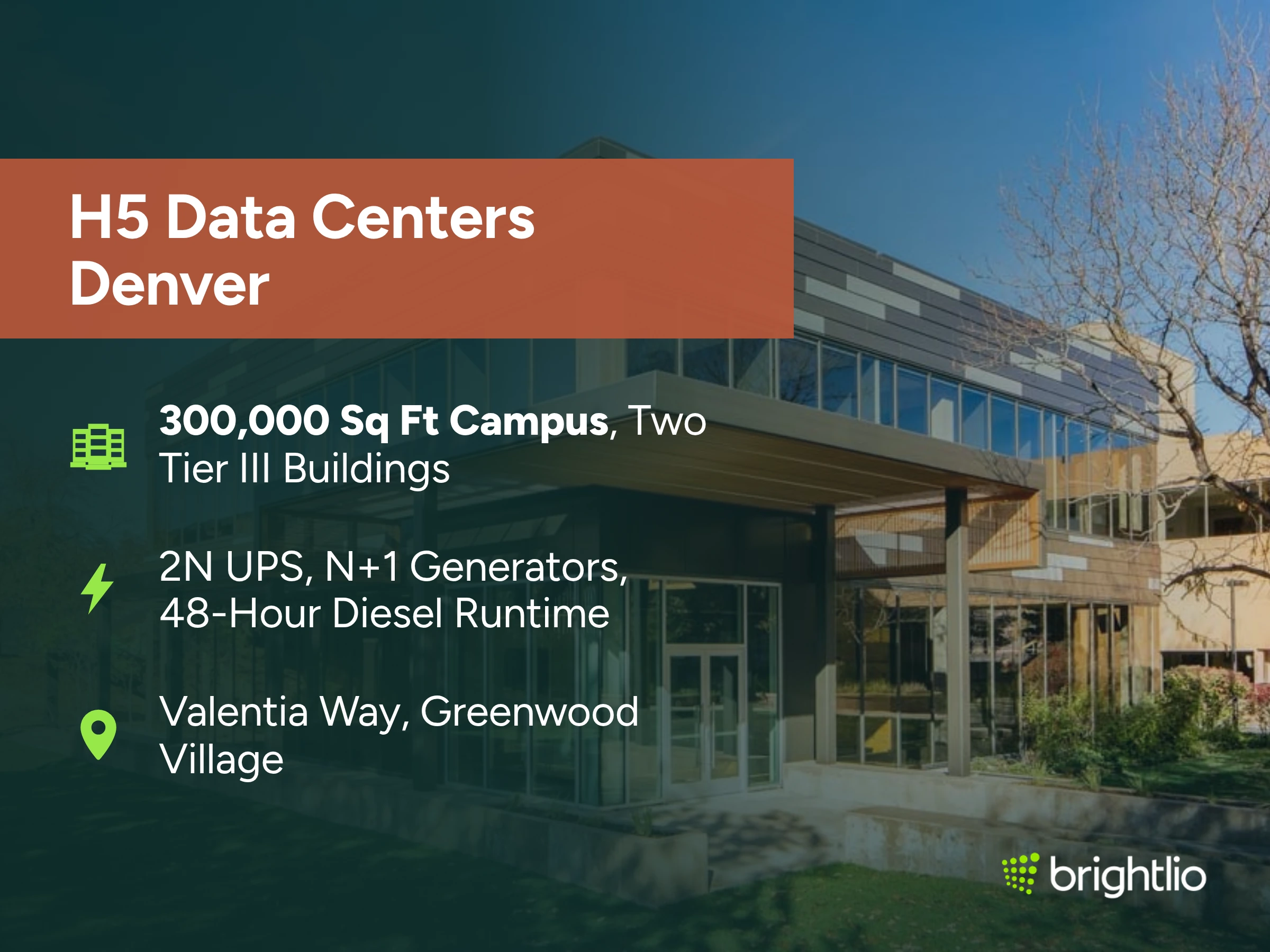
Location: 5350 South Valentia Way, Greenwood Village. Operator: H5 Data Centers.
H5 describes a 300,000-square-foot campus on 12 acres in the Denver Tech Center. It comprises two independent data centers that the operator describes as Tier III and concurrently maintainable. Concurrent maintainability means the design supports planned maintenance without interrupting the critical load.
The operator lists 2N UPS power and N+1 backup generators. A UPS is an uninterruptible power supply that bridges interruptions in utility power.
In these labels, 2N indicates two complete sets of capacity. N+1 indicates the required capacity plus a spare component.
H5 lists 48 hours of diesel runtime and continuous on-site staffing. Its network services include carrier-neutral connectivity and cloud access options.
The campus square footage does not establish the server space available to a new customer. Buyers should request the proposed suite's electrical design and maintenance procedures, particularly when comparing redundancy claims from different operators.
4. EdgeConneX Denver
Location: 8535 and 8451 Highfield Parkway, Englewood. Operator: EdgeConneX.
The tracker groups EDCDEN01 and EDCDEN02 as a two-building operating campus. The operator's Denver data sheet identifies both Highfield Parkway addresses and describes power systems designed for concurrent maintenance.
Its specifications include N+1 redundancy and branch-circuit monitoring. Branch-circuit monitoring measures power on the circuits supplying customer equipment, helping operators identify changes in electrical load.
The tracker does not assign the campus a comparable operating MW total. A proposal should state the building and data hall that will serve the deployment, with usable IT capacity shown separately from the wider campus design.
For dense equipment, provide the operator with the actual server configuration. The review should establish the supported rack load during normal operation and maintenance.
5. CoreSite Denver DE1
Location: 910 15th Street, Denver. Operator: CoreSite.
CoreSite DE1 operates in a downtown carrier hotel. Its role centers on interconnection with telecommunications networks and cloud services. The operator connects DE1 with its DE2 facility through high-capacity fiber.
CoreSite's Denver campus lists more than 30 cloud offerings. The campus totals cover the wider ecosystem and should not be read as a count of services physically present in every room.
For buyers that need several network connections, DE1 deserves consideration based on the required providers and connection options. Confirm whether each connection is delivered in the building or through another location.
Connection delivery affects installation time and cost. Obtain a quote for the complete path to the required cloud service, including any transport and cloud-provider charges.
Drawbacks Of Colocating In Colorado
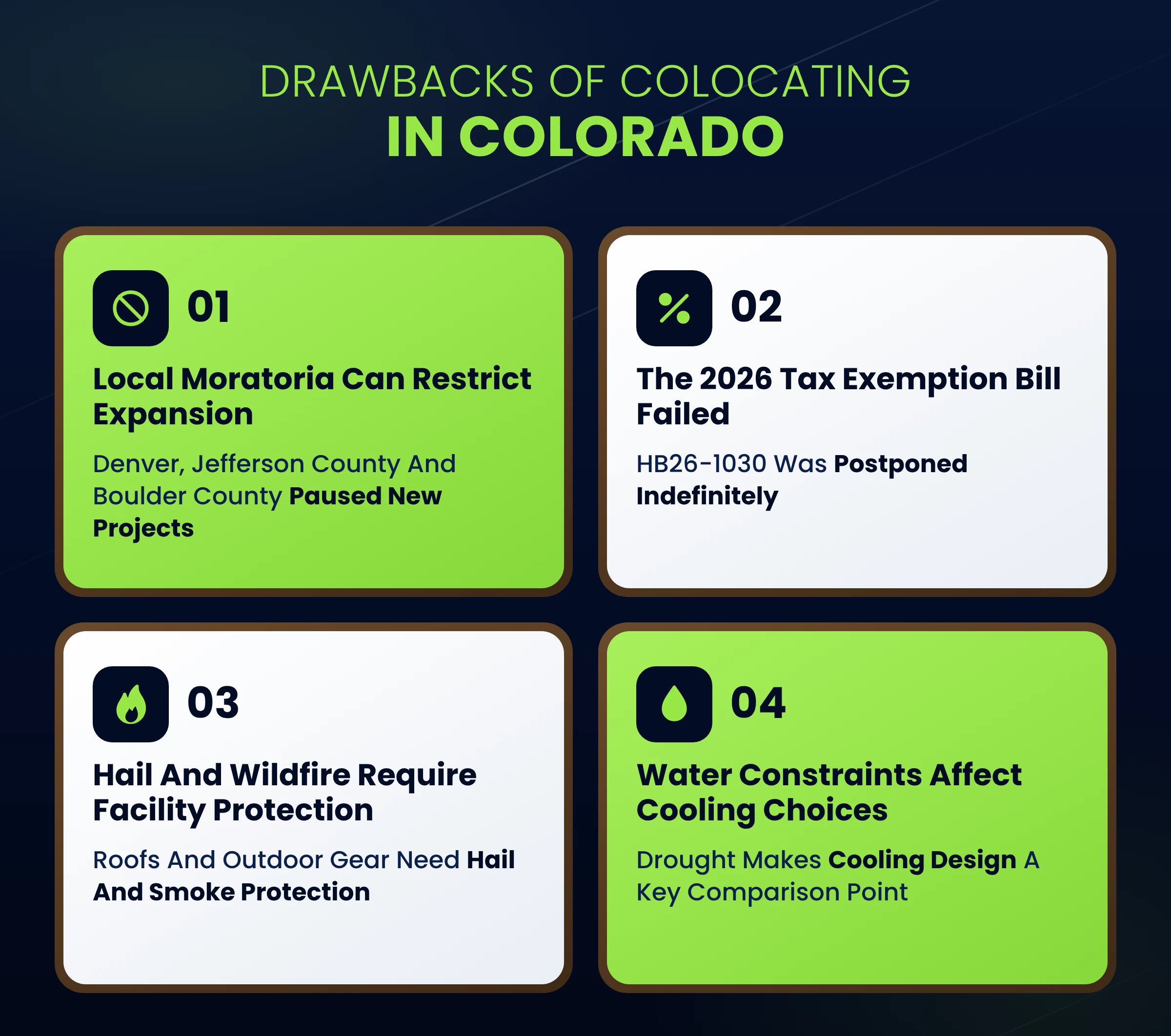
Colorado's operating market offers a useful range of providers. Local development restrictions can affect expansion, while the failed incentive bill changes the tax assumptions buyers can use. Environmental exposure requires a separate assessment at each address.
1. Local Moratoria Can Restrict Expansion
Denver's data center moratorium began May 21, 2026, with a one-year term. The city pauses applications for new primary-use data centers and expansions of existing facilities. Existing facilities can continue operating.
Jefferson County adopted a 10-month moratorium on May 19, 2026. Its rules exempt certain land already zoned for data centers through a Planned Development when the facility is at least 1,500 feet from a dwelling. Boulder County enacted a six-month moratorium from June 2, 2026, covering unincorporated areas.
These are local measures with different scopes. Buyers expecting to add substantial capacity should establish whether that growth uses already approved operating space or depends on a further land-use approval.
2. The 2026 Tax Exemption Bill Failed
Colorado's proposed data center incentive legislation, HB26-1030, was postponed indefinitely on May 7, 2026. Its proposed sales tax exemption did not become law through that bill.
A Colorado budget should therefore use the taxes applicable to the actual purchase and location. Any different exemption or local incentive needs its own eligibility review.
This matters when comparing a Colorado bid with a state offering a dedicated data center program. Ask each provider to identify the taxes included in its quote and the party responsible for claiming any available exemption.
3. Hail And Wildfire Require Facility Protection
The tracker identifies hail and wildfire among Colorado's main hazards. Facility review should cover the roof and outdoor equipment, with protection appropriate to the site's exposure. Wildfire assessment should include nearby vegetation and access routes.
Smoke deserves attention when a facility uses outside air for cooling. Ask the operator how it monitors air quality and changes cooling operation during smoke events. Review how filtration and backup cooling support the contracted IT load.
An urban location still needs its own hazard assessment. A statewide description of Colorado as low risk cannot establish the resilience of a particular building.
4. Water Constraints Affect Cooling Choices
Drought makes the cooling design part of a Colorado facility comparison. A system that rejects heat through evaporation has different water requirements from a dry-cooling design. The electricity required can differ, too.
Request water-consumption data with its measurement boundary and time period. Water usage effectiveness, or WUE, typically expresses site water use per unit of IT electricity. A useful comparison needs consistent definitions across proposals.
The water supplier's service terms matter alongside the equipment. Buyers should ask how the facility would maintain the required cooling during restrictions and what that operating mode would mean for their contracted capacity.
How Brightlio Helps You Choose A Colorado Data Center
Brightlio helps businesses compare colocation services against their technical requirements and budget. We can help narrow the Colorado shortlist around operating space, usable power, and the network connections your applications need.
Start with your current rack footprint and expected IT load. Identify workloads that require private cloud connections, then define your growth and recovery requirements. Those details give providers a consistent basis for preparing proposals.
Brightlio can help compare the resulting offers, including recurring power charges and cross-connect costs. Contact our team to discuss the Colorado locations that fit your deployment.
Frequently Asked Questions
1. How Many Data Centers Are In Colorado?
The tracker checked October 22, 2026, counts 54 facilities, including 44 operating sites. The operating total combines 10 campuses and 34 colocation facilities.
Data Center Map lists 60 facilities across five markets because its counting method differs. Shared buildings and separate suites can produce multiple directory entries. Use the counts to understand the market's breadth, then verify the actual operator and address when building a shortlist.
2. Is Denver Or Colorado Springs Better For Colocation?
Denver is a useful starting point when your priority is a wide provider shortlist and access to downtown network hubs. Colorado Springs deserves consideration for local operations or another regional location.
Compare the actual carrier routes and response times to your offices. For disaster recovery, evaluate shared utility and network dependencies between the proposed facility and your primary site. Application testing should determine whether the connection supports your recovery requirements.
3. How Much Does Colorado Colocation Cost?
The price depends on the space, usable power, and services in the agreement. A constant 5 kW IT load over 730 hours consumes 3,650 kWh. At Colorado's July 2026 commercial average, that equals about $504 in electricity.
This excludes cooling overhead and other colocation charges. Ask for a complete quote covering installation, bandwidth, and support. Brightlio's colocation pricing guide explains the components to compare.
4. Which Colorado Data Center Is The Largest?
The tracker does not support a reliable ranking of operating facilities by IT power. Some operators give campus capacity, while others give floor area or critical IT load.
For example, DataBank identifies 20 MW of critical IT load at its Centennial campus. Total campus power can include cooling and other support systems. Compare facilities using the same definition, with available customer capacity confirmed separately from the building's total capacity.
5. Can Colorado Colocation Connect Directly To Public Clouds?
Some facilities provide private cloud connectivity through their network ecosystems or connection platforms. CoreSite and H5 describe cloud connection options in Denver. Confirm the specific cloud provider and destination region before choosing a service.
Ask whether the connection originates in your building or requires transport to another facility. The proposal should identify the connection speed and the relevant charges. A cloud connection alone does not establish that a cloud region operates inside the building.
6. Can Colorado Data Centers Support AI And Dense GPU Racks?
Suitability depends on the specific data hall and server configuration. Give the operator the expected rack load and the cooling requirements from your equipment supplier. Confirm how those requirements will be met during maintenance and a power interruption.
If liquid cooling is required, identify who supplies and maintains the cooling distribution equipment. A campus MW figure alone cannot establish support for an individual rack. The supported configuration should be part of the contract.
7. Does Colorado Offer A Data Center Tax Exemption?
The exemption proposed in HB26-1030 did not become law through that bill. The House committee postponed it indefinitely on May 7, 2026.
Buyers should budget using the taxes that apply to their actual equipment purchases and location. Other exemptions or local incentives require a separate eligibility review. Ask whether taxes are included in the provider's pricing and who is responsible for applying for any benefit the proposal assumes.
8. Do Colorado's Moratoria Close Existing Data Centers?
Denver's moratorium allows existing facilities to continue operating. It pauses applications for new primary-use data centers and expansions, with a one-year term beginning May 21, 2026.
Jefferson County and unincorporated Boulder County have separate measures with their own scopes. A buyer should confirm the rules at the actual address. Growth within approved operating space needs a different review from growth that requires a new building or land-use approval.
9. Does Free Cooling Mean A Colorado Data Center Uses No Water?
Free cooling uses suitable outdoor conditions to help remove heat. The term does not establish the site's water consumption.
An economizer can operate alongside cooling equipment that uses water, and some systems circulate water in a closed loop. Ask the operator to explain how heat leaves the facility during different seasons. Request measured water use and the relevant operating boundaries before comparing a waterless claim with another provider's cooling design.
10. Is Colorado A Good Disaster Recovery Location?
Colorado can be considered for disaster recovery when its location and network connections fit your primary site's risks. Review shared dependencies before assuming two facilities provide useful separation.
The assessment should cover utility infrastructure and fiber routes, with the area's wildfire, hail, and drought exposure considered at each address. Test replication and restoration against your recovery objectives. An appropriate location still needs a recovery process that your team can execute.

Tamzid is a cybersecurity researcher with 5+ years of experience across SaaS, security, compliance, data centers and cloud. He writes for brightdefense.com and hipaasimple.com, covering security, compliance, and infrastructure topics. Certified through Cisco, Fortinet (NSE 1), and the Basel Institute on Governance in OSINT, he grounds his work in primary sources and verified data.
Recent Posts

Top 5 Floating Data Centers
Data Centers and Colocation in Colorado
Data Centers and Colocation in Delaware
Data Centers and Colocation in Hawaii
Let's start
a new project together