
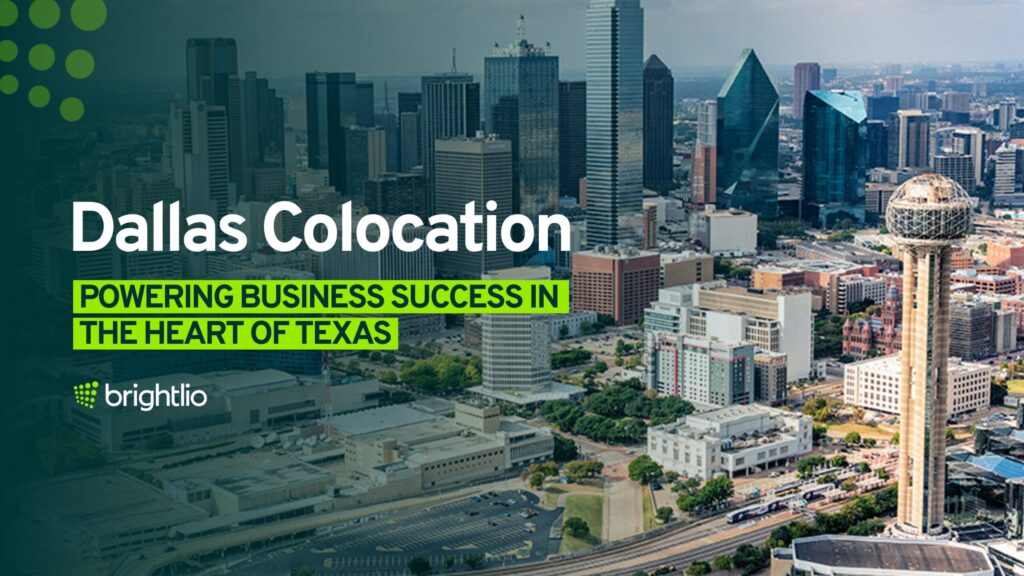
Whether you’re a burgeoning startup or a well-established enterprise, the ability to store, manage, and access data with speed, reliability, and security is paramount. This is where Dallas colocation stands out as a formidable solution that can reshape the way businesses operate.
Dallas is now one of the largest colocation markets in North America. Cushman & Wakefield ranked Dallas No. 3 in its 2025 Global Data Center Market Comparison, while CBRE says Dallas-Fort Worth is now a 1 GW colocation market, with about 700 MW under construction and another 3 GW planned.
Dallas, with its position as a major communications hub in the Southern U.S. and a deep ecosystem that includes 140+ cloud and network service providers and 240+ customers, offers an array of benefits that can give your business a competitive edge. In this blog post, we will delve into the world of Dallas colocation and explore the numerous advantages it brings to the table.
Whether you’re looking to improve your IT infrastructure, increase scalability, strengthen disaster recovery capabilities, or reduce costs, you’ll find that Dallas colocation is a powerful tool in your business arsenal.
Join us as we look at how Dallas colocation services can drive efficiency, resilience, and growth for your business in the digital age. From cost savings to stronger performance and everything in between, you’ll soon see why Dallas is an ideal destination for businesses seeking to harness the full potential of colocation.
Dallas Colocation Market Overview
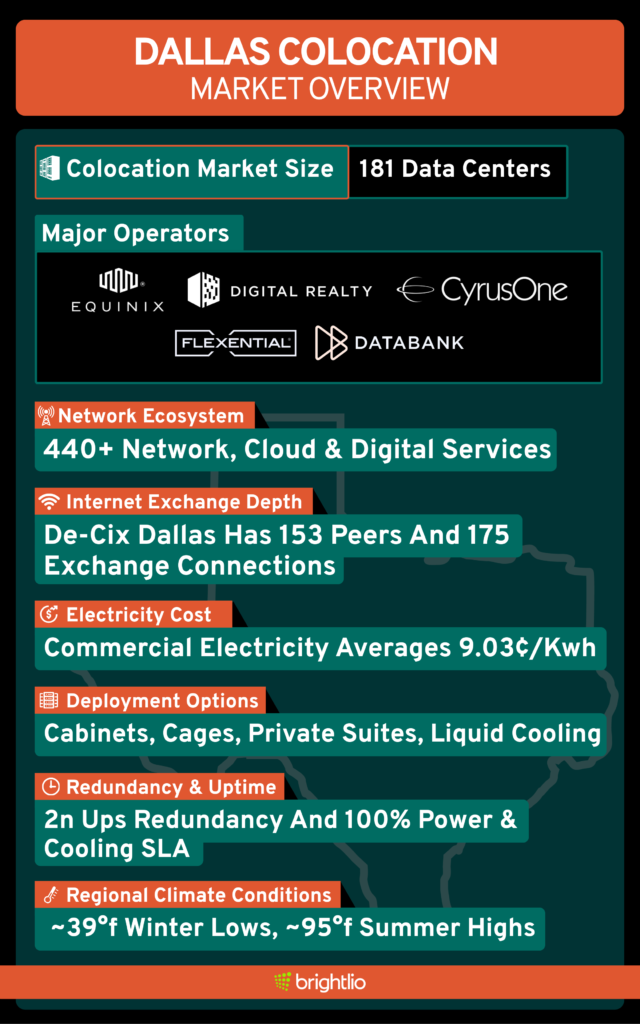
- Colocation Market Size: Dallas has 181 data center facilities listed in the metro market according to Data Center Map.
- Major Operators Present: Major colocation providers include Equinix, Digital Realty, CyrusOne, Flexential, and DataBank.
- Network And Interconnection Ecosystem: The Dallas interconnection ecosystem includes more than 440+ network, cloud, and digital service providers connected through Equinix facilities in the region.
- Internet Exchange Depth: DE-CIX Dallas reports 153 connected peers and 175 active exchange connections according to PeeringDB.
- Electricity Cost For Operations: Texas commercial electricity averaged 9.03¢/kWh according to the U.S. Energy Information Administration.
- Power Grid Reliability Context: Oncor is investing about $3 billion over four years through its System Resiliency Plan.
- High-Density Power Readiness: The Flexential Plano data center provides 18 MW of power across 261,425 square feet and supports cabinet densities above 80kW.
- Deployment Options: Dallas facilities offer cabinets, cages, private suites, wholesale deployments, and liquid cooling infrastructure through operators such as Digital Realty, DataBank, and Flexential.
- Redundancy And Uptime: Digital Realty Dallas facilities provide 2N UPS redundancy while Flexential Dallas locations publish a 100% power and cooling SLA.
- Compliance Coverage: Dallas operators support SOC 2, PCI DSS, and ISO 27001 compliance frameworks.
- Regional Climate And Cooling Conditions: Dallas averages winter lows around 39°F and summer highs near 95°F.
Dallas Offers a Strategic Geographic Location
Dallas’s strategic location is a key advantage that makes it an ideal destination for colocation data centers. Positioned in the heart of the United States, Dallas serves as a geographic hub, offering unparalleled connectivity and accessibility for businesses. Here’s how Dallas’s location plays a pivotal role in the success of colocation data centers:
Centralized Accessibility
Dallas is strategically located within easy reach of major cities across the country. This central location minimizes latency and reduces data transmission times, ensuring that businesses can serve their customers and clients with lightning-fast response rates. Whether your clients are in New York, Los Angeles, or anywhere in between, Dallas’s central position means that data can flow seamlessly, supporting a superior user experience.
Disaster Resilience
Dallas’s location offers a level of geographic stability that is reassuring for disaster recovery planning. Unlike some coastal cities prone to natural disasters, Dallas is relatively safe from hurricanes and earthquakes. This stability makes it an attractive choice for businesses looking to safeguard their critical data and operations.
Furthermore, what sets Dallas apart from many other major metropolitan areas is its energy infrastructure. Texas operates its own independent power grid, separate from the Eastern and Western grids of the United States.
This self-contained power grid provides a unique advantage in disaster recovery planning. In the event of power disruptions caused by natural disasters or other factors, Dallas’s colocation data centers can rely on a resilient and locally managed energy supply.
This added layer of independence can significantly reduce the risk of downtime and data loss during unforeseen circumstances. Companies building multi-site disaster recovery often pair a Dallas footprint with a second site outside Texas. A common central-U.S. option is colocation in Oklahoma, which connects back into Dallas on private transport at roughly 2ms.
Proximity to Business Hubs
Dallas is not only a bustling business hub in its own right but also in close proximity to other major business centers in Texas, such as Austin, Houston, and San Antonio. This makes it an excellent choice for companies that want to establish colocation facilities that cater to multiple regions within the state, further enhancing its appeal as a data center destination. For a statewide comparison, review colocation options across Texas.
In summary, Dallas’s strategic location in the heart of the United States provides a strong foundation for colocation data centers to thrive. Its central accessibility, global connectivity, disaster resilience, and proximity to key business hubs make it a prime choice for businesses seeking a reliable, high-performance colocation solution. Dallas truly stands as a gateway to business success through its strategic location for colocation data centers.

Power Costs in Dallas Are Lower Than the National Average
Texas operates largely within the ERCOT grid, which manages power for about 90% of the state's electric load. That structure does not remove federal involvement entirely, but it does leave Dallas in a very large state power market with deep in-state generation resources. As power remains one of the biggest expenses in colocation, that matters for overall operating costs and long-term site planning.
Dallas business power costs remain relatively low compared to many other major colocation markets. In 2024, Texas's average commercial electricity price was 8.55 cents per kWh, compared with the U.S. average of 12.75 cents per kWh. That was also well below California's 25.54 cents per kWh and slightly below Virginia's 8.72 cents per kWh. As power is one of the most important cost drivers for colocation services, lower electricity prices help support more competitive colocation pricing in Dallas. Compare the full breakdown of power, space, and connectivity costs when evaluating quotes. Texas also continues to operate a competitive retail electricity market, and ERCOT says about 85% of Texas electricity consumers can choose their retail provider.
In pursuit of renewable and sustainable power generation, Texas also benefits from a broad mix of energy sources that can support data center demand. EIA says Texas was the top U.S. dry natural gas-producing state in 2023, producing 9.75 Tcf. Within ERCOT, natural gas supplied 43% of electricity demand in the first nine months of 2025, while wind and solar together met 36%. Because the market draws on several major generation sources, providers have multiple power procurement paths, while Dallas facilities commonly add on-site redundancy such as 2N UPS and generator systems and feeds from 3 diverse utility substations.

Dallas Is a Highly Tech-Enabled Landscape
Dallas has positioned itself as a city with access to major cloud service providers. Google Cloud operates its Dallas region, us-south1, and IBM Cloud operates its Dallas multizone region, us-south, across three zones, with IBM adding DAL14 as a fourth availability zone in the Dallas area. This tech-enabled environment continues to support the growth of data centers.
With major technology and telecom employers such as Texas Instruments, whose executive offices are in Dallas, and AT&T, which continues to maintain its Dallas headquarters, businesses can draw from a strong local talent base. CBRE reports that Dallas-Fort Worth added 47,100 tech talent jobs between 2021 and 2024, with 26% growth, helping the metro continue to attract talent that can manage and service data center infrastructure.
There are also technical considerations around the Texas power grid. ERCOT manages about 90% of Texas electric load within the Texas Interconnection, which is separate from the Eastern and Western Interconnections. That structure can reduce direct exposure to disturbances on those other grids, although local reliability still depends on Texas-side preparedness and on-site redundancy. Since 2021, the Public Utility Commission of Texas has required weatherization compliance for generators and utilities, ERCOT continues weatherization inspections, and the PUCT has continued enforcement, including $334,000 in penalties assessed in January 2026. This policy pressure gives power supply companies more reason to protect operations against severe weather and other conditions that may affect reliable power supply.
Dallas Has an Abundance of Colocation Centers
Dallas is home to numerous data centers because it provides the resources they need to grow. With more than 80 business broadband providers operating across North Texas, more than one-third offering fiber service, and large-scale power capacity continuing to move into the market, more colocation facilities continue to come online across the metro. Dallas-Fort Worth is now one of the largest colocation markets in the United States. CBRE says the market has reached 1 GW of colocation capacity, with about 700 MW under construction and another 3 GW planned.
Many businesses choose to have their headquarters or major operations in Dallas-Fort Worth. The Dallas Regional Chamber says the region is home to 21 Fortune 500 companies, helping support a strong local ecosystem for data center space and related services. Data Center Map now lists 217 data centers in Dallas, Texas, run by 50 operators. The market footprint extends well beyond downtown Dallas into surrounding submarkets across the metro.
The abundance of colocation service providers gives you a wide variety to choose from in an area built to provide dependable support. Retail colocation options are widely available across the market. Digital Realty alone lists 12 Dallas-area data centers, while Equinix lists 8 Dallas data centers, alongside other operators serving the region.

Dallas Has Fantastic Internet Connectivity and Network Infrastructure
Fiber infrastructure in Dallas is robust, with extensive interconnectivity and high-bandwidth access. In North Texas, more than 80 business broadband providers operate across the region, and more than one-third offer fiber service. Dallas also has dense carrier infrastructure inside major interconnection facilities. Cologix says the Infomart has more than 8,700 strands of fiber and the largest number of carriers of any single building within a 900-mile radius.
With multinational telecommunications companies and cloud platforms active in the area, colocation customers have a wide range of network and interconnection options. Digital Realty says its Dallas market includes more than 140 cloud and network service providers, while Equinix says Dallas is the largest hub for communications and exchange in the South Central United States. Data centers in Dallas can also connect privately to major cloud platforms through services such as AWS Direct Connect, Microsoft Azure ExpressRoute, and Google Cloud connectivity, supporting secure and low-latency access to essential cloud environments. For a closer look at carrier choice, compare the benefits of carrier-neutral facilities.
With a central location in the middle of the United States, Dallas data centers also help businesses serve customers across major national markets. The Dallas Regional Chamber notes that North Texas sits in the Central Time Zone, which helps companies operate across both coasts, while Equinix says Dallas offers quick access to Latin American routes. That combination supports strong domestic reach and relatively efficient connectivity into Mexico and other parts of Latin America.
Dallas Enables Business Scalability
Dallas ranks well below many other major U.S. metropolitan areas when it comes to the cost of doing business. The Dallas Regional Chamber says the cost of doing business is up to 5% lower in DFW than the national average, and notes that labor and rent costs in Dallas and Fort Worth also rank below many large U.S. markets, including Los Angeles, San Diego, San Francisco, and San Jose. Texas also continues to offer a broad set of grants, financing tools, and tax refund programs that support business expansion and relocation.
Dallas also has one of the largest concentrations of corporate headquarters in the country, with the Dallas Regional Chamber reporting 21 Fortune 500 companies in DFW in 2025. That concentration helps sustain strong demand for data centers and related services. At the same time, the size of the provider ecosystem helps keep the market competitive. CBRE says Dallas-Fort Worth has reached 1 GW of colocation capacity, with about 700 MW under construction and another 3 GW planned.
With Dallas Fort Worth International Airport and Dallas Love Field, Dallas presents a major opportunity for new and expanding businesses. The region also offers access to a large and growing skilled labor pool. CBRE reports that Dallas-Fort Worth added 47,100 tech talent jobs between 2021 and 2024, with 26% growth. That combination of air access, business scale, and workforce depth gives companies room to grow in Dallas.
Dallas Has an Abundance of Affordable Real Estate
Dallas continues to offer a cost advantage for companies comparing major U.S. markets. The Dallas Regional Chamber says the cost of doing business in DFW is up to 5% lower than the national average, and Moody’s North American Cost Review places the Dallas Metro Division at an overall business-cost index of 100.5, compared with 119.8 for Los Angeles, 169.6 for San Jose, and 202.2 for San Francisco. Office real estate also remains comparatively attainable. CoStar data in the chamber’s 2025 guide shows DFW with about 432,478,520 square feet of office inventory and an average asking rent of $32.10 per square foot. This continues to make the city attractive for companies seeking and providing colocation services.
Due to severe weather risks, buildings in Dallas are subject to current construction codes that account for structural and wind-resistance requirements. The City of Dallas says its construction rules are based on the 2021 International Building Code with local amendments, effective May 12, 2023, and the Texas Department of Insurance says required wind speeds must be determined for each structure based on its location. This code framework adds another layer of safety for many colocation centers in the city.
Dallas Offers Lucrative Tax Incentives for IT
Texas offers significant sales-tax incentives that can benefit qualified data center projects in the Dallas market. In 2013, Texas lawmakers passed House Bill 1223, which created the state's qualified data center sales-tax exemption, now administered by the Texas Comptroller. Under the current program, a qualifying data center must generally commit to at least $200 million in capital investment over five years and create at least 20 qualifying jobs. Qualifying large data center projects face higher thresholds of $500 million, 40 qualifying jobs, and at least 20 megawatts of transmission capacity.
For qualified data centers, certain necessary and essential items are exempt from the 6.25% state sales and use tax, including electricity, cooling systems, emergency generators, servers and hardware, data storage devices, network connectivity equipment, and software. For standard qualified data centers, the exemption lasts 10 or 15 years depending on whether investment reaches at least $200 million or $250 million in the first five years, and local sales and use tax still applies. For qualifying large data center projects, qualifying purchases are exempt from both state and local sales and use tax for 20 years.
As a central U.S. market, Dallas also benefits from quick access to Latin American routes, which adds to its appeal for national and international deployments. The Texas Comptroller's current registry already includes qualifying Dallas-area projects in Allen, Richardson, Red Oak, Garland, Irving, and Dallas, showing that the incentive structure continues to support data center growth across the metro.

Dallas Data Center Options We Recommend
Dallas has many data center options to choose from. Here are a few options Brightlio recommends:
1. Cologix
Cologix operates three data centers in the city, DAL1-DAL3. All three data centers are located near downtown Dallas in the renowned Infomart building at 1950 North Stemmons Freeway. Dallas Infomart is the region's preeminent carrier hotel and a major interconnection hub for the South Central United States. In total, Cologix offers more than 53,000 square feet of colocation space in Infomart.
Why we recommend these data centers:
- Strong network connectivity and bandwidth options in one of the most connected communications markets in the U.S.
- Cologix operates a core Meet-Me-Room in the Infomart building
- The building has more than 8,700 strands of fiber and the largest number of carriers of any single building within a 900-mile radius
- Direct cloud connectivity to AWS Direct Connect and Microsoft Azure ExpressRoute
- Cologix operates 45+ data centers across 13 strategic North American edge markets
2. Csquare (formerly Evoque)
Csquare now operates three data centers in the Dallas-Fort Worth region, following the 2024 rebrand that combined Evoque and Cyxtera under the Centersquare name. Its Allen DFW2 site is located 20 miles north of Dallas with easy access to both DFW International Airport and Dallas Love Field Airport. It offers 43,366 square feet of raised floor space, 8.6MW of utility power, 12 carrier-neutral service providers, and 24/7 on-site staffing.
Csquare's Dallas DFW3 data center is larger, with 61,348 square feet of raised floor space and 18.3MW of utility power. It features 16 carrier-neutral service providers, cloud and point-to-point connectivity, and a 100% SLA on power, network, and bandwidth.
Why we recommend these data centers:
- Ample capacity across three Dallas-Fort Worth sites, with more than 238,000 square feet of raised floor and 78.8MW of combined utility power
- Csquare's broader footprint across 80 data centers in 16 North American markets and London gives enterprises a strong platform for a national colocation strategy
- The Allen and Dallas sites meet multiple compliance standards, including SOC 1 Type II, SOC 2 Type II, PCI-DSS, and ISAE 3402
3. Flexential
Flexential has three data center options in the area located in downtown Dallas, Plano, and Richardson. Combined space in the market is 459,000+ square feet, with 28.4 MW of market power. Flexential also offers Remote Hands, DDoS scrubbing, disaster recovery, and other support options. The distinction between remote hands and managed support helps set expectations for ongoing operations.
Why we recommend these data centers:
- Three sites to choose from give enterprises multiple space, bandwidth, and support options
- Flexential says its data centers have the capability to deliver more than 1,500 watts per square foot, and its Plano site is built for high-density deployments with efficient cooling support
- Flexential supports both retail and wholesale colocation models, giving customers more deployment flexibility
4. Psychz
Psychz's Dallas data center presence is located at 1515 Round Table Drive in Dallas. Psychz describes its Dallas footprint as carrier neutral, with access to 1,000 major Internet hubs and a Dallas network hub at 1950 North Stemmons Freeway. Psychz also offers colocation options ranging from single-server deployments to quarter-rack, half-rack, full-cabinet, and cage configurations.
Why we recommend Psychz Dallas:
- Multiple space and power options including single server, quarter rack, half rack, full cabinet, and cage configurations
- Carrier-neutral connectivity with access to 1,000 major Internet hubs through Psychz's Dallas network footprint
- With other U.S. locations in Los Angeles, Chicago, and Ashburn, Psychz is a good partner for a national colocation or disaster recovery strategy

Brightlio Delivers Dallas Colocation!
If you're in the market for colocation services, a Dallas, TX data center might be right for you. Dallas is a growing tech hub that provides reliable and affordable power supply, robust fiber connectivity, and favorable tax incentives.
If you are interested in learning more about colocation space in Dallas, or other locations, Brightlio can help. Our global network of colocation providers means we have the right partner for your needs and budget. We offer services from single-server colocation to dedicated servers, racks, cabinets, cages, and suites. As a telecommunication broker, our services are free to you.
Brightlio is also leading provider of network connectivity, unified communications, cloud-on ramps, and public cloud services. Our service portfolio makes us the perfect partner for all your technology requirements.
Request Dallas colocation quotes.
FAQ
DataCenterMap’s Dallas market page lists 217 data centers, while its Texas market rollup lists 181 for Dallas, which reflects how directory counts can change as listings are updated.
Dallas is widely positioned as a major communications and exchange hub in the South Central United States, and large carrier rich facilities in the area support many on site connectivity options.
Yes. Several operators cluster around 1950 North Stemmons Freeway, and providers describe the Infomart building as a carrier hotel and interconnection hub with many on site carriers.
Yes. Texas offers sales and use tax exemptions for qualifying data centers under a Comptroller administered program, with specific eligibility and documentation requirements.
A cabinet fit works for small footprints, a cage fit works for multi rack deployments that need a defined security boundary, and a private suite fit works for larger deployments that need dedicated space and more control over layout and access.
Power resilience questions should cover whether the site is concurrently maintainable, what redundancy design is in place, and what planned maintenance looks like, since these items shape how maintenance and failures affect IT operation.
Colocation bills commonly reflect power fees, bandwidth charges, connectivity expenses, change fees, and support costs, and cross connect fees can add meaningful one time and recurring charges plus lead times.
Yes. Remote hands services let customers delegate physical tasks in the facility to on site technicians, which supports day to day operations when staff are not local.
- Confirm rack space, power commit, and delivery dates in the order form
- Schedule cross connects early because they can take time and may require extra paperwork
- Plan IP transit and routing, then test connectivity before production cutover
- Set up access procedures, badges, and approved visitor lists for installs and break fix work
- Run an acceptance test for power, network, and monitoring after the first in
Dallas has a large data center market, and one major directory lists 217 data centers in Dallas, Texas
The largest employment supersector in the Dallas–Fort Worth–Arlington metro area is Trade, Transportation, and Utilities, listed at about 925.7 thousand jobs (not seasonally adjusted, Dec 2025 preliminary)
In the United States, ranked by 2025 active IT capacity, the top five are Amazon Web Services (2.3 GW), Meta (1.5 GW), Microsoft Azure (1.2 GW), Equinix (995 MW), and QTS (811 MW)

Adetayo Sogbesan writes for Brightlio on data center, cloud, and network infrastructure topics, delivering insights that help businesses optimize technology strategies and understand industry trends.
Recent Posts

Data Centers In Pennsylvania

Data Centers In Nebraska

Data Centers In Mississippi

Data Centers In Indiana
Let's start
a new project together