
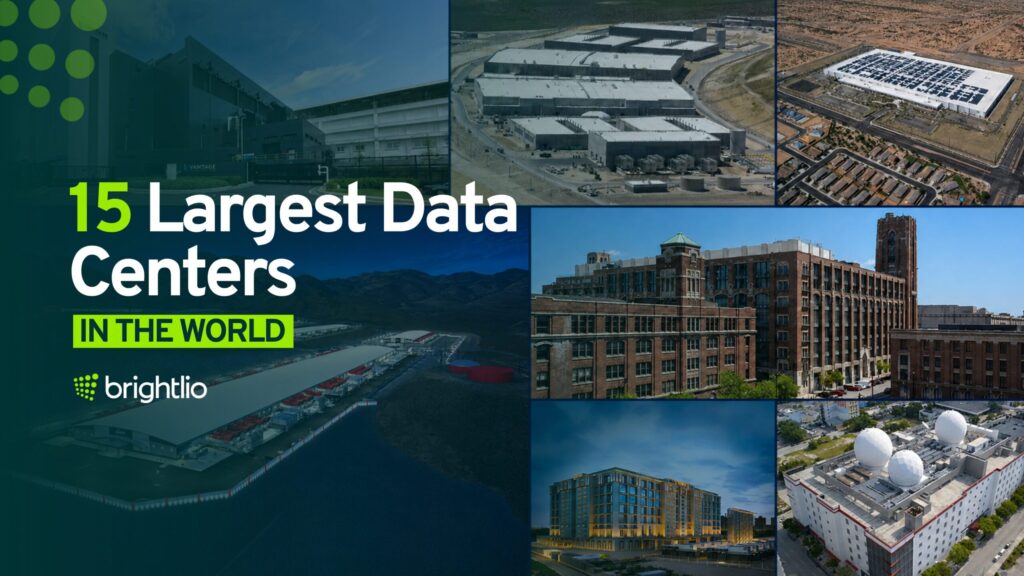
Data centers now measure in the millions of square feet. The biggest ones run entire campuses of server halls, power systems and cooling plants that keep the world’s largest platforms online.
This article ranks the 15 largest data centers in the world, with the operator, location, size and status behind each campus.
Let’s break it down, starting at number 15 and working up to the largest facility on the planet.
Largest Data Centers Compared
The comparison table and profiles run from 15 to 1. Ties at 2.5 million square feet are ordered by the recency and clarity of the available operating evidence, not by invented precision.
| Rank | Data Center | Cited Size |
|---|---|---|
| 15 | China Mobile Harbin | Over 1.72 million sq ft |
| 14 | Switch Citadel | 1.82 million sq ft |
| 13 | Switch Core | Over 2 million sq ft |
| 12 | China Mobile Hohhot | 2.18 million sq ft |
| 11 | Meta DeKalb | 2.3 million sq ft |
| 10 | Meta Huntsville | Nearly 2.5 million sq ft |
| 9 | Meta New Albany | 2.5 million sq ft |
| 8 | Meta Stanton Springs | 2.5 million sq ft |
| 7 | Meta Eagle Mountain | 2.5 million sq ft |
| 6 | Google Council Bluffs | 2.89 million sq ft |
| 5 | Meta Sarpy | 4 million sq ft |
| 4 | Meta Altoona | Over 4.1 million sq ft |
| 3 | Meta Prineville | 4.6 million sq ft |
| 2 | Range International Information Hub | 4.88 million sq ft |
| 1 | China Telecom Inner Mongolia Information Park | 10.8 million sq ft |
15 Largest Operational Data Centers in the World
Each profile below lists the operator, location, building area and current status, along with the power capacity, rack count or green-building certification published for that site.
Footprints run from 1.72 million square feet to 10.8 million square feet, and every campus is in service today. The 15 entries begin at number 15 and climb to the largest operating data center in the world:
15. China Mobile Harbin Data Center
- Operator: China Mobile
- Location: Harbin, Heilongjiang, China
- Building Area: Over 1.72 million sq ft
- Rack Capacity: 18,000
- Design Standard: T3+
- Status: Operational
China Mobile’s Harbin Data Center is one of the operator’s three major national data centers and a central facility for northern China’s computing infrastructure. Located in Harbin’s Pingfang District, the campus supports Heilongjiang’s digital economy through large-scale data processing and storage infrastructure.
The campus contains five data center buildings covering more than 160,000 square meters. China Mobile’s investment exceeds RMB 12 billion, reflecting the site’s importance within its national infrastructure network. Its combination of building space and rack capacity provides substantial room for servers, storage systems, and networking equipment.
Harbin’s cold climate gives the location a practical cooling advantage. Low outdoor temperatures create opportunities to use natural cooling during colder periods, reducing the mechanical refrigeration needed to remove server heat. For a campus of this scale, cooling efficiency directly affects electricity consumption and operating costs.
14. Switch Citadel Campus
- Operator: Switch
- Location: Storey County, Nevada, USA
- Building Area: 1.82 million sq ft across TR1 and TR2
- Power Capacity: Up to 185 MW across both buildings
- Year Opened: 2017
- Status: Operational
Switch’s Citadel Campus is a large colocation complex within the Tahoe Reno Industrial Center. Colocation allows businesses to house their servers in a facility that supplies power, cooling, security, and network connectivity. The campus occupies a 2,000-acre property and accommodates enterprise applications, cloud infrastructure, and demanding computing workloads.
Connectivity is a major feature of the Citadel Campus. Switch’s SUPERLOOP fiber network connects Tahoe Reno with Las Vegas, San Francisco, and Los Angeles. Dedicated connections between Switch’s Nevada campuses support businesses that distribute applications and backup systems across separate locations.
The campus uses 100% renewable electricity and incorporates redundant power systems to support continuous operation. Physical protection includes a 20-foot concrete perimeter wall, round-the-clock security, and on-site fire and safety personnel. These features combine substantial computing capacity with the network access and operational support needed for business-critical systems.
13. Switch Core Campus
- Operator: Switch
- Location: Las Vegas, Nevada, USA
- Building Area: Over 2 million sq ft
- Power Capacity: Up to 315 MW
- Year Opened: 2003
- Status: Operational
Switch’s Core Campus is a major colocation hub in Las Vegas, supporting enterprise IT, cloud services, and large computing deployments. Its multiple buildings give businesses room to expand their equipment within the same campus while retaining access to shared connectivity and operational support.
The campus uses 100% renewable electricity and includes facilities built to Switch’s proprietary Tier 5 standard. LAS VEGAS 8, 9, and 10 follow this design framework. The addition of LAS VEGAS 10 contributed nearly 350,000 square feet and up to 40 MW of power, illustrating the scale of individual buildings within the complex.
The Core’s network connections include 5-millisecond connectivity to Los Angeles and a dedicated 7-millisecond fiber connection to the Citadel Campus in Tahoe Reno. These connections support businesses that need fast access to West Coast markets or want to distribute applications and backup systems between geographically separate facilities.
12. China Mobile Hohhot Data Center
- Operator: China Mobile
- Location: Hohhot, Inner Mongolia, China
- Building Area: 2.18 million sq ft
- Rack Capacity: 23,600
- Year Opened: 2016
- Status: Operational
China Mobile’s Hohhot Data Center is a major cloud and computing campus serving government agencies, financial institutions, and internet businesses. It supports China’s East Data, West Computing initiative, which connects demand in eastern population centers with computing infrastructure in western regions. The campus supplies computing resources to Beijing, Tianjin, Hebei, and other markets.
Its services include server hosting, public cloud, private cloud, and AI computing. The campus’s liquid-cooled AI computing center contains more than 2,300 AI servers across eight computing clusters. These systems support large AI model training and applications in government, healthcare, energy, and customer service.
Energy efficiency is a central feature of the campus. Hohhot’s cold climate supports natural cooling, while heat recovery systems reuse server heat to warm offices and other campus spaces. Dual electricity feeds, diesel generators, and battery backup support continuous operation during power interruptions.
11. Meta DeKalb Data Center
- Operator: Meta
- Location: DeKalb, Illinois, USA
- Building Area: 2.3 million sq ft
- Certification: LEED Gold
- Year Opened: 2023
- Status: Operational
Meta’s DeKalb Data Center forms part of the global infrastructure behind the company’s social media and messaging services. The campus occupies 500 acres, 65 miles west of Chicago, and represents an investment exceeding $1 billion. Its location provides access to regional infrastructure, renewable energy projects, and construction and operations workers.
The campus incorporates hot aisle containment, which separates heated server exhaust from cooler intake air. Water conservation measures include repeated water reuse, native landscaping that reduces irrigation needs, and rainwater capture. Meta matches its electricity consumption with clean and renewable energy.
DeKalb hosted a distinctive AI-assisted concrete pilot with the University of Illinois Urbana-Champaign. The project used artificial intelligence to help develop concrete mixes with a lower environmental impact. Construction involved prefabricated walls and electrical infrastructure produced off-site, supporting consistent assembly across the large campus.
10. Meta Huntsville Data Center
- Operator: Meta
- Location: Huntsville, Alabama, USA
- Building Area: Nearly 2.5 million sq ft
- Certification: LEED Gold
- Year Opened: 2021
- Status: Operational
Meta’s Huntsville Data Center is the company’s first data center in Alabama and supports its global social media and messaging infrastructure. Located in the North Huntsville Industrial Park, the campus represents an investment exceeding $1.5 billion. Construction began in 2018, with the first buildings entering service in 2021.
Meta works with the Tennessee Valley Authority to plan the campus’s electricity supply. The company matches its electricity consumption with clean and renewable energy, with supporting projects that include solar generation in Muscle Shoals, Alabama. Huntsville Utilities provides water and wastewater services for the facility.
Water conservation measures include repeated water reuse before discharge, rainwater capture, and native landscaping that reduces irrigation demand. The operational buildings hold LEED Gold certification, a green-building rating that evaluates areas such as energy efficiency, water use, and materials. These features address the resource demands of running a large computing campus continuously.
9. Meta New Albany Data Center
- Operator: Meta
- Location: New Albany, Ohio, USA
- Building Area: 2.5 million sq ft
- Certification: LEED Gold
- Year Opened: 2020
- Status: Operational
Meta’s New Albany Data Center was the company’s first facility in Ohio. Construction began in 2017, and the campus now supports the computing and storage infrastructure behind Meta’s social media and messaging platforms. The site represents an investment exceeding $1.5 billion and supports more than 300 operational jobs, including roles in electrical maintenance, cooling systems, and server management.
American Electric Power works with Meta on the campus’s electricity requirements, while the City of Columbus provides water and wastewater services. Meta matches its electricity consumption with clean and renewable energy, supported through projects that add generation to the grid.
The campus combines water-efficient cooling with repeated water reuse before discharge. Rainwater capture, water-saving fixtures, and native landscaping help reduce demand on local supplies. Its operational buildings hold LEED Gold certification, reflecting measures addressing energy performance, water efficiency, and construction materials across the facility.
8. Meta Stanton Springs Data Center
- Operator: Meta
- Location: Newton County, Georgia, USA
- Building Area: 2.5 million sq ft
- Certification: LEED Gold
- Year Opened: 2020
- Status: Operational
Meta’s Stanton Springs Data Center supports the computing and storage systems behind the company’s social media and messaging platforms. Construction began in 2018, and the facility entered service in 2020. The campus forms part of Meta’s investment exceeding $2 billion in Georgia.
Walton Electric Membership Corporation supplies electricity to the campus and works with Meta on its energy requirements. Meta matches its electricity consumption with clean and renewable energy. Its operational buildings hold LEED Gold certification, which evaluates building performance across energy use, water efficiency, materials, and other environmental criteria.
Newton County Water and Sewerage Authority provides water and wastewater services. The campus uses water-efficient cooling technology and recirculates water multiple times before discharge, reducing the amount of fresh water needed for operations. Native vegetation limits irrigation demand, while water-saving fixtures reduce consumption inside the buildings. Meta covers its utility service costs and funds the infrastructure required to connect the facility.
7. Meta Eagle Mountain Data Center
- Operator: Meta
- Location: Eagle Mountain, Utah, USA
- Building Area: 2.5 million sq ft
- Certification: LEED Gold
- Year Opened: 2021
- Status: Operational
Meta’s Eagle Mountain Data Center supports the computing and storage infrastructure behind the company’s global platforms. Construction began in 2018, and the campus entered service in 2021. The facility supports more than 300 operational jobs, including positions in server maintenance, electrical systems, and cooling.
The campus uses prefabricated building components produced at a manufacturing facility in West Jordan, Utah. These include concrete structures that protect underground electrical conduits, wall assemblies, and hot-aisle containment systems. Hot-aisle containment separates warm server exhaust from cool supply air, helping maintain suitable operating temperatures. Manufacturing these components off-site reduced the assembly work required at the campus.
Rocky Mountain Power works with Meta on electricity requirements, while Eagle Mountain City provides water and wastewater services. The facility reuses cooling water multiple times before discharge. Native vegetation and water-saving fixtures reduce other water demands, complementing the efficiency measures reflected in its LEED Gold certification.
6. Google Council Bluffs Data Center
- Operator: Google
- Location: Council Bluffs, Iowa, USA
- Building Area: 2.89 million sq ft
- Facility Type: Hyperscale Campus
- Year Opened: 2009
- Status: Operational
Google’s Council Bluffs Data Center supports services including Google Search and YouTube. The company announced its initial $600 million investment in 2007, and operations began in 2009. Subsequent expansions added computing capacity across the campus, making Council Bluffs a major location within Google’s global infrastructure.
The facility combines cooling towers with controlled airflow inside its equipment rooms. In the campus network room, cool air enters through the floor, while transparent containment curtains prevent warm air from mixing with the cold supply. This separation directs cooling toward the equipment that needs it and helps maintain suitable operating temperatures.
Routers and switches connect Council Bluffs with Google’s other data centers through high-speed fiber-optic links. Overhead cable trays organize these connections, while the building’s steel framework supports electrical distribution. These cooling, networking, and power systems support the continuous operation of the campus’s computing equipment.
5. Meta Sarpy Data Center
- Operator: Meta
- Location: Papillion and Springfield, Nebraska, USA
- Building Area: 4 million sq ft
- Certification: LEED Gold
- Year Opened: 2019
- Status: Operational
Meta’s Sarpy Data Center spans Papillion and Springfield and supports platforms including Facebook and Instagram. Construction began in Papillion in 2017, with operations starting in 2019. Expansion across Capehart Road into Springfield prompted the Sarpy name in 2021. The nine-building campus brings together server facilities and the infrastructure needed to operate them.
Omaha Public Power District supplies electricity to the site. Meta matches its electricity consumption with renewable energy, supported through wind investments that include a project in Dixon County, Nebraska. The campus supports more than 300 operational jobs across server maintenance, networking, electrical systems, and cooling.
Metropolitan Utilities District provides water services. The facility uses water-efficient cooling and recirculates water multiple times before discharge. Rainwater capture, native vegetation, and water-saving fixtures reduce other water demands. Its operational buildings hold LEED Gold certification, reflecting measures addressing energy efficiency, water use, and construction materials.
4. Meta Altoona Data Center
- Operator: Meta
- Location: Altoona, Iowa, USA
- Building Area: More than 4.1 million sq ft
- Certification: LEED Gold
- Year Opened: 2014
- Status: Operational
Meta’s Altoona Data Center supports the company’s global social media and messaging infrastructure. Construction began in 2013, and operations started in 2014. The campus supports more than 400 operational jobs across server maintenance, networking, electrical systems, and cooling.
Altoona was the first site to deploy Meta’s data center fabric, a network design that connects groups of servers through multiple paths. Its original design organized equipment into pods containing 48 server racks each. This modular structure allows network capacity to grow through added switches and helps traffic route around failed components. The building layout places central networking equipment close to the data halls to shorten cable runs.
MidAmerican Energy supplies electricity to the campus, while the City of Altoona provides water and wastewater services. Meta matches its electricity consumption with clean and renewable energy. Water-efficient cooling, repeated water reuse, and rainwater capture help manage the facility’s water requirements.
3. Meta Prineville Data Center
- Operator: Meta
- Location: Prineville, Oregon, USA
- Building Area: 4.6 million sq ft
- Certification: LEED Gold
- Year Opened: 2011
- Status: Operational
Meta’s Prineville Data Center was the company’s first purpose-built data center. Construction began in 2010, and the campus opened in 2011. It supports Meta’s global computing infrastructure and more than 350 operational jobs, including positions in server maintenance, electrical systems, and cooling.
Prineville provided the original server, power, and building designs shared through the Open Compute Project, an initiative that publishes hardware specifications for wider industry use. Its original design combined custom-built servers with a 480-volt electrical distribution system to reduce power losses. Warm server exhaust heated offices and incoming outside air during winter, putting waste heat to practical use.
Pacific Power supplies electricity to the campus, while the City of Prineville provides water and wastewater services. Meta matches its electricity consumption with clean and renewable energy. Water-efficient cooling, repeated water reuse, and rainwater capture help manage demand on local water supplies.
2. Range International Information Hub
- Operator: Range IDC / Runze Technology
- Location: Langfang, Hebei, China
- Building Area: 4.88 million sq ft
- Facility Type: Hyperscale Campus
- Power Supply: Independent Utility Feeds
- Status: Operational
Range International Information Hub is a large data center campus in Langfang, between Beijing and Tianjin. Construction began in 2010, and the complex serves the surrounding region’s demand for cloud computing and data storage. Its facilities provide server space, electricity, cooling, and operational support for large computing deployments.
The campus follows a colocation model, where customers house their computing equipment in facilities managed by a specialist operator. Its multiple buildings support deployments in stages, allowing customers to expand their server installations as demand grows. The location places this capacity close to two major commercial and technology markets in northern China.
Range IDC’s infrastructure includes independent electricity supply routes from separate substations. These connections provide alternative paths for incoming power and reduce dependence on a single utility feed. Dedicated operations teams maintain the facilities and their supporting equipment to keep customer systems running.
1. China Telecom Inner Mongolia Information Park
- Operator: China Telecom
- Location: Hohhot, Inner Mongolia, China
- Campus Area: 10.8 million sq ft
- Installed Racks: 20,000
- Year Opened: 2013
- Status: Operational
China Telecom Inner Mongolia Information Park serves as a northern hub for cloud computing, data storage, and artificial intelligence workloads. Located in Hohhot’s Horinger New Area, it participates in China’s East Data, West Computing program, which places computing capacity in western regions to serve demand from eastern cities. The operating complex includes 10 data center buildings and six support buildings.
The region’s cold climate supports indirect free cooling, which transfers server heat to outside air without bringing that air directly into equipment rooms. High-voltage direct-current power distribution reduces electrical conversion losses, while targeted airflow helps deliver cooling where equipment needs it.
Direct connections to China Telecom’s backbone network support rack hosting, cloud servers, cloud storage, and private network services. The park accommodates enterprise and government workloads alongside China Telecom’s internal systems. Its combination of telecommunications connectivity and large computing facilities makes it an important service location within the operator’s national cloud network.
Largest Planned Data Center Campuses
The projects below are impressive, but their published totals are planned or full-buildout figures.
| Project | Location | Planned Area | Status / Area Basis | Power Basis |
|---|---|---|---|---|
| Range International Information Hub | Langfang, China | 2.62M m² total building area (about 28.2M sq ft) | Master plan; operating component ranked separately | Campus-wide power not public |
| Switch Citadel / Tahoe Reno | Nevada, USA | Up to 17.4M sq ft | Current operator end-state plan | Up to 850 MW |
| Meta Richland Parish / Hyperion | Louisiana, USA | About 10M sq ft reported plan | Under construction | Up to 5 GW planned |
Largest Operational Data Centers by IT Power
Power rankings depend on the definition used. The table below uses Epoch AI’s modeled current operational IT power, checked September 5, 2026. It does not mix utility feeds, MVA ratings, future substations or full-buildout targets.
| Rank | Facility | Location | Operational IT Power | Basis |
|---|---|---|---|---|
| 1 | Colossus 2 | Memphis, USA | 946 MW | Modeled operational IT power |
| 2 | Anthropic–Amazon New Carlisle | Indiana, USA | 910 MW | Modeled operational IT power |
| 3 | Microsoft Fairwater Atlanta | Georgia, USA | 636 MW | Modeled operational IT power |
| 4 | Meta Prometheus | Ohio, USA | 562 MW | Modeled operational IT power |
| 5 | Google Pryor North | Oklahoma, USA | 368 MW | Modeled operational IT power |
On this basis, Colossus 2 leads at an estimated 946 MW, followed by Anthropic–Amazon New Carlisle at 910 MW. Meta Hyperion’s 5 GW remains planned and is not an operational comparison.
Largest AI Data Centers by Compute
H100-equivalent compute normalizes different accelerator types by estimated 8-bit operations per second. Epoch AI derives many of these values from modeled IT power, chip assumptions, permits and satellite imagery, so they are estimates rather than operator-certified server counts.
| Rank | AI Data Center | H100-Equivalent Compute | Modeled IT Power |
|---|---|---|---|
| 1 | Colossus 2 | 1,112,000 | 946 MW |
| 2 | Microsoft Fairwater Atlanta | 769,000 | 636 MW |
| 3 | Anthropic–Amazon New Carlisle | 686,000 | 910 MW |
| 4 | Meta Prometheus | 680,000 | 562 MW |
| 5 | Google Pryor North | 637,000 | 368 MW |
The correction that matters most is Google Pryor North: 637,000 H100-equivalents and 368 MW, placing it fifth, not third. The other current records are Fairwater Atlanta, New Carlisle and Meta Prometheus. All five values were checked against Epoch AI pages updated September 3, 2026.
Which Countries Have the Largest Data Centers?
The United States accounts for 11 of the 15 operating campuses in this ranking, led by Meta Prineville, Altoona and Sarpy.
China also has the largest published master-plan figures, while the U.S. leads the current list of very large, verifiable operating footprints. Those statements can both be true because planned area and delivered area answer different questions.
Largest Colocation Data Centers You Can Lease Space In
Most of the top 15 are owner-operated hyperscale campuses. Businesses looking for space, power and connectivity should focus on commercial facilities, including several that sit below the operational top-15 cutoff.
| Operator | Facility | Confirmed Area | Commercial Note |
|---|---|---|---|
| Switch | Core Campus, Las Vegas | 2.0M+ sq ft operating | Large carrier-neutral campus; up to 315 MW design |
| Switch | Citadel Campus, Nevada | About 1.82M sq ft commissioned | Two commissioned buildings; expansion continues |
| Digital Realty | Ashburn Corporate Campus, Virginia | 1.6M sq ft reported | Major multi-building Northern Virginia campus |
| Vantage | CWL1, Newport, Wales | 1.042M sq ft across two buildings | 80 MW online in April 2024; further fit-out and a third building planned |
| Digital Realty | Lakeside Technology Center, Chicago | 1,005,500 sq ft | Large single-building carrier hotel |
| QTS | Atlanta 1 | 970,000 sq ft reported | Operator now markets more than 278 MW of critical capacity campus-wide |
| Yotta | NM1, Navi Mumbai | 820,000 sq ft | 36 MW IT; Tier IV certifications |
| Equinix | MI1, Miami | 750,000 sq ft gross | 255,513 sq ft of colocation space; key Latin America gateway |
Availability varies by current inventory, rack density, power draw, redundancy, carrier access and contract size. Brightlio’s Northern Virginia data-center guide covers the Ashburn market and its unusually dense network ecosystem.
Frequently Asked Questions
Is the largest data center by area also the largest by power?
No. Floor area measures buildings; IT megawatts measure computing load; utility or substation capacity can include overhead or future headroom. Colossus 2 leads Epoch AI’s current modeled operational IT-power list even though it is not the largest campus by floor area.
Which large data centers sell colocation space?
Switch, Digital Realty, Vantage, QTS, Yotta and Equinix operate large commercial facilities where qualified customers can lease capacity. Hyperscaler campuses operated by Meta, Google and Microsoft generally do not sell standard retail colocation.
How often should this ranking be rechecked?
At least quarterly. Construction, commissioning and new disclosures can change operating footprints quickly. A project should move into the main ranking only when its completed area and operating status can both be supported.
Related Guides
- Largest Data Centers in the United States
- Largest AI Data Centers in the World
- The Ultimate Guide to Colocation
Compare Colocation Options with Brightlio
If you are choosing among commercial data centers, Brightlio can compare providers, carrier options, redundancy, power density and pricing without forcing a fit to one operator. Share your location, capacity and connectivity requirements through the Brightlio contact page to start a no-cost review.

Tamzid is a technology writer focused on SEO, content marketing, and data center infrastructure. He explains topics like colocation, cloud architecture, and network connectivity in clear, practical terms. At Brightlio, he tracks data center trends and the systems that keep digital services online.
Recent Posts
10 Largest AI Data Centers in the World

Data Centers In Oklahoma: Why You Must Colocate
Data Center and Colocation In North Dakota
Idaho Data Centers And Colocation Opportunities
Let's start
a new project together