

West Virginia data centers serve a mix of commercial hosting, federal computing, and bitcoin mining. The state has 15 operating facilities as of November 2026. Ten of those operating facilities provide colocation, where businesses rent secure space and supporting infrastructure for their own servers.
For buyers, the strongest reasons to consider West Virginia are its below-average commercial electricity price and access to regional colocation providers.
Businesses can also evaluate the state for disaster recovery, using a second location to restore services after an outage. Choosing the right facility requires a close look at available power, network routes, and flood exposure.
Check out Brightlio’s colocation services for help comparing West Virginia providers with alternatives in neighboring states. This guide explains the benefits, operating locations, notable facilities, and practical questions to ask before signing a contract.
West Virginia Data Center Tracker
28total data centers
15 operational13 planned
Counts cover individual data center buildings and sites, so Monarch's three listed buildings and Adams Fork's two sites count separately. Planned covers proposed, certified, permitted and under-construction projects.
Market Snapshot
Notable Operating Data Centers In West Virginia
Only one operating site publishes floor space, so this is not a size ranking. Federal computing centers and Citynet's three facilities anchor the market, with colocation sites shown as green squares.
- Continent 8 West Virginia DC2Petersburg10,200 sq ftOperational
Purpose-built colocation, hosting and disaster recovery facility with a 2-foot raised floor and a 1.25 MW backup generator
- Address:
- 155 Technology Ln, Petersburg
- Operator:
- Continent 8 Technologies
- FBI CJIS Division Data CenterClarksburgNot publishedOperational
Data center for the FBI's Criminal Justice Information Services Division, which runs national fingerprint and background check systems
- Location:
- Clarksburg, Harrison County
- Operator:
- FBI
- IRS Martinsburg Computing CenterMartinsburgNot publishedOperational
One of the IRS's core computing centers for federal tax processing
- Location:
- Martinsburg, Berkeley County
- Operator:
- Internal Revenue Service
- Citynet BridgeportBridgeportNot publishedOperational
Headquarters data center of Citynet, which runs three West Virginia facilities, offering cages, cabinets and remote hands
- Address:
- 100 Platinum Dr, Bridgeport
- Operator:
- Citynet
- Blockchain Power Blacksville Mining SiteBlacksvilleNot publishedOperational
Bitcoin mining site in Monongalia County near the Pennsylvania line
- Location:
- Blacksville, Monongalia County
- Operator:
- Blockchain Power
Largest Planned Data Centers In West Virginia
Ranked by announced MW, which mixes on-site generation and computing load. Most large projects plan their own off-grid gas plants under the state's 2025 microgrid law.
- Adams Fork Data Center Energy Campus (2 sites)Mingo County, on-site gas generation2,400+ MWPermitted
Off-grid campus at the former Twisted Gun golf course and the Harless Industrial Park, with state air permits approved in 2025 and a data center expansion path to 9.8 GW
- Location:
- Mingo and Logan counties
- Developer:
- TransGas Development Systems
- Fundamental Data Ridgeline ComplexTucker County, computing load, phase 12,000+ MWPermitted
14 buildings in phase one, powered by about 800 MW of gas generation and nearly 1.3 GW of solar, with operations targeted for 2028. Its air permit was upheld on appeal in February 2026
- Location:
- Near Thomas and Davis, Tucker County
- Developer:
- Fundamental Data
- Nscale Monarch Compute CampusPoint Pleasant, on-site power by 20282,000 MWPlanned
2,250-acre off-grid AI campus that can scale past 8 GW. Microsoft signed a letter of intent for 1.35 GW of compute, with deliveries starting in late 2027
- Location:
- Ohio River Rd (WV-62), Mason County
- Developer:
- Nscale
- Bedington CampusFalling Waters, up to600 MWCertified
548-acre, $4 billion campus with about 1.9 million sq ft of buildings, the first project certified under the state's data center law
- Location:
- Falling Waters District, Berkeley County
- Developer:
- Penzance
- Silicon Foundation Energy Warwood CampusWheeling, first phase10 MWPlanned
Battery-backed campus on the former Centre Foundry property, which the developer wants running by the end of 2026
- Location:
- Warwood, Wheeling
- Developer:
- Silicon Foundation Energy
Other planned projects, shown on the map in coral: , , , , .
Notable Colocation Facilities In West Virginia
Colocation sits mainly around Charleston, Bridgeport and the Eastern Panhandle. These operating facilities also count in the Operational total.
- Continent 8 West Virginia DC2Petersburg10,200 sq ftColocation
Purpose-built colocation, hosting and disaster recovery facility with a 2-foot raised floor and a 1.25 MW backup generator
- Address:
- 155 Technology Ln, Petersburg
- Operator:
- Continent 8 Technologies
- Citynet BridgeportBridgeportNot publishedColocation
Headquarters data center of Citynet, which runs three West Virginia facilities, offering cages, cabinets and remote hands
- Address:
- 100 Platinum Dr, Bridgeport
- Operator:
- Citynet
- Citynet CharlestonCharlestonNot publishedColocation
- Pinnacle Technical Solutions NitroNitroNot publishedColocation
- Alpha Technologies South CharlestonSouth CharlestonNot publishedColocation
Other colocation facilities, shown on the map as green squares: , , , , .
Choose a category to switch the list and highlight its sites on the map. Click any site card to find it on the map, or click a marker to jump to its card. Pins are approximate, and each MW figure carries the basis shown beside it.
Data sourced from Data Center Map, EIA rates, PJM, More Than Just Parks, WV Clean and Beautiful, Kayla Young, The Next Web, POWER Magazine and West Virginia Public Broadcasting, checked November 8, 2026. Totals count individual data center buildings and sites.
Why Colocate In West Virginia
West Virginia can suit businesses that want equipment close to their local operations or need a second location for recovery. Its advantages depend on the workload and the particular building. The following are three benefits to consider.
1. Commercial Electricity Costs Below The National Average
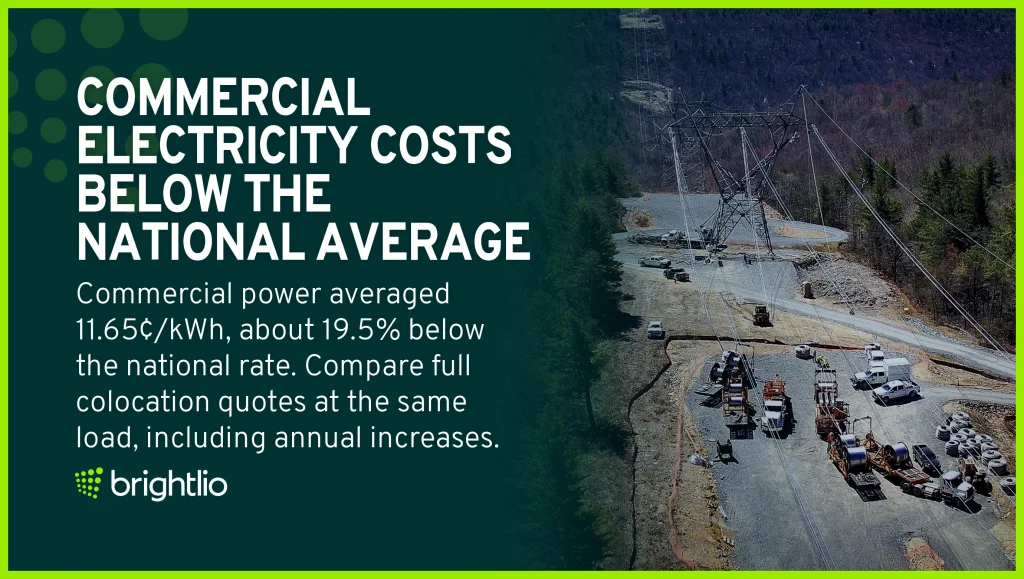
West Virginia’s average commercial electricity price was 11.65¢ per kilowatt-hour in August 2026. The national commercial average was 14.47¢ for the same month, according to the U.S. Energy Information Administration. That puts the state approximately 19.5% below the national benchmark.
West Virginia’s August 2026 commercial electricity average was 11.65¢/kWh—about 19.5% below the U.S. average of 14.47¢/kWh.
That difference can make West Virginia worth including in a cost comparison. Electricity supports the servers as well as cooling and other building systems. A lower underlying energy price can help the economics of a continuously running deployment.
The customer’s bill still depends on the provider’s contract. A colocation quote may bundle electricity with reserved power capacity and cooling. Compare the full monthly charge at the same equipment load. Check any annual increase or utility cost adjustment. Brightlio’s colocation pricing guide explains the main components of that comparison.
2. Regional Providers Support Smaller Deployments
West Virginia has commercial options for businesses that need cabinets or a private cage. A cage is a secured enclosure for multiple cabinets.
Citynet and Continent 8 offer commercial colocation in West Virginia. Other operating choices include Alpha Technologies, Pinnacle Technical Solutions, Dedispec, Segra, and DC Corp.
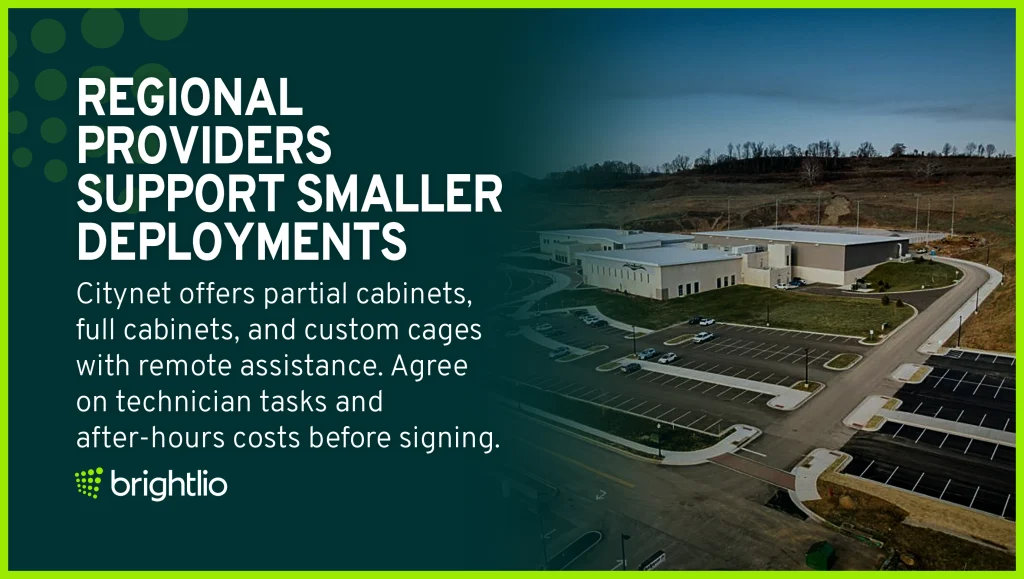
Citynet’s colocation service includes partial cabinets, full cabinets, and custom cages. It also offers remote assistance, allowing a customer to request help with equipment without sending an employee to the facility. This can be useful for a small IT team whose staff also support offices or production sites.
A nearby provider can make equipment delivery and maintenance visits easier to arrange. The value depends on where your staff work and how quickly the provider can respond after hours. Before committing, agree on which tasks technicians will perform and what emergency assistance costs. Proximity is most useful when it comes with a clear support process.
3. Separate Locations For Disaster Recovery
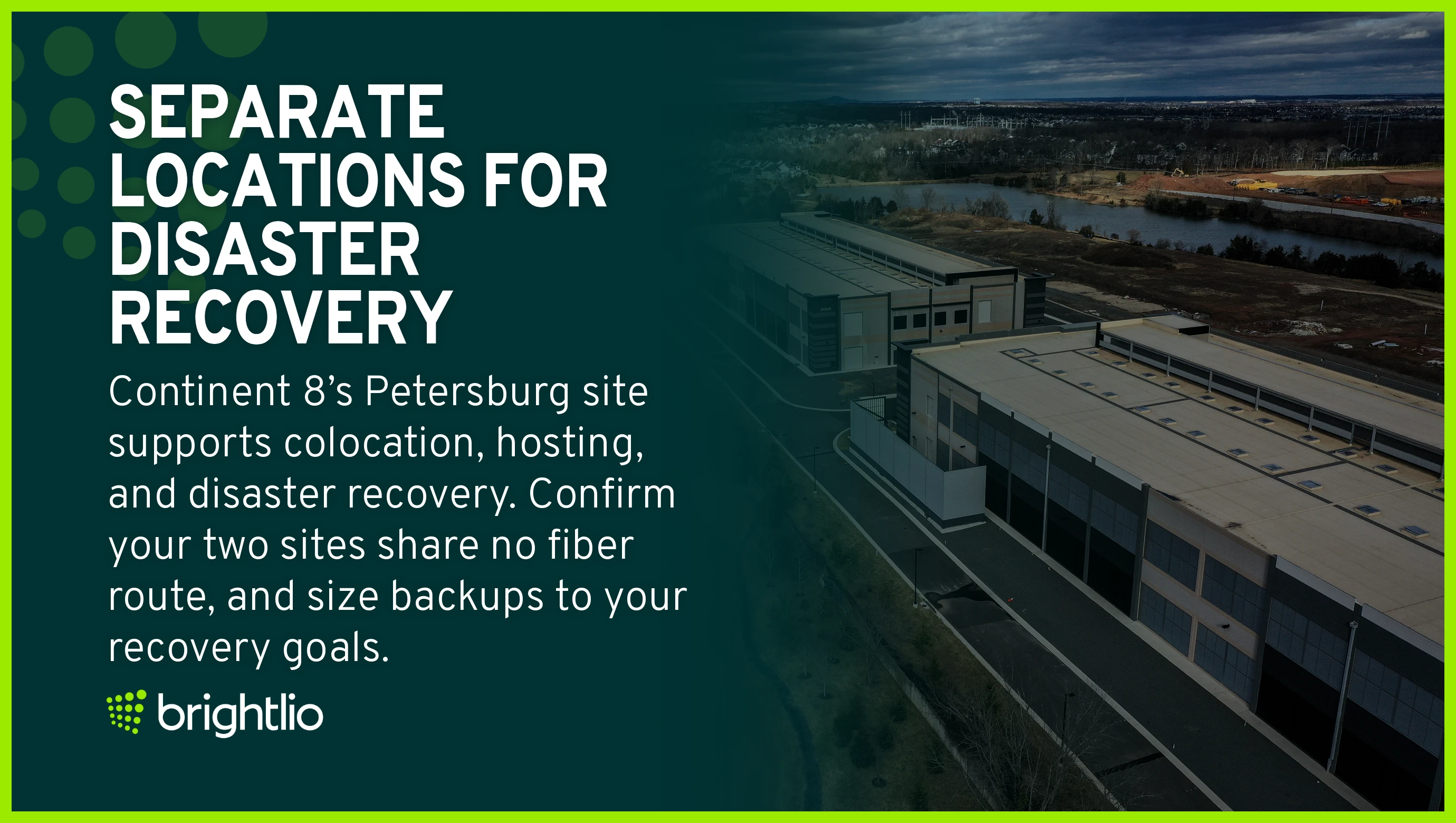
West Virginia offers an option for businesses that want recovery systems away from their primary office or data center. Continent 8’s Petersburg facility was established to support colocation, hosting, and disaster recovery.
Announcing the Petersburg opening in February 2024, Continent 8 founder and CEO Michael Tobin said:
“We are thrilled to have added a second site, allowing us to expand our offering to include disaster recovery…”
Design the separation between your operating locations around the failures you need to survive. Two addresses can still depend on a common fiber route or access road. Ask how long an application can be unavailable and how much recent data the business can afford to lose. Those answers determine the bandwidth, backup frequency, and recovery resources you need.
Where West Virginia Data Centers Are Located
Commercial facilities are spread across several regional centers. Government computing and mining sites add to the operating footprint, although they serve different customers. The following are six areas to understand when comparing locations.
1. Charleston, South Charleston, And Nitro
The Charleston area brings together several commercial providers. Citynet Charleston and the Segra Charleston Network Center serve the capital area. Alpha Technologies operates in South Charleston, while Pinnacle Technical Solutions has a presence in Nitro.
This grouping gives businesses in the Kanawha Valley several starting points for a provider comparison. Evaluate each building’s connectivity and support arrangements separately. A provider’s presence in the region does not establish that a particular cabinet configuration is available immediately.
Flood exposure deserves attention at the property level. Check the equipment floor, electrical systems, and delivery access. A facility that remains operational during heavy rain can still be difficult to reach if nearby roads are closed.
2. Bridgeport And Clarksburg
Bridgeport and Clarksburg combine commercial colocation with federal computing. Citynet’s Bridgeport facility supports customer deployments. The FBI’s Criminal Justice Information Services Division operates in Clarksburg.
For businesses seeking space, Citynet is the relevant commercial option among those two facilities. The FBI site serves government systems and does not provide ordinary retail colocation.
For a Bridgeport deployment, ask whether power for future cabinets can be reserved in the same room. Keeping an expansion together may simplify equipment access and cabling.
3. Martinsburg And Berkeley Springs
The Eastern Panhandle includes the IRS Martinsburg Computing Center, DC Corp Martinsburg, and Dedispec Berkeley Springs. The IRS facility supports federal tax systems. DC Corp and Dedispec belong to the commercial side of the market.
This part of West Virginia merits consideration for organizations with operations extending into Maryland and Virginia. The choice should follow actual staff access and network requirements. Geographic proximity to another city does not establish network latency, the delay in moving data between two points.
Ask providers to identify the networks available inside their building. If your application depends on connections to offices or cloud services outside West Virginia, compare the complete circuit cost and test the proposed route before migration.
4. Petersburg
Petersburg is home to Continent 8 West Virginia DC2 in the Grant County Business & Technology Park. The 10,200-square-foot building supports hosting and recovery workloads.
A Petersburg deployment may appeal to buyers seeking a location separate from their existing operations. The facility’s role in disaster recovery makes recovery testing an especially useful part of the evaluation. Ask how equipment access, backup restoration, and provider support will work during an incident.
For latency-sensitive workloads, request measurements between the facility and your actual users or primary site. Test backup transfers with a realistic volume of data to see whether they finish within the time available.
5. Morgantown And Blacksville
Citynet Morgantown provides a commercial colocation option in north-central West Virginia. Blacksville, near the Pennsylvania border in Monongalia County, is home to Blockchain Power’s bitcoin-mining operation.
These facilities represent different kinds of computing infrastructure. A business comparing server housing should evaluate Citynet’s commercial offering. The mining site should not be treated as an enterprise hosting provider without a separate, verified service offering.
For a local deployment, determine whether technicians will work on site or travel from another location. Ask how replacement parts are received and stored. Those details can affect recovery time when a server or network device fails.
6. Huntington
Alpha Technologies Huntington adds a commercial location in western West Virginia. It gives businesses around Huntington another option to examine alongside providers in the Charleston area.
A local facility can be useful when staff need regular access to hardware. Compare the travel requirement with the provider’s remote support coverage. A slightly more distant location may still be practical if trained technicians can perform the tasks your team would otherwise handle.
Review power, carrier availability, and flood exposure for the specific Huntington property. Services and infrastructure at another facility operated by the same company do not automatically apply here.
Five Notable Operating Data Centers In West Virginia
West Virginia’s operating facilities include commercial providers and dedicated computing sites. Their published specifications do not support a reliable size ranking. The following are five notable facilities and the role each plays in the market.
1. Continent 8 West Virginia DC2
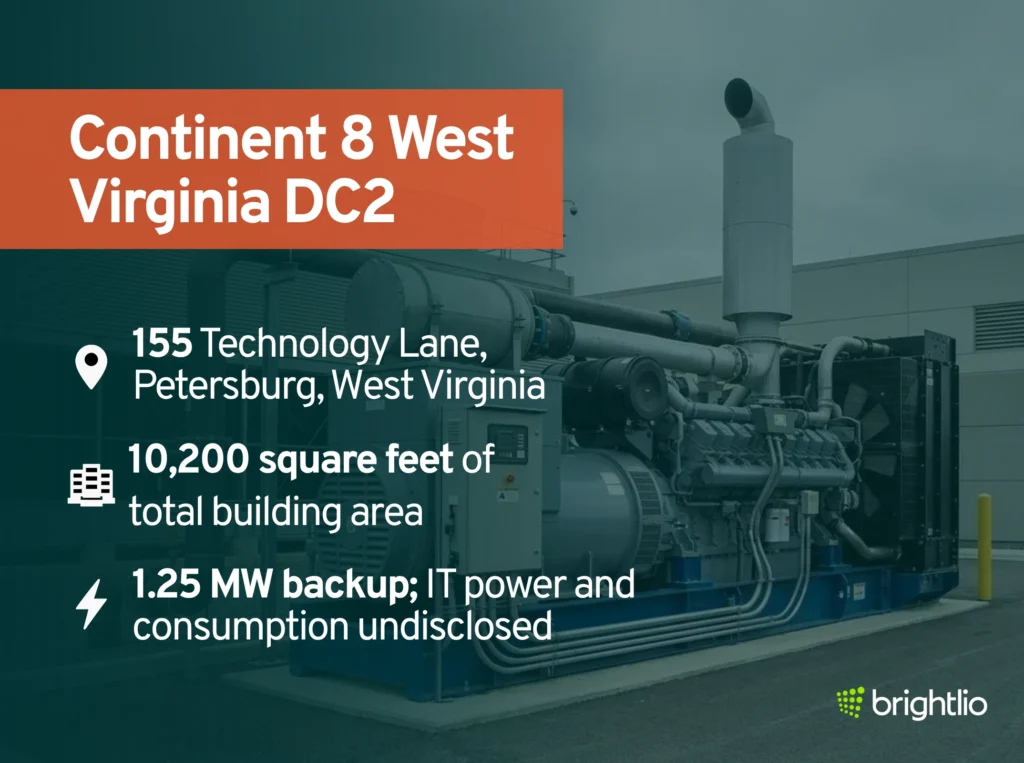
- Location: 155 Technology Lane, Petersburg, West Virginia.
- Facility Size: 10,200 square feet of total building area.
- Power: 1.25 megawatts (MW) of backup generator capacity; IT power capacity and actual electricity consumption are not publicly disclosed.
Continent 8 West Virginia DC2 is a purpose-built facility for colocation, hosting, and disaster recovery. Developed with the Seneca Rocks Regional Development Authority, it includes a two-foot raised floor.
The facility has a 1,250-kilowatt (kW) backup generator. That rating measures backup generation. It does not establish how much power is available to customer servers or how much electricity the facility consumes.
Ask for the power allocation available to your cabinets and the cooling supported at that load. Recovery customers should also confirm how often they can test failover—the process of switching an application to its backup environment—and whether testing carries additional fees.
2. FBI CJIS Division Data Center
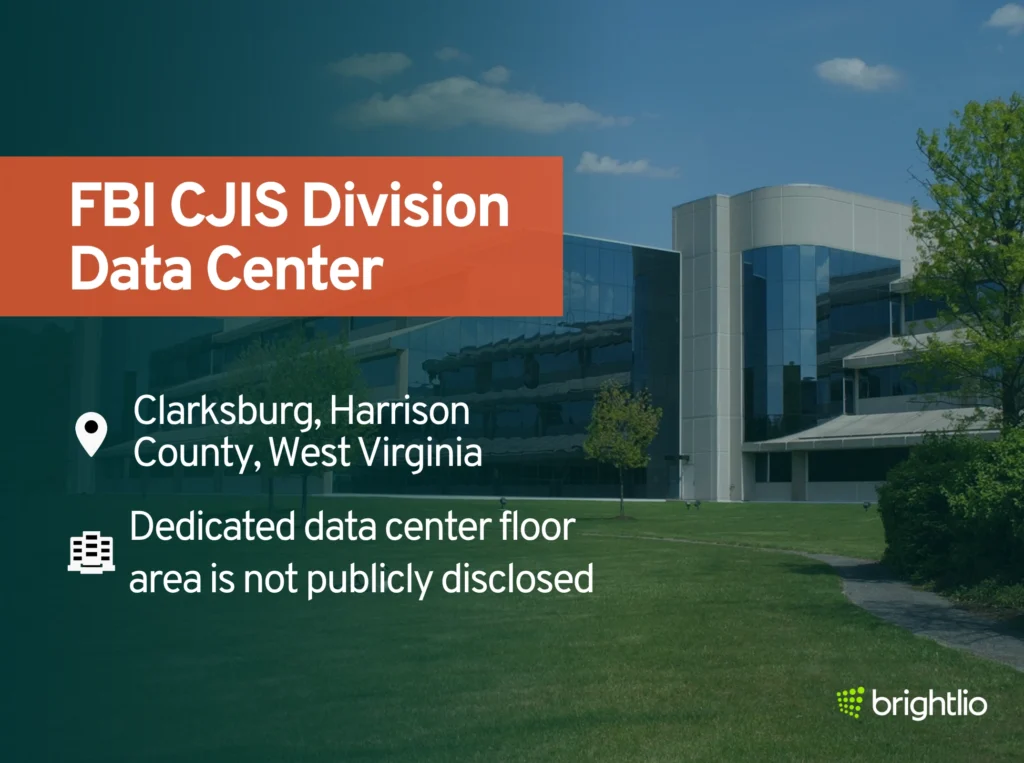
- Location: Clarksburg, Harrison County, West Virginia.
- Facility Size: Dedicated data center floor area is not publicly disclosed.
- Power: IT power capacity and actual electricity consumption are not publicly disclosed.
The FBI’s Criminal Justice Information Services Division, commonly called CJIS, supports national fingerprint and criminal justice information services. Its responsibilities include background-check systems used across the country.
The facility is dedicated to federal computing and does not offer retail colocation.
3. IRS Martinsburg Computing Center
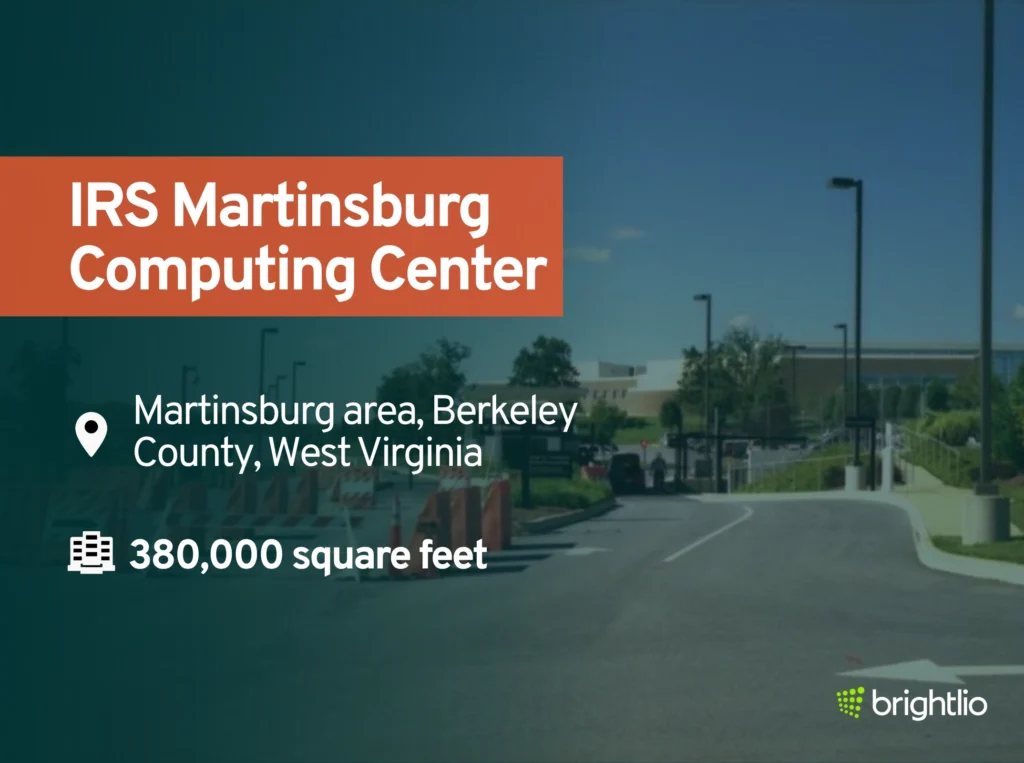
- Location: Martinsburg area, Berkeley County, West Virginia.
- Facility Size: Dedicated data center floor area is not publicly disclosed.
- Power: IT power capacity and actual electricity consumption are not publicly disclosed.
The IRS Martinsburg Computing Center is part of the federal government’s tax-processing infrastructure. Also known as the Enterprise Computing Center at Martinsburg, it supports taxpayer-account processing and related systems.
The Martinsburg center does not offer ordinary retail cabinets or private cages to businesses. Its presence is significant for the state’s federal computing sector, while commercial demand in the same area is served separately. Organizations seeking space for their own equipment can evaluate DC Corp Martinsburg and other regional providers.
4. Citynet Bridgeport
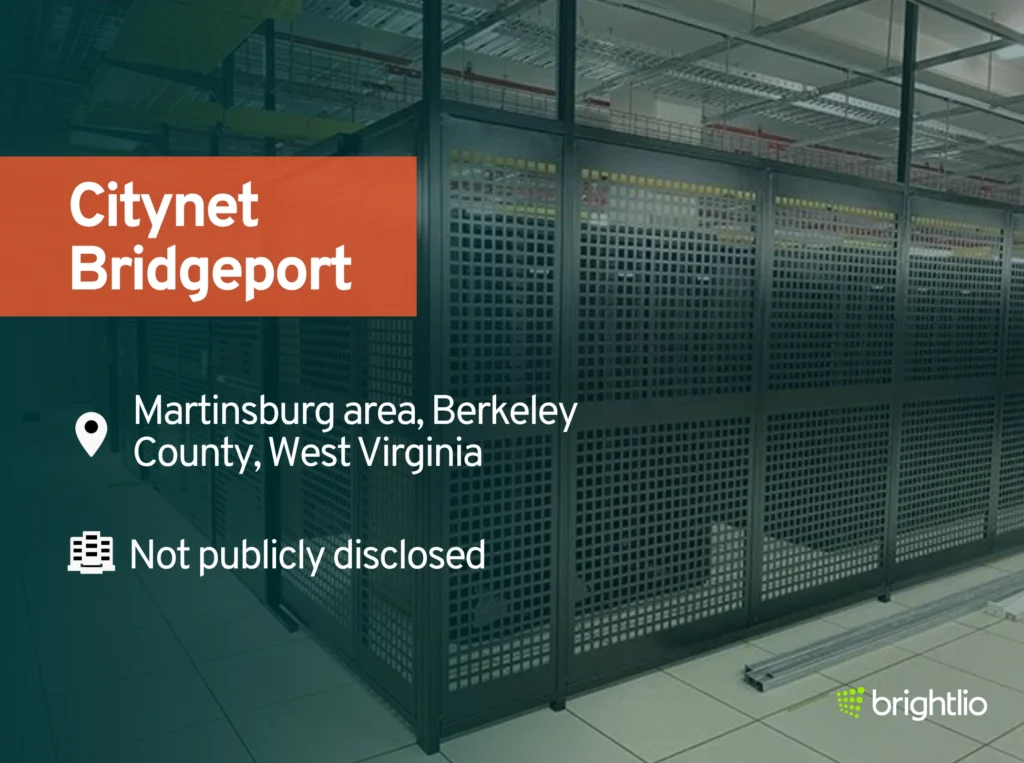
- Location: 100 Platinum Drive, Bridgeport, West Virginia.
- Facility Size: Not publicly disclosed.
- Power: IT power capacity and actual electricity consumption are not publicly disclosed.
Citynet’s Bridgeport data center forms part of its West Virginia commercial presence alongside Charleston and Morgantown. Its offering includes cabinets, cages, and remote hands—on-site help with physical tasks involving customer equipment.
Citynet’s colocation services include monitoring and remote assistance. Customers can evaluate how much equipment management they want to retain and which support tasks they want the provider to perform.
Before contracting, request a proposal for the Bridgeport building itself. Confirm the cabinet power allowance and the arrangements for access outside normal business hours. Ask which monitoring and support services are included in the recurring price, since optional assistance can change the total cost.
5. Blockchain Power Blacksville Mining Site
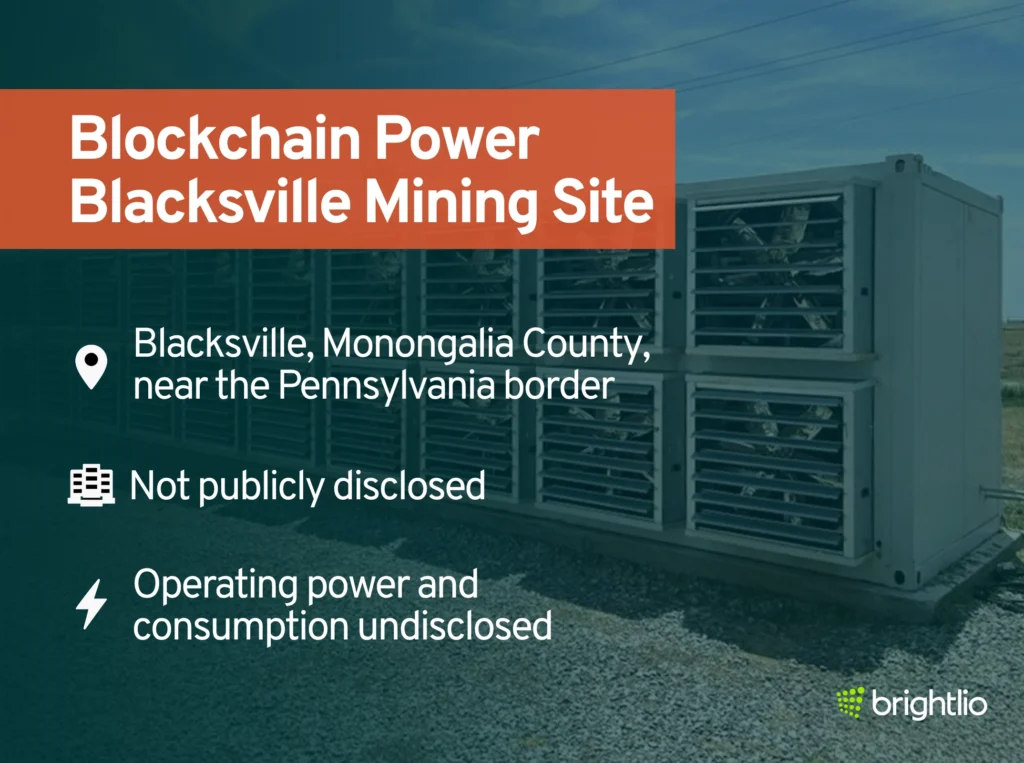
- Location: Blacksville, Monongalia County, near the Pennsylvania border.
- Facility Size: Not publicly disclosed.
- Power: Operating power capacity and actual electricity consumption are not publicly disclosed.
Blockchain Power’s Blacksville site is a bitcoin-mining operation. Mining uses computing equipment to participate in the bitcoin network. That purpose places the site within West Virginia’s operating computing footprint, but it differs from providing space for enterprise servers.
Enterprise hosting requires defined cooling, connectivity, and service commitments. A mining operation’s electrical infrastructure alone does not establish those capabilities.
Buyers seeking artificial intelligence hosting should make the same distinction. Confirm support for the proposed equipment and its cooling needs through a specific commercial offer. Do not infer AI hosting capability from the presence of mining hardware.
Drawbacks Of West Virginia Colocation
West Virginia can work well for a suitable deployment, but several constraints deserve attention before choosing a building. The following are three drawbacks that can affect cost, resilience, and growth.
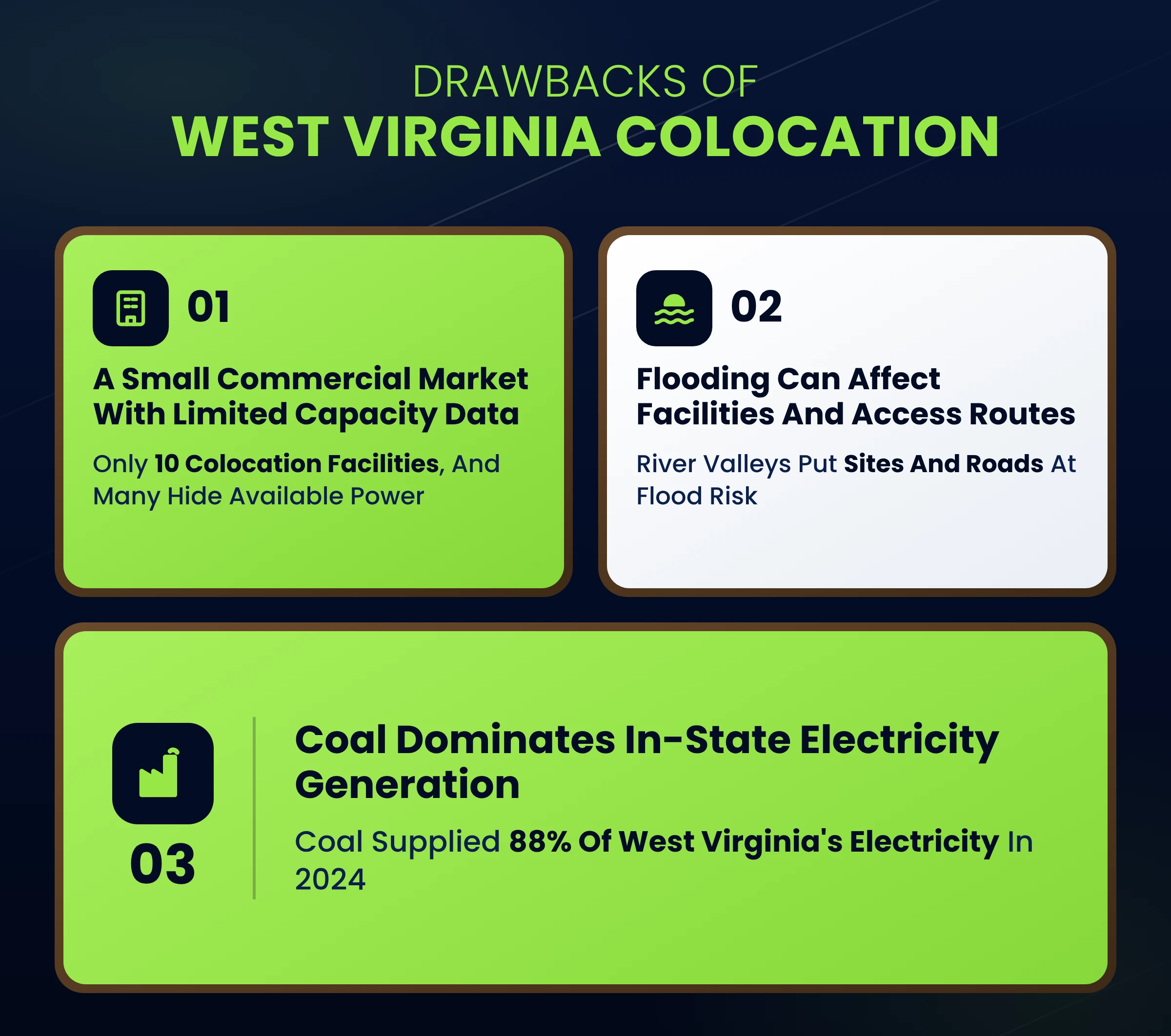
1. A Small Commercial Market With Limited Public Capacity Data
West Virginia has ten colocation facilities within its 15-site operating base. Federal facilities and mining operations account for part of the broader footprint. Only the commercial facilities can offer space to a typical colocation customer.
Many providers do not publish the power available for new customers. That makes it difficult to establish whether a building can accommodate a large private cage or substantially more power per cabinet. Empty floor space alone does not answer that question.
Obtain a written power commitment for the initial deployment and any reserved expansion. Ask about the lead time for adding cabinets or upgrading circuits. For a large requirement, compare nearby markets early enough that a capacity constraint does not force a rushed relocation decision.
2. Flooding Can Affect Facilities And Access Routes
West Virginia’s mountainous terrain and river valleys make flooding a material site-selection concern. Heavy rain can move rapidly into low-lying areas. The state’s hazard mitigation plan describes how topography and development along rivers contribute to this exposure.
Evaluate more than the server-room floor. Electrical equipment, generators, and fuel storage also need protection. Access roads matter because a facility may depend on staff, replacement equipment, or fuel deliveries during a prolonged disruption.
Ask for the property’s flood assessment and the operator’s response procedures. Review the routes used by maintenance crews and fuel suppliers. For disaster recovery, avoid choosing a second location whose access or communications depend on the same vulnerable corridor as the primary site.
3. Coal Dominates In-State Electricity Generation
West Virginia’s 2024 electricity generation mix was heavily dependent on coal. Natural gas supplied 7%, while wind supplied 4%, as shown in PJM’s West Virginia infrastructure report.
Coal supplied 88% of electricity generated in West Virginia in 2024.
That is relevant for companies with emissions targets. However, the state’s generation mix does not determine the exact electricity supply or emissions associated with every data center. West Virginia participates in PJM, the regional grid operator, and electricity moves across state borders.
Ask each provider for energy-source documentation and the method used to calculate customer emissions. If renewable energy is part of the offer, establish what is being purchased and how it is assigned to your account.\
Clarify whether renewable purchases match annual electricity use or cover consumption hour by hour. Those approaches can produce different results for an organization’s energy goals.
How West Virginia’s Data Center Rules Affect Buyers
West Virginia’s certification framework gives certain high-impact data centers and microgrid districts different treatment from ordinary commercial facilities.
A microgrid is a local electricity system that can supply a defined group of users. Certification can affect development rules, but it does not establish that a provider has space or power ready for a customer.
Under the state’s rules for certified projects, county and municipal zoning, noise, and land-use restrictions are preempted for qualifying certified developments. These provisions should not be applied automatically to every operating colocation building.
The tax mechanism also needs careful interpretation. The property-tax increment is the qualifying increase in property-tax revenue. State law directs 50% of that positive increment to the Personal Income Tax Reduction Fund.
Another 30% goes to the host county. These are rules for distributing tax revenue, rather than a blanket tax exemption for customers renting cabinets.
For a colocation purchase, ask which provisions apply to the facility and how any financial benefit appears in the contract. Keep the decision centered on deliverable power, service terms, and total cost. A favorable development framework does not replace those commitments.
Find West Virginia Colocation With Brightlio
Brightlio helps businesses compare colocation providers around their technical requirements and budget. In West Virginia, that starts with identifying the commercial facilities that can support the deployment, then checking power, connectivity, and support.
Share your cabinet count and expected power draw. Explain which offices, customers, and cloud services need to connect to the environment. Include your target installation date and any recovery requirements so proposals can be compared on the same basis.
If network choice is important, review what a carrier-neutral data center offers. Carrier neutrality means customers can choose among available network providers. The contract should establish which carriers can actually serve your equipment and what connections cost.
Contact Brightlio to compare West Virginia colocation options with nearby markets and find a facility suited to your workload.
Frequently Asked Questions
1. How Many Operating Data Centers Are In West Virginia?
West Virginia has 15 operating data center facilities as of November 2026. Ten provide colocation and are included within that operating total. The remaining facilities serve other purposes, including federal computing and bitcoin mining. For a business seeking rental space, the commercial subset is the useful starting point. A facility count does not establish the number of cabinets available or the power a provider can allocate to new customers.
2. Where Can Businesses Find Colocation In West Virginia?
Commercial colocation is concentrated around Charleston, Bridgeport, and the Eastern Panhandle. Additional options serve Morgantown, Huntington, and Petersburg. Citynet operates in Bridgeport, Charleston, and Morgantown, while Continent 8 West Virginia DC2 operates in Petersburg. Alpha Technologies has South Charleston and Huntington locations. Choose the area around your network performance and staff-access requirements. Then confirm the exact service and capacity available at the building you are considering.
3. Is Electricity Cheaper In West Virginia?
West Virginia’s August 2026 average commercial electricity price was 11.65¢/kWh, compared with 14.47¢ nationally. That is approximately 19.5% lower. It is a useful market benchmark, but it does not establish a colocation customer’s final power charge. Providers may bundle cooling, reserved capacity, and electrical infrastructure into their pricing. Compare complete quotes at the same load and check how utility-cost changes or annual increases affect the contract.
4. How Much Does Colocation Cost In West Virginia?
The price depends on the amount of space, power allocation, connectivity, and support required. There is no single statewide cabinet rate. Request quotes with the same equipment load and backup power requirements so the comparison is meaningful. Ask providers to separate installation costs from recurring charges. Include network connections, remote hands, and any minimum commitment in the budget. A low cabinet rental price may become less attractive once those services are added.
5. Is West Virginia Suitable For Disaster Recovery?
It can be, particularly when the chosen site is separate from the primary environment’s flood exposure, power supply, and communications routes. Continent 8’s Petersburg facility supports disaster recovery, providing a commercial option to evaluate. Define how quickly applications must restart and how much recent data can be lost. Then test whether the backup arrangement meets those goals. Distance between two buildings is only one part of an effective recovery design.
6. Can Businesses Rent Space At The FBI Or IRS Data Centers?
The FBI CJIS Division Data Center and IRS Martinsburg Computing Center serve federal computing missions. They are not ordinary retail colocation facilities offering cabinets or private cages to businesses. Their presence helps explain West Virginia’s broader operating footprint, but it does not increase commercial rental availability. Buyers should compare providers offering customer space, such as Citynet, Continent 8, and the other commercial operators serving the state.
7. Can West Virginia Data Centers Support AI Servers?
Support must be confirmed for the specific equipment and facility. Many operating sites do not disclose available IT power, and a bitcoin mine is not automatically suitable for AI hosting. Give the provider the expected power draw per cabinet and the equipment’s cooling requirements. Ask whether the proposed installation needs changes to the building. Obtain a committed delivery date and a written statement of the supported configuration before purchasing or moving hardware.
8. What Does The 1.25 MW Figure At Continent 8 DC2 Mean?
It is the rating of the Petersburg facility’s backup generator. It does not establish the IT power available for servers, the capacity available to a new tenant, or actual electricity consumption. Those measurements describe different things. For a deployment, request the power that can be committed to your cabinets and the cooling available at that load. Ask how the backup arrangement supports your equipment during a utility outage.
9. Do West Virginia Data Centers Receive Tax Benefits?
West Virginia has special provisions for certified high-impact data centers. One mechanism allocates the applicable property-tax increment, with 50% going to the state’s Personal Income Tax Reduction Fund and 30% to the host county. This is not a 50% tax discount for colocation customers. Determine whether the specific facility qualifies for any relevant treatment. Any claimed customer saving should be reflected clearly in the commercial proposal and contract.
10. What Should Buyers Check Before Choosing A Provider?
Start with the power the provider can commit to your equipment and the date it will be ready. Confirm network routes, access arrangements, and remote support coverage. Review flood exposure for the building and its access roads. Ask for any compliance evidence your workload requires, including its scope and validity period. Finally, compare installation fees, recurring charges, renewal terms, and expansion rights using the same requirements for every proposal.
Explore Nearby Data Center Markets
Continue your comparison with Brightlio’s colocation guides for these neighboring states:

Tamzid is a cybersecurity researcher with 5+ years of experience across SaaS, security, compliance, data centers and cloud. He writes for brightdefense.com and hipaasimple.com, covering security, compliance, and infrastructure topics. Certified through Cisco, Fortinet (NSE 1), and the Basel Institute on Governance in OSINT, he grounds his work in primary sources and verified data.
Recent Posts
Top 5 Floating Data Centers
Data Centers and Colocation in Colorado
Data Centers and Colocation in Delaware
Data Centers and Colocation in Hawaii
Let's start
a new project together