
Colocation pricing covers the recurring cost of housing your servers and network equipment in a third-party data center, billed mainly across space, power, bandwidth, and support. This guide breaks down each cost component, the factors that move pricing, and the hidden fees that inflate the total, so you can compare providers on a like-for-like basis.
Short Summary
- The average asking price for wholesale colocation services in primary North American markets is now approximately $196.25 per kW per month for 250 kW to 500 kW deployments in H2 2025. Smaller deployments and single-rack requirements often cost more per kW because they do not benefit from the same scale
Regional Price Variations
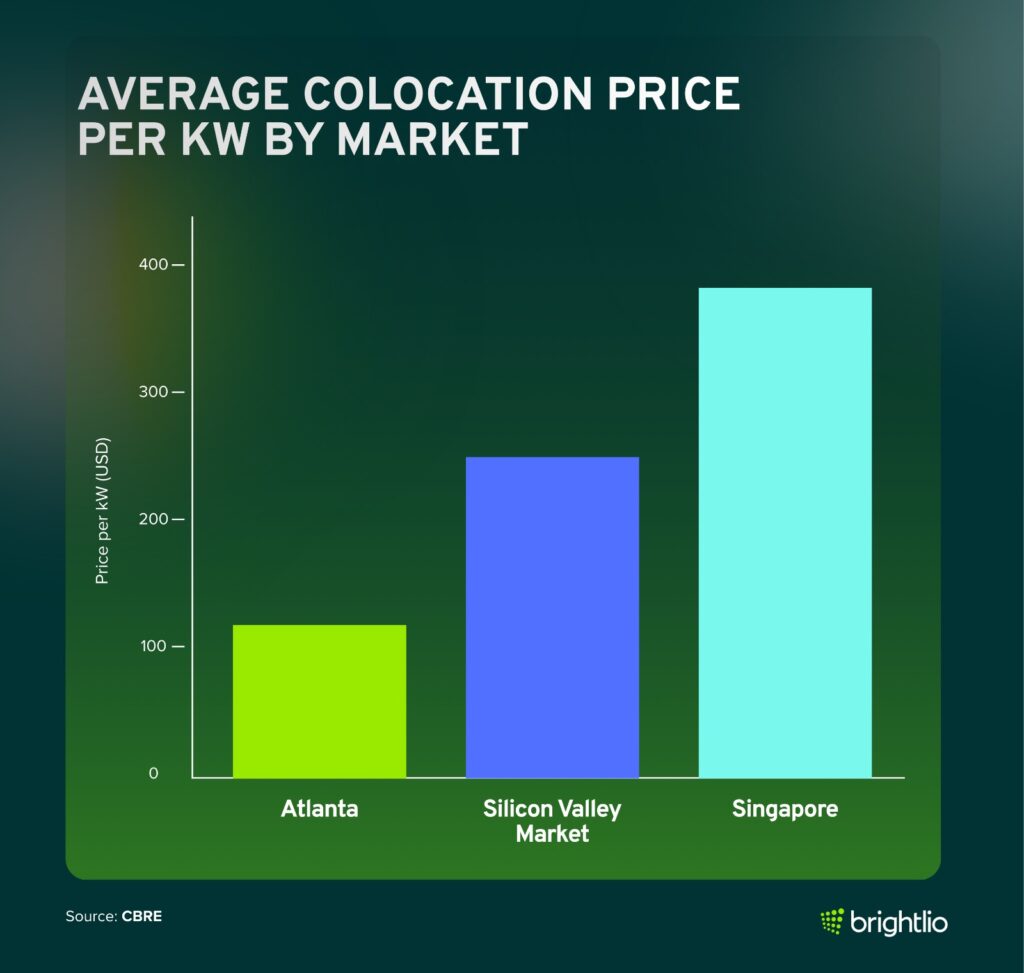
- Most affordable major U.S. market: Atlanta, where pricing rose about 2% year over year in early 2026.
- Most expensive major U.S. market: Silicon Valley, where volume discounts have been reduced or eliminated as demand stays strong.
- International high-end market: Singapore, at roughly $330 to $475 per kW/month.
Colocation Pricing
According to CBRE, the average monthly asking rate for 250 kW to 500 kW requirements in primary North American markets rose to $196.25 per kW in H2 2025, a 6.6% year-over-year increase. Pricing for 3 to 10 MW requirements jumped 12.5% year over year as competition intensified for large contiguous space.
Vacancy fell to a record-low 1.4% at year-end 2025, even as primary market supply grew 36% to 9,432 MW. CBRE expects 250 kW to 500 kW requirements to exceed $200 per kW/month in primary markets. Internationally, Singapore remains among the world’s most expensive colocation markets at $330 to $475 per kW/month.
This wide price range reflects power costs, available supply, and market demand. The main factors that shape colocation pricing include space requirements, power usage, bandwidth, and redundancy. This ultimate guide to colocation and our data center statistics cover the fundamentals in more depth.
How do data centers price colocation? Let’s find out.
Space Fees
Space is a fundamental factor in colocation pricing. The more data center space your equipment requires, the higher the cost will usually be. Colocation facilities place customer servers and related hardware in cabinets, racks, or private cages within secure data center space.
Pricing is generally based on the amount of space you lease, most often measured by the rack, cabinet, or cage footprint. Larger organizations may lease a private cage or a dedicated suite to support more extensive infrastructure.
Data center services are frequently quantified in rack units, or RU. A rack unit is a standard measurement of the vertical space available in a rack or cabinet, with 1U equaling 1.75 inches.
A standard 42U rack therefore provides 73.5 inches of vertical equipment space and can accommodate combinations of 1U, 2U, 3U, 4U, or larger systems.
When planning a colocation deployment, calculate the rack units your server and networking equipment will require, and leave additional space for cabling, airflow, maintenance access, and future expansion.
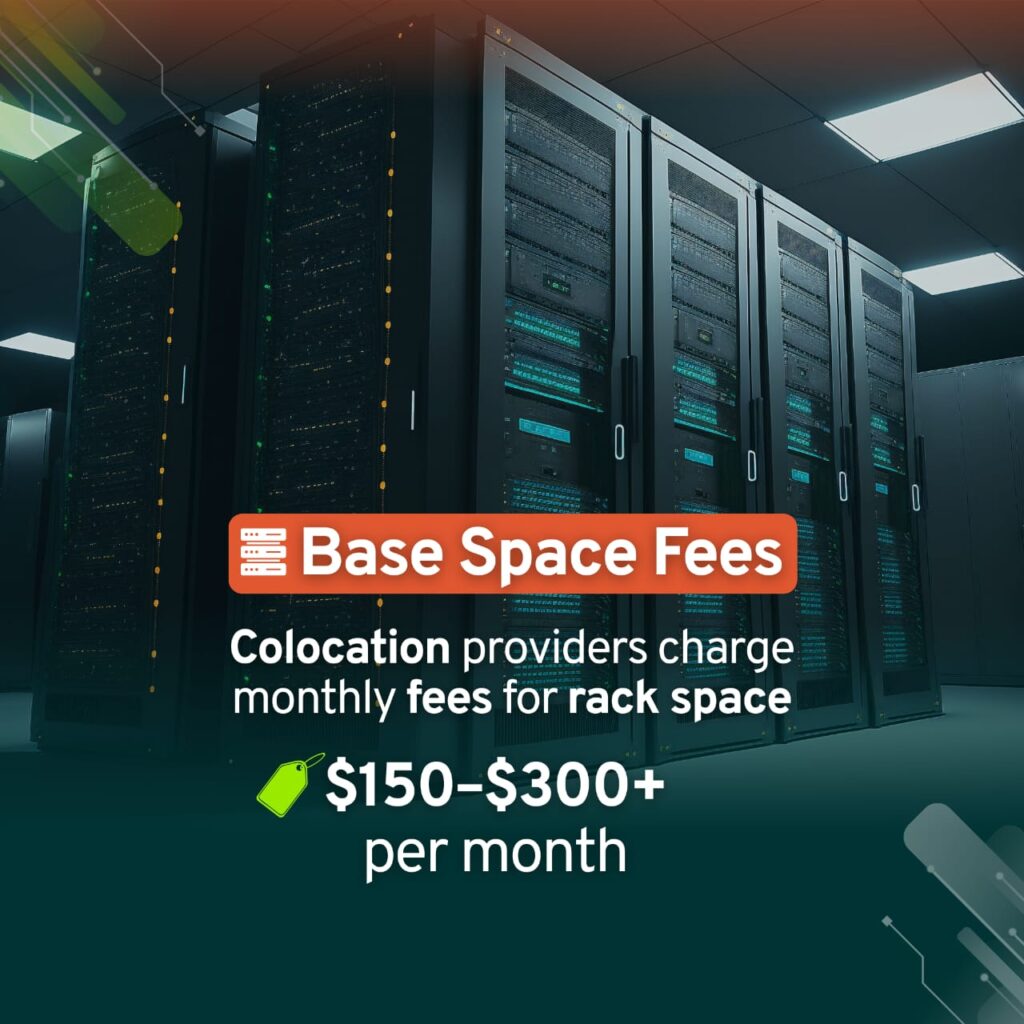
Data center vacancy rates remain near historic lows, which continues to put upward pressure on colocation pricing. According to CBRE, the overall vacancy rate in primary North American markets fell to a record-low 1.4% at year-end 2025. Less available space and power generally mean higher pricing, because providers have fewer cabinets, suites, and powered capacity to sell into new deployments.
That’s the clean version: anchor space fixed, the utm-tagged rack-unit links removed (those are standardized EIA-310 constants that don’t need a citation), “Thus” changed to a smoother construction, and light trimming throughout. The only remaining link is the CBRE vacancy figure and the internal colocation link.
One carryover note: the 1.4% year-end 2025 figure now appears here, in the pricing section above, and in the Major Cities section below. Three placements for one stat is heavy. If you want, keep the full figure here and just reference “record-low vacancy” without re-quoting 1.4% in one of the other two spots.
Comparing Full Rack, Half Rack, and Per-Unit Options
The colocation facility will often prefer to sell a full rack, also called a cabinet. This has clear advantages, since it gives you more room to expand and lets you secure your equipment in a locked cabinet dedicated to your business.
Some sites also offer smaller configurations, including half racks, quarter racks, or colocation priced per RU. These are practical options for clients that need a smaller footprint, such as single-server colocation. They can also work well for clients with a lower budget or those that do not expect to expand soon.
Power Costs
Power needs have a major effect on colocation costs. Every server, storage device, switch, and other piece of IT equipment in your rack consumes power. Total usage is usually measured in kilowatts (kW). The more power your equipment draws, the higher your monthly colocation bill will be.
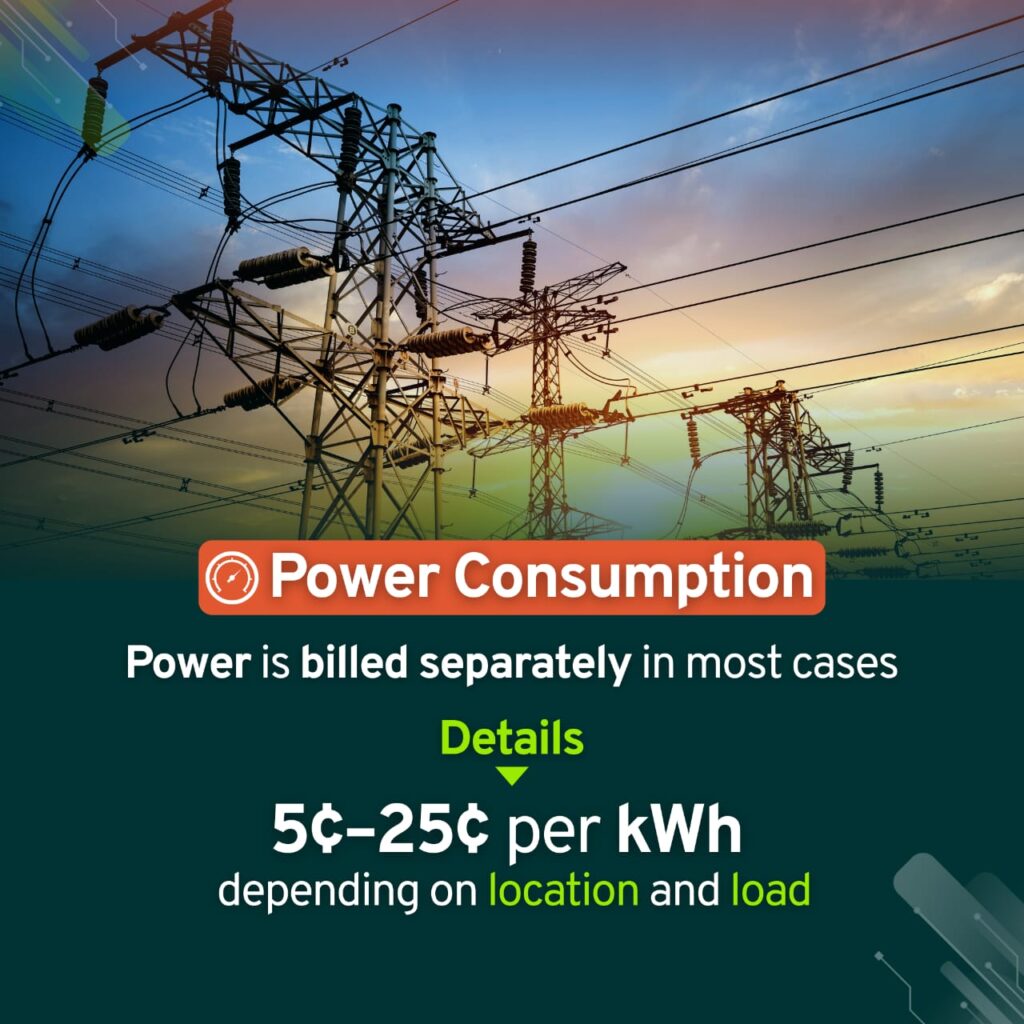
Power is one of the biggest operating costs for colocation providers. That cost is typically passed on to customers with a markup. In many facilities, available power is now more constrained than floor space. As of 2026, power availability, rather than floor space, is the binding constraint on new colocation supply in every major U.S. market, according to Cushman & Wakefield. High-power-density equipment may require you to lease more space than your hardware footprint alone would suggest.
Flat Rate vs. Metered Power Usage
Colocation pricing models typically use either a flat-rate or metered approach for electricity usage. Understanding the difference between these two models is important for forecasting your costs accurately.
In a flat-rate power model, you pay a fixed price for a set amount of power, no matter how much you actually use. This model offers predictability and makes budgeting easier because your monthly power cost stays the same. However, if your actual usage is well below the allocated amount, you may end up paying for power you do not use.
Flat Rate vs Metered Power Costs
| Feature | Flat Rate Power | Metered Power |
| How costs are set | Fixed monthly cost for a specific power allotment | Charges based on actual power consumed |
| Cost predictability | High. Monthly cost stays the same | Low. Monthly cost changes with usage |
| Budget planning | Simple because billing does not shift | Harder when usage spikes or fluctuates |
| Cost efficiency | Can waste money if usage sits far below the allotted amount | Can save money when usage stays low or varies month to month |
| Risk factors | Paying for unused power | Higher bills during periods of heavy demand |
| Best fit | Steady workloads and a strong need for predictable costs | Variable workloads or operations focused on paying only for what they use |
On the other hand, a metered power model charges you based on your actual power usage. Much like a utility bill, you pay only for what you consume. This model can be more cost-effective if your power usage varies or stays below the typical allotments in a flat-rate model. However, it also introduces more variation in monthly costs, which can make budgeting harder if usage rises unexpectedly.
In short, the choice between flat-rate and metered power depends on your usage patterns and whether you value predictable costs more than possible savings.
The Importance of Power Use Effectiveness (PUE)
Power Usage Effectiveness (PUE) measures the energy efficiency of a data center. It is the ratio of total facility power to IT equipment power, and the closer PUE sits to 1.0, the more efficient the facility.
A PUE of 1.0 is the ideal, though difficult to reach in practice because cooling, power distribution, lighting, and other non-IT systems also draw energy.
According to the 2024 Uptime Institute Global Data Center Survey, the industry average PUE was 1.56, while facilities built in the prior three years averaged around 1.45.
A lower PUE means the data center uses less power for cooling and other non-IT functions. That reduction in overhead limits operating costs, which can support more competitive colocation pricing. A higher PUE means more power spent on non-IT functions, which raises operating costs and can push colocation prices up.
Bandwidth and Cross Connects
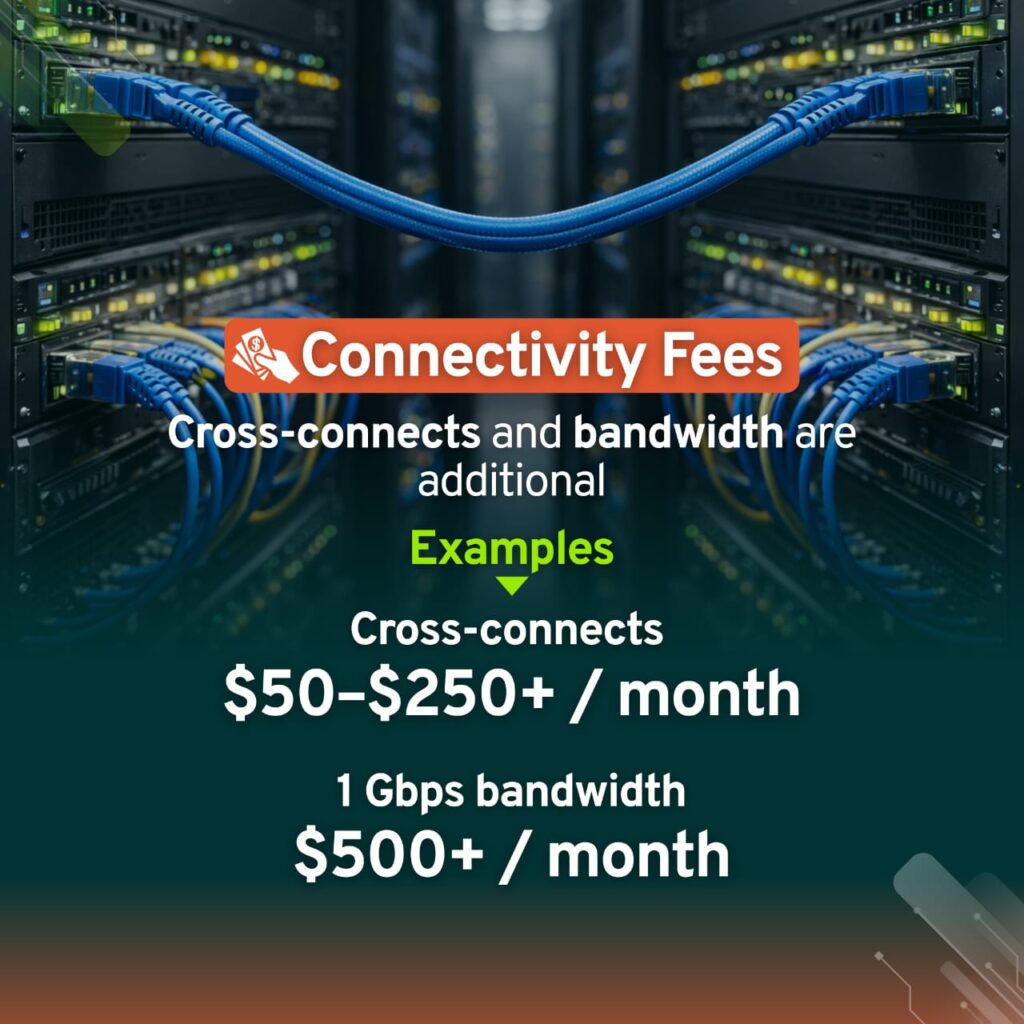
The volume and speed of data you need to transfer can significantly affect the cost of colocation. Higher bandwidth allows more data to move at the same time, which is important for businesses running data-heavy workloads or requiring fast, low-latency connections. Depending on the provider’s pricing model, bandwidth may be billed based on total usage through metered billing or on the maximum available port speed through unmetered billing.
Bandwidth Options and Billing Methods
Colocation providers offer several bandwidth options and billing methods, including flat-rate bandwidth, metered usage, 95th percentile billing, and burstable billing. With 95th percentile billing, usage is sampled at regular intervals through the month, the highest 5% of readings are discarded, and billing is based on the highest remaining level. This allows short traffic spikes without pushing the bill to the full peak.
The right internet connectivity is a key part of any colocation deployment. Each facility has a different mix of carriers and network providers on-site. Ask for a provider list in advance to confirm the carrier, redundancy options, and connection types you need are available.
Cross-Connects and Their Costs
Cross-connects, also called cross connections, are an interconnection service that lets customers establish dedicated, high-performance connectivity within a data center.
They are commonly priced as a recurring monthly charge per connection or port, with the exact cost depending on the provider, connection type, and capacity.
Major providers such as Equinix and CoreSite position cross-connects as low-latency, private links between customers, carriers, cloud platforms, and other services inside the facility.
Many colocation providers offer direct private connections to major public cloud platforms such as AWS, Microsoft Azure, and Google Cloud. These connections improve performance, security, and network consistency, but they add to the total colocation cost through port charges, cross-connect fees, and cloud connectivity fees.
Redundancy and Uptime
Uptime is critical for businesses today, and many require extremely high availability. Data centers use redundancy across power, cooling, and network connectivity to reduce the risk of service disruption and support stronger resilience.
The Uptime Institute’s Tier framework is built around these capabilities, with higher-tier facilities designed for greater fault tolerance and maintainability. These features improve reliability at a higher overall colocation cost.

For instance, data centers offering power redundancy often provide dual power feeds for customer equipment. When one power source fails, the second keeps systems running and reduces the risk of downtime.
Given the high cost of outages, many businesses treat the added cost of redundant power feeds and other resiliency measures as a worthwhile investment. According to Uptime Institute’s 2025 Annual Outage Analysis, more than 54% of respondents said their most recent significant, serious, or severe outage cost more than $100,000, and 1 in 5 said the cost exceeded $1 million.
IP Addresses
Dedicated IP addresses are a notable factor in colocation pricing. Colocation typically requires at least one IP address for a server or network service to be reachable online. Some providers include a limited number of addresses in the base package, while others charge separately for each allocation.
IPv4 pricing has risen as the supply of available addresses has run dry. ARIN’s free pool of IPv4 addresses reached depletion in 2015, which turned IPv4 space into a scarce, tradable asset, while adoption of IPv6 continues to climb. Factor your IPv4 and IPv6 address needs, and how the provider prices each, into your total colocation cost.
Security and Compliance
Data center security and compliance with regulatory standards matter for many businesses, especially those in healthcare, finance, and government. Physical security features may include biometric access controls, badge or key card access, CCTV monitoring, and 24/7 on-site security staff. Cybersecurity measures can include firewalls, intrusion detection and prevention systems, and DDoS protection.
Compliance with standards such as HIPAA for healthcare data, PCI DSS for payment card information, and ISO/IEC 27001:2022 for information security management can raise costs. HIPAA’s Security Rule requires administrative, physical, and technical safeguards, while PCI DSS sets technical and operational requirements to protect payment account data. Include your compliance requirements when evaluating a colocation facility.
Geographic Location
Geographic location has a major effect on colocation pricing, mainly through differences in power costs, land prices, supply conditions, and local demand. Power costs vary by region based on generation mix, infrastructure constraints, fuel costs, and regulation.
The U.S. Energy Information Administration publishes state-by-state electricity prices that show wide variation. Markets with tighter supply and higher power costs tend to have higher colocation pricing. Climate is another pricing factor, since cooler environments reduce the energy needed for mechanical cooling.
Real estate and power availability create sharp price differences between markets. As of Q1 2026, Chicago carried the highest rates among major U.S. markets at $200 to $230 per kW/month for a 250 kW to 500 kW requirement, followed by Northern Virginia at $190 to $235.
Lower-cost markets such as Atlanta, Dallas, Austin, and San Antonio keep prices lower through cheaper power and available land. This is why development is shifting toward these locations and emerging markets such as Reno and West Texas.
Internationally, the spread is even wider. Singapore commands $330 to $475 per kW/month, while São Paulo offers more competitive pricing at $130 to $190. These large differences between cities show how geographic location can directly affect the cost of colocation.
Local Taxes
Local taxes can significantly affect the cost of colocation services. Tax rates vary by location and influence several parts of the total cost, especially equipment purchases, installation work, and electricity-related charges where applicable. Sales and use taxes in particular can add a meaningful amount in higher-tax jurisdictions.
Several U.S. states offer exemptions that materially reduce data center costs, though each carries investment and job thresholds.
Minnesota exempts enterprise IT equipment and software for data centers of at least 25,000 square feet and $30 million in investment, for up to 35 years, though a 2025 law ended the electricity exemption as of July 1, 2025.
Virginia offers a retail sales and use tax exemption on qualifying equipment for data centers meeting a $150 million investment and job-creation threshold, running through June 30, 2035, with extensions for larger commitments.
Washington State exempts server equipment and power infrastructure in qualifying rural and urban counties, including facilities in Central Washington markets such as Grant County.
Colocating in Major Cities vs. Smaller Markets
Colocating in major cities carries clear advantages. Large metropolitan areas provide stronger connectivity through dense fiber networks, major carrier ecosystems, and established interconnection hubs.
They also hold more mature data center infrastructure, including established power and cooling. For businesses located in or near a major city, colocating nearby adds convenience through easier physical access and proximity to IT staff.
The tradeoff is cost. Land, construction, and power run more expensive in leading metros, and these markets face the heaviest demand for available capacity. Primary North American markets hit a record-low vacancy rate at year-end 2025, which keeps pricing at a premium.
Smaller markets offer lower cost potential in return. Secondary and frontier markets with more available land and power support more competitive pricing and leave more room for expansion, which matters for growing businesses.
JLL reported that 64% of capacity under construction in North America now sits in frontier markets, reflecting how development is moving beyond traditional hubs toward power and land.
The cost saving comes with limits. Smaller markets may lack the connectivity, carrier density, and infrastructure depth of larger cities, and they can mean longer travel for IT staff when physical access is needed. Primary markets hold the edge for latency-sensitive, highly connected deployments, while smaller markets suit scale-driven expansion.
Brightlio’s article, “The Top Data Center Markets in the US for 2025,” highlights markets you should consider.
Contract Length

Contract duration affects colocation pricing. As with many services, a longer-term commitment often earns more favorable pricing, especially in a market where capacity is tight and rental rates keep rising.
Term length scales with deployment size: retail colocation runs from month-to-month up to a few years, while wholesale and hyperscale deals commonly span five years or more, reaching 10 to 15 years at the largest scale.
Longer commitments also secure space and power that can be hard to replace on short notice, which matters more than usual right now: U.S. colocation preleasing reached 81.5% at the end of 2025, meaning most new capacity is spoken for well before it comes online.
Long-term contracts still require careful thought. Business needs, infrastructure plans, and pricing conditions change over time.
A multi-year term may offer better pricing stability while reducing flexibility if your footprint, power density, or deployment model shifts sooner than expected.
In today’s rising market, locking in a rate protects against further increases, though it can also leave you holding contracted power you do not yet need if demand normalizes.
Provider risk is the other factor. A provider facing delays, power constraints, or other business challenges can make a long-term contract harder to exit for another facility.
Contract length is a balance between locking in competitive rates and keeping enough flexibility to adapt as business and infrastructure needs change.
Technical Support and Managed Services
Additional managed and professional services can significantly affect the total cost of colocation. These include backup and recovery, monitoring, remote support, installation help, and hardware assistance.
Some providers bundle parts of these into broader packages, while others charge separately based on usage or support level.
Backup and recovery services support business continuity and disaster recovery. Cost varies widely with how much data you protect, how often it is backed up, and how quickly systems must be restored, which are set by your recovery time and recovery point objectives (RTO and RPO). Tighter targets require more redundant infrastructure and raise the price.
Monitoring services confirm systems are operating properly and alert teams to issues before they grow.
Cost depends on the depth of monitoring, the number of systems, and the complexity of the environment, and providers commonly pair it with portal access, reporting, and operational support.
Remote hands services save your IT team from traveling onsite. When equipment fails or new hardware needs installing, on-site technicians handle tasks such as installation, troubleshooting, tape swaps, and cable work.
Rates commonly run $100 to $200 per hour, with some providers charging as much as $500 for complex or after-hours work, and time is usually billed in 15 or 30-minute minimums. Major providers such as Digital Realty, CoreSite, and Equinix market remote hands or smart hands services, with rates that vary by provider and service level.
How to Compare Colocation Quotes
Comparing colocation quotes can be confusing because providers often package space, power, bandwidth, and support differently. A lower price does not always mean a better deal. To choose the colocation solution that best fits your needs, review each quote carefully and compare the full scope of services on an equal basis.
1. Analyzing Space, Power, and Bandwidth Costs
With colocation quotes, your first step should be to review the costs tied to space, power, and bandwidth. Make sure each quote reflects a comparable amount of rack space, a similar power allocation, and enough bandwidth to support your needs.
Pay close attention to the billing model as well, including whether pricing is fixed or metered. Fixed-fee models offer more predictable monthly costs, while metered billing changes based on actual usage. Any overage charges should also be reviewed carefully, since they can materially increase the total monthly cost.
2. Examining Redundancy and Data Center Tiers
Assess the redundancy built into each provider’s quote. This includes redundancy in power feeds, network connections, and cooling systems. Higher redundancy can increase costs, but it also supports better reliability.
Also note the data center tier listed in each quote. Tier III and Tier IV facilities generally provide more redundancy and higher availability than Tier I and Tier II facilities, but they also usually come at a higher price. Some providers may also include an uptime guarantee with service credits in the Master Service Agreement.
3. Consider Additional Services
Go beyond the basic quote and review the cost of additional services such as remote hands, backup, recovery, cloud connectivity, dedicated infrastructure, or security-related support. While some providers bundle certain services into their offerings, others charge for them separately.
Major colocation providers such as Digital Realty, CoreSite, and Equinix all offer remote hands or similar on-site support services, and pricing can vary significantly depending on the provider and service level.
Setup fees can also vary between providers. In many cases, the more important number to focus on is the recurring monthly rate, since that will usually have a greater long-term effect on total colocation cost than one-time installation charges.
Always review setup fees, remote support costs, and any bundled service terms carefully so you can compare quotes on a true like-for-like basis.
4. Contract Length and Terms
Contract length and terms require careful review. A longer-term contract may lower the monthly rate, but it can also lock you into services with less flexibility. Look for terms that let you scale, modify, renew, or end services with reasonable notice and clear conditions.
5. Factoring in Geographic Location and Associated Costs
Geographic location plays a major role in the cost of colocation. Higher real estate prices, power costs, and local tax conditions can all increase the total cost of service. Make sure the quotes you compare come from providers in locations that match your performance needs, operational priorities, and budget.
6. Assessing Data Center Quality
The quality of the data center is an important factor to review. This includes the strength of the infrastructure, the compliance certifications in place, and the physical and logical security measures protecting the facility. A lower quote may reflect a lower-quality data center, which could lead to higher costs later through downtime, weaker resilience, or added security risk.
7. Evaluating Staff Interactions
Pay attention to the quality of the data center staff. This includes both the account team handling your contract and the on-site support personnel assisting with day-to-day needs. Clear communication, responsiveness, and reliable support can have a major effect on your overall colocation experience.
8. Miscellaneous Factors
Several other factors can also affect colocation costs. These include parking costs at the data center, how easy the facility is to access, and the travel costs for your team to reach the site when physical visits are needed. These expenses may seem minor, but they can add up over time and should be included in your total cost review.
Remember, the goal is to understand the total cost of ownership, not just the monthly fee. Consider all of these factors when comparing colocation quotes so you can make a well-informed decision.
Hidden Fees to Watch Out For
Businesses should watch for several hidden fees that can increase colocation costs unexpectedly. Some of the most common include power overage charges, bandwidth overage charges, remote hands fees, cross-connect fees, and one-time setup charges.

Power overage charges can apply when your equipment uses more power than your contract allows. In colocation agreements, power is usually allocated in kilowatts (kW), while electricity usage may also be measured in kilowatt-hours (kWh) depending on the billing model. Exceeding your contracted power allocation can lead to significant extra charges.
Many providers charge a flat rate for a set power allocation and then apply overage fees when usage goes above that limit. For that reason, it is important to estimate your power needs carefully and monitor actual usage closely.
Bandwidth overage charges happen when your data transfer or committed usage exceeds the limit in your contract. If your servers experience a traffic spike or you move large volumes of data, you could go over your allowance and face added costs.
Understanding your bandwidth needs and confirming that they are properly covered in your contract can help avoid these charges.
Remote hands fees are another common hidden cost. These are charges for tasks completed by data center staff on your behalf, such as rebooting servers, replacing failed components, or handling other routine maintenance work.
Some providers include a limited amount of remote hands support in their standard package, while others bill for it separately. Be sure to clarify this in advance with your provider.
Summary
Understanding and comparing colocation costs can be a complex process. This colocation pricing guide is intended to help businesses work through that complexity and make a well-informed decision.
It is important to consider the total cost of ownership, not just the monthly fee, when evaluating colocation providers. Factors such as space, power, bandwidth, redundancy, contract length, geographic location, data center quality, staff interactions, and even smaller considerations like parking and travel costs can all affect the final price.
The right provider will communicate potential charges clearly, deliver high-quality service, and offer contract terms that fit your business needs as they change over time. The lowest quote does not always offer the best value.
A complete understanding of these factors and a careful review of each quote are essential when choosing the right colocation provider for your business.
We hope this guide helps support your decision-making process and gives you a stronger position when negotiating a contract that fits your needs and budget, leading to a successful partnership with your chosen colocation provider.
Brightlio Delivers Colocation Solutions
Brightlio, as a leading telecom broker, offers businesses the advantage of competitive data center quotes from an extensive global network of trusted providers. Our expertise in the field and our broad connections allow us to seek out the most cost-effective and reliable solutions for your specific needs. Brightlio can facilitate various options to best align with your business objectives, whether you require colocation services in major city centers or emerging markets.
Beyond colocation, Brightlio also excels in providing comprehensive technology solutions for businesses. This includes unified communications, network connectivity, public cloud solutions, and advisory services. With Brightlio, you’ll gain a partner committed to driving your success through optimized, reliable, cost-effective technology solutions.
Get started with Brightlio today!
- If you liked this article, check out “A Comprehensive Guide to Cheap Colocation“.
Frequently Asked Questions Regarding Colocation Pricing
Colocation pricing refers to the cost structure for renting physical space in a third-party data center where businesses can house their own servers and networking equipment. This pricing typically includes charges for rack space, power consumption, internet bandwidth, cooling, and support services like security and remote hands.
The primary elements that make up colocation pricing include the physical space you lease (such as rack units or full cabinets), the amount of power your equipment consumes, the bandwidth needed for connectivity, and the infrastructure to support it, like cooling and physical security. Additional charges may apply for services like cross-connects and on-demand technical support.
Data center space is billed based on how much room your hardware occupies. This could be per rack unit (commonly 1.75 inches in height), a half rack, a full rack, or a custom cage. Larger deployments may qualify for discounts, especially in wholesale colocation environments.
Power is one of the largest factors in colocation pricing. Some providers offer flat-rate power plans that provide predictable monthly billing, while others use metered billing that charges based on actual kilowatt usage. The more power your servers consume, the higher your overall monthly charges will be.
Power Usage Effectiveness (PUE) is a measure of how efficiently a data center uses energy; it’s calculated by dividing total facility energy by the energy used by IT equipment. A lower PUE means the facility is more efficient, which can reduce operational costs that may be passed on to tenants through lower rates or better energy usage options.
Bandwidth in colocation is typically billed in one of several ways: flat-rate plans that offer a fixed amount of bandwidth per month, metered billing based on total data transferred, or the 95th percentile method, which averages traffic usage while ignoring the top 5% of usage peaks. Some data centers also offer burstable bandwidth, allowing for traffic spikes without penalty up to a certain threshold.
Cross-connects are private, high-speed links between your rack and other networks or cloud providers in the data center. These are usually billed separately on a monthly basis. Hidden costs in colocation agreements might include fees for power overages, premium bandwidth usage, after-hours support, installation services, or automatic rate escalators baked into long-term contracts.
The physical location of the data center significantly impacts pricing. Facilities in major metropolitan areas like New York or San Francisco tend to be more expensive due to higher real estate and utility costs. Additionally, higher-tier data centers (Tier III or IV), which offer advanced redundancy and uptime guarantees, typically charge more than lower-tier sites due to the greater infrastructure investment and service quality.
As of H2 2025, the average monthly asking rate for colocation in primary North American markets was approximately $196.25 per kW for mid-size deployments between 250 kW and 500 kW. Prices still vary by region. Atlanta remains one of the lower-priced major markets, with pricing up about 2% year over year in early 2026, while international hubs such as Singapore can range from about $330 to $475 per kW/month.
Businesses can manage colocation expenses by carefully estimating their actual space, power, and bandwidth needs. Selecting the most suitable power billing model, reviewing contract terms for escalation clauses, and bundling services like cross-connects or remote hands support into the monthly fee can reduce surprise costs. It also helps to compare offers from multiple providers and negotiate service-level agreements that align with your operational requirements.
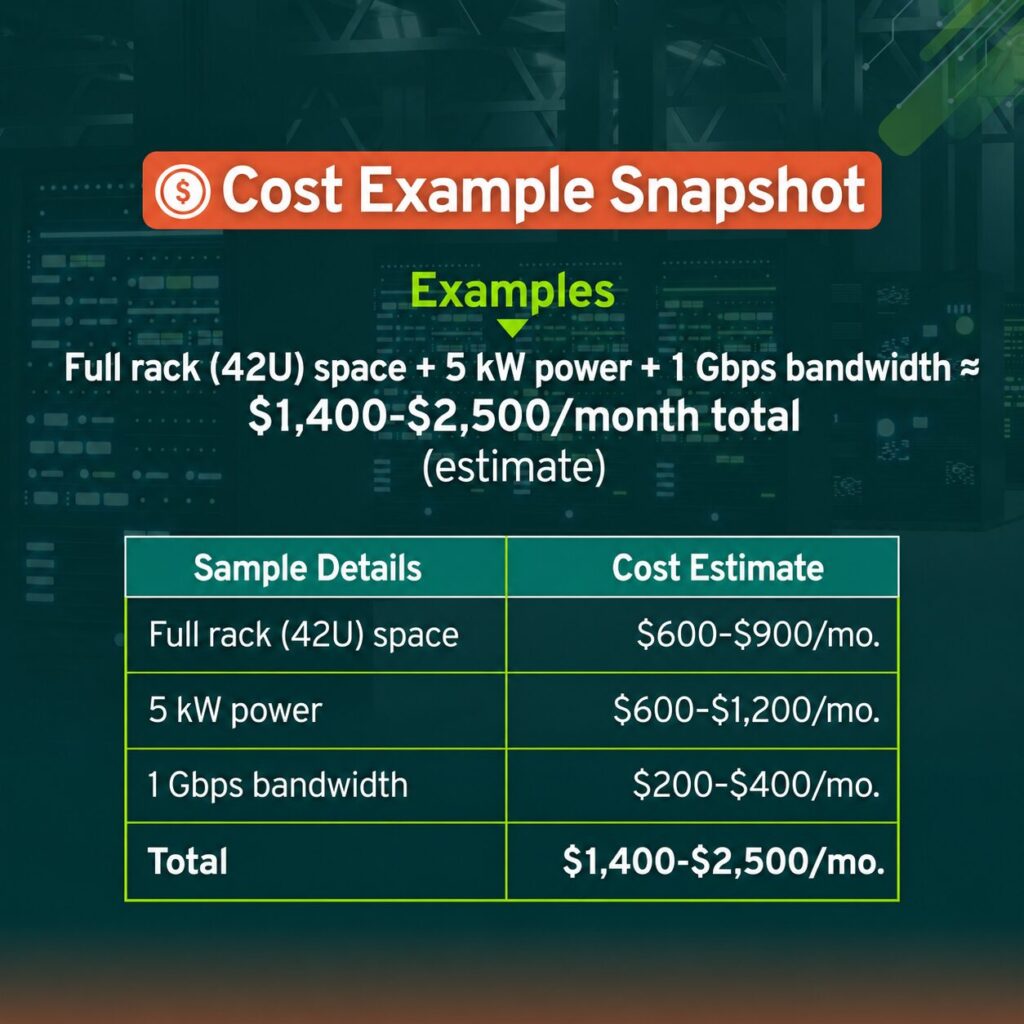
Connectivity is often separate from the base colocation fee, with TechTarget citing bandwidth costs from $225 per month for 25 Mbps up to $2,500 per month for 1 Gbps and $10,000 per month for 10 Gbps, plus a one-time cross-connect fee that can run around $750.
Higher densities can require more power delivery and more cooling capacity per rack, and Uptime Institute reporting notes broader adoption of racks in the 10 to 30 kW range while stating few facilities exceed 30 kW, which often translates into tighter capacity and more restrictive design constraints at higher loads.
Small deployments vary widely, but one provider example states a full rack often runs around 3 to 5 kW and $300 to $1,000 monthly for power, while higher-density usage in the 10 to 20 kW range is described at $1,000 to $4,000 monthly.
Overages can trigger higher unit pricing, penalty rates, or forced upgrades to a larger power commit, and industry guidance flags power and network overages as recurring sources of surprise charges when actual usage outpaces the contracted baseline.
Comparable quotes usually require the same cabinet or cage size, committed kW and power feed approach, redundancy expectations, cross-connect count, bandwidth targets, remote-hands expectations, term length, and a written list of one-time fees and monthly recurring fees so totals reflect the same scope.
Common misses include cross-connect install charges, bandwidth and IP address add-ons, security deposits and setup fees, remote-hands billing rules, and network setup fees that do not appear in the base cabinet price.
17. What negotiation points matter most at renewal or when signing a new contract?
Renewal outcomes often depend on re-checking power needs, confirming flexibility for growth or density changes, validating cross-connect and one-time fees, and matching the contract term and service levels to how the site is actually used.
18. What is an example of a colocation data center?
Equinix’s Miami MI1 facility at 50 NE 9th Street, Miami, FL 33132 is an example of a carrier-neutral colocation data center, and Equinix lists 255,513 ft² of colocation space for MI1.
19. What is the cost of rack colocation?
Rack colocation is commonly priced by rack units or by a rack package that bundles space, power, and a port. One widely cited range is $50 to $300 per 1U per month.
Concrete U.S. examples of packaged pricing include 1U $75/month, 10U $399/month, and 42U $999/month from Colocation America.
For larger deployments priced around power commitments, CBRE reported average asking rates of $196.25 per kW per month for 250 kW to 500 kW requirements in H2 2025, up 6.6% year over year.
20. How much does it cost to host a server in a data center?
Hosting a single server typically maps to a 1U or small-U colocation plan, such as 1U $75/month, with many providers pricing single-server space in the $50 to $300 per-U per-month range depending on market, power, and network.
If you pay the provider to install hardware, one guide lists “rack and stack” deployment costs of $500 to $3,000 as a one-time fee.

John Minnix is the Founder and CEO of Brightlio, with two decades of experience in data center, cloud, and network solutions. He previously built VPLS Solutions into a top Southern California technology partner before its acquisition by Evocative, where he served as President and COO overseeing global sales, operations, and strategic acquisitions.
Recent Posts

10 Largest AI Data Centers in the World

Data Centers In Oklahoma: Why You Must Colocate

Data Center and Colocation In North Dakota

Idaho Data Centers And Colocation Opportunities
Let's start
a new project together