
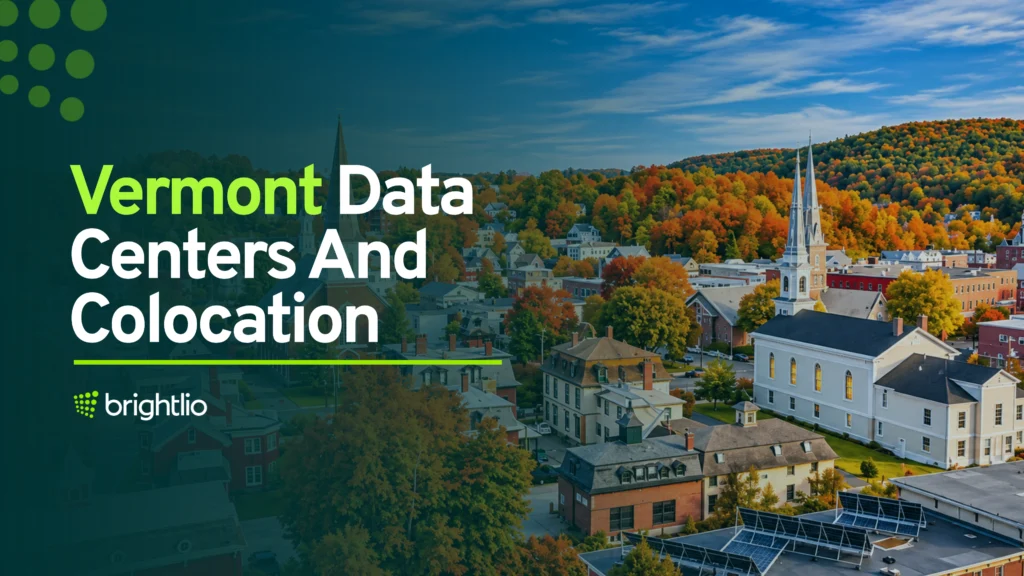
Vermont data centers serve businesses that want their equipment close to local staff and customers. Commercial colocation concentrates around Burlington, South Burlington, and Williston, with a smaller hosting option in Stowe. The market comprises six operating facilities, including five colocation sites.
Colocation lets you place your own servers in a facility that supplies power, cooling, physical security, and network access. Vermont can suit a local company moving equipment out of an office server room. It can serve as a recovery location for an organization with infrastructure elsewhere in the Northeast.
The decision depends on your power requirements and growth plans. Vermont’s commercial electricity price was 20.47¢ per kilowatt-hour in August 2026, above the national average. Its small provider base makes it especially important to confirm available cabinet space before planning a move.
Check out Brightlio’s colocation services for help comparing Vermont facilities and nearby alternatives. This guide explores the market’s benefits, locations, operating facilities, and practical drawbacks.
Vermont Data Center Tracker
6total data centers
6 operational0 planned
This tracker counts each facility once. It covers 6 operating sites, 5 of them colocation, and no active planned projects.
Market Snapshot
Notable Operating Data Centers In Vermont
Only two of Vermont's six operating sites publish floor space, so this is not a size ranking. Five are colocation facilities, shown on the map as green squares.
- Tech Vault South BurlingtonSouth Burlington, built-out whitespace39,000 sq ftOperational
Carrier-neutral colocation facility retrofitted in 2010, with 1 MW of built-out power. The operator describes it as a Tier 3 design and Vermont's first LEED-certified commercial data center
- Address:
- 21 Gregory Dr, South Burlington
- Operator:
- Tech Vault
- VELCO Rutland Data CenterRutland6,900 sq ftOperational
EMP-shielded utility data center completed in 2019, with 12-inch conductive concrete walls and two 800 kW backup generators. It runs Vermont's transmission grid systems and VELCO's own computing
- Address:
- 366 Pinnacle Ridge Rd, Rutland
- Operator:
- Vermont Electric Power Company (VELCO)
- Lightboard Carrier HotelSouth BurlingtonNot publishedOperational
Vermont's only neutral carrier hotel with an internet exchange, served by about a dozen fiber providers and two separate substations
- Address:
- 530 Community Dr, South Burlington
- Operator:
- Lightboard
- FirstLight WillistonWillistonNot publishedOperational
SOC 2 Type 2 facility on FirstLight's fiber network, with A and B UPS feeds and five days of on-site generator fuel
- Address:
- 45 Krupp Dr, Williston
- Operator:
- FirstLight Fiber
- Consolidated Communications BurlingtonBurlingtonNot publishedOperational
Downtown Burlington technology hub run by the state's largest telecom carrier
- Address:
- 266 Main St, Burlington
- Operator:
- Consolidated Communications
Planned Data Centers In Vermont
Vermont has no active data center proposals. A large project in St. Albans was withdrawn after developers found it would need costly transmission upgrades.
Colocation Facilities In Vermont
Colocation clusters around Burlington, with one small site in Stowe. These operating facilities also count in the Operational tab.
- Tech Vault South BurlingtonSouth Burlington, built-out whitespace39,000 sq ftColocation
Carrier-neutral colocation facility retrofitted in 2010, with 1 MW of built-out power. The operator describes it as a Tier 3 design and Vermont's first LEED-certified commercial data center
- Address:
- 21 Gregory Dr, South Burlington
- Operator:
- Tech Vault
- Lightboard Carrier HotelSouth BurlingtonNot publishedColocation
Vermont's only neutral carrier hotel with an internet exchange, served by about a dozen fiber providers and two separate substations
- Address:
- 530 Community Dr, South Burlington
- Operator:
- Lightboard
- FirstLight WillistonWillistonNot publishedColocation
SOC 2 Type 2 facility on FirstLight's fiber network, with A and B UPS feeds and five days of on-site generator fuel
- Address:
- 45 Krupp Dr, Williston
- Operator:
- FirstLight Fiber
- Consolidated Communications BurlingtonBurlingtonNot publishedColocation
Downtown Burlington technology hub run by the state's largest telecom carrier
- Address:
- 266 Main St, Burlington
- Operator:
- Consolidated Communications
- Power Shift StoweVT Data CenterStoweNot publishedColocation
Small data center for Vermont businesses running their own servers, with redundant power and internet uplinks
- Address:
- 571 S Main St, Stowe
- Operator:
- Power Shift
Choose a category to switch the list and highlight its sites on the map. Click any site card to find it on the map, or click a marker to jump to its card. Pins are approximate, and each MW figure carries the basis shown beside it.
Data sourced from Data Center Map, EIA rates, Inside Climate News, Vermont Public, Vermont Business Magazine, Brownstein, Seven Days, T&D World, PeeringDB, FirstLight and Kadoa, checked November 8, 2026. Totals count each campus or facility once.
Why Colocate In Vermont
Vermont offers useful advantages for organizations with a local presence or a need for a separate Northeast location. The following are four benefits to consider when matching the market to your workload.
1. Keep Infrastructure Within Reach Of Your Team
For a business based near Burlington, local colocation can make equipment maintenance easier to coordinate. Your technicians can visit the facility for an installation or hardware replacement without organizing a trip to a distant metropolitan market. This matters when a failed storage controller or network appliance requires hands-on attention.
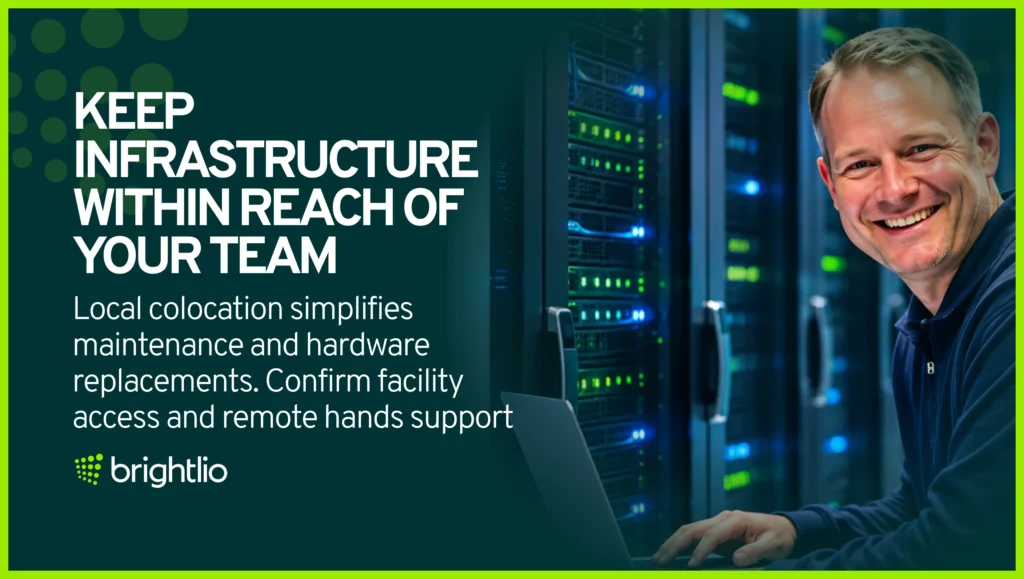
Local access is especially useful when you retain responsibility for your servers. A provider’s remote hands service covers agreed physical tasks, such as replacing a drive or checking a cable. It does not automatically include application troubleshooting or responsibility for recovering your systems.
Compare access procedures before choosing a site. Confirm whether authorized staff can enter outside business hours and how replacement equipment is received. An accessible facility with a clear support arrangement can reduce the time between identifying a hardware problem and getting someone to the rack.
2. Connect Through Established Regional Networks
Vermont has commercial facilities built around regional fiber connectivity. FirstLight’s Williston site connects to its Northeast network. South Burlington provides carrier-neutral options, including Tech Vault and the Lightboard carrier hotel on Community Drive.
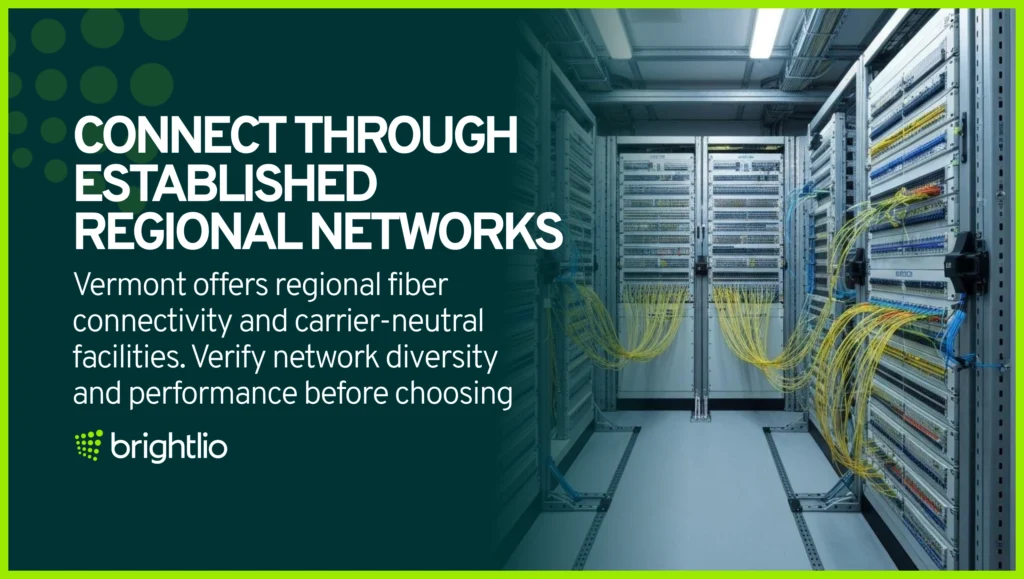
A carrier-neutral data center lets customers choose among participating network providers. This can help a business compare bandwidth prices or arrange a second connection. A carrier hotel emphasizes connections between networks, making the available providers particularly important to the buying decision.
The benefit depends on the actual routes into your cabinet. Two carrier contracts can share the same underground conduit or upstream infrastructure. Ask for route information and test performance to your offices, cloud services, and customers before treating a second circuit as an independent recovery path.
3. Use Cold Weather To Reduce Cooling Demand
Vermont’s long cold season creates opportunities to remove server heat with less compressor-based refrigeration. Facilities equipped for this can use cool outdoor conditions through an economizer or dry-cooling system. Dry cooling transfers heat to outdoor air through a heat exchanger, reducing the need to run refrigeration equipment when conditions allow.
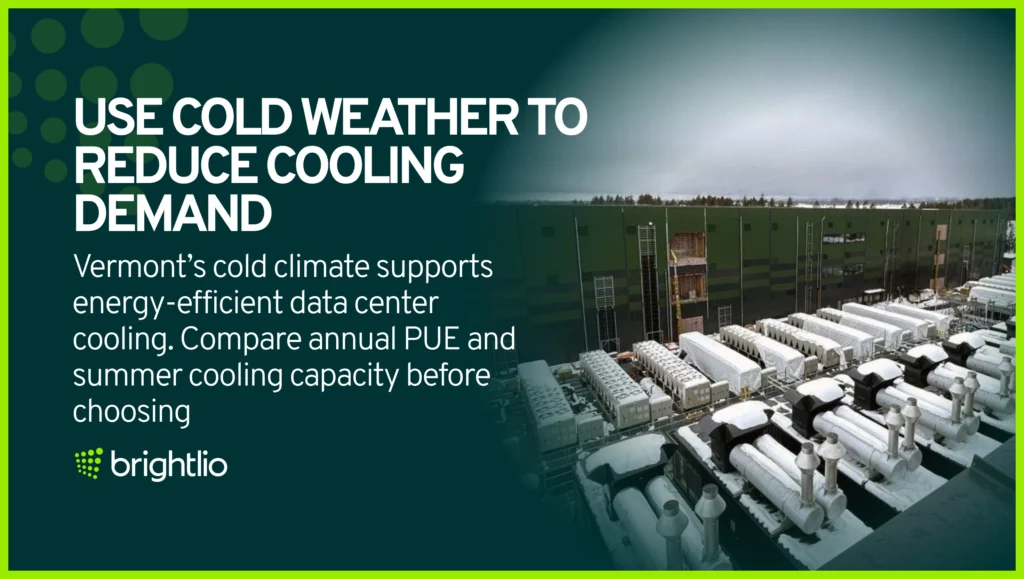
This approach is often called free cooling, although fans, pumps, controls, and other equipment still consume electricity. Savings depend on the cooling design, outdoor conditions, and the temperature limits of the installed equipment. A cold climate alone does not establish how efficiently a particular building operates.
Ask the provider for measured annual efficiency and its summer cooling capacity. Power usage effectiveness, or PUE, compares total facility electricity with electricity used by IT equipment.
An annual measurement gives a more useful picture than a favorable winter reading when comparing the overhead included in your colocation price.
4. Support Renewable Electricity Goals
Renewable Energy Snapshot: Hydropower supplied 51% of Vermont’s total in-state electricity generation in 2024. Nearly all electricity generated within the state came from renewable sources.
This gives Vermont a distinctive energy profile for organizations examining the environmental impact of their infrastructure.
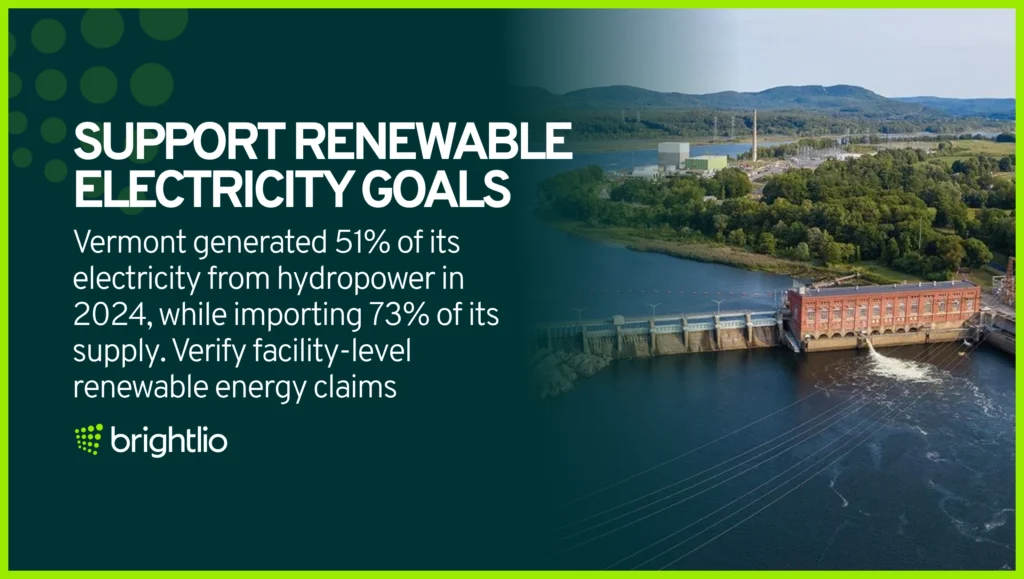
The supply picture extends beyond the state boundary. About 73% of Vermont’s electricity supply came from outside the state in 2024, much of it Canadian hydropower. The EIA’s Vermont energy overview distinguishes local generation from the electricity imported to meet demand.
For a colocation buyer, the relevant evidence is the facility’s electricity procurement and emissions information. Ask how renewable energy attributes are assigned to your service and what documentation accompanies them.
That makes it possible to support a sustainability claim with your own contract rather than relying on Vermont’s statewide generation mix.
Where Vermont Data Centers Are Located
Commercial colocation is concentrated in the Burlington area, while Stowe serves smaller hosting needs. Rutland has important utility computing infrastructure. The following are five locations that explain how Vermont’s data center market is organized.
1. South Burlington
South Burlington contains Tech Vault at 21 Gregory Drive and Lightboard’s carrier hotel at 530 Community Drive. These facilities give the area both enterprise colocation and a location for network interconnection.
Choose between them based on the service you need. A business housing production servers should examine cabinet power, cooling, and support.
A network operator may place more weight on available interconnections and the cost of connecting to other networks. Nearby addresses do not guarantee the same services or the same physical fiber routes.
2. Williston
FirstLight’s facility at 45 Krupp Drive serves businesses seeking colocation connected to a regional fiber network. It is often described as the company’s Burlington-area data center, but its physical location is Williston.
The site merits consideration when you want network transport and rack space coordinated through one provider. Compare the end-to-end service from your office to the facility, including installation timing and outage responsibilities. A rack that is ready before the circuit arrives will not meet your migration deadline.
3. Burlington
The telecommunications facility at 266 Main Street forms part of downtown Burlington’s network infrastructure. It is associated with Consolidated Communications and the Fidium business.
For a downtown organization, proximity may simplify equipment access and local connectivity. Confirm the specific colocation product available at this address, however. A telecommunications building can support network equipment without offering the same cabinet configurations, access arrangements, or managed services as a dedicated retail colocation facility.
4. Stowe
Power Shift offers shared and colocated server hosting from its Stowe business at 571 South Main Street. Its services are oriented toward small and medium-sized businesses, making it relevant for organizations with modest hosting requirements in Lamoille County.
Discuss the equipment you intend to install before assuming a full cabinet or a large power allocation is available. Establish who maintains the operating system and backups. The division of responsibility is especially important when comparing a managed hosting package with space for servers your own team will operate.
5. Rutland
Rutland houses VELCO’s data center at 366 Pinnacle Ridge Road. This facility supports the transmission utility’s own computing and systems used to manage Vermont’s electricity grid.
Its presence shows that Vermont’s operating facilities include critical infrastructure beyond commercial hosting. VELCO is not a retail colocation option for a business seeking a cabinet. Buyers comparing local commercial providers should therefore treat Rutland’s utility facility separately from the Burlington-area colocation market.
Five Notable Operating Data Centers In Vermont
The following are five notable operating facilities in Vermont. Their roles differ, and comparable size and IT-power figures are unavailable across all five, so the profiles follow no size ranking. Power ratings describe capacity where known; they do not measure actual electricity consumption.
1. Tech Vault South Burlington
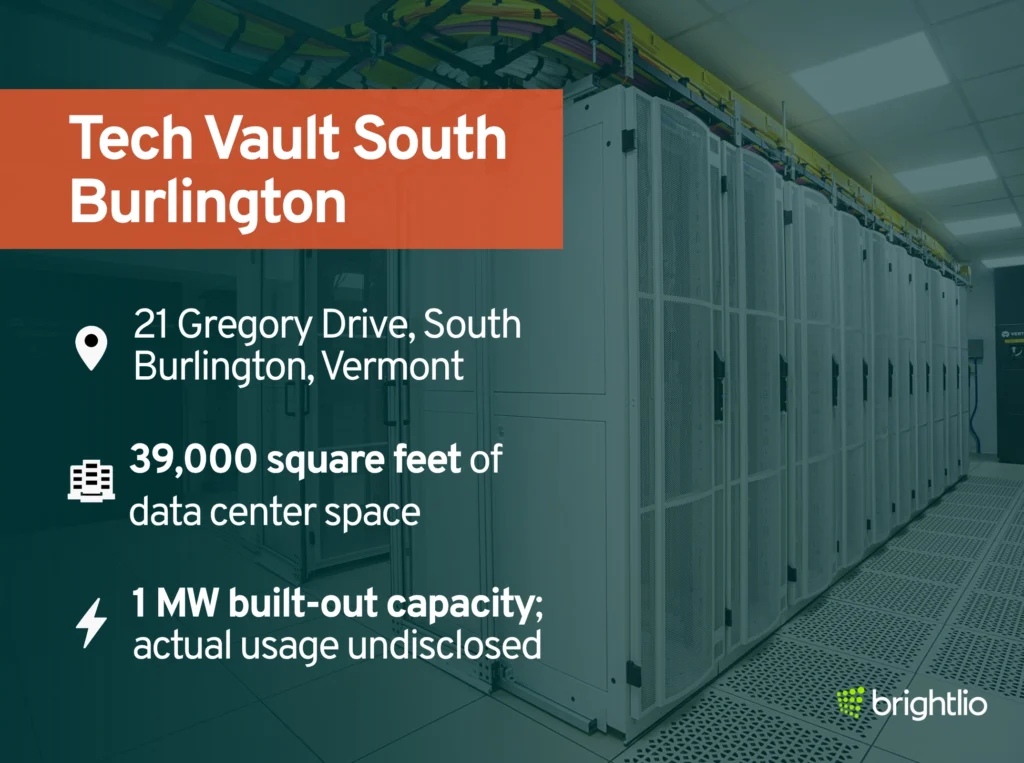
- Location: 21 Gregory Drive, South Burlington, Vermont.
- Facility Size: 39,000 square feet of data center space.
- Power: 1 MW of fully built-out power; actual electricity consumption is not publicly disclosed.
Tech Vault is a commercial colocation facility with a focus on enterprise infrastructure and managed services. Its Vermont facility specifications describe carrier-neutral connectivity and cooling and electrical infrastructure independent of the host building.
Physical safeguards include biometric access controls, camera surveillance, and reinforced walls. The facility holds LEED Silver certification, a building sustainability designation. Its cooling equipment includes in-row units, which place cooling close to the equipment producing heat.
The site is relevant for businesses that need local rack space with options for additional infrastructure services. Before ordering, confirm the power available to your cabinet and the support tasks included in the agreement. The facility’s 1 MW rating does not establish the amount of capacity currently available for a new deployment.
2. VELCO Rutland Data Center
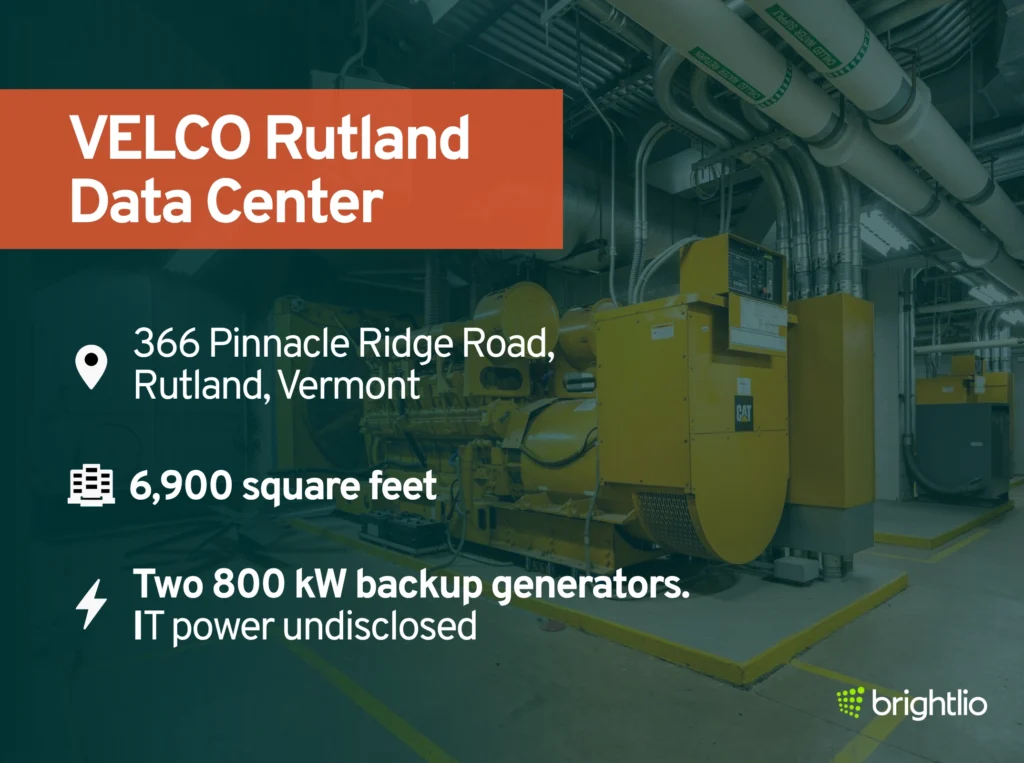
- Location: 366 Pinnacle Ridge Road, Rutland, Vermont.
- Facility Size: 6,900 square feet.
- Power: IT-power capacity and actual consumption are not publicly disclosed. Backup equipment includes two 800 kW generators.
VELCO’s facility supports its corporate computing, communications, and energy management systems. The utility migrated systems into the new data center during 2019. Its purpose is to protect infrastructure needed to operate Vermont’s transmission network.
The building incorporates shielding against electromagnetic pulses, which can disrupt electronic equipment. VELCO’s Pinnacle data center specifications identify separate housing for the emergency generators and protection against severe weather and other physical threats.
The generator ratings should not be combined into a claim that the building provides 1.6 MW of IT capacity. Backup equipment may serve redundant functions and support cooling or other facility loads. This is a utility operations facility, with no general retail colocation offering.
3. Lightboard Carrier Hotel
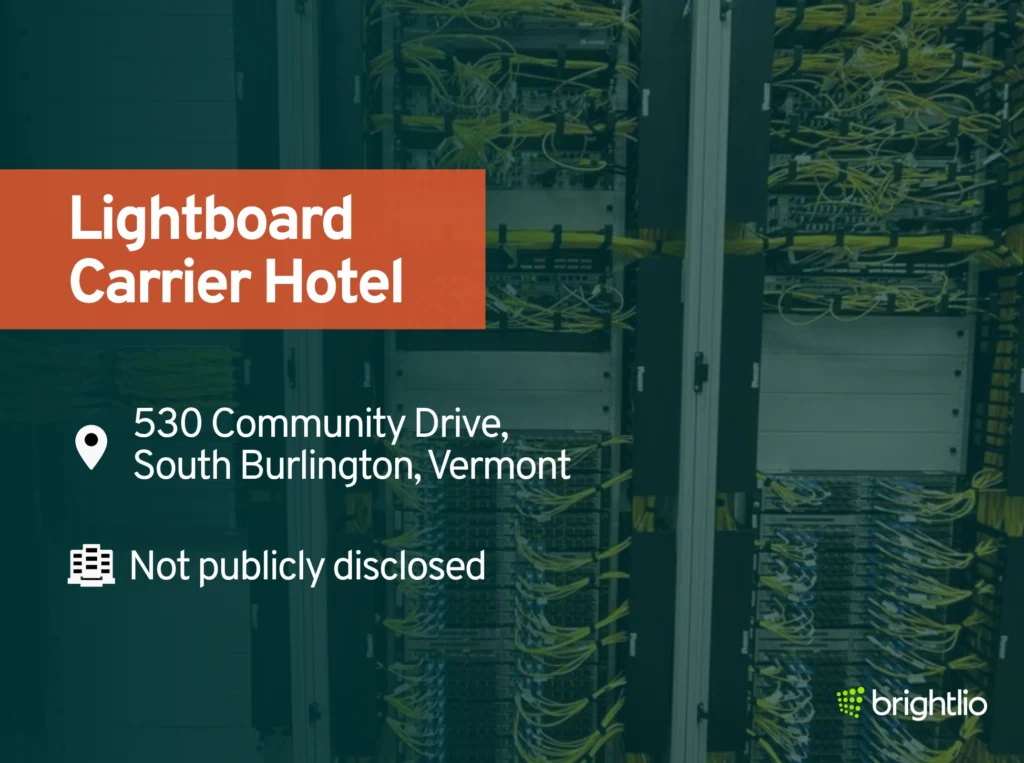
- Location: 530 Community Drive, South Burlington, Vermont.
- Facility Size: Not publicly disclosed.
- Power: Total facility capacity and actual consumption are not publicly disclosed.
Lightboard’s South Burlington carrier hotel provides a location for network interconnection and access to Vermont IX. An internet exchange lets participating networks exchange traffic directly. The benefit for a customer depends on which networks participate and how its traffic is routed.
The facility’s network interconnection details identify service from separate substations. For a tenant, the next step is to establish how that supply reaches the equipment and which paths remain available during maintenance.
This site is particularly relevant when connectivity drives the location decision. Ask about cabinet availability, cross-connect charges, and the process for ordering a connection to another network. Confirm the exact entrance and suite during a tour because the Community Drive property appears under more than one street-number reference.
4. FirstLight Williston
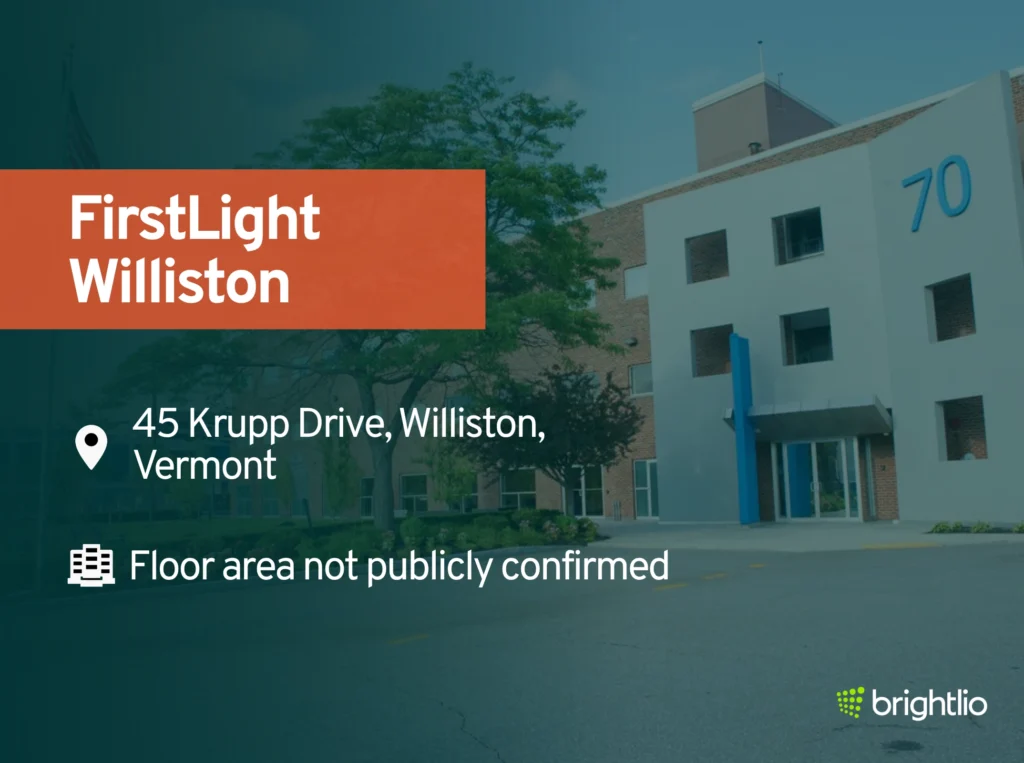
- Location: 45 Krupp Drive, Williston, Vermont.
- Facility Size: A current, consistently defined floor-area figure is not publicly confirmed.
- Power: Total facility capacity and actual consumption are not publicly disclosed.
FirstLight offers full and half cabinets at its Williston facility. Its Williston data center specifications describe separate A and B uninterruptible power supply feeds and generator backup with five days of fuel stored on site.
An uninterruptible power supply, or UPS, bridges interruptions while another source of power takes over. For equipment with two power supplies, the provider should explain how each connects to the separate feeds. Confirm the supported load if one feed is unavailable.
The facility offers private network connections up to 100 Gbps, subject to the service ordered. It supports authorized customer access around the clock. Businesses comparing it with other sites should request the applicable SOC 2 Type 2 report and confirm its coverage of the facility and contracted services.
5. Consolidated Communications Burlington
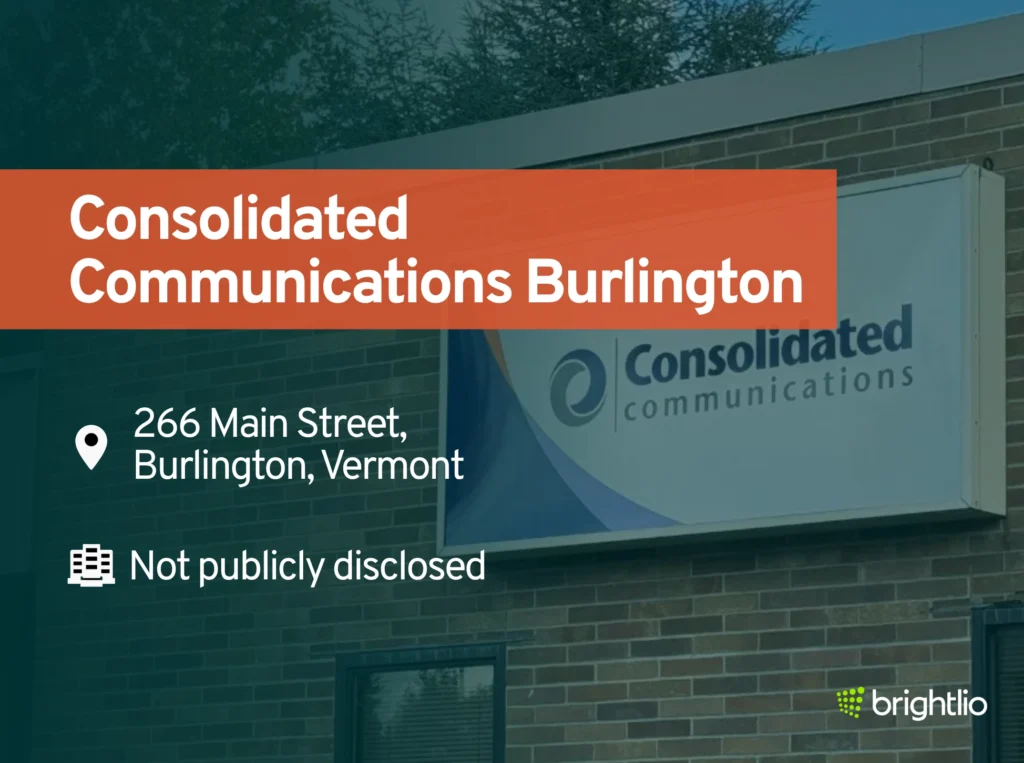
- Location: 266 Main Street, Burlington, Vermont.
- Facility Size: Not publicly disclosed.
- Power: Total facility capacity and actual consumption are not publicly disclosed.
The Main Street facility is part of Burlington’s telecommunications infrastructure and provides a downtown option for colocation enquiries. Its network-oriented role makes the exact product available at the building an important part of the evaluation.
Request a site-specific proposal covering the cabinet or equipment footprint, permitted electrical load, and customer access. Confirm whether installation and ongoing support come from the building operator or another service provider. Those responsibilities should be clear before arranging equipment delivery.
For organizations already buying connectivity from Consolidated Communications or Fidium, the address may be worth evaluating alongside their existing services. Confirm the current contracting entity and service scope. Do not assume that an existing internet agreement includes colocation access or hardware support.
Drawbacks Of Colocating In Vermont
Vermont’s small market and energy costs can narrow the available options. The following are five drawbacks to weigh against the convenience of keeping equipment close to your team.
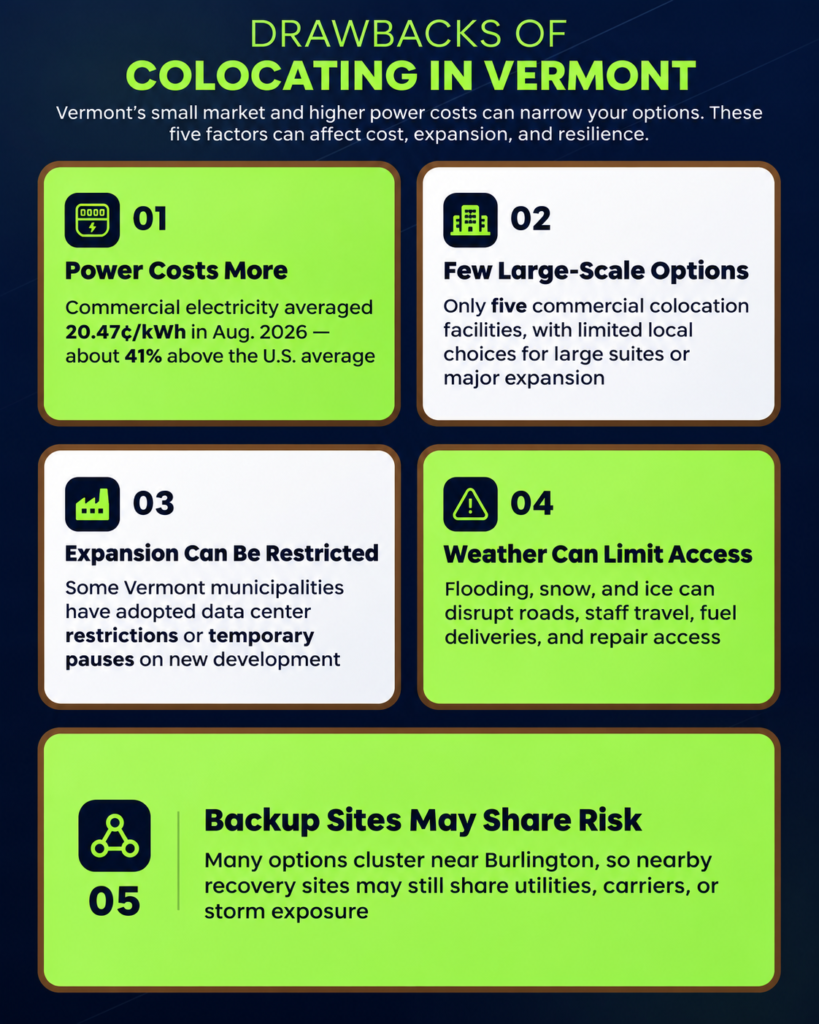
1. Commercial Electricity Costs More Than The National Average
Power Cost Snapshot: Vermont’s commercial electricity price averaged 20.47¢/kWh in August 2026, about 41% above the U.S. average of 14.47¢/kWh. Source: EIA electricity prices.
At a steady 5 kW over a 730-hour month, equipment would consume 3,650 kWh. Applying those averages gives about $747 in Vermont, versus $528 nationally, before cooling and other facility costs. This is an energy illustration, not a cabinet quote.
A provider’s actual tariff and billing method may differ. Ask whether power is metered or bundled into the monthly commitment, and how rate changes affect your bill. Compare the complete contract cost over the intended term rather than treating the state average as the price you will pay.
2. Large Deployments Have Few Local Alternatives
With five commercial colocation facilities, Vermont offers a narrow pool of providers for a growing deployment. Public specifications do not establish broad availability for large private suites or several megawatts of customer IT load. Space in an existing building is useful only when suitable power and cooling are available with it.
Discussing the prospects for large data centers in Vermont in February 2026, University of Vermont electrical power systems researcher Sam Chevalier explained:
“The infrastructure limits and the price of electricity together just make it kind of a non-starter.”
— Sam Chevalier, University of Vermont, Vermont Public
For a colocation customer, those constraints make it important to distinguish installed capacity from expansion that still needs electrical upgrades.
This becomes important when a company expects to add cabinets during the contract. A provider may accommodate the first installation but require a different room, electrical upgrade, or additional location for later equipment. Obtain a written expansion plan with an agreed delivery schedule.
For a substantial deployment, compare Vermont with nearby New England and New York markets early in the buying process. Include circuit costs and staff travel in that comparison. A distant facility can offer more growth options, while a local site may make physical maintenance easier.
3. Local Development Restrictions Can Limit Expansion
Vermont municipalities have adopted different approaches to data center development. South Burlington adopted zoning restrictions on August 3, 2026, prohibiting new data center uses with footprints of 20,000 square feet or more.
Royalton voters approved a five-year measure aimed at AI and cryptocurrency data centers, while Morristown adopted a two-year pause covering data centers and certain high-impact uses.
These municipal restrictions matter most when a provider needs permission to build or expand. They do not establish that an existing commercial facility must stop accepting customers. The approved use of the property and the work needed for your deployment determine the practical effect.
Ask whether your requested capacity is already installed and permitted. If delivery requires building work, establish which approvals remain outstanding and what happens if the schedule slips. An expansion commitment is more useful when the contract explains both the delivery milestone and the remedy for a missed date.
4. Flooding And Winter Weather Can Disrupt Access
Vermont has significant inland flood exposure. During the July 2023 floods, 3–9 inches of rain fell within 48 hoursacross the state, damaging roads and communities. The USGS account of the flooding shows why distance from the coast is not a sufficient measure of disaster risk.
Evaluate each property’s elevation, drainage, and placement of electrical equipment. A data hall can remain dry while floodwater blocks the access road or disrupts a nearby fiber route. Snow and ice create different problems for staff travel, fuel deliveries, and repair crews.
Request the facility’s emergency access and fuel replenishment procedures. Ask how support operates when local personnel cannot reach the building. If you are choosing a recovery site, examine shared roads, utility dependencies, and fiber routes between it and your primary location.
5. Moving Equipment To A Second Nearby Site May Leave Shared Risks
Most Vermont colocation options are clustered around Burlington. That concentration makes facility tours convenient, but it can limit geographic separation for a business seeking a backup location. Two buildings may still depend on the same regional infrastructure or face the same disruptive storm.
Physical distance is only one part of recovery planning. Check whether the sites share upstream carriers, utility infrastructure, or the technicians responsible for emergency work. A second address does not by itself establish that both environments can operate independently.
Choose the recovery arrangement around the outage you need to survive. A nearby facility may be appropriate for an office power failure or equipment-room incident. A wider regional disruption may call for another market, with recovery procedures tested from outside the affected area.
What To Compare In A Vermont Colocation Quote
Start with the electrical load your equipment will use, its rack space, and its network requirements. A full cabinet can reach its power limit before every mounting position is occupied. Include room for growth in both the physical footprint and the permitted load.
Ask each provider to price the same configuration. Include the power arrangement, bandwidth commitment, cross-connects, and the amount of remote hands support you expect to use. Brightlio’s colocation pricing guide explains how these components contribute to the total bill.
Review installation charges, annual increases, and the conditions for renewing or ending the contract. Establish who pays for equipment removal and circuit cancellation. A low initial monthly figure can become less attractive once these obligations are included.
Before committing, request a facility tour and a written delivery date. Confirm that the capacity offered belongs to the exact building you inspected. Vermont’s limited supply makes a specific, ready-to-deliver proposal more valuable than a general statement that an operator serves the region.
How Brightlio Helps You Choose A Vermont Data Center
Brightlio helps businesses compare colocation providers against their technical requirements and budget. We can help define the cabinet footprint, assess connectivity needs, and obtain proposals for suitable locations.
For a Vermont deployment, the comparison should begin with available power and the support your team needs. We can help evaluate local options alongside nearby markets when your requirements call for more capacity or greater geographic separation.
Share your equipment requirements, current power use, preferred location, and target move date with Brightlio. We can help you compare the options and understand the costs before you commit.
Frequently Asked Questions
1. How Many Data Centers Are In Vermont?
Vermont’s market comprises six operating facilities, including five commercial colocation sites. The commercial options are Tech Vault, Lightboard, FirstLight Williston, Consolidated Communications Burlington, and Power Shift in Stowe.
VELCO’s Rutland facility supports utility operations. Private server rooms at businesses and institutions fall outside this market count. The five colocation facilities are part of the six operating sites, so those figures should not be added together.
2. What Is The Largest Commercial Data Center In Vermont?
Tech Vault has 39,000 square feet of data center space and 1 MW of fully built-out power, making it a notable larger commercial option in Vermont.
A definitive statewide ranking is difficult because comparable size and power figures are unavailable for every facility. For a buyer, the available capacity matters more than total building size. Confirm the power and cabinet space the provider can deliver for your installation date.
3. How Much Does Colocation Cost In Vermont?
Pricing depends on the equipment footprint, electrical load, connectivity, and support package. There is no reliable statewide cabinet price that applies across Vermont’s providers.
As an energy illustration, a continuous 5 kW load uses 3,650 kWh in a 730-hour month. At the August 2026 commercial average, that represents roughly $747 in electricity. A colocation proposal must account for cooling, facility infrastructure, space, and service costs as well.
4. Can I Colocate A Single Server In Vermont?
Smaller deployments are possible, but the minimum order depends on the provider. Power Shift offers colocated server hosting, while FirstLight’s Williston materials describe half and full cabinets. Send the provider your server dimensions, power requirements, and network needs before requesting a price.
Confirm whether shared rack space is available and how technicians access your equipment. A small server can still require substantial electrical capacity if it contains power-intensive processors.
5. Is Vermont Suitable For AI And GPU Servers?
Suitability depends on the specific equipment and facility. A few graphics processing unit, or GPU, servers may fit an existing cabinet arrangement, while a dense training cluster can need substantially more power and specialized cooling.
Ask for the supported kilowatts per cabinet and the cooling arrangement for your hardware. In-row liquid cooling equipment does not automatically mean a facility offers direct liquid connections to customer servers. Obtain written approval for the proposed configuration.
6. Do Vermont Data Centers Run Entirely On Renewable Energy?
That depends on the facility’s electricity procurement. Nearly all Vermont’s in-state generation came from renewable sources in 2024, but about 73% of the state’s electricity supply came from outside Vermont.
Local generation statistics do not establish the electricity attributes assigned to a particular customer. Ask the provider for its supply mix and renewable energy documentation. Confirm whether your organization can use those attributes in its own emissions reporting.
7. Does Vermont Offer A Data Center Tax Incentive?
Vermont has no dedicated statewide data center tax incentive. The 2026 H.727 bill concerned data center regulation, rather than an enacted incentive program. The governor vetoed it on May 28, and the House sustained the veto on May 29.
Businesses evaluating a deployment should price applicable taxes explicitly with the provider. Any general business incentive or exemption requires its own eligibility review and should not be assumed to apply to colocation.
8. Do Local Data Center Restrictions Prevent Me From Renting A Rack?
Local restrictions primarily affect development and permitted uses. Renting existing capacity may involve a different approval position from constructing or enlarging a facility. South Burlington’s size restrictions therefore do not, by themselves, answer whether a particular provider can accept your equipment.
Ask whether the proposed installation fits the property’s existing approvals. If it requires additional electrical or building work, confirm the approvals and schedule before signing a time-sensitive contract.
9. Is Vermont A Good Disaster Recovery Location?
Vermont can be suitable when the selected site provides meaningful separation from your primary systems. Compare flood exposure, utility dependencies, and network routes between the locations.
A Burlington-area backup site may help during a problem at a local office, but the two locations could still share regional storm risks. Define how much data loss and downtime your business can tolerate, then test whether the proposed recovery arrangement meets those limits.
10. Should I Choose Vermont Or A Nearby Larger Market?
Choose Vermont when local access and the available facilities fit your requirements. Compare nearby markets when you need more provider choice, a large private deployment, or a recovery site outside the Burlington area.
Evaluate the full cost of network connections and travel alongside the facility quote. Test application performance from your users’ actual locations. The best choice is the one that meets your operational requirements with capacity available when you need it.
Explore Nearby Data Center Markets
Continue comparing your options with our colocation guides for these nearby states and markets:

Tamzid is a cybersecurity researcher with 5+ years of experience across SaaS, security, compliance, data centers and cloud. He writes for brightdefense.com and hipaasimple.com, covering security, compliance, and infrastructure topics. Certified through Cisco, Fortinet (NSE 1), and the Basel Institute on Governance in OSINT, he grounds his work in primary sources and verified data.
Recent Posts
Top 5 Floating Data Centers
Data Centers and Colocation in Colorado
Data Centers and Colocation in Delaware
Data Centers and Colocation in Hawaii
Let's start
a new project together