
Table of Contents
Data Centers in Florida: Colocation in the Sunshine State
Data center location directly affects application performance, network latency, and business continuity. Companies evaluating colocation providers increasingly favor markets with strong infrastructure, dense connectivity, and room to scale. Florida checks all three boxes.
Colocation data centers are concentrated across the state. With about 110 data centers spread across 18 markets, Florida holds one of the highest data center concentrations in the U.S. Strategic geography, carrier-dense connectivity, and a deep labor pool put Florida among the most competitive data center markets in the country.
Florida’s tech workforce ranks 4th nationally in size, with approximately 530,000 people employed in tech roles across the state. That figure represents roughly 5.2% of the total state workforce, according to CompTIA’s State of the Tech Workforce report.
Net tech employment grew by 4.8% in 2022, outpacing the 3.2% national average. Florida ranks 1st for submarine fiber landings in the U.S. and 3rd in absolute tech job growth nationally.
This guide breaks down what makes Florida a strong colocation market, from network density and power infrastructure to tax advantages and disaster preparedness.
Florida Colocation Market Overview
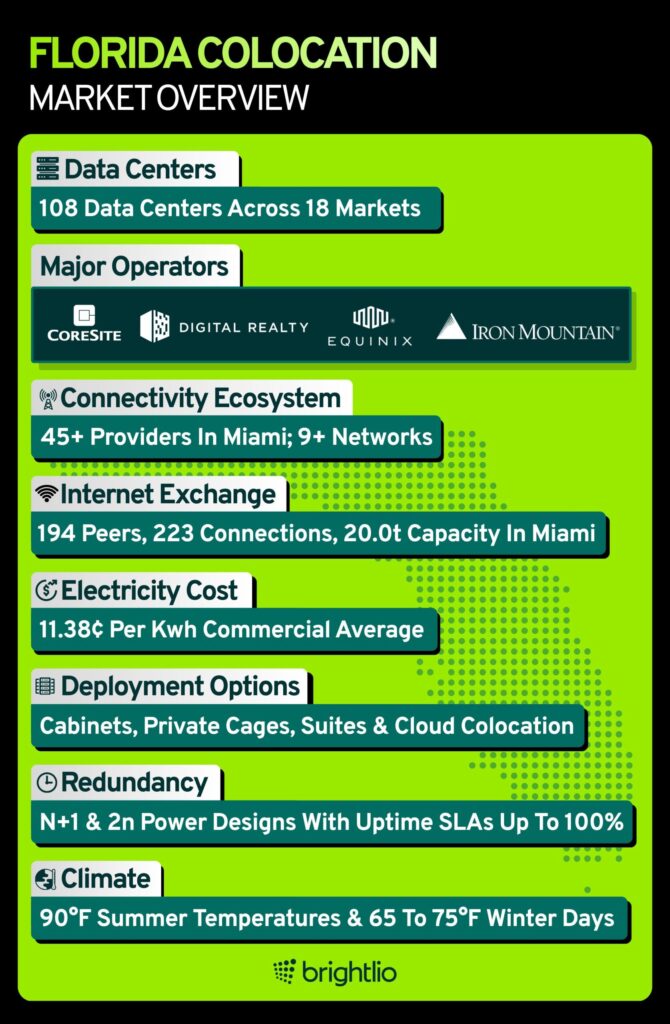
- Colocation Market Size: Florida has 108 listed data center facilities across 18 markets according to Data Center Map.
- Major Operators Present: Major operators active in Florida include Equinix, Digital Realty, CoreSite, EdgeConneX, and Iron Mountain.
- Network And Interconnection Ecosystem: Digital Realty Miami lists 45+ cloud and network providers and 60+ customers, while CoreSite OR1 lists 9+ network providers and a 140+ digital community in Orlando.
- Internet Exchange Depth: FL-IX in Miami shows 194 peers, 223 connections, and 20.0T total speed on PeeringDB.
- Electricity Cost For Operations: Florida commercial electricity averaged 11.38¢/kWh in December 2025 in the latest U.S. Energy Information Administration table.
- Power Grid Reliability Context: FPL says the North Florida Resiliency Connection is 176 miles long and supports about $1.5 billion in customer benefits tied to stronger statewide grid resilience.
- High-Density Power Readiness: Iron Mountain Miami MIA-1 is planned as a 150,000 ft², 16 MW GPU-ready facility, while EdgeConneX Miami supports 20+kW per cabinet.
- Deployment Options: Florida operators publicly show cabinets, private cages, and suites at CoreSite MI2 and cloud-connected colocation at EdgeConneX Miami.
- Redundancy And Uptime: CoreSite OR1 lists N+1, 2N redundancy and a 100% uptime SLA, while its Orlando brochure lists a 99.99% uptime SLA for OR1.
- Compliance Coverage: Digital Realty Miami lists SOC 2, SOC 3, PCI-DSS, and ISO 27001, while CoreSite MI2 lists SOC 1 Type 2, SOC 2 Type 2, ISO 27001, NIST 800-53, PCI DSS, and HIPAA.
- Regional Climate And Cooling Conditions: Average temperatures in Florida reach about 90°F (32°C) in summer and range from 65 to 75°F (18 to 24°C) during winter daytime.
Florida Offers Strategic Proximity to South America & Caribbean
Florida’s unique geographical positioning offers businesses a distinct edge in accessing markets in Latin America and the Caribbean. Florida colocation facilitates faster and more efficient data transmissions due to shorter distances compared to other parts of the U.S. For organizations with customers in these regions, having a colocation facility in Florida can mean reduced latency and improved performance.
Moreover, Florida’s infrastructure has been continuously enhanced to cater to the growing demands of international trade and communications. Several undersea cable systems land in Florida, providing direct data connections to South America and the Caribbean.
As a result, businesses that colocate in Florida benefit from a broader range of connectivity options and can optimize their network routes for cost and performance.
Florida is a Hub to the Southeastern U.S.
Florida remains a strong hub for the broader Southeastern United States. Colocating in Florida gives companies fast, reliable connectivity across major Southeastern markets through South Florida’s dense carrier and exchange ecosystem, including FL-IX, which supports traffic exchange across many sites in South Florida and offers 10G, 100G, and 400G port options.
Florida remains one of the most important connectivity hubs in the world. Miami’s data centers sit in the heart of one of the world’s largest internet exchange points and serve as major communications gateways to Latin America, the Northeastern U.S., and Europe. Miami is ranked as one of the top five most-connected cities in the world, and MI1 serves as a pathway for data traffic from the Caribbean and South and Central America to more than 148 countries worldwide.
The presence of major carriers and interconnection providers in the Sunshine State supports lower latency and faster data transfer speeds.
Florida’s official broadband map shows 7,133,068 of 7,419,981 broadband serviceable locations are served, which equals about 96.1% of locations statewide, and U.S. Census QuickFacts reports that 91.6% of Florida households had a broadband internet subscription in 2020-2024.
Florida Offers Friendly Tax Policies
Florida offers a sales tax exemption for qualifying data center property, including construction materials, component parts, machinery, equipment, computers, servers, operating or enabling software, and electricity used exclusively at the data center.
This exemption eliminates sales tax and use tax on qualifying purchases for data centers that meet the state’s current requirements, which include at least $150 million in cumulative capital investment, a critical IT load of 100 megawatts or more, and at least 1 megawatt dedicated to each individual owner or tenant.
These provisions continue to make Florida an attractive location for businesses in the tech industry and can help eligible data centers save on costs.
Florida gives eligible projects a longer runway to qualify for this incentive, as the Department of Revenue may issue temporary tax exemption certificates through June 30, 2037. This extended timeline adds another layer of support for large-scale data center development in the state.
While Florida levies a corporate income tax, its 5.5% rate remains competitive compared to other states like Iowa, where the top corporate rate is 7.1%, Pennsylvania, where the corporate net income tax rate is 7.49% for 2026, Illinois, where the 7% corporate income tax and 2.5% replacement tax bring the combined rate to 9.5%, and California, where the corporate tax rate is 8.84%. Additionally, the state provides various credits, exemptions, and deductions, which can further reduce the effective tax rate for qualifying businesses. (Florida Dept. of Revenue, IOWA Dept. of Revenue)
These provisions and the state’s competitive tax structure make Florida a financially strategic location for eligible data center operators looking to maximize their profits while benefiting from a stable and supportive business environment.
Why Companies Colocate in Florida?
Florida combines direct Latin American connectivity through Miami's submarine cable infrastructure with unusual geographic spread across multiple data center metros.
These qualities give colocation buyers routing advantages and site diversity that most secondary U.S. markets cannot match.
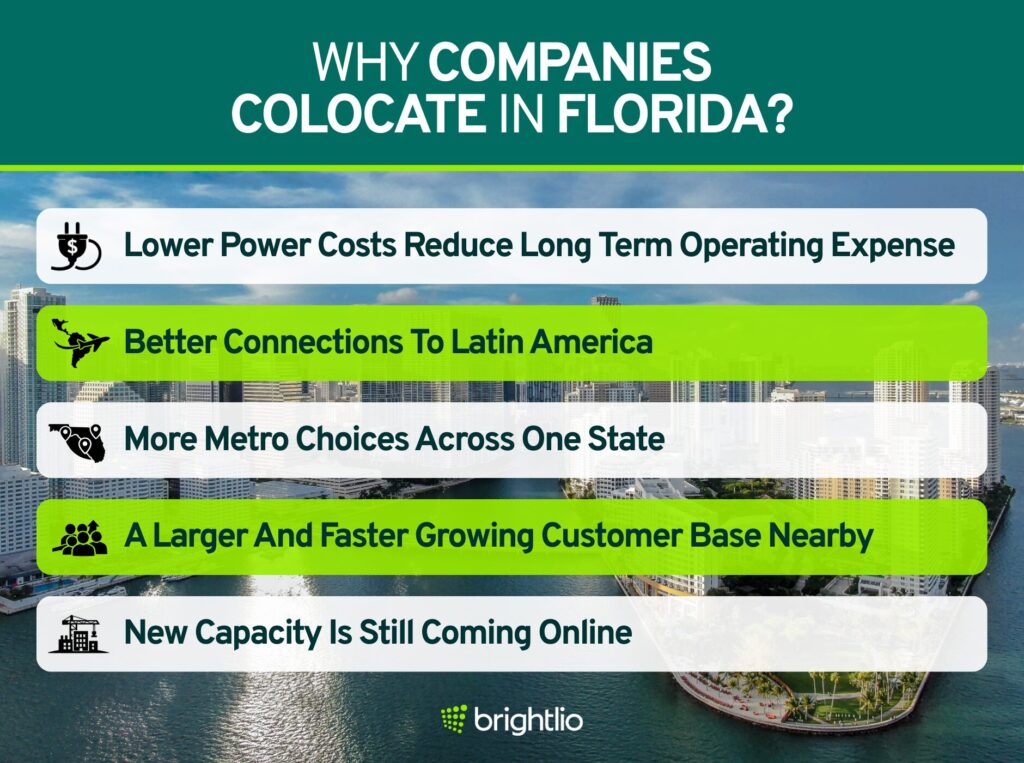
1. Power Costs Stay Below Many Coastal Markets
Florida's commercial electricity rates give operators a measurable cost advantage over most coastal alternatives. EIA's December 2025 data places the state's commercial rate at 11.38 cents per kWh, well under the U.S. average of 13.63 cents and roughly half of California's 26.92 cents.
Georgia sits at a comparable 11.49 cents. Industrial rates came in at 8.79 cents per kWh, close to the national average of 8.53 cents and below Virginia's 9.35 cents, though higher than Texas at 6.67 cents.
Retail colocation, managed hosting, and edge deployments typically operate under commercial tariffs, making that spread against West Coast pricing particularly relevant to ongoing operating budgets. Larger deployments on industrial rates still avoid the steep premiums attached to California and Northeast markets. (U.S. Energy Information Administration)
2. Better Connections to Latin America
Miami offers colocation buyers one of the most direct U.S. network paths into Latin American traffic. Equinix ranks the metro as one of the world's top five most-connected cities and reports that its campuses reach Brazilian markets through the Monet subsea system, with connectivity extending to more than 148 countries.
Local peering depth backs up that positioning. Data Center Map lists 6 internet exchanges in Miami, including FL-IX spanning 11 data centers, and records 14 cloud providers in Miami compared with 12 in Atlanta and 8 in Arizona.
Cross-connect density, cloud adjacency, and shorter southbound network paths reduce transport complexity for SaaS, media, fintech, and enterprise workloads serving the Caribbean, Central America, and South America. (Equinix)
3. More Metro Choices Across One State
Florida distributes data center capacity across more metros than many competing states, which matters for edge placement and multi-site design. Data Center Map lists 108 facilities across 18 markets in the state. Washington matches with 108 facilities but only 11 markets.
Arizona concentrates 162 facilities in just 3 markets, while Nevada spreads 68 facilities across 4 markets. Within the state, Miami accounts for 29 facilities, Tampa 21, Orlando 12, and Jacksonville 12.
That distribution gives colocation buyers room to place customer-facing, backup, and regional workloads across separate metros rather than concentrating every rack in one location. Teams that want lower network distance to users across the peninsula can keep procurement options open across multiple providers and cities. (datacentermap.com)
4. A Larger and Faster-Growing Customer Base Nearby
The state's demand-side scale adds another reason to colocate here. Florida had 23,462,518 residents as of July 2025, along with 645,575 employer establishments and 9,988,508 jobs recorded in 2023. Virginia posted 8,880,107 residents, 210,842 establishments, and 3,581,650 jobs.
Arizona recorded 7,623,818 residents, 162,845 establishments, and 2,890,429 jobs. Growth rates have been stronger as well. Florida's population rose 8.9% since April 2020, compared with 5.5% in Georgia and 2.9% in Virginia. A larger and faster-growing local market supports lower-latency delivery to end users and a wider pool of nearby enterprise, healthcare, media, and financial customers. (Census.gov)
5. New Capacity Is Still Coming Online
Active construction gives buyers a better chance of finding available space than in the most constrained legacy hubs. Iron Mountain says its MIA-1 project will phase up to 16 MW of customer IT load by mid 2026. Metrobloks announced a 15.2 MW multi-tenant facility in March 2025.
A proposed campus in Polk County won zoning approval for up to 4.4 million square feet of data center development. Silicon Valley remains tighter by comparison. CBRE reported only 16 MW commissioned at one new location in H1 2025 and noted that power limitations were pushing several planned sites back to industrial use. Procurement risk often comes down to whether future capacity is real, permitted, and powerable, and Florida's pipeline currently clears that bar more comfortably than several top-tier markets. (Iron Mountain)
Florida Data Center Options We Recommend
Florida offers several credible enterprise data center options, and Equinix, Digital Realty, ColoHouse, and Cologix stand out for connectivity, capacity, reliability, and enterprise deployment needs across major markets such as Miami, Jacksonville, and Lakeland.
1. Equinix
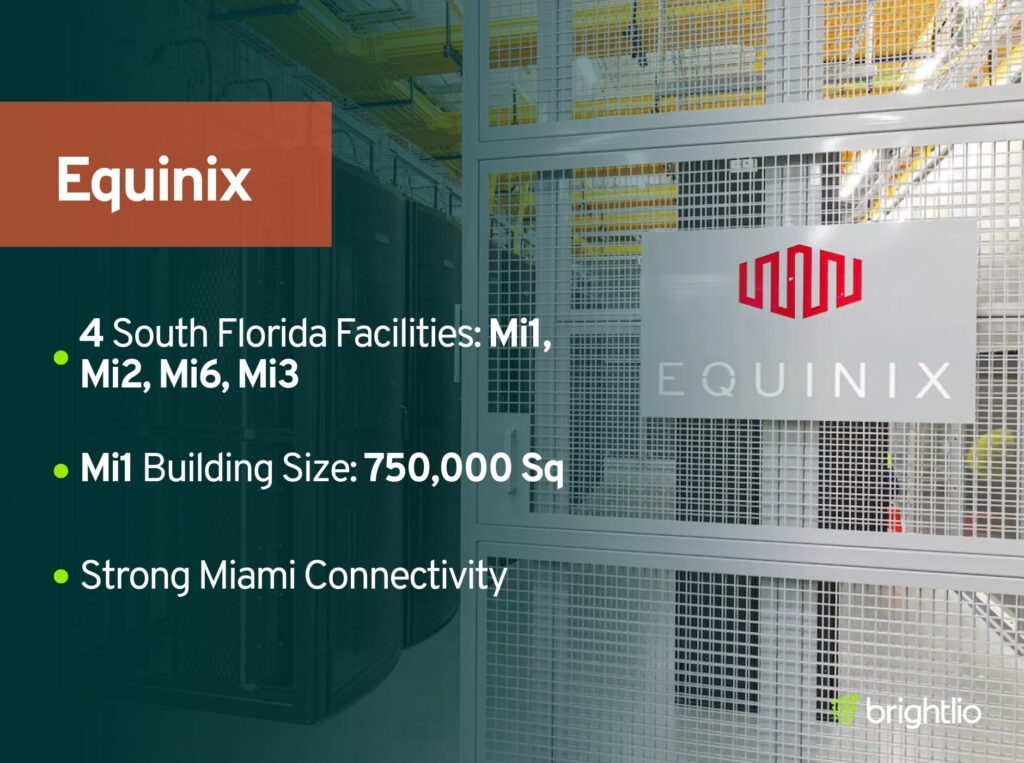
Equinix operates 4 South Florida facilities in its Miami metro cluster: MI1 in downtown Miami, MI2 in downtown Miami, MI6 in Doral, and MI3 in Boca Raton. Its MI1 facility remains the anchor site, with 750,000 sq. ft. of total building size and 255,512 sq. ft. of built-out whitespace.
Equinix describes Miami as a major interconnection gateway between the U.S. and Latin America and states that the metro provides direct connectivity to network and cloud service providers. MI1, MI2, MI3, and MI6 list certifications that include ISO 27001, ISO 22301, PCI DSS, SOC 1 Type II, SOC 2 Type II, and HIPAA, and Miami is listed as an available metro for Network Edge deployments.
Why we recommend these data centers:
- The 4 South Florida sites give enterprises cleaner local redundancy options inside one operator footprint.
- The 750,000 sq. ft. MI1 building gives larger deployments room to grow without an early migration.
- Miami's position as a Latin America gateway can reduce routing complexity for regional traffic and partner interconnection.
- The published compliance set supports buyers in finance, healthcare, and other regulated sectors.
- Network Edge availability helps teams connect branch, cloud, and core environments with less dependence on physical appliances.
2. Digital Realty
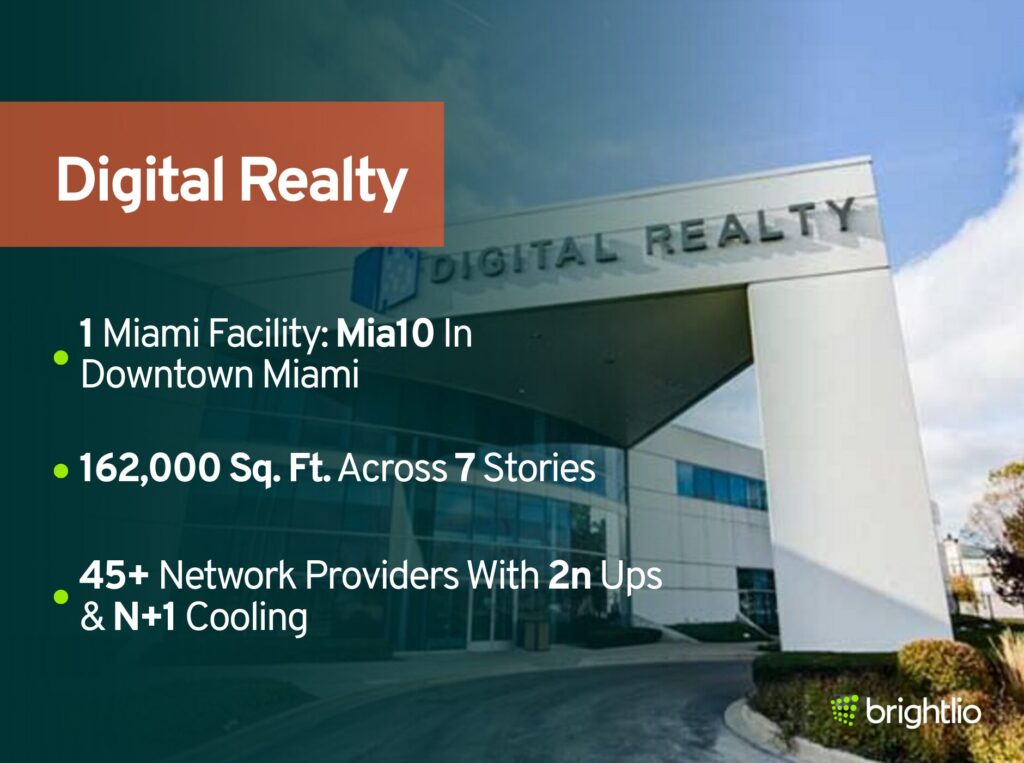
Digital Realty markets 1 Miami facility, MIA10, at 36 NE 2nd Street in downtown Miami. The building totals 162,000 sq. ft. across 7 stories, and the company offers deployments from single cabinets to private data center suites.
Digital Realty's Miami metro page lists 45+ cloud and network service providers and an ecosystem of 60+ customers. For MIA10, the company lists SOC 2, SOC 3, PCI-DSS, and ISO 27001, with 2N UPS redundancy and N+1 cooling redundancy.
Why we recommend these data centers:
- The 162,000 sq. ft. footprint fits enterprises that want meaningful room for phased growth.
- Access to 45+ cloud and network providers gives buyers more sourcing flexibility.
- The 2N UPS design and N+1 cooling support higher uptime expectations.
- Cabinets through private suites make it easier to match space commitments to actual demand.
- The listed certifications make MIA10 easier to shortlist for control-heavy enterprise environments.
3. ColoHouse
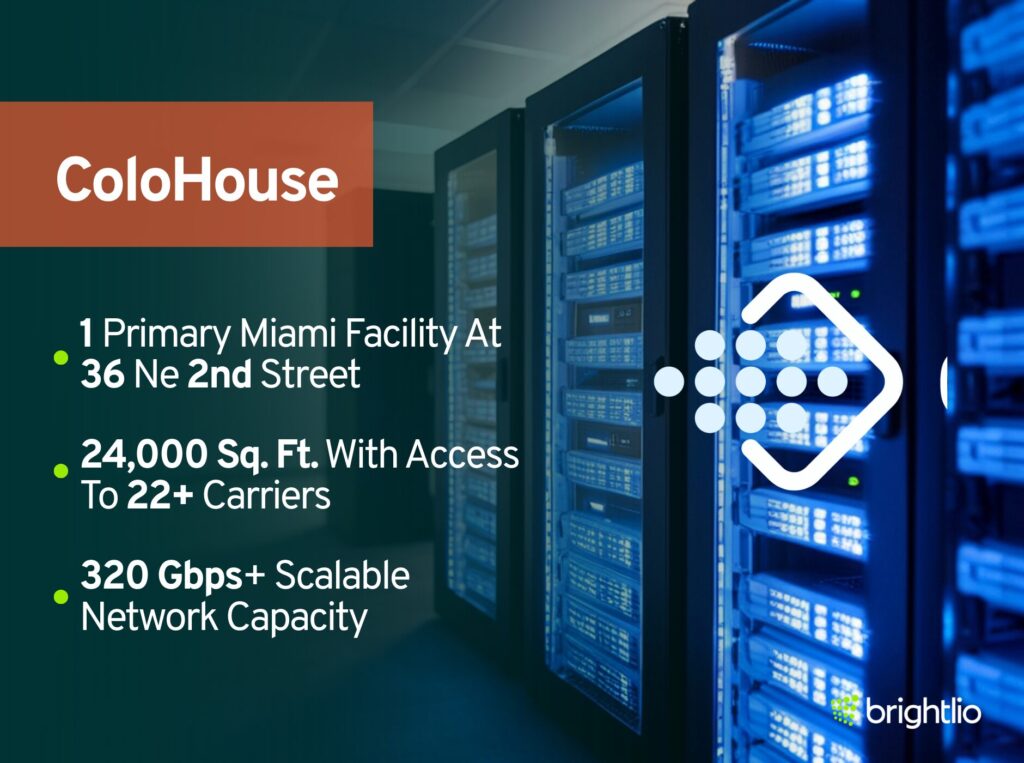
ColoHouse operates 1 primary Miami facility at 36 NE 2nd Street in downtown Miami. Its published Miami spec sheet lists 24,000 sq. ft. of space, access to 22+ carriers through the meet-me-room, and 320 Gbps+ scalable network capacity.
ColoHouse states that the Miami site houses 2 data centers, MIA I and MIA II, uses 3 separate utility power feeds on diversified grids, and runs N+1 redundancy on environmental systems. The same report describes colocation, managed services, private, public, and hybrid cloud, DDoS protection, dedicated servers, and 24/7/365 support.
Why we recommend these data centers:
- The 22+ carrier options support more competitive bandwidth procurement.
- The 320 Gbps+ network capacity is useful for traffic-heavy production or replication workloads.
- The 3 utility feeds and N+1 environmental design support continuity planning.
- Colocation plus managed services and cloud options can reduce the amount of work that internal infrastructure teams must absorb.
- The downtown Miami position works well for organizations serving South Florida and Latin America from one metro.
4. Cologix
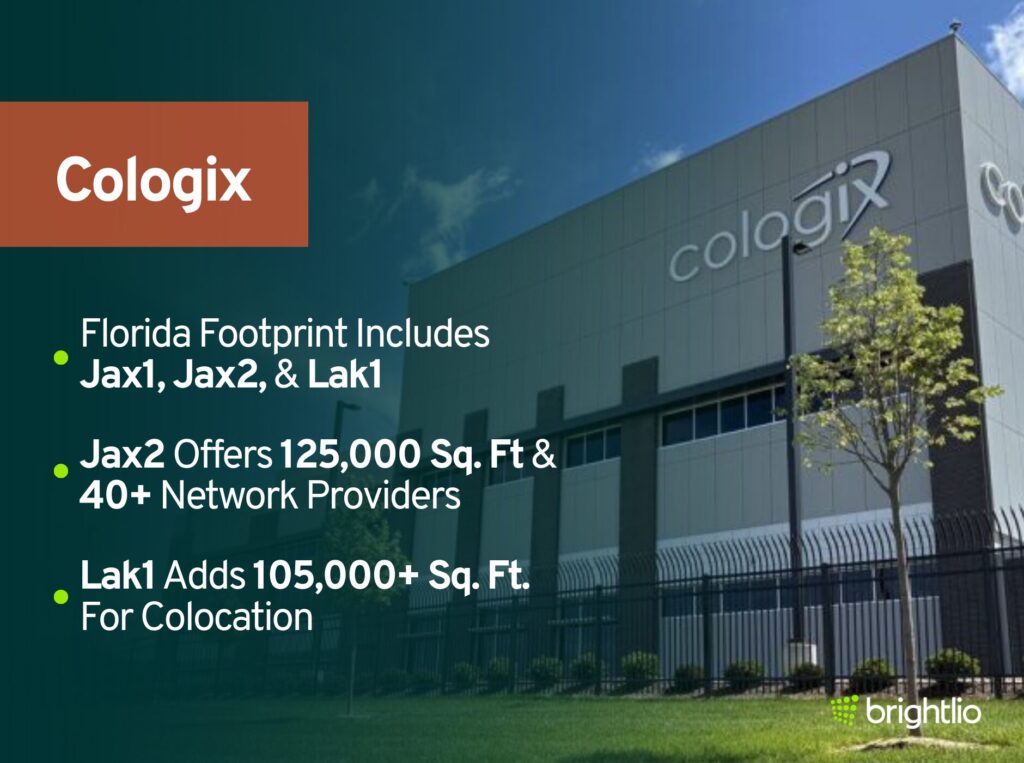
Cologix's Florida footprint spans JAX1, JAX2, and LAK1. In Jacksonville, JAX1 provides 11,000 sq. ft. and 5+ kW per cabinet, while JAX2 provides 125,000 sq. ft. and access to 40+ unique network providers through dark fiber connectivity to JAX1. Cologix lists 2 x 3.75 MW utility power entrances for JAX2, ISO 27001 for both Jacksonville sites, and 24/7 support and monitoring. LAK1 adds 105,000+ sq. ft. of colocation and disaster recovery space between Tampa and Orlando.
Why we recommend these data centers:
- The Jacksonville and Lakeland mix supports primary site and disaster recovery separation inside one state.
- JAX1's 5+ kW per cabinet and JAX2's 2 x 3.75 MW utility entrances support denser enterprise deployments.
- Access to 40+ networks at JAX2 strengthens interconnection choice in North Florida.
- ISO 27001 and the listed compliance controls make the Jacksonville sites easier to evaluate for regulated workloads.
- LAK1's 105,000+ sq. ft. gives buyers a central Florida recovery option away from Miami concentration risk.
Major Data Center Markets in Florida
Customers looking into data centers in Florida are presented with various key markets to consider. Let's explore them:
1. Miami: The Gateway City
Miami is one of Florida’s most important data center markets. CoreSite’s Miami campus now includes 2 data centers totaling more than 148K square feet, and Equinix states that its Miami facilities sit in the heart of one of the world’s largest internet exchange points.
Miami remains the primary network exchange point between the U.S. and Latin America, and Equinix ranks the city among the top five most-connected cities in the world. Positioned as a major international hub, Miami continues to serve as a pivotal location for data centers. Key facilities such as Equinix MI1 and MI3 support direct connectivity to commercial centers in Latin America, the Northeastern U.S., and Europe.
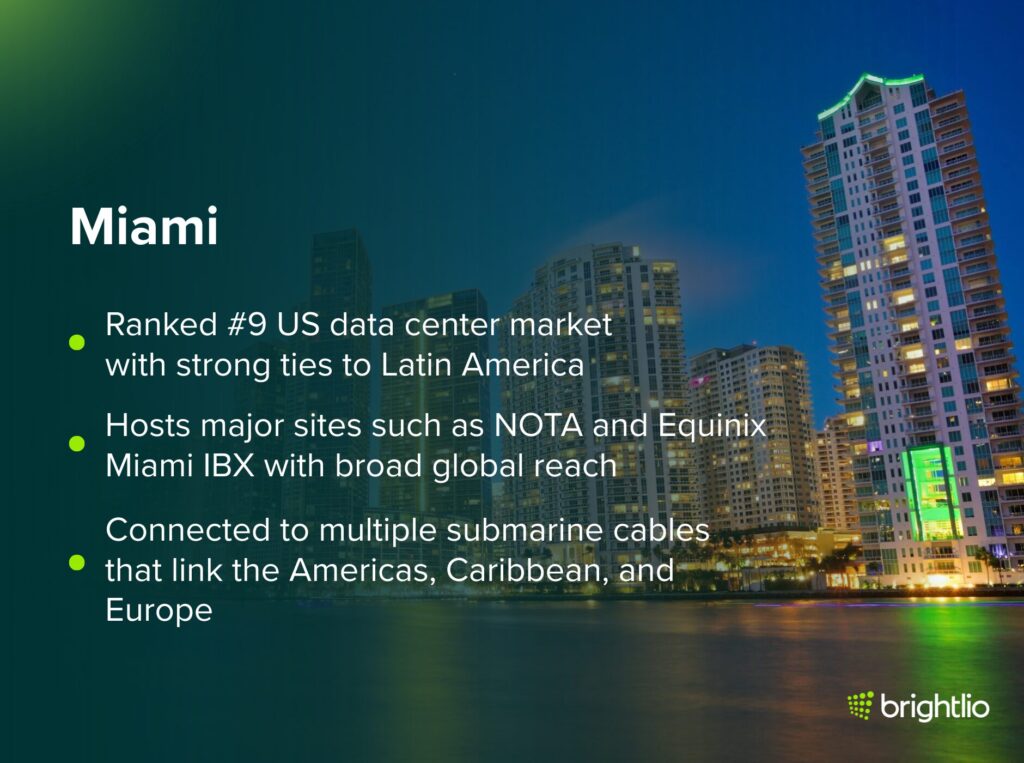
Miami data centers benefit from access to major submarine cable systems and high-capacity interconnection routes. Equinix lists the lowest-latency route to Brazil through GlobeNet and direct access to Brazilian markets through the Monet subsea system, which lands inside MI3 in Boca Raton. CoreSite states that its MI1 and MI2 facilities are connected through a lit fiber network supporting speeds of up to 100Gbps.
These connections give colocation providers, carriers, and cloud service providers strong access to South America, the Caribbean, and other global markets, while MI1 serves as a pathway for traffic from the Caribbean and South and Central America to more than 148 countries worldwide.
2. Orlando: The Innovation Hub
Orlando is an emerging and increasingly important data center market in Florida. Often recognized for its world-renowned attractions and vibrant tourism industry, Orlando is building a stronger position in digital infrastructure as well.
Cloudscene ranks Orlando as the #39 data center market in the United States, and Datacenters.com lists 13 data centers and 11 data center providers in the market. Its central location within the state makes it a practical choice for businesses seeking broad in-state coverage, and CoreSite says its Orlando campus offers low-latency regional and global reach.
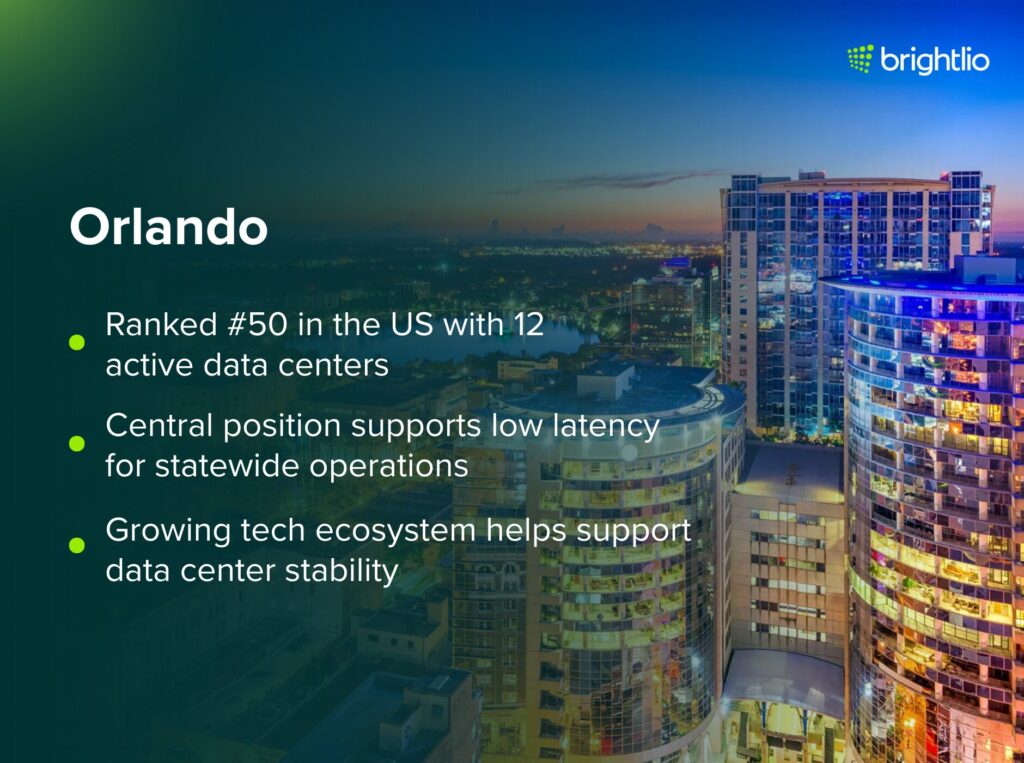
Orlando boasts a growing tech ecosystem supported by academic institutions, incubators, and a rising talent base. CBRE reports that Orlando ranked #32, had 49,570 tech talent workers, and produced 15,203 tech graduates, while regional business resources highlight the role of local startup and incubation support.
Being inland gives Orlando an advantage over coastal markets when storm surge risk is a concern, though hurricane wind and inland flooding still remain important planning factors.
3. Jacksonville: The Northern Powerhouse
Jacksonville is strengthening its position as a major Northern Florida data center market. This strategic location, often seen as a bridge between the Deep South and the East Coast, offers a strong mix of connectivity and scalability for businesses seeking reliable data center capacity.
Cloudscene currently ranks Jacksonville as the #3 data center market in the United States, with 17 colocation data centers, 93 cloud service providers, and 17 network fabrics in its connectivity ecosystem.
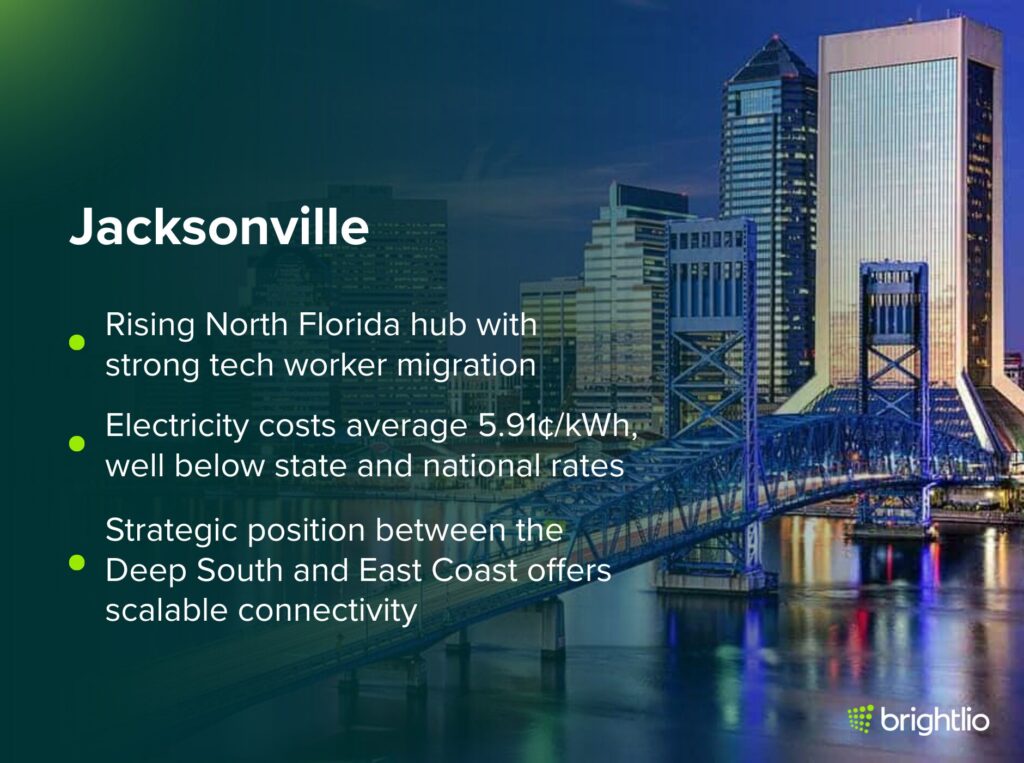
Cologix describes JAX1 as one of the most interconnected hubs in Florida, positioned at fiber crossroads to Atlanta and Florida and in the middle of subsea cables linking Central and South America. CBRE ranked Jacksonville #42 in its 2024 Scoring Tech Talent report.
Electricity costs remain a meaningful consideration in Jacksonville for large users evaluating colocation and digital infrastructure. JEA’s current General Service Large Demand Time-of-Day tariff for customers above 1,000 kW lists an on-peak energy charge of 5.193¢/kWh and an off-peak energy charge of 1.696¢/kWh.
For comparison, the U.S. Energy Information Administration reports Florida’s average industrial electricity price at 8.79¢/kWh and the U.S. average at 8.53¢/kWh for December 2025. Lower power costs can help support more competitive operating economics for colocation services and other high-uptime facilities.
Final Thoughts
Choosing Florida for data center operations provides a wealth of advantages. Its strategic position as a gateway to Latin America and Europe and its thriving tech workforce make it an attractive hub for businesses.
From the internationally connected Miami and the innovative powerhouse of Orlando to the burgeoning technological capabilities of Jacksonville, enterprises can pinpoint a location within Florida that seamlessly caters to their specific needs.
Consequently, as the demand for digital infrastructure surges, Florida colocation centers stand ready to bolster businesses in their quest for scalability, connectivity, and digital advancement.
Brightlio Delivers Florida Colocation Services
If you're investigating data centers in Florida, turn to Brightlio. As a telecommunications and colocation broker, we have data center partners in Florida and across the globe ready to provide solutions tailored to your needs and budget. Simply share your space, power, and connectivity needs and we'll provide colocation pricing at no charge.
Beyond colocation, we also offer connectivity, unified communications, cloud, infrastructure hosting, disaster recovery, and advisory services. This comprehensive suite ensures we can offer your enterprise a complete technology solution.
Contact Brightlio now to get started!
If you enjoyed this article, you may also like these articles about other states:
- California Data Centers: Brightlio’s Ultimate Guide to Colocation in the Golden State
- Data Centers in Connecticut: Six Reasons to Colocate in the Constitution State
- The Iowa Data Center Market: Colocation In America’s Heartland
- Data Centers in Maryland: Innovation in The Old Line State
- New Jersey Data Centers: Powering the Digital Future of the Garden State
- Data Centers in New York: The Gateway to Colocation in the Empire State
- Data Centers in Oregon: 5 Reasons to Colocate in the Pacific Northwest
- Data Centers in Texas: Colocation in the Lone Star State
FAQ
Colocation means placing your organization’s servers and related hardware in rented space inside a data center operated by a third party.
DataCenterMap lists 108 data centers in Florida across 18 markets.
DataCenterMap’s Florida market list shows the largest counts in Miami (29), Tampa (21), Orlando (12), and Jacksonville (12).
Yes, the Florida market list shows Miami (29) as the largest market in the state.
Yes, Florida law provides an exemption for “data center property” when eligibility thresholds are met, including $150 million in cumulative capital investment and a 100 MW critical IT load.
Start with latency and user geography, then confirm carrier options and cross-connect availability at the specific facility, and validate performance with a short test circuit before long contract terms.
Ask for flood-risk details for the site, generator runtime and fuel contract terms, and documented results from recent facility failover or recovery tests.
Costs typically change with space size, power commit, bandwidth and connectivity charges, cross-connects, and remote-hands support fees, plus contract length.
Yes, asking for available audit or assurance reports helps buyers evaluate facility and operational controls during vendor reviews.
It depends on whether you need dedicated hardware, predictable connectivity, and physical control over equipment, versus the flexibility of cloud for variable workloads.
Baxtel lists NAP of the Americas (Equinix Miami MI1) as Florida’s largest, with 18 MW and 355,000 sq ft, and DataCenterMap lists the same site with a 750,000 sq ft building and 255,512 sq ft of fully built-out whitespace.
Frequently listed major colocation operators include Equinix, Digital Realty, NTT Global Data Centers, CyrusOne, QTS Data Centers, KDDI/Telehouse, GDS, and Iron Mountain Data Centers.
A common four-way grouping is enterprise (on-premises), public cloud and hyperscale, managed and colocation, and edge data centers.

Adetayo Sogbesan writes for Brightlio on data center, cloud, and network infrastructure topics, delivering insights that help businesses optimize technology strategies and understand industry trends.
Recent Posts

Data Centers in Kentucky and Colocation Opportunities

Data Centers In Alabama: Why You Must Colocate

10 Largest Underground Data Centers in the World

100+ VoIP Statistics from Credible Sources (Jan – 2026)
Let's start
a new project together