
Washington runs on two engines: a dense retail market around Seattle and a cluster of hydro-powered campuses in Central Washington. Vantage’s WA1 campus in Quincy is the largest operating site with a published figure, at 89 MW of critical IT.
The next three sites are far smaller. Sabey’s Tukwila campus runs 54 MW, Serverfarm’s TiTAN facility in Moses Lake 34 MW, and Digital Fortress’s North Seattle site in Lynnwood 6 MW.
Microsoft’s Quincy campus, home of its West US 2 Azure region, rounds out the five largest operating sites. Microsoft publishes no capacity, though the campus lists 10 buildings.
Cheap, clean hydropower built this market, and that advantage is shrinking. Grant PUD now caps data center load growth and raised large-load rates in April 2026, and Washington cut its data center tax break for replacement servers in July 2026.
Buyers get one of the cleanest grids in the country and the deepest interconnection hub in the Pacific Northwest. New large loads face capped power, a weaker tax break, and a pipeline that publishes almost no capacity.
Washington Data Center Tracker
80data center facilities
11 operational5 planned64 colocation
Data Center Map counts 117 buildings across 14 markets here. Multi-building campuses count once, while tenant suites in shared buildings count separately.
Market Snapshot
5 Largest Operating Data Centers In Washington
These are the five largest operating sites by published capacity. Vantage's Quincy campus and Sabey's Tukwila campus lead, while Microsoft's large Quincy and Wenatchee campuses don't publish MW, and every other listing appears on the map, with operating sites in green and planned ones in coral.
- Vantage WA1 Quincy CampusQuincy, critical IT89 MWOperational
68-acre campus with 775,000 sq ft across three facilities
- Address:
- 2101 to 2133 M St NE, Quincy
- Operator:
- Vantage Data Centers
- Buildings:
- WA11, WA12 and WA13
- Sabey SDC Seattle CampusTukwila, campus power54 MWOperational
Five-building campus with a campus-wide average annualized PUE of about 1.5, per Sabey
- Address:
- 3355 35th Ave S, Tukwila
- Operator:
- Sabey Data Centers
- TiTAN Moses Lake Data CenterMoses Lake, reported34 MWOperational
Mid-size Grant County facility on the Columbia Basin hydropower grid
- Location:
- Moses Lake, Grant County
- Operator:
- Serverfarm
- Digital Fortress North SeattleLynnwood, available power6 MWOperational
Facility with 6 MW of N+1 power available for immediate occupancy, per Digital Fortress
- Address:
- 4200 194th St SW, Lynnwood
- Operator:
- Digital Fortress
- Microsoft Quincy Campus (West US 2)QuincyNot publishedOperational
Home of Microsoft's West US 2 Azure region, with 10 buildings listed
- Address:
- 1515 Port Industrial Way, Quincy
- Operator:
- Microsoft
Other operating sites, shown on the map in green: , , , , , .
Planned Data Centers In Washington
Washington's published pipeline is small, led by a proposed data center of under 20 MW inside Seattle's Starbucks Center, while Amazon and Keel work on larger campuses in Walla Walla County and Moses Lake.
- 2401 Utah Avenue South (Starbucks Center)Seattle, upper bound20 MWProposed
Data center of under 20 MW planned inside the Starbucks global headquarters building
- Address:
- 2401 Utah Ave S, Seattle
- Developer:
- Colossus Data Center Advisors
- Keel Infrastructure Moses Lake CampusMoses LakeNot publishedUnder construction
Campus under construction in Grant County
- Location:
- Moses Lake, Grant County
- Developer:
- Keel Infrastructure
- Amazon Wallula Gap Business ParkWallulaNot publishedProposed
Proposed campus in Walla Walla County
- Location:
- Walla Walla County
- Developer:
- Amazon
- Digital Realty 301 Virginia StreetSeattleNot publishedPlanned
Six-story, 58,000 sq ft downtown building, with construction possibly starting in 2027
- Address:
- 301 Virginia St, Seattle
- Developer:
- Digital Realty
- 3625 First Avenue SouthSeattleNot publishedProposed
Proposed nine-story Sodo building with up to 320,000 sq ft
- Address:
- 3625 1st Ave S, Seattle
- Developer:
- PACLAND
5 Largest Colocation Facilities In Washington
Retail colocation splits between downtown Seattle's Westin Building, one of the West Coast's most connected carrier hotels, and the Tukwila cluster near Sea-Tac, while Quincy and Wenatchee host the largest wholesale floors.
- CyrusOne PNW1 QuincyQuincy720,000 sq ftColocation
Nearly 930,000 sq ft facility with 720,000 sq ft of colocation space
- Address:
- 1025 D St NW, Quincy
- Operator:
- CyrusOne
- Sabey SDC Quincy CampusQuincy530,000 sq ftColocation
Five buildings in a mild climate suited to efficient evaporative cooling
- Address:
- 2200 M St NE, Quincy
- Operator:
- Sabey Data Centers
- Sabey SDC Columbia CampusEast Wenatchee438,000 sq ftColocation
Hydro-powered campus with electric rates under $0.05 per kWh, per Sabey
- Address:
- 4405 Grant Rd, East Wenatchee
- Operator:
- Sabey Data Centers
- Utility:
- Douglas County PUD
- H5 Data Centers SeattleSeattle293,000 sq ftColocation
Data center and carrier hotel next to Amazon's corporate campus
- Address:
- 1000 Denny Way, Seattle
- Operator:
- H5 Data Centers
- NTT QuincyQuincy180,000 sq ftColocation
Former Dell facility powered by 100% renewable hydroelectric energy
- Address:
- 525 D St NW, Quincy
- Operator:
- NTT DATA
Other colocation facilities, shown on the map as green squares: , , , , , , , , , , , , , , , , , , , , , , , , , , , , , , , , , , , , , , , , , , , , , , , , , , , , , , , , , , .
Choose a category to switch the list and highlight its sites on the map. Click any site card to find it on the map, or click a marker to jump to its card. Pins are approximate, and each MW figure carries the basis shown beside it.
Data sourced from Data Center Map, EIA, Datacentres.com, More Than Just Parks, S&P Global and Inflect, checked October 10, 2026. Listings count individual buildings, and the lists show the largest sites in each category.
Why Colocate In Washington?
Washington pairs a carrier-dense Seattle market with hydro-powered wholesale campuses east of the Cascades. Its strengths are clean power, low industrial rates, interconnection, and climate, and each now comes with tighter limits than a few years ago.
The six benefits below explain why buyers still pick Washington.
1. Market Access And Latency
Seattle is the network gateway of the Pacific Northwest. The metro holds 742 MW of commissioned data center capacity, which makes it the region's main market for enterprise and cloud deployments.
The city's carrier hotels connect the Northwest to California, Canada, and trans-Pacific routes to Asia. Buyers serving Seattle, Portland, Vancouver, and Pacific Rim users can reach all of them from one market.
Central Washington sits about three hours east of Seattle. Those campuses suit workloads that care more about power cost than latency to Seattle users.
2. Network Connectivity And Peering
The Westin Building in downtown Seattle is one of the most connected carrier hotels on the West Coast. Digital Realty, Equinix, DataBank, Hivelocity, and a long list of smaller operators run space in and around it.
H5's 293,000 sq ft facility at 1000 Denny Way adds a second downtown carrier hotel next to Amazon's corporate campus. South of the city, Tukwila near Sea-Tac holds a second cluster led by Sabey's Intergate.West at 173,000 sq ft.
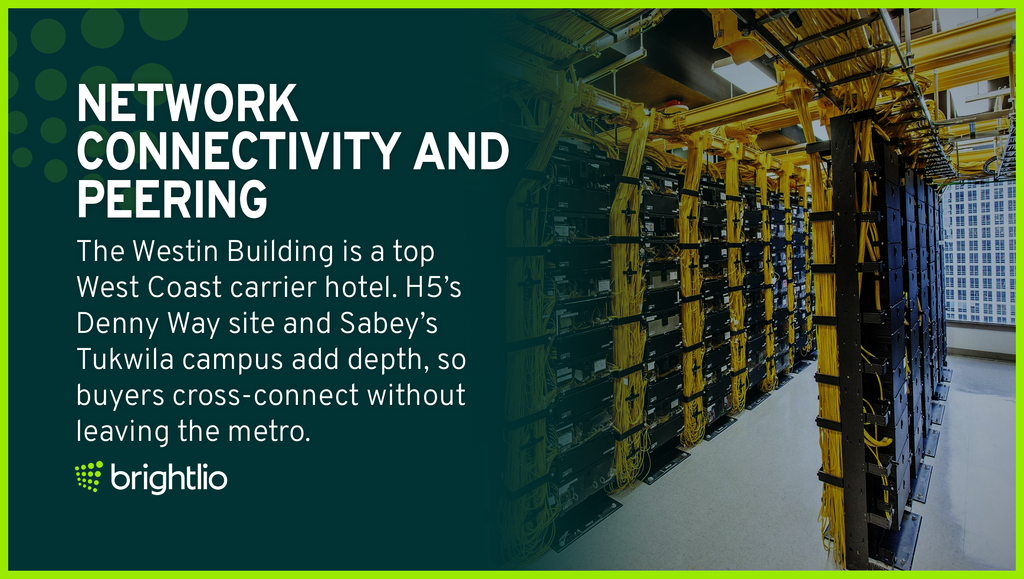
That depth lets Seattle buyers cross-connect to cloud providers and carriers without leaving the metro. Central Washington campuses rely on long-haul fiber back to Seattle for the same access.
3. Low-Cost Hydropower East Of The Cascades
Industrial customers paid 7.24¢/kWh in May 2026, while business customers paid 11.72¢/kWh. The gap reflects the county public utility districts, known as PUDs, that sell Columbia River hydropower in Central Washington.
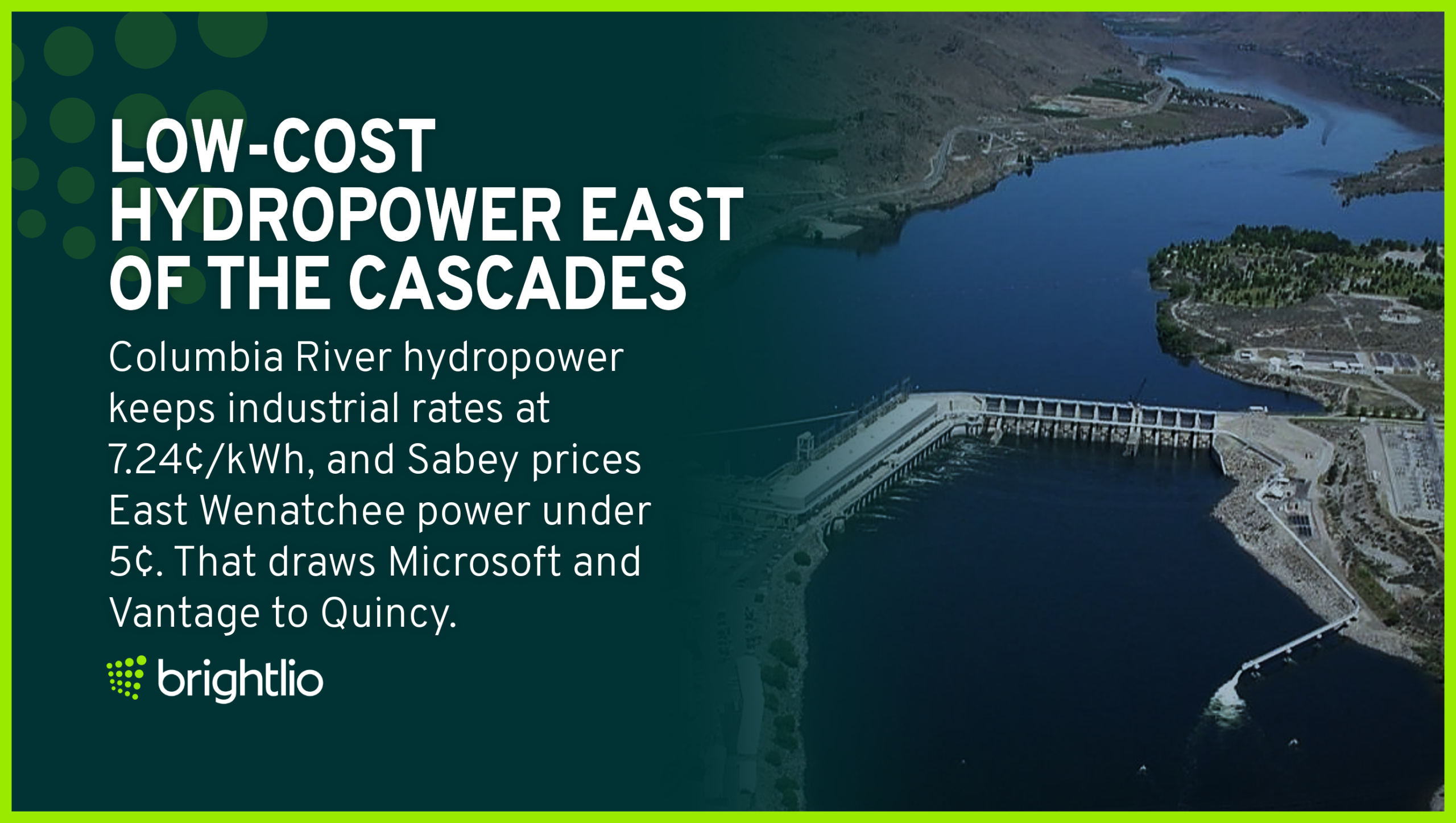
Sabey prices power at its East Wenatchee campus under $0.05/kWh through Douglas County PUD. Rates like that are why Microsoft, Vantage, Sabey, and CyrusOne built in Quincy and Wenatchee.
Seattle-area buyers see little of that discount. Retail colocation in the metro runs on standard commercial rates.
4. One Of The Cleanest Grids In The Country
Hydropower supplied 65% of Washington's generation and wind 12%. Washington produced a quarter of U.S. utility-scale hydropower in 2024.
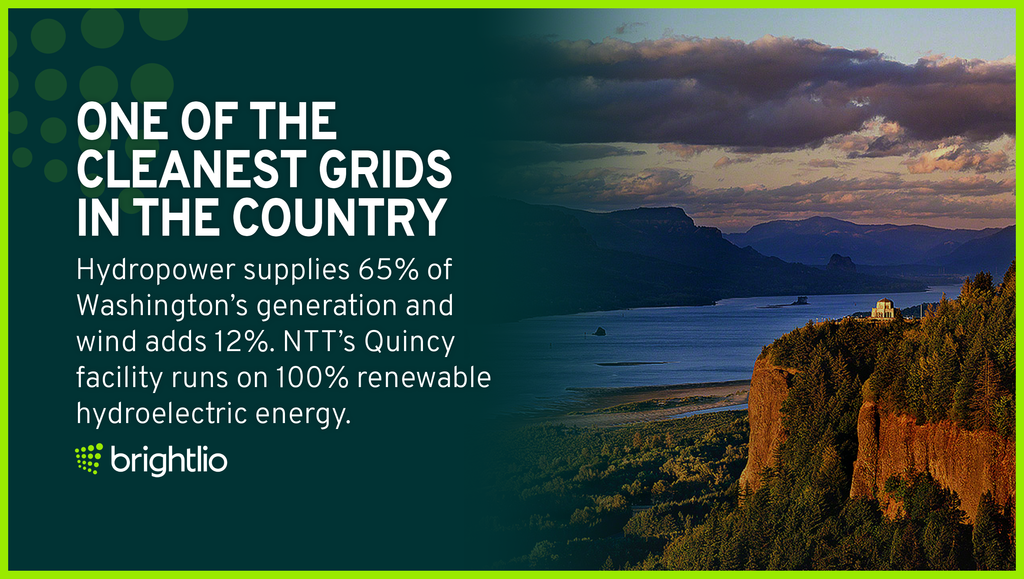
For buyers with carbon targets, that mix does most of the work before any renewable contract. NTT's Quincy facility runs on 100% renewable hydroelectric energy.
5. Cool, Dry Climate And Large Wholesale Floors
Central Washington's mild, dry climate suits efficient evaporative cooling, which uses evaporating water to cool air at a fraction of the power of chillers.
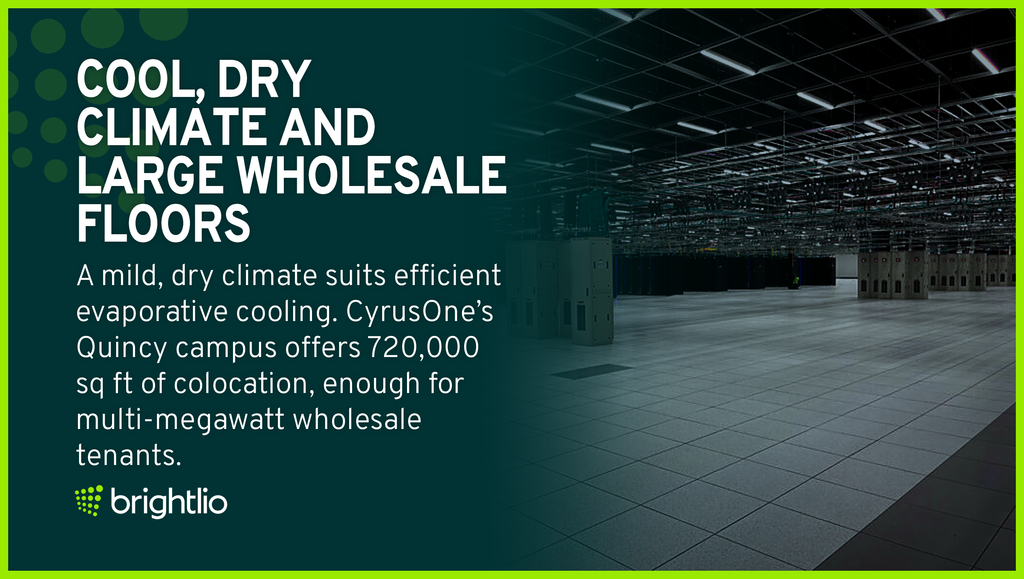
The region holds some of the largest colocation floors in the Northwest. CyrusOne's PNW1 in Quincy offers 720,000 sq ft of colocation space inside a nearly 930,000 sq ft building, enough for multi-megawatt wholesale tenants.
6. Tax Exemption On New Equipment
Washington exempts eligible server equipment and power infrastructure from its 6.5% state sales tax, plus local rates, in 29 rural counties and 3 urban counties. A buyer installing $50 million of new servers in Quincy avoids more than $3.25 million in state sales tax alone.
The break is narrower than it was. Since July 1, 2026, replacement servers no longer qualify and the refurbishment exemption is gone, so the savings now cover the first build only.
Key Cities Or Submarkets In Washington
Washington's market splits along the Cascades. Retail colocation and interconnection sit in the Seattle metro, while hyperscale and wholesale capacity sits on the Columbia River in Grant and Douglas counties.
The five submarkets below run from Seattle's carrier core to the eastern edge of the state.
1. Downtown Seattle
Downtown Seattle is the state's interconnection core. The Westin Building houses Digital Realty's SEA10, Equinix SE2 and SE3, DataBank SEA1, and smaller operators such as Optic Fusion and Semaphore. Digital Realty runs SEA11 nearby at 2020 5th Ave.
New supply is coming in small pieces. Digital Realty plans a six-story, 58,000 sq ft building at 301 Virginia St, with construction possibly starting in 2027.
Sodo, just south of downtown, has two proposals. Colossus Data Center Advisors plans a site of under 20 MW inside the Starbucks Center at 2401 Utah Ave S, and PACLAND proposes a nine-story, 320,000 sq ft building at 3625 1st Ave S.
The Seattle colocation market suits cloud, software, gaming, and financial buyers that need dense carrier access and cross-connects to the major clouds.
2. Tukwila, Kent, And The South Sound
Tukwila near Sea-Tac holds the metro's largest cluster outside downtown. Sabey's SDC Seattle campus, profiled below, anchors the area, and Csquare, DataBank, Digital Fortress, CherryRoad, Wowrack, LeaseWeb, and IBM run sites nearby.
Equinix SE4 in Kent and Cogent's facility in Federal Way extend the cluster south. Tacoma adds smaller options, including Optic Fusion in the Perkins Building and Colocation Northwest.
This submarket suits enterprises that want Seattle-area colocation with more space and lower cost than downtown, plus a recovery site separate from the Westin Building.
3. Lynnwood, Bothell, And The North Suburbs
The north suburbs hold a smaller set of sites. Digital Fortress's North Seattle facility in Lynnwood, profiled below, and Csquare's SEA3-A serve the corridor, and Lumen, Ziply Fiber, and Pacific Internet run sites in Bothell.
Colocation Northwest operates in Redmond near Microsoft's headquarters.
Growth here faces a utility hurdle. Snohomish County PUD charges large loads for the infrastructure they need, a growth-pays-for-growth model that has pushed large projects elsewhere.
4. Quincy, Moses Lake, And Grant County
Quincy is Washington's hyperscale capital. At least 27 data center buildings sit in and around the city, including Vantage's WA1 and Microsoft's West US 2 campus, both profiled below, and Microsoft's Columbia campus with 6 more listings.
The wholesale floors are large. Sabey's five-building Quincy campus at 2200 M St NE offers 530,000 sq ft, NTT runs 180,000 sq ft in a former Dell facility at 525 D St NW, and H5 and Columbia Colocation operate local sites.
Power is the constraint. Grant PUD's 8 data center operators drew about 280 average MW in 2025, roughly 37% of the county's load, and another 800 MW of large-load requests sits in its queue.
Moses Lake, to the southeast, hosts Serverfarm's TiTAN facility, profiled below, and Keel Infrastructure's campus under construction.
5. Wenatchee, Spokane, And Eastern Washington
East Wenatchee and Malaga in Douglas and Chelan counties hold Microsoft's second hydro cluster, with 7 listings in East Wenatchee and 4 in Malaga. Sabey's Columbia campus at 4405 Grant Rd covers 438,000 sq ft, and Actapio, Bitdeer, and T-Mobile operate nearby.
Spokane serves the Inland Northwest with smaller retail sites from TierPoint in Liberty Lake, Cogent, Lumen, NetRiver in the Davenport Hotel, Neutron, and OrbitCom.
In the southeast, Amazon has proposed a campus at the Wallula Gap Business Park in Walla Walla County, and Franklin PUD runs a data center in Pasco. These markets suit regional enterprises and recovery sites.
Notable Colocation Providers And Facilities In Washington
Washington's five largest operating sites span both sides of the Cascades: two wholesale and hyperscale campuses in Grant County and three Puget Sound and Columbia Basin facilities. Only four of them publish a capacity figure.
The five profiles below follow the tracker's ranking.
1. Vantage WA1 Quincy Campus
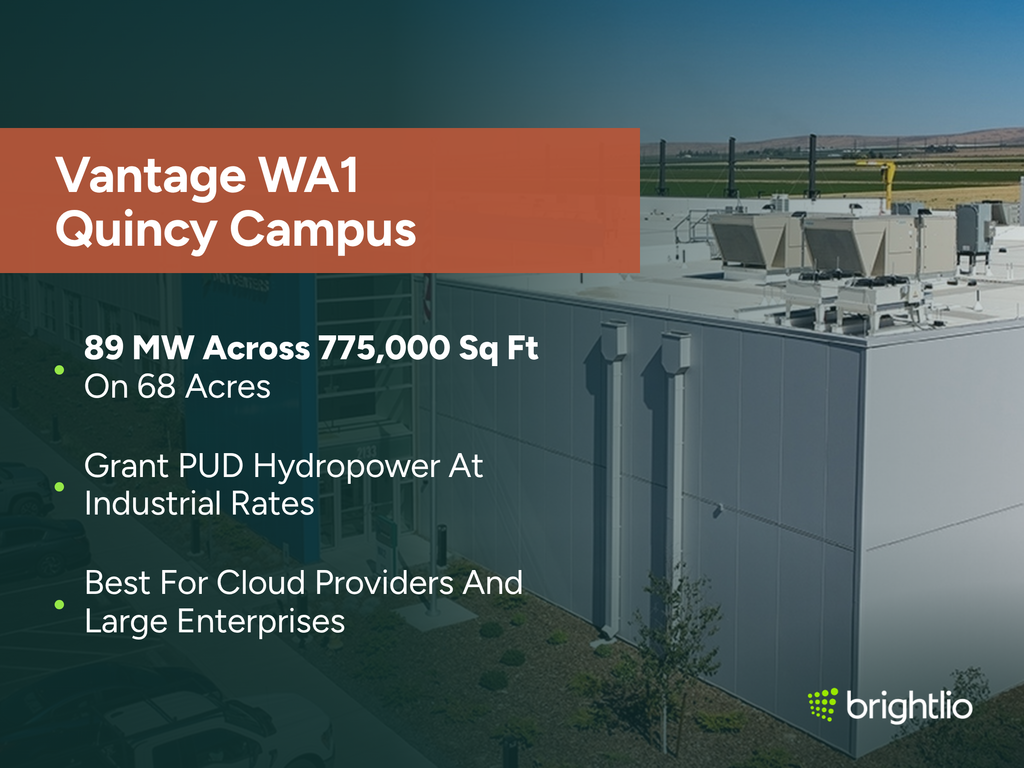
Vantage's WA1 campus at 2101 to 2133 M St NE in Quincy runs 89 MW of critical IT across three facilities, WA11, WA12, and WA13. The 68-acre campus covers 775,000 sq ft.
Vantage builds for hyperscale and large enterprise tenants, so space here is leased in halls or full buildings. The campus draws Grant PUD hydropower, which gives tenants low-carbon supply at industrial rates.
WA1 is best suited for cloud providers and large enterprises that want wholesale capacity on a clean grid.
2. Sabey SDC Seattle Campus
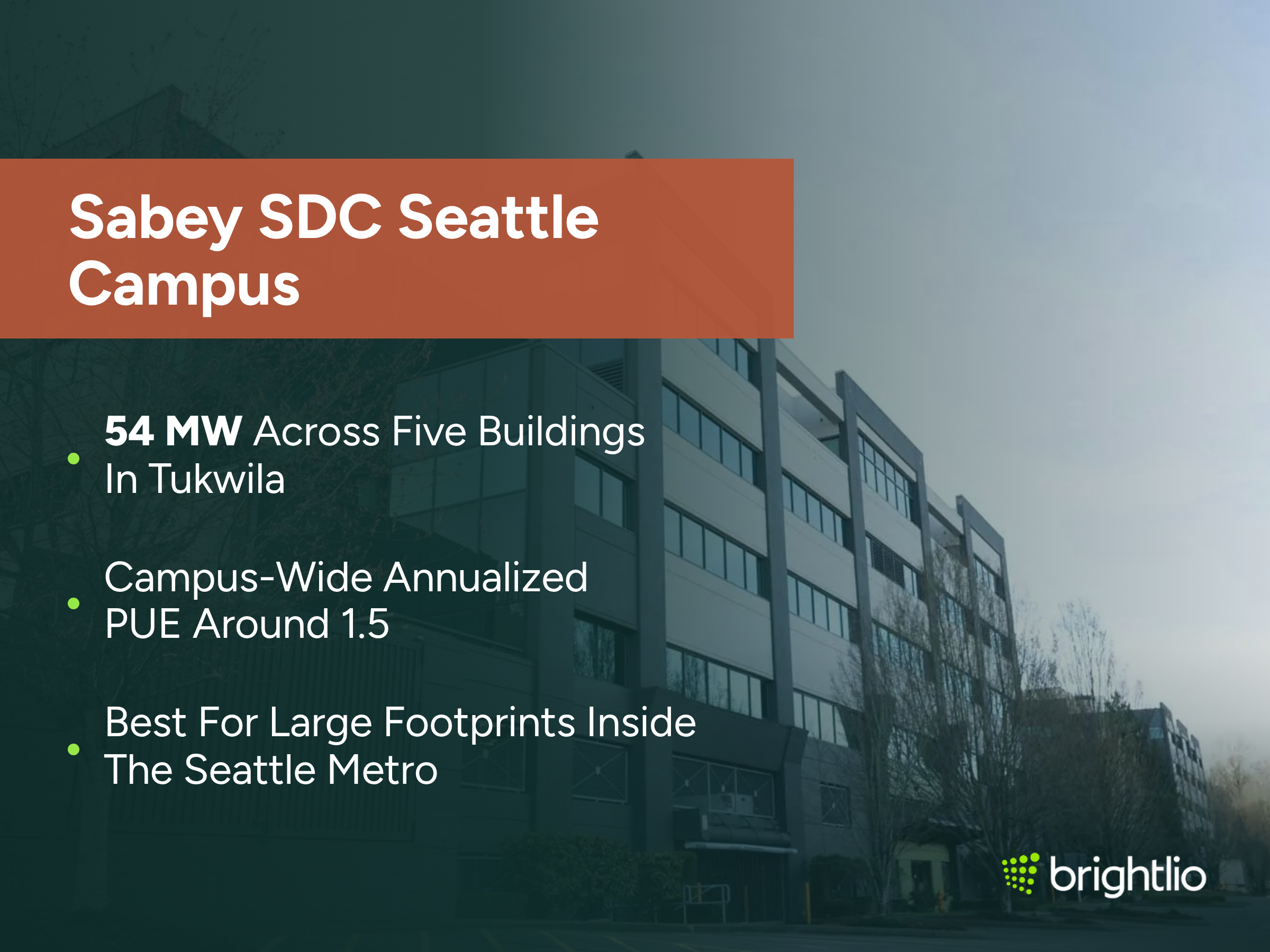
Sabey's five-building SDC Seattle campus at 3355 35th Ave S in Tukwila carries 54 MW of campus power. Sabey puts the campus-wide average annualized PUE, a measure of how much power goes to cooling and overhead, at about 1.5.
The campus gives Seattle-area buyers multi-megawatt space close to the city, which few metro facilities can match.
SDC Seattle is best suited for enterprises and cloud tenants that need large footprints inside the Seattle metro.
3. TiTAN Moses Lake Data Center
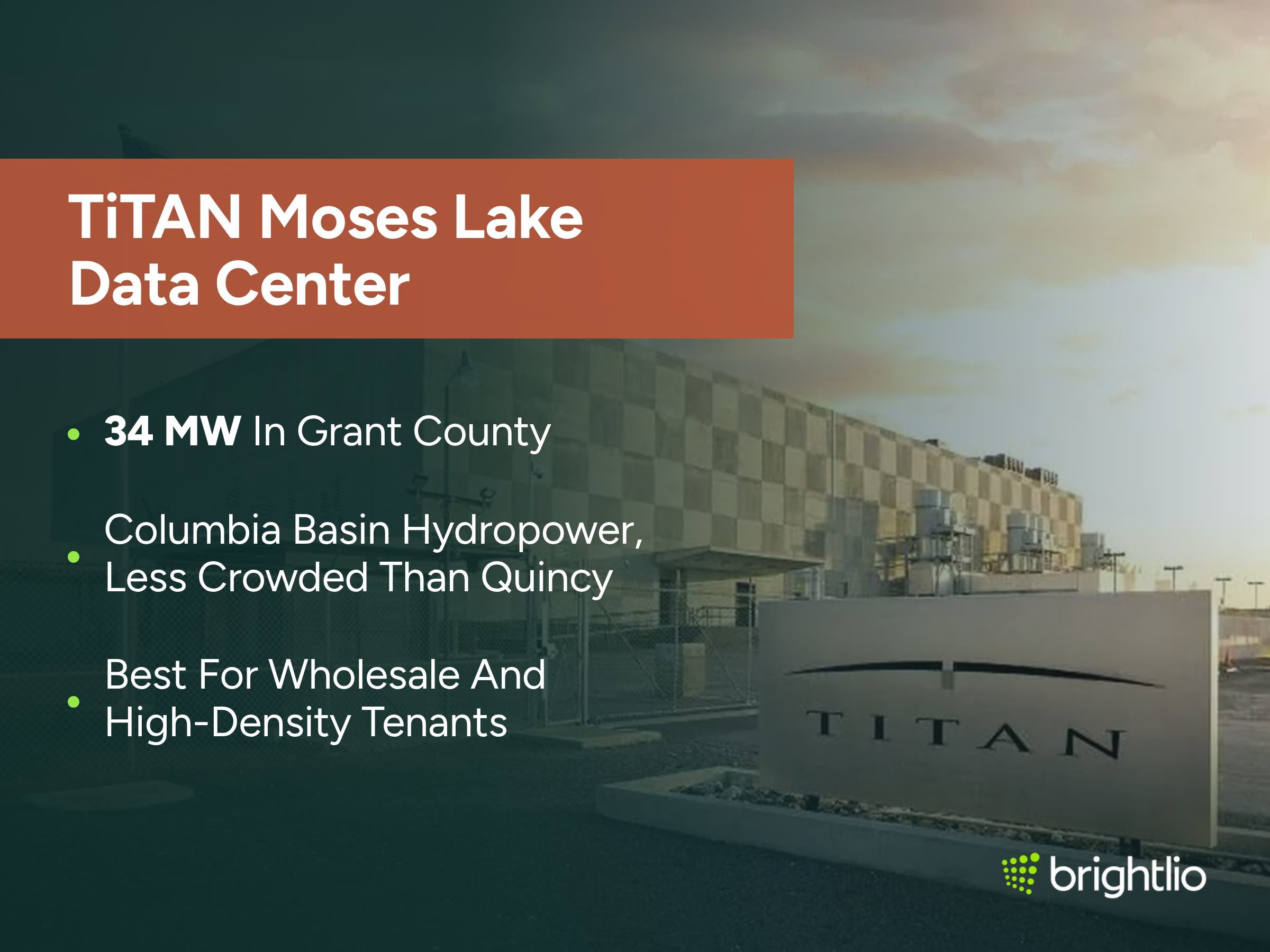
Serverfarm runs the TiTAN facility in Moses Lake with 34 MW of capacity. It is a mid-size Grant County site on the Columbia Basin hydropower grid.
Moses Lake offers the same cheap hydro as Quincy with less crowding from hyperscale campuses.
TiTAN is best suited for wholesale and high-density tenants that want Central Washington power outside Quincy.
4. Digital Fortress North Seattle
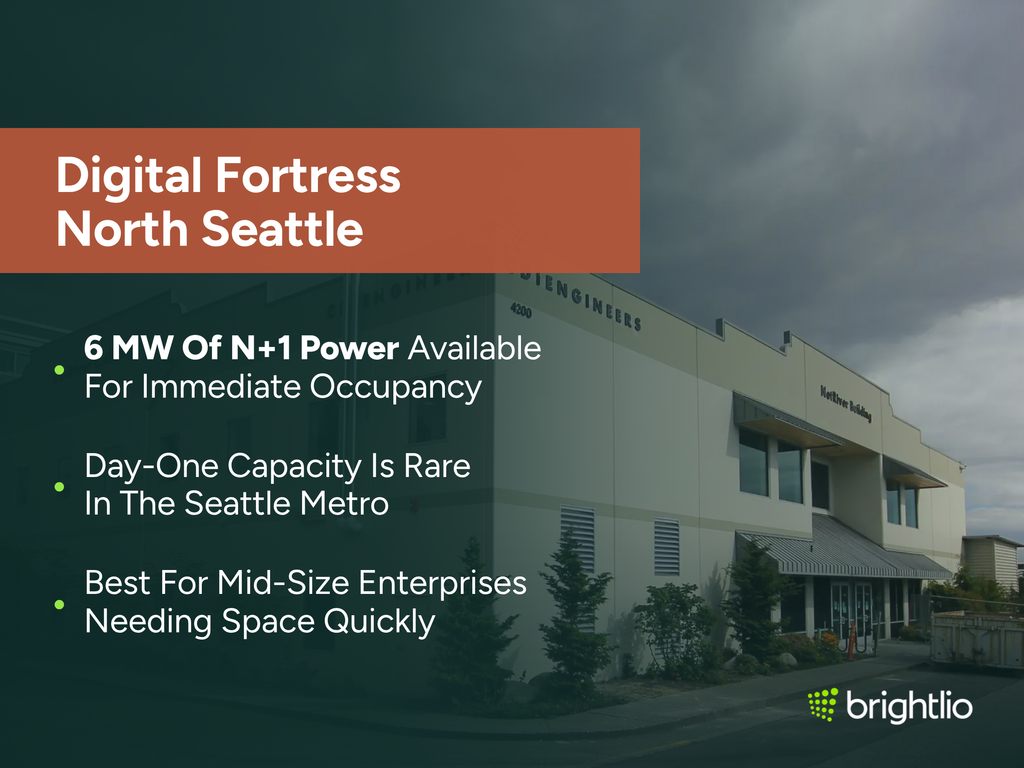
Digital Fortress's North Seattle facility at 4200 194th St SW in Lynnwood has 6 MW of N+1 power available for immediate occupancy, per Digital Fortress.
Available power on day one is rare in the Seattle metro, which makes this site a fast option for buyers who cannot wait for new construction.
Digital Fortress North is best suited for mid-size enterprises that need Seattle-area colocation quickly.
5. Microsoft Quincy Campus (West US 2)
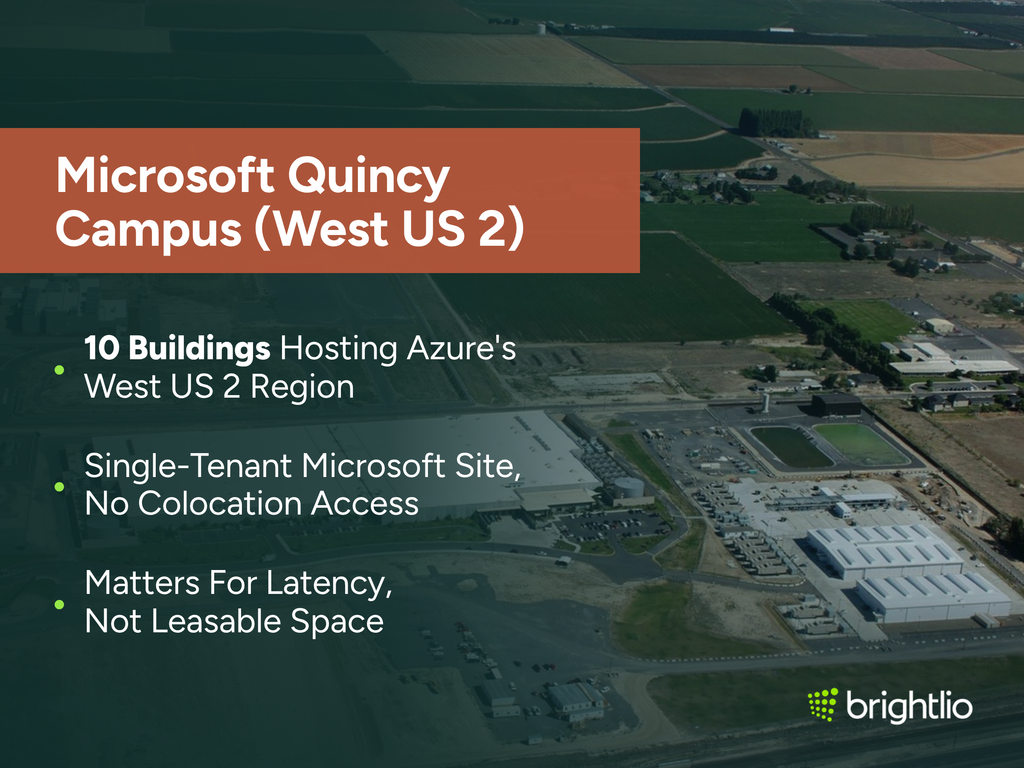
Microsoft's Quincy campus at 1515 Port Industrial Way is home to its West US 2 Azure region, with 10 buildings listed. Microsoft does not publish capacity.
The campus is single-tenant and offers no colocation access. Its relevance to other buyers is proximity: Quincy colocation tenants can reach Azure's West US 2 region with very low latency.
Recent Developments In Washington (Last 12 To 24 Months)
- July 2026: Washington stopped exempting replacement server equipment from sales tax and ended new refurbishment certificates for rural data centers on July 1. The change raises the cost of every server refresh in the state.
- May 2026: Residents raised concerns about a proposed Arlington data center at a Snohomish County PUD meeting, as the utility planned for large-load customers after 8 inquiries in 2025.
- April 2026: Grant PUD raised rates for large power users, including data centers, by an average of 9.5%, the first step in increases planned through 2030.
- April 2026: Washington declared a statewide drought emergency with snowpack at about half of normal, putting summer hydropower output at risk.
- February 2026: A Columbia Riverkeeper report counted at least 27 data center buildings in and around Quincy, adding to pressure on Grant PUD over power and water use.
Drawbacks And Considerations For Colocation In Washington
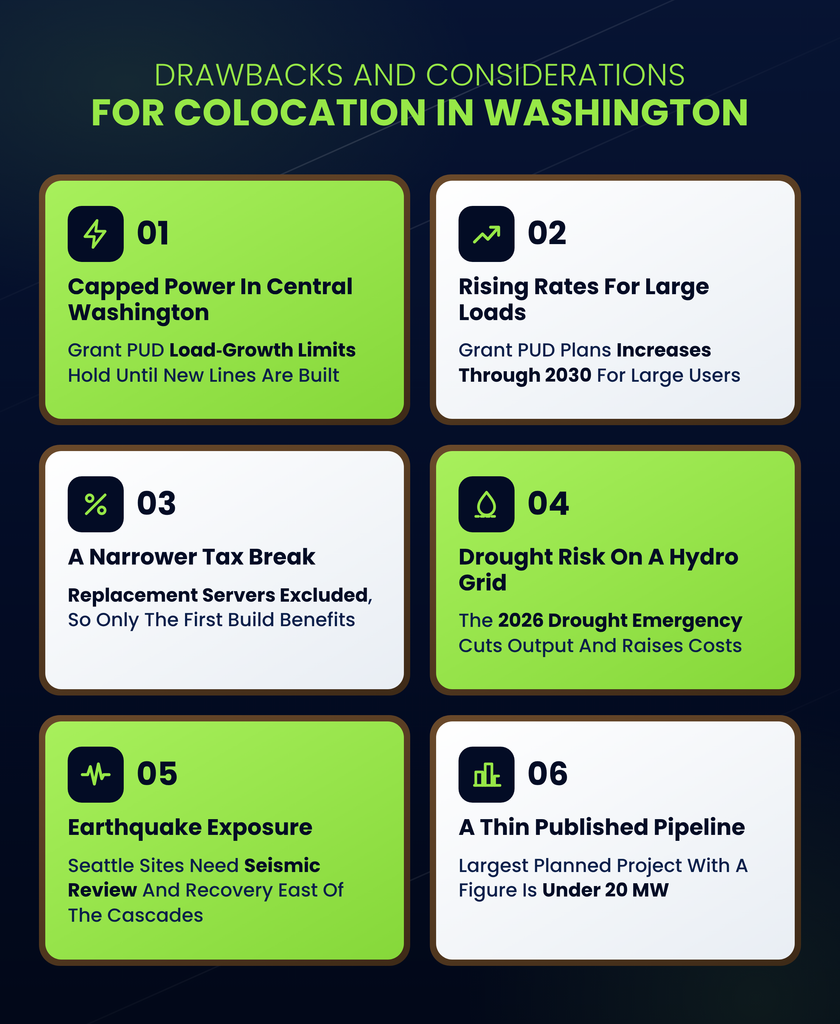
Washington's advantages rest on hydropower, and most of its drawbacks come from the limits of that same system.
The six drawbacks below matter most when comparing Washington with Oregon, Idaho, and Nevada.
1. Capped Power In Central Washington
Grant PUD has set load-growth limits for data centers because demand would exceed what its transmission lines can carry. Relief depends on new lines, including a high-capacity link from Wanapum Dam to Quincy.
2. Rising Rates For Large Loads
Central Washington's cheap power is getting more expensive, with Grant PUD planning increases for large users through 2030. Buyers comparing colocation pricing need to model the full rate path through 2030.
3. A Narrower Tax Break
With replacement servers excluded, the exemption now helps only the first build. Operators refreshing hardware every few years lose a benefit they once counted on.
4. Drought Risk On A Hydro Grid
A dry year cuts hydropower output, and the 2026 drought emergency shows that risk is real. Low water raises market purchases and costs for utilities that depend on the Columbia.
5. Earthquake Exposure
Western Washington sits in an active seismic zone. Seattle-area deployments need seismic design review and a recovery site east of the Cascades or out of state.
6. A Thin Published Pipeline
The largest planned project with a published figure is under 20 MW, and the rest publish none. Buyers needing large new capacity in the next few years will find more firm supply in other markets.
How Brightlio Can Help With Colocation In Washington
Brightlio helps organizations compare Washington colocation, cloud connectivity, AI infrastructure, and disaster recovery options across Seattle, Tukwila, Lynnwood, Quincy, Wenatchee, Spokane, and nearby Pacific Northwest markets. Our team helps clients evaluate facility fit, power pricing, carrier access, compliance needs, power density, cooling design, and long-term site risk.
We compare providers such as Sabey, Vantage, CyrusOne, H5 Data Centers, Digital Realty, Equinix, DataBank, Digital Fortress, NTT, and other Washington operators. For Washington projects, we pay close attention to PUD load limits and rate paths, sales tax exemption eligibility, seismic design in the Puget Sound, drought exposure on hydro supply, carrier routes from Central Washington to Seattle, and expansion rights.
Brightlio can support cabinet, cage, private suite, single-tenant, high-density, AI, and multi-site disaster recovery planning, and our quotes come free to clients. Contact Brightlio to compare Washington colocation solutions and start planning a cost-effective and resilient deployment.
Frequently Asked Questions
1. Which U.S. State Has The Most Data Centers?
Virginia has the most data centers in the United States, led by Northern Virginia's Loudoun County cluster. Washington is a major Western market with 80 facilities in the tracker and 742 MW commissioned in the Seattle market alone.
2. How Many Data Centers Are In Washington?
Washington has 80 data center facilities from 57 operators: 11 operational campuses, 5 planned projects, and 64 colocation sites. Data Center Map counts 117 buildings across 14 markets, since it lists campus buildings and tenant suites separately.
3. What Is The Largest Data Center In Washington?
Vantage's WA1 campus in Quincy is the largest with a published figure, at 89 MW of critical IT. CyrusOne's PNW1 in Quincy holds the largest colocation floor, at 720,000 sq ft.
4. Who Is Building Data Centers In Washington?
Amazon has proposed a campus at the Wallula Gap Business Park, and Keel Infrastructure is building in Moses Lake. In Seattle, Digital Realty, PACLAND, and Colossus Data Center Advisors have smaller downtown and Sodo projects in the works.
5. Are Washington Electricity Costs Favorable For Colocation?
Yes, in Central Washington. Industrial customers paid 7.24¢/kWh in May 2026 on PUD hydropower, though Grant PUD is raising large-load rates through 2030. Seattle-area business customers paid 11.72¢/kWh, a standard commercial rate.
6. What Tax Incentives Does Washington Offer Data Centers?
Qualifying data centers in 29 rural and 3 urban counties are exempt from sales tax on new server equipment and power infrastructure. Since July 1, 2026, replacement servers no longer qualify.
7. Which Cities Are Best For Colocation In Washington?
Seattle is the best fit for interconnection, led by the Westin Building, and Tukwila offers larger, lower-cost space near Sea-Tac. Quincy and Wenatchee suit wholesale and hyperscale tenants, and Spokane serves the Inland Northwest.
8. Can Washington Colocation Support AI Or High-Density Workloads?
Yes, at Central Washington's wholesale campuses, where Vantage, Sabey, and CyrusOne offer multi-megawatt space on hydropower. Grant PUD's load-growth limits slow new expansions, and Seattle retail buildings offer less room for dense GPU racks.
9. Is There Enough Power For New Data Centers In Washington?
Not quickly in Quincy. Grant PUD has capped data center load growth until new transmission comes online, and 800 MW of large-load requests sits in its queue. Snohomish County PUD makes large loads pay for their own infrastructure.
10. Who May Not Need Washington Colocation?
Buyers needing large new capacity within a year will struggle with Washington's power limits and thin pipeline. Companies refreshing servers often lose the tax benefit, and primary deployments in the Puget Sound carry seismic risk.
Keep reading with our colocation guides for these nearby markets:

Tamzid is a cybersecurity researcher with 5+ years of experience across SaaS, security, compliance, data centers and cloud. He writes for brightdefense.com and hipaasimple.com, covering security, compliance, and infrastructure topics. Certified through Cisco, Fortinet (NSE 1), and the Basel Institute on Governance in OSINT, he grounds his work in primary sources and verified data.
Recent Posts
Data Centers and Colocation In New Mexico
Data Centers and Colocation In Washington
Data Centers and Colocation In Michigan
Data Centers and Colocation in Wisconsin
Let's start
a new project together