
The global data center market is undergoing a significant transformation as enterprises and service providers respond to growing demand for cloud computing, artificial intelligence (AI), and edge computing. The market was valued at USD 383.8 billion in 2025 and is projected to reach USD 425.3 billion in 2026, driven by network infrastructure expansion, new workload types, and regulatory requirements for secure data handling.
Data centers are evolving from traditional enterprise facilities to complex ecosystems supporting hyperscale cloud, colocation, modular edge deployments, and high-performance computing workloads. Generative AI and advanced analytics are pushing compute density requirements higher, creating demand for advanced cooling technologies, power optimization strategies, and sustainable operations
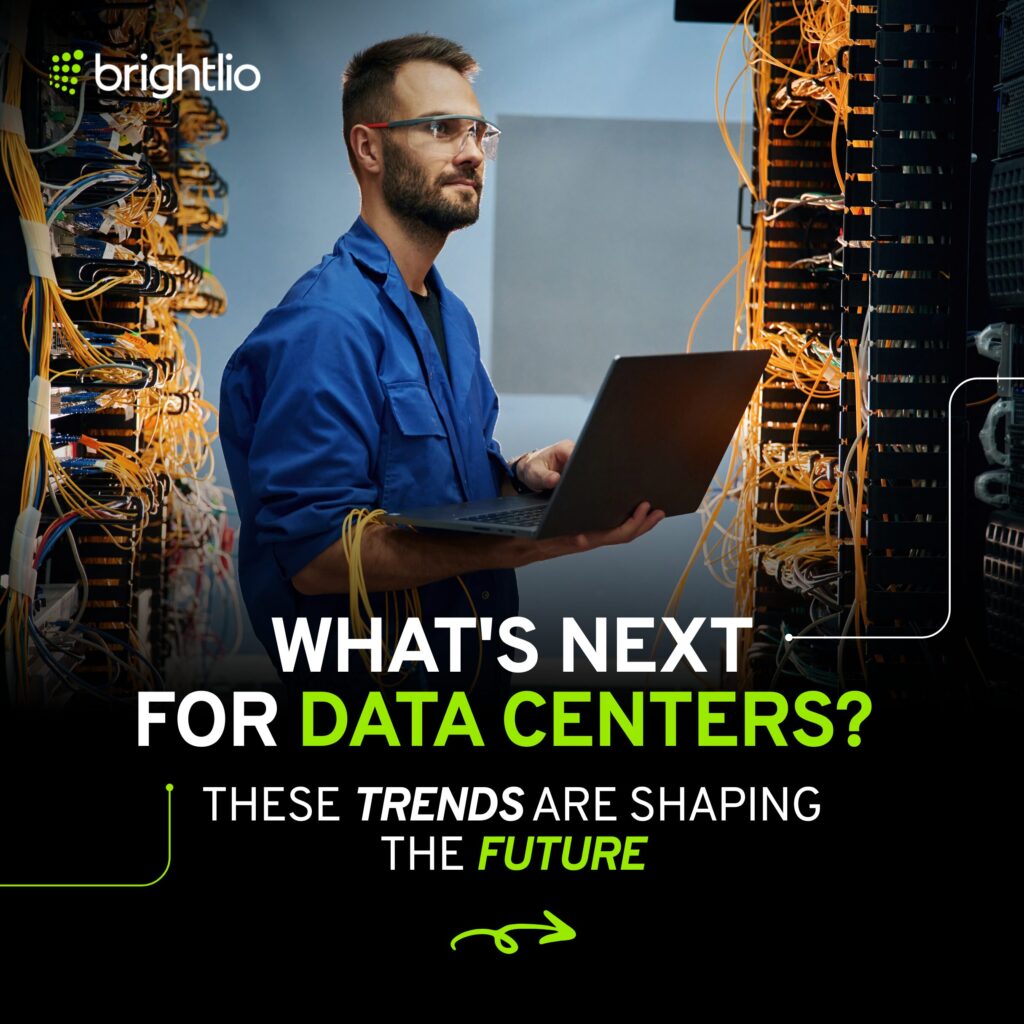
6 Data Center Market Trends for 2026
The data center industry is transforming to meet rising demands from AI, cloud computing, edge deployments, and sustainability requirements.
These six trends show how operators are preparing for 2026 and beyond:
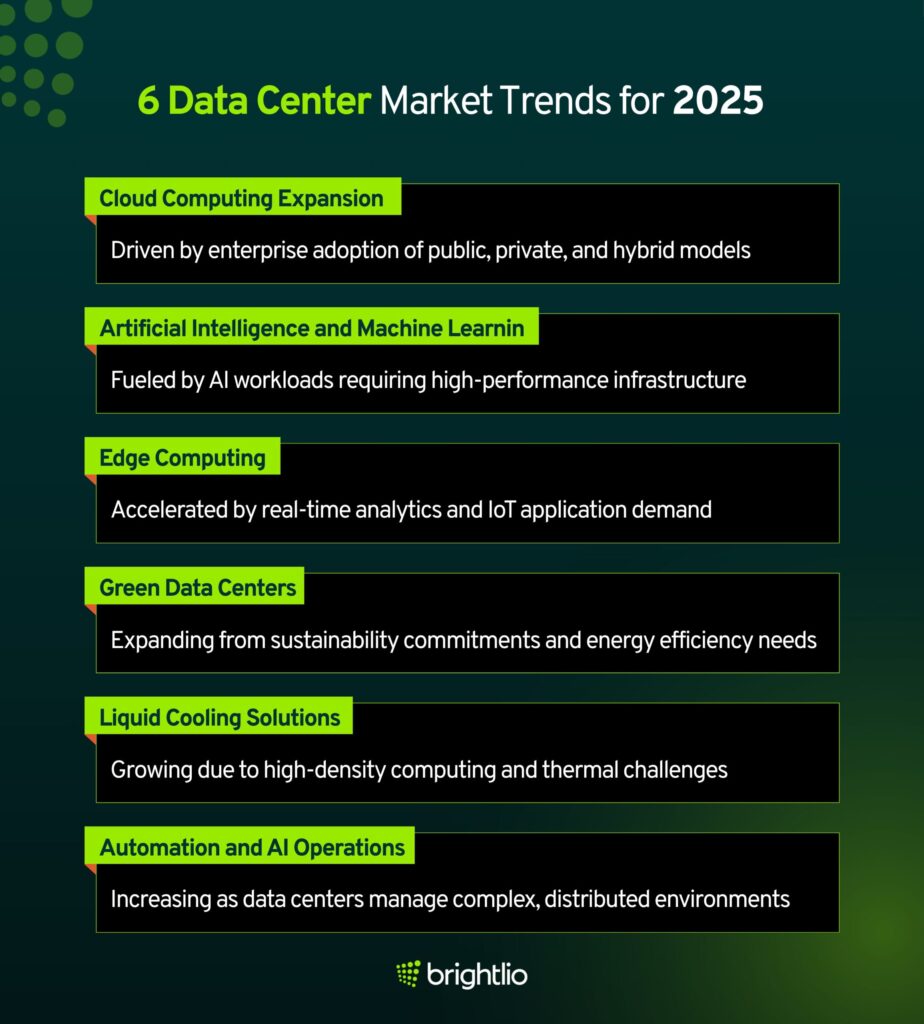
1. Cloud Computing Expansion
Cloud computing remains a central driver of data center growth as enterprises continue to adopt public, private, and hybrid cloud models. That demand is still supporting hyperscale expansion. Synergy Research Group reported that the number of large hyperscale data centers reached 1,360 at the end of 2025, while CBRE said record leasing in Q1 2025 was fueled by hyperscalers and cloud service providers as cloud adoption remained strong.
According to Technavio, the global data center market is forecast to grow by $535.6 billion from 2024 to 2029 at a 15.6% CAGR, driven in part by multi-cloud adoption and network upgrades.
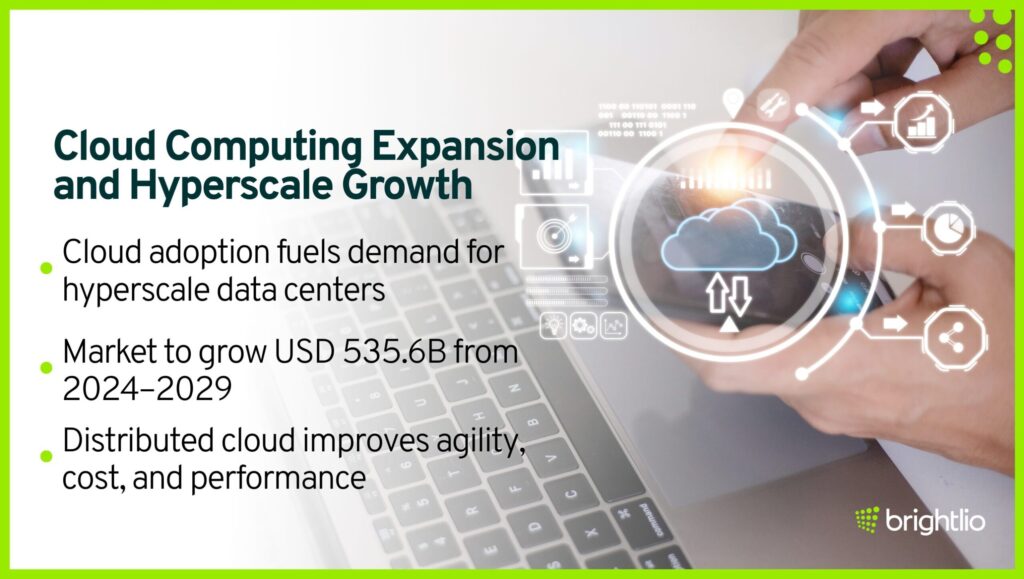
The shift to distributed cloud architectures is helping organizations improve agility and cost-effective scalability while placing workloads closer to users and data sources to support better performance and lower latency. That is leading to continued investment in advanced data center infrastructure built for more flexible, high-performance deployment models.
Hyperscale providers such as AWS, Microsoft, and Google are still scaling their operations to support high-volume transactions and AI workloads. Together, they accounted for 63% of enterprise spending on cloud infrastructure services in Q2 2026, and McKinsey says cloud service providers such as AWS, Google Cloud, and Microsoft Azure are fueling most of today’s incremental demand for AI-ready data centers.
Regional markets reflect the same pattern. North America continues to lead cloud infrastructure expansion, with CBRE reporting an all-time-low 1.6% data center vacancy rate in H1 2025 as hyperscale and AI occupiers raced to secure power and capacity. Tight supply and strong enterprise migration demand continue to reinforce the region’s lead.
In Asia-Pacific, cloud demand is also accelerating. MarketsandMarkets projects the regional cloud computing market will grow from $348.75 billion in 2025 to $752.78 billion by 2030 at a 16.6% CAGR. CBRE says markets such as Tokyo continue to see strong demand from cloud service providers and AI-related deployments, while MarketsandMarkets notes that data localization rules in markets such as India are also encouraging more local hosting and infrastructure investment.
2. Artificial Intelligence and Machine Learning
The rapid adoption of artificial intelligence (AI) and machine learning (ML) is reshaping data center infrastructure needs. These workloads are highly compute-intensive and require high-performance GPUs, denser rack designs, specialized networking, advanced storage, and more aggressive cooling strategies. JLL notes that next-generation AI deployments are already pushing rack densities into the 40 kW to 130 kW range, with future chips projected to reach 250 kW per rack.
According to JLL, AI and cloud demand are expected to drive the global data center sector at a 14% CAGR through 2030, with nearly 100 GW of new capacity added between 2026 and 2030, effectively doubling global capacity. JLL also says AI represented about 25% of all data center workloads in 2025 and could account for 50% by 2030, which helps explain why AI demand is continuing to drive record construction activity and long-term infrastructure investment.
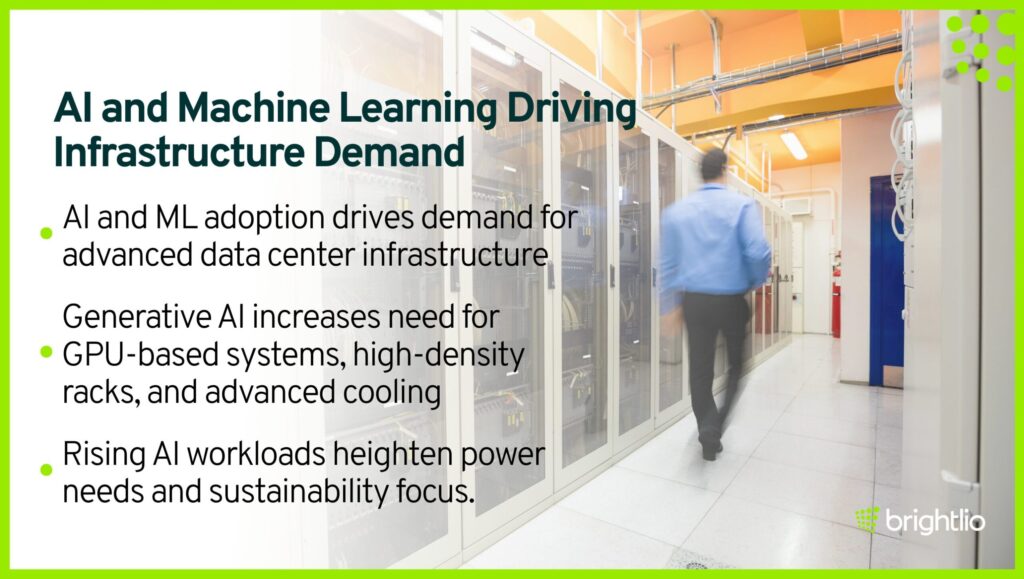
Generative AI applications, especially large language models, have intensified demand for GPU-heavy infrastructure. JLL says next-generation AI deployments are already pushing rack densities into the 40 kW to 130 kW range, with future chips projected to reach 250 kW per rack, while JLL has also noted that densities above 70 kW generally require liquid cooling. As a result, operators are adopting high-density rack designs and more advanced thermal approaches, including direct-to-chip liquid cooling and, in some cases, immersion cooling. (JLL)
The surge in AI workloads is also increasing power demand and sharpening the focus on power sourcing and sustainability strategies. The IEA projects that electricity generation to supply data centers will rise from 460 TWh in 2024 to more than 1,000 TWh by 2030, with renewables expected to meet nearly half of the additional demand over the next five years. That is why operators are putting more weight on long-term power availability, grid access, and lower-carbon energy sourcing as they expand AI-ready capacity. (IEA)
Industry leaders such as NVIDIA, Dell, and Supermicro are delivering AI-specific hardware and infrastructure architectures. NVIDIA now positions its AI factories as pre-engineered, rack-level building blocks for large-scale AI deployment, Dell has expanded its AI Factory with NVIDIA as an end-to-end enterprise AI platform, and Supermicro launched seven AI data platform solutions with NVIDIA and ecosystem partners in March 2026.
Hyperscale cloud providers are also expanding AI-optimized data center capacity. Microsoft said in January 2025 that it planned to invest more than $35 billion across 14 countries over three years to build AI and cloud datacenter infrastructure, and McKinsey says cloud providers such as AWS, Google Cloud, and Microsoft Azure are driving most of today’s incremental demand for AI-ready data centers.
This shift is not limited to hyperscale facilities. Colocation and edge data centers are also integrating AI-ready infrastructure to support enterprises deploying AI workloads at scale. CoreSite highlights liquid cooling, higher-density power strategies, and direct cloud connectivity as part of this transition, while EdgeConneX and Lambda announced plans in 2025 to deliver more than 30 MW of AI-enabled data center infrastructure across Chicago and Atlanta for advanced AI and cloud workloads.
3. Edge Computing
Edge computing is continuing to shift data processing away from fully centralized environments and toward distributed infrastructure placed closer to users, devices, and operational sites. This model reduces latency, improves response times, and supports real-time analytics for use cases such as autonomous vehicles, smart manufacturing, and advanced IoT deployments. IBM defines edge computing as a distributed framework that brings applications closer to data sources, while Ericsson notes that it is best suited to situations that require low latency, real-time processing, or local handling of large data volumes. (ibm.com) (ericsson.com)
This shift is also changing how infrastructure gets deployed. Rather than relying only on large centralized campuses, operators are increasingly using micro, modular, and containerized edge infrastructure that can be installed closer to industrial environments, remote sites, and other locations where local processing matters most. Vertiv positions micro data centers as an all-in-one edge solution for constrained environments, while Schneider Electric says micro data centers help bring IT closer to the factory floor and support Industry 4.0 and edge computing use cases. (vertiv.com) (se.com)
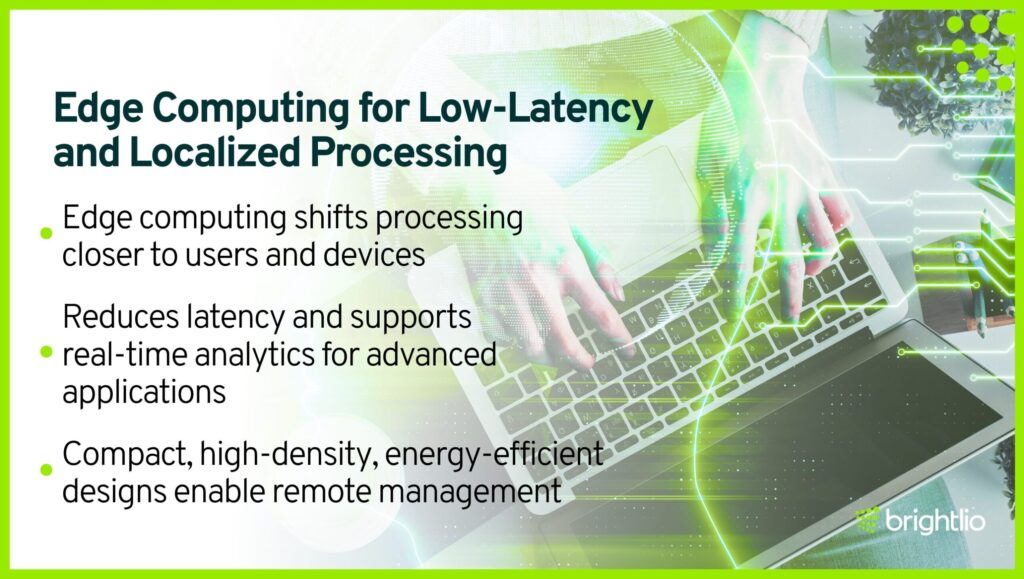
This transition is pushing operators to design compact yet powerful facilities that can support higher-density computing in much smaller footprints. Edge data centers are increasingly built with space-saving cooling and secure remote management so operators can run distributed IT workloads efficiently without constant on-site intervention.
Telecommunications providers are expanding edge capabilities alongside 5G rollouts to support cloud, AI, and other latency-sensitive services. An analysis of annual reports from the top 50 telecom companies found that telecom operators continue to prioritize investment in fiber and cloud/edge infrastructure, with 5G infrastructure also remaining a key focus. Ericsson likewise positions edge computing as part of virtual and hybrid 5G private network environments built for high-bandwidth and low-latency use cases.
The edge model also aligns with regulatory trends that require data to remain within regional boundaries, which is pushing more localized processing and storage. IBM notes that some countries impose data localization requirements that keep data in a specific location with limited or no transfer outside that region, while Red Hat says sovereign cloud models increasingly rely on in-country data centers and geo-fencing policies for data localization.
As organizations move workloads to the edge, traditional core data centers are being complemented rather than replaced, creating a hybrid model of centralized and distributed infrastructure.
4. Green Data Centers
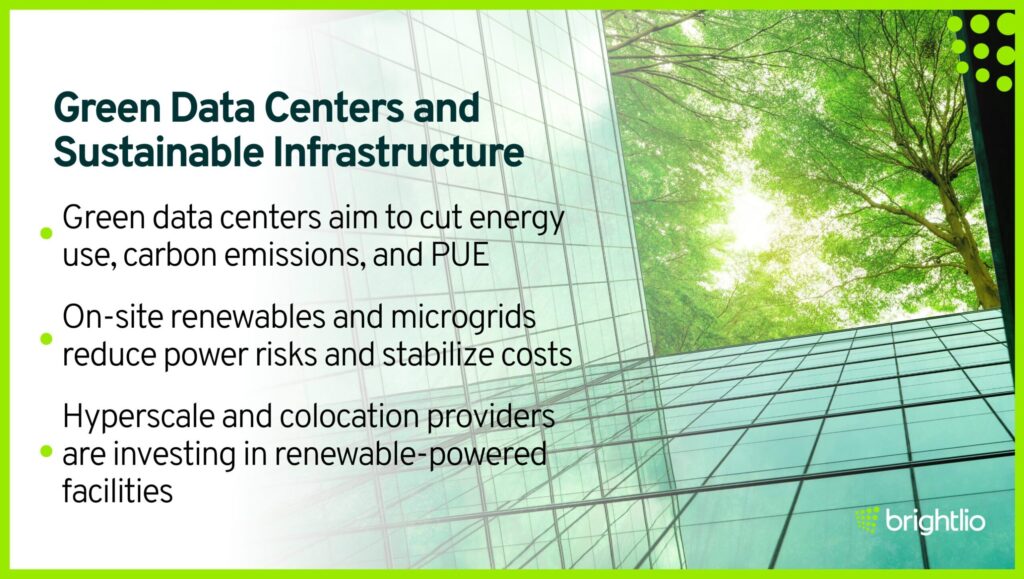
Sustainability has become a top priority for data center operators as energy consumption and environmental impact continue to grow. Green data centers focus on reducing power usage effectiveness (PUE), integrating renewable energy, and lowering carbon emissions. Uptime Institute reported an industry-average annual PUE of 1.56 in 2024, while IDC estimates that by 2027, 35% of all data center energy consumption will be powered by renewables.
Operators are also working toward net-zero and lower-carbon infrastructure through more efficient facility designs, advanced cooling, and better energy management. JLL says new AI-era deployments are pushing rack densities into the 40 kW to 130 kW range, which is accelerating the use of liquid cooling and other high-efficiency thermal strategies, while the IEA projects that renewables will supply about half of the growth in data center electricity demand through 2035.
Liquid cooling, particularly direct-to-chip and immersion cooling, is gaining traction as operators adapt facilities for denser AI and high-performance computing workloads. JLL says rack densities above 70 kW increasingly make liquid cooling the only practical option for these environments, while Uptime notes that operators are actively planning and deploying direct liquid cooling as AI infrastructure expands.
Operators are also exploring on-site power, battery storage, and microgrid-style energy strategies to reduce power availability risk and stabilize long-term energy costs. JLL’s 2026 outlook says data center operators are expected to increase behind-the-meter power arrangements and explore colocated battery storage as average grid-connection wait times in primary markets exceed four years, while Knight Frank notes that renewable energy and microgrids are becoming more important as operators seek greater energy autonomy and resilience.
Regulatory pressure and corporate ESG commitments are accelerating this shift. In Europe, the recast Energy Efficiency Directive and the EU’s sustainability-rating scheme for data centers now require operators to report key performance indicators to a European database from 2025 onward, and the European Commission says the scheme is intended to promote renewable energy use and waste-heat reuse. A related 2025 EU assessment also notes that the Climate Neutral Data Centre Pact includes targets such as 75% renewable energy or hourly carbon-free energy matching by the end of 2025, alongside heat recovery and reuse goals. (Energy)
In North America and Asia-Pacific, hyperscale cloud providers and colocation companies are making similar investments in renewable-backed infrastructure. Google says it signed about 8 GW of clean energy generation capacity in 2024 and is pairing a new Wilbarger County, Texas data center with clean energy, while Microsoft says it met its goal of matching 100% of its electricity use in datacenters and other operations with renewable energy purchases by 2025. Amazon also said it continued in 2024 to match 100% of electricity consumed in all data center regions with renewable energy sources, and AirTrunk’s Hong Kong renewable energy solution matches Microsoft data center electricity consumption with local renewable energy certificates tied to landfill-gas generation. These projects support sustainability goals while also helping operators strengthen long-term power resilience. (Google)
5. Liquid Cooling Solutions
The growth of AI, high-performance computing, and other dense workloads is accelerating the adoption of liquid cooling technologies. Traditional air cooling is under growing pressure in GPU-heavy environments, and JLL says rack densities above 70 kW now make liquid cooling the only practical option in many cases. JLL also reports that next-generation AI deployments are already pushing rack densities into the 40 kW to 130 kW range, with future chips projected to reach 250 kW per rack.
Direct liquid cooling and immersion cooling are both gaining ground as operators adapt facilities for higher-density computing. Uptime Institute’s 2025 Cooling Systems Survey says direct liquid cooling adoption is still gradual, but it is advancing as rack densities rise and the cost of maintaining air-cooled environments becomes harder to justify. In a separate 2025 AI infrastructure survey, Uptime found that 51% of owner-operators hosting AI applications were upgrading cooling systems to support those workloads.
Direct-to-chip cooling sends coolant through cold plates mounted directly on CPUs and GPUs, which improves heat removal and helps data centers handle higher rack densities more efficiently. Immersion cooling takes a different approach by submerging IT components or full servers in a dielectric, non-conductive liquid that removes heat through direct contact. Both methods are gaining market share as operators build facilities for denser AI and HPC deployments.
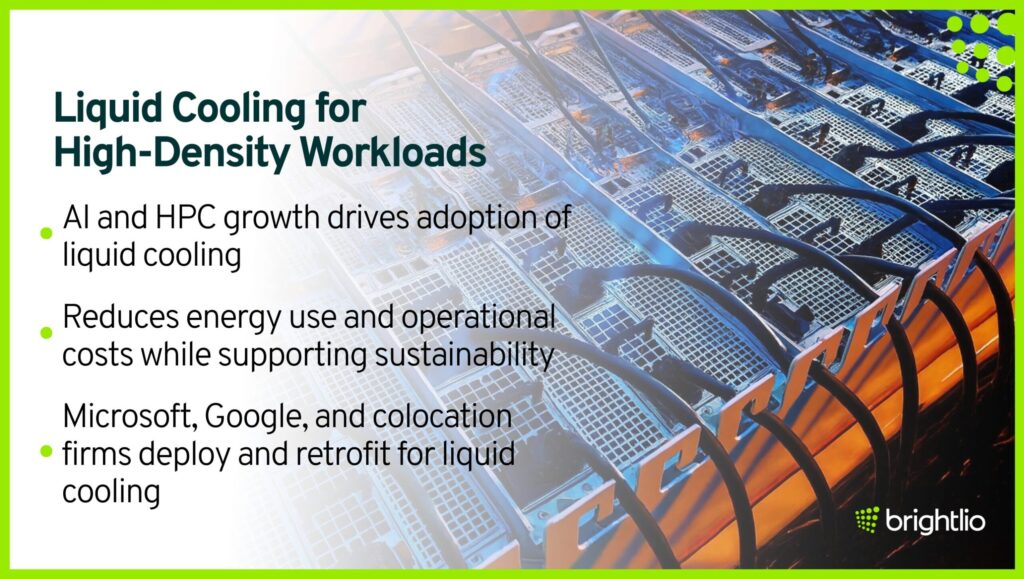
Immersion cooling, where servers are submerged in a non-conductive dielectric fluid, can deliver even greater thermal efficiency and is already being used for demanding workloads such as AI, HPC, and cryptocurrency mining. Microsoft reported in 2025 that cold plates and the two immersion cooling methods it studied reduced lifecycle greenhouse gas emissions by 15% to 21%, energy demand by 15% to 20%, and water consumption by 31% to 52% compared with air cooling. (Source)
Major providers are already putting liquid-based cooling into real deployments. Microsoft said it launched a new datacenter design in August 2024 optimized for AI workloads that uses chip-level cooling and consumes zero water for cooling, while Google says water cooling is an energy-efficient and often more sustainable option than chillers or air conditioning in its data centers. (Microsoft)
This shift is no longer limited to hyperscale campuses. CoreSite says it has been retrofitting existing data centers to support high-density AI workloads, and Digital Realty notes that retrofitting existing facilities for liquid cooling is becoming part of the industry transition. As AI-driven demand rises, liquid cooling is expected to expand further, especially as JLL says rack densities above 70 kW increasingly make liquid cooling the only practical option. (CoreSite)
6. Automation and AI Operations
Automation and AI-driven management have become vital for modern data centers as infrastructure complexity grows, power constraints tighten, and operators face rising demands from AI workloads. Uptime Institute’s 2025 Global Data Center Survey says the industry is dealing with rising costs, worsening power constraints, and increasing pressure to meet AI-related density and capacity demands.
These technologies support real-time monitoring, predictive maintenance, anomaly detection, and more intelligent control of power and cooling systems. Uptime Institute says the three main near-term machine learning applications in data centers are equipment setting optimization, predictive analytics for maintenance and capacity planning, and anomaly detection to help prevent outages. It also notes that AI in cooling is moving from predictive insight toward more prescriptive and autonomous control.
Data center infrastructure management platforms now include AI features that help operators forecast capacity needs, detect anomalies, and optimize power and cooling across single sites and distributed environments. Schneider Electric’s DCIM tools, as summarized by TechTarget and Schneider’s own capacity management guidance, now provide real-time monitoring, intelligent alarming, AI-assisted capacity planning, and automation to optimize space, power, cooling, and network resources across on-premises, hybrid, colocation, and large multi-site environments.
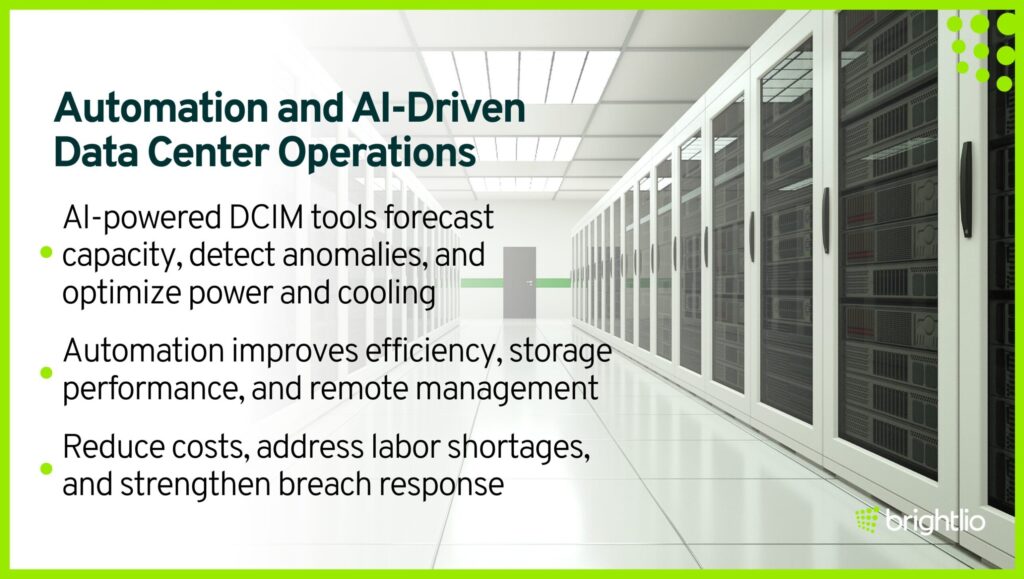
This helps data centers run more efficiently across distributed environments. IDC says AI agents can monitor cloud usage in real time, dynamically adjust compute power, storage, and bandwidth to match demand, and reduce waste and costs while maintaining performance. The same research says AI can analyze logs, detect anomalies, identify service issues before they escalate, and auto-diagnose problems or apply patches, which helps reduce downtime.
IDC also notes that these capabilities matter more as infrastructure becomes more distributed. Its cloud research says 88% of cloud buyers are deploying or already operating a hybrid cloud, 79% use multiple cloud providers, and 49% of public cloud applications include an edge component. IDC adds that autonomous operations use observability and automation to manage, scale, and secure infrastructure consistently across data centers, colocation, cloud, and edge locations.
AI-driven workload orchestration is also playing a larger role. IDC says AI agents can distribute workloads across platforms based on cost, performance, and latency requirements. Separate IDC edge research found that staff time and expertise are in short supply, making automation increasingly important for reducing operational pressure while helping teams follow processes and security requirements. In that study, 53% of organizations said edge investments improved data security, 52% cited better business or operational resilience, and 41% reported stronger operational efficiency.
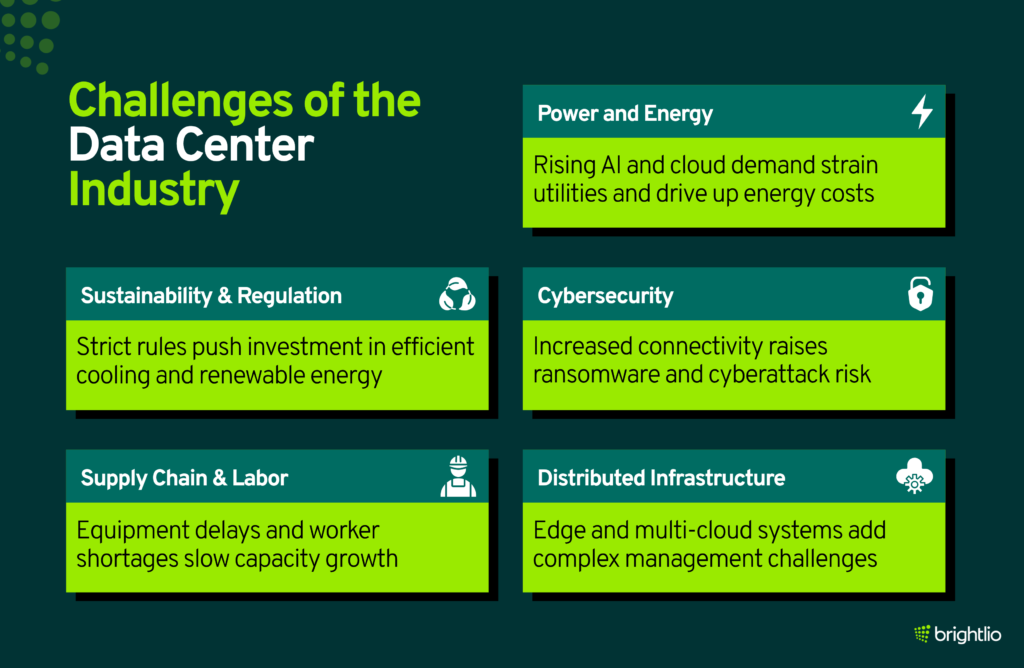
Challenges of the Data Center Industry
Despite rapid growth and innovation, data centers face several critical challenges. Some of the challenges data center industry faces are discussed below:
1. Power and Energy Constraints
Rising demand from AI, HPC, and cloud workloads is increasing power density requirements, straining utility infrastructure, and putting more pressure on energy costs. Uptime Institute’s 2025 Global Data Center Survey says operators are facing worsening power constraints as they try to meet growing AI-related density and capacity requirements, while McKinsey estimates that global demand for data center capacity could grow at an annual rate of 19% to 22% from 2023 to 2030, reaching 171 GW to 219 GW of annual demand by 2030.
In some regions, grid limitations are now a major barrier to fast expansion. JLL’s 2026 Global Data Center Outlook says power, rather than location or cost, is becoming the primary site-selection factor, with average grid-connection wait times in primary data center markets now exceeding four years.
To deal with these constraints, operators are turning to on-site generation, behind-the-meter power arrangements, colocated battery storage, and renewable energy strategies. JLL says these approaches are gaining traction as developers look for faster access to power and more predictable long-term capacity.
2. Sustainability and Regulatory Pressure
Data centers now face heavier sustainability pressure as operators work to meet stricter environmental rules and internal decarbonization targets. That is pushing more spending into energy-efficient infrastructure, advanced cooling, power monitoring, and renewable energy sourcing. In Europe, the revised Energy Efficiency Directive has already created a formal reporting framework for larger facilities, and the European Commission says data center operators must submit key performance indicators to the EU database each year, with the first submissions beginning in 2024 and recurring by May 15 in 2025 and later years.
Those requirements add complexity to expansion plans, especially in markets already dealing with power constraints and higher sustainability expectations. The Commission is also moving ahead with an EU-wide sustainability rating scheme for data centers, while JLL’s 2026 outlook says the sector will likely expand at a 14% CAGR through 2030 and will need energy innovation to address grid and sustainability challenges.
3. Cybersecurity Risks
Increased connectivity, hybrid deployments, and remote management have expanded the attack surface for modern data centers. IBM notes that growing cloud adoption, digital transformation, and remote work have made enterprise environments larger, more distributed, and more dynamic, creating more exposed assets and attack paths for adversaries. CISA also warns that nation-state actors continue to target critical infrastructure, which keeps cyber risk elevated for the digital systems and facilities organizations depend on every day.
Ransomware, credential theft, and other intrusion activity remain major concerns. Verizon’s 2025 Data Breach Investigations Report says ransomware was linked to 75% of system-intrusion breaches, while IBM X-Force reported that critical infrastructure organizations accounted for 70% of the attacks it responded to in 2024 and observed an 84% increase in emails delivering infostealers. Ensuring physical and logical security at scale remains a constant challenge as operators add automation, remote access tools, and more distributed hybrid infrastructure. In the 2026 DBIR, software vulnerability exploitation initiated 31% of breaches studied. (Source: Verizon; related server security statistics.)
4. Supply Chain and Skilled Labor Shortages
The construction of new facilities and the retrofitting of existing ones continue to face delays tied to equipment availability and a shortage of skilled labor. Uptime Institute’s 2025 Global Data Center Survey says operators expanding and modernizing facilities must contend with staffing challenges and supply chain delays, while CBRE noted in H2 2025 that shortages of mechanics, electricians, plumbers, laborers, and construction workers remained a constraint for greenfield and remote development. RLB’s 2026 Data Centre Trends Report adds that generator and equipment lead times, which had eased to 38 weeks in 2025, were already rising back toward 52 weeks as hyperscale demand returned.
These pressures slow time-to-market for new capacity and raise development and operating costs. S&P Global says securing specialized labor and procuring equipment with long lead times have become chronic issues for the sector, while CBRE notes that competition for skilled trades is increasing project costs.
5. Managing Distributed Infrastructure
With the rise of edge computing and multi-cloud environments, operators now have to manage infrastructure that is more complex and more geographically dispersed than traditional centralized deployments. IDC says 88% of cloud buyers are deploying or already operating a hybrid cloud, 79% use multiple cloud providers, and 49% of public cloud applications now include an edge component. That shift makes coordination across sites, platforms, and workloads much harder. (idc.com)
Managing these environments requires stronger monitoring, more automation, and better orchestration. IDC says autonomous operations use observability and automation to manage, scale, and secure infrastructure consistently across data centers, colocation sites, cloud platforms, and edge locations. Uptime Institute also says machine learning in data centers is increasingly used for equipment optimization, predictive maintenance, capacity planning, and anomaly detection, which reflects how important AI-driven operations have become in distributed environments. (idc.com) (intelligence.uptimeinstitute.com)
Skilled personnel remain a constraint at the same time. IDC’s edge research found that staff time and expertise are in short supply, which makes it harder for operators to manage distributed infrastructure manually and increases the value of automation and centralized control. (intel.com)
Data Center Industry Geographical Trends
This section looks at how data centers are growing in three key regions: North America, Europe, and Asia. Each has its own trends, challenges, and opportunities shaping how the industry is developing.
1. North America
Let’s take a closer look at North America, where data center growth is accelerating. Growth is fueled by hyperscale cloud providers, new power solutions, and state-level incentives, attracting heavy investment.
Hyperscale Expansion
North America, especially the U.S., continues to lead the global data center surge. CBRE reports that North America recorded the largest year-over-year inventory increase in Q1 2025, with inventory up 43%, while the region also posted the world’s lowest average vacancy rate at 2.3%. Northern Virginia remained the largest North American market, and Atlanta and Phoenix moved into the second and third spots, ahead of Dallas and Silicon Valley. (cbre.com)
The hyperscale footprint is also still expanding quickly. Synergy Research Group says the number of large hyperscale data centers reached 1,360 at the end of 2025, and the U.S. accounted for 55% of worldwide hyperscale operational capacity. (srgresearch.com)
Hyperscale cloud providers such as AWS, Microsoft, Google, Meta, and Oracle remain the main force behind this growth. CBRE says demand from hyperscalers and cloud service providers drove record leasing activity in Q1 2025, despite persistent power constraints, while JLL says AI and cloud demand are expected to drive the global data center sector at a 14% CAGR through 2030. (cbre.com)
Sustainable Energy & Power Strategies
Power scarcity has become the chief operational constraint for data center growth. JLL’s 2026 Global Data Center Outlook says power is now the primary site-selection factor, with average grid-connection wait times in primary markets exceeding four years. As AI-driven demand accelerates, utilities and developers are responding with new power strategies that combine firm generation, storage, and renewable supply. In Texas, Fermi America says its proposed HyperGrid campus is designed around a mix of natural gas, behind-the-meter grid power, solar, battery storage, and advanced nuclear power, reflecting the industry’s move toward multi-source energy systems for AI infrastructure.
Tech companies are also signing long-term renewable power agreements at very large scale while exploring new sources of dependable low-carbon energy. Microsoft said in 2026 that it had contracted 40 GW of new renewable energy, and Amazon’s carbon-free energy portfolio has also surpassed 40 GW. Google, meanwhile, signed new agreements for 1 GW of solar capacity in Texas for its data centers and recently added 1 GW of demand response capacity to help balance grid conditions. At the same time, interest in small modular reactors is growing. The EU’s new SMR strategy says these systems can help supply reliable clean power for high-demand users such as data centers, showing how the sector is looking beyond traditional grid supply to secure long-term, low-carbon baseload energy. (energy.ec.europa.eu)
Operational and Environmental Tensions
Data centers are creating growing operational and environmental tension as electricity demand rises and local communities absorb more of the impact. The International Energy Agency projects global data center electricity use will reach about 945 TWh by 2030, which is slightly higher than Japan’s total electricity consumption today. In the United States, Lawrence Berkeley National Laboratory estimated that data centers used about 176 TWh in 2023 and could reach 325 to 580 TWh by 2028, increasing pressure on grids and local energy systems. (iea.org)
That growth is also drawing more scrutiny in local markets. AP reports that lawmakers and consumer advocates in places including Illinois and Arizona are pushing back over rising electricity costs, water use, and tax incentives tied to data center expansion. As more facilities move closer to populated areas, communities are also raising concerns about the economic, environmental, and public health effects of rapid infrastructure growth. (apnews.com)
Private Capital and Market Momentum
Alongside hyperscale builds, colocation and modular campuses are also scaling rapidly. JLL’s 2026 Global Data Center Outlook says colocation is projected to lead sector growth at a 19% CAGR through 2030, while CBRE reports that tight supply and strong preleasing continue to push private capital into both stabilized and development-stage assets. (jll.com)
Vacancy rates in top U.S. markets remain extremely low. CBRE reported that North American vacancy in the top four U.S. markets stayed low in Q1 2025, with Northern Virginia at just 0.76%, while its broader primary-market report put overall vacancy at a record-low 1.4% by year-end 2025. CBRE also said total under-construction capacity across primary North American markets reached 6,350 MW in H2 2024 and remained elevated at 5,242.5 MW in H1 2025, with strong preleasing continuing to limit available large-scale capacity. (cbre.com)
Pre-commitment levels remain exceptionally high. Cushman & Wakefield reported that development activity across the Americas reached 25.3 GW in H2 2025, with nearly 89% of that capacity pre-committed before delivery. In Northern Virginia alone, Cushman & Wakefield said capacity under construction was 88.7% preleased, which shows how quickly new supply is being absorbed. (cushmanwakefield.com)
2. Europe
Now, let’s turn to Europe, where data centers are growing fast but with a unique focus on sustainability and regulation:
Hyperscale and Colocation Growth
The Europe hyperscale data center market was valued at USD 31.39 billion in 2023 and is projected to reach USD 45.65 billion by 2029 at a 6.44% CAGR. Colocation services also continue to expand quickly. One current forecast values the global data center colocation market at USD 84.14 billion in 2024 and projects it to reach USD 162.68 billion by 2029 at a 14.1% CAGR.
Top metro markets such as Frankfurt, London, Amsterdam, Paris, and Dublin continue to dominate European growth. CBRE reports that Europe’s overall vacancy rate across the top four markets fell to a record-low 7.4% in Q1 2025, while its later market figures show that Frankfurt and London together accounted for about half of Europe’s total growth in 2025. Germany and the UK also remain at the center of Europe’s buildout. Frankfurt became only the second European market to exceed 1 GW of operational supply in Q2 2025, and London remains Europe’s largest data center market, with 1,189 MW in operation and another 1,678 MW in the pipeline.
capital inflows and innovation in green infrastructure and AI‑ready facilities.
Sustainability and Regulation
Europe is moving ahead with policies that favor more energy-efficient, lower-carbon data centers. Under the Climate Neutral Data Centre Pact, signatories have committed to match data center electricity demand with [75% renewable energy or hourly carbon-free energy by December 31, 2025 and 100% by December 31, 2030. Those targets are shaping design, procurement, and operating decisions across the market. Operators are also adopting lower-impact approaches such as modular construction, liquid cooling, and district heating systems that reuse waste heat. In Espoo, one live project now sends recycled heat from a data center to a nearby retail site and is expected to cut emissions from district heating use by about 200 tonnes of CO₂ equivalent per year.
Further support comes from legacy infrastructure. Reuters reported that European utilities including Engie, RWE, and Enel are marketing former coal and gas plant sites for data center development because those locations already offer grid connections, cooling access, and industrial land that can shorten build timelines. This trend is becoming more important as Europe races to add AI-ready capacity while working within tighter power and permitting constraints.
Power and Supply Constraints
Europe continues to trail the U.S. in development speed because power availability and permitting remain major constraints. CBRE says limited power availability is still the main inhibitor of data center growth in core hub markets, while Reuters reported in November 2025 that capacity growth across Europe, the Middle East, and Africa had slowed during the year as a lack of available power pushed project timelines back. Demand, however, remains strong. CBRE said in its 2025 global outlook that demand continued to outpace new supply across both core and emerging hubs, with vacancy still falling in key markets.
Constraints on available land and power are also pushing developers toward newer European markets. Cushman & Wakefield says emerging markets are drawing greater interest because they offer shorter power delivery timelines, more favorable land pricing, and less competition for prime sites. That shift is helping direct more attention toward markets such as Spain, Portugal, Greece, and parts of the Nordics, where developers are also drawn to cooler climates and stronger renewable energy potential.
Market Drives & Demand
Demand is driven by digital transformation, AI deployments, edge and 5G rollouts, and increased cloud adoption across industries including finance, healthcare, and retail. Capacity in MW terms is expected to climb from about 13.6 GW in 2025 to over 21 GW by 2030 (~9% CAGR). Growth rates across markets remain high, with hyperscale projects expanding rapidly, especially in Western Europe and the Nordics.
3. Asia‑Pacific
Finally, let’s look at Asia-Pacific, one of the fastest-growing regions for data centers. Driven by AI, cloud services, and strong national investments, this region is rapidly building new capacity while adopting green energy and innovative infrastructure strategies:
Hyperscale & Market Growth
Asia-Pacific remains one of the fastest-growing regions in the global data center market. Current market research shows the region is expected to add more than 31.4 GW of installed power capacity between 2025 and 2030, while Cushman & Wakefield reported that operational capacity had already reached 13,763 MW in H2 2025 and that the regional development pipeline had grown to 19,371 MW. Colocation growth is also strong. Arizton values the APAC colocation market at USD 19.32 billion in 2024 and projects it to reach USD 50.19 billion by 2030, at a 17.25% CAGR.
Annual expansion is still accelerating, driven by AI infrastructure demand, cloud growth, and rising digital sovereignty requirements across major APAC markets. Recent regulatory analysis notes that countries such as India, Indonesia, and Malaysia are tightening or shaping location, infrastructure, and compliance requirements for data center development, while China remains the region’s largest market and is expected to account for about 49% of total APAC data center investment. India, Malaysia, Indonesia, Japan, and Australia also continue to rank among the region’s key growth markets. (Arizton; Cushman & Wakefield)
Emerging National Markets
India is quickly becoming a regional hub. The country’s data center capacity is expected to exceed 4,500 MW by 2030, supported by roughly $20–25 billion in projected investment over the next several years. Airtel’s Nxtra plans to double capacity to about 400 MW by 2027 through an investment of around Rs 5,000 crore, or roughly $600 million. Meanwhile, Google is set to invest $6 billion in a 1 GW data center and supporting power infrastructure in Andhra Pradesh, with about $2 billion earmarked for renewable energy.
Sustainability & Energy Strategies
Green energy adoption is rising across the region. In Malaysia, YTL’s Green Data Center Park in Johor remains a flagship example. YTL says the park is a 500 MW facility powered by an equivalent amount of on-site solar energy, and its AI infrastructure collaboration with NVIDIA is helping position Johor as a major AI and high-performance computing location.
Singapore is also keeping strict energy-efficiency rules in place for new builds. IMDA’s Green Data Centre Roadmap says the country aims to provide at least 300 MW of additional capacity in the near term through greener deployments, while the refreshed Green Mark for Data Centres 2024 and the new SS 715:2025 standard are raising sustainability requirements for operators and IT equipment. Industry guidance tied to the roadmap continues to cite a target PUE below 1.3 for new facilities, and Singapore’s current water framework still points to a water usage effectiveness goal of 2.0 m³/MWh or less over the next 10 years.
Southeast Asian countries are also looking at cross-border power sharing through the ASEAN Power Grid to support cleaner and more reliable electricity supply for energy-intensive infrastructure. The IEA says the ASEAN Power Grid is intended to strengthen energy security, support the region’s energy transition, and improve access to cost-competitive electricity through deeper regional interconnection and cross-border trade.
Supply & Regulatory Constraints
Land and power availability remain tight in core markets like Singapore and Hong Kong. CBRE says supply-side constraints are still affecting new developments in major Asia-Pacific hubs, with Singapore’s vacancy rate at just 2% in Q1 2025, while Hong Kong continues to face limited land availability and power constraints. These pressures are pushing more developers and operators toward secondary markets. CBRE notes that expansion is increasingly shifting to places such as Johor, Malaysia and that investors looking to grow in Southeast Asia continue to explore nearby markets, especially Malaysia and Thailand, while Malaysia, Indonesia, and Thailand are posting some of the region’s fastest pipeline growth.
In Australia, major cities face similar constraints. CBRE says Sydney is dealing with planning constraints, and that demand is shifting toward Melbourne, which offers better land and power availability for large hyperscale and AI deployments. Across the broader region, CBRE also says insufficient power supply, elevated construction costs, and supply chain constraints continue to slow new development in several established markets.
Operational & Market Dynamics
Major players including AWS, Microsoft, Google, Alibaba, Equinix, and NTT DATA continue to expand their presence across APAC, alongside regional operators such as AirTrunk, GDS, ST Telemedia Global Data Centres, Princeton Digital Group, and NEXTDC. Demand is no longer driven only by cloud. Research and Markets projects the broader hyperscale data center market to grow at a 24.6% CAGR through 2030, while APAC digital growth from e-commerce, AI workloads, and online consumer platforms continues to add to that pressure. Pre-leasing also remains common across supply-constrained markets. CBRE reports that tight capacity and strong occupier demand are still supporting higher rents, while average rental rates across global data center markets rose 13.0% year over year in Q1 2025. Longer-term growth forecasts remain aggressive. JLL projects that the global data center sector will add 97 GW between 2025 and 2030, effectively doubling over five years, with APAC expected to remain one of the main engines of that expansion.
Latest Data Center Trend News
Let’s find out what’s new in the world of data centers, where major investments and AI-driven innovations are rapidly changing how infrastructure is built and powered.
1. Google to Build $6 Billion Data Center in Andhra Pradesh
Google is now planning a much larger investment in Andhra Pradesh than earlier reports suggested. In October 2025, Reuters reported that Google would invest about $15 billion over five years to build an AI data center campus in Visakhapatnam, with an initial capacity of 1 gigawatt. The project remains Google’s first major data center investment of this kind in India and one of its largest infrastructure bets in Asia.
Earlier reporting in July 2025 had placed the project at $6 billion, including about $2 billion for renewable energy infrastructure. The later Reuters report indicates that the scope expanded materially. The Visakhapatnam campus is part of Google’s wider regional buildout, alongside ongoing investments in markets such as Singapore, Malaysia, and Thailand.
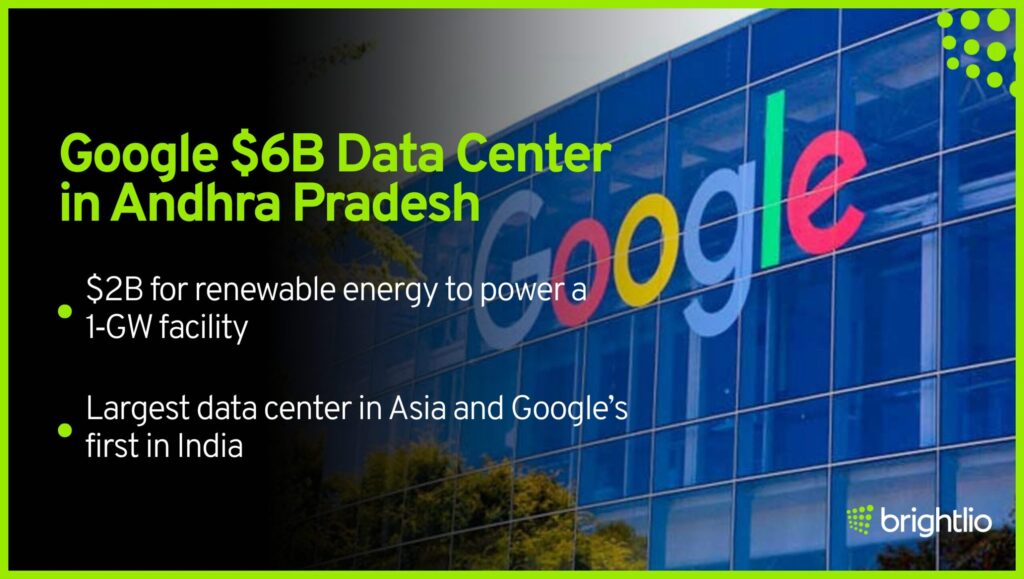
Andhra Pradesh aims to build 6 GW of data center capacity over the next five years, with 1.6 GW already secured through commitments expected to come online within about two years. The state is also planning three cable landing stations in Visakhapatnam to strengthen global connectivity, while officials expect data center growth to push power needs to roughly 10 GW over the same period, with green energy positioned as a major part of the supply mix.
2. NVIDIA Unveils Vision for AI Factories at Data Center World 2025
At Data Center World 2025, NVIDIA executives described “AI factories” as a new class of large-scale data centers built specifically for accelerated computing, with much heavier power density and more advanced cooling than traditional facilities. NVIDIA separately said in April 2025 that tens of “gigawatt AI factories” are expected to be built in the coming years. (nvidia.com)
A leading example is the Lancium Clean Campus in Abilene, Texas. Crusoe and Lancium began with an initial 200 MW deployment and expanded the campus plan to 1.2 GW. Crusoe says each building is designed to support up to [50,000 NVIDIA GB200 NVL72 systems](https://www.crusoe.ai/resources/newsroom/crusoe-expands-ai-data-center-campus-in-ab ilene-to-1-2-gigawatts) on a single integrated network fabric, and the site uses direct-to-chip liquid cooling with closed-loop water systems. Current project reporting indicates the expanded campus is scheduled to come online by mid-2026.
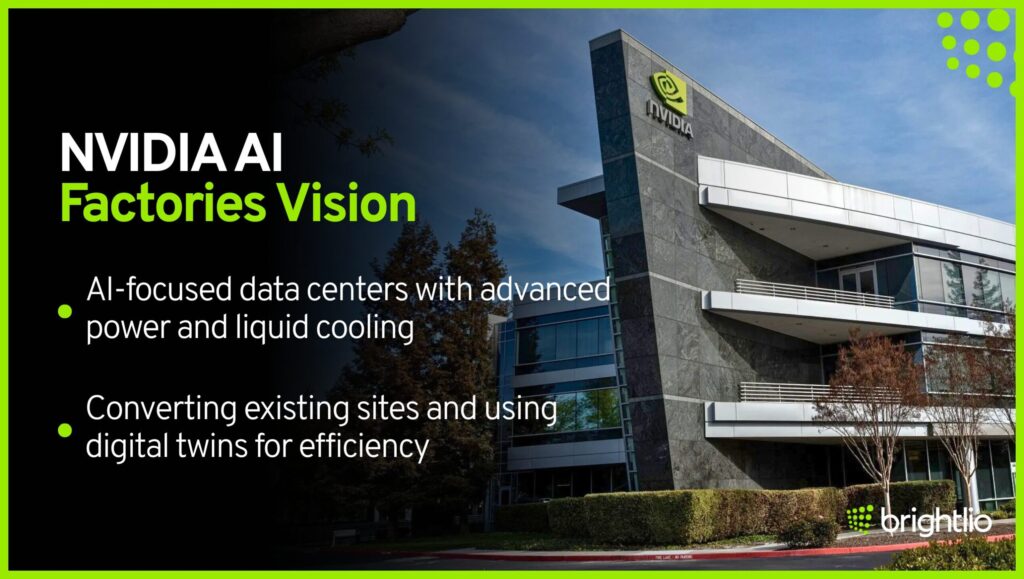
NVIDIA also pointed to reusing existing sites as part of its AI factory vision. At Data Center World 2025, NVIDIA’s Wade Vinson said older mills, manufacturing sites, and even retail properties with existing grid access could be converted more quickly than new-build campuses, and he added that many colocation facilities built in the last 10 years have enough power and cooling to transition into AI-ready environments. NVIDIA also emphasized planning through its Omniverse digital twin platform to model layouts, power, cooling, and operational performance before construction or retrofit work begins. Vinson said AI could raise business and personal productivity by 10% or more and add about $100 trillion to the global economy, framing AI factories as a major shift in infrastructure and productivity.
3. New Data Center Developments: July 2025
Data center development continued to accelerate worldwide in July 2025, with major projects and power deals showing that digital infrastructure remains a top investment priority for hyperscalers and developers.
In North America, Google said it would invest $7 billion more in Iowa over the next two years to expand cloud and AI infrastructure, including Cedar Rapids. Amazon also continued its large-scale buildout, with a planned $10 billion cloud and AI campus in Richmond County, North Carolina, and a separate $20 billion investment in Pennsylvania for AI infrastructure.
Other notable announcements reinforced the same pattern. EdgeCore Digital Infrastructure unveiled plans for a 1.1 GW campus in Louisa County, Virginia. Microsoft’s power strategy also remained in focus through its agreement tied to the restart of Three Mile Island, with Constellation aiming to bring the plant back by 2027 to support Microsoft data center demand.
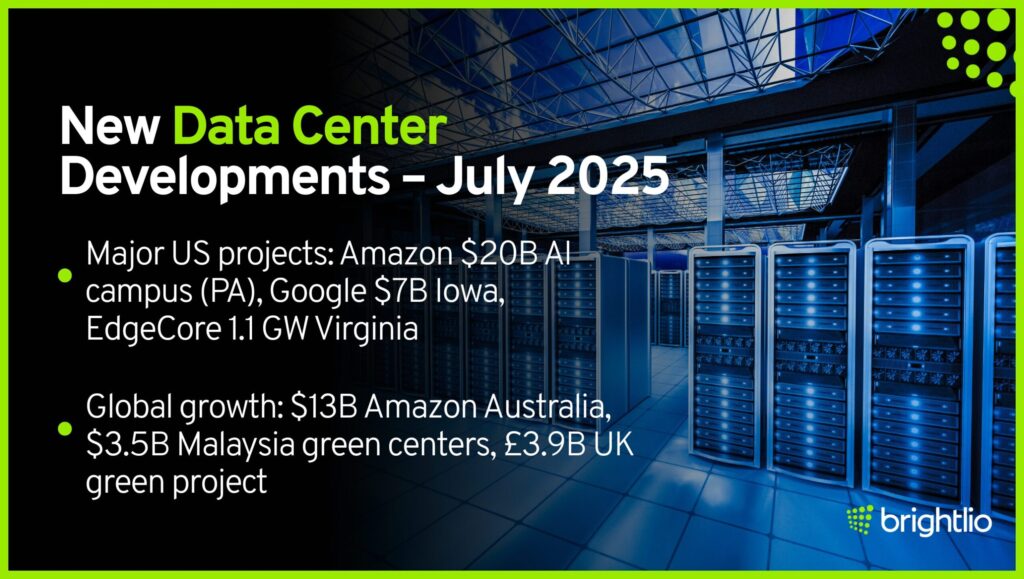
In Europe, investment momentum remains strong despite power, land, and supply-chain constraints that continue to slow delivery in some markets. Spain is set to get a new 300 MW campus outside Pamplona, while the UK’s SWI Group has proposed a 330 MW data center between Cambridge and Peterborough. Scotland’s Ravenscraig project is being pitched as a £3.9 billion green data center development, and Hochtief is still expanding its data center strategy in Germany. Austria also launched its first Microsoft cloud region in 2025, while Germany’s JUPITER system ranked as Europe’s fastest supercomputer and 4th in the world on the June 2025 TOP500 list.
In Asia-Pacific, investment activity also remains strong. India’s Anant Raj plans to invest about $2.1 billion in new data centers, while Amazon announced a A$20 billion investment in Australia focused on expanding cloud and AI infrastructure. Singapore-based DayOne secured $3.5 billion for green data centers in Malaysia, East Jakarta approved a Tier IV facility with 7,000 racks, and Digital Edge partnered with B.Grimm Power on $1 billion hyperscale campuses in Thailand. Japan also saw ST Telemedia open its first data center with integrated solar power, while Alibaba expanded further in Southeast Asia with new cloud infrastructure in Malaysia and the Philippines.
4. Google to Limit AI Data Center Power Use During Grid Strain
Google has signed agreements with Indiana Michigan Power and the Tennessee Valley Authority to reduce electricity use at AI data centers during periods of high demand. Reuters reported that the move is part of Google’s first formal push into utility demand-response programs for data centers, as AI workloads place growing pressure on U.S. power systems.
The agreements are designed to help reduce strain on the grid during peak periods, lower pressure on broader system capacity, and delay the need for some new generation and transmission infrastructure. Reuters also noted that rising data center demand has increased concern about blackouts, grid congestion, and higher costs for other customers as utilities work to keep up with AI-driven electricity use.
These agreements are part of demand-response programs that let Google temporarily reduce electricity use at participating data centers when utilities call for load relief, which frees up grid capacity during peak demand periods. Google says this approach can help large loads connect faster, reduce the need for some new transmission and power plant buildouts, and help grid operators manage the system more efficiently. The company also presents flexible data center demand as a way to support a more reliable and affordable grid as renewable energy use grows and power constraints become more visible in fast-growing AI markets.
5. Electricity Prices Rise Amid Data Center Boom
Average U.S. residential electricity prices rose 6.5% from May 2024 to May 2025, with some of the sharpest increases recorded in Maine (+36.3%), Connecticut (+18.4%), and Utah (+15.2%), while Nevada (-17.7%) saw a decline. Federal data also show that electricity prices kept rising into mid-2025, with the national average in June 2025 running 6.7% above the level a year earlier.
Analysts point to several drivers behind the increase, including rising demand from data centers, AI workloads, electric vehicles, and air conditioning. Reuters reported that sustained electricity demand growth from data centers and AI applications is one of the factors pushing U.S. power costs higher, while the EIA has separately said retail electricity prices have been rising faster than inflation since 2022.
Grid operators are spending heavily on new transmission and generation to keep up with fast-rising data center demand, and a growing share of those costs is flowing through to customers. In PJM, an analysis from the Institute for Energy Economics and Financial Analysis found that data centers were responsible for about 63% of the recent jump in capacity market costs, adding roughly $9.3 billion in one year. In Virginia, the state’s Joint Legislative Audit and Review Commission found that a typical Dominion residential customer could see generation- and transmission-related costs rise by about $14 to $37 per month by 2040, independent of inflation. The broader picture points to mounting pressure from the AI buildout. Reuters reported that U.S. power costs have been rising as electricity demand from data centers, AI, electric vehicles, and air conditioning climbs, while federal energy planning has continued to rely on a mix of coal, natural gas, nuclear, hydropower, and renewables.
6. Meta Plans Massive Data Center and AI Spending
Meta is sharply increasing its AI infrastructure spending. In July 2025, Mark Zuckerberg said the company would spend hundreds of billions of dollars on AI data centers and related infrastructure. He said the first multi-gigawatt site, Prometheus, is expected to come online in 2026, while Hyperion is planned to scale to 5 GW over time.
Zuckerberg also said that one of Meta’s titan clusters would cover a significant part of Manhattan’s footprint, which reflects the sheer physical scale of the company’s AI buildout. Reuters separately reported that industry analysis from SemiAnalysis pointed to Meta as a likely first mover in bringing a gigawatt-plus AI supercluster online. Meta’s earlier 2025 capital spending plan had already called for up to $65 billion in that year alone, which shows how quickly the company’s infrastructure ambitions have expanded.
The company also reorganized its AI work under Meta Superintelligence Labs, a new division led by Alexandr Wang and Nat Friedman after setbacks tied to Llama 4 and a series of key talent departures. Reuters reported that the unit is focused on Meta’s core AI products and long-term model work as the company tries to compete more aggressively with OpenAI and Google. Meta’s spending push also follows a rise in advertising revenue supported in part by AI-driven improvements to ad performance, and the company raised its 2025 capital expenditure outlook to $64 billion to $72 billion as it recruits top AI talent and expands infrastructure.
7. Cheyenne to Host Gigantic AI Data Center
Cheyenne, Wyoming, is set to host one of the largest announced AI data center projects in the United States. The project, a partnership between Crusoe and Tallgrass, starts with 1.8 GW of planned capacity and is designed to scale to as much as 10 GW over time. Associated Press reported that the initial phase alone would use more electricity than all Wyoming homes combined, with the full buildout reaching roughly five times that level.
The site will be supported through dedicated energy infrastructure rather than relying only on the existing grid. Crusoe and Tallgrass said the campus will use natural gas and renewable energy to power the development, reflecting the wider shift toward self-supplied or directly paired generation for large AI workloads. The project has since moved forward, with DatacenterDynamics reporting in January 2026 that the developers received approval for the 1.8 GW campus and associated power plant.
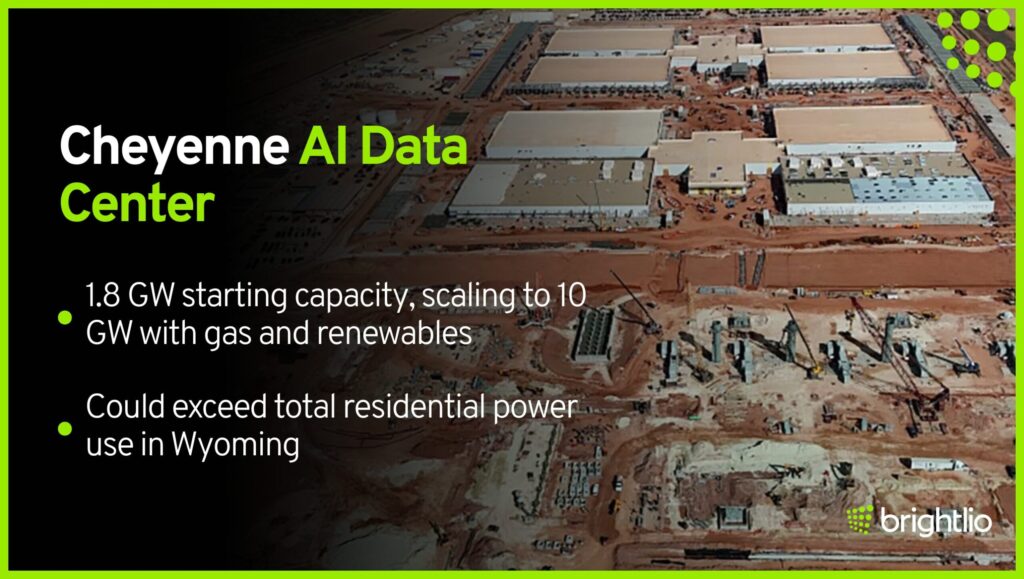
Wyoming’s cool climate, relatively low power costs, and large energy base continue to make it attractive for large-scale computing. Cheyenne already hosts Microsoft data centers, and Meta’s $800 million facility in the city was reported as nearing completion in later regional coverage. At the same time, analysts and policymakers continue to warn that projects of this scale can affect electricity bills and grid planning as utilities respond to large new loads. The Cheyenne site also has not been publicly confirmed as part of OpenAI’s Stargate initiative, although Crusoe has separately worked on major AI infrastructure tied to OpenAI in Texas.
What are the Top 10 data centre companies?
The data centre industry is powered by some of the biggest names in technology and infrastructure. Leading the field is AWS, with its global cloud platform supporting businesses in over 190 countries. The top data center companies include:
- AWS (Amazon Web Services) – Largest cloud provider with over 200 products and services, supporting businesses in 190+ countries with scalable computing, storage, and AI solutions.
- Microsoft Azure – Global cloud platform operating 160+ data centres across 60 regions, known for secure, scalable, and sustainable cloud services.
- Google Cloud Platform – Cloud services built on Google’s infrastructure, focusing on energy-efficient, carbon-neutral data centres.
- Digital Realty – Operates 300+ data centres in 27 countries, providing colocation and interconnection for global businesses.
- Equinix – Runs 248 data centres on five continents, enabling enterprises to interconnect networks, clouds, and IT providers.
- Oracle Cloud – Offers cloud infrastructure, autonomous databases, and enterprise applications to drive business innovation and security.
- Meta – Advanced, energy-efficient data centres powering Facebook, Instagram, WhatsApp, and metaverse initiatives with renewable energy focus.
- IBM Cloud – Hybrid cloud and AI solutions with a secure, enterprise-grade data centre network serving key industries.
- SAP BTP – Data centres running 100% on renewable energy, supporting intelligent and sustainable enterprise operations.
- Iron Mountain – Specializes in secure colocation with compliance, sustainability, and physical security for regulated industries.
What is the Global Data Center Market Size?
The global data centre market was valued at approximately USD 347.6 billion in 2024, and it is expected to reach around USD 652 billion by 2030, growing at a compounded annual growth rate (CAGR) of roughly 11.2%.
Other sources offer similar forecasts:
- USD 269.8 billion in 2025, growing to USD 584.9 billion by 2032 at ~11.7% CAGR.
- USD 456.9 billion in 2023, rising to USD 1,189.5 billion by 2032 at ~11.5% CAGR.
- USD 213.6 billion in 2024, projected to reach USD 494.5 billion by 2033 at ~9.3% CAGR.
Consensus across reports suggests that the global data centre market is growing steadily—with consistent annual growth in the 9–12% range depending on timeframe and methodology.
Final Thoughts
The data center market is evolving faster than ever, driven by AI, cloud adoption, and the push for sustainability.
From hyperscale expansion to renewable energy strategies and advanced cooling technologies, data centers are becoming smarter, greener, and more critical to global digital infrastructure.
As demand grows, so do opportunities for innovation, efficiency, and collaboration across regions and industries.
The coming years will define how these facilities meet rising expectations while supporting a connected, data-driven world.
FAQs
Data centers are scaling infrastructure to handle artificial intelligence and machine learning workloads.
These applications require powerful GPUs and high bandwidth networks. Operators are investing in advanced power and cooling systems to support these high density environments and maintain operational efficiency.
This trend is reshaping facility design and increasing demand for specialized infrastructure focused on computational efficiency and speed.
AI and high performance computing workloads generate far more heat than traditional IT systems. Liquid cooling provides better thermal management and energy efficiency compared to air cooling.
In 2025 more operators are adopting liquid cooling to support dense server racks, lower operating costs, and extend hardware life while also preparing for significant challenges related to future workload density and sustainability goals.
Edge data centers are growing as 5G and Internet of Things deployments increase. Placing compute and storage resources closer to end users reduces latency and improves application performance.
In 2025 industries such as autonomous vehicles, smart manufacturing, and smart cities are driving demand for edge facilities that support real time data processing and also require digital transformation initiatives to integrate distributed architectures effectively.
Environmental responsibility is becoming a core focus for data center operators. Companies are investing in renewable energy sources, advanced energy storage, and efficient cooling technologies to meet carbon neutral and regulatory requirements.
Clients increasingly choose providers based on environmental performance. In 2025 sustainability is a competitive differentiator and a key factor in new facility design and operations, with some firms emphasizing robust infrastructure to support renewable power adoption.
Modular and prefabricated data centers reduce construction time and allow scalable deployments. In 2025 these solutions help cloud providers and enterprises meet sudden growth demands more quickly and at lower cost.
Prefabricated designs are delivered to sites preassembled, accelerating installation and ensuring predictable quality.
This flexibility supports faster technology adoption and geographic expansion, enabling facilities to adapt to emerging technologies without extensive redesigns.
The increase in ransomware, supply chain attacks, and insider threats makes security critical. Data center operators are implementing zero trust architectures, stronger physical security, and advanced monitoring systems.
In 2025 the focus is on preventing unauthorized access and protecting data across hybrid and multi cloud environments, ensuring business continuity and customer trust.

Tamzid is a cybersecurity researcher with 5+ years of experience across SaaS, security, compliance, data centers and cloud. He writes for brightdefense.com and hipaasimple.com, covering security, compliance, and infrastructure topics. Certified through Cisco, Fortinet (NSE 1), and the Basel Institute on Governance in OSINT, he grounds his work in primary sources and verified data.
Recent Posts

Data Centers In Indiana

Data Centers In Arizona
What Is a Data Center?
10 Largest AI Data Centers in the World
Let's start
a new project together