

Wyoming data centers combine a large corporate computing footprint with a smaller commercial colocation market. Cheyenne is the center of activity. Microsoft operates cloud infrastructure there, while Lunavi and Cogent offer facilities where businesses can house their own equipment.
The October 10, 2026 market snapshot identifies 11 facilities, divided into six operating entries, four planned projects, and one separate colocation entry. These categories describe the tracker’s organization. Lunavi and Cogent offer colocation services within its operating group.
Data Center Map lists 31 facilities across four Wyoming markets. Its directory includes separate building entries that the campus-based snapshot combines. Neither count measures how much space a customer can lease today.
Electricity prices and cooling conditions support Wyoming’s appeal. EIA’s newer July 2026 figures put the state’s average commercial electricity price at 10.26¢/kWh, compared with 14.53¢/kWh nationally. Large developments still need their own utility agreements, and a retail colocation bill includes more than electricity.
This guide explains Wyoming’s operating facilities, development pipeline, and purchasing tradeoffs. For a near-term installation, begin with providers that offer your required commercial service. Evaluate the large corporate campuses separately from a cabinet or private-suite search.
Wyoming Data Center Tracker
11data center facilities
6 operational4 planned1 colocation
Data Center Map lists 31 buildings across 4 markets. This tracker counts each campus or facility once, so multi-building campuses and duplicate listings for one building are merged.
Market Snapshot
Notable Operating Data Centers In Wyoming
These are five notable operating sites, not a size ranking. Microsoft's two Cheyenne campuses are likely the largest but don't publish MW, and every other listing appears on the map, with operating sites in green and planned ones in coral.
- CleanSpark Cheyenne 1 and 2Cheyenne, available power75 MWOperational
Two bitcoin mining sites acquired with 75 MW of available power
- Addresses:
- 9010 Venture Dr and 635 Logistics Dr, Cheyenne
- Operator:
- CleanSpark
- Cogent Data Center CheyenneCheyenne, live power2.49 MWOperational
Carrier-neutral facility with 32,860 sq ft of colocation space and ports up to 100GE
- Address:
- 114 W 10th St, Cheyenne
- Operator:
- Cogent Communications
- Microsoft Cheyenne Campus (West Central US)CheyenneNot publishedOperational
Home of Microsoft's West Central US Azure region, with seven buildings listed
- Address:
- 644 Logistics Dr, Cheyenne
- Operator:
- Microsoft
- Microsoft Bison Business ParkCheyenneNot publishedOperational
Second Microsoft campus in Cheyenne, with six buildings listed
- Location:
- Loving Trl and Wapiti Trl, Cheyenne
- Operator:
- Microsoft
Other operating sites, shown on the map in green: .
Planned Data Centers In Wyoming
A 1.8 GW gas-powered campus south of Cheyenne, listed under both Google's Project Tembo and Crusoe's Project Jade, leads the pipeline alongside Related Digital's 302 MW campus.
- Google Project Tembo (Project Jade)Cheyenne, gas-fired campus1,800 MWPlanned
Gas-powered campus with potential to scale to 10 GW and closed-loop cooling, with first buildings expected in 2027
- Location:
- Terry Ranch Rd and CanAm Hwy, Cheyenne
- Listed under:
- Google Project Tembo and Crusoe's Project Jade
- Microsoft HR Ranch Road CampusCheyenneNot publishedUnder construction
New campus east of Cheyenne, with construction expected to take 18 to 24 months
- Location:
- HR Ranch Rd, east of Cheyenne
- Developer:
- Microsoft
- Contractor:
- JE Dunn
- Meta Cheyenne CampusCheyenneNot publishedPlanned
Two-building Meta campus south of Cheyenne
- Address:
- 1800 High Plains Rd, Cheyenne
- Developer:
- Meta
Colocation Facilities In Wyoming
Retail colocation is limited to a handful of Cheyenne facilities.
- MWTN CheyenneCheyenneNot publishedColocation
Suites, cages, cabinets and cloud servers
- Address:
- 6101 Yellowstone Rd, Cheyenne
- Operator:
- Mountain West Technology Network
Choose a category to switch the list and highlight its sites on the map. Click any site card to find it on the map, or click a marker to jump to its card. Pins are approximate, and each MW figure carries the basis shown beside it.
Data sourced from Data Center Map, EIA, Area Development and Black Hills Energy, checked October 10, 2026. Totals count each campus or facility once; Data Center Map's own count lists individual buildings.
Why Colocate In Wyoming
Wyoming’s clearest advantages are electricity pricing, a climate that supports efficient cooling, equipment tax relief, and established connectivity around Cheyenne. Each advantage depends on the facility and the customer’s deployment. Each section connects a market advantage to the evidence needed for a purchasing decision.
Electricity Prices Below The National Commercial Average
Wyoming’s 10.26¢/kWh commercial average in July 2026 was about 29% below the national commercial average. Industrial customers paid an average of 8.62¢/kWh that month. These are statewide averages for different customer classes.
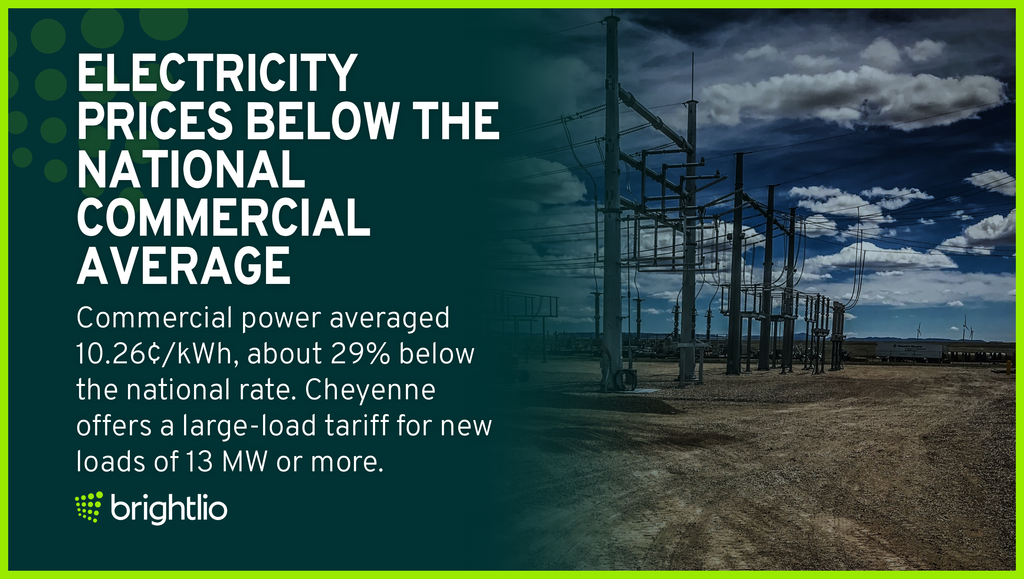
A colocation operator may buy electricity under a different tariff. Its customer contract can combine reserved power with the cost of backup systems and cooling. A low state average therefore supports a market comparison without establishing the price of a particular cabinet.
For larger projects in Cheyenne, Black Hills Energy offers a Large Power Contract Service tariff for new loads of 13 MW or greater. One megawatt (MW) equals 1,000 kilowatts (kW). The utility describes arrangements involving market energy, customer generation, or interruption, depending on the applicable service.
Compare proposals using the same usable IT power. IT power is the electricity allocated to computing equipment. Establish whether demand charges, annual price changes, and cooling overhead are included before calculating long-term savings.
A Climate That Supports Free Cooling
Cheyenne’s cool high-plains climate can reduce the need for mechanical refrigeration. Free cooling uses favorable outdoor conditions to remove heat. The design can use outside air directly or transfer heat through an indirect system.

Lunavi describes filtered outside air and indirect evaporative cooling at its Cheyenne facility. These are actual design choices behind the climate argument. They provide a stronger basis for evaluation than a statewide annual temperature alone.
The number of usable cooling hours depends on the equipment design and operating limits. Summer conditions still matter. A provider should explain how the facility supports the proposed load during its most demanding weather.
Ask for seasonal operating data where available. Compare your servers’ cooling requirements with the supported rack configuration, including the conditions expected during summer.
Equipment Tax Relief For Qualifying Investments
Wyoming’s data center equipment exemption has an entry tier requiring $5 million in capital infrastructure and qualifying annual equipment purchases above $2 million. State guidance identifies a separate $50 million infrastructure tier that extends eligibility to specified power and environmental equipment.
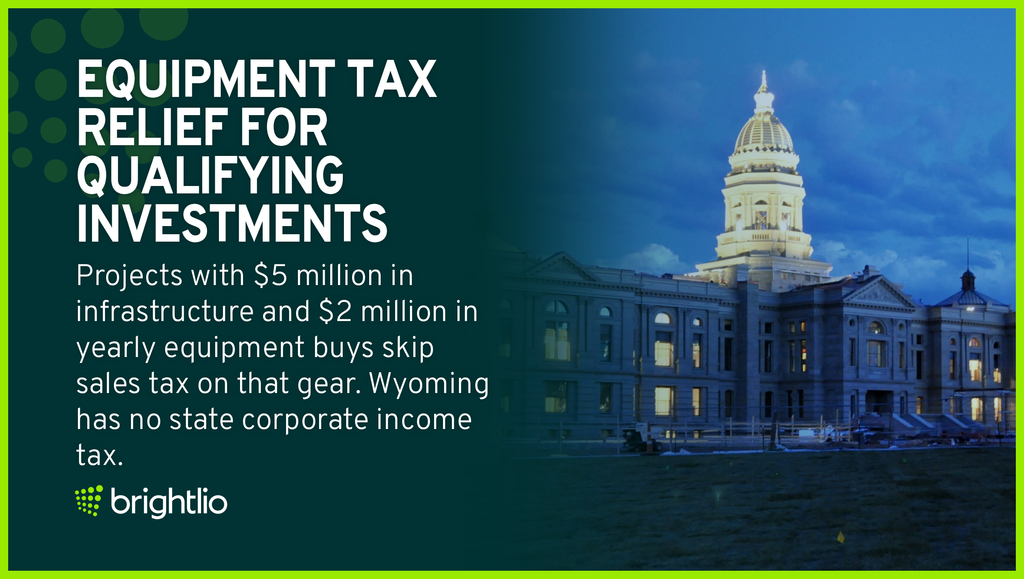
The Wyoming Business Council certifies job creation appropriate to the project’s size and development stage. The Department of Revenue determines whether the purchaser qualifies for the exemption.
Colocation facilities can aggregate qualifying investment across occupying entities under the applicable rules. A tenant still needs to establish which purchases qualify and who holds the required certification. Electricity is outside the equipment exemption.
Wyoming has no state corporate income tax. The financial effect on a business depends on its wider operations and tax obligations. For a colocation comparison, evaluate the treatment of the actual equipment purchases alongside the provider’s recurring charges.
Established Connections To Regional Networks
Cheyenne has operating network facilities as well as large corporate campuses. Cogent’s West 10th Street location and Lunavi’s Progress Circle facility give buyers commercial options within the city.

Network choice matters when connecting offices, cloud services, or a recovery site. A carrier-neutral data center allows customers to choose among network providers. The useful comparison is the service available in the proposed room and its route to your other locations.
Cheyenne can be considered alongside Denver for regional deployments. Test latency, the delay in transmitting data, between the application endpoints that matter to your business. Use measured circuit performance when comparing the locations.
Request the available carriers and installation lead times. Confirm whether two circuits use separate building entrances and routes. Buying from two carriers provides less protection when both connections share the same physical failure point.
Where Wyoming Data Centers Are Located
Cheyenne contains most of the state’s listed facilities. Its business parks accommodate enterprise colocation and corporate campuses, while larger developments extend into surrounding Laramie County. The locations below help buyers distinguish established operating areas from emerging construction sites.
Cheyenne Business Parkway And Progress Circle
Lunavi operates at 340 Progress Circle in Cheyenne Business Parkway. Microsoft has an operating presence in the park, and Related Digital is developing its campus there.
This area illustrates the variety of business models within one location. Lunavi offers customer colocation.
Microsoft’s buildings support its cloud platform. Related Digital’s first building has an anchor tenant for a large computing commitment.
For an enterprise installation, establish the specific operator and commercial product before comparing campus size. Review access for your technicians and equipment deliveries. Confirm whether any future expansion would remain in the same building.
Logistics Drive And Venture Drive
The tracker places Microsoft’s established Cheyenne campus at 644 Logistics Drive. It assigns CleanSpark’s two Cheyenne entries to 9010 Venture Drive and 635 Logistics Drive.
These locations form part of the city’s larger computing footprint. CleanSpark’s bitcoin mining operations and Microsoft’s cloud infrastructure serve different purposes from a retail colocation facility.
Buyers evaluating this area need an identified commercial offer. Establish which company would lease the space and what infrastructure it would provide.
West Cheyenne And Bison Business Park
Microsoft operates in Bison Business Park near Loving Trail and Wapiti Trail. Microsoft’s 2021 announcement confirms the addition of Bison Business Park and Cheyenne Business Parkway facilities to its West Central US region.
In April 2026, Microsoft announced its intent to buy approximately 3,200 acres for further development in Cheyenne. The announcement describes a multiyear planning and development process. It should be considered separately from the existing campuses.
The existing campuses and future land plans demonstrate Microsoft’s continuing presence in the market. An Azure service purchase follows a different procurement process from housing customer-owned equipment with a commercial operator.
South And East Cheyenne And Surrounding Laramie County
The tracker places Google’s Project Tembo near Terry Ranch Road and CanAm Highway, south of Cheyenne. Meta’s campus is listed at 1800 High Plains Road. Microsoft’s HR Ranch Road project is east of the city.
These projects require separate assessments of development status and utility delivery. The responsible permitting authority and service infrastructure depend on the property’s location.
For a future commitment, match the proposed building to its construction phase. Review the schedule for permanent power and the conditions attached to water service. The date a campus starts construction can differ substantially from the date computing equipment can run.
Casper And Other Wyoming Markets
Data Center Map lists Casper, Evanston, and Afton alongside Cheyenne. Cheyenne accounts for 27 of its 31 listings, while Casper has two. Evanston and Afton have one each.
Mountain West Technologies currently markets Data Center of the Rockies in Casper. This is separate from the tracker’s MWTN Cheyenne entry. The Casper service should be evaluated using its own address and specifications.
Smaller markets may suit a local service requirement or a particular recovery design. Assess technical support and the network path to your users at the actual facility.
Five Notable Operating Wyoming Data Centers
These five profiles represent the operating sites selected in the market snapshot. They are not a size ranking. Facility power, IT capacity, and historical power contracts measure different things, and Microsoft does not provide a firm campus MW figure in the sources reviewed here.
CleanSpark Cheyenne 1 And 2
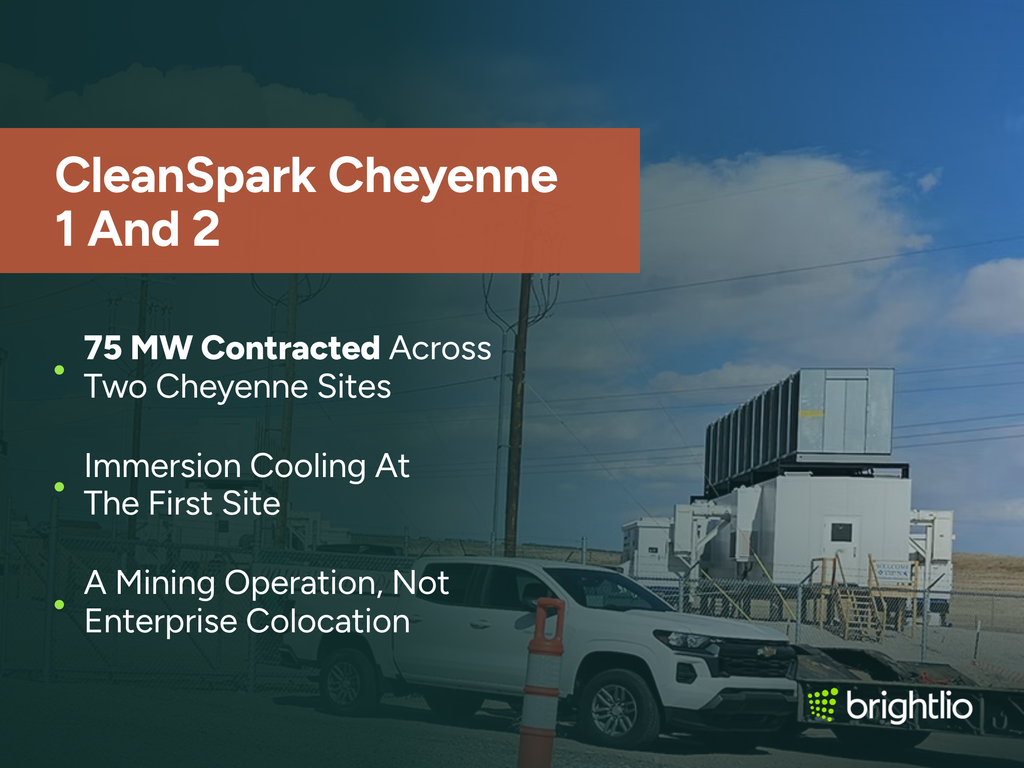
Location: 9010 Venture Drive and 635 Logistics Drive, Cheyenne. Operator: CleanSpark.
CleanSpark’s 75 MW figure comes from power contracts announced in August 2024. The company described a first Wyoming site with 30 MW and a second planned site adding 45 MW. That announcement does not establish a fresh measurement of commissioned capacity across both properties.
The first site’s design uses immersion cooling, which places computing hardware in a suitable cooling liquid. CleanSpark’s business here centers on bitcoin mining. These facilities should remain outside an ordinary enterprise colocation shortlist unless the operator offers a separate, suitable service.
Mining and enterprise workloads can have different continuity requirements. For any proposed hosting service, establish whether its power agreement supports the application’s required uptime. The historical 75 MW contract total should remain separate from the capacity committed to a customer.
Lunavi Cheyenne
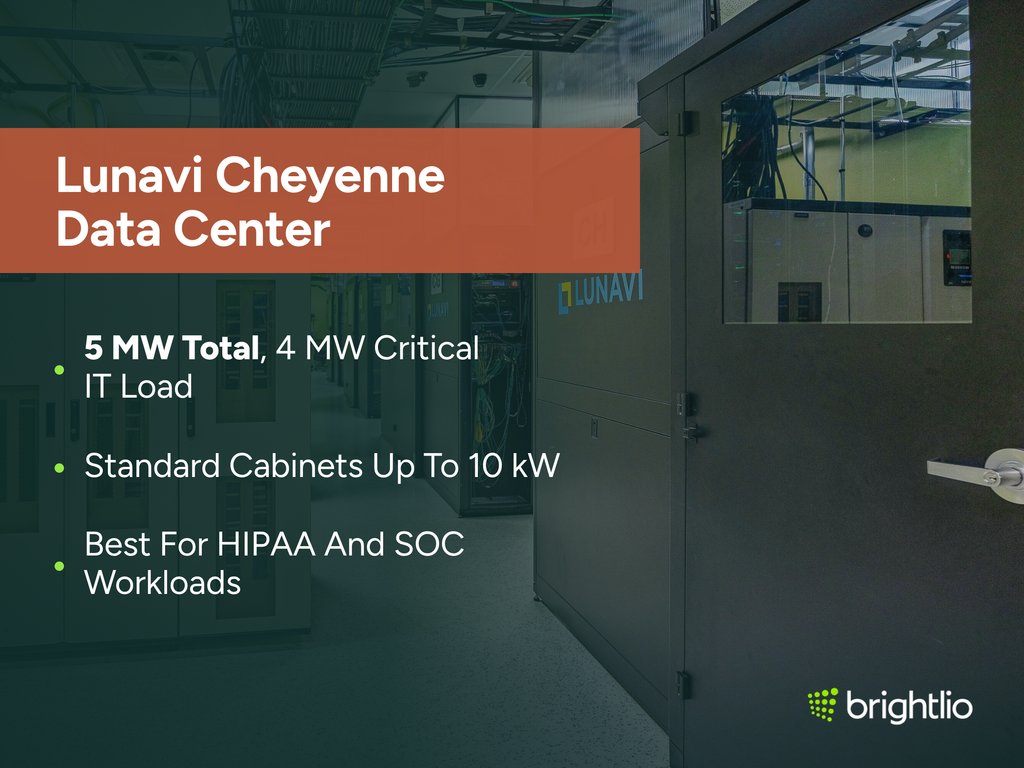
Location: 340 Progress Circle, Cheyenne. Operator: Lunavi, formerly Green House Data.
Lunavi’s Cheyenne specifications distinguish 5 MW of total power from 4 MW of critical IT load. The page allocates the remaining 1 MW to cooling. This is more precise than describing all 5 MW as computing capacity.
The operator offers individual cabinets and private suites. Its standard cabinet information states support up to 10 kW per cabinet. Buyers with higher-density equipment need a specific design review rather than an assumption based on the facility’s total size.
Lunavi describes support for the Health Insurance Portability and Accountability Act (HIPAA) and System and Organization Controls (SOC) requirements. Request current audit materials and confirm which services they cover.
Review which technical tasks staff perform under the contract. Customers retain responsibility for their own systems and compliance obligations, including access permissions and data handling.
Cogent Data Center Cheyenne
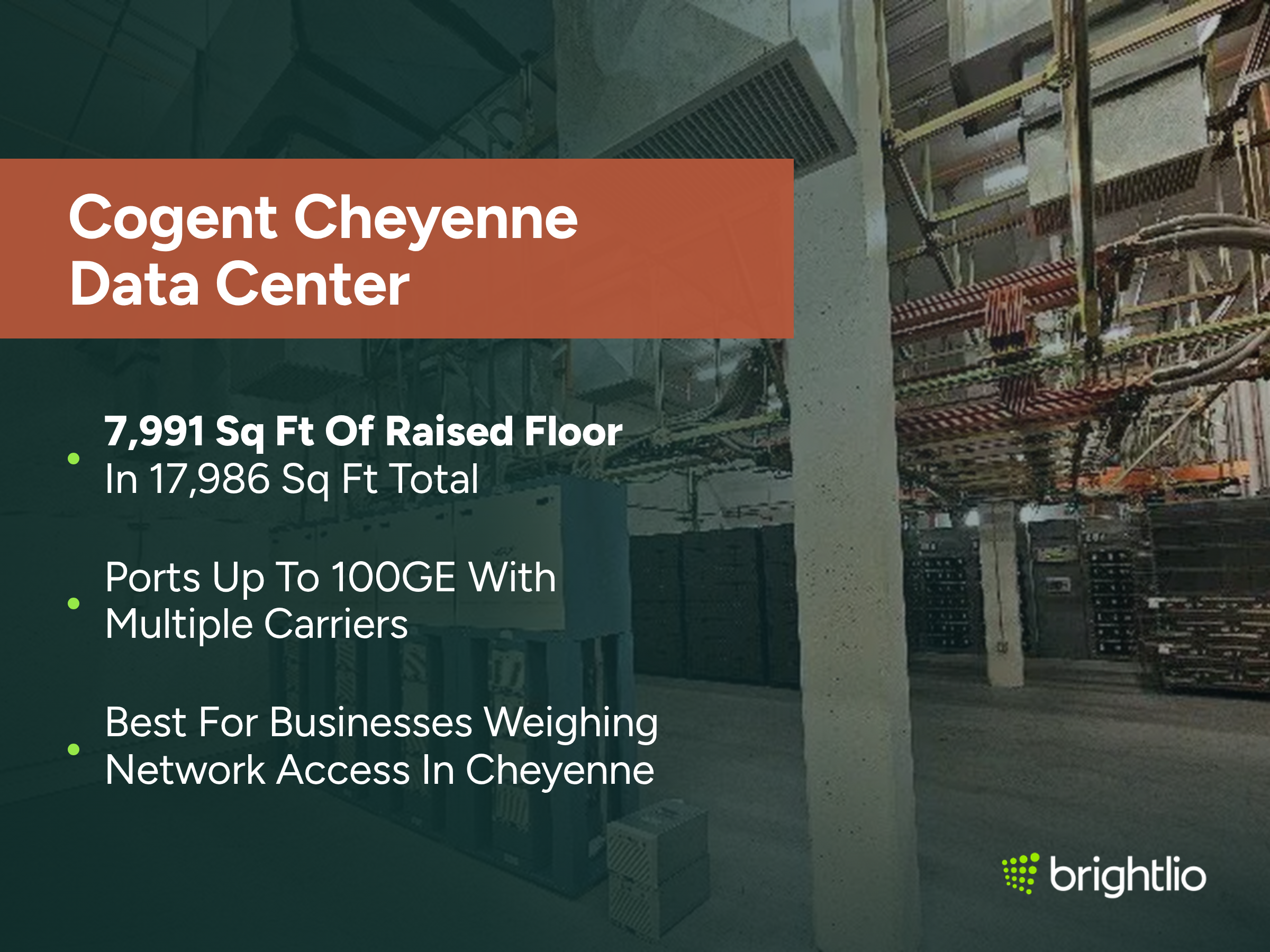
Location: 114 West 10th Street, Cheyenne. Operator: Cogent Communications.
Cogent’s facility brochure lists 17,986 square feet of space. It divides this into 7,991 square feet of raised floor and 9,995 square feet of non-raised space. This differs from the tracker’s 32,860-square-foot figure.
The brochure identifies ports up to 100GE, meaning 100 Gigabit Ethernet. It lists several available carriers and describes backup power equipment. The tracker’s 2.49 MW figure needs operator confirmation before it is treated as available IT capacity.
This is a commercial option for businesses evaluating network access and colocation in Cheyenne. Confirm the carriers available to the proposed cabinet and any connection charges. Request the bandwidth allocation separately from the port’s maximum speed.
Review the electrical design for the actual deployment. Generator nameplate ratings and building-level specifications should be kept separate from the power allocation reserved for a customer.
Microsoft Cheyenne Campus
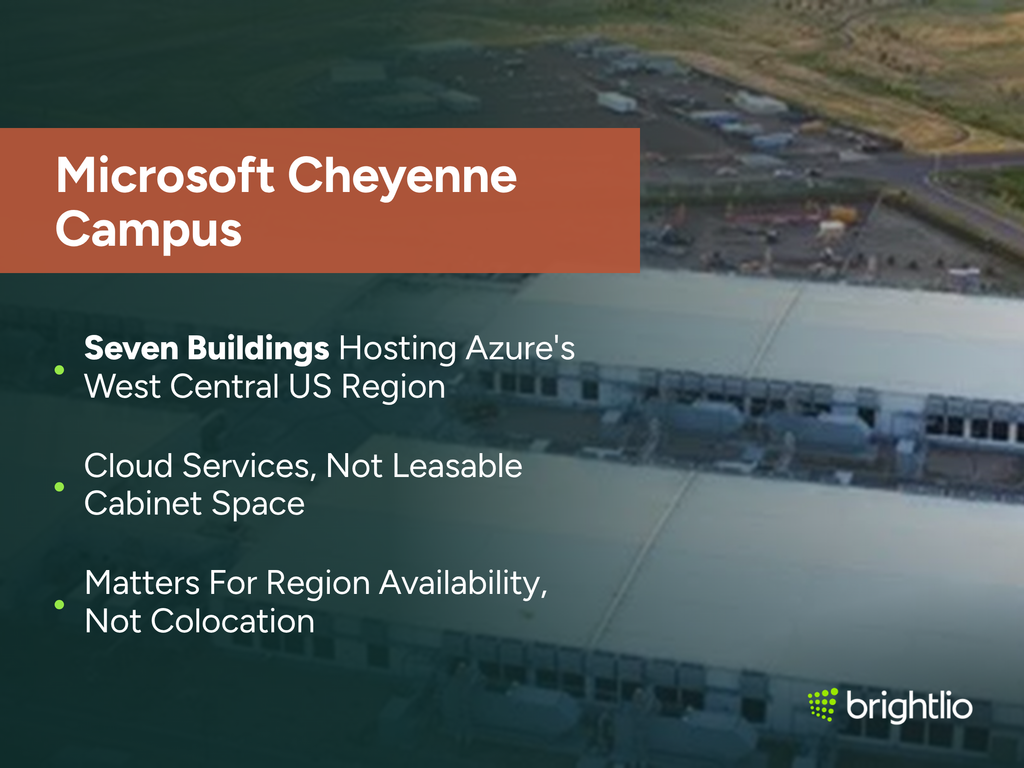
Location: 644 Logistics Drive, Cheyenne, according to the market snapshot. Operator: Microsoft.
Microsoft’s Cheyenne infrastructure supports Azure’s West Central US region, a geographic grouping of cloud infrastructure. The snapshot combines seven building listings under the established campus. It provides no firm campus MW figure.
Microsoft identifies Wyoming as the location of West Central US. Businesses can consume available Azure services through Microsoft’s cloud platform. This differs from leasing a cabinet and installing customer-owned servers in a Microsoft campus.
For a deployment combining cloud services with customer-owned equipment, confirm that the required Azure services are available in the selected region. Ask the colocation provider for the proposed private connection or internet path to those services.
Test application behavior over the proposed connection. Evaluate any dependencies shared by the local colocation facility and cloud services when designing recovery.
Microsoft Bison Business Park
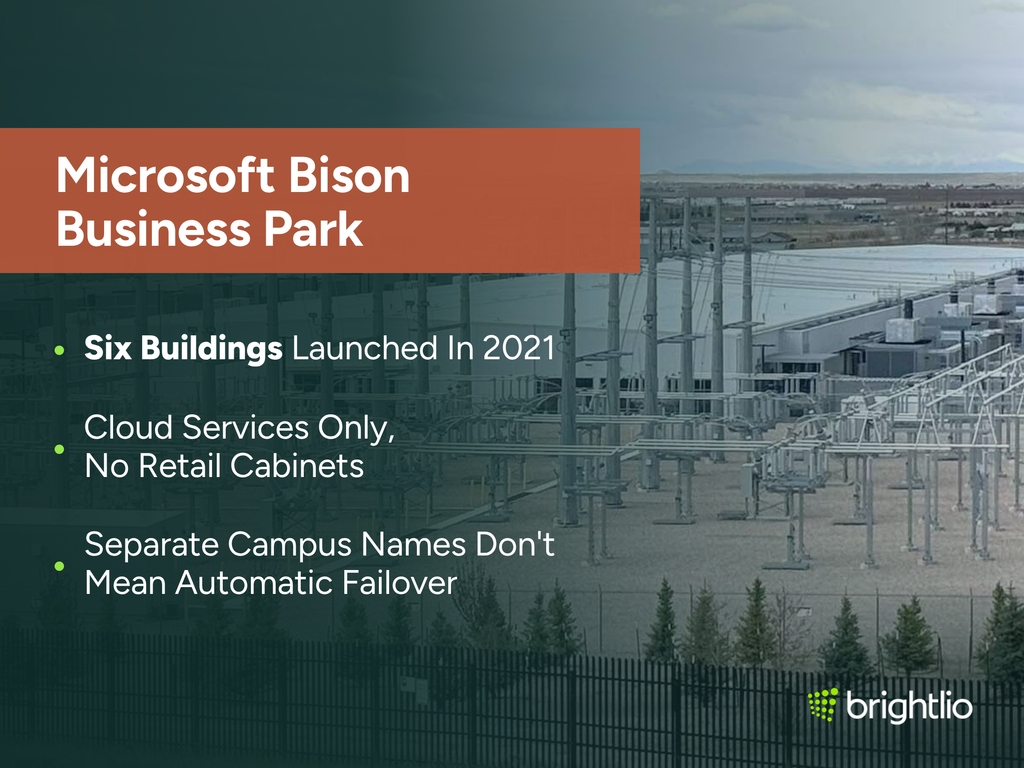
Location: Loving Trail and Wapiti Trail, Cheyenne, according to the market snapshot. Operator: Microsoft.
Microsoft confirmed the launch of its Bison Business Park facility in 2021. The snapshot groups six building listings at this campus. A firm campus capacity is not established in the sources used for this guide.
The campus contributes to Cheyenne’s cloud infrastructure footprint. Businesses access the supported services through Microsoft’s cloud offerings; the reviewed materials do not offer retail cabinets here.
Cloud customers need to use the resilience features available for their chosen service and region. Confirm the architecture against the workload’s recovery requirements instead of assuming separate campus names establish automatic failover.
For a local enterprise deployment, obtain a connection design and quote that identify the services and network path included.
Planned Projects And Recent Developments
Wyoming’s largest proposals focus on corporate computing and artificial intelligence (AI) infrastructure. The tracker’s 2,102 MW total combines the older 1,800 MW Tembo figure with Related Digital’s 302 MW campus plan. These numbers describe development scope, and newer power announcements use additional measurement bases.
Google Project Tembo
Project Tembo and Project Jade refer to successive versions of the same development south of Cheyenne. Laramie County’s July 2026 notice identifies the name change. They should be counted once when comparing campus inventories.
Black Hills announced definitive agreements for Google’s planned Cheyenne data center on October 6, 2026. The plan provides 2.7 GW of power resources including reserves, with energy service beginning in late 2027 and a ramp toward peak load in 2030. One gigawatt (GW) equals 1,000 MW.
The supply combines grid-connected service and third-party resources coordinated through a private microgrid. A microgrid manages a defined set of electrical resources and loads. Black Hills states that Google bears the costs of serving the project.
These figures describe the power supply plan. They do not establish 2.7 GW of leasable IT capacity. The older 10 GW expansion concept should remain outside an assessment of committed, customer-ready supply.
Related Digital Cheyenne
Related Digital broke ground in Cheyenne Business Parkway in October 2025. The developer describes a 115-acre campus with up to 302 MW of critical IT capacity. Its $1.2 billion announcement concerns the initial development phase.
The first building is planned at 184,000 square feet. CoreWeave is the anchor tenant under a long-term lease for 88 MW of critical IT capacity. The announcement targets completion in late 2026, which remains a target rather than evidence that the building is operating.
Related specifies air-cooled chillers and nominal water consumption primarily for domestic use. Buyers assessing water requirements should use this building’s design and service arrangements.
The anchor lease reserves a substantial part of the first development. Any offer to another customer needs a stated phase, power allocation, and delivery date.
Microsoft HR Ranch Road And Further Expansion
Microsoft identifies JE Dunn as the general contractor for its HR Ranch Road project. Its construction update contains an 18–24-month duration and an early-2026 completion target.
Those time references do not provide a consistent current schedule. The reviewed update does not provide a clear commissioning confirmation.
Its current operating milestone needs direct confirmation. The older construction duration is historical guidance, not a fresh forecast of the remaining work.
Microsoft’s separate April 2026 land announcement signals additional long-term growth. The intended acquisition of approximately 3,200 acres comes with a multiyear planning process. This land plan requires its own project assessment before any operating capacity can be assigned to it.
For a market assessment, the land announcement adds evidence of long-term expansion intentions. It does not establish another commissioned campus or a quantified power allocation.
Meta Cheyenne Campus
The tracker places Meta’s campus at 1800 High Plains Road and retains it in the planned category. Meta’s original announcement describes a 715,000-square-foot campus designed to support its own platforms and AI workloads.
Meta’s September 2026 information sheet still describes the campus using future wording. A firm campus MW figure and an unambiguous commissioning date are not established in the primary materials reviewed for this guide.
The facility supports Meta’s own infrastructure program. Businesses seeking physical colocation need an offer from a commercial provider.
AEP Fuel Cell Generation For Google
On October 14, 2026, AEP announced a 702 MW fuel cell generation project near Cheyenne. The planned investment is approximately $4 billion, supported by a 20-year power purchase agreement with Google.
AEP targets full operation by the end of 2028. The announcement follows Google’s agreements with Black Hills. Fuel cells generate electricity through an electrochemical process, and this project uses natural gas as its fuel source.
The 702 MW figure measures generation capacity. It should not be added to the tracker’s data center pipeline as a separate computing campus. Evaluating the energy plan requires attention to how the resources support the same underlying customer demand.
Colocation Options In Wyoming
MWTN is the single facility listed in the tracker’s separate colocation category. Lunavi and Cogent provide colocation within the operating section. Wyoming’s commercial options therefore extend beyond that one category label.
MWTN Cheyenne
The tracker lists MWTN at 6101 Yellowstone Road, Cheyenne. It describes suites, cages, cabinets, and cloud servers without assigning a capacity figure.
Mountain West Technologies’ current data center website focuses on Data Center of the Rockies in Casper. Confirm the current Cheyenne service location and product before including it in a procurement shortlist. The Casper specifications describe a separate facility.
Ask for the electrical allocation and supported equipment configuration. Establish whether the offer concerns physical colocation, hosted servers, or another service. The distinction affects equipment ownership and the responsibilities retained by your team.
Mountain West Technologies In Casper
The operator markets a 100-rack capacity at its Casper data center. Its website offers shared rack space and larger cabinet products. This is a separate commercial option that the supplied Cheyenne-focused list does not describe.
For Casper, obtain an address-specific proposal covering available space and power. Compare the network path and technical support with the requirements of the application.
Drawbacks Of Colocating In Wyoming
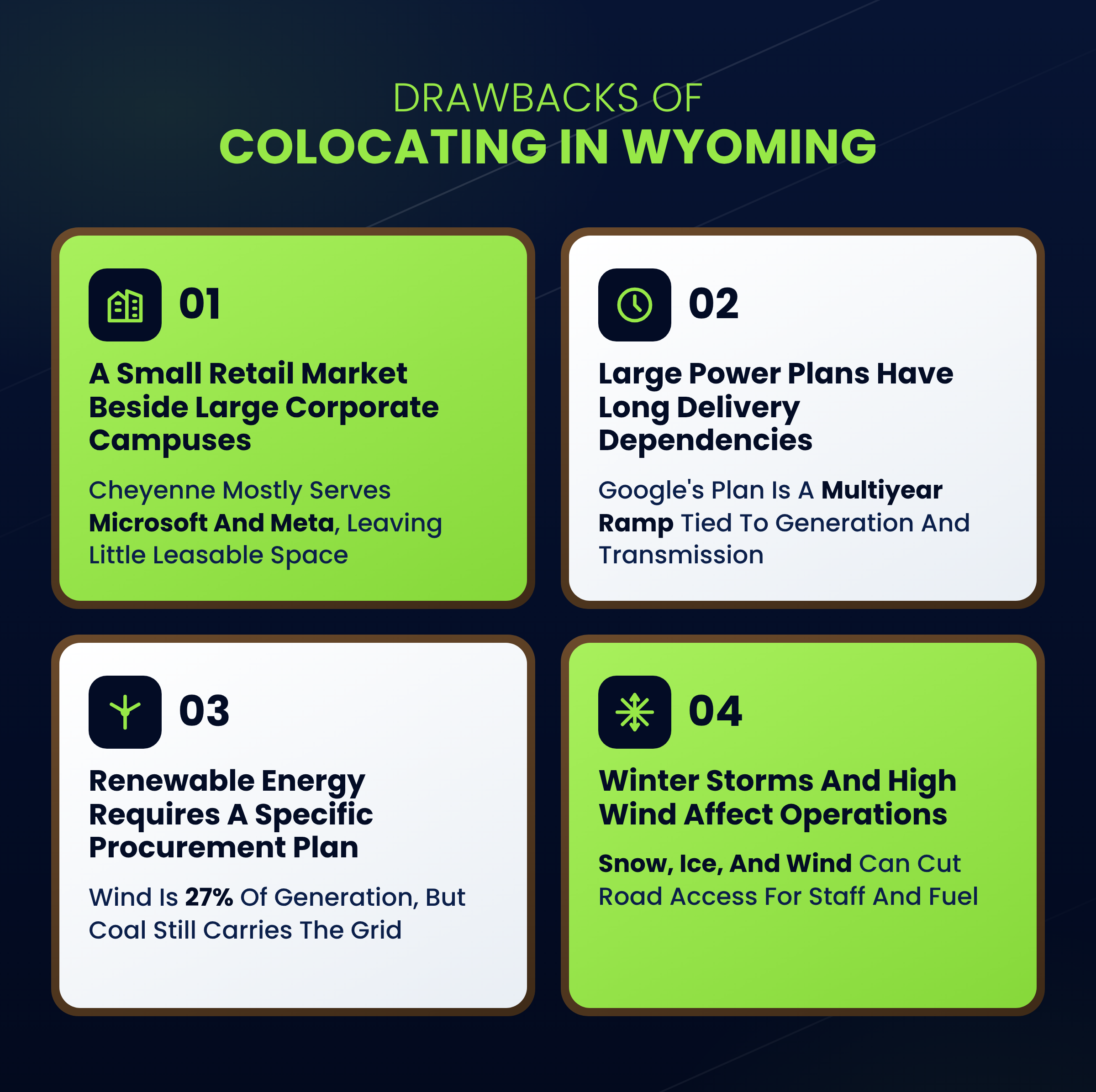
Wyoming’s main limitations concern commercial choice, utility delivery, energy sourcing, and weather. The operating campus count alone can obscure these issues. Buyers need evidence for the specific building and service they intend to use.
A Small Retail Market Beside Large Corporate Campuses
Much of Cheyenne’s computing footprint serves Microsoft, Meta, or specialized workloads. A large development pipeline can therefore coexist with limited immediately leasable commercial space.
Lunavi and Cogent give enterprise buyers concrete starting points. MWTN’s Cheyenne listing needs current location confirmation. Buyers seeking multiple large competing proposals should compare another regional market alongside Wyoming.
A smaller provider pool can limit the options for expansion or specialized cooling. Obtain a phased growth plan where those needs matter. Confirm whether additional power would require a move or new construction.
Large Power Plans Have Long Delivery Dependencies
The Google energy plan involves a multiyear ramp. Related Digital’s first building has a major anchor commitment. A customer’s installation schedule therefore needs a specific delivery commitment.
A future building may depend on generation, transmission, and other utility work. Permitting and equipment delivery can affect the schedule. Confirm which milestones are complete and which remain conditions of the offer.
The special power tariff is relevant to qualifying large loads. An ordinary colocation customer buys the provider’s service under a separate contract. Establish the recurring charges and any interruption provisions that reach the customer’s deployment.
Renewable Energy Requires A Specific Procurement Plan
Coal remains important to Wyoming’s electricity system. EIA’s newer state profile puts wind at 27% of in-state generation in 2025, above the tracker’s older 23% figure. Neither percentage establishes the electricity product purchased by a particular facility.
The Google energy announcements include natural gas generation. A low-water design or an efficient cooling system answers a different question from the source of electricity. Businesses with emissions commitments need information about both.
Ask how the provider allocates renewable energy attributes to customers. Establish the reporting period and whether backup generation is included. Compare the evidence with the environmental claims your organization must make.
Winter Storms And High Wind Affect Operations
Wyoming’s climate creates operating challenges alongside cooling benefits. Snow, ice, and high wind can disrupt roads and delay staff or equipment deliveries. A working equipment room can still depend on people and supplies reaching the site.
Review the facility’s winter staffing and snow-removal arrangements. Ask how fuel replenishment works when road access is restricted. Evaluate wind exposure for outdoor electrical and cooling equipment.
For disaster recovery, assess the primary and recovery sites together. Physical separation helps when the sites avoid the same likely failures. Check shared network routes and the operational resources needed during a regional event.
How Brightlio Helps You Compare Wyoming Providers
Brightlio helps businesses compare colocation providers against their power, connectivity, and support needs. Wyoming’s mixture of commercial facilities and corporate campuses makes a precise shortlist especially useful.
Start with the equipment load and the power needed per rack. Identify the required network endpoints and the technical work your team expects the provider to perform. Include the installation deadline and any planned growth.
Brightlio can help compare proposals on the same requirements. Review installation charges alongside recurring costs. Confirm that the offered service supports the workload before choosing a provider based on the state’s electricity average.
Explore Brightlio’s colocation services to build a Wyoming shortlist and compare suitable regional alternatives.
Frequently Asked Questions
How Many Data Centers Are In Wyoming?
The October 10, 2026 snapshot contains 11 campus or facility entries. It groups six as operational, four as planned, and one separately as colocation. Lunavi and Cogent provide colocation services despite appearing in the operational group.
Data Center Map lists 31 entries across four markets. It includes individual building listings that the campus inventory combines. Cheyenne accounts for most of those listings.
A building directory helps identify locations, while a campus inventory reduces duplicate project counting. Neither establishes available power or current vacancy.
For a purchasing shortlist, count facilities that offer the required service and delivery date. Check each property’s current status and the terms under which it can accept equipment. This produces a more useful comparison than a statewide total that combines corporate campuses, commercial facilities, and future proposals.
How Much Does Wyoming Colocation Cost?
There is no single statewide colocation price. EIA’s July 2026 commercial electricity average of 10.26¢/kWh is a utility benchmark. It does not price the complete service a data center provider sells.
A continuous 5 kW IT load uses 3,650 kWh in a 730-hour month. At that benchmark, the electricity alone is about $374. The example excludes cooling, backup infrastructure, physical space, network services, and provider charges.
Compare quotes using the same reserved power and network requirements. Check whether billing is based on a committed allocation or measured consumption.
Review installation fees and annual price changes. Brightlio’s colocation pricing guide explains the main cost components. A low energy average can support a competitive offer, but the decision should use the total contract cost for the actual deployment.
Can Businesses Lease Space In Microsoft Or Meta Data Centers?
The campuses described here support the operators’ own infrastructure. Microsoft provides Azure services from its West Central US region in Wyoming.
Meta builds infrastructure for its platforms and AI workloads. These campuses are not presented as retail cabinet offerings in the reviewed materials.
A cloud purchase provides access to computing services. Colocation provides space and supporting infrastructure for customer-owned equipment. When ownership and physical access are requirements, focus on commercial providers offering that service.
Lunavi and Cogent are relevant starting points in Cheyenne. Confirm the precise service model in every proposal.
The provider may offer colocation, hosted computing, or another managed service, each with different responsibilities. A nearby corporate campus does not establish direct cloud connectivity from every commercial building. Request the connection design for the chosen application.
Are Project Tembo And Project Jade Two Different Campuses?
They are names used for successive versions of the same development south of Cheyenne. Laramie County’s July 2026 public notice identifies the change from Project Jade to Project Tembo. Counting both names would overstate the project inventory.
The tracker’s 1,800 MW figure describes an earlier campus scope. Black Hills’ October agreement describes 2.7 GW of supply resources including reserve margins for Google. These numbers have different measurement bases.
Generation capacity, electricity service, and IT load measure different things. Reserves support reliability, so a resource portfolio can be larger than the computing load it serves.
Keep the two project names together in a market inventory. For a proposed purchase, request the current building scope and delivery schedule. Establish whether the campus offers the commercial service being sought before including its power figure in a supply comparison.
Does Wyoming Offer Enough Capacity For AI Workloads?
Wyoming has major AI infrastructure developments, but their capacity does not establish an immediately available colocation product. Related Digital’s first Cheyenne building has an 88 MW anchor commitment from CoreWeave. Other major campuses support their operators’ own platforms.
For customer-owned AI hardware, the relevant limit is the supported configuration in the offered room. Lunavi’s standard cabinet information specifies up to 10 kW per cabinet. More demanding equipment requires a specific engineering review.
Provide the server models and expected sustained load. Confirm whether the deployment requires liquid cooling and who operates that cooling equipment.
Ask about equipment delivery, maintenance access, and the date permanent power becomes available. Treat a campus expansion plan separately from capacity reserved for your installation. The best proposal identifies the infrastructure supporting the actual hardware and states when it will be ready.
Who Qualifies For Wyoming’s Data Center Tax Exemption?
The entry equipment tier combines $5 million of infrastructure investment with qualifying annual equipment purchases above $2 million. A higher infrastructure tier covers specified support equipment. The state’s certification process includes job creation appropriate to the project.
A tenant should not assume every purchase becomes exempt because a facility describes itself as qualifying. The purchaser and transaction need to satisfy the applicable requirements. Colocation aggregation provisions can be relevant where multiple entities occupy a facility.
Before including savings in a budget, establish who holds the certification and which purchases it covers. Confirm the treatment of customer-owned equipment with the responsible tax adviser and state agencies.
Electricity is outside the equipment exemption. Keep the equipment purchase calculation separate from the provider’s recurring service charges so the same saving is not counted twice.
Can Wyoming Data Centers Use Renewable Energy?
Yes, renewable procurement can form part of a facility’s energy arrangements. EIA identifies wind as 27% of Wyoming’s in-state generation in 2025. That statewide figure does not measure a particular customer’s contracted energy attributes.
Wyoming’s electricity system still includes substantial coal generation. The newer Google power plans include natural gas resources. Buyers with emissions targets need to assess the proposed provider’s arrangements rather than infer a result from the state’s wind share.
Ask which renewable attributes are assigned to the customer and how double counting is prevented. Confirm whether the claim covers an annual total or a more granular matching period.
Review the treatment of backup generation and any on-site energy supply. Cooling efficiency can reduce electricity consumption, while renewable procurement addresses the source or attributes of that consumption. A procurement review needs evidence for both questions.
Is Cheyenne A Good Disaster Recovery Location?
Cheyenne can be evaluated for disaster recovery when it reduces the failures shared with the primary site. Its inland location avoids coastal storm surge. Winter weather and high wind remain part of the operating assessment.
Begin with the systems the business must restore and the time available to restore them. Then assess utility service, network routes, and the support needed at the recovery facility. Two locations can remain dependent on the same carrier route or service team.
Ask how staff reach the site during road restrictions. Review generator fuel replenishment and the recovery procedure for equipment failures.
Run a practical recovery exercise using the proposed network design. A location’s general hazard profile is useful context, but successful recovery depends on the application design and the resources available during the incident.
Does Free Cooling Mean Wyoming Data Centers Use No Water?
Free cooling describes how favorable outdoor conditions help remove heat. It does not establish a facility’s total water consumption. Different designs can use outside air, indirect cooling, evaporative systems, or air-cooled chillers.
Lunavi identifies indirect evaporative cooling in Cheyenne. Related Digital describes air-cooled chillers and nominal water consumption primarily for domestic use at its planned campus. These are different systems with different water requirements.
Ask for the cooling method used in the proposed building. Review the conditions under which mechanical refrigeration or water is required.
For a development, establish water-service and wastewater arrangements before relying on a commissioning date. Closed-loop equipment recirculates a working fluid, but the term alone does not establish zero water use across the property. Use measured facility data where available and keep routine operation separate from construction and maintenance requirements.
Should I Compare Cheyenne With Denver Or Salt Lake City?
Yes, when your application can operate from more than one regional market. Compare actual provider proposals using the same equipment load and service requirements. A state electricity average alone cannot settle the choice.
Cheyenne’s market includes established commercial sites alongside large corporate campuses. Another city may offer a different mix of providers or network connections. Confirm those options through current proposals rather than assuming every directory listing has available space.
Measure application performance to the offices, users, and cloud endpoints that matter. Include technician travel and remote support in the operating cost.
For disaster recovery, compare shared failure dependencies as well as distance. The preferred market is the one that meets the installation deadline and operating requirements at an acceptable total cost. Where growth is expected, obtain a credible plan for the next deployment phase.

Tamzid is a cybersecurity researcher with 5+ years of experience across SaaS, security, compliance, data centers and cloud. He writes for brightdefense.com and hipaasimple.com, covering security, compliance, and infrastructure topics. Certified through Cisco, Fortinet (NSE 1), and the Basel Institute on Governance in OSINT, he grounds his work in primary sources and verified data.
Recent Posts

Data Centers and Colocation In Wyoming

Most Secure Data Centers in the World

Data Centers in Space and the Future of Computing

Nuclear Powered Data Centers
Let's start
a new project together