
Table of Contents
Southern California Colocation: Top Facilities & Pricing
Southern California colocation represents a strategic choice for businesses looking to bolster their digital infrastructure. Positioned uniquely for geographical advantages and technological superiority, Southern California offers an optimal blend of connectivity, innovation, and stability. From the vibrant tech ecosystems in Irvine and San Diego to the media-centric hubs of Los Angeles and Burbank, Southern California colocation provides unparalleled opportunities to leverage advanced data center services.
This article explores why this region is a top choice for businesses seeking to enhance their technological reach. Let’s get started!

Southern California Data Center Infrastructure Overview
- Number of Data Centers: Southern California hosts 70 data centers in Los Angeles and 10 in San Diego, totaling 80 facilities. (Data Center Map)
- Average Temperature: Annual temperatures in Los Angeles typically range from 48°F to 84°F. (Weather Spark)
- Internet Speed (Average & Maximum):
- Average Speed: Approximately 334 Mbps.
- Maximum Speed: Up to 10,000 Mbps (10 Gbps) available through select fiber providers. (Data Center Map)
- Energy Cost per kWh: As of May 2025, California’s average commercial electricity rate is 23.13¢ per kWh. (Electric Choice)
Geographic and Connectivity Advantages
Southern California is a digital traffic gateway between the Americas and Asia. It’s home to key submarine cable systems like SEA-US and JUPITER. These directly connect the Los Angeles area to Southeast Asia and the Pacific and to Japan and the Philippines. These high-capacity routes are important for international business operations, adding route diversity and reliability across the Pacific. This benefits businesses involved in content delivery and other latency-sensitive operations.
Additionally, Los Angeles offers direct connectivity to Latin American markets. One notable example is the Curie undersea cable, a 10,500-kilometer system delivering 72 Tbps between the United States and Chile. The cable terminates in Valparaíso and in Southern California at Equinix LA4. This connection supports business operations with South America and adds route diversity and resiliency for data transmission.
Southern California’s connectivity benefits include international and local network access. Operators and public agencies continue to expand the region’s infrastructure to support rising demand for data services. This is reflected in California’s $3.25 billion open-access middle-mile network initiative, with nearly 4,430 miles moved into installation as of December 2025. The state also reported active hut construction at five Southern California sites and earlier node installation at the CoreSite data center in Los Angeles, helping businesses in Southern California remain at the forefront of digital connectivity and innovation.
Proximity to Economic and Innovation Hubs
Southern California’s colocation services benefit significantly from their proximity to major economic and innovation hubs like Los Angeles, Irvine, and San Diego. In 2024, Los Angeles County ($1.00 trillion), Orange County ($351.8 billion), and San Diego County ($331.9 billion) together generated about $1.69 trillion in gross domestic product. This scale gives businesses direct access to large markets, technology sectors, and a deep talent base.
The proximity to these hubs also supports faster access to IT, communications, and workforce resources. Companies benefit from immediate access to major university and research ecosystems, including UCLA, which receives more than $1.6 billion each year in competitively awarded grants and contracts, UC San Diego, which reported $1.73 billion in research awards for FY24, and UC Irvine, which received a record $668 million in research funding in fiscal 2023-24. These institutions help sustain the collaborative atmosphere that drives innovation across the region.
Moreover, the area’s status as a global city opens doors to international business opportunities. This is especially true for digital media, entertainment, and technology companies. Los Angeles County describes itself as the global hub for film and television production, with the highest concentration of studios and creative talent in the country, while Irvine’s 2024 Innovation Economy Report highlights healthcare innovation, medical technologies, and enabling and creative technologies, and San Diego’s regional EDC points to more than 3,100 software establishments, more than 100 research institutions, and nearly 1,000 cyber firms supporting nearly 26,000 impacted jobs. Colocation in Southern California allows businesses to operate close to these industry ecosystems, while advanced IT infrastructure built for high-speed data transmission and cloud services supports that engagement.

Advanced Technological Infrastructure
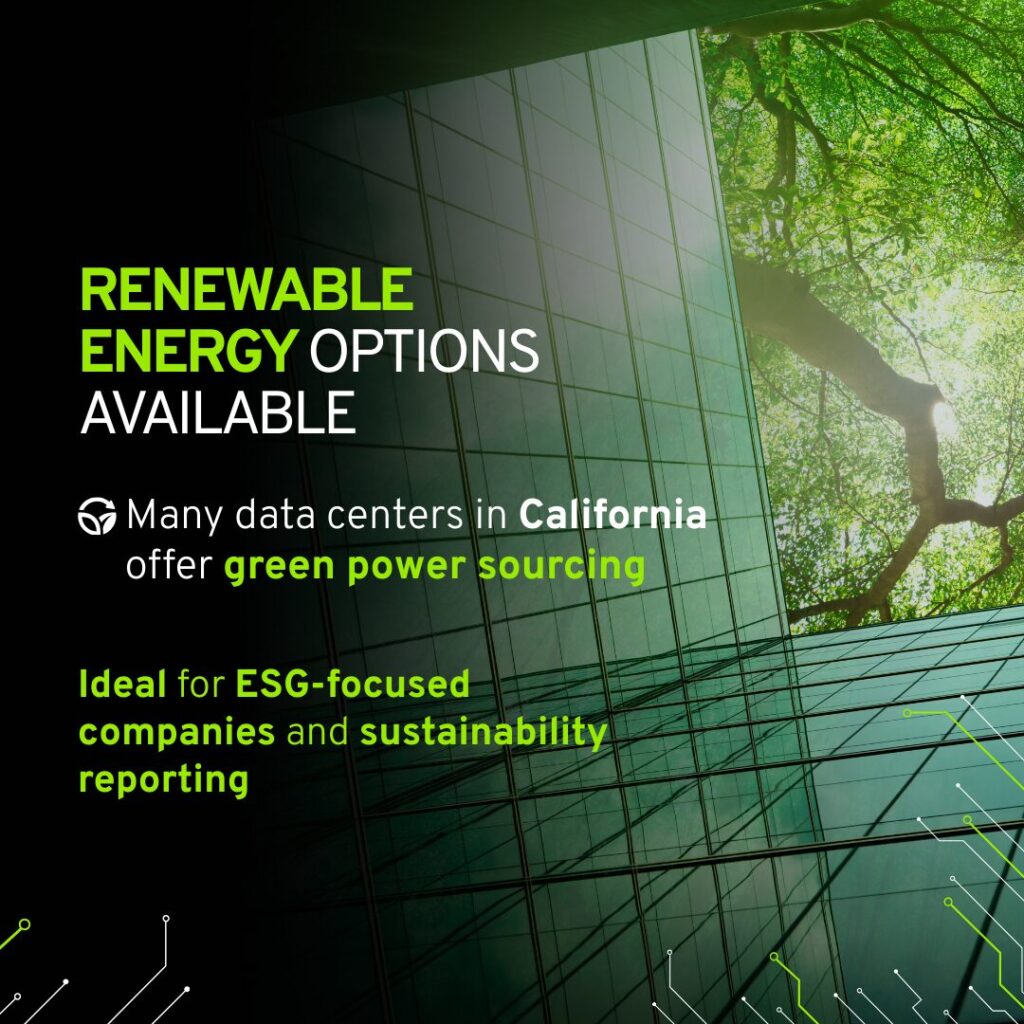
Southern California's colocation facilities benefit from an advanced technological infrastructure that supports high-density power configurations, extensive cooling capabilities, and top-tier security measures. This infrastructure is a cornerstone for businesses requiring robust IT environments, especially those in high-tech industries such as digital media, aerospace, and biotechnology. For instance, Equinix's El Segundo facilities, LA3 and LA4, each reported 100% renewable coverage in 2024 and ISO 50001 certification, reflecting California's clean-energy target of 100% retail electricity from renewable and zero-carbon resources by 2045. This supports green business practices while serving demanding workloads.
Additionally, the region's data centers are equipped for dense interconnection and can tap dark fiber and wavelength services. This supports low-latency and high-capacity communications essential for cloud services, content delivery networks, and global financial transactions.
The proximity to major internet exchange points and connectivity providers in Los Angeles strengthens these capabilities, offering businesses direct and speedy access to global telecommunications networks and leading cloud service providers. CoreSite says its Los Angeles market provides access to 335+ networks, including global carriers and subsea cables, while its LA1 site at One Wilshire connects to Any2Exchange and all major public cloud providers.
Southern California also prioritizes the resilience of its technological infrastructure. Builders often construct facilities to withstand natural disasters like earthquakes, which are crucial in seismically active regions. They achieve this resilience using architectural designs and building materials that comply with California's Title 24 building standards and seismic building code provisions intended to limit earthquake risk.

Why Should Companies Colocate in Southern California?
Southern California combines competitive pricing, direct transpacific connectivity, and strong infrastructure density across one of the largest U.S. data center markets.
These factors create specific advantages for companies evaluating West Coast colocation options:
1. Lower Colocation Cost Than Silicon Valley
Colocation pricing in the Los Angeles market typically undercuts Silicon Valley while still delivering similar West Coast proximity and connectivity advantages. CBRE market data for deployments between 250 kW and 500 kW shows asking rates of about $180 to $250 per kW per month.
Silicon Valley reaches higher ceilings near $275 per kW per month. Northern Virginia averages around $190 to $235 per kW per month. The upper pricing difference between Silicon Valley and Los Angeles can reach about $25 per kW per month. A 1 MW deployment priced at that gap represents roughly $300,000 in annual cost differences.
For companies needing California proximity without paying the highest West Coast pricing tier, the region often provides a more balanced cost structure.
2. Direct Access to Asia-Pacific Networks Improves International Connectivity
Direct access to major transpacific network routes makes Los Angeles one of the most strategic colocation locations for organizations serving Asia-Pacific users.
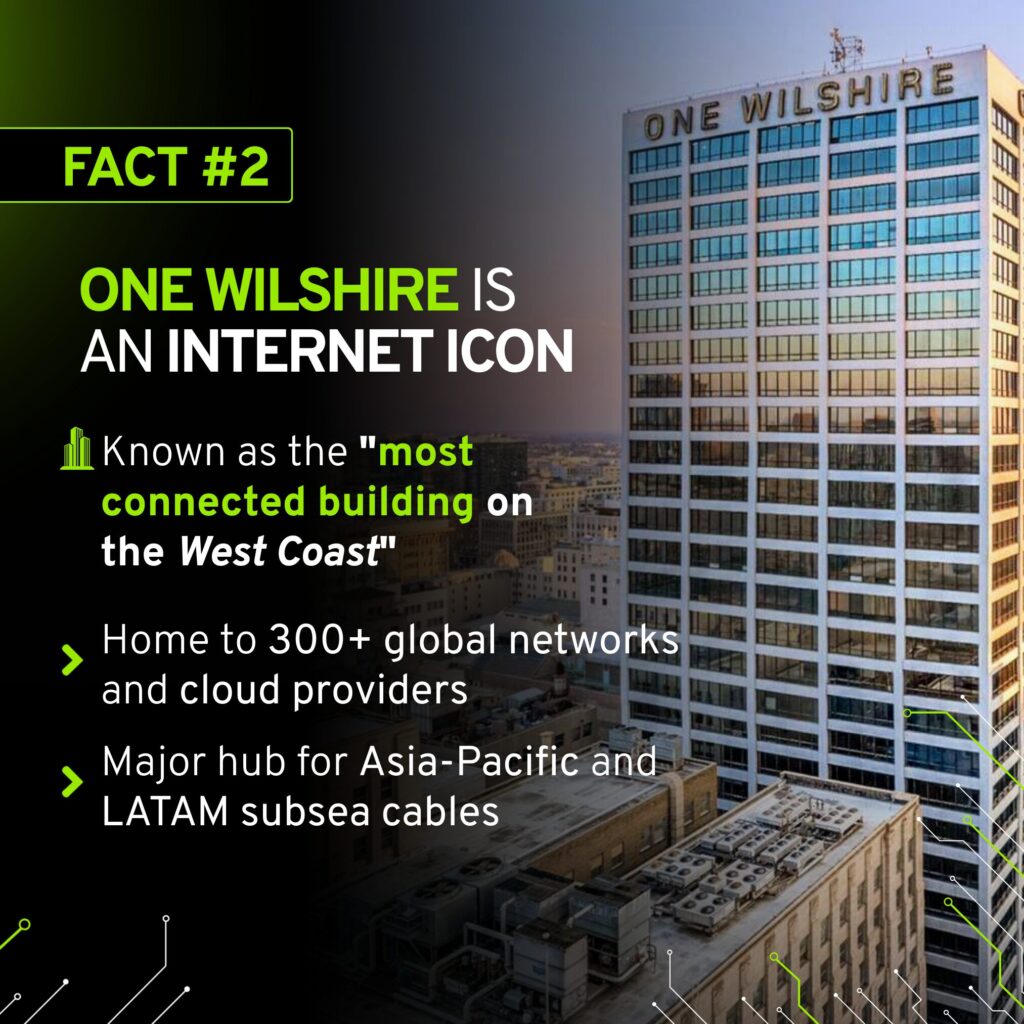
Facilities such as One Wilshire connect to more than 300 carriers and include five major fiber entry points tied to global submarine cable systems.
CoreSite reports that the Any2 Internet Exchange includes 400+ networks, with over 250 connected in California, creating the largest internet exchange on the West Coast.
Network measurements illustrate the performance impact. Microsoft Azure latency benchmarks show connections from California reaching Japan East at roughly 107 ms round-trip.
Comparable routes measure about 113 ms from Arizona, 129 ms from Texas, and around 164 ms from East Coast regions. Lower latency directly improves application responsiveness, data replication, and user experience for companies delivering services across the Pacific.
3. Close Proximity to the Largest West Coast Customer Base
Colocation infrastructure located in the Los Angeles region sits near the largest concentration of users and enterprises on the U.S. West Coast. California’s population reached about 39,355,309 residents, compared with roughly 7,623,818 residents in Arizona and 8,880,107 residents in Virginia.
The difference becomes even more significant when measured through economic activity. California hosts about 1,029,689 employer establishments and around 16,405,436 jobs. Arizona supports roughly 162,845 establishments and 2,890,429 jobs, while Virginia records about 210,842 establishments and 3,581,650 jobs.
Infrastructure positioned within this economic center reduces reliance on long-distance transport networks when delivering services to California users and businesses.
4. Growing Data Center Capacity Provides Expansion Opportunities
Strong demand combined with a visible construction pipeline gives the Los Angeles colocation market meaningful long-term growth potential. CBRE reported that available capacity dropped to approximately 5 MW during the second half of 2024 while annual net absorption reached about 22.7 MW.
New developments are expanding supply. Goodman’s Vernon LAX01 project includes around 49.5 MW of shell power and roughly 32 MW of critical IT capacity. Limited vacancy in competing markets highlights the significance of this expansion.
Northern Virginia, the largest U.S. data center hub, reported only about 0.72% vacancy. Buyers planning multi-megawatt deployments often prioritize regions where additional capacity will remain available within the same metropolitan market.
5. Cleaner Electricity Supply Compared with the U.S. Average
Electricity procurement in California can deliver a significantly lower carbon intensity compared with the broader U.S. utility baseline. Southern California Edison reports that about 49% of its electricity supply is carbon-free.
The utility’s power content label shows approximately 258 pounds of CO2e per MWh for certain green energy offerings. California’s statewide utility average sits around 359 pounds of CO2e per MWh. The broader U.S. utility average is approximately 775 pounds of CO2e per MWh. That difference places regional electricity emissions at roughly one-third of the national utility baseline.
Lower carbon intensity matters for colocation buyers because many enterprises track Scope 2 emissions as part of regulatory reporting, sustainability commitments, and procurement standards.
Key Regions in Southern California for Data Centers
California ranks as the third-largest U.S. state by area, covering approximately 163,696 square miles. That total surpasses the entire United Kingdom's landmass of roughly 94,000 square miles. The state's concentration of technology companies, cloud providers, and digital infrastructure investment has made it one of the country's leading colocation markets.
Here are the key regions across California that support major data center operations:
Downtown Los Angeles
Downtown Los Angeles (DTLA) is a core region for data centers due to its dense network infrastructure and connectivity. It is home to One Wilshire, one of the most interconnected buildings in the world and the site of CoreSite's LA1 facility. One Wilshire hosts more than 300 networks, and CoreSite says the building is the termination point for multiple subsea cables that create connectivity from the West Coast to the Asia-Pacific region. This concentration of interconnection makes DTLA an ideal location for businesses that require global digital communication and high-speed data transfer.
Burbank
Burbank remains renowned for its proximity to major media and entertainment companies, including several Hollywood studios. The city still describes itself as the “Media Capital of the World” and lists Warner Bros. Entertainment, The Walt Disney Company, Nickelodeon Animation Studios, Netflix Animation, and Cartoon Network Studios among its major employers. This proximity keeps it a strategic location for media-related businesses that need high bandwidth and low latency for digital content creation and distribution. Burbank’s data center footprint reflects that market profile. Digital Realty’s BUR10 facility, located in Burbank, is positioned for the local media and entertainment market and offers cloud and connectivity options alongside world-class security and reliability.
El Segundo
El Segundo benefits from its proximity to nearby subsea landing infrastructure in Hermosa Beach, where the Hermosa Beach Cable Landing Station was designed to land multiple cables and offer colocation space. It is also closely tied to Los Angeles interconnection infrastructure, with the JUPITER cable system’s terminal equipment installed at CoreSite LA2. El Segundo remains a significant hub for aerospace and defense industries. The city says it is home to Los Angeles Air Force Base, Space Systems Command at 483 N. Aviation Blvd, and major employers including Boeing and Raytheon. The area’s data centers also continue to show strong cooling, compliance, and sustainability capabilities. Equinix says its El Segundo facilities, LA3 and LA4, are optimized for low-latency workloads, each provide N+1 cooling redundancy, and recorded 100% renewable coverage in 2024, with ISO 27001, PCI DSS, SOC 1 Type II, and SOC 2 Type II among the listed certifications.
Irvine
Irvine is a tech hub with a growing business ecosystem that supports innovation and startup activity. The City of Irvine’s 2024 Irvine Innovation Economy Report identifies healthcare innovation, medical technologies, and enabling and creative technologies as key drivers of the city’s innovation economy, and the city’s 2026-2028 economic development blueprint puts added focus on venture capital, workforce development, and national and global competitiveness. Irvine’s data centers continue to offer robust infrastructure with a focus on scalability and security for growing companies. DataBank’s two Irvine facilities provide a combined 89,870 raised square feet and 10.64MW of critical IT load, with 12 onsite carriers at SNA1 and 14 onsite carriers at SNA2, plus N+1 power redundancy and compliance with SSAE 18, HIPAA/HITECH, PCI, and ISO 27001.akes it an attractive site for data center operations.
San Diego
The San Diego market remains a key player in cross-border connectivity and life sciences. Its location near the border with Mexico continues to create direct opportunities for businesses that need to connect North American and Latin American markets. San Diego Regional EDC describes the region as a top three U.S. life sciences cluster, notes its proximity to Tijuana’s medical device manufacturing hub, and highlights a deep innovation base that includes nearly 1,000 cyber firms and nearly 26,000 total impacted jobs. UC San Diego also reported $1.73 billion in FY24 research awards. San Diego’s data centers are built for demanding enterprise and research workloads. DataBank’s SAN1 facility lists 55,239 raised square feet, 7.2MW of critical IT load, 13 onsite carriers, 2N power, N+1 cooling, and 40kW+ cab density air, while MDC says its San Diego campus supports Tier-1 networks, leading CDNs on the border, and the largest concentration of Mexican carriers in the U.S..

Data Center Dynamics: Comparing Northern and Southern California
Southern California and Northern California have unique advantages for data centers. Northern cities like San Francisco, Oakland, and San Jose anchor a vibrant tech hub. The 2025 Silicon Valley Index reports $69 billion in venture capital, and current global rankings place San Francisco-San Jose at No. 1 among innovation hubs.
With its tech density and innovation, this region continues to attract data center providers. Its market remains competitive, with providers emphasizing interconnection and low-latency performance. In San Jose, for example, CoreSite says its SV1 facility connects to more than 65 networks, while Equinix says its Silicon Valley platform offers less than 10 ms latency.
Southern California, featuring Los Angeles and San Diego, offers a diverse market. Data centers here continue to highlight connections to Asia and Latin America. At One Wilshire in Los Angeles, multiple subsea cables create connectivity from the West Coast to the Asia-Pacific region, while Google’s Curie system connects the United States and Chile with 72 Tbps of capacity.
The providers support a range of industries, including entertainment, biotech, aerospace, and defense. Los Angeles County says it remains the global hub for film and television production, and San Diego Regional EDC says the region continues to rank among the top three life sciences markets in the world. The region’s commitment to renewable energy also continues to influence data center operations, with California maintaining a 100% clean-energy goal for 2045 and reporting 67% clean electricity in 2023.
Final Thoughts
Southern California is a prime location for data center colocation, offering a blend of strategic geographic positioning, advanced technological infrastructure, and a dynamic economic environment. The region's connectivity to global and local markets and state-of-the-art facilities make it an ideal choice for businesses aiming to improve operational efficiency. By choosing Southern California, companies place themselves in a region with direct gateways to Asia-Pacific and Latin America, within a state where 67% of retail electricity sales came from zero-carbon generation in 2023 and where the clean-electricity target rises to 100% by 2045.
Readers interested in data centers in Texas may also want to review these related regional analyses covering other high-capacity U.S. data center hubs.
Brightlio Delivers Southern California Data Center Solutions!
If you are looking for retail colocation services in Southern California, Brightlio can help. The company says it works with colocation partners in Southern California and nationwide to deliver solutions that fit different business requirements. Additionally, Brightlio publicly lists connectivity, cloud, unified communications, value-added resale, and advisory services as part of its offering, making it a strong fit for a broad range of technology needs. need.
Brightlio is committed to being your most trusted and responsive technology partner. Contact us today to get started!
FAQ
Colocation means placing an organization’s servers and related hardware in rented space inside a physical data center operated by a third party.
DataCenterMap lists 72 data centers in Los Angeles, California.
DataCenterMap lists 14 data centers in San Diego, California.
DataCenterMap lists 3 data centers in El Segundo and 4 data centers in Riverside.
Yes. One Wilshire is described as a highly interconnected telecom and data center site in the Western United States, with the building listing over 250 network service providers and a meet-me-room used for interconnection.
Pick the facility that matches your latency targets, the carriers you need inside that building, and how often someone must visit for installs and break-fix work, then validate with a short test circuit before long contract terms.
Colocation costs commonly include power fees, bandwidth charges, connectivity expenses, change fees, and support costs, and the mix varies across providers and contracts.
A cross-connect is an in-facility connection between your cabinet or cage and a carrier or partner, and it can add one-time and recurring charges plus lead times that affect go-live dates.
Remote hands is a service that lets you delegate on-site tasks to data center technicians, which matters when you cannot visit quickly for swaps, reboots, or cabling work.
Ask for written details on power delivery and redundancy, planned maintenance and testing practices, physical access rules, remote-hands pricing and response targets, cross-connect ordering steps, and the full fee schedule that applies after go-live.
Yes, DataCenterMap lists multiple Southern California markets with data centers, including Los Angeles (58), Irvine (15), San Diego (14), plus smaller nearby markets such as Riverside (4) and El Segundo (2).
DataCenterMap lists 58 data centers in the Los Angeles market.
Commonly cited major colocation providers include Equinix, Digital Realty, NTT Global Data Centers, CyrusOne, CoreSite, QTS Data Centers, KDDI/Telehouse, and Iron Mountain.

John Minnix is the Founder and CEO of Brightlio, with two decades of experience in data center, cloud, and network solutions. He previously built VPLS Solutions into a top Southern California technology partner before its acquisition by Evocative, where he served as President and COO overseeing global sales, operations, and strategic acquisitions.
Recent Posts

Data Centers in Kentucky and Colocation Opportunities

Data Centers In Alabama: Why You Must Colocate

10 Largest Underground Data Centers in the World

100+ VoIP Statistics from Credible Sources (Jan – 2026)
Let's start
a new project together