

Colocation lets businesses house their own servers in a data center run by another company. In North Carolina, Charlotte and the Research Triangle offer commercial cabinets, cages, and private suites. The western foothills contain major campuses operated by Apple, Meta, and Google for their own infrastructure.
The tracker checked October 24, 2026, counts 68 sites, including 53 operating sites. Of those operating sites, 46 provide colocation. The colocation figure is part of the operating total, rather than an additional category to add to it.
North Carolina’s commercial electricity price averaged 10.73¢ per kilowatt-hour in August 2026, about 26% below the national commercial average. Equipment tax exemptions remain available under qualifying programs, although the state repealed the electricity exemption for certified data centers in 2026.
The practical choice depends on the workload. Network access and support coverage matter for a small enterprise deployment. Larger requirements need a closer comparison of commissioned IT power, cooling, and the approvals behind any growth commitment.
North Carolina Data Center Tracker
68tracked data center sites
53 operational, 46 of them colocation15 planned
This tracker counts each campus or building once, merges listings that share an address and leaves out canceled projects. It covers 53 operating sites, 46 of them colocation, plus 15 planned projects. Planned MW figures mix IT capacity and total power.
Market Snapshot
Largest Operating Data Centers In North Carolina
Apple, Meta and Google do not publish power, so their hyperscale campuses lead on footprint. Core Scientific and CyrusOne lead among sites with published power, with WhiteFiber NC-1 matching CyrusOne at 40 MW. Colocation facilities appear as green squares, planned projects in coral.
- Apple Maiden CampusMaiden, main building500,000 sq ftOperational
Hyperscale campus anchored by a 500,000 sq ft data center, with five buildings and on-site solar arrays
- Address:
- 5977-6028 Startown Rd, Maiden
- Operator:
- Apple
- Meta Forest City CampusForest City, first building370,000 sq ftOperational
153-acre campus opened in 2012, with three buildings. The first building has four data suites across two levels
- Address:
- 404 Social Circle, Forest City
- Operator:
- Meta
- Google Lenoir CampusLenoirNot publishedOperational
Three-building campus announced in 2007, with its first data center opening in 2008. In March 2026, Google announced a $1 billion North Carolina investment over two years that includes growth at Lenoir
- Address:
- 708 Lynhaven Dr, Lenoir
- Operator:
- Core Scientific MarbleMarble, energized104 MWOperational
Former thread mill converted in 2018, with 250,000 sq ft under roof on 70 acres
- Address:
- 155 Palmer Ln, Marble
- Operator:
- Core Scientific
- CyrusOne DUR1 and DUR2Durham, IT capacity, campus40 MWOperational
420,000 sq ft multi-phase campus near Research Triangle Park
- Address:
- 2223 NE Creek Pkwy, Durham
- Operator:
- CyrusOne
Largest Planned Data Centers In North Carolina
The pipeline runs from Charlotte's western suburbs to the Triangle, led by Eco TIP's 750 MW Moncure campus. Canceled projects in Apex, Mooresville and High Point are left off.
- Eco TIP West MoncureMoncure750 MWPlanned
Campus in the Triangle Innovation Point West business park. A judge ruled in September 2026 that it can proceed despite Chatham County's moratorium
- Location:
- Near Moncure, Chatham County
- Developer:
- Eco TIP West
- Compass Statesville CampusStatesville, site marketed for up to500 MWProposed
Five buildings totaling about 1.34 million sq ft on 333 acres, near a Duke Energy substation, with air cooling
- Location:
- Stamey Farm Rd, Statesville
- Developer:
- Compass Datacenters
- Digital Realty Moores Chapel CampusCharlotte, estimated, up to400 MWPlanned
Up to 3 million sq ft in two phases on about 200 acres west of Charlotte
- Address:
- 12899 Moores Chapel Rd, Charlotte
- Developer:
- Digital Realty
- PowerHouse CharlotteCharlotte, campus300 MWZoning approved
Up to 2.5 million sq ft on 123.8 acres in University City
- Address:
- 10800 University City Blvd, Charlotte
- Developer:
- PowerHouse Data Centers and Town Lane
- Microsoft Lyle Creek CampusConover, five 48 MW buildings240 MWUnder construction
One of three Microsoft campuses in Catawba County, along with Boyd Farms and Stover North. Construction resumed in early 2026, and first buildings are not expected before late 2027
- Address:
- 1521 N NC 16 Hwy, Conover
- Developer:
- Microsoft
Other planned projects, shown on the map in coral: , , , , , , , , , .
Largest Colocation Facilities In North Carolina
Ranked by published floor space. Charlotte's Uptown Myers Street corridor and the Triangle hold most of the state's colocation, and these operating facilities also count in the Operational tab.
- CyrusOne DUR1 and DUR2Durham, 40 MW IT capacity420,000 sq ftColocation
420,000 sq ft multi-phase campus near Research Triangle Park
- Address:
- 2223 NE Creek Pkwy, Durham
- Operator:
- CyrusOne
- Flexential RaleighMorrisville, footprint99,976 sq ftColocation
Flexential's Triangle facility near Raleigh-Durham International Airport
- Address:
- 5150 McCrimmon Pkwy, Morrisville
- Operator:
- Flexential
- T5@CharlotteKings Mountain, expandable to 139,00075,000 sq ftColocation
Wholesale facility west of Charlotte, with powered shell space for build-to-suit leases
- Address:
- 131 Riverside Ct, Kings Mountain
- Operator:
- T5 Data Centers
- Digital Realty Charlotte CampusCharlotte, CLT10 alone29,200+ sq ftColocation
Uptown carrier campus across 113 and 125 N Myers St and 731 E Trade St, with TierPoint suites inside
- Addresses:
- 113 and 125 N Myers St, 731 E Trade St, Charlotte
- Operator:
- Digital Realty
- Lumen Charlotte 2Charlotte20,000 sq ftColocation
Uptown network and colocation building on the Myers Street fiber corridor
- Address:
- 112 N Myers St, Charlotte
- Operator:
- Lumen
Other colocation facilities, shown on the map as green squares: , , , , , , , , , , , , , , , , , , , , , , , , , , , , , , , , , , , , , , , , .
Choose a category to switch the list and highlight its sites on the map. Click any site card to find it on the map, or click a marker to jump to its card. Pins are approximate, and each MW figure carries the basis shown beside it.
Data sourced from Data Center Map, EIA rates, Low-Carbon Power, Data Center Knowledge, NCDOR, Google, City of Lenoir, CyrusOne, Flexential, WUNC, NC Newsline, WFAE, National Law Review, DatacenterDynamics and MarketBeat, checked October 24, 2026. Totals count each campus or facility once.
Why Colocate In North Carolina
North Carolina combines a substantial commercial inventory with electricity prices below the national average. Charlotte and the Triangle offer different provider and network choices. Compare them using the same power and service requirement.
1. Commercial Electricity Prices Below The National Average
EIA's August 2026 electricity data puts North Carolina's commercial average at 10.73¢/kWh, compared with 14.47¢/kWh nationally. That is a difference of 3.74¢/kWh, or about 26%.

For a constant 100 kW load over a 730-hour month, the difference between those two averages represents about $2,730 in electricity. A kilowatt, or kW, measures power. A kilowatt-hour, or kWh, measures the energy used by one kW over one hour.
A colocation quote follows the provider's billing terms and the applicable utility arrangements. Confirm how it prices reserved power and actual consumption. Duke Energy Carolinas and Duke Energy Progress serve much of the state's large-load market, with the serving utility depending on the address.
2. Equipment Exemptions Remain Available
North Carolina retained exemptions for certain purchases used at certified data centers when it repealed the electricity exemption. That preserves a potential benefit for businesses investing in eligible infrastructure.
One qualifying-data-center route requires a Commerce determination of at least $75 million in investment over five years. Investment can come from one or more owners, users, or tenants. Applicable wage and health-insurance conditions form part of the requirements.
The threshold applies to the qualifying facility arrangement. It should not be read as a requirement that every tenant independently spends $75 million. Ask the operator which certification supports the proposal and whether the particular equipment purchase meets the exemption's conditions.
3. A Broad Choice Of Commercial Providers
The tracker's 46 operating colocation sites give buyers options across several service models. The inventory includes CyrusOne, Flexential, Digital Realty, TierPoint, Segra, and other providers.

Charlotte provides a concentration of network and enterprise facilities. Raleigh, Durham, Morrisville, and Cary create another substantial group in the Triangle. Smaller markets provide further locations for local operations and recovery planning.
This range lets a buyer compare the importance of local access with the services available in each building. A company with one cabinet may need hands-on assistance, while a larger deployment may prioritize private space. Current availability requires confirmation from the operator.
4. Network And Cloud Connection Options
Charlotte's Uptown Myers Street corridor contains several telecommunications and colocation buildings. In the Triangle, operators such as Flexential and CyrusOne provide facilities with network connection options for enterprise customers.
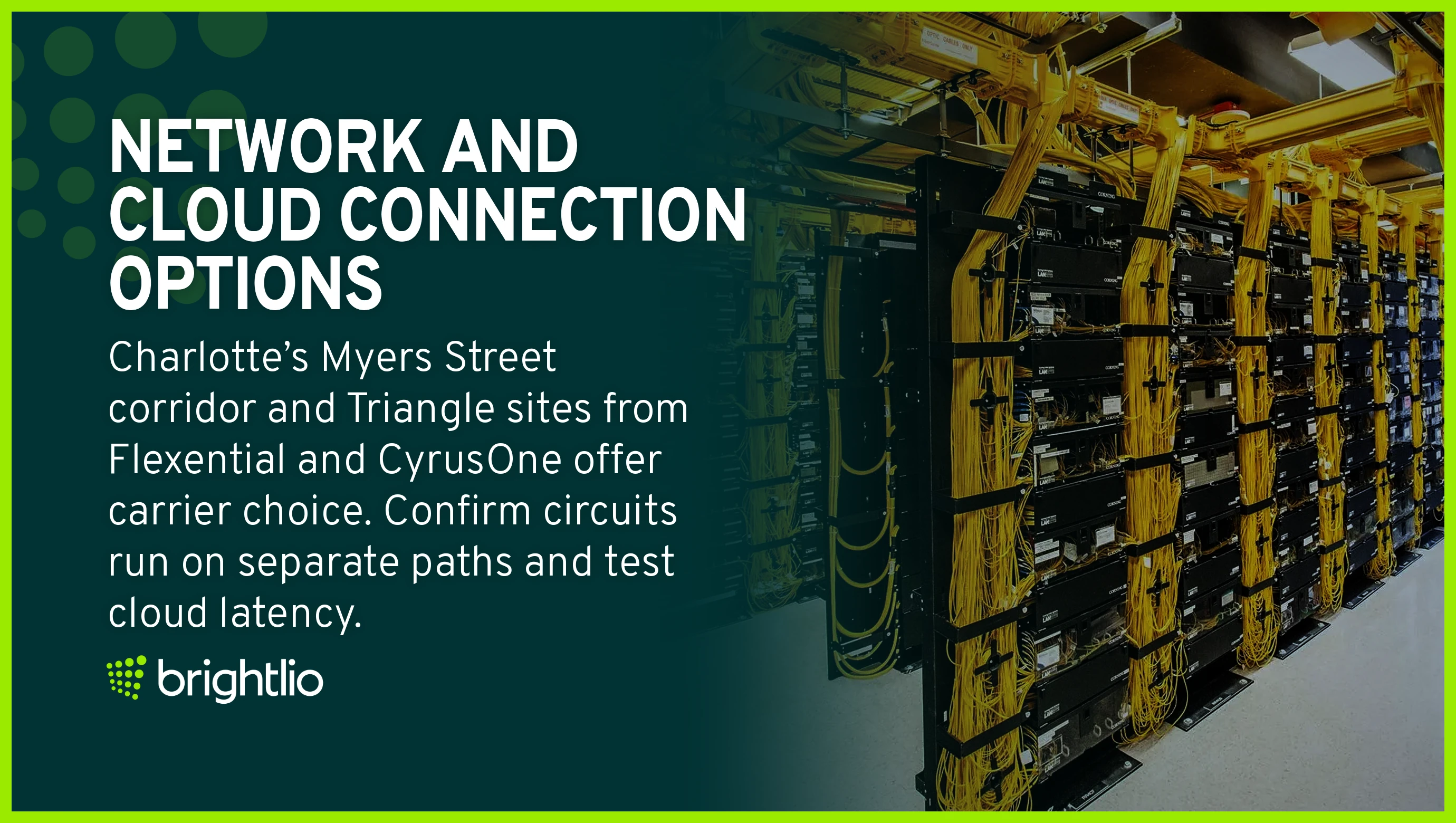
A carrier-neutral facility allows customers to choose among the network providers available at the site. A meet-me room brings customer and provider connections together. Neither feature alone establishes that two purchased circuits follow independent physical routes.
Cloud connection services need a similar review. Ask where the service reaches the cloud provider and whether transport to another building or city is involved. Test the connection against the application's actual destination and latency requirement.
Where North Carolina Data Centers Are Located
The state's commercial and private campuses follow different geographic patterns. Charlotte and the Triangle are the main starting points for a colocation search. The foothills and other regional markets add locations with different operators and infrastructure roles.
Charlotte And Uptown
Charlotte's Uptown network corridor includes Digital Realty addresses at 113 and 125 North Myers Street and 731 East Trade Street. The tracker identifies Lumen Charlotte 2 at 112 North Myers Street.
These locations matter to businesses that need several carrier connections or access to regional network services. Building ownership and the operator delivering the service may differ. A suite operated by another provider inside a Digital Realty building should be reviewed as a specific offer at that address.
The wider Charlotte area includes enterprise facilities outside Uptown. Compare each location's network routes and maintenance access against your requirements.
Raleigh And Durham
Durham's CyrusOne campus is at 2223 Northeast Creek Parkway, near Research Triangle Park. Raleigh-area choices in the tracker include TierPoint, Segra, LightEdge, and Lumen.
The Triangle is relevant to businesses that want infrastructure close to their regional operations. A facility's metro label may cover a neighboring municipality, so compare exact addresses when planning engineer visits or equipment deliveries.
For applications that connect to another site or public cloud, ask for the full network path. A nearby building can still require a carrier circuit with its own installation lead time and recurring cost.
Morrisville And Cary
Flexential's Raleigh facility is in Morrisville at 5150 McCrimmon Parkway, according to the tracker. Cary's inventory includes NetActuate. These locations give buyers additional options within the Triangle.
Proximity to Raleigh-Durham International Airport may help teams traveling to maintain equipment.
Evaluate the service package at the proposed address. Include the operator's remote-hands coverage, which provides assistance with physical equipment tasks, if your own engineers are not based nearby.
The Western Foothills
Apple's Maiden campus, Meta's Forest City campus, and Google's Lenoir campus give the western foothills a major role in North Carolina's data center industry. These are private hyperscale operations, meaning infrastructure built to support computing at very large scale.
Commercial providers in the broader region include CentriLogic in Lenoir.
Ask western North Carolina operators for the network routes to your offices and other facilities. Test whether those connections meet the application and replication requirements.
The Triad And Other Regional Markets
The tracker includes Lumen and Dynamic Quest facilities around Greensboro. Winston-Salem entries include Segra and SolidSpace. These markets provide other locations for businesses seeking proximity to regional staff or operations.
Other entries extend into smaller western communities and Fayetteville. The service model varies, so a statewide list should be narrowed by the specific application and support requirement.
For disaster recovery, compare the site's dependencies with those of the primary facility. A different city may still share a carrier route or other infrastructure that matters during an outage.
Five Major Operating Data Centers In North Carolina
These profiles cover five prominent operating sites from the tracker. Comparable IT-power figures are unavailable for several campuses, so their order is not a size ranking. Main-building area, energized site power, and campus IT capacity measure different things, and the private campuses do not represent public colocation inventory.
1. Apple Maiden Campus
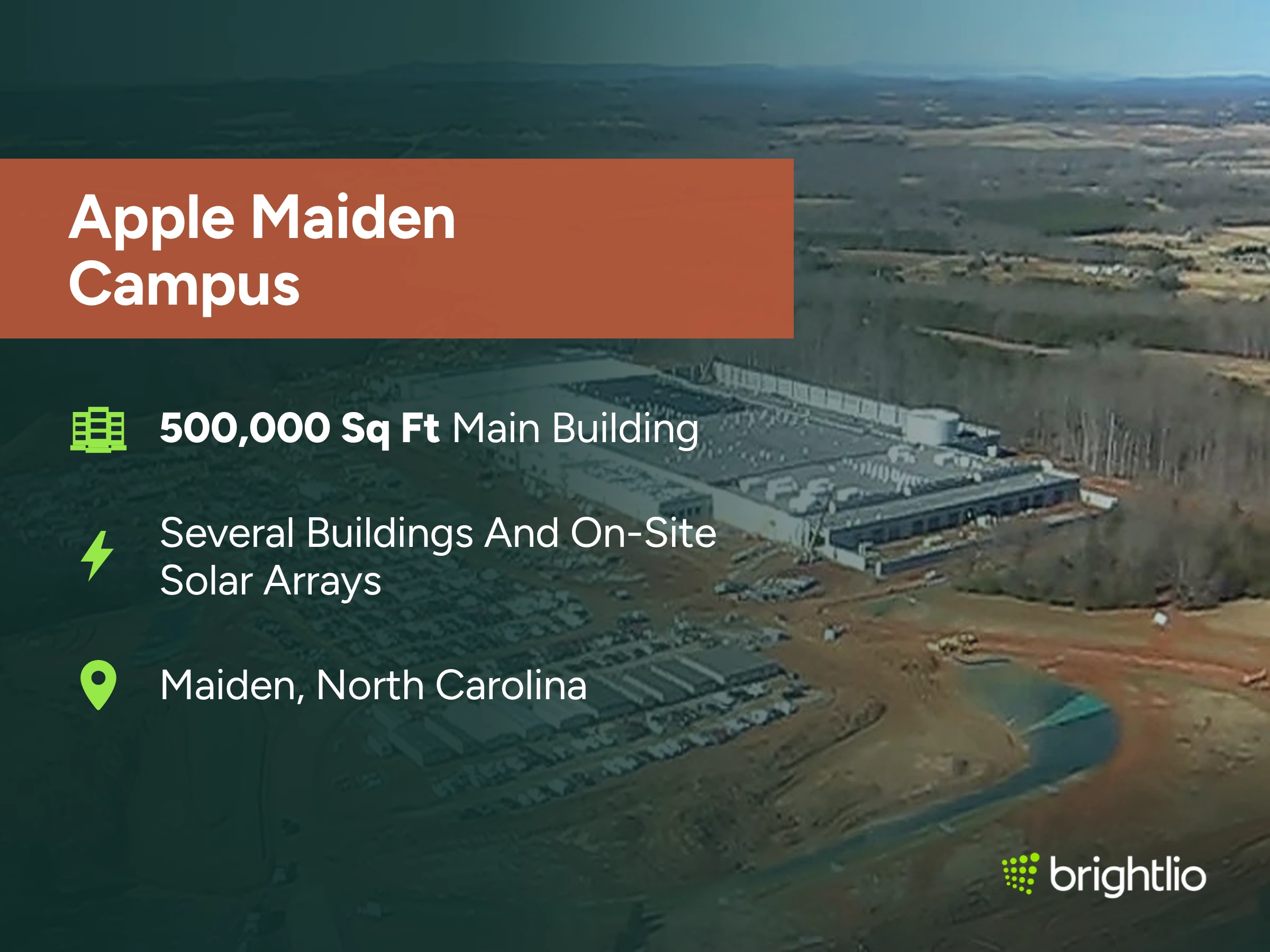
Location: 5977–6028 Startown Road, Maiden, as listed in the tracker. Operator: Apple.
The tracker identifies a 500,000-square-foot main building at Apple's Maiden campus. Apple identifies Maiden as infrastructure supporting users of its services.
The inventory includes several buildings and solar arrays at the location. A comparable operating IT-power figure is not established in the materials used for this guide.
The campus demonstrates the scale of private infrastructure in the foothills. Businesses seeking cabinets or a private cage should assess commercial operators rather than treat Apple's campus as an available retail facility.
2. Meta Forest City Campus
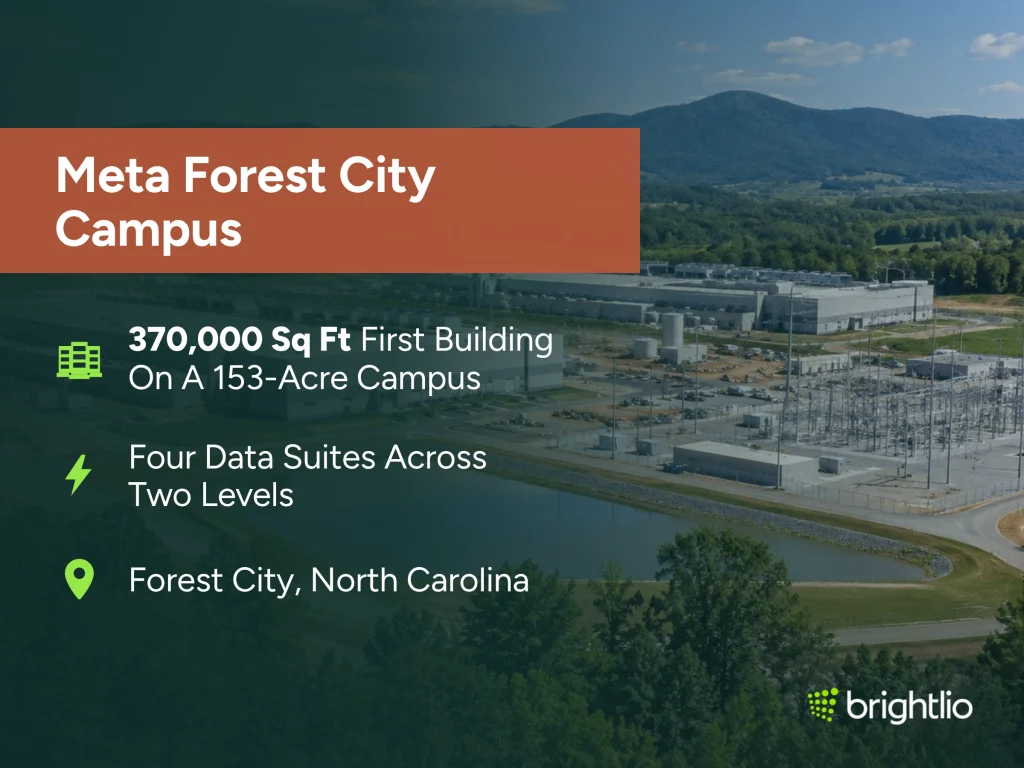
Location: 404 Social Circle, Forest City, as listed in the tracker. Operator: Meta.
Meta's primary opening announcement confirms that Forest City began serving live traffic on April 19, 2012. The tracker identifies a 153-acre campus and a 370,000-square-foot first building.
The first building contains four data suites across two levels, according to the supplied inventory.
Forest City is private infrastructure for Meta's services. Its 2012 opening announcement described testing outdoor-air cooling in the local climate.
3. Google Lenoir Campus
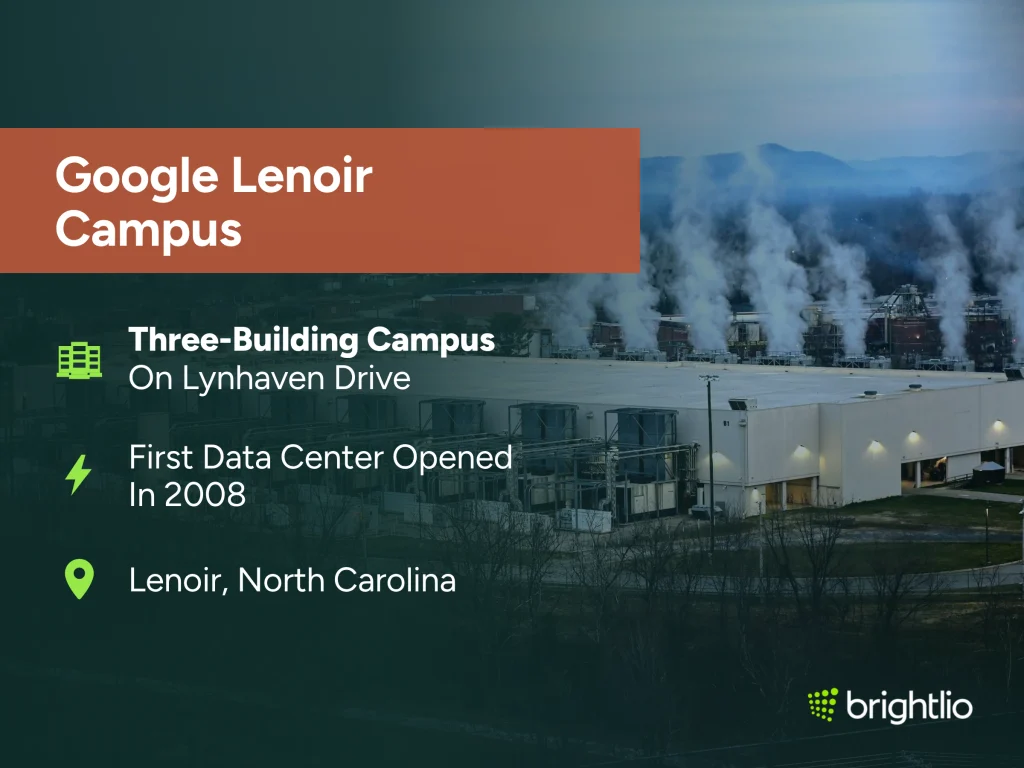
Location: 708 Lynhaven Drive, Lenoir, as listed in the tracker. Operator: Google.
Google's Lenoir timeline dates its announcement to 2007 and the opening of its first data center to 2008.
The tracker groups the location as a three-building campus. A comparable operating MW total is not established in the materials reviewed for this guide. A megawatt, or MW, equals 1,000 kW.
Google operates the Lenoir campus for its own infrastructure and services.
4. Core Scientific Marble

Location: 155 Palmer Lane, Marble. Operator: Core Scientific.
The tracker gives Marble 104 MW of energized power. Core Scientific's current location page lists 117 MW of total power capacity, along with 250,000 square feet on 70 acres.
The power figures use different definitions. Confirm their scope before comparing them, then establish the commissioned IT power available to a new customer.
The tracker describes a former thread mill converted in 2018. Core Scientific now markets Marble for high-density computing.
5. CyrusOne Durham DUR1 And DUR2
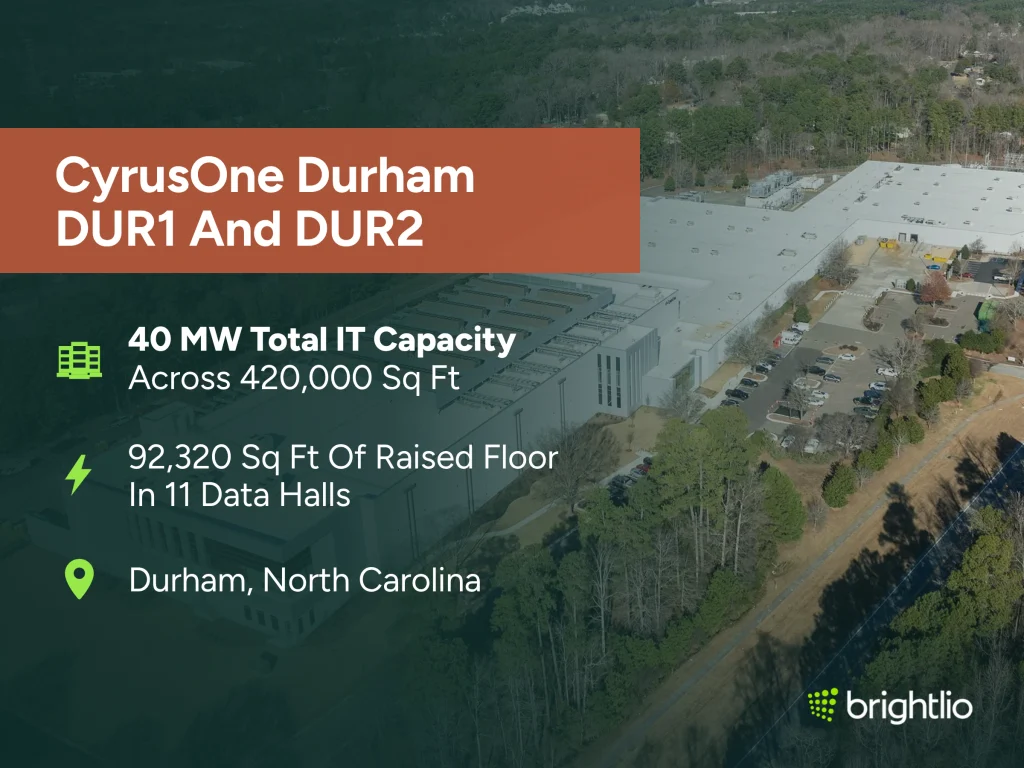
Location: 2223 Northeast Creek Parkway, Durham. Operator: CyrusOne.
CyrusOne's Durham campus lists 40 MW of total IT capacity and 420,000 square feet within its campus description. The operator separately identifies 92,320 square feet of raised floor across 11 data halls.
Those areas should not be treated as interchangeable. The campus capacity figure covers a wider scope than a particular commissioned hall, so the proposal needs to identify the space and usable power offered to the customer.
CyrusOne describes carrier-neutral connectivity and continuous operations support. It provides a commercial option for businesses comparing colocation requirements in the Triangle.
Commercial Colocation Options In North Carolina
The largest private campuses provide context for the state's infrastructure. A commercial shortlist needs a separate look at the facilities selling customer space. These examples complement the operating-site profiles without assuming a vacant rack or suite is available today.
Flexential Raleigh
Flexential's Raleigh facility lists 4.31 MW of critical-load UPS capacity. Its inventory gives a 99,976-square-foot footprint, which should not be labeled entirely as customer IT floor space.
A UPS is an uninterruptible power supply that bridges interruptions in utility power. The facility page describes N+1 power and cooling redundancy. N+1 means the required capacity plus a spare component.
The operator describes connections through its wider network ecosystem. Confirm which cloud and carrier services are delivered locally and which depend on transport elsewhere. The facility's total critical-load capacity does not establish the capacity available under a new contract.
Digital Realty's Uptown Charlotte Buildings
Digital Realty identifies CLT10 at 113 North Myers Street. The tracker groups it with the campus's other Uptown addresses. Its figure of roughly 29,200 square feet refers to CLT10 alone, rather than the entire Charlotte campus.
The inventory includes suites operated by other providers within these buildings. Identify the company responsible for your contracted power, cooling, and support. A building-level network ecosystem does not establish the services included with every suite.
For an interconnection-focused deployment, request the carrier list and physical route information at the specific address. Include cross-connect charges, which cover the short connections between customer equipment and another provider within a facility.
Other Retail And Managed-Service Options
TierPoint and Segra have multiple North Carolina entries in the tracker. The Triangle inventory includes LightEdge and NetActuate, while other regional operators provide additional choices.
Use the service requirement to narrow that list. A business needing a small cabinet footprint may value remote hands and straightforward network access. A company seeking a private suite should establish the reserved IT power and cooling allocation.
Certification claims need a facility-specific review. Request the relevant assessment or certificate and confirm which services it covers before assuming that the provider's controls meet your organization's obligations.
Drawbacks Of Colocating In North Carolina
North Carolina's operating choices and electricity prices need to be weighed against changes in tax treatment, local approval restrictions, and storm exposure. Each issue affects a different part of the decision. A contract should reflect the conditions at the selected facility.
1. The Electricity Tax Exemption Ended In 2026
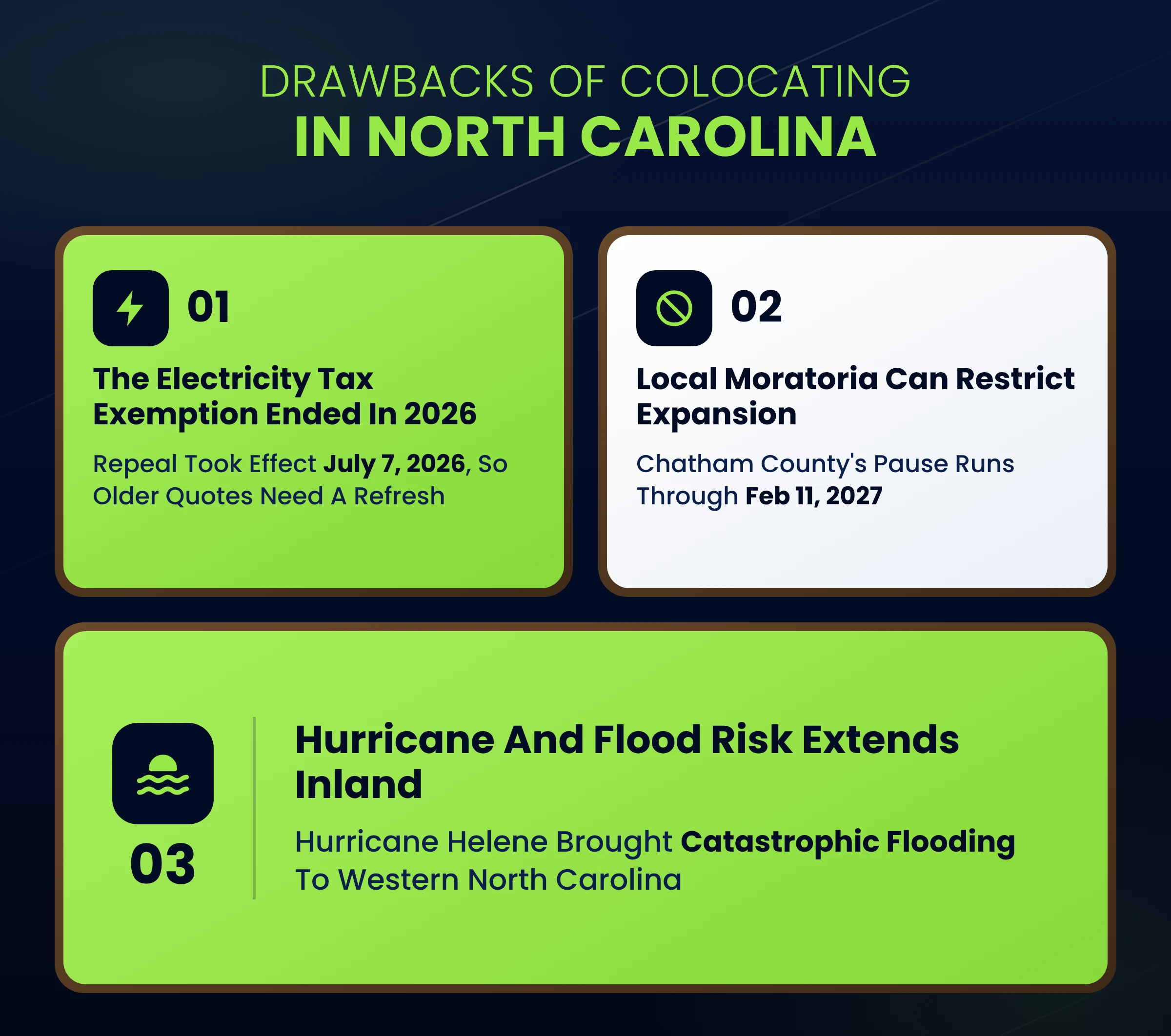
NCDOR's repeal notice states that the electricity exemption repeal became effective July 7, 2026. It applies to the first affected billing period beginning on or after August 6, 2026.
The change concerns electricity purchased for certified data centers. It does not remove the exemptions for certain other qualifying purchases.
Older proposals that assume exempt electricity need to be refreshed. Ask the provider how current electricity taxes appear in its pricing and how the contract handles changes to power-related charges.
2. Local Moratoria Can Restrict Expansion
The tracker identifies numerous local pauses on data center development. Chatham County's official announcement provides one concrete example: its moratorium began February 11, 2026, in unincorporated areas.
The county set a term through February 11, 2027, or until new zoning regulations are adopted if earlier. That scope should not be interpreted as a statewide closure of operating data centers.
For a growth commitment, determine whether the operator will use approved operating space or require further permits. Confirm the relevant city or county jurisdiction and the approvals behind the delivery date.
3. Hurricane And Flood Risk Extends Inland
Hurricane Helene caused catastrophic flooding in western North Carolina in September 2024. National Weather Service accounts identify severe impacts across the southern Appalachians, including damage to power lines and infrastructure.
An inland or mountain address therefore needs its own resilience review. Assess the building's flood exposure and the elevation of critical electrical equipment. Include access roads, fuel deliveries, and the infrastructure serving the property.
For a second site, examine whether the same storm could affect both locations. Test restoration procedures against the time the business can tolerate an interruption.
How Brightlio Helps You Choose A North Carolina Data Center
Brightlio helps businesses compare colocation services against their technical requirements and budget. We can help assess Charlotte, Triangle, and regional options using a consistent requirement.
Start with rack count and usable IT power. Identify the network destinations and support coverage your team needs. Include a growth forecast so the provider can distinguish current operating capacity from commitments that depend on further work or approvals.
Brightlio can help compare the resulting offers, including recurring power costs and network charges. Contact our team to discuss North Carolina facilities that fit your deployment.
Frequently Asked Questions
1. How Many Data Centers Are In North Carolina?
The tracker checked October 24, 2026, counts 68 sites, including 53 operating sites and 15 planned sites. Of the operating sites, 46 provide colocation. The colocation count is included within the operating total.
The tracker merges entries sharing an address and counts each campus or building once under its stated rules. Other directories can use different definitions. These inventory figures do not establish current cabinet availability or the amount of power a customer can lease.
2. Should I Choose Charlotte Or The Research Triangle?
Charlotte is a useful starting point when your offices or required network connections are concentrated there. The Uptown Myers Street corridor provides several buildings to investigate. The Triangle offers a separate group of providers around Raleigh, Durham, Morrisville, and Cary.
Compare exact addresses and the network paths to your applications. Include your team's travel needs and the operator's support coverage. Test performance against the real endpoints rather than assuming one metro is faster for every workload.
3. How Much Does North Carolina Colocation Cost?
A constant 5 kW IT load over a 730-hour month uses 3,650 kWh. At the August 2026 state commercial average, that represents about $392 in electricity. It is an energy illustration rather than a complete colocation quote.
Request a proposal covering space, power billing, and network charges. Include installation and support costs in the comparison. Brightlio's colocation pricing guide explains the components that determine the full recurring bill.
4. Which North Carolina Data Center Is The Largest?
The tracker does not support a single ranking across all operating sites by commissioned IT power. Apple's 500,000-square-foot main building measures area. Core Scientific Marble's 104 MW energized figure measures site power, while the operator lists a separate 117 MW total-capacity figure.
CyrusOne's 40 MW figure covers campus IT capacity. Compare facilities using the same measure and confirm the capacity available for your contract. A campus total does not establish vacant customer power.
5. Can I Lease Colocation Space At Apple, Meta, Or Google?
The Maiden, Forest City, and Lenoir campuses described here are private infrastructure for their operators. They should not be added to a commercial shortlist as publicly available cabinets or cages. Buying a cloud service is a different arrangement from leasing physical space.
For a colocation requirement, evaluate the commercial providers in the tracker. Confirm who operates the customer suite and which services the contract includes. Proximity to a technology company's campus does not establish a direct cloud connection.
6. What Tax Incentives Are Available For North Carolina Data Centers?
Certain equipment purchases at certified facilities can remain exempt. One qualifying route requires a Commerce determination of $75 million over five years, with applicable wage and health-insurance conditions. Investment can involve owners, users, or tenants.
The electricity exemption was repealed effective July 7, 2026, applying to affected billing periods beginning on or after August 6, 2026. Ask which certification and purchase rules support any equipment exemption assumed in the proposal. Qualification should be established for the actual transaction.
7. Do Local Moratoria Prevent Me From Leasing Colocation Space?
Check the scope of the local rule and the capacity the operator is offering. Chatham County's announcement concerns permitting in unincorporated areas, with a term through February 11, 2027, or adoption of new regulations if earlier.
A lease within existing approved operating space needs a different review from capacity requiring further construction or permits. Have the operator identify the approvals supporting its delivery commitment. A county announcement should not be applied automatically to every municipality or facility in the state.
8. Can North Carolina Facilities Support AI And Dense GPU Racks?
Support depends on the data hall and the actual server configuration. A campus MW figure does not establish the power or cooling available to an individual rack. Give the operator the equipment supplier's electrical and cooling specifications.
If liquid cooling is required, establish who supplies and maintains the necessary systems. Confirm the supported rack load during maintenance and utility interruptions. The proposal should specify the commissioned capacity and operating conditions attached to the offered configuration.
9. Are North Carolina Data Centers Powered By Renewable Energy?
The answer depends on the facility's electricity procurement. The tracker's electricity-use snapshot for July 2025 through June 2026 assigns about 36% to gas, 27% to nuclear, 12% to coal, and 9% to solar. Net imports account for about 11%.
Those figures describe electricity used, including imports, rather than only generation within the state. Ask for the evidence supporting a provider's renewable-energy claim and how it attributes that procurement to customers. The statewide mix cannot establish a particular contract's emissions.
10. Is North Carolina Suitable For Disaster Recovery?
North Carolina can be considered when the facility offers useful separation from your primary site's risks. Helene's 2024 flooding shows why an inland or mountain location still needs a storm and flood assessment. Review the infrastructure supporting both sites.
Test replication and restoration against the business's recovery objectives. Include carrier routes and access during a regional disruption. Two sites in different North Carolina cities can still share dependencies, so distance alone should not determine the recovery design.
Explore Related Data Center Markets
Continue your Southeast location comparison with our colocation guides for these neighboring markets:

Tamzid is a cybersecurity researcher with 5+ years of experience across SaaS, security, compliance, data centers and cloud. He writes for brightdefense.com and hipaasimple.com, covering security, compliance, and infrastructure topics. Certified through Cisco, Fortinet (NSE 1), and the Basel Institute on Governance in OSINT, he grounds his work in primary sources and verified data.
Recent Posts

Top 5 Floating Data Centers

Data Centers and Colocation in Colorado

Data Centers and Colocation in Delaware

Data Centers and Colocation in Hawaii
Let's start
a new project together