

Delaware data centers serve a compact market centered on Wilmington, New Castle, and Newark. Businesses can find retail colocation and managed hosting close to their northern Delaware operations. The state suits buyers who value local access and connections along the Mid-Atlantic corridor.
The tracker checked October 23, 2026, lists six colocation facilities. It classifies three enterprise sites as operating, based on public records rather than current confirmation from their operators. Those private enterprise sites should be considered separately from facilities selling space to outside customers.
The full tracker contains 12 sites when proposals are included. Data Center Map’s state page lists 19 facilities across two markets, using a different counting method. Neither count establishes how much commercial space or power is available to lease.
Delaware’s commercial electricity price averaged 13.80¢ per kilowatt-hour in July 2026. The state has no state or local sales tax, which can benefit equipment purchasing. Large facilities face separate energy and incentive requirements that need careful review.
This guide covers Delaware’s colocation advantages, its main locations, and five facilities to compare. It explains the supply limits and site-specific risks that should shape a buying decision.
Delaware Data Center Tracker
12data center facilities
3 enterprise3 proposals6 colocation
Data Center Map lists 19 facilities across 2 markets, counting rooms within shared buildings as separate listings. Project Washington’s two campuses make up most of those listings. This tracker counts each campus or site once and adds enterprise sites and proposals from public records. 9 sites are listed as operating: 3 enterprise data centers and 6 colocation facilities. Operating status for the enterprise sites comes from public records.
Market Snapshot
Operating Enterprise Data Centers In Delaware
Delaware has no operating hyperscale or wholesale campus. Its largest single-company sites belong to JPMorgan Chase and DXC, with operating sites in green and proposals in coral on the map.
- JPMorgan Chase Delaware Technology CenterWilmingtonNot publishedOperational
Enterprise data center serving JPMorgan Chase's large Delaware operations. Address comes from public records, and the operator has not confirmed current status
- Address:
- 4001 Governor Printz Blvd, Wilmington
- Operator:
- JPMorgan Chase
- JPMorgan Chase Bear ChristianaBearNot publishedOperational
Second JPMorgan Chase enterprise data center in New Castle County. Address comes from public records, and the operator has not confirmed current status
- Address:
- 501 Bear Christiana Rd, Bear
- Operator:
- JPMorgan Chase
- DXC Technology NewarkNewarkNot publishedOperational
IT services data center operated by DXC Technology. Address comes from public records, and the operator has not confirmed current status
- Address:
- 645 Paper Mill Rd, Newark
- Operator:
- DXC Technology
Proposals And Stalled Projects In Delaware
No large project is moving forward right now. Project Washington, the 1.2 GW plan near Delaware City, is halted, and a 100 MW Harrington proposal was denied, so it is left off.
- Project WashingtonDelaware City, proposed campus1,200 MWHalted
11 buildings totaling about 6.1 million sq ft on two parcels, phased over 8 to 10 years. The state ruled it prohibited under the Coastal Zone Act, a state board upheld the denial after a March 2026 hearing, and Starwood dropped its court appeal in July
- Sites:
- River Rd and 825 Governor Lea Rd, New Castle County
- Developer:
- Starwood Digital Ventures
- St. Georges Area ProposalSt. Georges, requested load300 MWPreliminary
Load request found in Delmarva Power filings. The developer is not identified, and matching the request to a specific project is uncertain
- Location:
- Near St. Georges, New Castle County
- Developer:
- Not disclosed
- White Clay Center Data CenterNewarkNot publishedStalled
Proposed on a 44-acre site in the White Clay Center Industrial Park and paused in July 2026. Spotlight Delaware reported in September that part of the site could become a Christina School District building
- Location:
- Ogletown Rd, Newark
- Developer:
- Verdantas and Shelbourne
Notable Colocation Facilities In Delaware
Retail colocation sits in Wilmington, New Castle and Newark. Power figures are operator or directory specifications, not IT load.
- DaSTOR New CastleNew Castle, fully built-out power8 MWColocation
About 60,000 sq ft of whitespace with 2N+1 UPS redundancy
- Address:
- 3 Boulden Cir, New Castle
- Operator:
- DaSTOR
- Data Canopy NewarkNewark, building power6 MWColocation
16,085 sq ft of white space, per the operator. Formerly Hosting.com, then Ntirety, before Data Canopy bought the colocation business in 2023
- Address:
- 350 Pencader Dr, Newark
- Operator:
- Data Canopy
- DaSTOR Wilmington CCCWilmington, power4 MWColocation
Downtown Wilmington facility, formerly operated by IPR International
- Address:
- 1201 N Market St, Wilmington
- Operator:
- DaSTOR
- Lumen Wilmington 1Wilmington15,000 sq ftColocation
15,000 sq ft network facility with 1,228 sq ft of colocation space
- Address:
- 1603 N Jessup St, Wilmington
- Operator:
- Lumen
- Lumen Newark 1NewarkNot publishedColocation
Lumen network and colocation site in Newark
- Location:
- Newark
- Operator:
- Lumen
Other colocation facilities, shown on the map as green squares: .
Choose a category to switch the list and highlight its sites on the map. Click any site card to find it on the map, or click a marker to jump to its card. Pins are approximate, and each MW figure carries the basis shown beside it.
Data sourced from Data Center Map, EIA, PJM, Spotlight Delaware, WHYY, Delaware Business Now, Technical.ly, DatacenterDynamics, Data Canopy, DaSTOR, DNREC, Delaware.gov and Kadoa, checked October 23, 2026. Totals count each campus or facility once; Data Center Map’s own count lists individual facilities.
Why Colocate In Delaware
Delaware’s strongest advantages concern equipment purchasing, access to local operations, and regional connectivity. Its commercial electricity average provides a useful cost benchmark. The value of each benefit depends on the facility and the services included in the proposal.
1. No State Or Local Sales Tax
The Delaware Division of Revenue confirms that Delaware imposes no state or local sales tax. That can make the state attractive for businesses buying servers and network equipment for use at a Delaware facility.
The purchasing effect can be meaningful for a hardware refresh. For comparison, a 6% sales tax on a $1 million equipment purchase would equal $60,000. That is an illustration of the tax component, rather than a guaranteed saving against every other location.
Delaware imposes other business taxes, including a gross receipts tax on sellers and service providers. Equipment used in another state needs a separate tax review. The absence of sales tax is distinct from the state’s rules for job and investment credits.
2. Connections Along The Mid-Atlantic Corridor
Northern Delaware sits between the Philadelphia area and markets farther south along Interstate 95. DaSTOR describes its New Castle facility as positioned between Ashburn and New York/New Jersey, with connections to multiple network providers.
A Delaware facility can keep equipment within reach of an IT team based in Wilmington or Newark. That can help businesses whose engineers regularly replace hardware or maintain systems in person.
Managed support can reduce the need for those visits. Data Canopy’s Newark service includes remote hands, which means on-site assistance with physical tasks such as checking a connection or replacing a component. The operator lists full and half racks alongside private cage options.
Match the support model to your staffing. Confirm which tasks the provider performs and the response times attached to the service. Continuous customer access and service-desk monitoring are different from an engineer being available immediately for every request.
That geography gives buyers a reason to compare Delaware when their applications serve regional offices or customers. A carrier-neutral data center allows customers to choose among the network providers available at the site.
The actual routes determine application performance. Ask whether the required carrier is in the building and whether a cloud connection needs transport to another city. Test latency, the time data takes to travel between systems, against the endpoints your applications use.
3. Local Access And Managed Support
A Delaware facility can keep equipment within reach of an IT team based in Wilmington or Newark. That can help businesses whose engineers regularly replace hardware or maintain systems in person.
Managed support can reduce the need for those visits. Data Canopy’s Newark service includes remote hands, which means on-site assistance with physical tasks such as checking a connection or replacing a component. The operator lists full and half racks alongside private cage options.
Match the support model to your staffing. Confirm which tasks the provider performs and the response times attached to the service. Continuous customer access and service-desk monitoring are different from an engineer being available immediately for every request.
4. Commercial Electricity Below The National Average
EIA’s July 2026 data puts Delaware’s commercial electricity average at 13.80¢/kWh, compared with 14.53¢/kWh nationally. Delaware’s figure was about 5% lower for that month.
The difference is modest enough that the full colocation proposal remains essential. Rental charges and the provider’s power billing can outweigh a small difference in electricity averages. A facility’s applicable utility tariff may differ from the statewide commercial average.
Delaware participates in PJM, the regional organization that coordinates the high-voltage grid and wholesale electricity markets. Delmarva Power is a utility serving the northern Delaware market. Confirm the utility arrangements at the actual address when comparing power offers.
Where Delaware Data Centers Are Located
The commercial facilities in the tracker cluster in northern Delaware’s New Castle County. Wilmington, New Castle, and Newark provide three useful location groups for a buyer. Data Center Map groups listings into the broader Wilmington and Newark markets, so directory market labels do not always match municipal boundaries.
Wilmington
DaSTOR operates its downtown facility at 1201 North Market Street. The tracker identifies Lumen Wilmington 1 at 1603 North Jessup Street. These addresses serve different parts of the city and should receive separate network and hazard assessments.
Wilmington is a useful starting point for companies whose IT teams work nearby. Review loading access and delivery procedures if the deployment involves frequent equipment shipments. Downtown convenience should be assessed alongside the power and floor space available for the required date.
The tracker lists a JPMorgan Chase enterprise site in Wilmington. Its inclusion in an inventory does not make it a retail colocation option, and the operator has not confirmed its current status for this guide.
New Castle And The Interstate 95 Corridor
DaSTOR’s New Castle facility is at 3 Boulden Circle. The operator’s location page identifies an 8 megawatt (MW) power specification. One MW equals 1,000 kilowatts (kW). It provides one of the larger power figures among the commercial sites in the supplied tracker.
This area is relevant to buyers comparing northern Delaware with Philadelphia-area facilities. Evaluate the carrier routes to your offices and any cloud connection point. A favorable position on the road network does not establish a specific fiber path or round-trip latency.
Use the service address to establish the relevant planning authority. A New Castle mailing address alone does not settle whether a property falls under a city’s zoning rules or the county’s land-use jurisdiction.
Newark And The Pencader Area
Data Canopy’s Newark facility is at 350 Pencader Drive. The operator lists 16,085 square feet of white space, meaning the area used for customer IT equipment. It identifies 6 MW of building power capacity.
Lumen includes Newark, Delaware, in its network colocation market sheet. Data Center Map identifies the Newark 1 facility at 504 Interchange Boulevard. Buyers should have Lumen confirm the service address and available configuration in its proposal.
Newark’s commercial choices should be kept separate from the private enterprise sites around Newark and Bear. The tracker includes DXC and JPMorgan Chase locations based on public records, with current status unconfirmed by those operators.
Five Delaware Colocation Facilities To Compare
These five profiles cover notable commercial facilities in the tracker. They are not a verified size ranking. The MW figures use different measures, while some facilities provide no comparable power total.
1. DaSTOR New Castle
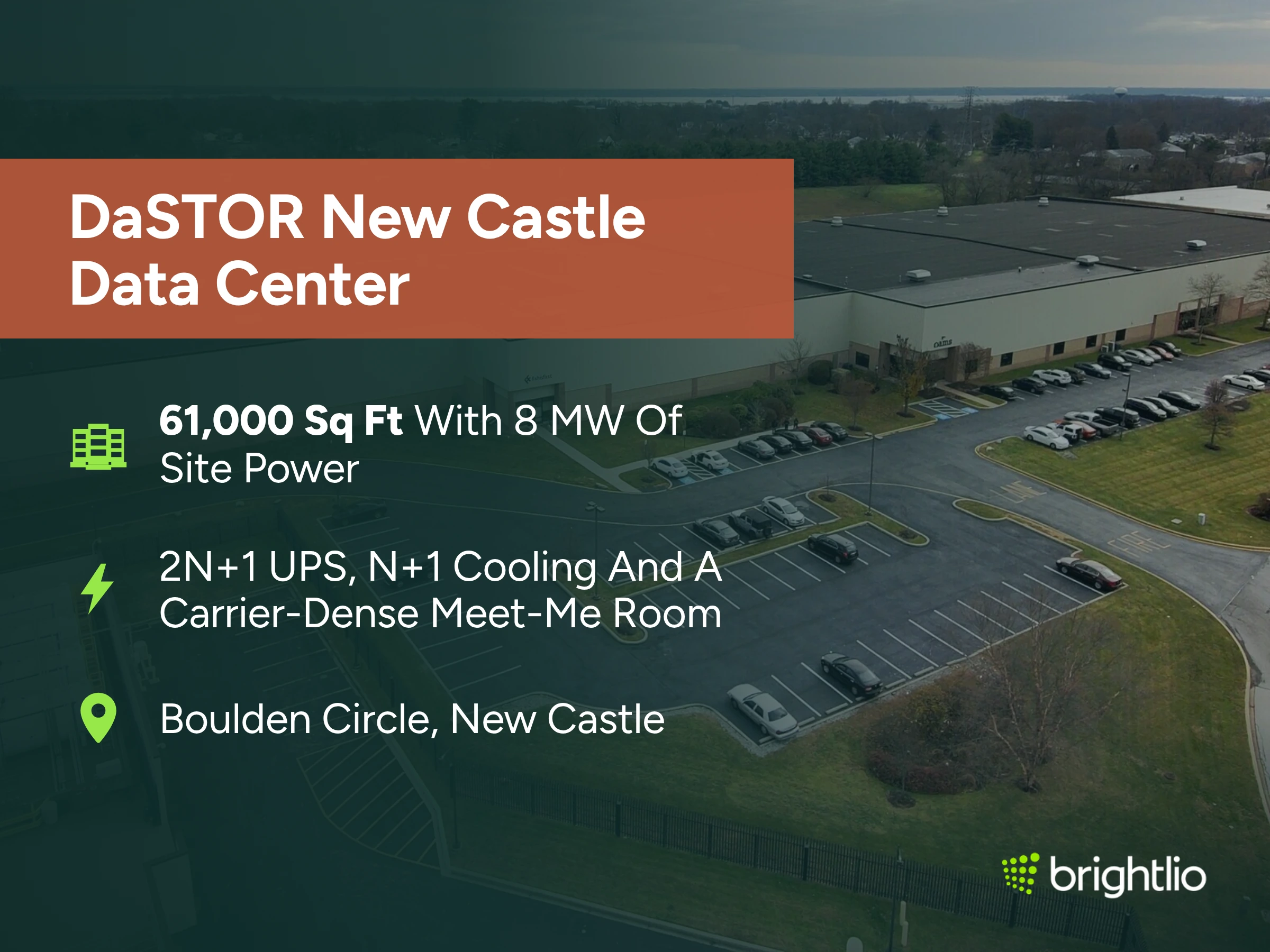
Location: 3 Boulden Circle, New Castle. Operator: DaSTOR.
DaSTOR’s location specifications identify 61,000 square feet and 8 MW of power at New Castle. The area should not be treated as entirely customer IT floor space. The operator’s 2024 acquisition announcement separately identified more than 30,000 square feet of raised floor at that time.
The location page lists 2N+1 UPS redundancy and N+1 cooling. A UPS is an uninterruptible power supply that bridges interruptions in utility power. N+1 means the required capacity plus a spare component. The 2N+1 label indicates two sets of required capacity plus a spare.
Review the exact electrical design serving the customer space.
DaSTOR describes a carrier-dense meet-me room, where customer and provider connections are brought together. For a proposal, establish which carriers can deliver the required circuits to the contracted space.
The 8 MW figure is a site specification. It does not establish that the same amount is commissioned critical IT power or available for a new customer.
2. Data Canopy Newark
Location: 350 Pencader Drive, Newark. Operator: Data Canopy.
Data Canopy’s Newark specifications identify 6 MW of building power and 16,085 square feet of white space. Building power includes the facility’s electrical scope and should not be read as an equivalent quantity of available IT load.
The operator lists three utility feeds and redundant power distribution. Multiple feeds require a closer design review before a buyer assumes they provide independent upstream utility sources.
The facility offers private cages and full or half racks. Remote hands and continuous customer access make it relevant to businesses that need local equipment access with support for physical tasks.
Compare the proposed cabinet power and cooling allocation with the actual hardware configuration. The agreement should identify how much usable IT power is included and what happens if the deployment needs more.
3. DaSTOR Wilmington CCC
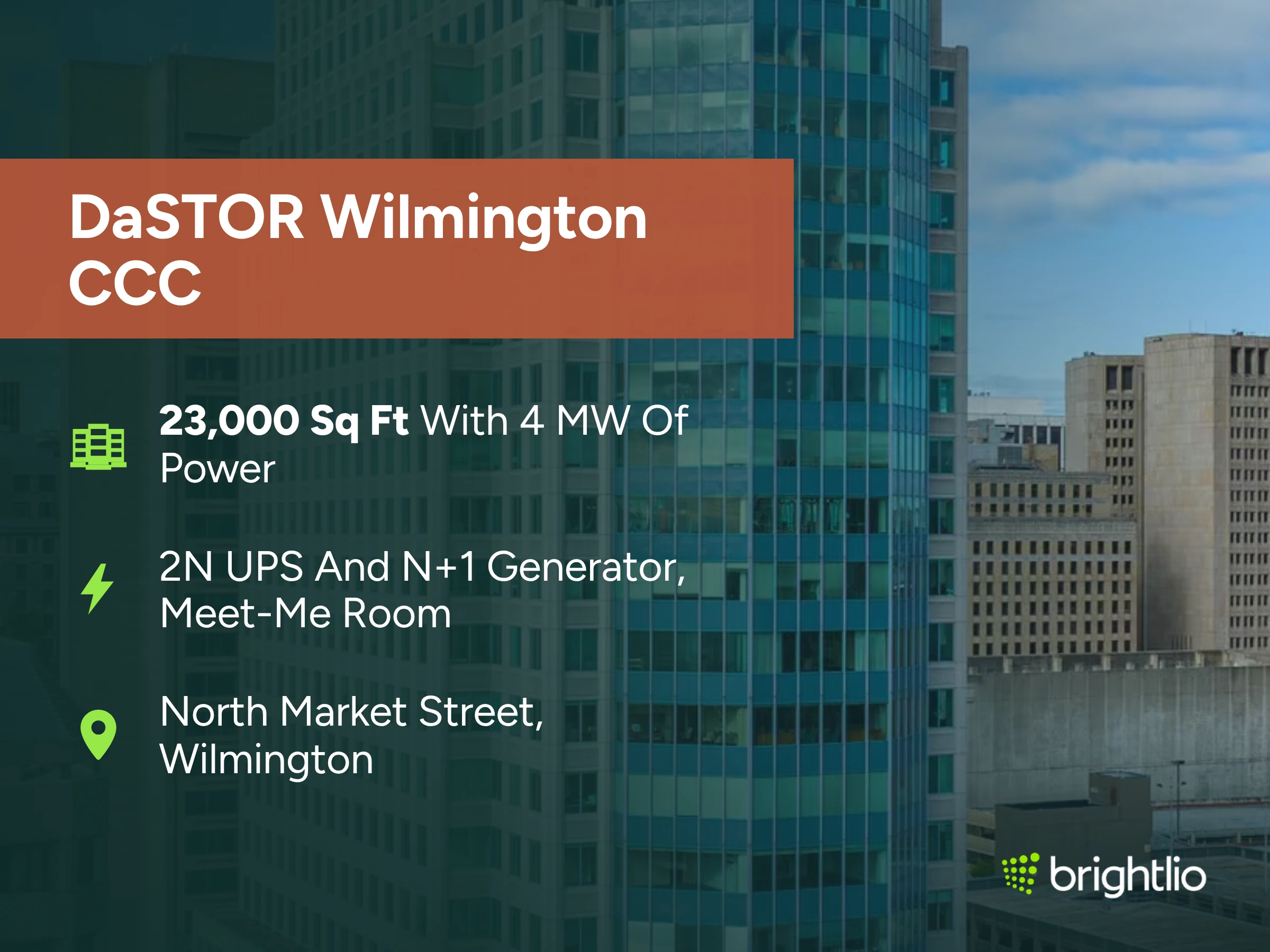
Location: 1201 North Market Street, Wilmington. Operator: DaSTOR.
DaSTOR’s current location page lists 23,000 square feet and 4 MW of power at its Wilmington facility. The tracker identifies the location as formerly operated by IPR International.
The operator specifies 2N UPS and N+1 generator arrangements. The 2N label indicates two complete sets of capacity. Review how the customer power paths use that redundancy.
The location includes a meet-me room and controlled access. It is a downtown option for businesses that want to evaluate colocation close to their Wilmington operations.
A proposal should explain the electrical paths serving the specific customer space. The operator’s site-level figures do not establish how many racks or kilowatts are available for a new contract.
4. Lumen Wilmington 1
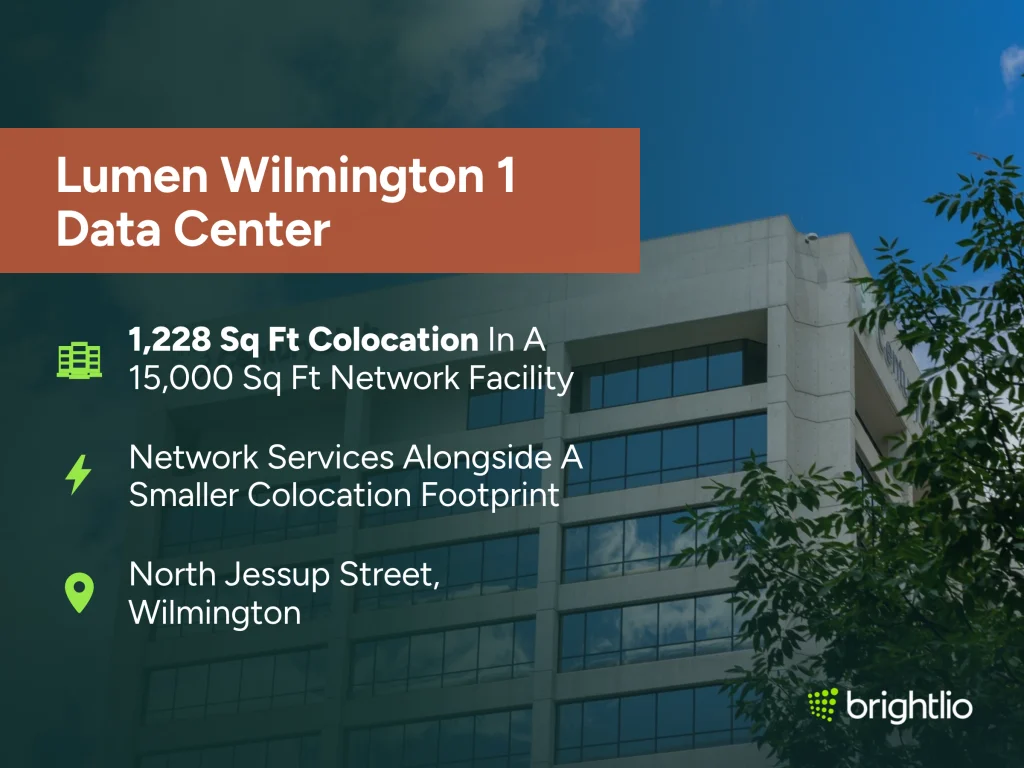
Location: 1603 North Jessup Street, Wilmington, as listed in the tracker. Operator: Lumen.
The tracker identifies a 15,000-square-foot network facility with 1,228 square feet of colocation space. The distinction matters because the building’s total area is much larger than the area identified for customer equipment.
Lumen’s network colocation market sheet includes Wilmington, Delaware. The building-specific area figures come from the tracker and should be confirmed in the operator’s proposal.
This site is relevant to a comparison involving network services alongside a smaller colocation footprint. Ask for the usable cabinet allocation and the connections available at the address. No comparable MW figure is established in the supplied tracker.
5. Lumen Newark 1
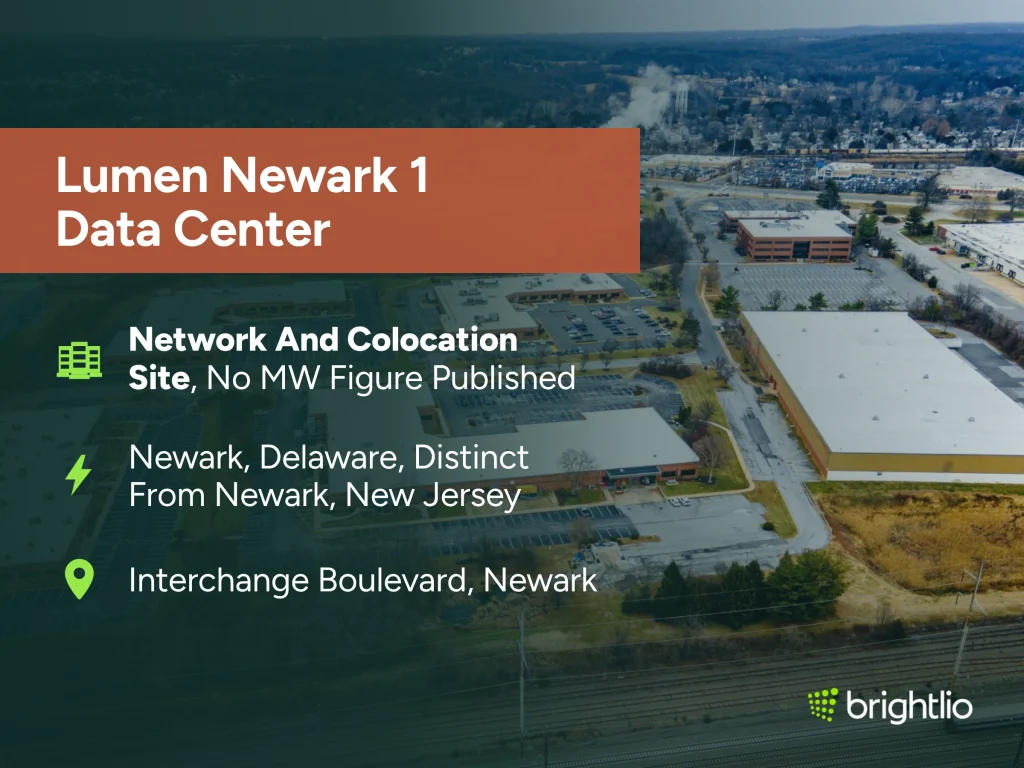
Location: Newark, Delaware. Data Center Map lists 504 Interchange Boulevard. Operator: Lumen.
Lumen’s market sheet lists Newark, Delaware, separately from Newark, New Jersey. That distinction helps avoid mixing facilities from two different states during a directory search.
The tracker identifies Newark 1 as a network and colocation location but gives no MW figure. Its entry is useful as a lead for a provider discussion, with the operating configuration and service address requiring confirmation from Lumen.
Ask the operator to identify the customer space and network services available for the requested deployment date. The national market sheet describes services that vary by site. Confirm the services delivered at this building.
Drawbacks Of Colocating In Delaware
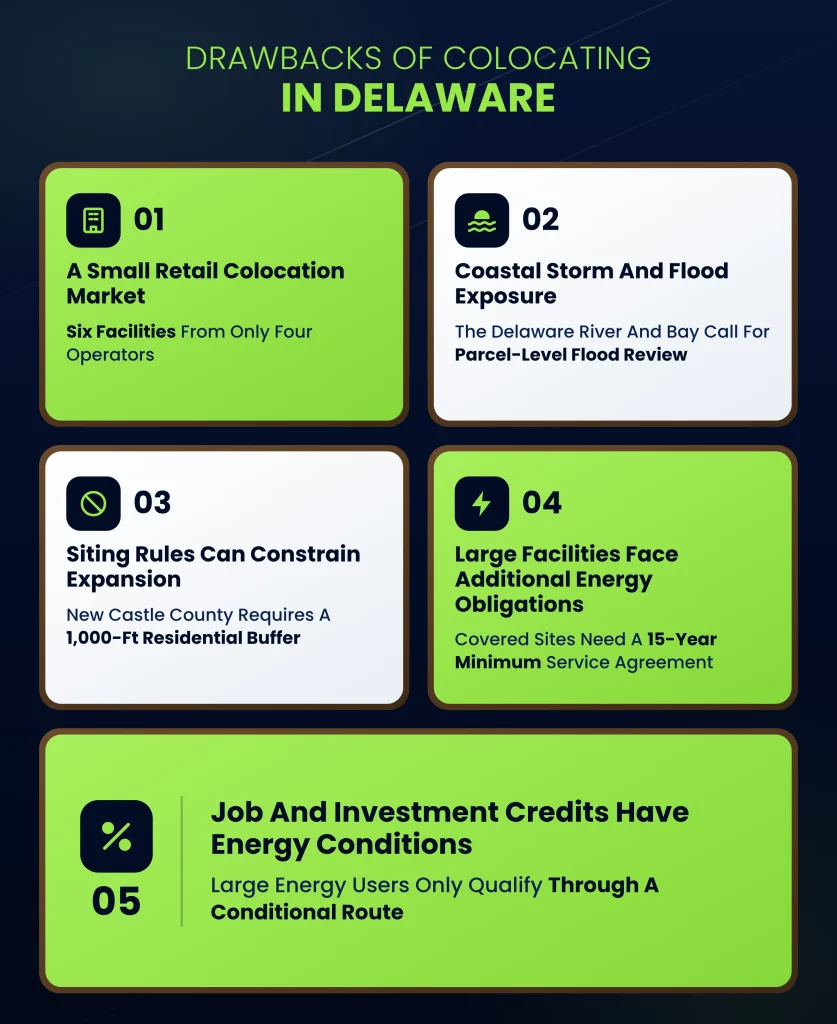
Delaware has fewer commercial facilities than the nearby major data center markets. Expansion and large-load requirements add further constraints. Flood exposure needs its own assessment at each address, including the infrastructure that keeps the site accessible and powered.
1. A Small Retail Colocation Market
The tracker lists six colocation facilities. Two belong to DaSTOR and two to Lumen, with Data Canopy and Trijit providing the other entries. Facility count therefore gives a broader impression of choice than the number of distinct operators.
This can narrow the shortlist when a buyer needs a particular carrier or a large private suite. The tracker does not establish vacancy, and the private enterprise sites do not add publicly available cabinets.
Start a Delaware search with the required usable power and deployment date. Include a neighboring market in the comparison when the local operators cannot meet the requirement.
2. Coastal Storm And Flood Exposure
The Delaware River and Bay create location-specific flood and storm-surge exposure. Northern Delaware facilities still require a parcel-level review, even when they are away from the ocean shoreline.
The Delaware Department of Natural Resources and Environmental Control (DNREC) provides flood-planning maps to help assess properties. Review the elevation of electrical equipment and generator controls, with access roads and fuel deliveries included in the assessment.
A flood-zone label should be read with its map date and limitations. A lower-risk designation does not establish that a building or its surrounding infrastructure cannot flood.
3. Siting Rules Can Constrain Expansion
New Castle County signed its data center standards in March 2026. The tracker identifies a 1,000-foot residential buffer among the requirements. The relevant jurisdiction and the scope of a proposed expansion determine which rules apply.
Delaware’s Coastal Zone Act regulates specified industrial activities through a separate review process. Buyers should establish whether the facility’s location and activities require that review.
For a customer expecting substantial growth, determine whether the operator can provide it within approved operating space. Any reliance on additional construction or land-use approval needs a separate delivery commitment.
4. Large Facilities Face Additional Energy Obligations
Delaware’s 2026 rules create a distinct framework for large energy-use facilities. They address utility cost allocation and financial commitments. They should not be applied automatically to an individual customer renting a cabinet.
Title 26 of the Delaware Code requires a separate service classification for covered facilities. The rules assign costs to those facilities and establish service-agreement requirements, including a minimum total contract term of 15 years.
Title 29 imposes generation and procurement conditions. It provides a regulated route to meeting 100% of annual energy needs within ten years, subject to operating and reliability conditions.
The law permits qualifying procurement arrangements, so its requirements should not be reduced to a universal obligation to build all power on site.
The operator should explain whether its facility falls within this framework and how the applicable terms affect the customer’s service agreement.
5. Job And Investment Credits Have Energy Conditions
Delaware’s absence of sales tax does not establish automatic eligibility for job or investment incentives. The qualified-facility rules in Title 30 exclude large energy-use facilities from the ordinary definition, then provide a conditional route to qualification.
That route depends on specified generation or procurement requirements. Other conditions in the credit program still need to be met. The current code therefore requires a more careful eligibility assessment than a simple claim that every large facility qualifies or every data center is barred.
Ask the provider to identify the specific program and the basis for any incentive included in its financial comparison. Include a credit in the budget only after its eligibility is established.
How Brightlio Helps You Choose A Delaware Data Center
Brightlio helps businesses compare colocation services against their technical needs and budget. We can help you assess Delaware facilities alongside nearby markets using a consistent requirement.
Start with the number of racks and usable IT power your deployment needs. Identify the carrier connections and support tasks that matter to your team. Include a growth forecast so providers can distinguish the space available today from capacity that needs further approval.
Brightlio can help compare the complete offers, including power billing and network connection charges. Contact our team to discuss the Delaware options that fit your deployment.
Frequently Asked Questions
1. How Many Data Centers Are In Delaware?
The tracker checked October 23, 2026, lists 12 sites, including six colocation facilities. It classifies three enterprise sites as operating based on public records, with current status unconfirmed by the operators. The remaining entries are proposals.
Data Center Map’s state page lists 19 facilities under a different counting method. These totals describe inventories. They do not establish the number of facilities currently accepting customers or the amount of available power.
2. Which Delaware Data Center Is The Largest?
The tracker does not establish a complete ranking by operating IT capacity. DaSTOR New Castle has an 8 MW site power specification. Data Canopy Newark identifies 6 MW of building power, while DaSTOR Wilmington lists 4 MW.
Those figures do not establish vacant customer IT power. Ask providers for the same capacity measure before comparing them. Total building area should be checked separately from the floor area allocated to server equipment.
3. How Much Does Delaware Colocation Cost?
A constant 5 kW IT load over a 730-hour month uses 3,650 kWh. At Delaware’s July 2026 commercial electricity average, that equals about $504 in electricity. It excludes cooling overhead and the other costs of colocation.
A provider’s quote should identify space rental, power billing, and network charges. Include support and installation costs in the comparison. Brightlio’s colocation pricing guide explains the components behind the complete monthly bill.
4. Does Delaware Offer Tax Advantages For Data Centers?
Delaware imposes no state or local sales tax. That can benefit equipment purchasing for a Delaware installation. Other business taxes still apply, and equipment used elsewhere needs its own tax review.
Job and investment credits are a separate issue. The current qualified-facility code includes special conditions for large energy-use facilities, with a route to qualification tied to generation or procurement requirements. Any credit assumed in a financial comparison needs its own eligibility assessment.
5. Do The New Energy Rules Apply To Every Colocation Customer?
The rules use facility-level definitions, so a company renting one cabinet should not assume it independently triggers the large-facility requirements. One threshold covers specified data-processing and hosting facilities able to use 30 MW or more of monthly maximum demand.
Other thresholds and aggregation rules can apply. Ask the operator whether its facility falls within the framework and how its approved utility terms affect your service. The customer contract should make the relevant costs and obligations clear.
6. Can A Delaware Data Center Connect To Public Clouds?
Cloud connectivity is available through some providers, but the delivery path needs confirmation for the selected building. DaSTOR describes public-cloud connection services within its broader offering. That does not establish a direct connection to every cloud in each Delaware facility.
Ask which cloud and destination region the service reaches. Confirm whether it needs transport to another city and which supplier bills for it. A connection service does not mean the cloud operates a region inside the building.
7. Can Delaware Facilities Support AI And Dense GPU Racks?
Suitability depends on the contracted space and the actual hardware. A site’s MW specification alone cannot establish the power and cooling available to an individual rack. Give the operator the server manufacturer’s electrical and cooling requirements.
If the equipment needs liquid cooling, establish who supplies and maintains the required systems. Confirm the supported configuration during maintenance and utility interruptions. The proposal should identify the usable rack power and the conditions attached to that commitment.
8. Is Delaware Suitable For Disaster Recovery?
Delaware can be considered when it provides useful separation from the primary site’s risks and meets the application’s network requirements. Two facilities in northern Delaware may still share storm exposure or supporting infrastructure. Distance alone does not establish independent failure risks.
Review flood exposure and carrier routes at both sites. Test replication and restoration against the recovery objectives. If the primary site is nearby, include a more distant location in the assessment before choosing a second facility.
9. Are Delaware Data Centers Powered By Renewable Energy?
An individual facility’s renewable-energy position depends on its procurement and supporting evidence. The tracker’s 2025 in-state generation snapshot assigns 86% to natural gas, 5% to coal, and 3% to solar. Those figures exclude the wider supply picture created by electricity imports through PJM.
Ask the operator what renewable or clean-energy products it purchases and how it attributes them to customers. State generation percentages alone cannot establish the emissions associated with a specific colocation contract.
10. Can Businesses Lease Space In Delaware’s Bank Or DXC Data Centers?
The tracker identifies the JPMorgan Chase and DXC sites as enterprise facilities. It does not identify them as retail colocation offers, and their operators have not confirmed current status for this guide. Their presence should not expand a commercial shortlist automatically.
For space available to outside customers, begin with the colocation providers. Confirm the contracting operator and the service address. A public-record entry for a private enterprise building does not establish that it accepts third-party equipment.

Tamzid is a cybersecurity researcher with 5+ years of experience across SaaS, security, compliance, data centers and cloud. He writes for brightdefense.com and hipaasimple.com, covering security, compliance, and infrastructure topics. Certified through Cisco, Fortinet (NSE 1), and the Basel Institute on Governance in OSINT, he grounds his work in primary sources and verified data.
Recent Posts

Top 5 Floating Data Centers

Data Centers and Colocation in Colorado

Data Centers and Colocation in Delaware

Data Centers and Colocation in Hawaii
Let's start
a new project together