
Kentucky is rapidly becoming a focal point for new digital-infrastructure investment. The state attracts data-center developers with abundant coal-fired and natural gas generation, competitive electricity rates and a central location that puts two-thirds of the U.S. population within a day’s drive.
Recent legislation provides generous tax exemptions for large projects, and several hyperscale campuses are under construction or in the planning stages, with some early proposals framed as a potential data center to local stakeholders. This overview summarizes Kentucky’s existing colocation market, fiber infrastructure, tax environment and major developments as of early 2026.
Kentucky Data‑Center Market at a Glance
Kentucky hosts a modest but growing colocation market. According to Baxtel’s market database, the Commonwealth has around 28 commercial data centers operated by 15 providers, with the largest being Core Scientific’s Calvert City complex.
In areas where prime farmland borders industrial corridors, site selection can require added community outreach.
The overview below summarises key facts about the state’s data-center landscape.
- Data Centers: About 28 facilities run by 15 providers. (Baxtel)
- Largest Site: Core Scientific Calvert City, 60,000 ft², 15 acres, 150 MW. (Core Scientific)
- Hyperscale Build: PowerHouse Louisville, 154 acres, up to 1.8M ft², 402 MW; phase 1 (130 MW) due Oct 2026. (Data Center Map)
- Power Price (Feb 2026): 12.15¢/kWh, about 20% under US average. (Electricchoice)
- Broadband: 183.31 Mbps average, 35th nationally. (HighSpeedInternet)
- Climate: Louisville highs 44°F (Jan) to 89°F (Jul); lows 28°F to 71°F.(US Climate Data)
- Energy Mix (2024): 67% coal, 26% natural gas, most remaining hydro. (Kentucky Lantern)
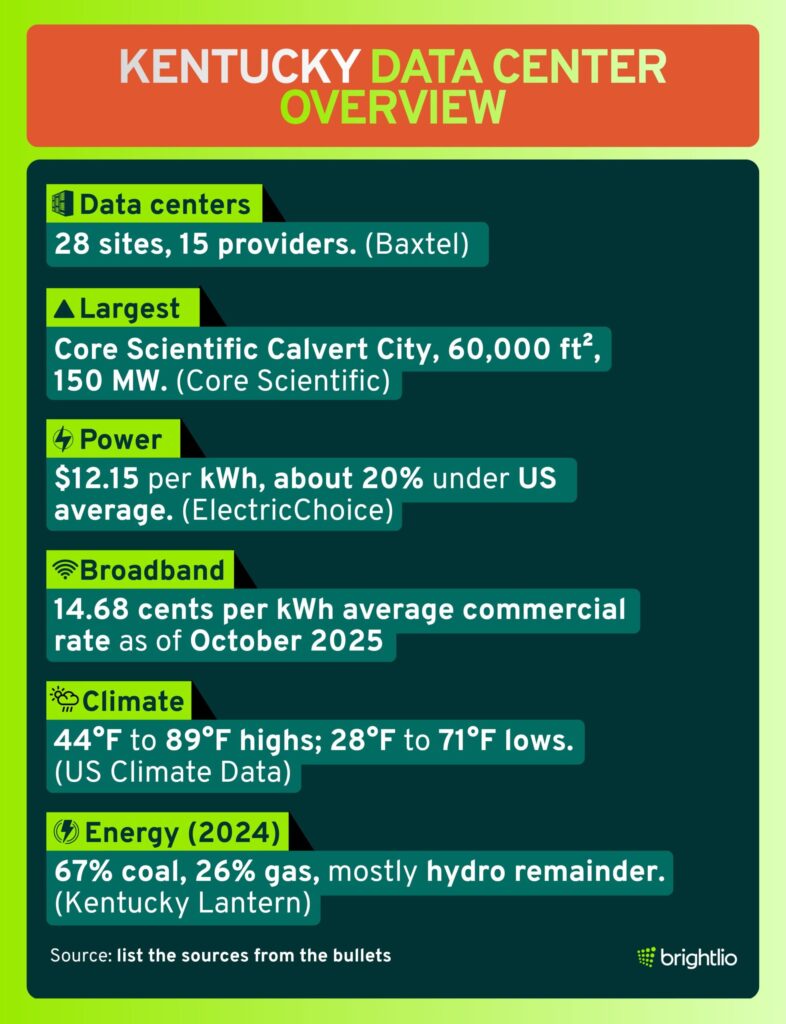
These metrics illustrate why Kentucky appeals to hyperscale developers. Low energy prices, a favorable climate and abundant land offset the market’s relatively small scale, while electricity costs remain a key sensitivity for large power allocations.
Fiber and Connectivity Infrastructure
Kentucky’s central position in the eastern United States places it at the intersection of multiple long‑haul fiber routes.
The Louisville metro area sits within 300 miles of Chicago, St. Louis, Indianapolis, Nashville and Cincinnati, making it a convenient location for latency‑sensitive workloads. Major national carriers like AT&T, Lumen (formerly CenturyLink), Zayo, Comcast and Arelion offer fiber services in Louisville, and the region hosts network hubs and internet exchanges.
Flexential’s Louisville data centers provide connections to more than 40 data centers across the United States via a 100 Gbps national backbone that is scalable to 400 Gbps.
AT&T’s presence is particularly notable. In 2018 the company announced that its fiber network reached more than 100,000 locations in Louisville and central Kentucky, making the city part of AT&T’s 67‑metro ultra‑fast footprint. This expansion supports enterprise‑grade internet speeds and underpins much of the local carrier market.
Lumen operates a colocation facility on South 8th Street in downtown Louisville with 2 MW of power, redundant fiber paths and multiple carriers, providing additional carrier‑neutral capacity for enterprises.
Flexential Kentucky’s dominant colocation provider operates two carrier neutral facilities in Louisville. The Downtown Louisville data center offers a 61080 ft² footprint, 3.09 MW of critical power, 2N UPS redundancy, N+1 cooling and a 100 Gbps network backbone.
The East Louisville facility provides 33 588 ft² of raised floor space, 1.46 MW of critical load and identical connectivity features. Both sites deliver 100 % SLA on power and bandwidth and connect to a rich ecosystem of carriers and cloud providers.
Tax Environment and Regulatory Landscape
Kentucky has enacted incentives to attract hyperscale development while adding protections for ratepayers.
House Bill 8 in 2024 exempts sales and use taxes on qualifying data center equipment when operators invest at least $450 million, or project organizers invest $150 million, within five years and site the project in a consolidated local government of at least 500,000 people, effectively Louisville.
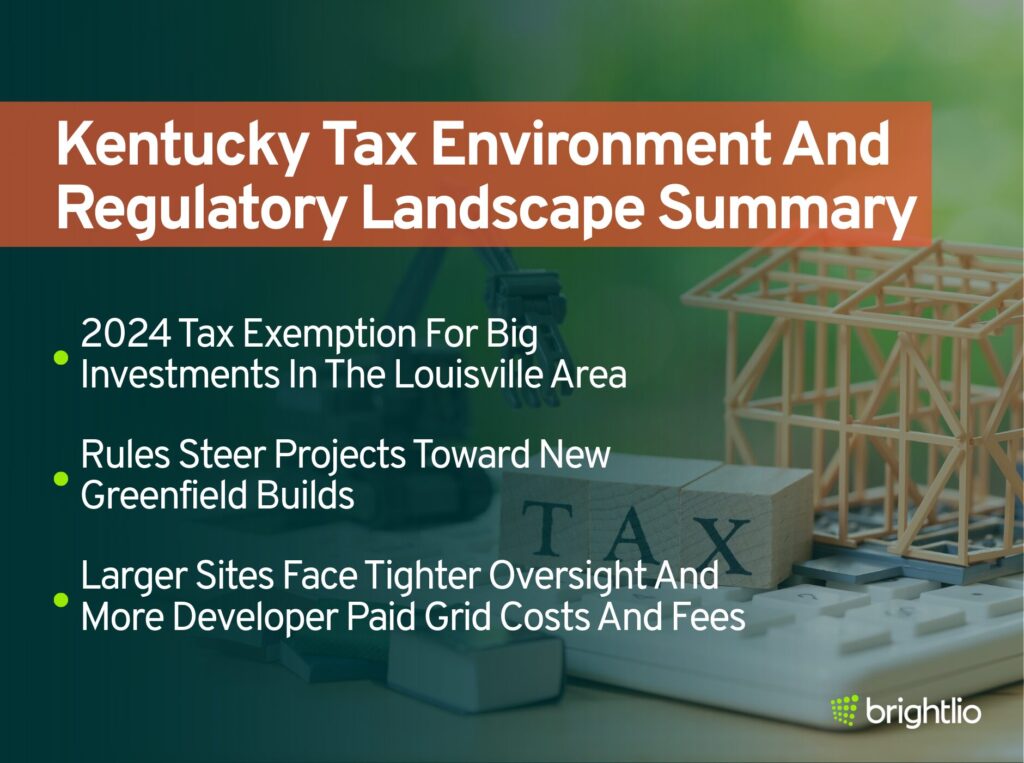
Eligible projects cannot replace existing data centers or take other incentives, which pushes development toward new greenfield sites.
House Bill 593, filed in 2026, would require developers to pay the full cost of transmission upgrades and related infrastructure, require dedicated energy sources for facilities above 250 MW, and charge a $75,000 application fee.
Regulators approved a special tariff requiring large data center contracts at 15 MW or more to be filed with the Kentucky Public Service Commission and lifting the cap on application fees.
Legislation And Economic Impact Of Data Centers
Kentucky lawmakers have responded to hyperscale growth with tax incentives paired with ratepayer protections.
House Bill 8, enacted in 2024, exempts sales and use taxes on qualifying data center equipment when developers invest at least $450 million, or $150 million for project organizers, within five years and locate within a consolidated local government such as Louisville.
The law blocks projects that replace existing data centers and limits incentive stacking to discourage simple site upgrades.
In early 2026, House Bill 593 proposed requiring large data center utility customers to sign contracts that cover the full cost of transmission upgrades, including a $75,000 application fee, and to secure dedicated energy sources for facilities above 250 MW.
Regulators approved a special tariff requiring large load contracts at 15 MW or more to be filed with the Kentucky Public Service Commission, raising application fee caps and increasing collateral to protect other customers.
LG&E and Kentucky Utilities state that new customers pay for on site infrastructure through tariff mechanisms such as the Excess Facilities Rider, which keeps cost recovery outside base rates.
Projects such as the PowerHouse Poe campus include a $28.4 million grid upgrade that becomes a permanent asset for nearby customers, showing how policy aims to balance economic development with cost accountability.
Job Creation And Economic Benefits
Hyperscale facilities are positioned as major economic drivers for Kentucky, with Large hyperscale projects are positioned as major economic drivers through private investment, job creation, and long term tax revenue.
LG&E and KU estimate the PowerHouse Poe Louisville project represents $11.1 billion in private investment, creates about 1,700 construction jobs over a four year build, and supports more than 500 ongoing jobs, including 210 direct and 332 indirect roles, with average wages above $110,000.

The project is projected to generate about $5.4 billion in regional output and more than $68 million in annual local tax revenue, including $45.8 million per year for Jefferson County Public Schools.
LG&E and KU state each data center job supports six additional local jobs and can produce more than 13 times the local tax revenue compared with related public service costs.
Local reporting cites similar expectations for Louisville, and Maysville officials say a proposed hyperscale site could create hundreds of jobs while funding millions in new water infrastructure.
Environmental And Community Concerns
Large data centers can create major local impacts because they demand heavy electricity and water use, raise noise, and can increase air pollution.
Community groups in Louisville warn hyperscale projects could strain utilities and worsen pollution, which has led the Louisville Metro Council to study new rules and gather public input.
University of Louisville professor David Hein says server cooling increases water and energy use, with added noise from fans and potential emissions from diesel generators, and residents point to long running pollution concerns in Rubbertown, with the 2024 State of Black Louisville Report linking chemical emissions to serious health harms.
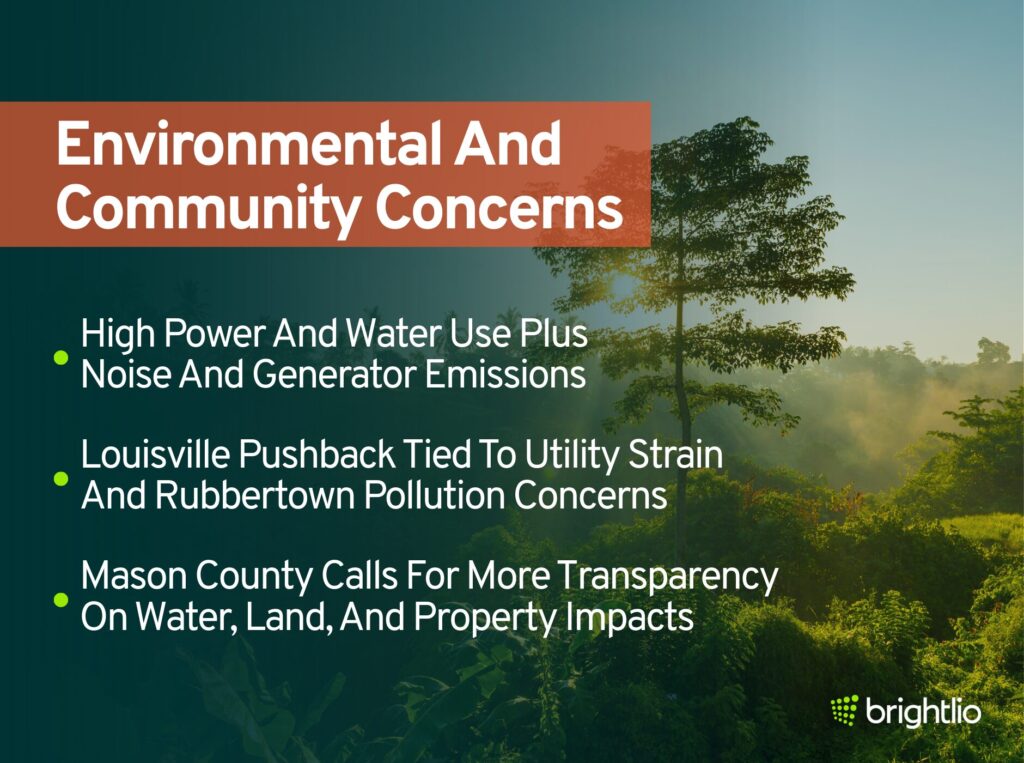
In Mason County, residents and We Are Mason County are pushing for transparency and regulation over concerns about farmland, water supplies, property values, and reports of wells running dry near data centers elsewhere, alongside WEKU hearing testimony about constant noise and grid stress.
Environmental advocates warn some facilities can use up to 5 million gallons per day, comparable to a town of 10,000 to 50,000 people, recommend direct to chip or immersion cooling, and note 230 environmental organizations have called for a moratorium on new AI driven data centers.
Energy Infrastructure For Data Centers
Kentucky’s grid still relies heavily on fossil fuels, with coal at 67% of generation and natural gas at 26%, yet rising data center demand is driving new projects and policy shifts.
Utilities run load studies and use tariff tools such as the Excess Facilities Rider so new customers pay for the dedicated infrastructure they require.
The PowerHouse Poe campus includes a $28.4 million upgrade, while LG&E and KU are building a 640 MW combined cycle unit, a 125 MW battery storage system, two 120 MW solar facilities, and have approvals for two additional 645 MW natural gas units.
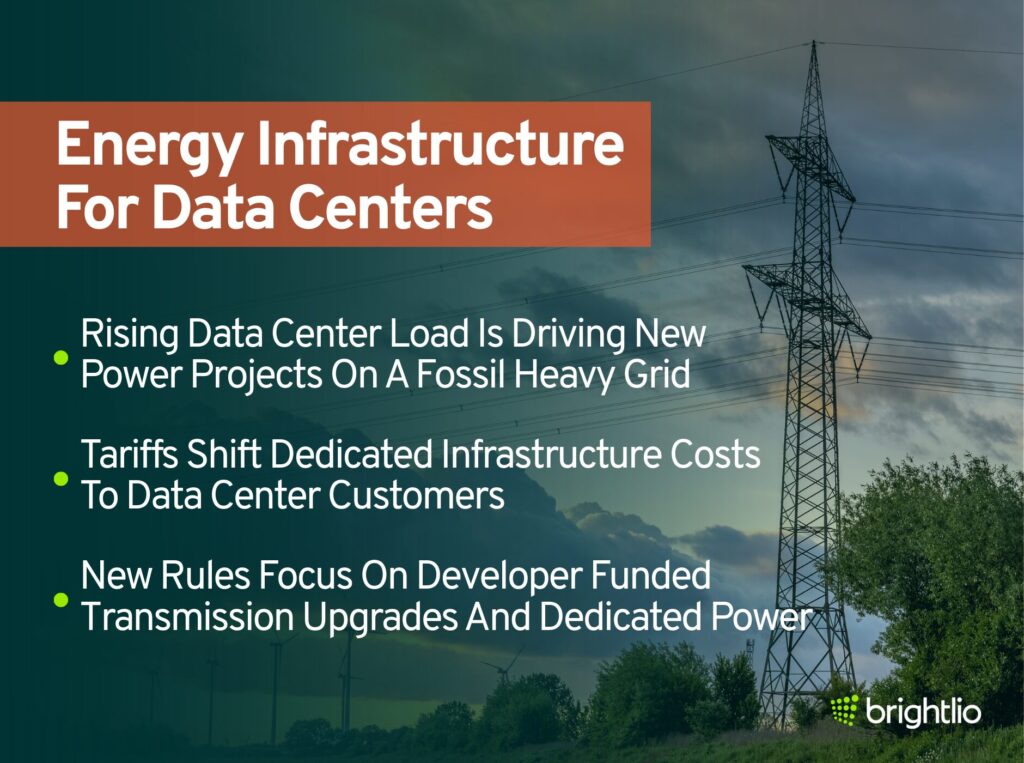
East Kentucky Power Cooperative has filed plans to increase load by 2.2 GW for a proposed hyperscale campus, with costs assigned to the developer, and House Bill 593 would require developers to fund transmission upgrades and secure dedicated energy sources.
LG&E and KU have proposed a new rate category for extremely high load customers, and projections indicate data center energy use could double again by 2026, which goes to show planning and fair cost recovery remain critical to protect residential ratepayers.
Major Data‑Center Developments
Kentucky’s data‑center market is poised to expand dramatically thanks to several high‑profile projects. These developments could transform the state from a niche market into a regional hub.
1. Powerhouse Louisville Hyperscale Campus
Developers PowerHouse Data Centers and Poe Companies are transforming a 154‑acre site on Camp Ground Road in southwestern Louisville into the state’s first hyperscale campus. The campus will include six two‑story buildings and provide up to 402 MW of power across 1.8 million ft². Initial construction will deliver 130 MW of capacity by October 2026, with an ultimate build‑out of 355 MW before reaching the full 402‑MW design.
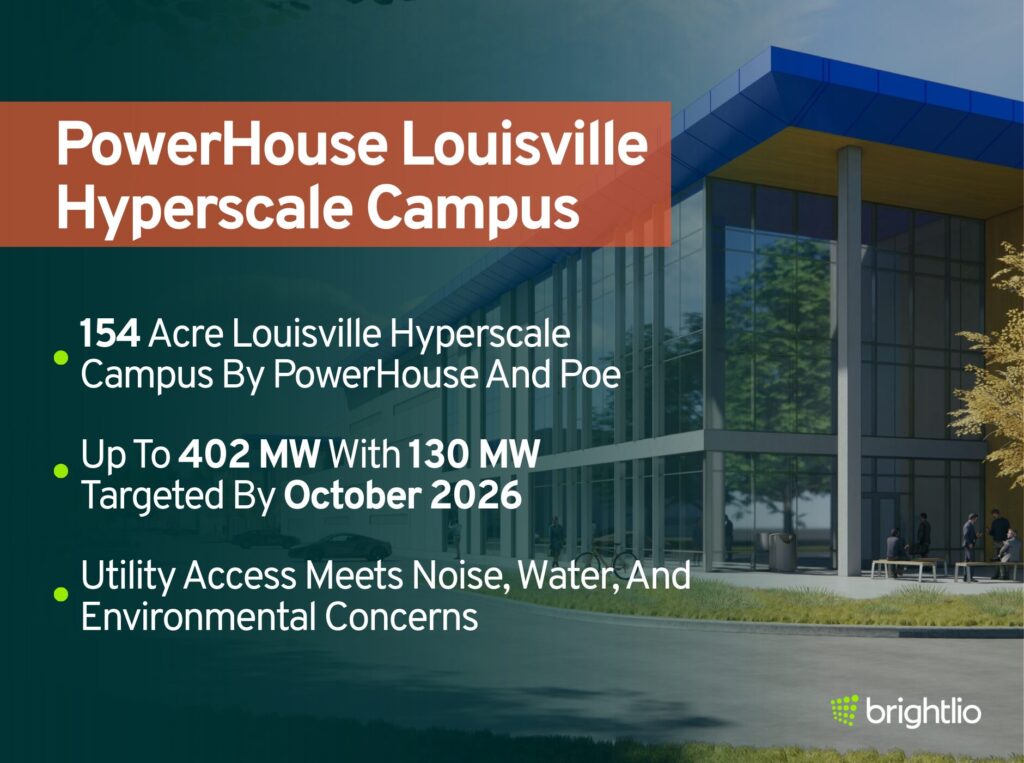
The location offers ready access to power lines from Louisville Gas & Electric’s Cane Run station, abundant water from the Ohio River and proximity to the Louisville Water Company.
State and local officials tout the project as a transformative economic development, expecting hundreds of jobs and millions in property tax revenue. Community groups have raised concerns about noise, water consumption and environmental impacts, and the Louisville Metro Council is studying potential regulations.
2. Core Scientific in Calvert City
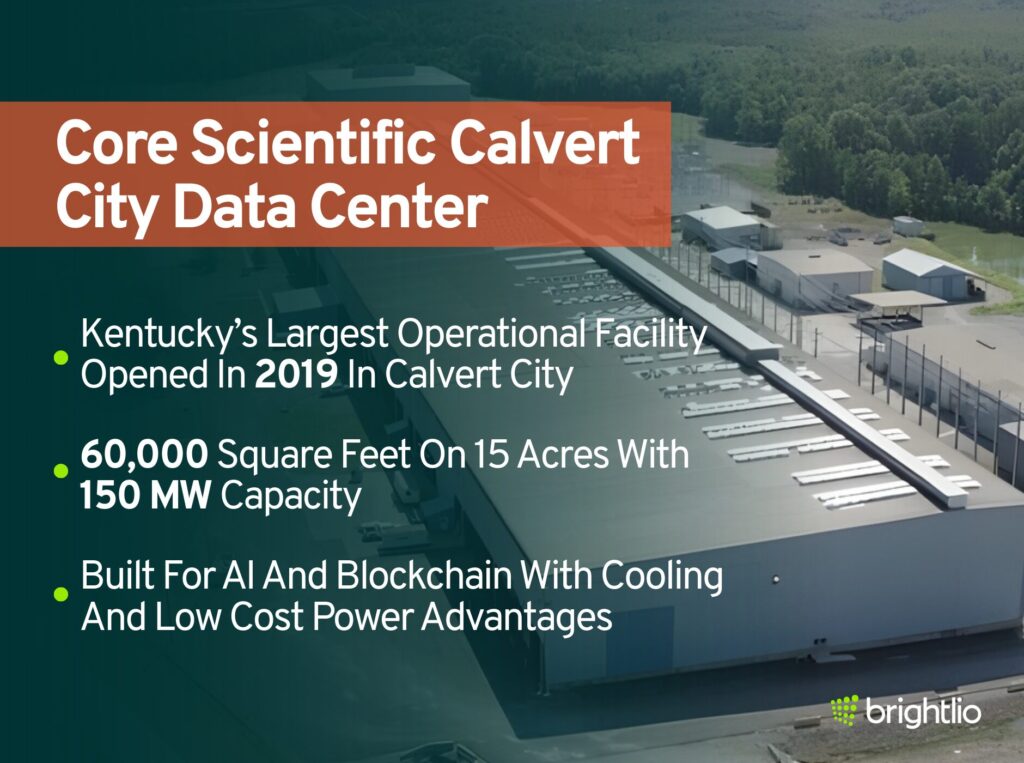
Core Scientific’s Calvert City data center is Kentucky’s largest operational facility. Opened in 2019 on the site of a former steel mill, the campus occupies 60,000 ft² on 15 acres and delivers 150 MW of capacity. The high‑density design supports AI and blockchain workloads and benefits from the region’s low temperatures and inexpensive electricity.
3. TeraWulf’s Hawesville redevelopment
In western Kentucky, TeraWulf Inc. acquired the idle Century Aluminum smelter in Hawesville, Hancock County, to repurpose it as a digital‑infrastructure campus. The former smelter provides more than 250 buildable acres and includes an on‑site substation, multiple high‑voltage transmission lines and a direct connection to the regional grid.
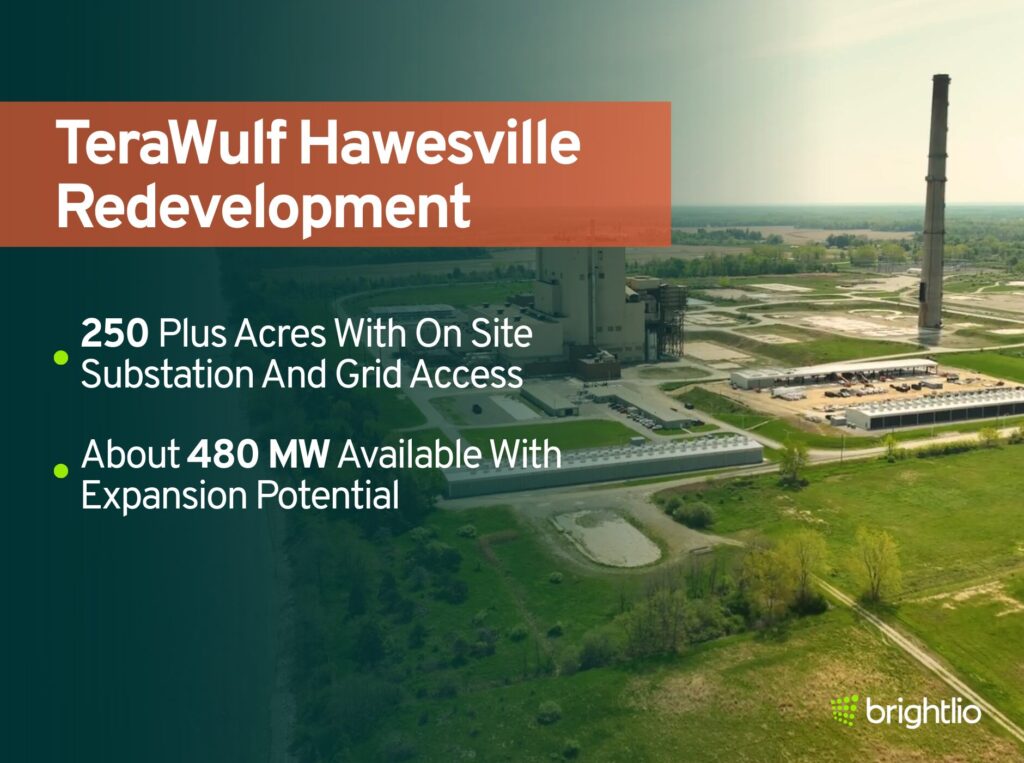
The site has approximately 480 MW of existing power availability with potential for expansion. Officials say repurposing the facility will bring back jobs lost when the smelter closed and relieve pressure on electricity rates because the power infrastructure already exists.
4. Flexential’s Louisville facilities
Flexential operates two carrier‑neutral colocation facilities in Louisville. Downtown Louisville provides 61 080 ft² of raised floor, 3.09 MW of critical power, 2N UPS, N+1 cooling, 150 W per square foot power density and a 100 Gbps backbone.
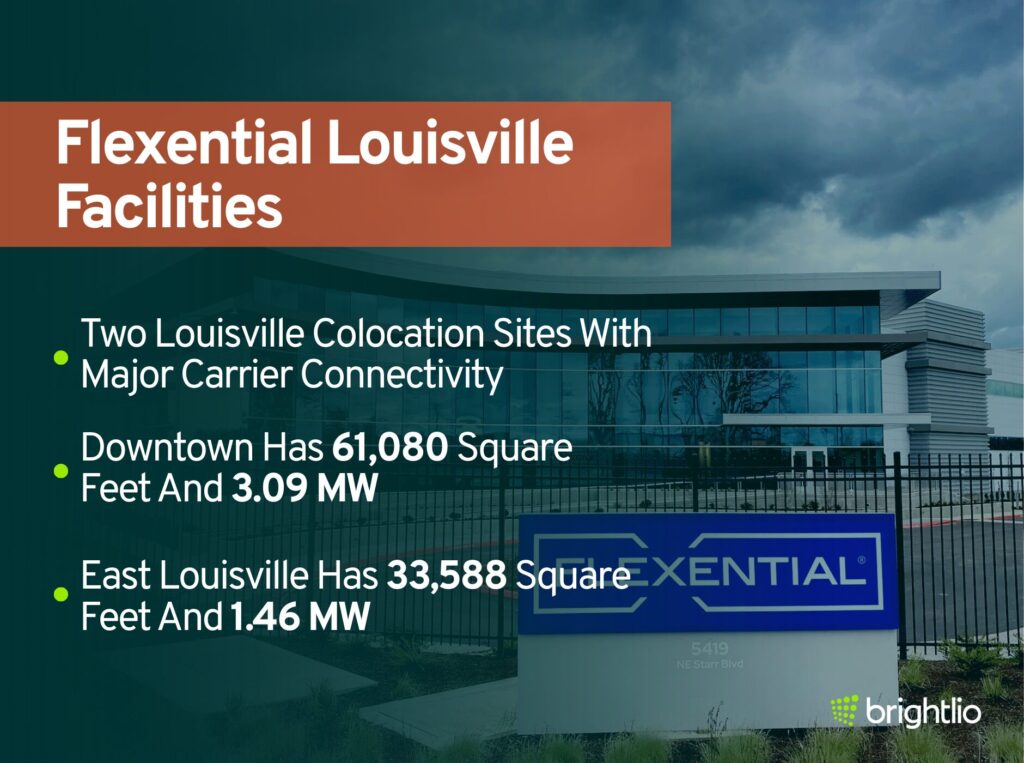
East Louisville offers 33 588 ft², 1.46 MW of critical load and similar redundancy features. Both sites guarantee 100 % uptime and connect to carriers including AT&T, Lumen, Zayo, Comcast and Arelion.
5. Lumen Louisville and other providers
At 848 South 8th Street, Lumen (formerly Level 3) operates a colocation facility with approximately 2 MW of power, redundant cooling and multiple fiber paths. Security features include 24/7 on‑site staff, biometric access and surveillance systems.
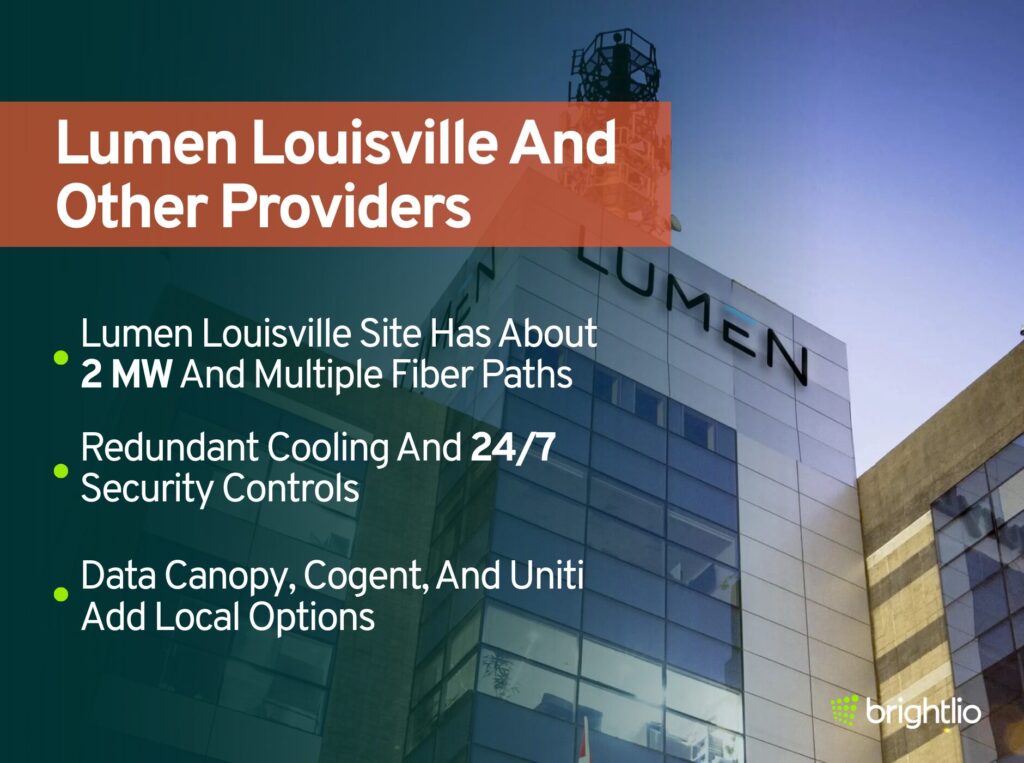
The site is part of a downtown cluster that includes smaller facilities operated by Data Canopy, Cogent and Uniti, illustrating the growing diversity of providers.
6. Proposed Maysville Hyperscale Campus (Mason County)
In northeastern Kentucky, the town of Maysville is negotiating with an undisclosed Fortune 100 company planning a hyperscale campus on thousands of acres near the Ohio River. Local officials confirmed that East Kentucky Power Cooperative has filed plans to increase its load by 2.2 GW to supply the development—more power than the entire town currently uses.
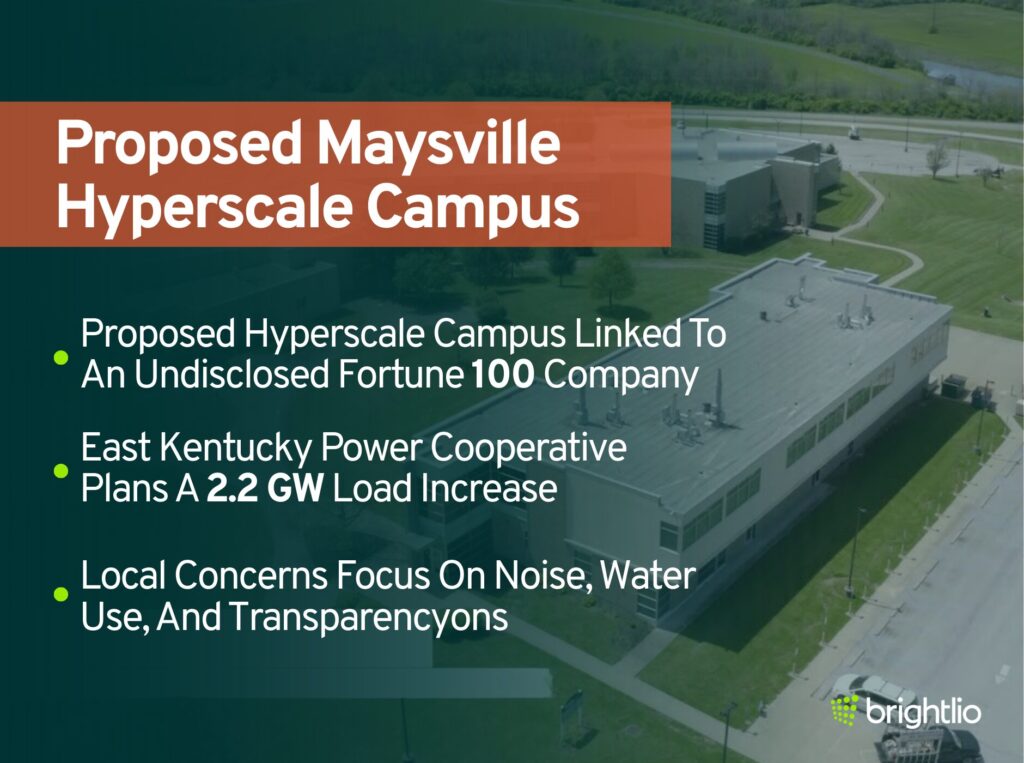
Farmers have reportedly been offered $35 000 per acre for land near Big Pond Pike, sparking opposition from residents concerned about noise, water usage and secrecy. The project, still unapproved, highlights both the scale of demand from AI workloads and the potential strain on rural communities.
Emerging Proposals In Other Counties
Developers have proposed hyperscale projects in Simpson, Oldham and Meade counties. Local officials have enacted moratoriums on data‑center construction and called for community input, reflecting growing unease about large power loads and environmental impacts.
As Kentucky’s regulatory framework evolves, these debates will shape where future facilities are permitted.
Brightlio Delivers Colocation Solutions In Kentucky
Brightlio is a telecommunications and colocation broker with a nationwide network of data center providers. We source competitive colocation pricing across Louisville, Lexington, Northern Kentucky, and emerging hyperscale markets.
Single racks, private cabinets, secure cages, and dedicated suites are all available through facilities matched to your performance, compliance, and budget requirements.
Our services extend beyond colocation. We support cloud strategy, hybrid and multi-cloud deployments, carrier diversity, SD-WAN, dedicated internet access, and unified communications.
Our advisory team evaluates power density, network paths, disaster recovery design, and long-term scalability to support confident infrastructure decisions.
Brightlio serves as a single point of contact for sourcing, negotiating, and managing mission-critical technology services across Kentucky. Contact us today to find the right colocation solution for your business.
Keep reading with our colocation guides for these states:
- Virginia Data Centers: Brightlio’s Ultimate Guide to Colocation in the Old Dominion
- Data Centers in Georgia: Colocation in the Peach State
- The Illinois Data Center Market: Colocation In the Prairie State
- Data Centers in Virginia: Innovation in the Old Dominion
- Colorado Data Centers: Powering the Digital Future of the Centennial State
Frequently Asked Questions About Kentucky Data Centers
Market tracking services such as Baxtel list around 28 active data centers in Kentucky. The majority are small colocation sites concentrated in Louisville, Lexington and Calvert City, though additional data centers in Kentucky have been discussed as part of a broader proposed development in several counties.
Core Scientific’s Calvert City facility is currently the largest operational site. It offers 150 MW of power, 60,000 ft² of space and occupies a 15-acre campus. The site is located in western Kentucky near the Ohio River, positioning it close to existing industrial infrastructure.
House Bill 8 (2024) exempts sales and use taxes on equipment for qualified data-center projects. To qualify, developers must invest $450 million (or $150 million for site developers) within five years and locate within a consolidated local government such as Louisville. Projects may not replace existing data centers or combine incentives, and each parent company must meet the statutory thresholds independently.
The PowerHouse Louisville campus will eventually need 402 MW, while a potential project in northeastern Kentucky could demand 2.2 GW of additional generation. TeraWulf’s Hawesville site has 480 MW of existing capacity, though further expansion would likely require a new power plant to meet long-term demand.
Key operators include Core Scientific (Calvert City), Flexential (Downtown and East Louisville), Lumen, Data Canopy and Cogent in Louisville, and planned hyperscale facilities by PowerHouse Data Centers, TeraWulf and an undisclosed Fortune 100 end user. Telecommunications carriers such as AT&T, Lumen, Zayo, Comcast and Arelion provide fiber connectivity across these sites, supporting workloads tied to artificial intelligence and large-scale cloud computing.
Kentucky’s grid is predominantly coal-powered, supplying about 67 % of the state’s electricity, with gas-fired plants providing another 26 %. Utilities say they can accommodate the first phase of the Louisville hyperscale project but warn that additional centers will require new transmission lines and generation assets.
The Kentucky Public Service Commission would review major infrastructure upgrades, and debate continues over electricity costs and how to allocate a fair share of expansion expenses among ratepayers and developers.
Community reaction varies depending on location and land use history. In rural areas, local residents sometimes raise concerns about prime farmland conversion, traffic and noise pollution. Public meetings often involve elected officials and planning and zoning boards reviewing zoning ordinances before final approvals are granted.
Large facilities can expand the tax base, support construction jobs and generate long-term utility revenue. County governments evaluate each proposed development to determine whether projected tax revenue and infrastructure investment outweigh potential land-use tradeoffs.

Tamzid is a technology writer focused on SEO, content marketing, and data center infrastructure. He explains topics like colocation, cloud architecture, and network connectivity in clear, practical terms. At Brightlio, he tracks data center trends and the systems that keep digital services online.
Recent Posts

10 Largest AI Data Centers in the World

Data Centers In Oklahoma: Why You Must Colocate

Data Center and Colocation In North Dakota

Idaho Data Centers And Colocation Opportunities
Let's start
a new project together