
Table of Contents
Houston Data Centers: Colocation in Space City
Houston remains one of Texas’s larger colocation hubs, with 41 facilities currently tracked in the metro market. Core interconnection infrastructure still centers on 1301 Fannin, where Netrality reports 73+ on-net unique network providers.
The Houston Internet Exchange lists 6 locations and 81 participating ASNs, which gives tenants several regional peering paths with low-latency reach. Geography continues to matter as well.
Port Houston operates 8 public terminals along the 52-mile Houston Ship Channel. The broader Houston region exported $180.9 billion in goods in 2024, which kept it at No. 1 nationally for exports.
That combination of interconnection density, port infrastructure, and trade volume keeps Houston colocation practical for businesses with cross-border data flows and regional compliance demands.
This article provides a detailed overview of the Houston colocation market and helps you choose a provider that matches your requirements.
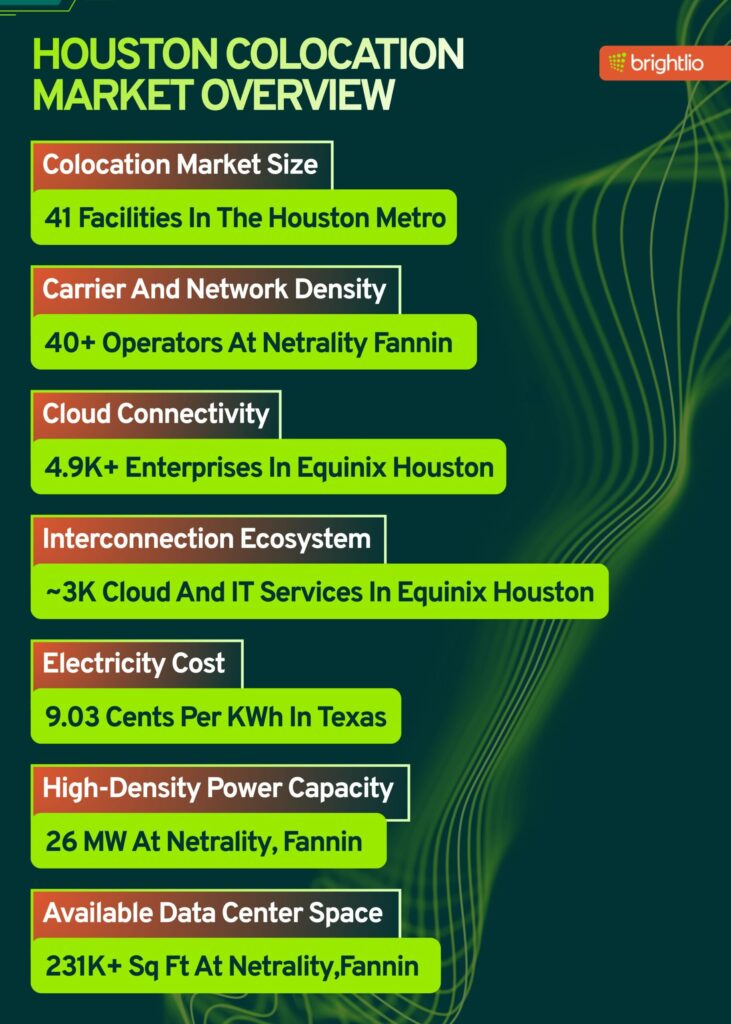
Houston Data Center Infrastructure Overview
- Colocation Market Size: Houston has 41 facilities listed in the metro market.
- Carrier And Network Density: 40+ network operators at Netrality 1301 Fannin.
- Cloud Connectivity: ~3,000 cloud and IT services in the Equinix Houston ecosystem.
- Interconnection Ecosystem Size: 4,900+ enterprises in the Equinix Houston ecosystem.
- Internet Exchange Capacity: 81 participating ASNs on Houston Internet Exchange.
- Electricity Cost: 9.03 cents per kWh for Texas commercial power.
- High Density Power Capacity: 26 MW at Netrality 1301 Fannin.
- Available Data Center Space: 231,700 square feet of raised floor space at Netrality 1301 Fannin.
- Redundancy Architecture: N+1 UPS redundancy at Digital Realty IAH10.
- Regional Climate Conditions: 47°F to 94°F average annual low to high range.
Houston Offers a Dynamic Economic Landscape
Houston, Texas, the fourth-largest city in the United States, has a metro population of more than 7.8 million people. The city’s economy is remarkably broad and diverse, with strong footholds in the energy, healthcare, aerospace, and technology sectors.
Known as the world’s energy capital, Houston remains the leading domestic and international center for virtually every segment of the energy industry. The city hosts the prestigious Texas Medical Center, the world’s largest medical complex, and it is also home to NASA’s Johnson Space Center, home to America’s astronaut corps and Mission Control Center.
The city has also seen substantial technology and manufacturing growth in recent years. This broad-based economic strength combines to give the Houston metro a GDP of over $696.9 billion, accounting for roughly 27% of the economic output of the State of Texas.

Houston’s Strategic Location
Situated within the Texas Triangle alongside key economic hubs like Austin, Dallas-Fort Worth, and San Antonio, Houston’s location supports strong connectivity to these major business centers. The Texas Department of Transportation says the broader region is home to more than 22 million residents and accounts for nearly 80% of Texas GDP, reinforcing Houston’s place in one of the state’s most important freight and business corridors.
Moreover, the city serves as a strategic gateway to the Gulf Coast and the Southeast United States. Recent network expansion has added a direct route from Houston to Jacksonville through Louisiana, Alabama, and Florida, along with additional route diversity from Texas to Georgia and Florida, supporting low-latency regional connectivity.
The connectivity advantage for Houston colocation services extends beyond the domestic sphere, offering low-latency access to international markets. Houston remains a critical location for network operators because of its proximity to Mexico and the Gulf, and the city’s core interconnection hub at 1301 Fannin currently supports 73+ on-net unique network providers.
That terrestrial reach now connects into Florida landing-station infrastructure in Boca Raton and Jacksonville, where operators are expanding submarine and terrestrial paths to connect Latin American customers to North America. This interconnected network supports fast, reliable data movement for businesses serving Latin American markets.
Cost-Efficient Power
The cost of power drives the cost of data center services. Your business can realize substantial savings by using a colocation data center in a market with lower power prices.
Much of the Texas power market is open to retail competition. In those areas, businesses can buy electricity from Retail Electric Providers, creating a competitive market for commercial power procurement. Texas also continues to post lower-than-national industrial electricity prices, averaging 6.12¢ per kWh in 2024, compared with the U.S. average of 8.13¢ per kWh. That cost advantage can help Houston colocation facilities offer competitively priced services without compromising service quality.
The power picture also extends beyond traditional sources. Texas remains the national leader in wind-generated electricity, accounting for 28% of U.S. wind generation in 2024, and the state had nearly 66,000 megawatts of utility-scale renewable generating capacity in 2024, or about 69,000 megawatts including small-scale solar. Solar growth has also accelerated.
The EIA reported that Texas surpassed California in 2024 as the state with the most utility-scale solar capacity, and in ERCOT, wind and solar together supplied 36% of electricity demand in the first nine months of 2025. As data centers tap into these renewable resources, they gain access to a cost-efficient energy supply that also supports corporate social responsibility objectives.
Enhanced Connectivity and Bandwidth
Positioned strategically at the intersection of major domestic and international network paths, Houston stands out as a critical technology hub known for strong connectivity and bandwidth capabilities.
Houston data centers provide extensive network infrastructure that includes key interconnection assets such as the Houston Internet Exchange (HOUIX), which currently offers peering from 6 locations and connects networks across more than 80 participating ASNs, helping improve connectivity and reduce latency.
Furthermore, Houston remains a prominent point of presence for major carriers and service providers. At 1301 Fannin, one of the city’s core interconnection facilities, the ecosystem includes 73+ on-net unique network providers, with current provider listings that include AT&T, Comcast Business, and Verizon. This dense carrier presence supports high-speed, reliable connections for colocation customers.
Houston also serves as a junction point for multiple long-haul fiber routes. Recent network builds include new fully diverse Texas mesh routes linking Austin, Dallas, and Houston, along with a new Houston-to-Jacksonville Gulf Coast route that connects Texas traffic to East Coast landing stations and adds route diversity toward Georgia and Florida.
Companies using Houston colocation services can capitalize on these fiber paths for fast, secure data transmission across major U.S. markets. This route diversity also strengthens Houston colocation as an attractive disaster recovery option.

Why Companies Colocate in Houston?
Houston gives colocation buyers a combination of cost, capacity, and connectivity that several more prominent markets struggle to match right now.
Here are five reasons the metro stands out for new deployments:
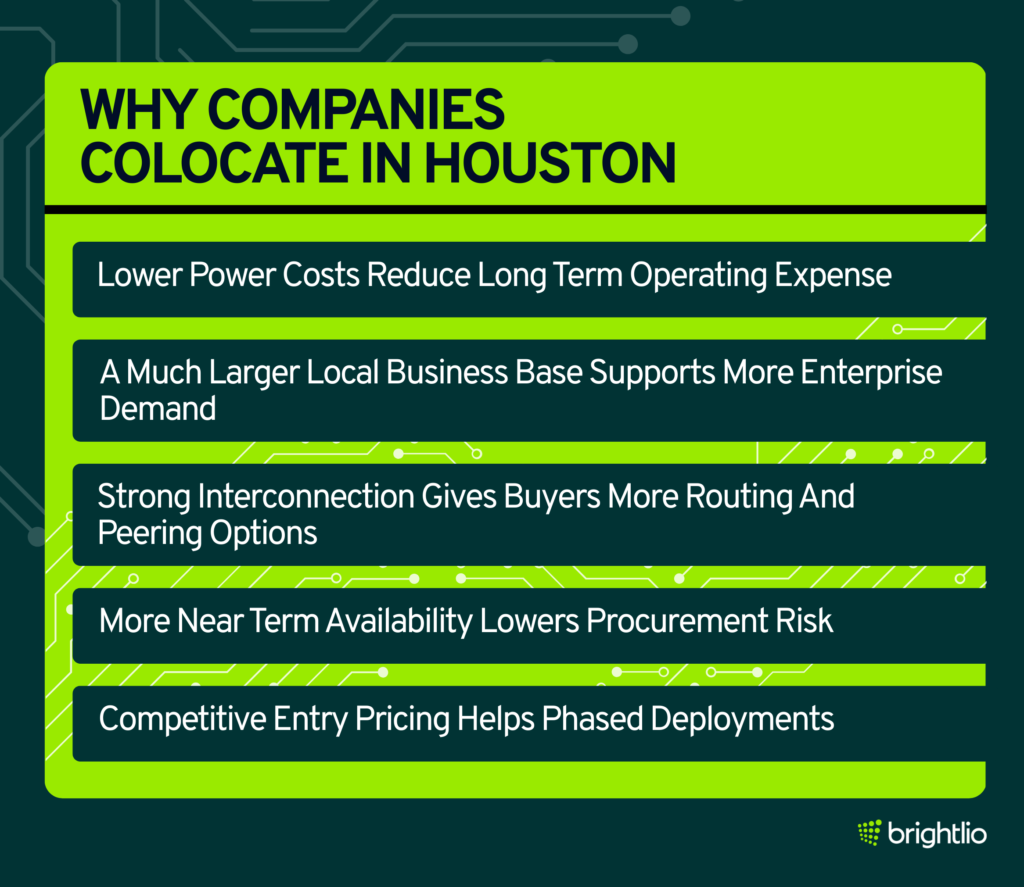
1. Lower Power Costs Reduce Long-Term Operating Expense
Texas electricity pricing gives Houston-based deployments a durable cost edge over most competing metros. The state posted a commercial electricity price of 9.03 cents per kWh in December 2025, compared with the U.S. average of 13.63 cents, California's 26.92 cents, Virginia's 10.21 cents, and Arizona's 11.87 cents.
Industrial rates are similarly favorable. Texas came in at 6.67 cents per kWh, versus the U.S. average of 8.53 cents, Virginia's 9.35 cents, and Arizona's 7.22 cents. Power and cooling are recurring operating costs rather than one-time build expenses, so a market that stays below national and coastal benchmarks gives buyers more predictable rack economics over multi-year terms.
2. A Much Larger Local Business Base Supports More Enterprise Demand
A larger surrounding economy makes the metro more useful for buyers placing infrastructure near enterprise customers, partners, and end users. Harris County had a 2024 population of 5,009,302, 111,215 employer establishments, and 2,182,164 jobs in 2023. Maricopa County, which anchors Phoenix, recorded 4,673,096 residents, 109,863 establishments, and 2,016,986 jobs.
Fairfax County, a major part of Northern Virginia's enterprise base, was far smaller at 1,160,925 residents, 31,931 establishments, and 696,002 jobs. The GDP gap is just as notable. Harris County reached about $429.7 billion in real GDP in 2023, compared with about $311.3 billion in Maricopa and about $146.7 billion in Fairfax. Larger nearby demand bases support denser ecosystems for enterprise colocation, managed services, and network interconnection.
3. Strong Interconnection Gives Buyers More Routing and Peering Options
Houston's interconnection depth is a measurable draw for network-sensitive deployments. Netrality's 1301 Fannin carrier hotel lists 73+ on-net network providers, 27 networks that peer, 6 peering exchanges, 6 cloud and SDN connection providers, and 3 diverse points of entry.
DataCenterMap's metro listing shows 6 internet exchanges in Houston, while Austin lists only 1 exchange and Phoenix lists 5 exchanges. Netrality ties much of the site's value to Houston's proximity to Mexico and the Gulf, which broadens routing options for cross-border and Gulf Coast traffic.
More local carriers and exchanges create more ways to optimize routing, reduce reliance on a single upstream network, and make cross-connect spending more productive.
4. More Near-Term Availability Lowers Procurement Risk
Availability is a primary reason buyers turn to Houston when tighter markets become difficult to contract. CBRE's H1 2025 market data shows 21.6 MW of available capacity, 148.8 MW under construction, and 484.4 MW of total inventory.
Dallas-Fort Worth had only 10.5 MW available, and Phoenix had 16.4 MW available. CBRE's Houston profile adds that a recent delivery pushed local vacancy up to 19.7%, with 15 MW scheduled for delivery by year-end 2026.
The practical question for colocation buyers is not whether a market is well known. The question is whether contractable space exists now, with a believable path for expansion later. Houston clears that bar more comfortably than several more crowded hubs.
5. Competitive Entry Pricing Helps Phased Deployments
Entry pricing strengthens the case for buyers starting with smaller footprints. CBRE's H1 2025 figures place Houston at $175 to $275 per kW per month for standard colocation pricing bands. The range starts below Silicon Valley at $180 to $250, below Phoenix at $185 to $215, and below Northern Virginia at $190 to $235.
The top end is not the cheapest in the country, so the value case is strongest for buyers entering near the lower part of the range. A starting-rate gap of $5 to $15 per kW per month versus those markets works out to roughly $15,000 to $45,000 in annual run-rate rent on a 250 kW footprint.
For enterprises buying their first few hundred kilowatts, backup space, or a secondary site, that spread can materially improve budget efficiency.
Key Houston Colocation Providers
The Houston, Texas, colocation market includes 59 data centers. Below are a few of the major service providers in the city.
1. Digital Realty Houston
Digital Realty’s IAH10 data center at 12001 North Freeway is a key part of Houston’s digital landscape. This Houston facility is notable for its network access, with 15+ network providers and 5+ cloud and content providers available across the Digital Houston campus. The site offers 50,000 square feet of building space, with N+1 UPS redundancy and N+1 cooling redundancy.
2. Equinix Houston
Situated at 1515 Aldine Meadows Road, Equinix's Houston data center, HO1, connects customers to more than 3,600 energy-related organizations and 10 of the U.S.'s top 25 oil and gas exploration and production firms. The site boasts more than 76,500 square feet of colocation space, along with easy connectivity to carriers such as AT&T and Verizon inside the facility.
3. TRG Data Centers
TRG Datacenters’ Houston-area campus in Spring, TX at 2626 Spring Cypress Road is anchored by HOU1, a 45,000 GSF facility with 6 MW of utility power that has operated since 2018. It stands out for reliability, with TRG reporting a 100% uptime track record since opening, and for strong connectivity options with 16 on-site campus carriers available.
4. Netrality Houston
Located at 1301 Fannin in the heart of downtown Houston, Netrality's Houston data center is a major core interconnection facility. Netrality already owned the building and acquired INAP's colocation and meet-me-room assets at the site in June 2020. It comprises a 784,000-square-foot facility with 73+ on-net unique network providers, and its location places it directly in Houston’s downtown business district.
Final Thoughts
In conclusion, there are many benefits associated with colocation in Houston, Texas. As businesses prepare for future expansion and seek to establish a reliable presence in the digital realm, Houstong colocation services presents a strategic advantage. Offering a blend of connectivity, affordability, and access to a significant market base, it is an excellent choice for clients looking for data center rack space.
Are You Looking for a Houston Data Center? Brightlio Can Help!
Brightlio is a telecommunications broker specializing in colocation. Our consultative approach combines with our network of global partners to deliver the best overall value for our clients. If you are looking for a top colocation facility or data center in the Houston area, or in other global markets, we can help. Our data center partners offer fully managed colocation, managed services, remote hands, dedicated servers, and more from carrier neutral colocation facilities.
Additionally, we offer other services, including bandwidth, unified communications, public cloud, and advisory services. This allows us to meet a broad spectrum of your IT needs. Quotes and solution designs are always free. We are committed to being your most trusted and responsive IT solutions provider.
Contact Brightlio today!
FAQ
Colocation is a data center service where a business rents space for its own IT hardware while the facility provides building space, power, cooling, and physical security.
A major directory lists 59 data centers in Houston, Texas.
Listings commonly include Downtown Houston addresses, sites near the IAH corridor, and multi-building campuses in west and northwest areas of the metro.
A carrier hotel is a highly connected building that concentrates many network providers and interconnection options, and 1301 Fannin is widely described as Houston’s primary telecom hotel and interconnection point.
Yes. Texas offers a state sales and use tax exemption program for qualifying data centers, with eligibility tied to requirements described by the Texas Comptroller.
Start with the facility’s power options and contracted power terms, the on-site network and interconnection choices, and your operational needs such as access rules and response times for on-site support.
Typical cost drivers include power fees, bandwidth charges, connectivity expenses, change fees, and support costs.
No. Many customers rely on remote hands, which is a colocation service where on-site technicians perform requested tasks that require physical access to equipment.
A cross-connect is a point-to-point connection inside a data center between two endpoints, and it can add ordering steps, fees, and lead times that affect the installation schedule.
Ask what third-party audit reports and certifications the facility can share, since some providers list items such as SOC reports and ISO standards for their sites.
Houston is called Space City because NASA’s human spaceflight center and Mission Control operations are based at the Johnson Space Center in the Houston area, which linked the city’s identity to the U.S. space program from the 1960s onward.
The biggest global colocation operators commonly cited include Equinix, Digital Realty, NTT Global Data Centers, QTS, CoreSite, CyrusOne, KDDI Telehouse, and Iron Mountain Data Centers.
Large space-based data centers face major practical barriers, including high launch and replacement logistics, radiation-driven reliability problems, difficult heat rejection in vacuum, and operations and maintenance constraints compared with terrestrial sites.
One of the largest announced AI-scale data center campuses in Texas is Vantage Data Centers’ “Frontier” mega-campus in Shackelford County, Texas, planned for 1.4 GW and 10 buildings totaling 3.7 million square feet.

Recent Posts

Data Centers in Kentucky and Colocation Opportunities

Data Centers In Alabama: Why You Must Colocate

10 Largest Underground Data Centers in the World

100+ VoIP Statistics from Credible Sources (Jan – 2026)
Let's start
a new project together